| (19) |
 |
|
(11) |
EP 1 866 209 B2 |
| (12) |
NEW EUROPEAN PATENT SPECIFICATION |
|
After opposition procedure |
| (45) |
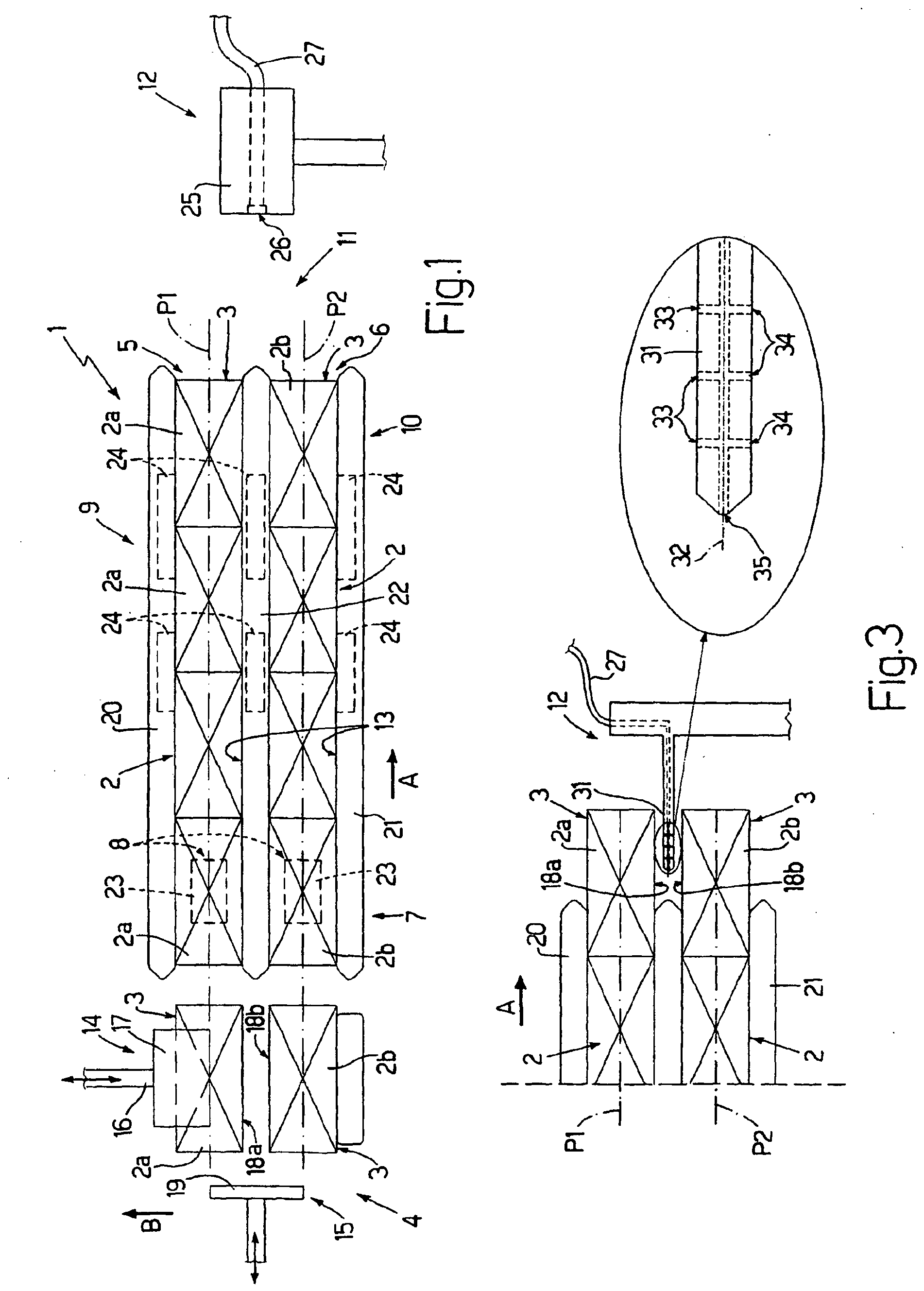
Date of publication and mentionof the opposition decision: |
|
16.12.2020 Bulletin 2020/51 |
| (45) |
Mention of the grant of the patent: |
|
15.12.2010 Bulletin 2010/50 |
| (22) |
Date of filing: 23.03.2006 |
|
| (51) |
International Patent Classification (IPC):
|
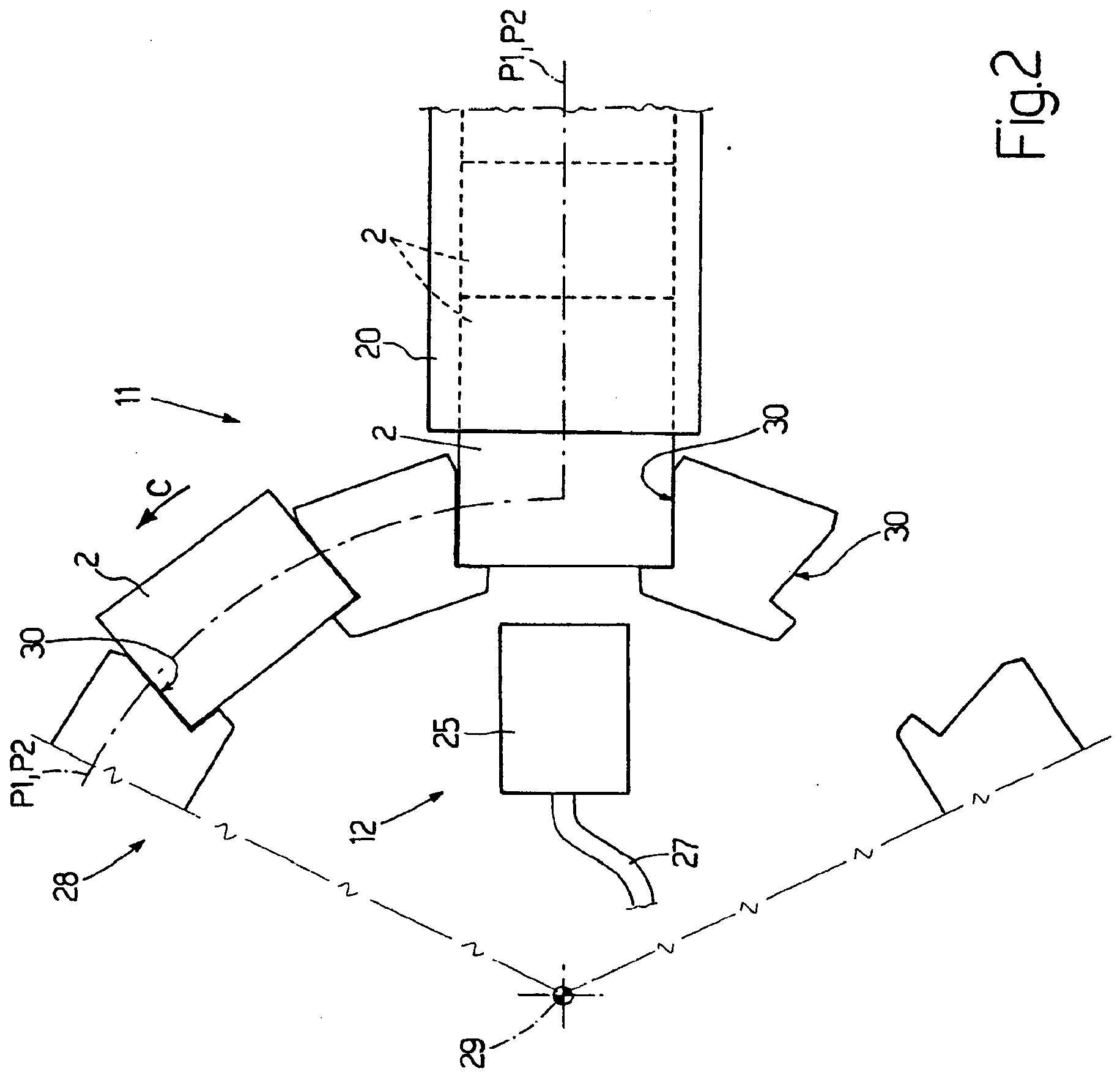
| (86) |
International application number: |
|
PCT/EP2006/060986 |
| (87) |
International publication number: |
|
WO 2006/100287 (28.09.2006 Gazette 2006/39) |
|
| (54) |
METHOD AND DEVICE FOR FINISHING PACKETS HAVING RESPECTIVE OVERWRAPPINGS OF HEAT-SHRINK
MATERIAL
VERFAHREN UND VORRICHTUNG ZUR FERTIGSTELLUNG VON PACKUNGEN MIT JEWEILIGEN UMHÜLLUNGEN
AUS WÄRMESCHRUMPFMATERIAL
PROCEDE ET DISPOSITIF SERVANT A EFFECTUER LA FINITION DE PAQUETS POSSEDANT DES SUREMBALLAGES
RESPECTIFS EN MATERIAU THERMORETRECISSANT
|
| (84) |
Designated Contracting States: |
|
AT BE BG CH CY CZ DE DK EE ES FI FR GB GR HU IE IS IT LI LT LU LV MC NL PL PT RO SE
SI SK TR |
| (30) |
Priority: |
24.03.2005 IT BO20050188
|
| (43) |
Date of publication of application: |
|
19.12.2007 Bulletin 2007/51 |
| (73) |
Proprietor: G.D Societa' per Azioni |
|
40133 Bologna (IT) |
|
| (72) |
Inventors: |
|
- BORIANI, Silvano
40100 Bologna (IT)
- NEGRINI, Stefano
40012 Calderara di Reno (IT)
|
| (74) |
Representative: Bergadano, Mirko et al |
|
Studio Torta S.p.A.
Via Viotti, 9
10121 Torino
10121 Torino (IT) |
| (56) |
References cited: :
EP-A- 1 103 465
GB-A- 1 234 731
US-A- 5 058 361
US-B1- 6 511 405
|
DE-A1- 3 824 924
US-A- 3 830 036
US-A1- 2004 151 481
|
|
| |
|
|
|
|
| |
|
TECHNICAL FIELD
[0001] The present invention relates to a method and device for finishing packets having
respective overwrappings of heat-shrink material.
[0002] In particular, the present invention relates to a device for finishing packets having
respective overwrappings of heat-shrink material, the device comprising feed means
for feeding at least a first and at least a second packet, each of which has a respective
lateral surface, along a first and second feed path, respectively, to a work station
through a sealing station and a heat-shrink station; a sealing unit located at the
sealing station to seal the overwrappings about respective packets; a heat-shrink
unit located at the heat-shrink station to heat the overwrappings, so that the overwrappings
shrink and adapt to the configuration of the packets; in the area of the work station,
in use, the first and second packet are brought together so that the lateral surfaces
of the first and second packet are brought into contact with each other; the heat-shrink
unit comprising at least one heating member for shrinking the overwrapping of the
first packet by heating at least the lateral surface of the first packet.
BACKGROUND ART
[0003] The present invention may be used to advantage in the packing of cigarettes, to which
the following description refers purely by way of example.
[0004] US6511405 discloses that packs, once an outer wrapper has been provided and sealed, are conveyed
through a shrinking station and subjected to the action of heat in the region of the
large-surface-area pack sides, in particular in the region of upwardly directed front
sides. For this purpose, heating plates are positioned in the region of the shrinking
station and transmit heat to the upwardly directed surfaces of the packs.
[0005] Though the shrinkage of the overwrappings normally provides for good aesthetic results,
the packets brought together after the shrinkage tend to stick to each other. This
leads to further processing difficulties (the packets are to be separated) and to
an increased risk of damaging the overwrappings.
DISCLOSURE OF INVENTION
[0006] It is an object of the present invention to provide a method and device for finishing
packets having respective overwrappings of heat-shrink material, designed to at least
partly eliminate the aforementioned drawbacks, and which at the same time are cheap
and easy to implement.
[0007] According to the present invention, there is provided a device for finishing packets,
as claimed in Claim 1 or in any one of the following Claims depending directly or
indirectly on Claim 1.
[0008] According to the present invention, there is also provided a method of finishing
packets, as claimed in Claim 12 or in any one of the following Claims depending directly
or indirectly on Claim 12.
BRIEF DESCRIPTION OF THE DRAWINGS
[0009] A number of non-limiting embodiments of the present invention will be described by
way of example with reference to the accompanying drawings, in which:
Figure 1 shows a schematic side view, with parts removed for clarity, of a device
in accordance with the present invention;
Figure 2 shows a schematic plan view, with parts removed for clarity, of the Figure
1 device;
Figure 3 shows a schematic side view of a further embodiment of a detail of the Figure
1 and 2 device.
BEST MODE FOR CARRYING OUT THE INVENTION
[0010] Number 1 in Figure 1 indicates as a whole a device for finishing rigid, hinged-lid
packets 2 of cigarettes (not shown) having respective overwrappings 3 of heat-shrink
material, e.g. polypropylene.
[0011] Device 1 comprises a feed unit 4 for feeding two separate rows 5, 6 of respective
packets 2a, 2b along respective first and second feed paths P1, P2 through a sealing
station 7, where a sealing unit 8 seals overwrappings 3; through a heat-shrink station
9, where a heat-shrink unit 10 heat-shrinks overwrappings 3 to adapt overwrappings
3 to the configuration of respective packets 2; and through a work station 11, where
a cooling unit 12 cools overwrappings 3.
[0012] Feed unit 4 comprises two superimposed, substantially parallel feed channels 13;
a spacer assembly 14 for separating packets 2a and 2b immediately upstream from channels
13; and a transfer assembly 15 for feeding the separated packets 2a and 2b in a substantially
horizontal travelling direction A along channels 13.
[0013] Spacer assembly 14 comprises a gripping head 16, and an actuator (not shown) for
moving gripping head 16 in a substantially vertical direction B; and gripping head
16 comprises jaws 17 (only one shown in Figure 1) for gripping packets 2a. In alternative
embodiments not shown, gripping head 16 comprises suction devices instead of jaws
17.
[0014] Packets 2a have respective major lateral surfaces 18a, which, when packets 2a and
2b are inside channels 13, face downwards and are substantially parallel to travelling
direction A and to upward-facing major lateral surfaces 18b of packets 2b. At work
station 11, each packet 2a is superposed on a respective packet 2b, so that lateral
surfaces 18a and 18b are brought into contact.
[0015] Transfer assembly 15 comprises a pusher 19, and an actuator (not shown) for moving
the pusher in travelling direction A. Channels 13 partly define feed paths P1 and
P2, are bounded by a top slide member 20 and a bottom slide member 21, and are separated
by a partition member 22.
[0016] Sealing unit 8 comprises a number of sealing heads 23 (shown by dash lines in Figure
1), which move back and forth crosswise to travelling direction A to correctly seal
overwrappings 3.
[0017] Heat-shrink unit 10 comprises a number of hot plates 24 (shown by dash lines in Figure
1) located at slide members 20 and 21 and partition member 22. More specifically,
hot plates 24 at partition member 22 are interposed between feed paths P1 and P2 to
heat overwrappings 3 of both packets 2a and 2b.
[0018] Cooling unit 12 comprises a cooling head 25 located at the output of channels 13
and alongside feed paths P1 and P2. Cooling head 25 comprises an outlet nozzle 26
connected to a compressed-air source (not shown) by a conduit 27, and which emits
an air jet, in a direction parallel to and opposite travelling direction A, onto partition
member 22 and lateral surfaces 18a, 18b, to cool lateral surfaces 18a, 18b before
lateral surfaces 18a, 18b are brought into contact with one another.
[0019] By so doing, overwrappings 3 set faster and are therefore less subject to deformation
at the follow-up processing stages.
[0020] More specifically, with reference to device 1, cooling overwrappings 3 after they
are heat-shrunk prevents even only partial bonding of lateral surfaces 18a and 18b.
In this connection, it is important to point out that even only partial bonding of
overwrappings 3 of superimposed packets 2a and 2b at work station 11 may result in
damage to overwrappings 3 when packets 2a are separated from corresponding packets
2b.
[0021] Moreover, the air jet from nozzle 26 is directed onto partition member 22, so that,
in the event of a breakdown of device 1 resulting in packets 2 remaining inside channels
13 for a relatively prolonged period of time, heating of packets 2 by hot plates 24
is reduced fairly quickly, so there is relatively little danger of damage caused by
overheating in the event of a machine stoppage.
[0022] In a further embodiment not shown, cooling unit 12 comprises movable cooling plates,
which provide for cooling by coming into contact with packets 2a and 2b. The air-jet
solution, however, is more advantageous, by comprising a relatively straightforward
device and enabling relatively easy, effective cooling of hot plates 24.
[0023] With reference to Figure 2, device 1 also comprises a conveyor wheel 28 mounted to
rotate in steps about a vertical axis 29, and having a number of peripheral pockets
30 equally spaced about axis 29 and for receiving respective pairs of superimposed
packets 2a, 2b.
[0024] Conveyor wheel 28 rotates anticlockwise to feed pairs of packets 2a, 2b successively
along feed paths P1 and P2 in a substantially horizontal direction C crosswise to
travelling direction A.
[0025] Operation of device 1 will now be described relative to one pair of superimposed
packets 2a, 2b, and as of the instant in which the two packets are located immediately
upstream from channels 13.
[0026] In actual use, once separated vertically in direction B by spacer assembly 14, packets
2a, 2b are fed along channels 13 by pusher 19. Along channels 13, lateral surfaces
18a, 18b of packets 21, 2b are maintained substantially parallel to travelling direction
A.
[0027] When packets 2a, 2b reach sealing station 7, sealing heads 23 are moved to seal the
minor lateral walls of the folded overwrappings 3.
[0028] At this point, packets 2a, 2b are fed along to heat-shrink station 9, where the heat
from hot plates 24 shrinks overwrappings 3.
[0029] Once overwrappings 3 have been heated sufficiently, packets 2a, 2b are fed along,
in travelling direction A, to work station 11, where the air jet from nozzle 26 cools
lateral surfaces 18a, 18b. At this point, conveyor wheel 28 rotates about axis 29
to feed packets 2a, 2b further along feed paths P1 and P2, and packet 2a is superimposed
on packet 2b so that lateral surfaces 18a and 18b are brought into contact with each
other.
[0030] Figure 3 shows a further embodiment of cooling unit 12, which, in this case, comprises
a substantially cylindrical cooling head 31. Cooling head 31 has an axis 32 substantially
parallel to travelling direction A, and is interposed between first and second feed
path P1 and P2 at work station 11.
[0031] The cooling head 31 comprises a number of - in the example shown, six - outlet nozzles
33 and 34 oriented crosswise to travelling direction A to direct respective air jets
onto lateral surfaces 18a and 18b. More specifically, nozzles 33 (three in number
in the example shown) direct respective air jets onto lateral surfaces 18a in a direction
crosswise to lateral surfaces 18a; and nozzles 34 (three in number in the example
shown) direct respective air jets onto lateral surfaces 18b in a direction crosswise
to lateral surfaces 18b.
[0032] The cooling head also comprises an outlet nozzle 35 oriented parallel to travelling
direction A to emit an air jet in the opposite direction to travelling direction A.
[0033] Nozzles 33, 34, 35 are connected by conduit 27 to a compressed-air source (not shown).
[0034] Though the above description and accompanying drawings refer to finishing rigid,
hinged-lid packets of cigarettes, the teachings of the present invention obviously
also apply to finishing packets of cigarettes of any type, e.g. "soft" packets, rounded-
or bevelled-edged, hinged-lid packets, as well as to finishing packets of other than
cigarettes, e.g. packets of food products, confectionary, or toiletries.
1. A device for finishing packets having respective overwrappings of heat-shrink material,
the device (1) comprising feed means (4) for feeding at least a first and at least
a second packet (2a, 2b), each of which has a respective lateral surface (18a, 18b),
along a first and second feed path (P1, P2), respectively, to a work station (11)
through a sealing station (7) and a heat-shrink station (9); a sealing unit (8) located
at the sealing station (7) to seal the overwrappings (3) about respective packets
(2, 2a, 2b); a heat-shrink unit (10) located at the heat-shrink station (9) to heat
the overwrappings (3), so that the overwrappings (3) shrink and adapt to the configuration
of the packets (2, 2a, 2b); in the area of the work station (11), in use, the first
and second packet (2a, 2b) are brought together so that the lateral surfaces (18a,
18b) of the first and second packet (2a, 2b) are brought into contact with each other;
the heat-shrink unit (10) comprising at least one heating member (24) for shrinking
the overwrapping (3) of the first packet (2a) by heating at least the lateral surface
(18a) of the first packet (2a); the device being characterized by comprising a cooling unit (12) located downstream from the heat-shrink station (9)
to cool the overwrappings (3); and at least two feed channels (13) for respectively
directing the first and the second packet (2a, 2b), along the first and the second
feed path (P1, P2), respectively; the cooling unit (12) being located downstream from
the heating member (24) to cool at least the lateral surface (18a) of the first packet
(2a) before the lateral surfaces (18a, 18b) of the first and second packets (2a, 2b)
are brought into contact with each other; the cooling unit (12) being located at the
work station, at the end of the two feed channels (13); the heating member (24) is
interposed between the first and the second feed path (P1, P2) to shrink the overwrappings
(3) of the first and second packet (2a, 2b) heating the lateral surfaces (18a, 18b)
of the first and second packet (2a, 2b); the cooling unit (12) being located downstream
from the heating member (24) to cool the lateral surfaces (18a, 18b) of the first
and second packet (2a, 2b) before the lateral surfaces (18a, 18b) of the first and
second packet (2a, 2b) are brought into contact with each other; the cooling unit
(12) comprises at least one outlet nozzle (26; 33, 34, 35) to emit at least one air
jet onto the lateral surface (18a, 18b) of the first and/or second packet (2a, 2b);
the outlet nozzle (26; 35) being oriented substantially parallel to the travelling
direction (A).
2. A device as claimed in Claim 1, wherein the first and second feed path (P1, P2) are
substantially parallel and substantially superimposed; the feed channels (13) maintaining
the lateral surfaces (18a, 18b) of the first and second packet (2a, 2b) substantially
parallel and facing each other; and the first and second packet (2a, 2b) being superimposed,
in use, at the work station (11), so that the lateral surfaces (18a, 18b) of the first
and second packet (2a, 2b) are brought into contact with each other.
3. A device as claimed in one of the foregoing Claims, wherein the cooling unit (12)
comprises at least one outlet nozzle (26; 33, 34, 35) to emit at least one air jet
onto the packets (2, 2a, 2b).
4. A device as claimed in one of the foregoing Claims, wherein the cooling unit (12)
comprises at least one outlet nozzle (26; 33, 34, 35) to emit at least one air jet
onto the heating member (24).
5. A device as claimed in any one of the foregoing Claims, wherein the cooling unit (12)
comprises at least two outlet nozzles (26; 35, 33; 34), of which one is oriented parallel
to the travelling direction (A), and one is oriented crosswise to the lateral surfaces
(18a, 18b) of the first and second packet (2a, 2b).
6. A device as claimed in one of the foregoing Claims, wherein the cooling unit (12)
comprises at least a first and a second outlet nozzle (33, 34, 35) to emit at least
a first and a second air jet, respectively; the first air jet being directed onto
the packets (2, 2a, 2b), and the second air jet being directed onto the heating member
(24).
7. A device as claimed in one of the foregoing Claims, wherein the cooling unit (12)
comprises a cooling head (31) interposed between the first and second feed path (P1,
P2), so that the first and second packet (2a, 2b) travel, in use, on opposite sides
of the cooling head (31) .
8. A device as claimed in Claim 7, wherein the cooling head (25) comprises at least two
outlet nozzles (33, 34) oriented crosswise to the travelling direction (A) to emit
a first and second air jet respectively.
9. A device as claimed in Claim 8, wherein the two outlet nozzles (33, 34) are oriented
in opposite directions, so that the first air jet is directed onto the lateral surface
(18a) of the first packet (2a), and the second air jet is directed onto the lateral
surface (18b) of the second packet (2b).
10. A device as claimed in Claim 9, wherein the cooling head (25) comprises at least one
further outlet nozzle (35) to emit a further air jet onto the heating member (24)
in substantially the opposite direction to the travelling direction (A).
11. A device as claimed in one of the foregoing Claims, and comprising transfer means
(28) for conveying the first and second packet (2a, 2b), one above the other, from
the work station (11) along the respective first and second feed paths (P1, P2) in
a transfer direction (C) crosswise to the travelling direction.
12. Method of finishing packets having respective overwrappings of heat-shrink material,
the method comprising a sealing step to seal the overwrappings (3), and a heat-shrink
step to heat the overwrappings (3) so that the overwrappings (3) adapt to the configuration
of the packets (2, 2a, 2b); the heat-shrink step being performed after the sealing
step; a feed step to feed at least a first and a second packet (2a, 2b), each of which
has a respective lateral surface (18a, 18b), in a traveling direction along a first
and a second feed path (P1, P2), respectively, to a work station (11) where the first
and second packet (2a, 2b) are brought together so that the lateral surfaces (18a,
18b) of the first and second packet (2a, 2b) are brought into contact with each other;
at the heat-shrink step, a heating member (24) heats at least the lateral surface
(18a) of the first packet (2a) to shrink the overwrapping (3) of the first packet
(2a); and the method being characterized by comprising a cooling step, wherein a cooling unit (12) cools the overwrappings (3);
the cooling step being performed after the heat-shrink step and before the lateral
surfaces (18a, 18b) of the first and second packet (2a, 2b) are brought into contact
with each other; at least two feed channels (13) for respectively directing the first
and the second packet (2a, 2b), along the first and the second feed path (P1, P2),
respectively, being provided; the cooling unit (12) being located at the work station,
at the end of the two feed channels (13); the heating member (24) being interposed
between the first and second feed path (P1, P2) and shrinks the overwrappings (3)
of the first and second packet (2a, 2b) heating the lateral surfaces (18a, 18b) of
the first and second packet (2a, 2b); the cooling unit (12) is located downstream
from the heating member (24) and cools the lateral surfaces (18a, 18b) of the first
and second packet (2a, 2b) before the lateral surfaces (18a, 18b) of the first and
second packet (2a, 2b) are brought into contact with each other; at the cooling step,
at least one air jet is directed onto the lateral surface (18a, 18b) of the first
and/or second packet (2a, 2b); at least one air jet is directed parallel to the travelling
direction (A).
13. Method as claimed in Claim 12, wherein the first and second feed path (P1, P2) are
substantially parallel and substantially superimposed; the first and second packet
(2a, 2b) being fed substantially parallel to each other along the first and second
feed path (P1, P2), so that the lateral surfaces (18a, 18b) of the first and second
packet (2a, 2b) are maintained parallel and facing each other; at the work station
(11), the first and second packet (2a, 2b) being superimposed so that the lateral
surfaces (18a, 18b) of the first and second packet (2a, 2b) are brought into contact
with each other.
14. Method as claimed in any one of Claims 12 or 13, wherein at least one air jet is directed
onto the heating member (24).
15. Method as claimed in any one of Claims 12 to 14, wherein at least one air jet is directed
crosswise to the travelling direction (A).
16. Method as claimed in any one of Claims 12 to 15, and comprising a transfer step to
convey the first and second packet (2a, 2b), one on top of the other, from the work
station (11) along the respective first and second feed paths (P1, P2) in a transfer
direction (C) crosswise to the travelling direction (A).
1. Vorrichtung zum Fertigstellen von Paketen, die jeweilige Umwicklungen aus Wärmeschrumpfmaterial
besitzen, wobei die Vorrichtung (1) umfasst: Zufuhrmittel (4) zum Zuführen wenigstens
eines ersten und wenigstens eines zweiten Pakets (2a, 2b), wovon jedes eine jeweilige
seitliche Oberfläche (18a, 18b) besitzt, längs eines ersten bzw. zweiten Zufuhrwegs
(P1, P2) zu einer Arbeitsstation (11) durch eine Versiegelungsstation (7) und eine
Wärmeschrumpfstation (9); eine Versiegelungseinheit (8), die sich bei der Versiegelungsstation
(7) befindet, um die Umwicklungen (3) um die jeweiligen Pakete (2, 2a, 2b) zu versiegeln;
eine Wärmeschrumpfeinheit (10), die sich bei der Wärmeschrumpfstation (9) befindet,
um die Umwicklungen (3) zu erwärmen, so dass die Umwicklungen (3) schrumpfen und sich
an die Konfiguration der Pakete (2, 2a, 2b) anpassen; wobei im Bereich der Arbeitsstation
(11) im Betrieb das erste und das zweite Paket (2a, 2b) zusammengebracht werden, damit
die seitlichen Oberflächen (18a, 18b) des ersten und des zweiten Pakets (2a, 2b) miteinander
in Kontakt gebracht werden; wobei die Wärmeschrumpfeinheit (10) wenigstens ein Heizelement
(24) umfasst, um die Umwicklung (3) des ersten Pakets (2a) durch Erwärmen wenigstens
der seitlichen Oberfläche (18a) des ersten Pakets (2a) zu schrumpfen; wobei die Vorrichtung
gekennzeichnet ist durch eine Kühlungseinheit (12), die sich stromabseitig der Wärmeschrumpfstation (9) befindet,
um die Umwicklungen (3) zu kühlen; und wenigstens zwei Zufuhrkanäle (13), um das erste
bzw. das zweite Paket (2a, 2b) längs des ersten bzw. des zweiten Zufuhrwegs (P1, P2)
zu lenken; sich die Kühlungseinheit (12) stromabseitig des Heizelements (24) befindet,
um wenigstens die seitliche Oberfläche (18a) des ersten Pakets (2a) zu kühlen, bevor
die seitlichen Oberflächen (18a, 18b) des ersten und des zweiten Pakets (2a, 2b) miteinander
in Kontakt gebracht werden; sich die Kühlungseinheit (12) bei der Arbeitsstation am
Ende der beiden Zufuhrkanäle (13) befindet; das Heizelement (24) zwischen den ersten
und den zweiten Zufuhrweg (P1, P2) eingesetzt ist und die Umwicklungen (3) des ersten
und des zweiten Pakets (2a, 2b) schrumpft, indem es die seitlichen Oberflächen (18a,
18b) des ersten und des zweiten Pakets (2a, 2b) erwärmt; sich die Kühlungseinheit
(12) stromabseitig des Heizelements (24) befindet und die seitlichen Oberflächen (18a,
18b) des ersten und des zweiten Pakets (2a, 2b) kühlt, bevor die seitlichen Oberflächen
(18a, 18b) des ersten und des zweiten Pakets (2a, 2b) miteinander in Kontakt gebracht
werden; die Kühlungseinheit (12) wenigstens eine Auslassdüse (26; 33, 34, 35) aufweist,
um wenigstens einen Luftstrahl auf die seitliche Oberfläche (18a, 18b) des ersten
und/oder des zweiten Pakets (2a, 2b) auszustoßen; die Auslassdüse (26; 35) im Wesentlichen
parallel zu der Bewegungsrichtung (A) orientiert ist.
2. Vorrichtung nach Anspruch 1, wobei der erste und der zweite Zufuhrweg (P1, P2) im
Wesentlichen parallel und im Wesentlichen überlagert sind; die Zufuhrkanäle (13) die
seitlichen Oberflächen (18a, 18b) das ersten und des zweiten Pakets (2a, 2b) im Wesentlichen
parallel und einander zugewandt halten; und das erste und das zweite Paket (2a, 2b)
im Betrieb bei der Arbeitsstation (11) überlagert sind, so dass die seitlichen Oberflächen
(18a, 18b) des ersten und des zweiten Pakets (2a, 2b) miteinander in Kontakt gebracht
werden.
3. Vorrichtung nach einem der vorhergehenden Ansprüche, wobei die Kühlungseinheit (12)
wenigstens eine Auslassdüse (26; 33, 34, 35) aufweist, um wenigstens einen Luftstrahl
zu den Paketen (2, 2a, 2b) auszustoßen.
4. Vorrichtung nach einem der vorhergehenden Ansprüche, wobei die Kühlungseinheit (12)
wenigstens eine Auslassdüse (26; 33, 34, 35) aufweist, um wenigstens einen Luftstrahl
auf das Heizelement (24) auszustoßen.
5. Vorrichtung nach einem der vorhergehenden Ansprüche, wobei die Kühlungseinheit (12)
wenigstens zwei Auslassdüsen (26; 35, 33; 34) umfasst, wovon eine parallel zu der
Bewegungsrichtung (A) orientiert ist und eine quer zu den seitlichen Oberflächen (18a,
18b) des ersten und des zweiten Pakets (2a, 2b) orientiert ist.
6. Vorrichtung nach einem der vorhergehenden Ansprüche, wobei die Kühlungseinheit (12)
wenigstens eine erste und eine zweite Auslassdüse (33, 34, 35) umfasst, um wenigstens
einen ersten bzw. einen zweiten Luftstrahl auszustoßen; wobei der erste Luftstrahl
auf die Pakete (2, 2a, 2b) gelenkt wird und der zweite Luftstrahl auf das Heizelement
(24) gelenkt wird.
7. Vorrichtung nach einem der vorhergehenden Ansprüche, wobei die Kühlungseinheit (12)
einen Kühlungskopf (31) aufweist, der zwischen den ersten und den zweiten Zufuhrweg
(P1, P2) eingesetzt ist, so dass sich das erste und das zweite Paket (2a, 2b) im Betrieb
auf gegenüberliegenden Seiten des Kühlungskopfs (31) bewegen.
8. Vorrichtung nach Anspruch 7, wobei der Kühlungskopf (25) wenigstens zwei Auslassdüsen
(33, 34) umfasst, die quer zu der Bewegungsrichtung (A) orientiert sind, um einen
ersten bzw. einen zweiten Luftstrahl auszustoßen.
9. Vorrichtung nach Anspruch 8, wobei die zwei Auslassdüsen (33, 34) in entgegen gesetzten
Richtungen orientiert sind, so dass der erste Luftstrahl auf die seitliche Oberfläche
(18a) des ersten Pakets (2a) gelenkt wird und der zweite Luftstrahl auf die seitliche
Oberfläche (18b) des zweiten Pakets (2b) gelenkt wird.
10. Vorrichtung nach Anspruch 9, wobei der Kühlungskopf (25) wenigstens eine weitere Auslassdüse
(35) umfasst, um einen weiteren Luftstrahl auf das Heizelement (24) in einer Richtung,
die zu der Bewegungsrichtung (A) im Wesentlichen entgegengesetzt ist, auszustoßen.
11. Vorrichtung nach einem der vorhergehenden Ansprüche, die ferner Umlademittel (28)
umfasst, um das erste und das zweite Paket (2a, 2b) eines über dem anderen von der
Arbeitsstation (11) längs des ersten bzw. des zweiten Zufuhrwegs (P1, P2) in einer
Umladerichtung (C) quer zu der Bewegungsrichtung zu transportieren.
12. Verfahren zum Fertigstellen von Paketen, die jeweilige Umwicklungen aus Wärmeschrumpfmaterial
besitzen, wobei das Verfahren umfasst: einen Versiegelungsschritt, um die Umwicklungen
(3) zu versiegeln, und einen Wärmeschrumpfschritt, um die Umwicklungen (3) zu erwärmen,
so dass sich die Umwicklungen (3) an die Konfiguration der Pakete (2, 2a, 2b) anpassen;
wobei der Wärmeschrumpfschritt nach dem Versiegelungsschritt ausgeführt wird; einen
Zufuhrschritt, um wenigstens ein erstes und ein zweites Paket (2a, 2b), wovon jedes
eine jeweilige seitliche Oberfläche (18a, 18b) besitzt, in einer Bewegungsrichtung
längs eines ersten bzw. zweiten Zufuhrwegs (P1, P2) einer Arbeitsstation (11) zuzuführen,
wo das erste und das zweite Paket (2a, 2b) zusammengebracht werden, damit die seitlichen
Oberflächen (18a, 18b) des ersten und des zweiten Pakets (2a, 2b) miteinander in Kontakt
gebracht werden; wobei in dem Wärmeschrumpfschritt ein Heizelement (24) wenigstens
die seitliche Oberfläche (18a) des ersten Pakets (2a) erwärmt, um die Umwicklung (3)
des ersten Pakets (2a) zu schrumpfen; und wobei das Verfahren gekennzeichnet ist durch einen Kühlungsschritt, in dem eine Kühlungseinheit (12) die Umwicklungen (3) kühlt;
wobei der Kühlungsschritt nach dem Wärmeschrumpfschritt und vor dem Herstellen des
gegenseitigen Kontakts der seitlichen Oberflächen (18a, 18b) des ersten und des zweiten
Pakets (2a, 2b) ausgeführt wird; wobei wenigstens zwei Zufuhrkanäle (13), um das erste
bzw. das zweite Paket (2a, 2b) längs des ersten bzw. des zweiten Zufuhrwegs (P1, P2)
zu lenken, bereitgestellt sind; wobei sich die Kühlungseinheit (12) bei der Arbeitsstation
am Ende der beiden Zufuhrkanäle (13) befindet; wobei das Heizelement (24) zwischen
den ersten und den zweiten Zufuhrweg (P1, P2) eingesetzt ist und die Umwicklungen
(3) des ersten und des zweiten Pakets (2a, 2b) schrumpft, indem es die seitlichen
Oberflächen (18a, 18b) des ersten und des zweiten Pakets (2a, 2b) erwärmt; wobei sich
die Kühlungseinheit (12) stromabseitig des Heizelements befindet und die seitlichen
Oberflächen (18a, 18b) des ersten und des zweiten Pakets (2a, 2b) kühlt, bevor die
seitlichen Oberflächen (18a, 18b) des ersten und des zweiten Pakets (2a, 2b) miteinander
in Kontakt gebracht werden; im Kühlungsschritt wenigstens ein Luftstrahl auf die seitliche
Oberfläche (18a, 18b) des ersten und/oder des zweiten Pakets (2a, 2b) gelenkt wird;
wobei wenigstens ein Luftstrahl parallel zu der Bewegungsrichtung (A) gelenkt wird.
13. Verfahren nach Anspruch 12, wobei der erste und der zweite Zufuhrweg (P1, P2) im Wesentlichen
parallel und im Wesentlichen überlagert sind; das erste und das zweite Paket (2a,
2b) längs des ersten und des zweiten Zufuhrwegs (P1, P2) im Wesentlichen zueinander
parallel zugeführt werden, so dass die seitlichen Oberflächen (18a, 18b) des ersten
und des zweiten Pakets (2a, 2b) parallel und einander zugewandt gehalten werden; wobei
an der Arbeitsstation (11) das erste und das zweite Paket (2a, 2b) überlagert werden,
so dass die seitlichen Oberflächen (18a, 18b) des ersten und des zweiten Pakets (2a,
2b) miteinander in Kontakt gebracht werden.
14. Verfahren nach einem der Ansprüche 12 oder 13, wobei wenigstens ein Luftstrahl auf
das Heizelement (24) gelenkt wird.
15. Verfahren nach einem der Ansprüche 12 bis 14, wobei wenigstens ein Luftstrahl quer
zu der Bewegungsrichtung (A) gelenkt wird.
16. Verfahren nach einem der Ansprüche 12 bis 15, das einen Umladeschritt umfasst, um
das erste und das zweite Paket (2a, 2b) eines über dem anderen von der Arbeitsstation
(11) längs des ersten bzw. des zweiten Zufuhrwegs (P1, P2) in einer Umladerichtung
(C) quer zu der Bewegungsrichtung (A) zu transportieren.
1. Dispositif servant à effectuer la finition de paquets possédant des suremballages
respectifs en matériau thermorétrécissable, le dispositif (1) comprenant un moyen
de distribution (4) pour distribuer au moins un premier et au moins un deuxième paquet
(2a, 2b), chaque paquet ayant une surface latérale (18a, 18b) respective, le long
d'une première et d'une deuxième trajectoire de distribution (P1, P2), respectivement,
jusqu'à un poste de travail (11) en passant par un poste de scellage (7) et un poste
de thermorétrécissement (9) ; une unité de scellage (8) située au poste de scellage
(7) pour sceller les suremballages (3) autour des paquets (2, 2a, 2b) respectifs ;
une unité de thermorétrécissement (10) située au poste de thermorétrécissement (9)
pour chauffer les suremballages (3), de manière que les suremballages (3) rétrécissent
et épousent la configuration des paquets (2, 2a, 2b) ; dans la région du poste de
travail (11), en service, le premier et le deuxième paquet (2a, 2b) sont rapprochés
de manière que les surfaces latérales (18a, 18b) du premier et du deuxième paquet
(2a, 2b) soient amenées en contact l'une avec l'autre ; l'unité de thermorétrécissement
(10) comprenant au moins un élément chauffant (24) pour rétrécir le suremballage (3)
du premier paquet (2a) en chauffant au moins la surface latérale (18a) du premier
paquet (2a) ; le dispositif étant caractérisé en ce qu'il comprend une unité de refroidissement (12) située en aval du poste de thermorétrécissement
(9) pour refroidir les suremballages (3) ; et au moins deux canaux de distribution
(13) pour diriger respectivement les premier et deuxième paquets (2a, 2b), le long
des première et deuxième trajectoires de distribution (P1, P2), respectivement ; l'unité
de refroidissement (12) étant située en aval de l'élément chauffant (24) pour refroidir
au moins la surface latérale (18a) du premier paquet (2a) avant que les surfaces latérales
(18a, 18b) des premier et deuxième paquets (2a, 2b) soient amenées en contact l'une
avec l'autre ; l'unité de refroidissement (12) étant située au poste de travail, à
la fin des deux canaux de distribution (13) ; l'élément chauffant (24) est intercalé
entre les première et deuxième trajectoires de distribution (P1, P2) pour rétrécir
les suremballages (3) des premier et deuxième paquets (2a, 2b) en chauffant les surfaces
latérales (18a, 18b) des premier et deuxième paquets (2a, 2b) ; l'unité de refroidissement
(12) étant située en aval de l'élément chauffant (24) pour refroidir les surfaces
latérales (18a, 18b) des premier et deuxième paquets (2a, 2b) avant que les surfaces
latérales (18a, 18b) des premier et deuxième paquets (2a, 2b) soient amenées en contact
l'une avec l'autre ; l'unité de refroidissement (12) comprend au moins une buse de
sortie (26 ; 33, 34, 35) pour émettre au moins un jet d'air sur la surface latérale
(18a, 18b) du premier et/ou deuxième paquet (2, 2a, 2b) ; la buse de sortie (26 ;
35) est orientée sensiblement parallèlement à la direction de déplacement (A).
2. Dispositif selon la revendication 1, dans lequel les première et deuxième trajectoires
de distribution (P1, P2) sont sensiblement parallèles et sensiblement superposées
; les canaux de distribution (13) maintenant les surfaces latérales (18a, 18b) des
premier et deuxième paquets (2a, 2b) sensiblement parallèles et tournées l'une vers
l'autre ; et les premier et deuxième paquets (2a, 2b) étant superposés, en service,
au poste de travail (11), de manière que les surfaces latérales (18a, 18b) des premier
et deuxième paquets (2a, 2b) soient amenées en contact l'une avec l'autre.
3. Dispositif selon l'une quelconque des revendications précédentes, dans lequel l'unité
de refroidissement (12) comprend au moins une buse de sortie (26 ; 33, 34, 35) pour
émettre au moins un jet d'air sur les paquets (2, 2a, 2b).
4. Dispositif selon l'une quelconque des revendications précédentes, dans lequel l'unité
de refroidissement (12) comprend au moins une buse de sortie (26 ; 33, 34, 35) pour
émettre au moins un jet d'air sur l'élément chauffant (24).
5. Dispositif selon l'une quelconque des revendications précédentes, dans lequel l'unité
de refroidissement (12) comprend au moins deux buses de sortie (26 ; 35, 33 ; 34),
dont l'une est orientée parallèlement à la direction de déplacement (A), et l'autre
est orientée transversalement aux surfaces latérales (18a, 18b) des premier et deuxième
paquets (2a, 2b).
6. Dispositif selon l'une quelconque des revendications précédentes, dans lequel l'unité
de refroidissement (12) comprend au moins une première et une deuxième buse de sortie
(33, 34, 35) pour émettre au moins un premier et un deuxième jet d'air, respectivement
; le premier jet d'air étant dirigé sur les paquets (2, 2a, 2b), et le deuxième jet
d'air étant dirigé sur l'élément chauffant (24).
7. Dispositif selon l'une quelconque des revendications précédentes, dans lequel l'unité
de refroidissement (12) comprend une tête de refroidissement (31) intercalée entre
les première et deuxième trajectoires de distribution (P1, P2), de manière que les
premier et deuxième paquets (2a, 2b) se déplacent, en service, sur des côtés opposés
de la tête de refroidissement (31).
8. Dispositif selon la revendication 7, dans lequel la tête de refroidissement (25) comprend
au moins deux buses de sortie (33, 34) orientées transversalement à la direction de
déplacement (A) pour émettre un premier et un deuxième jet d'air, respectivement
9. Dispositif selon la revendication 8, dans lequel les deux buses de sortie (33, 34)
sont orientées dans des directions opposées, de manière que le premier jet d'air soit
dirigé sur la surface latérale (18a) du premier paquet (2a), et le deuxième jet d'air
soit dirigé sur la surface latérale (18b) du deuxième paquet (2b).
10. Dispositif selon la revendication 9, dans lequel la tête de refroidissement (25) comprend
au moins une buse de sortie (35) supplémentaire pour émettre un jet d'air supplémentaire
sur l'élément chauffant (24) sensiblement dans la direction opposée à la direction
de déplacement (A) .
11. Dispositif selon l'une quelconque des revendications précédentes, et comprenant un
moyen de transfert (28) pour transporter les premier et deuxième paquets (2a, 2b),
l'un au-dessus de l'autre, depuis le poste de travail (11) le long des première et
deuxième trajectoires de distribution respectives (P1, P2) dans une direction de transfert
(C) transversale à la direction de déplacement.
12. Procédé servant à effectuer la finition de paquets possédant des suremballages respectifs
en matériau thermorétrécissable, le procédé comprenant une étape de scellage pour
sceller les suremballages (3) et une étape de thermorétrécissement pour chauffer les
suremballages (3) de manière que les suremballages (3) épousent la configuration des
paquets (2, 2a, 2b) ; l'étape de thermorétrécissement étant réalisée après l'étape
de scellage ; une étape de distribution pour distribuer au moins un premier et un
deuxième paquet (2a, 2b), chacun ayant une surface latérale respective (18a, 18b),
dans une direction de déplacement le long d'une première et d'une deuxième trajectoire
de distribution (P1, P2), respectivement, jusqu'à un poste de travail (11) où les
premier et deuxième paquets (2a, 2b) sont rapprochés de manière que les surfaces latérales
(18a, 18b) des premier et deuxième paquets (2a, 2b) soient amenées en contact l'une
avec l'autre ; à l'étape de thermorétrécissement, un élément chauffant (24) chauffe
au moins la surface latérale (18a) du premier paquet (2a) pour rétrécir le suremballage
(3) du premier paquet (2a) ; et le procédé étant caractérisé en ce qu'il comprend une étape de refroidissement, où une unité de refroidissement (12) refroidit
les suremballages (3) ; l'étape de refroidissement étant réalisée après l'étape de
thermorétrécissement et avant que les surfaces latérales (18a, 18b) des premier et
deuxième paquets (2a, 2b) ne soient amenées en contact l'une avec l'autre ; au moins
deux canaux de distribution (13) pour diriger respectivement les premier et deuxième
paquets (2a, 2b), le long des première et deuxième trajectoires de distribution (P1,
P2), respectivement, étant prévus ; l'unité de refroidissement (12) étant située au
poste de travail, à la fin des deux canaux de distribution (13) ; l'élément chauffant
(24) étant intercalé entre les première et deuxième trajectoires de distribution (P1,
P2) et rétrécit les suremballages (3) des premier et deuxième paquets (2a, 2b) en
chauffant les surfaces latérales (18a, 18b) des premier et deuxième paquets (2a, 2b)
; l'unité de refroidissement (12) est située en aval de l'élément chauffant (24) et
refroidit les surfaces latérales (18a, 18b) des premier et deuxième paquets (2a, 2b)
avant que les surfaces latérales (18a, 18b) des premier et deuxième paquets (2a, 2b)
ne soient amenées en contact l'une avec l'autre ; à l'étape de refroidissement, au
moins un jet d'air est dirigé sur la surface latérale (18a, 18b) du premier et/ou
deuxième paquet (2a, 2b) ; au moins un jet d'air est dirigé parallèlement à la direction
de déplacement (A).
13. Procédé selon la revendication 12, dans lequel les première et deuxième trajectoires
de distribution (P1, P2) sont sensiblement parallèles et sensiblement superposées
; les premier et deuxième paquets (2a, 2b) étant distribués sensiblement parallèlement
l'un à l'autre le long des première et deuxième trajectoires de distribution (P1,
P2), de manière que les surfaces latérales (18a, 18b) du premier et du deuxième paquet
(2a, 2b) soient maintenues parallèles et tournées l'une vers l'autre ; au poste de
travail (11), les premier et deuxième paquets (2a, 2b) étant superposés de manière
que les surfaces latérales (18a, 18b) des premier et deuxième paquets (2a, 2b) soient
amenées en contact l'une avec l'autre.
14. Procédé selon l'une quelconque des revendications 12 ou 13, dans lequel au moins un
jet d'air est dirigé sur l'élément chauffant (24).
15. Procédé selon l'une quelconque des revendications 12 à 14, dans lequel au moins un
jet d'air est dirigé transversalement à la direction de déplacement (A).
16. Procédé selon l'une quelconque des revendications 12 à 15, et comprenant une étape
de transfert pour transporter les premier et deuxième paquets (2a, 2b), l'un sur l'autre,
depuis le poste de travail (11) le long des première et deuxième trajectoires de distribution
respectives (P1, P2) dans une direction de transfert (C) transversale à la direction
de déplacement (A).
REFERENCES CITED IN THE DESCRIPTION
This list of references cited by the applicant is for the reader's convenience only.
It does not form part of the European patent document. Even though great care has
been taken in compiling the references, errors or omissions cannot be excluded and
the EPO disclaims all liability in this regard.
Patent documents cited in the description