|
(11) | EP 1 873 145 B1 |

| (12) | EUROPEAN PATENT SPECIFICATION |
|
|
| (54) |
METHOD FOR PRODUCING NICOTINIC ACID DERIVATIVE OR SALT THEREOF VERFAHREN ZUR HERSTELLUNG EINES NIKOTINSÄUREDERIVATS ODER SALZES DAVON PROCEDE DE PRODUCTION D'UN DERIVE DE L'ACIDE NICOTIQUE OU D'UN SEL DE CELUI-CI |
|
|
|||||||||||||||||||||||||||||||||||
| Note: Within nine months from the publication of the mention of the grant of the European patent, any person may give notice to the European Patent Office of opposition to the European patent granted. Notice of opposition shall be filed in a written reasoned statement. It shall not be deemed to have been filed until the opposition fee has been paid. (Art. 99(1) European Patent Convention). |
TECHNICAL FIELD
[0001] The present invention relates to a method for producing a nicotinic acid derivative or a salt thereof, which is useful as an intermediate for pharmaceuticals or agricultural chemicals.
BACKGROUND ART
[0002] Some of nicotinic acid derivatives represented by the after-mentioned formula (I) and compounds represented by the after-mentioned formula (II) as starting materials for the production thereof, are included in the compounds represented by the formula (I) disclosed in EP-494770A. However, in such publication, there is no specific disclosure of the respective compounds or a method for their production. On the other hand, some of compounds represented by the after-mentioned formula (III) are disclosed as compounds of the formula (VI) in JP-A-6-41116 at pages 41 and 58 to 69. A further method for preparing a nicotinic acid derivative of formula (I) is known from SARGES A. et al. J. Med. Chem. 1990, 33, 1859 - 1895
Patent Document 1: EP-494770A
Patent Document 2: JP-A-6-41116
DISCLOSURE OF THE INVENTION
PROBLEM TO BE SOLVED BY THE INVENTION
[0003] Heretofore, various methods for producing nicotinic acid derivatives have been known, but they are not necessarily efficient for producing nicotinic acid derivatives having specific substituent patterns. Further, a method for efficiently producing a nicotinic acid derivative represented by the after-mentioned formula (I) or a salt thereof has been desired.
MEANS TO SOLVE THE PROBLEM
[0004] The present inventors have conducted a study to solve the above problem and as a result, have found a method for producing a nicotinic acid derivative represented by the after-mentioned formula (I) or a salt thereof, wherein a compound represented by the after-mentioned formula (III) or a salt thereof is used as a starting material, and have accomplished the present invention.
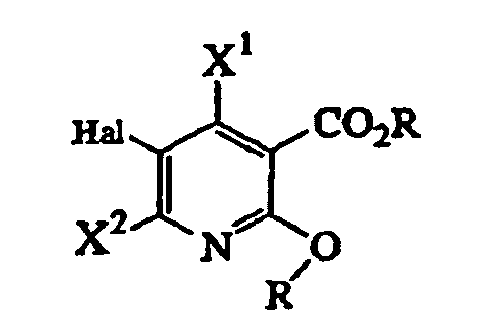
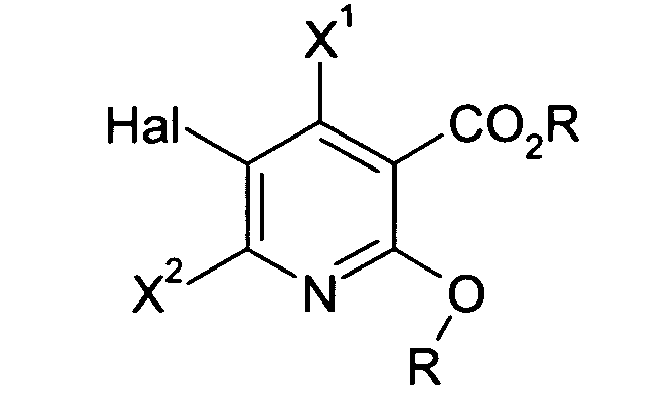
[0005] Namely, the present invention provides a method for producing a nicotinic acid derivative represented by the formula (I):
wherein each of X1 and X2 which are independent of each other, is a hydrogen atom, a halogen atom, an alkyl group, an alkoxy group, a haloalkyl group or a haloalkoxy group; R is an alkyl group; and Hal is a chlorine atom or a bromine atom; or a salt thereof, which comprises reacting a compound represented by the formula (II):
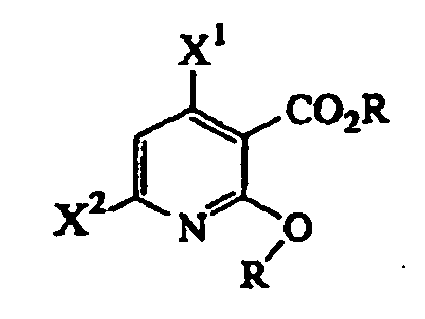
wherein X1, X2 and R are as defined above, or a salt thereof, with a halogenating agent.
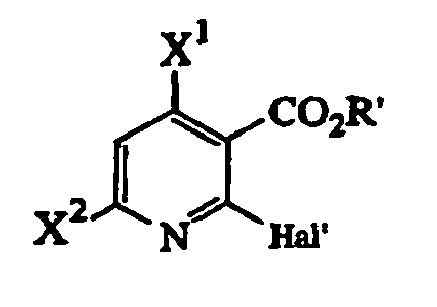
[0006] Further, the present invention provides the method for producing the nicotinic acid derivative of the above formula (I) or a salt thereof, which comprises (i) a first step of reacting a compound represented by the formula (III) :
wherein each of X1 and X2 which are independent of each other, is a hydrogen atom, a halogen atom, an alkyl group, an alkoxy group, a haloalkyl group or a haloalkoxy group; R' is an alkyl group; and Hal' is a fluorine atom, a chlorine atom or a bromine atom; or a salt thereof, with an alkali metal alkoxide represented by the formula (IV):
RO-M
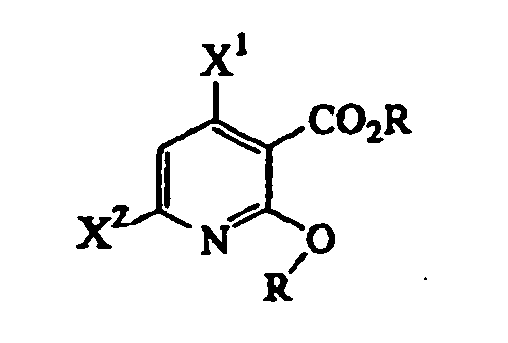
wherein R is an alkyl group, and M is an alkali metal atom, to obtain a compound represented by the formula (II) :
wherein X1, X2 and R are as defined above, or a salt thereof, and (ii) a second step of reacting the compound of the formula (II) or a salt thereof obtained in the first step, with the halogenating agent, to obtain a nicotinic acid derivative represented by the formula (I):
wherein X1, X2 and R are as defined above, and Hal is a chlorine atom or a bromine atom, or a salt thereof.
[0007] Further, the method of the present invention may include a method for producing a nicotinic acid represented by the formula (V) :
wherein X1, X2, R and Hal are as defined below, or a salt thereof, which comprises hydrolyzing a nicotinic acid derivative represented by the formula (I):
wherein each of X1 and X2 which are independent of each other, is a hydrogen atom, a halogen atom, an alkyl group, an alkoxy group, a haloalkyl group or a haloalkoxy group; R is an alkyl group; and Hal is a chlorine atom or a bromine atom; or a salt thereof.
[0008] The halogen atom, or the halogen moiety in the haloalkyl group or the haloalkoxy group, represented by X1 or X2 in the formula (I), (II), (III) or (V) may be fluorine, chlorine, bromine or iodine, preferably fluorine, chlorine or bromine.
[0009] The alkyl moiety contained in the formula (I), (II), (III) or (V) may, for example, be a C1-6 alkyl (such as methyl, ethyl, propyl, isopropyl, butyl, isobutyl or t-butyl).
[0010] The alkoxy moiety contained in the formula (I), (II), (III) or (V) may, for example, be a C1-6 alkoxy (such as methoxy, ethoxy, propoxy, isopropoxy, butoxy, isobutoxy or t-butoxy).
[0011] The compound of the formula (I), (II), (III) or (V) may form a salt together with an acidic substance and may, for example, form an inorganic salt such as a hydrochloride, a hydrobromide, a phosphate, a sulfate or a nitrate; or an organic salt such as an acetate, a p-toluenesulfonate, a methanesulfonate or a propanesulfonate. Further, the compound of the formula (V) may form an alkali metal salt or an alkaline earth metal salt and may, for example, form a sodium salt, a potassium salt, a magnesium salt or a calcium salt.
EFFECTS OF THE INVENTION
[0012] According to the present invention, it becomes possible to efficiently produce a nicotinic acid derivative or its salt useful as an intermediate for pharmaceuticals or agricultural chemicals.
BEST MODE FOR CARRYING OUT THE INVENTION
[0013] Now, the method for producing a nicotinic acid derivative or its salt of the present invention will be described in detail with reference to the reaction flow. The nicotinic acid derivative of the formula (I) or its salt is produced by reacting a compound of the formula (II) or its salt with a halogenating agent containing a chlorine atom or a bromine atom. However, it is efficient to produce it by two step reactions shown by the following flow.
[0015] The reaction of the first step of reacting a compound of the formula (III) or its salt with an alkali metal alkoxide represented by the formula (IV) to produce a compound of the above formula (II) or its salt, is preferably carried out in the presence of a solvent at a reaction temperature of from 0 to 150°C for a reaction time of from 0.1 to 24 hours. Here, the alkyl group represented by R' in the compound of the formula (III) and the alkyl group represented by R in the alkali metal alkoxide represented by the formula (IV) may be the same or different. This reaction may be carried out also under reduced pressure.
[0016] The alkali metal alkoxide of the formula (IV) to be used for the reaction of the first step may, for example, be sodium methoxide, sodium ethoxide or potassium methoxide. Among them, it is preferred to use sodium methoxide. The alkali metal alkoxide is preferably used in an amount of from 1.0 to 5.0 mols per mol of the compound of the formula (III) or its salt.
[0017] The solvent to be used for the reaction of the first step is not particularly limited so long as it will not be involved in the reaction. For example, an aromatic hydrocarbon such as benzene, toluene or xylene, an aliphatic hydrocarbon such as hexane or cyclohexane, a halogenated hydrocarbon such as methylene chloride or 1,2-dichloroethane, an alcohol such as methanol or ethanol, an ether such as tetrahydrofuran or 1,2-dimethoxyethane, or an aprotic polar solvent such as N,N-dimethylformamide or dimethylsulfoxide may be mentioned. Among them, it is preferred to use an alcohol.
[0018] The reaction of the second step of reacting the compound of the formula (II) or its salt with a halogenating agent containing a chlorine atom or a bromine atom to produce a nicotinic acid derivative of the above formula (I) or its salt, is preferably carried out in the presence of a base or a solvent at a reaction temperature of from 0 to 150°C for a reaction time of from 0.1 to 24 hours. This reaction may be carried out under reduced pressure.
[0019] The halogenating agent containing a chlorine atom or a bromine atom to be used for the reaction of the second step is not particularly limited so long as it is useful for usual chlorination or bromination. For example, chlorine, bromine, sulfuryl chloride, sodium hypochlorite, N-chlorosuccinimide, N-bromosuccinimide, 1,3-dichloro-5,5-dimethylhydantoin or 1,3-dibromo-5,5-dimethylhydantoin may be mentioned. Among them, it is preferred to use chlorine or bromine. Such a halogenating agent is preferably used in an amount of from 1.0 to 5.0 mols per mol of the compound of the formula (II).
[0020] A base to be used for the reaction of the second step may, for example, be an alkali metal hydroxide such as sodium hydroxide or potassium hydroxide; an alkali metal carbonate such as sodium carbonate or potassium carbonate; an alkali metal acetate such as sodium acetate or potassium acetate; an alkali metal hydrogencarbonate such as sodium hydrogencarbonate or potassium hydrogencarbonate; or an amine such as pyridine or triethylamine. Among them, it is preferred to use sodium acetate. Such a base is preferably used in an amount of from 0.1 to 5.0 mols per mol of the compound of the formula (II).
[0021] The solvent to be used for the reaction of the second step is not particularly limited so long as it will not be involved in the reaction. For example, aromatic hydrocarbon such as chlorobenzene or dichlorobenzene; an aliphatic hydrocarbon such as hexane or cyclohexane; a halogenated hydrocarbon such as methylene chloride or 1,2-dichloroethane; an ether such as tetrahydrofuran or 1,2-dimethoxyethane; a carboxylic acid such as acetic acid; an ester such as methyl acetate or ethyl acetate; a nitrile such as acetonitrile or propionitrile; or an aprotic polar solvent such as N,N-dimethylformamide or dimethylsulfoxide may be mentioned. Among them, it is preferred to use an ester.
[0022] A reaction for hydrolyzing the above-mentioned compound of the formula (I) or its salt to produce a compound of the formula (V) or its salt is preferably carried out in water or in a solvent containing water at a reaction temperature of from 0 to 150°C for a reaction time of from 0.1 to 24 hours. This reaction may be carried out under reduced pressure.
[0023] The base to be used for the hydrolysis may, for example, be an alkali metal hydroxide such as sodium hydroxide or potassium hydroxide; an alkaline earth metal hydroxide such as magnesium hydroxide or calcium hydroxide; an alkali metal carbonate such as sodium carbonate or potassium carbonate; an alkaline earth metal carbonate such as magnesium carbonate or calcium carbonate; or an alkali metal hydrogencarbonate such as sodium hydrogencarbonate or potassium hydrogencarbonate. Among them, it is preferred to use sodium hydroxide. The base is preferably used in an amount of at least one mol per mol of the compound of the formula (I) or its salt.
[0024] The solvent to be used for the hydrolysis is not particularly limited so long as it will not be involved in the reaction. For example, an aromatic hydrocarbon such as benzene, toluene or xylene; an aliphatic hydrocarbon such as hexane or cyclohexane; a halogenated hydrocarbon such as methylene chloride or 1,2-dichloroethane; an alcohol such as methanol or ethanol; an ether such as tetrahydrofuran or 1,2-dimethoxyethane; a nitrile such as acetonitrile or propionitrile; or an aprotic polar solvent such as N,N-dimethylformamide or dimethylsulfoxide may be mentioned. However, the hydrolysis is preferably carried out in water or in an alcohol containing water.
[0025] After completion of the hydrolysis, the compound of the formula (V) is treated for neutralization with a mineral acid such as hydrochloric acid or sulfuric acid to form an alkali metal salt or an alkaline earth metal salt, whereby a compound of the formula (V) will be obtained. Otherwise, without such neutralization treatment, an alkali metal salt or an alkaline earth metal salt of the compound of the formula (V) may be isolated.
EXAMPLES
[0026] Now, the present invention will be described with reference to Examples, but it should be understood that the present invention is by no means restricted to such Examples.
PREPARATION EXAMPLE 1
[0027] Into a 300 ml four necked flask equipped with a stirrer, a condenser and a thermometer, 137.8 g (714 mmol) of 28% sodium methylate methanol solution was charged, and while the internal temperature was maintained at 50°C, 48 ml of a methanol solution containing 47.5 g (238 mmol) of ethyl 2-chloro-4-methyl nicotinate was dropwise added, followed by stirring for 1 hour. The reaction solution was put into 500 ml of water and extracted with diethyl ether, followed by distillation under reduced pressure to obtain 27 g (yield: 63%) of methyl 2-methoxy-4-methyl nicotinate (boiling point: 95°C/7 mmHg).
PREPARATION EXAMPLE 2
[0028] Into a 500 ml four necked flask equipped with a stirrer, a thermometer, a condenser and an N2 gas supply tube, 203 g (1.05 mol) of a 28% sodium methylate methanol solution was charged in an N2 atmosphere. While the internal temperature was maintained at not higher than 40°C, 92.8 g (0.5 mol) of methyl 2-chloro-4-methyl nicotinate was dropwise added over a period of about 30 minutes. After completion of the dropwise addition, while the internal temperature was maintained from 45 to 50°C, the reaction was carried out for about 4 hours till disappearance of the starting materials. After completion of the reaction, about 100 ml of methanol in the system was distilled off under reduced pressure, and then the reaction solution was put into a mixed solution of 390 g of a 7% sulfuric acid aqueous solution and 300 ml of toluene with stirring. After extraction and liquid separation, the toluene layer was washed with 150 ml of a 0.5% sodium hydrogencarbonate aqueous solution. After distilling off toluene, a fraction of from 85 to 92°C/5 mmHg i.e. 83.3 g (yield: 92%) of methyl 2-methoxy-4-methyl nicotinate was obtained by distillation under reduced pressure.
PREPARATION EXAMPLE 3
[0029] Into a 500 ml four necked flask quipped with a stirrer, a thermometer, a condenser and a Cl2 gas supply tube, 90.6 g (0.5 mol) of methyl 2-methoxy-4-methyl nicotinate, 300 ml of ethyl acetate and 49.2 g (0.6 mol) of sodium acetate were charged. While the internal temperature was maintained at 70°C, chlorine gas (supply rate: 10 g/hr) was introduced for about 4 hours, and upon confirming disappearance of the starting materials, the reaction was terminated. The reaction mixture was put into 700 ml of cool water, and 200 ml of ethyl acetate was added, followed by extraction and liquid separation. Then, the ethyl acetate layer was washed with 150 ml of a 1% sodium hydrogencarbonate aqueous solution, and dried over anhydrous sodium sulfate, whereupon ethyl acetate was distilled off to obtain 105.6 g (crude yield: 98%) of crude crystals of desired methyl 5-chloro-2-methoxy-4-methyl nicotinate. This product was recrystallized from methanol to obtain 91.8 g (melting point: 43-44°C) of a recrystallized product.
PREPARATION EXAMPLE 4
[0030] Into a 1,000 ml four necked flask equipped with a stirrer, a condenser and a thermometer, 107.8 g (0.5 mol) of methyl 5-chloro-2-methoxy-4-methyl nicotinate and 210 g (0.525 mol) of a 10% sodium hydroxide aqueous solution were charged, followed by stirring for 2 hours at an internal temperature of 90°C. The reaction solution was left to cool and then a 15% sulfuric acid aqueous solution was dropwise added for neutralization and crystallization. Precipitated crystals were collected by filtration and then dried to obtain 99.3 g (yield: 98%) of 5-chloro-2-methoxy-4-methyl nicotinic acid (melting point: 127-129°C).
INDUSTRIAL APPLICABILITY
1. A method for producing a nicotinic acid derivative represented by the formula (I):
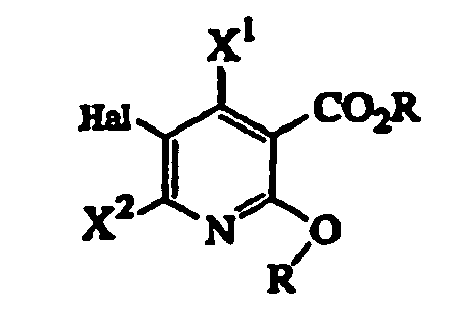
wherein each of X1 and X2 which are independent of each other, is a hydrogen atom, a halogen atom, an alkyl group, an alkoxy group, a haloalkyl group or a haloalkoxy group; R is an alkyl group; and Hal is a chlorine atom or a bromine atom; or a salt thereof, which comprises reacting a compound represented by the formula (II):
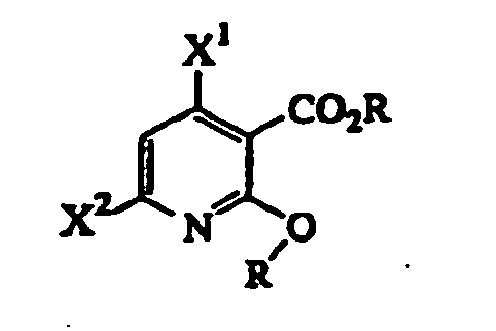
wherein X1, X2 and R are as defined above, or a salt thereof, with a halogenating agent.
wherein each of X1 and X2 which are independent of each other, is a hydrogen atom, a halogen atom, an alkyl group, an alkoxy group, a haloalkyl group or a haloalkoxy group; R is an alkyl group; and Hal is a chlorine atom or a bromine atom; or a salt thereof, which comprises reacting a compound represented by the formula (II):
wherein X1, X2 and R are as defined above, or a salt thereof, with a halogenating agent.
2. The method for producing a nicotinic acid derivative or a salt thereof according to
Claim 1, which comprises (i) a first step of reacting a compound represented by the
formula (III):
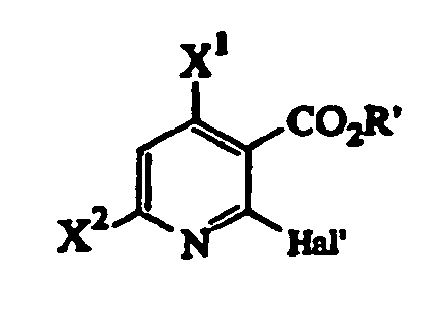
wherein each of X1 and X2 which are independent of each other, is a hydrogen atom, a halogen atom, an alkyl group, an alkoxy group, a haloalkyl group or a haloalkoxy group; R' is an alkyl group; and Hal' is a fluorine atom, a chlorine atom or a bromine atom; or a salt thereof, with an alkali metal alkoxide represented by the formula (IV):
RO-M
wherein R is an alkyl group, and M is an alkali metal atom, to obtain a compound represented by the formula (II) :
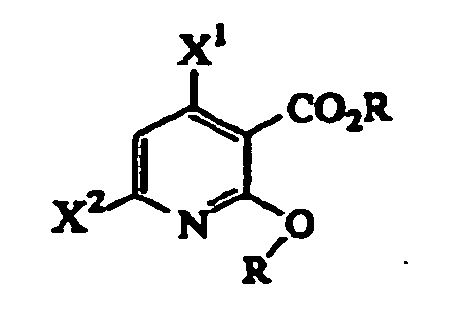
wherein X1, X2 and R are as defined above, or a salt thereof, and (ii) a second step of reacting the compound of the formula (II) or a salt thereof obtained in the first step, with the halogenating agent, to obtain a nicotinic acid derivative represented by the formula (I):
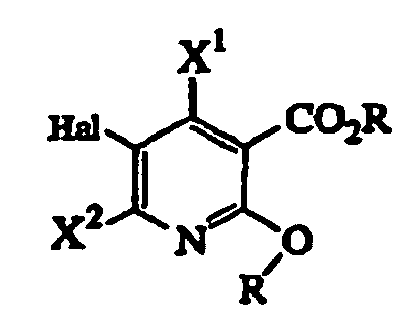
wherein X1, X2 and R are as defined above, and Hal is a chlorine atom or a bromine atom, or a salt thereof.
wherein each of X1 and X2 which are independent of each other, is a hydrogen atom, a halogen atom, an alkyl group, an alkoxy group, a haloalkyl group or a haloalkoxy group; R' is an alkyl group; and Hal' is a fluorine atom, a chlorine atom or a bromine atom; or a salt thereof, with an alkali metal alkoxide represented by the formula (IV):
RO-M
wherein R is an alkyl group, and M is an alkali metal atom, to obtain a compound represented by the formula (II) :
wherein X1, X2 and R are as defined above, or a salt thereof, and (ii) a second step of reacting the compound of the formula (II) or a salt thereof obtained in the first step, with the halogenating agent, to obtain a nicotinic acid derivative represented by the formula (I):
wherein X1, X2 and R are as defined above, and Hal is a chlorine atom or a bromine atom, or a salt thereof.
3. The method according to Claim 2, wherein the alkali metal alkoxide of the formula
(IV) is an alkali metal methoxide.
4. The method according to Claim 1, wherein the halogenating agent is chlorine or bromine.
5. A method according to any one of the preceding claims further comprising a step for producing a nicotinic acid represented by the formula (V):
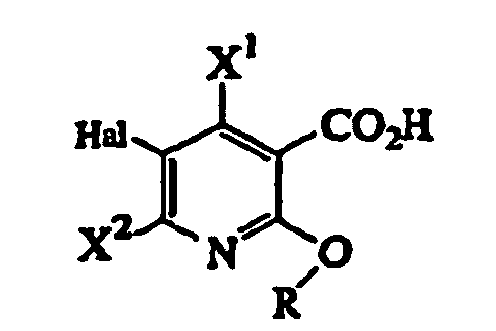
wherein X1, X2, R and Hal are as defined below, or a salt thereof, which comprises hydrolyzing the nicotinic acid derivative represented by the formula (I):
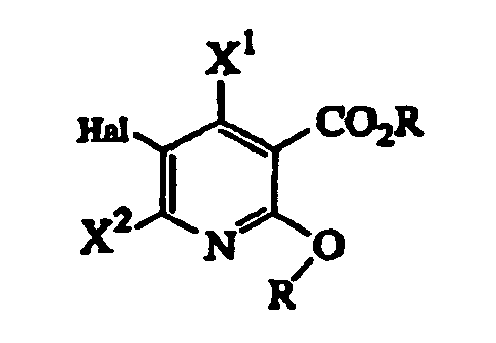
wherein each of X1 and X2 which are independent of each other, is a hydrogen atom, a halogen atom, an alkyl group, an alkoxy group, a haloalkyl group or a haloalkoxy group; R is an alkyl group; and Hal is a chlorine atom or a bromine atom; or a salt thereof.
wherein X1, X2, R and Hal are as defined below, or a salt thereof, which comprises hydrolyzing the nicotinic acid derivative represented by the formula (I):
wherein each of X1 and X2 which are independent of each other, is a hydrogen atom, a halogen atom, an alkyl group, an alkoxy group, a haloalkyl group or a haloalkoxy group; R is an alkyl group; and Hal is a chlorine atom or a bromine atom; or a salt thereof.
1. Verfahren zur Herstellung eines Nicotinsäurederivats der folgenden Formel (I):
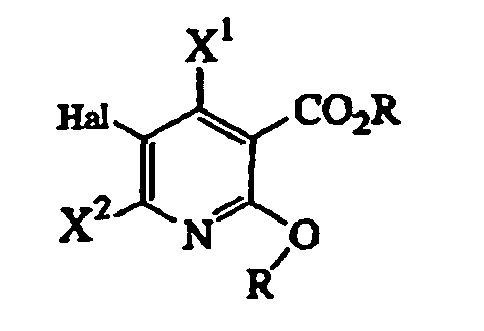
worin X1 und X2, die unabhängig voneinander sind, für ein Wasserstoffatom, ein Halogenatom, eine Alkylgruppe, eine Alkoxygruppe, eine Haloalkylgruppe oder eine Haloalkoxygruppe stehen; R für eine Alkylgruppe steht; und Hal ein Chloratom oder ein Bromatom ist, oder eines Salzes desselben, umfassend Umsetzen einer Verbindung der folgenden Formel (II):
worin X1, X2 und R wie oben definiert sind oder ein Salz davon mit einem Halogenierungsmittel.
worin X1 und X2, die unabhängig voneinander sind, für ein Wasserstoffatom, ein Halogenatom, eine Alkylgruppe, eine Alkoxygruppe, eine Haloalkylgruppe oder eine Haloalkoxygruppe stehen; R für eine Alkylgruppe steht; und Hal ein Chloratom oder ein Bromatom ist, oder eines Salzes desselben, umfassend Umsetzen einer Verbindung der folgenden Formel (II):
worin X1, X2 und R wie oben definiert sind oder ein Salz davon mit einem Halogenierungsmittel.
2. Das Verfahren zur Herstellung eines Nicotinsäurederivats oder eines Salzes davon gemäß
Anspruch 1, umfassend (i) einen ersten Schritt, in dem eine Verbindung der Formel
(III):
worin X1 und X2, die unabhängig voneinander sind, für ein Wasserstoffatom, ein Halogenatom, eine Alkylgruppe, eine Alkoxygruppe, eine Haloalkylgruppe oder eine Haloalkoxygruppe stehen; R' für eine Alkylgruppe steht; und Hal' ein Fluoratom, ein Chloratom oder ein Bromatom ist, oder ein Salz davon, mit einem Alkalimetallalkoxid der Formel (IV):
RO-M
umgesetzt wird, worin R eine Alkylgruppe und M ein Alkalimetallatom ist, um eine Verbindung der Formel (II) zu erhalten:
worin X1, X2 und R wie oben definiert sind, oder ein Salz davon, und (ii) einen zweiten Schritt, in dem die im ersten Schritt erhaltene Verbindung der Formel (II) oder ein Salz davon mit einem Halogenierungsmittel umgesetzt wird, um ein Nicotinsäurederivat der Formel (I) zu erhalten:
worin X1, X2 und R wie oben definiert sind und Hal ein Chloratom oder ein Bromatom ist oder ein Salz davon.
worin X1 und X2, die unabhängig voneinander sind, für ein Wasserstoffatom, ein Halogenatom, eine Alkylgruppe, eine Alkoxygruppe, eine Haloalkylgruppe oder eine Haloalkoxygruppe stehen; R' für eine Alkylgruppe steht; und Hal' ein Fluoratom, ein Chloratom oder ein Bromatom ist, oder ein Salz davon, mit einem Alkalimetallalkoxid der Formel (IV):
RO-M
umgesetzt wird, worin R eine Alkylgruppe und M ein Alkalimetallatom ist, um eine Verbindung der Formel (II) zu erhalten:
worin X1, X2 und R wie oben definiert sind, oder ein Salz davon, und (ii) einen zweiten Schritt, in dem die im ersten Schritt erhaltene Verbindung der Formel (II) oder ein Salz davon mit einem Halogenierungsmittel umgesetzt wird, um ein Nicotinsäurederivat der Formel (I) zu erhalten:
worin X1, X2 und R wie oben definiert sind und Hal ein Chloratom oder ein Bromatom ist oder ein Salz davon.
3. Das Verfahren gemäß Anspruch 2, worin das Alkalimetallalkoxid von Formel (IV) ein
Alkalimetallmethoxid ist.
4. Das Verfahren gemäß Anspruch 1, worin das Halogenierungsmittel Chlor oder Brom ist.
5. Ein Verfahren gemäß einem der vorangehenden Ansprüche, ferner umfassend einen Schritt
zur Herstellung einer Nicotinsäure der Formel (V):
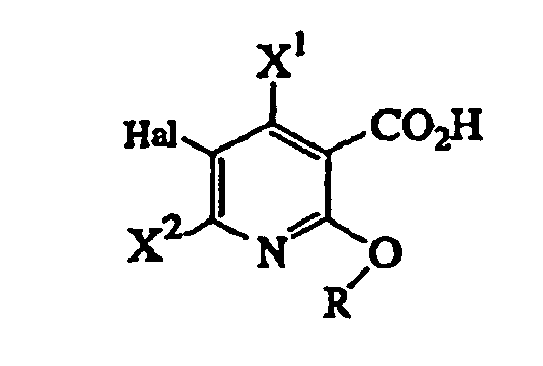
worin X1, X2, R und Hal wie oben definiert sind, oder ein Salz davon, umfassend Hydrolysieren des Nicotinsäurederivats der Formel (I):
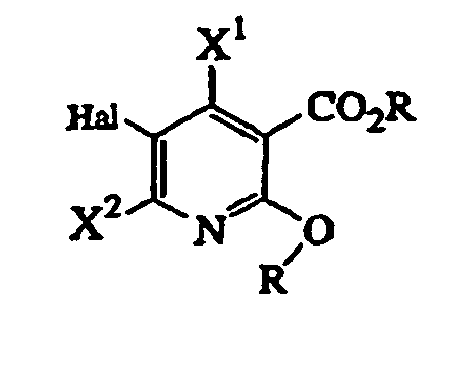
worin X1 und X2, die unabhängig voneinander sind, für ein Wasserstoffatom, ein Halogenatom, eine Alkylgruppe, eine Alkoxygruppe, eine Haloalkylgruppe oder eine Haloalkoxygruppe stehen; R für eine Alkylgruppe steht; und Hal ein Chloratom oder ein Bromatom ist oder ein Salz davon.
worin X1, X2, R und Hal wie oben definiert sind, oder ein Salz davon, umfassend Hydrolysieren des Nicotinsäurederivats der Formel (I):
worin X1 und X2, die unabhängig voneinander sind, für ein Wasserstoffatom, ein Halogenatom, eine Alkylgruppe, eine Alkoxygruppe, eine Haloalkylgruppe oder eine Haloalkoxygruppe stehen; R für eine Alkylgruppe steht; und Hal ein Chloratom oder ein Bromatom ist oder ein Salz davon.
1. Procédé pour produire un dérivé d'acide nicotinique représenté par la formule (I)
:
dans laquelle chacun de X1 et X2, qui sont indépendants l'un de l'autre, est un atome d'hydrogène, un atome d'halogène, un groupe alkyle, un groupe alcoxy, un groupe halogénoalkyle ou un groupe halogénoalcoxy ; R est un groupe alkyle ; et Hal est un atome de chlore ou un atome de brome ; ou un sel de celui-ci, qui comprend la réaction d'un composé représenté par la formule (II) :
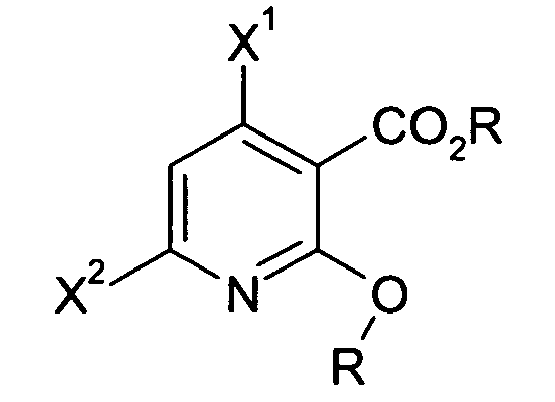
dans laquelle X1, X2 et R sont tels que définis ci-dessus, ou d'un sel de celui-ci, avec un agent d'halogénation.
dans laquelle chacun de X1 et X2, qui sont indépendants l'un de l'autre, est un atome d'hydrogène, un atome d'halogène, un groupe alkyle, un groupe alcoxy, un groupe halogénoalkyle ou un groupe halogénoalcoxy ; R est un groupe alkyle ; et Hal est un atome de chlore ou un atome de brome ; ou un sel de celui-ci, qui comprend la réaction d'un composé représenté par la formule (II) :
dans laquelle X1, X2 et R sont tels que définis ci-dessus, ou d'un sel de celui-ci, avec un agent d'halogénation.
2. Procédé pour produire un dérivé d'acide nicotinique ou un sel de celui-ci selon la
revendication 1, qui comprend (i) une première étape consistant à faire réagir un
composé représenté par la formule (III) :
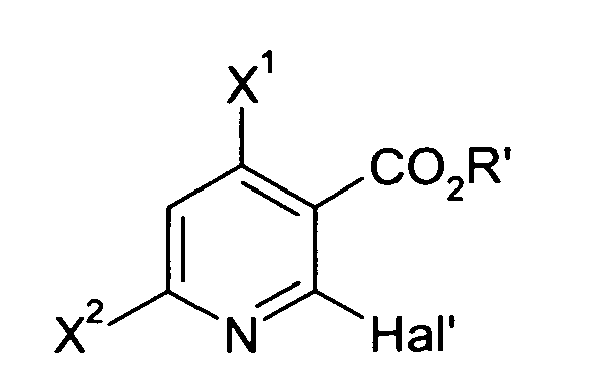
dans laquelle chacun de X1 et X2, qui sont indépendants l'un de l'autre, est un atome d'hydrogène, un atome d'halogène, un groupe alkyle, un groupe alcoxy, un groupe halogénoalkyle ou un groupe halogénoalcoxy ; R' est un groupe alkyle ; et Hal' est un atome de fluor, un atome de chlore ou un atome de brome ; ou un sel de celui-ci, avec un alkylate de métal alcalin représenté par la formule (IV) :
RO-M
dans laquelle R est un groupe alkyle, et M est un atome de métal alcalin, pour former un composé représenté par la formule (II) :
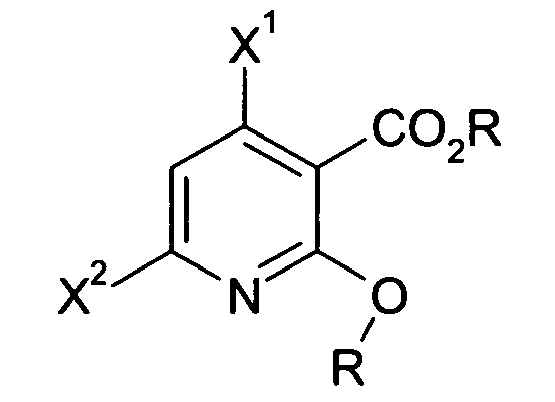
dans laquelle X1, X2 et R sont tels que définis ci-dessus, ou d'un sel de celui-ci, et (ii) une deuxième étape consistant à faire réagir le composé de formule (II) ou un sel de celui-ci obtenu dans la première étape, avec l'agent d'halogénation, pour former un dérivé d'acide nicotinique représenté par la formule (I) :
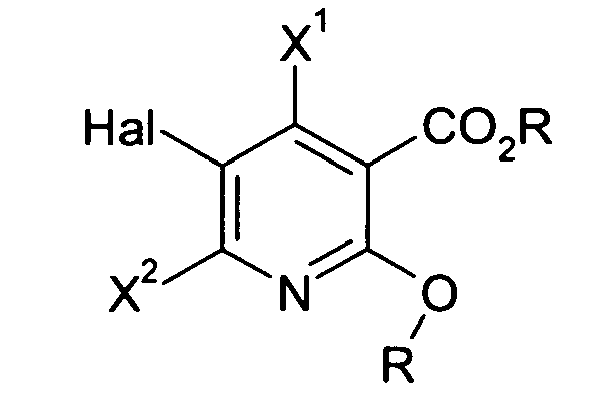
dans laquelle X1, X2 et R sont tels que définis ci-dessus, et Hal est un atome de chlore ou un atome de brome, ou un sel de celui-ci.
dans laquelle chacun de X1 et X2, qui sont indépendants l'un de l'autre, est un atome d'hydrogène, un atome d'halogène, un groupe alkyle, un groupe alcoxy, un groupe halogénoalkyle ou un groupe halogénoalcoxy ; R' est un groupe alkyle ; et Hal' est un atome de fluor, un atome de chlore ou un atome de brome ; ou un sel de celui-ci, avec un alkylate de métal alcalin représenté par la formule (IV) :
RO-M
dans laquelle R est un groupe alkyle, et M est un atome de métal alcalin, pour former un composé représenté par la formule (II) :
dans laquelle X1, X2 et R sont tels que définis ci-dessus, ou d'un sel de celui-ci, et (ii) une deuxième étape consistant à faire réagir le composé de formule (II) ou un sel de celui-ci obtenu dans la première étape, avec l'agent d'halogénation, pour former un dérivé d'acide nicotinique représenté par la formule (I) :
dans laquelle X1, X2 et R sont tels que définis ci-dessus, et Hal est un atome de chlore ou un atome de brome, ou un sel de celui-ci.
3. Procédé selon la revendication 2, dans lequel l'alkylate de métal alcalin de formule
(IV) est un méthylate de métal alcalin.
4. Procédé selon la revendication 1, dans lequel l'agent d'halogénation est le chlore
ou le brome.
5. Procédé selon l'une quelconque des revendications précédentes, comprenant en outre
une étape pour produire un acide nicotinique représenté par la formule (V) :
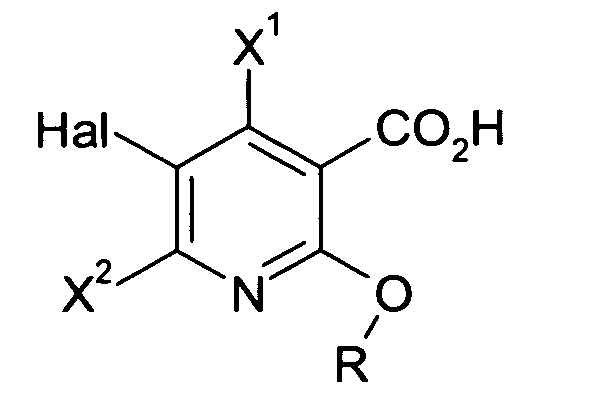
dans laquelle X1, X2, R et Hal sont tels que définis ci-dessus, ou un sel de celui-ci, qui comprend l'hydrolyse du dérivé d'acide nicotinique représenté par la formule (I) :
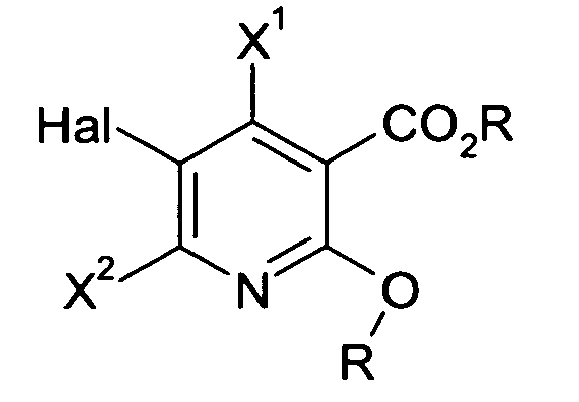
dans laquelle chacun de X1 et X2, qui sont indépendants l'un de l'autre, est un atome d'hydrogène, un atome d'halogène, un groupe alkyle, un groupe alcoxy, un groupe halogénoalkyle ou un groupe halogénoalcoxy ; R est un groupe alkyle ; et Hal est un atome de chlore ou un atome de brome ; ou d'un sel de celui-ci.
dans laquelle X1, X2, R et Hal sont tels que définis ci-dessus, ou un sel de celui-ci, qui comprend l'hydrolyse du dérivé d'acide nicotinique représenté par la formule (I) :
dans laquelle chacun de X1 et X2, qui sont indépendants l'un de l'autre, est un atome d'hydrogène, un atome d'halogène, un groupe alkyle, un groupe alcoxy, un groupe halogénoalkyle ou un groupe halogénoalcoxy ; R est un groupe alkyle ; et Hal est un atome de chlore ou un atome de brome ; ou d'un sel de celui-ci.
REFERENCES CITED IN THE DESCRIPTION
This list of references cited by the applicant is for the reader's convenience only. It does not form part of the European patent document. Even though great care has been taken in compiling the references, errors or omissions cannot be excluded and the EPO disclaims all liability in this regard.
Patent documents cited in the description
Non-patent literature cited in the description
- SARGES A. et al.J. Med. Chem., 1990, vol. 33, 1859-1895 [0002]