|
(11) | EP 1 902 099 B1 |

| (12) | EUROPEAN PATENT SPECIFICATION |
|
|
| (54) |
GAS-RESISTANT PHTHALOCYANINE DYES GASRESISTENTE PHTHALOCYANINFARBSTOFFE COLORANTS PHTALOCYANINES RESISTANTS AUX GAZ |
|
|
|||||||||||||||||||||||||||
|
||||||||||||||||||||||||||||
| Note: Within nine months from the publication of the mention of the grant of the European patent, any person may give notice to the European Patent Office of opposition to the European patent granted. Notice of opposition shall be filed in a written reasoned statement. It shall not be deemed to have been filed until the opposition fee has been paid. (Art. 99(1) European Patent Convention). |
[0001] The present invention relates to novel phthalocyanine-metal complex dye mixture and to the preparation thereof, and also to a method of dyeing or printing natural, semi-synthetic or synthetic material using those phthalocyanine-metal complex dyes.
[0002] The use of phthalocyanine-based dyes in dyeing and printing methods has been known for a long time.
[0003] WO 03/066751 discloses an ink composition comprising at least one dye having an oxidation potential of more than 1.0 V and a surface active agent, wherein said dye may be a phthalocyanine dye having 3, 4 or 8 sulfonyl substituents. JP-A-2003-12956 discloses an ink comprising symmetrically sulfonyl-substituted phthalocyanine dyes, prepared by reacting a phthalonitrile or a phthalic acid derivative pre-linked to a soluble group or its precursor having a Hammett constant σp of 0.4 or more with a metal derivative. JP-A-2003-213168 discloses an ink composition comprising a phthalocyanine compound having 4 or 8 sulfonyl substituents and at least one asymmetrical carbon atom in the substituent. EP-A-1271500 discloses an optical information recording medium, wherein the recording layer of said medium contains a phthalocyanine derivative, for example, a mixture of tri- or tetra-sulfo-substituted phthalocyanines. JP-A-02-116592 discloses an optical recording medium formed by providing a film mainly composed of a phthalocyanine compound having 3-8 substituents on a substrate.
[0004] However, it has been found that the known phthalocyanine dyes used in those methods do not always entirely satisfy the highest requirements, especially in respect of fastness to light. Besides fastness to light, resistance to gases, e.g. especially ozone but also nitrogen oxides, (so-called "gas fading") is, above all, a problem that has not been satisfactorily solved hitherto, especially in the case of ink-jet printing, above all in the case of printing on microporous materials such as, for example, quick-drying photo paper.
[0005] There is accordingly a need for new phthalocyanine-based dyes which result in light-fast and gas-resistant dyeings and which exhibit good all-round fastness properties.
[0006] It has now been found, surprisingly, that the phthalocyanine-metal complex dye mixture according to the invention largely meet the above-mentioned criteria.
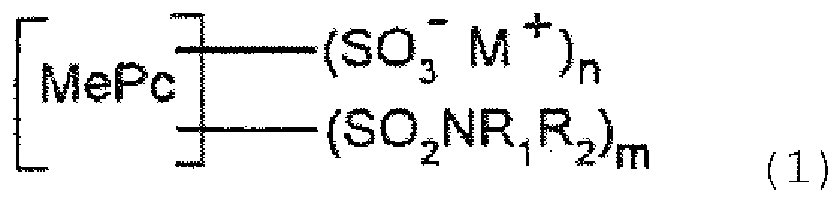
[0007] The present invention accordingly relates to a mixture comprising at least one dye of formula
wherein
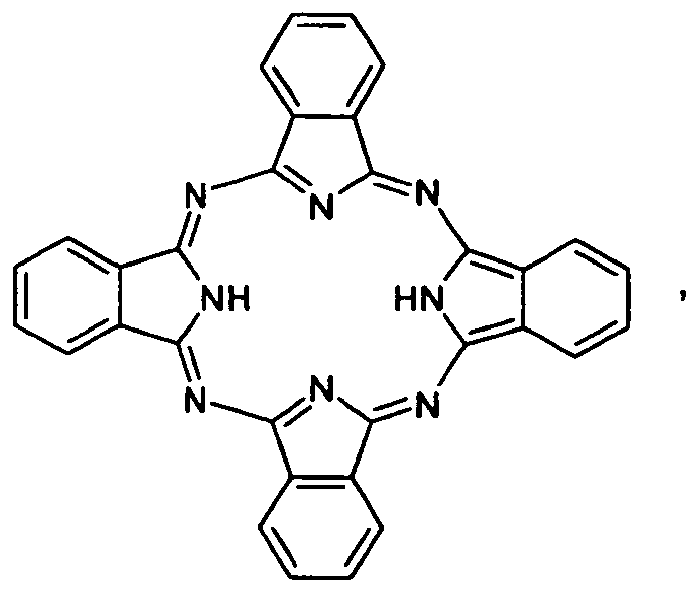
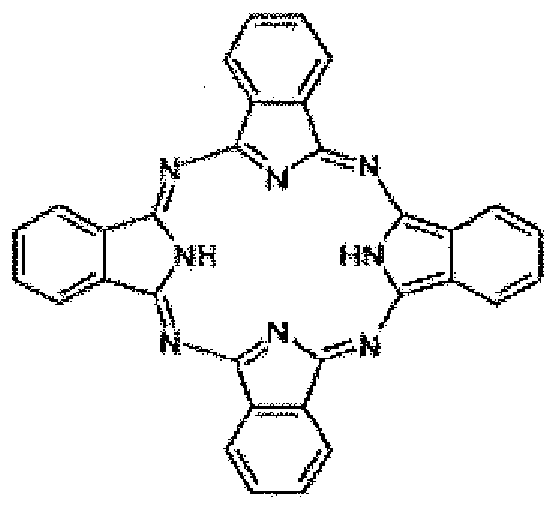
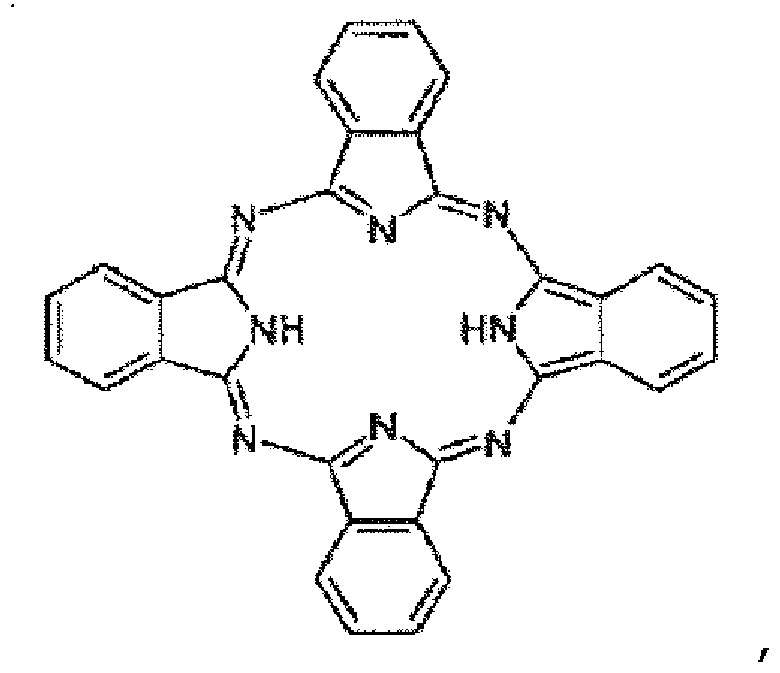
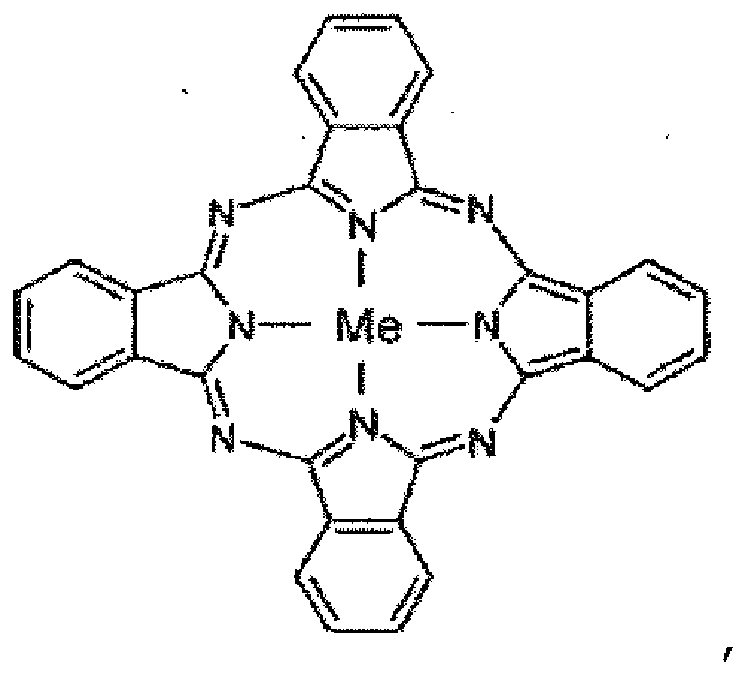
Pc is a phthalocyanine of formula
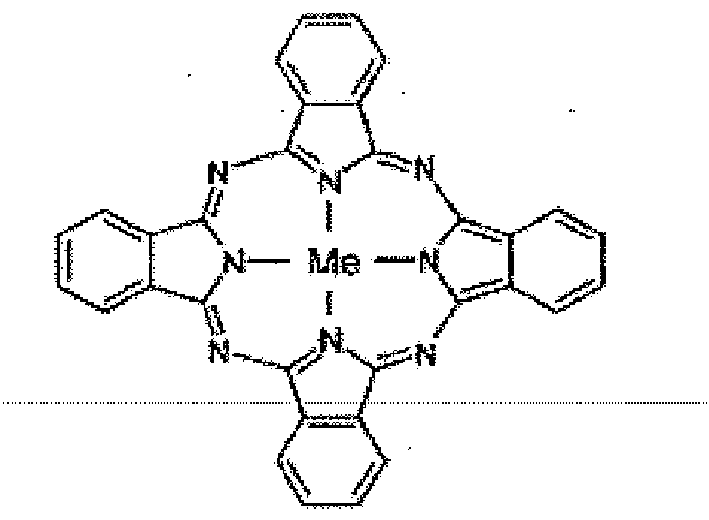
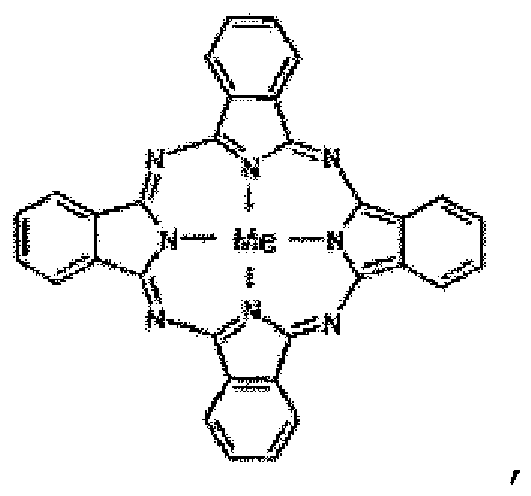
Me is a metal,
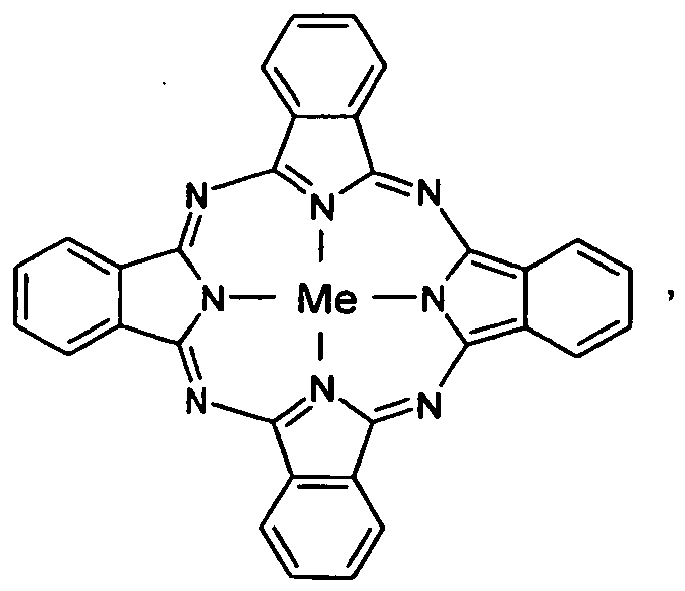
[MePc] is a phthalocyanine-metal complex of formula
M+ is an inorganic or organic cation,
R1 is hydrogen, unsubstituted or substituted alkyl, unsubstituted or substituted aralkyl or unsubstituted or substituted aryl, and
R2 is hydrogen, unsubstituted or substituted alkyl, unsubstituted or substituted aralkyl or unsubstituted or substituted aryl, and
n and m are each independently of the other 0, 1, 2, 3, 4, 5, 6 or 7,
the sum of (n + m) being a number 6 or 7.
[0009] An inorganic cation M+ is, for example, H+, a monovalent or divalent metal cation, especially an alkali metal or alkaline earth metal cation such as Na+, K+, Li+, Ca2+ or Mg2+, or NH4+ or phosphonium.
[0010] An organic cation M+ is, for example, 18-crown-6/Na+ (a compound of formula
or N+(R3,R4,R5,R6) wherein R3 to R6 are each independently of the others hydrogen, C1-C16alkyl, C7-C18aralkyl, C6-C18aryl or C1-C4alcohol, or a cation derived from Primene81 R®, a commercial product of Rohm & Haas which is a primary amine mixture having a highly branched C12-C14alkyl side chain, or from C1-C14tetraalkylammonium hydroxide, especially from tetrabutylammonium hydroxide.
[0011] The organic cation M+ is preferably the ammonium cation
of an amine of formula
wherein R7, R8, R9 and R10 are each independently of the others hydrogen or unsubstituted or hydroxy- or amino-substituted, linear or branched C1-C14alkyl which is uninterrupted or which may be, from C3 upwards, interrupted by an oxygen atom.
[0012] Suitable organic cations M+ also include those that are derived from the following amines: NH2(CH2)2SO3H, NH(CH3)(CH2)2SO3H, NH2(CH2)2OH, NH2(CH2)3OH, NH2(CH2)2OSO3H, NH(CH2CH2OH)2, NH(CH2CH2OSO3H)2, NH2(CH2)2O(CH2)2OH, NH2(CH2)5OH, NH2CH2CH(CH3)OH, NH2(CH2)2NH(CH2)2OH, NH2(CH2)2N(CH2CH3)2, NH2(CH2)3N(CH2CH3)2, NH2(CH2)NH(CH2)3NH2, NH2(CH2)2NH(CH2)NH2, NH2(CH2)3NH(CH2)NH2, NH2CH2C(CH3)2CH2NH2, NH2(CH2)3NHCH2CH3, NH2(CH2)3N(CH3)2, NH2(CH2)N(CH2CH3)2, NH2(CH2)3NH(CH2)N(CH3)2, NH2(CH2)3NH(CH2)3OH, NH2CH2CH(OH)CH2NH2,
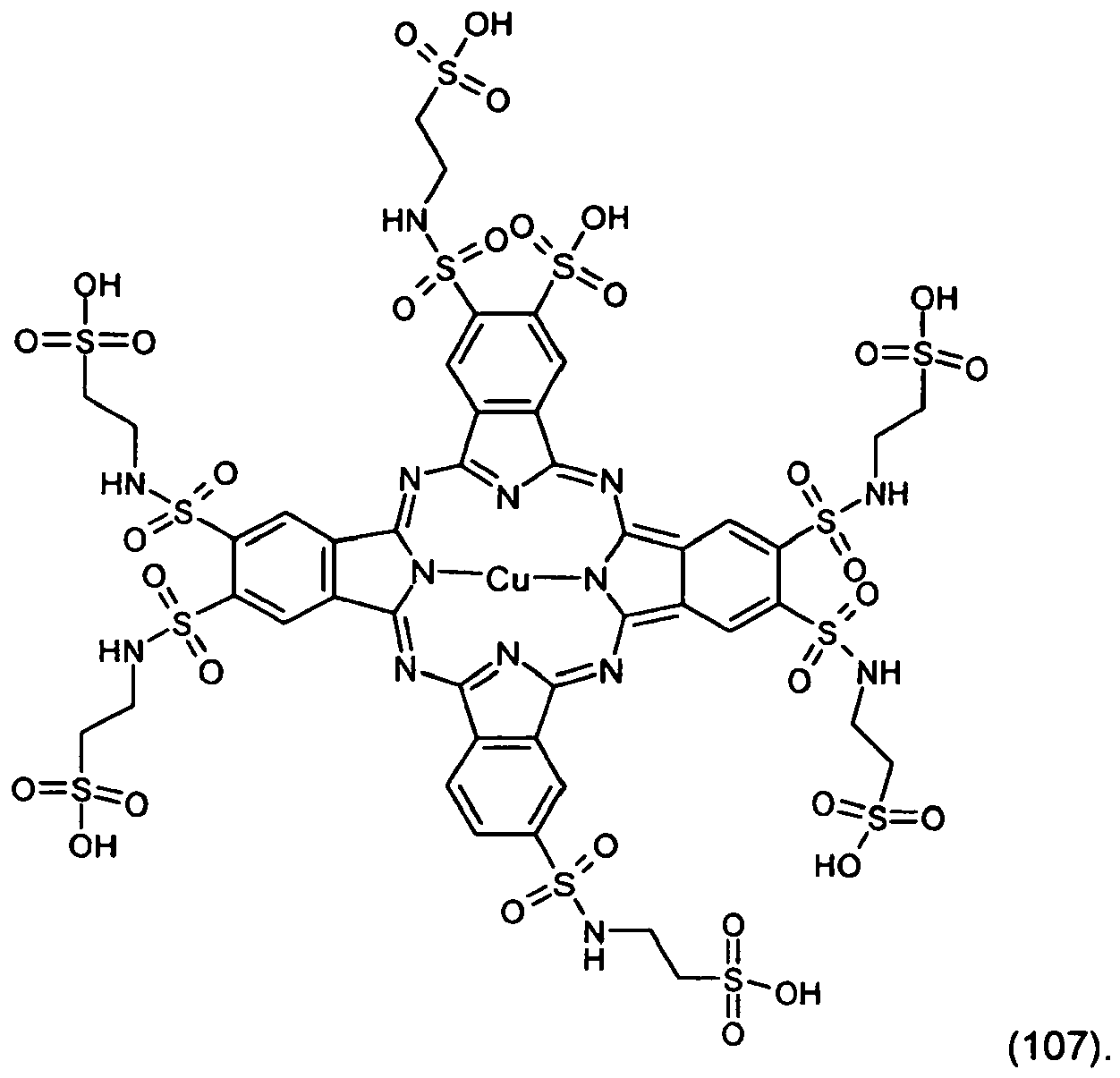
NH2OH, NH2(CH2)2COOH, NH2CH2COOH, morpholine, aniline-4-sulfonic acid, aniline-3-sulfonic acid, aniline-2-sulfonic acid, NH2(CH2)2S(CH2)2OH, NH2(C6H4)SO2CH2CH2OSO3H, piperazine,
NH(CH3)CH2COOH, NH2(CH2)5COOH, NH2CH2SO3H,
[0014] Alkyl as R1 may be straight-chained or branched and may be interrupted by oxygen radicals, nitrogen radicals and/or by sulfur radicals from C3 upwards.
[0015] R1 is preferably C1-C12alkyl such as, for example, methyl, ethyl, propyl, isopropyl, n-butyl, isobutyl, sec-butyl, tert-butyl, pentyl, hexyl, heptyl, octyl, nonyl, decyl, undecyl or dodecyl.
[0016] C3-C12Alkyl interrupted by an oxygen radical O, nitrogen radical N or sulfur radical S is, for example, C4alkyl such as -CH2-CH2-O-CH2-CH3, -CH2-CH2-NH-CH2-CH3 or -CH2-CH2-S-CH2-CH3.
C1-C12Alkyl as R1 may be unsubstituted or substituted by -OH, -NR11R12, -OSO3H or by -SO3H, wherein R11 and R12 are each independently of the other hydrogen or C1-C4alkyl.
[0017] R1 as aralkyl and aryl is, for example, C7-C25aralkyl, preferably C7-C12aralkyl, or C6-C24aryl, preferably C6-C12aryl.
[0018] C7-C25Aralkyl is, for example, benzyl, 2-benzyl-2-propyl, β-phenyl-ethyl, α,α-dimethylbenzyl, ω-phenyl-butyl, ω,ω-dimethyl-ω-phenyl-butyl, ω-phenyl-dodecyl, ω-phenyl-octadecyl, ω-phenyl-icosyl or ω-phenyl-docosyl.
[0019] C7-C12Aralkyl is, for example, benzyl, 2-benzyl-2-propyl, β-phenyl-ethyl, 9-fluorenyl, α,α-dimethylbenzyl, ω-phenyl-butyl, ω-phenyl-dodecyl or ω,ω-dimethyl-ω-phenyl-butyl. C6-C24Aryl is, for example, phenyl, 1-naphthyl, 2-naphthyl, 4-biphenylyl, phenanthryl, 2- or 9-fluorenyl, anthraquinonyl or anthryl.
[0021] Alkyl as R2 may be straight-chained or branched and may be interrupted by oxygen radicals, nitrogen radicals and/or by sulfur radicals.
[0022] R2 is preferably C1-C12alkyl such as, for example, methyl, ethyl, propyl, isopropyl, n-butyl, isobutyl, sec-butyl, tert-butyl, pentyl, hexyl, heptyl, octyl, nonyl, decyl, undecyl or dodecyl.
[0023] C3-C12Alkyl interrupted by an oxygen radical O, nitrogen radical N or sulfur radical S is, for example, C4alkyl such as -CH2-CH2-O-CH2-CH3, -CH2-CH2-NH-CH2-CH3 or -CH2-CH2-S-CH2-CH3.
[0024] C1-C12Alkyl as R2 may be unsubstituted or substituted by -OH, -NR11R12, -OSO3H or by -SO3H, wherein R11 and R12 are each independently of the other hydrogen or C1-C4alkyl.
[0025] R2 as aralkyl and aryl is, for example, C7-C25aralkyl, preferably C7-C12aralkyl, or C6-C24aryl, preferably C6-C12aryl.
[0026] C7-C25Aralkyl is, for example, benzyl, 2-benzyl-2-propyl, β-phenyl-ethyl, α,α-dimethylbenzyl, ω-phenyl-butyl, ω,ω-dimethyl-ω-phenyl-butyl, ω-phenyl-dodecyl, ω-phenyl-octadecyl, ω-phenyl-icosyl or ω-phenyl-docosyl.
[0027] C7-C12Aralkyl is, for example, benzyl, 2-benzyl-2-propyl, β-phenyl-ethyl, 9-fluorenyl, α,α-dimethylbenzyl, ω-phenyl-butyl, ω-phenyl-dodecyl or ω,ω-dimethyl-ω-phenyl-butyl. C6-C24Aryl is, for example, phenyl, 1-naphthyl, 2-naphthyl, 4-biphenylyl, phenanthryl, 2- or 9-fluorenyl, anthraquinonyl or anthryl.
[0029] The radical NR1R2 is derived, for example, from the following amines: NH2(CH2)2SO3H, NH(CH3)(CH2)2SO3H, NH2(CH2)2OH, NH2(CH2)3OH, NH2(CH2)2OSO3H, NH(CH2CH2OH)2, NH(CH2CH2OSO3H)2, NH2(CH2)2O(CH2)2OH, NH2(CH2)5OH, NH2CH2CH(CH3)OH, NH2(CH2)2NH(CH2)2OH, NH2(CH2)2N(CH2CH3)2, NH2(CH2)3N(CH2CH3)2, NH2(CH2)2NH(CH2)3NH2, NH2(CH2)2NH(CH2)2NH2, NH2(CH2)3NH(CH2)3NH2, NH2CH2C(CH3)2CH2NH2, NH2(CH2)3NHCH2CH3, NH2(CH2)3N(CH3)2, NH2(CH2)3N(CH2CH3)2, NH2(CH2)3NH(CH2)3N(CH3)2, NH2(CH2)3NH(CH2)3OH, NH2CH2CH(OH)CH2NH2,
[0033] The present invention relates also to a process for the preparation of the dyes of formula (1) according to the invention.
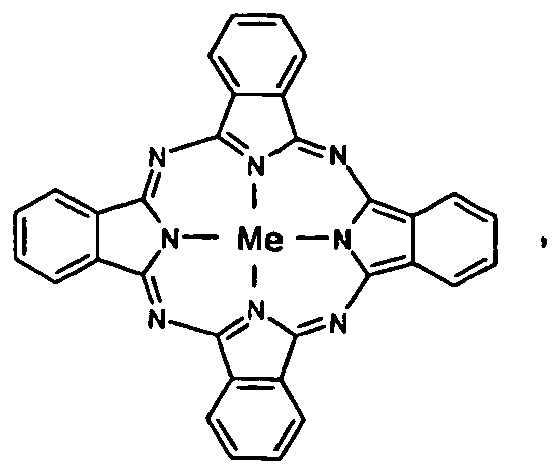
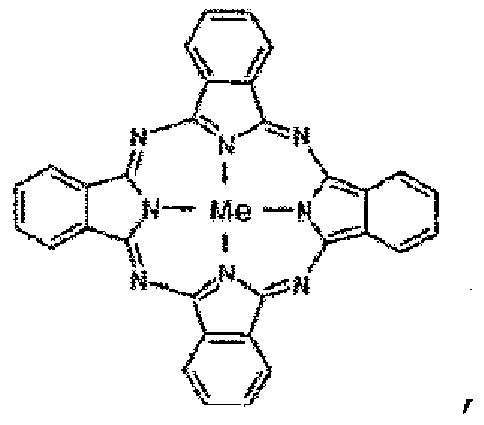
[0034] The dyes of formula (1) may be obtained in analogy to known methods, for example by sulfonating a compound of formula
wherein Me is a metal, using a strong sulfonating agent, for example chlorosulfonic acid or oleum/sulfuric acid monohydrate, and then optionally neutralising the resulting sulfonic acid using a compound containing the inorganic or organic cation M+. The sulfonic acid, or its salt, optionally is then converted, using suitable reagents, for example thionyl chloride or phosphorus oxychloride, into the corresponding sulfochloride, which is then reacted with ammonia or the amines mentioned hereinbefore.
[0035] Dyes of formula (1) wherein m=0 and n=7, m=1 and n=6, m=2 and n=5, m=3 and n=4, m=4 and n=3, m=5 and n=2, m=6 and n=1, and m=7 and n=0, and mixtures thereof, are important.
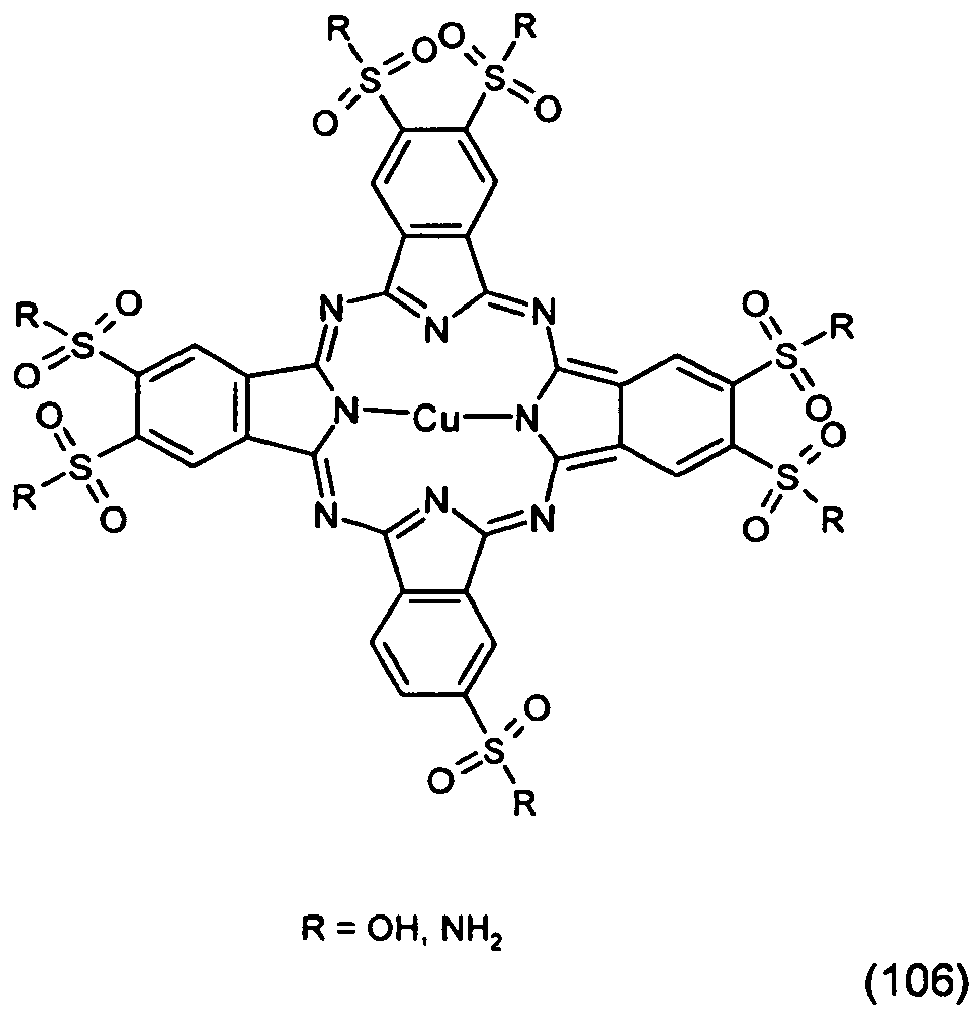
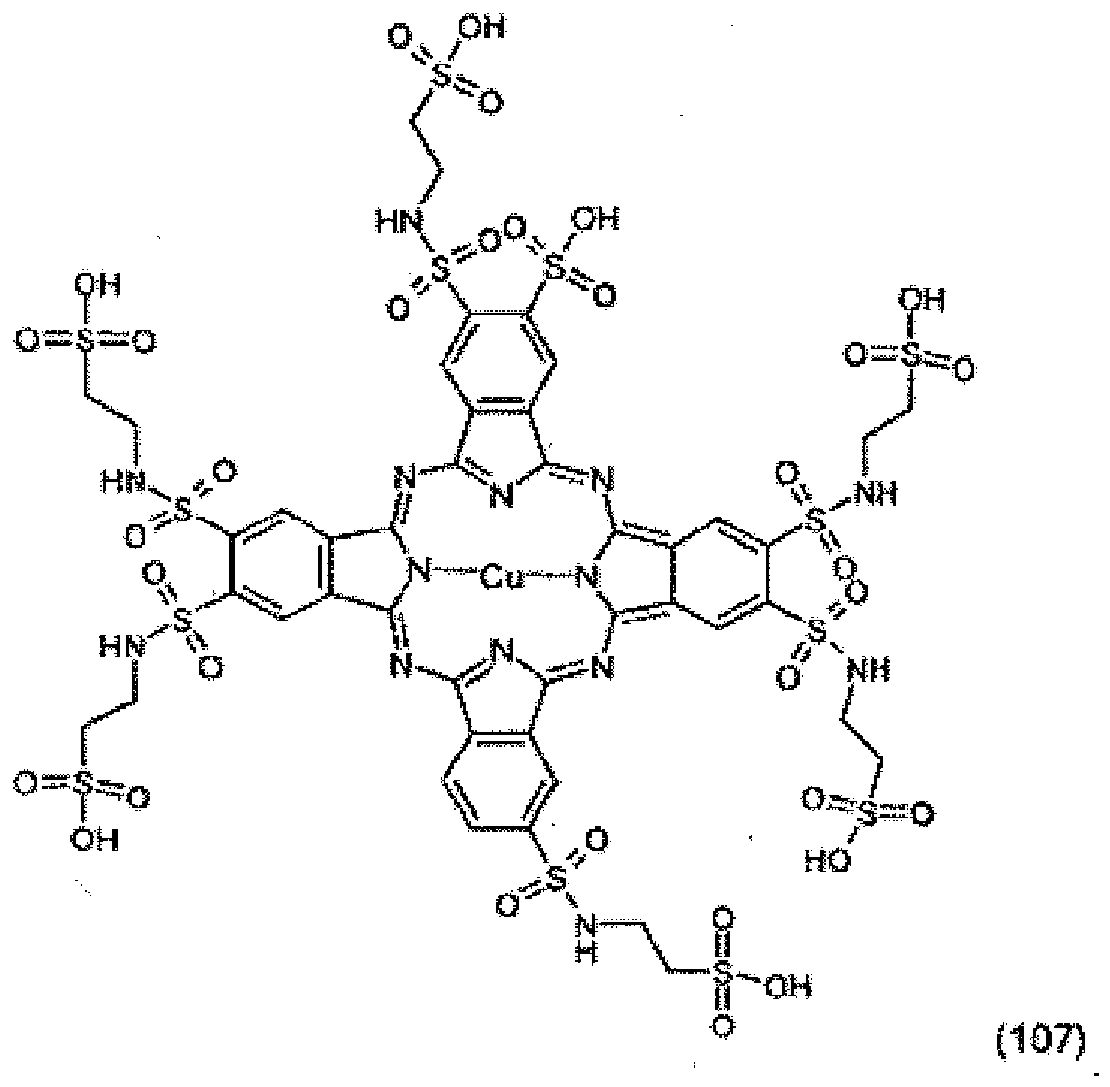
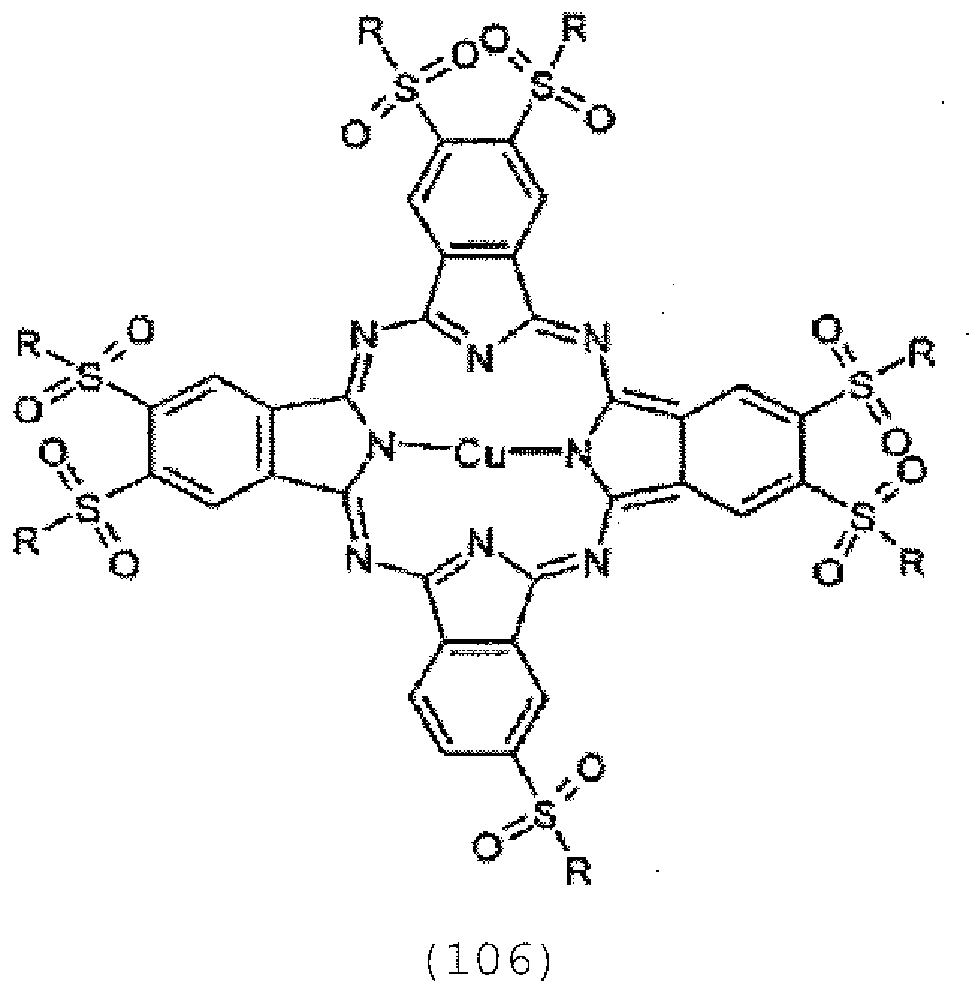
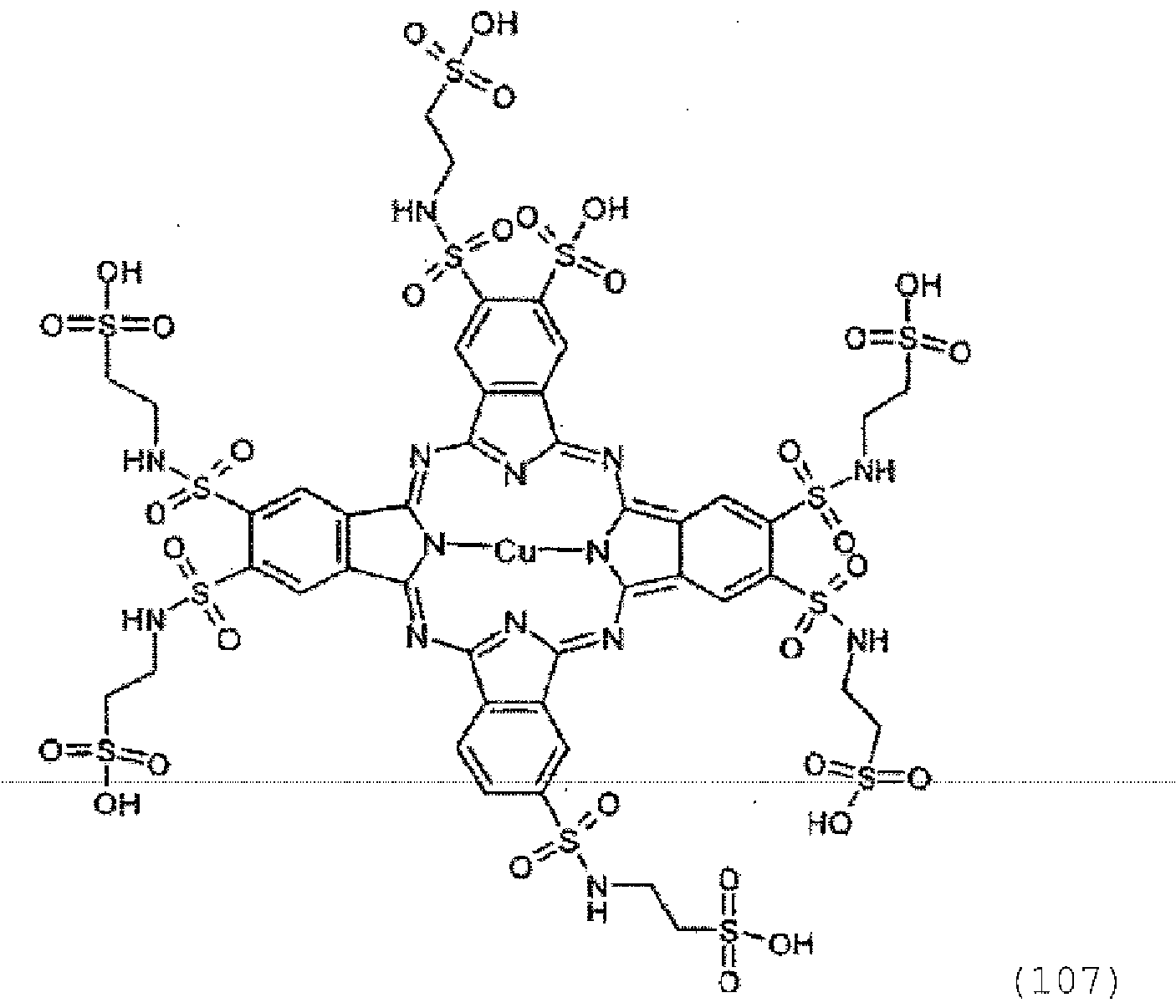
[0036] Examples of dyes of formula (1) are phthalocyanine-metal complex dyes of formulae
R = OH, NH2
[0037] [In formulae (100) to (115) above, the lines denote alkyl chains. Accordingly, for example, the representation
corresponds to the radical NHCH2CH2CH2N(CH2CH3)2].
[0038] The dyes of formula (1) may be used for dyeing or printing paper, wood or semi-synthetic or, especially, synthetic hydrophobic fibre materials such as, for example, textile materials. Textile materials composed of blend fabrics that comprise such semi-synthetic or synthetic hydrophobic textile materials may also be dyed or printed using the dyes according to the invention.
[0039] For printing, the customary thickeners will be used, for example modified or unmodified natural products, for example alginates, British gum, gum arabic, crystal gum, locust bean flour, tragacanth, carboxymethyl cellulose, hydroxyethyl cellulose, starch or synthetic products, for example polyacrylamides, polyacrylic acid or copolymers thereof, or polyvinyl alcohols.
[0040] The dyes according to the invention impart to the said materials level colour shades having very good in-use fastness properties, especially excellent resistance to ozone and to nitrogen oxides and also good fastness to light. In addition, the higher-sulfonamidated, especially heptasulfonamidated, phthalocyanine-metal complex dyes have an interesting and sought-after green-tinged cyan shade.
[0041] The dyes of formula (1) may also be used in admixture with other dyes, especially with one or more dyes of formula (1) wherein n and m are each independently of the other a number from 0 to 4 and the sum of (m+n) is from 1 to 4.
[0042] Such mixtures contain preferably from 5 to 99 % by weight, especially from 10 to 99 % by weight and more especially from 20 to 99 % by weight, of the dyes of formula (1) according to the invention.
[0043] In an especially preferred embodiment, the present invention relates to inks which comprise at least one dye of formula (1).
[0044] The inks according to the invention may comprise further dyes, in addition to the above-mentioned dyes, for the purpose of shade modification.
[0045] The inks contain from 1 to 35 % by weight, especially from 1 to 30 % by weight and more especially from 1 to 20 % by weight, of at least one dye of formula (1), based on the total weight of the ink.
[0046] Preference is given to such inks that have a viscosity of from 1 to 40 mPa·s (millipascal seconds).
[0047] The inks usually comprise water-miscible organic solvents in an amount of from 1 to 40 % by weight, for example C1-C4alcohols, for example methanol, ethanol, n-propanol, isopropanol, n-butanol, sec-butanol, tert-butanol and isobutanol; amides, for example dimethylformamide and dimethylacetamide; ketones or ketone alcohols, for example acetone and diacetone alcohol; ethers, for example tetrahydrofuran and dioxane; nitrogen-containing heterocyclic compounds, for example N-methyl-2-pyrrolidone and 1,3-dimethyl-2-imidazolidone; polyalkylene glycols, for example polyethylene glycol and polypropylene glycol; C2-C6-alkylene glycols and thioglycols, for example ethylene glycol, propylene glycol, butylene glycol, triethylene glycol, thiodiglycol, hexylene glycol and diethylene glycol; further polyols, for example glycerol and 1,2,6-hexanetriol; and C1-C4alkyl ethers of polyhydric alcohols, for example 2-methoxyethanol, 2-(2-methoxyethoxy)ethanol, 2-(2-ethoxyethoxy)ethanol, 2-[2-(2-methoxyethoxy)ethoxy]ethanol and 2-[2-(2-ethoxyethoxy)ethoxy]ethanol; preferably N-methyl-2-pyrrolidone, diethylene glycol, glycerol or especially 1,2-propylene glycol, preferably in an amount of from 2 to 30 % by weight, especially from 5 to 30% by weight and more especially from 10 to 25 % by weight, based on the total weight of the ink.
[0049] The inks may comprise thickeners of natural or synthetic origin inter alia for the purpose of adjusting the viscosity.
[0050] Examples of thickeners that may be mentioned include commercially available alginate thickeners, starch ethers or locust bean flour ethers, especially sodium alginate on its own or in admixture with modified cellulose, for example methylcellulose, ethylcellulose, carboxymethyl cellulose, hydroxyethyl cellulose, methyl hydroxyethyl cellulose, hydroxypropyl cellulose or hydroxypropyl methylcellulose, especially with preferably from 20 to 25 % by weight carboxymethyl cellulose. Synthetic thickeners that may be mentioned are, for example, those based on poly(meth)acrylic acids or poly(meth)acrylamides.
[0051] The inks comprise such thickeners, for example, in an amount of from 0.01 to 2 % by weight, especially from 0.01 to 1 % by weight and preferably from 0.01 to 0.5 % by weight, based on the total weight of the ink.
[0052] The inks may also comprise buffer substances, for example borax, borates, phosphates, polyphosphates or citrates. Examples that may be mentioned include borax, sodium borate, sodium tetraborate, sodium dihydrogen phosphate, disodium hydrogen phosphate, sodium tripolyphosphate, sodium pentapolyphosphate and sodium citrate. They are used especially in amounts of from 0.1 to 3 % by weight, preferably from 0.1 to 1 % by weight, based on the total weight of the ink, in order to establish a pH value of, for example, from 4 to 10, especially from 5 to 8.
[0054] Suitable surfactants include commercially available anionic or non-ionic surfactants. As humectants in the inks according to the invention there come into consideration, for example, urea, glycerol, propylene glycol, or a mixture of sodium lactate (advantageously in the form of a 50 % to 60 % aqueous solution) and glycerol and/or propylene glycol in amounts of preferably from 0.1 to 30 % by weight, especially from 2 to 30 % by weight.
[0055] If desired, the inks may additionally comprise acid donors such as butyrolactone or sodium hydrogen phosphate, preservatives, fungal- and/or bacterial-growth-inhibiting substances, antifoam agents, sequestering agents, emulsifiers, water-insoluble solvents, oxidising agents or deaerating agents.
[0056] Suitable preservatives are especially formaldehyde-yielding agents, for example paraformaldehyde and trioxane, specially aqueous, approximately from 30 to 40 % by weight formaldehyde solutions; suitable sequestering agents are, for example, sodium nitrilotriacetate, sodium ethylenediaminetraacetate, especially sodium polymetaphosphate, more especially sodium hexametaphosphate; suitable emulsifiers are especially adducts of an alkylene oxide and a fatty alcohol, especially an adduct of oleyl alcohol and ethylene oxide; suitable water-insoluble solvents are high boiling, saturated hydrocarbons, especially paraffins having a boiling range of approximately from 160 to 210°C (so-called white spirit); a suitable oxidising agent is, for example, an aromatic nitro compound, especially an aromatic mono- or di-nitro-carboxylic or -sulfonic acid which may be in the form of an alkylene oxide adduct, especially a nitrobenzenesulfonic acid; and suitable deaerating agents are, for example, high boiling solvents, especially turpentine oils, higher alcohols, preferably C8-C10alcohols, terpene alcohols or deaerating agents based on mineral oils and/or silicone oils, especially commercial formulations composed of approximately from 15 to 25 % by weight of a mineral oil and silicone oil mixture and approximately from 75 to 85 % by weight of a C8 alcohol, such as, for example, 2-ethyl-n-hexanol. These are usually used in amounts of from 0.01 to 5 % by weight, based on the total weight of the ink.
[0057] The inks can be prepared in customary manner by mixing together the individual constituents in the desired amount of water. Where necessary, the inks are clarified by filtration through a very fine filter.
[0058] The inks according to the invention are, for example, suitable for printing. Examples of appropriate printing methods that may be mentioned are conventional printing, stencil printing and inkjet printing methods.
[0059] The inks according to the invention are especially suitable for use in recording systems of a kind wherein an ink is expressed from a small opening in the form of droplets that are directed towards a substrate on which an image is produced. Suitable substrates are, for example, textile fibre materials, paper, or plastics films. Suitable recording systems are, for example, commercially available inkjet printers for use in paper printing or textile printing, or writing instruments, such as fountain pens or ballpoint pens and especially inkjet printers.
[0060] In inkjet printing, individual droplets of the ink are sprayed onto a substrate in a controlled manner from a nozzle. For that purpose, predominantly the continuous inkjet method and the drop-on-demand method are used. In the continuous inkjet method, the droplets are produced continuously and any droplets not required for the printing are conveyed to a collecting vessel and recycled, whereas in the drop-on-demand method droplets are produced and printed as required, that is to say droplets are produced only when required for the printing. The production of the droplets can be effected, for example, by means of a piezo-inkjet head or by means of thermal energy (bubble jet). Printing by means of a piezo-inkjet head is preferred for the method according to the invention. Printing by the continuous inkjet method is furthermore preferred for the method according to the invention.
[0061] Depending on the nature of its use, it may be necessary for e.g. the viscosity or other physical properties of the ink, especially those properties affecting the affinity for the substrate in question, to be modified as appropriate.
[0062] As textile fibre materials there come into consideration, especially, nitrogen-containing or hydroxy-group-containing fibre materials, for example textile fibre materials of cellulose, silk, wool or synthetic polyamides.
[0063] The inks according to the invention, which comprise the dyes of formula (1), are especially suitable for recording on paper and very especially suitable for use in paper printing.
[0064] As examples of paper that can be printed with the inks according to the invention there may be mentioned commercially available inkjet paper, photo paper, glossy paper, plastics-coated paper, for example Canon Photo Paper, Epson Inkjet Paper, Epson Photo Paper, Epson Glossy Film, HP Special Inkjet Paper, Encad Photo Gloss Paper, Ilford Photo Paper and, especially, microporous photo paper, for example Ilford Printasia Photo Glossy Paper, Canon Photo Paper Pro PR-101 and Epsom Premium Glossy Photo Paper.
[0065] Plastics films that can be printed with the inks according to the invention are, for example, transparent or cloudy/opaque. Suitable plastics films are, for example, 3M transparency film.
[0066] The present invention accordingly relates also to a method of printing paper, plastics films or textile fibre materials, especially by the inkjet printing method, wherein an aqueous ink is used which comprises
from 1 to 35 % by weight of at least one dye of formula (1) and
from 1 to 40 % by weight of a water-miscible organic solvent,
based on the total weight of the ink.
[0067] The inks according to the invention are storage-stable and exhibit no precipitation on storage for relatively long periods.
[0068] The prints produced in accordance with the invention are distinguished by good fastness to light and by excellent resistance to gases, especially ozone.
[0069] The following Examples serve to illustrate the invention. Unless otherwise indicated, the temperatures are given in degrees Celsius, parts (where given) are parts by weight and percentages relate to % by weight. Parts by weight relate to parts by volume in a ratio of kilograms to litres.
Example 1a: Cu-phthalocyanine heptasulfonic acid
[0070] 57.6 g of copper phthalocyanine are introduced into 200 ml of sulfuric acid monohydrate. After addition of 90 ml of oleum (66 %) over 30 minutes, the reaction mixture is maintained at 150°C for 160 hours.
After cooling to 60°C, the reaction solution is further processed in accordance with Example 1b.
Example 1b: Cu-phthalocyanine heptasulfochloride
[0071] To the reaction solution of Example 1a, cooled to 60°C, there are added, dropwise, 425 ml of thionyl chloride. After 16 hours at 75°C, the reaction mixture is cooled to room temperature and poured into ice-water. The product precipitates out completely, is filtered off and is washed with ice-water. After gentle drying in vacuo, 30 g of product comprising Cu-phthalocyanine heptasulfochloride are obtained.
Example 1c: Cu-Pc heptasulfonamide/sulfonic acid
[0072] 26.5 g of Cu-Pc heptasulfochloride according to Example 1 b are introduced into dilute aqueous ammonia solution (pH = 8), the pH being held constant at 8 by adding appropriate amounts of ammonia (12.5 %). After stirring for 20 hours at room temperature, heating at 40°C is carried out for a further 5 hours, whilst continuing to maintain the pH at 8. The reaction solution is then concentrated to 400 ml using a rotary evaporator, dialysed and then evaporated to dryness. 12.3 g of a green-tinged cyan dye comprising Cu-Pc heptasulfonamide/sulfonic acid are obtained.
Example 1d: Cu-phthalocyanine heptasulfonic acid
[0073] 57.6 g of copper phthalocyanine are introduced into 200 ml of sulfuric acid monohydrate. After addition of 90 ml of oleum (66 %) over 30 minutes, the reaction mixture is maintained at 160°C for 24 hours.
After cooling to 60°C, the reaction solution is further processed in accordance with Example 1b.
Example 2: Cu-Pc heptasulfotauride/sulfonic acid
[0074] 172.5 g of taurine are dissolved in water at pH 10. To the resulting solution there are added, at 0°C, with stirring, 28.75 g of product according to Example 1 b. After stirring for one hour whilst the pH is held constant at 10 using 4N sodium hydroxide solution, the temperature is increased to 40°C. After stirring for one hour at that temperature and at a constant pH of 10, the pH is lowered to 8 and the reaction solution is concentrated to 500 ml. After filtration, the solution is dialysed and then evaporated to dryness. 14.7 g of a green-tinged cyan dye are obtained.
[0075] By using the equivalent amount of the amines given in Table 1 instead of taurine in Example 2, corresponding dyes of formula (1) are likewise obtained:
Table 1
| Amine | Amine |
| NH(CH3)(CH2)2SO3H | NH2(CH2)2OH |
| NH2(CH2)3OH | NH2(CH2)2OSO3H |
| NH(CH2CH2OH)2 | NH(CH2CH2OSO3H)2 |
| NH2(CH2)2O(CH2)2OH | NH2(CH2)5OH |
| NH2CH2CH(CH3)OH | NH2(CH2)2NH(CH2)2OH |
| NH2(CH2)2N(CH2CH3)2 | NH2(CH2)3N(CH2CH3)2 |
| NH2(CH2)2NH(CH2)3NH2 | NH2(CH2)2NH(CH2)2NH2 |
| NH2(CH2)3NH(CH2)3NH2 | NH2CH2C(CH3)2CH2NH2 |
| NH2(CH2)3NHCH2CH3 | NH2(CH2)3N(CH3)2 |
| NH2(CH2)3N(CH2CH3)2 | NH2(CH2)3NH(CH2)N(CH3)2 |
| NH2(CH2)3NH(CH2)3OH | NH2CH2CH(OH)CH2NH2 |
|
|
|
|
|
|
|
|
|
|
|
|
| NH2OH | NH2(CH2)2COOH |
| NH2CH2COOH | morpholine |
| aniline-4-sulfonic acid | aniline-3-sulfonic acid |
| aniline-2-sulfonic acid | NH2(CH2)2S(CH2)2OH |
| NH2(C6H4)SO2CH2CH2OSO3H | piperazine |
|
|
|
| NH(CH3)CH2COOH | NH2(CH2)5COOH |
| NH2CH2SO3H |
|
|
|
|
Example 3: Preparation of printing inks and inkjet printing
[0076] 6.6 g of dye according to Example 1c are dissolved in 85 g of water. After adding 5 g of diethylene glycol, the resulting ink is introduced into an inkjet printing cartridge. Prints made using that cyan ink on photo paper (for example, Canon Photo Paper Pro PR-101, Epson Premium Glossy Photo Paper, Ilford Photo Paper or Ilford Printasia Photo Glossy Paper) have excellent resistance to ozone and to light.
Example 4: Preparation of printing inks and inkjet printing
1. A dye mixture comprising at least one dye of formula

wherein
Pc is a phthalocyanine of formula
Me is a metal,
[MePc] is a phthalocyanine-metal complex of formula
M+ is an inorganic or organic cation,
R1 is hydrogen, unsubstituted or substituted alkyl, unsubstituted or substituted aralkyl or unsubstituted or substituted aryl, and
R2 is hydrogen, unsubstituted or substituted alkyl, unsubstituted or substituted aralkyl or unsubstituted or substituted aryl, and
n and m are each independently of the other 0, 1, 2, 3, 4, 5, 6 or 7,
the sum of (n + m) being a number 6 or 7.
wherein
Pc is a phthalocyanine of formula
Me is a metal,
[MePc] is a phthalocyanine-metal complex of formula
M+ is an inorganic or organic cation,
R1 is hydrogen, unsubstituted or substituted alkyl, unsubstituted or substituted aralkyl or unsubstituted or substituted aryl, and
R2 is hydrogen, unsubstituted or substituted alkyl, unsubstituted or substituted aralkyl or unsubstituted or substituted aryl, and
n and m are each independently of the other 0, 1, 2, 3, 4, 5, 6 or 7,
the sum of (n + m) being a number 6 or 7.
2. A process for the preparation of a dye mixture comprising a dye of formula (1) according
to claim 1, which process comprises sulfonating a compound of formula
wherein Me is a
metal, using a strong sulfonating agent, for example chlorosulfonic acid or oleum/sulfuric acid monohydrate, then optionally neutralising the resulting sulfonic acid using a compound containing the inorganic or organic cation M+, and then optionally converting the sulfonic acid, or its salt, using suitable reagents, for example thionyl chloride or phosphorus oxychloride, into the corresponding sulfochloride, which is then reacted with, ammonia or an amine.
wherein Me is a
metal, using a strong sulfonating agent, for example chlorosulfonic acid or oleum/sulfuric acid monohydrate, then optionally neutralising the resulting sulfonic acid using a compound containing the inorganic or organic cation M+, and then optionally converting the sulfonic acid, or its salt, using suitable reagents, for example thionyl chloride or phosphorus oxychloride, into the corresponding sulfochloride, which is then reacted with, ammonia or an amine.
3. A dye mixture comprising at least one dye of formula (1) according to claim 1 and
at least one dye of formula (1) wherein n and m are each independently of the other
a number from 0 to 4 and the sum of (m+n) is from 1 to 4.
4. A dye mixture according to either claim 1 or claim 3 ., which contains from 5 to 99
% by weight, preferably from 10 to 99 % by weight, of at least one dye of formula
(1) according to claim 1.
5. A method of dyeing or printing natural, semi-synthetic or synthetic material, especially
textile material, in which method a dye mixture according to claim 1 is applied to
said material.
6. An ink containing from 1 to 35 % by weight of a dye mixture according to claim 1.
7. A method of printing natural, semi-synthetic or synthetic material by the inkjet printing
method, in which method an ink according to claim 6 is used.
8. A method according to claim 7 in which the natural, semi-synthetic or synthetic material
is paper, especially photo paper, a plastics film or textile fibre material.
9. A method according to claim 8 in which the paper is a microporous photo paper.
10. Natural, semi-synthetic or synthetic material dyed or printed using a dye mixture
according to claim 1.
11. A dye mixture according to claim 1 comprising a dye of formula
12. A dye mixture according to claim 1 comprising a dye of formula
1. Farbstoffmischung umfassend mindestens einen Farbstoff der Formel

bei der bedeuten:
Pc ist ein Phthalocyanin der Formel
Me ist ein Metall,
[MePc] ist ein Phthalocyaninmetallkomplex der Formel
M+ ist ein anorganisches oder organisches Kation,
R1 ist Wasserstoff, gegebenenfalls substituiertes Alkyl, gegebenenfalls substituiertes Aralkyl oder gegebenenfalls substituiertes Aryl,
R2 ist Wasserstoff, gegebenenfalls substituiertes Alkyl, gegebenenfalls substituiertes Aralkyl oder gegebenenfalls substituiertes Aryl,
n und m sind jeweils unabhängig voneinander 0, 1, 2, 3, 4, 5, 6 oder 7,
wobei die Summe (n + m) gleich einer Zahl 6 oder 7 ist.
bei der bedeuten:
Pc ist ein Phthalocyanin der Formel
Me ist ein Metall,
[MePc] ist ein Phthalocyaninmetallkomplex der Formel
M+ ist ein anorganisches oder organisches Kation,
R1 ist Wasserstoff, gegebenenfalls substituiertes Alkyl, gegebenenfalls substituiertes Aralkyl oder gegebenenfalls substituiertes Aryl,
R2 ist Wasserstoff, gegebenenfalls substituiertes Alkyl, gegebenenfalls substituiertes Aralkyl oder gegebenenfalls substituiertes Aryl,
n und m sind jeweils unabhängig voneinander 0, 1, 2, 3, 4, 5, 6 oder 7,
wobei die Summe (n + m) gleich einer Zahl 6 oder 7 ist.
2. Verfahren zur Herstellung einer Farbstoffmischung umfassend einen Farbstoff der Formel
(1) gemäß Anspruch 1, bei dem man eine Verbindung der Formel
in der Me ein Metall ist, mit einem starken Sulfonierungsmittel, wie zum Beispiel Chlorsulfonsäure oder Oleum/Schwefelsäuremonohydrat, sulfoniert, dann gegebenenfalls die entstandene Sulfonsäure mit einer das anorganische oder organische Kation M+ enthaltenden Verbindung neutralisiert und dann gegebenenfalls die Sulfonsäure oder deren Salz mit geeigneten Reagentien, wie zum Beispiel Thionylchlorid oder Phosphoroxychlorid, in das entsprechende Sulfochlorid überführt und dieses dann mit Ammoniak oder einem Amin umsetzt.
in der Me ein Metall ist, mit einem starken Sulfonierungsmittel, wie zum Beispiel Chlorsulfonsäure oder Oleum/Schwefelsäuremonohydrat, sulfoniert, dann gegebenenfalls die entstandene Sulfonsäure mit einer das anorganische oder organische Kation M+ enthaltenden Verbindung neutralisiert und dann gegebenenfalls die Sulfonsäure oder deren Salz mit geeigneten Reagentien, wie zum Beispiel Thionylchlorid oder Phosphoroxychlorid, in das entsprechende Sulfochlorid überführt und dieses dann mit Ammoniak oder einem Amin umsetzt.
3. Farbstoffmischung umfassend mindestens einen Farbstoff der Formel (1) gemäß Anspruch
1 und mindestens einen Farbstoff der Formel (1), bei der n und m jeweils unabhängig
voneinander eine Zahl von 0 bis 4 sind und die Summe (m+n) gleich 1 bis 4 ist.
4. Farbstoffmischung nach einem der Ansprüche 1 oder 3, bei der mindestens ein Farbstoff
der Formel (1) gemäß Anspruch 1 zu 5 bis 99 Gew.-% und bevorzugt zu 10 bis 99 Gew.-%
enthalten ist.
5. Verfahren zum Färben oder Bedrucken von natürlichem, halbsynthetischem oder synthetischem
Material, insbesondere Textilmaterial, bei dem man eine Farbstoffmischung gemäß Anspruch
1 auf das Material aufbringt.
6. Tinte enthaltend 1 bis 35 Gew.-% einer Farbstoffmischung gemäß Anspruch 1.
7. Verfahren zum Bedrucken von natürlichem, halbsynthetischem oder synthetischem Material
im Farbstrahldruck, bei dem man eine Tinte gemäß Anspruch 6 einsetzt.
8. Verfahren nach Anspruch 7, bei dem man als natürliches, halbsynthetisches oder synthetisches
Material Papier, insbesondere Fotopapier, eine Kunststofffolie oder Textilfasermaterial
einsetzt.
9. Verfahren nach Anspruch 8, bei dem man als Papier ein mikroporöses Fotopapier einsetzt.
10. Natürliches, halbsynthetisches oder synthetisches Material, gefärbt oder bedruckt
mit einer Farbstoffmischung gemäß Anspruch 1.
11. Farbstoffmischung nach Anspruch 1, umfassend einen Farbstoff der Formel
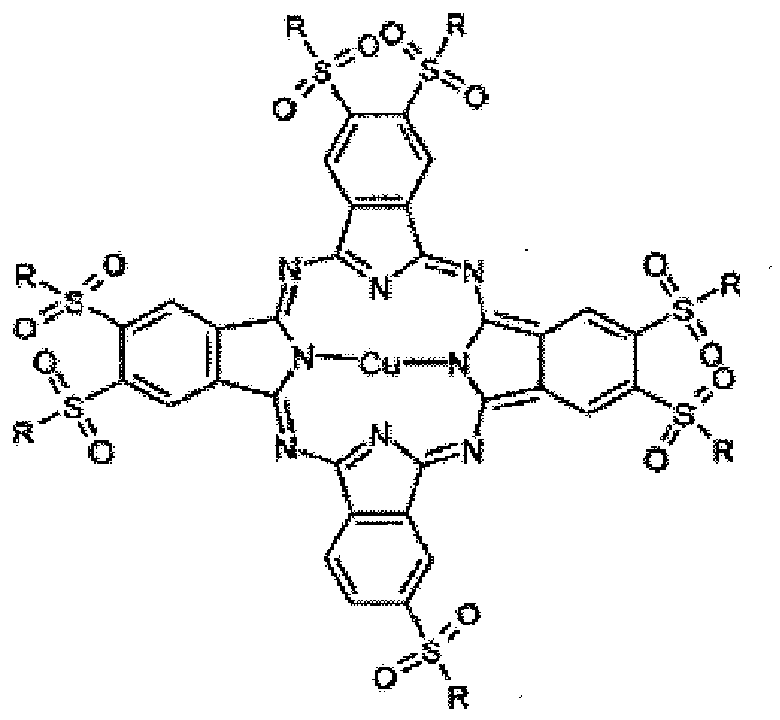
R = OH, NH2 (106) .
R = OH, NH2 (106) .
12. Farbstoffmischung nach Anspruch 1, umfassend einen Farbstoff der Formel
1. Mélange de colorants comprenant au moins un colorant de formule
dans laquelle
Pc est une phtalocyanine de formule
Me est un métal,
[MePc] est un complexe phtalocyanine-métal de formule
M+ est un cation inorganique ou organique,
R1 est hydrogène, alkyle non substitué ou substitué, aralkyle non substitué ou substitué ou aryle non substitué ou substitué, et
R2 est hydrogène, alkyle non substitué ou substitué, aralkyle non substitué ou substitué ou aryle non substitué ou substitué, et
n et m sont chacun indépendamment l'un de l'autre 0, 1, 2, 3, 4, 5, 6 ou 7,
la somme de (n + m) étant un nombre de 6 ou 7.
dans laquelle
Pc est une phtalocyanine de formule
Me est un métal,
[MePc] est un complexe phtalocyanine-métal de formule
M+ est un cation inorganique ou organique,
R1 est hydrogène, alkyle non substitué ou substitué, aralkyle non substitué ou substitué ou aryle non substitué ou substitué, et
R2 est hydrogène, alkyle non substitué ou substitué, aralkyle non substitué ou substitué ou aryle non substitué ou substitué, et
n et m sont chacun indépendamment l'un de l'autre 0, 1, 2, 3, 4, 5, 6 ou 7,
la somme de (n + m) étant un nombre de 6 ou 7.
2. Procédé pour la préparation d'un mélange de colorants comprenant un colorant de formule
(1) selon la revendication 1, ledit procédé comprenant la sulfonation d'un composé
de formule
dans laquelle Me est un métal, en utilisant un agent de sulfonation fort, par exemple l'acide chlorosulfonique ou l'oléum/acide sulfurique monohydraté, puis facultativement la neutralisation de l'acide sulfonique résultant en utilisant un composé contenant le cation inorganique ou organique M+, et ensuite facultativement la conversion de l'acide sulfonique, ou ses sels, en utilisant des réactifs adaptés, par exemple le chlorure de thionyle ou l'oxychlorure de phosphore, en sulfochlorure correspondant, qui réagit ensuite avec l'ammoniac ou une amine.
dans laquelle Me est un métal, en utilisant un agent de sulfonation fort, par exemple l'acide chlorosulfonique ou l'oléum/acide sulfurique monohydraté, puis facultativement la neutralisation de l'acide sulfonique résultant en utilisant un composé contenant le cation inorganique ou organique M+, et ensuite facultativement la conversion de l'acide sulfonique, ou ses sels, en utilisant des réactifs adaptés, par exemple le chlorure de thionyle ou l'oxychlorure de phosphore, en sulfochlorure correspondant, qui réagit ensuite avec l'ammoniac ou une amine.
3. Mélange de colorants comprenant au moins un colorant de formule (1) selon la revendication
1 et au moins un colorant de formule (1) dans laquelle n et m sont chacun indépendamment
l'un de l'autre un nombre de 0 à 4 et la somme de (m+n) est de 1 à 4.
4. Mélange de colorants selon la revendication 1 ou la revendication 3, qui contient
de 5 à 99 % en poids, de préférence de 10 à 99 % en poids, d'au moins un colorant
de formule (1) selon la revendication 1.
5. Procédé de coloration ou d'impression de matériau naturel, semi-synthétique ou synthétique,
en particulier un matériau textile, procédé dans lequel un mélange de colorants selon
la revendication 1 est appliqué sur ledit matériau.
6. Encre contenant de 1 à 35 % en poids d'un mélange de colorants selon la revendication
1.
7. Procédé d'impression de matériau naturel, semi-synthétique ou synthétique par le procédé
d'impression à jet d'encre, procédé dans lequel une encre selon la revendication 6
est utilisée.
8. Procédé selon la revendication 7 dans lequel le matériau naturel, semi-synthétique
ou synthétique est du papier, en particulier du papier photo, un film plastique ou
un matériau de fibre textile.
9. Procédé selon la revendication 8 dans lequel le papier est un papier photo microporeux.
10. Matériau naturel, semi-synthétique ou synthétique coloré ou imprimé en utilisant un
mélange de colorants selon la revendication 1.
11. Mélange de colorants selon la revendication 1 comprenant un colorant de formule
12. Mélange de colorants selon la revendication 1 comprenant un colorant de formule
REFERENCES CITED IN THE DESCRIPTION
This list of references cited by the applicant is for the reader's convenience only. It does not form part of the European patent document. Even though great care has been taken in compiling the references, errors or omissions cannot be excluded and the EPO disclaims all liability in this regard.
Patent documents cited in the description