|
(11) | EP 2 026 597 A1 |

| (12) | EUROPEAN PATENT APPLICATION |
|
|
|
|
||||||||||||||||||||
| (54) | Noise reduction by combined beamforming and post-filtering |
| (57) The present invention relates to a method for audio signal processing, comprising
detecting an audio signal by a microphone array to obtain microphone signals (ym); processing the microphone signals (ym) by a beamforming means (11) to obtain a beamformed signal (A); processing the microphone
signals (ym) by a blocking matrix means (12) to obtain the power densities (Um) of noise contributions of each of the microphone signals (ym); processing the power densities (Um) of noise contributions of each of the microphone signals (ym) to obtain an average short-time power density (V) from the noise contributions (Um) of each of the microphone signals (ym); estimating the power density of a noise contribution (An) of the beamformed signal
(A) on the basis of the average short-time power density (V) obtained from the power
densities (Um) of noise contributions of each of the microphone signals (ym) and post-filtering the beamformed signal (A) on the basis of the estimated power
density (Ãn) of the noise contribution (An) of the beamformed signal (A) to obtain an enhanced beamformed signal (P).
|
Field of Invention
[0001] The present invention relates to the art of noise reduction of audio signals in the context of electronically aided communication. In particular, the present invention relates to the beamforming of microphone signals and post-filtering of beamformed signals in order to obtain enhanced acoustic signals, in particular, speech signals.
Background of the invention
[0002] Two-way speech communication of two parties mutually transmitting and receiving audio signals, in particular, speech signals, often suffers from deterioration of the quality of the audio signals by background noise. Background noise in noisy environments can severely affect the quality and intelligibility of voice conversation and can, in the worst case, lead to a complete breakdown of the communication.
[0003] A prominent example is hands-free voice communication in vehicles. Hands-free telephones provide a comfortable and safe communication systems of particular use in motor vehicles. In the case of hands-free telephones, it is mandatory to suppress noise in order to guarantee the communication. The amplitudes and frequencies of the noise signals are temporally variable due to, for example, the speed of the vehicle and road noises.
[0004] In the art, single channel noise reduction methods employing spectral subtraction are well known. For instance, speech signals are divided into sub-bands by some sub-band filtering means and a noise reduction algorithm is applied to each of the sub-bands. These methods, however, are limited to (almost) stationary noise perturbations and positive signal-to-noise distances. The processed speech signals are distorted, since according to these methods perturbations are not eliminated but rather spectral components that are affected by noise are damped. The intelligibility of speech signals is, thus, normally not improved sufficiently.
[0005] Another method to improve the signal quality in distant talking speech acquisition is the utilization of multi-channel systems, i.e. microphone arrays, as described, e.g., in "Microphone Arrays: Signal Processing Techniques and Applications", eds. Brand-stein, M. and Ward, D., Springer, Berlin 2001. Beamforming of multiple microphone signals is performed in order to obtain an enhanced acoustic signal.
[0006] Current multi-channel systems primarily make use of the so-called "General Sidelobe Canceller" (GSC), see, e.g., "An alternative approach to linearly constrained adaptive beamforming", by Griffiths, L.J. and Jim, C.W., IEEE Transactions on Antennas and Propagation, vol. 30., p.27, 1982. The GSC consists of two signal processing paths: a first (or lower) adaptive path with a blocking matrix and an adaptive noise canceling means and a second (or upper) non-adaptive path with a fixed beamformer.
[0007] The fixed beamformer improves the signals pre-processed, e.g., by a means for time delay compensation, using a fixed beam pattern. Adaptive processing methods are characterized by a permanent adaptation of processing parameters such as filter coefficients during operation of the system. The lower signal processing path of the GSC is optimized to generate noise reference signals used to subtract the residual noise of the output signal of the fixed beamformer. The noise reduction signal processing path usually comprises a blocking matrix receiving the speech signals and employed to generate noise reference signals. In the simplest realization, the blocking matrix performs a subtraction of adjacent channels of the received signals.
[0008] Due to the finite time of convergence needed for adaptation the adaptive beamformers, however, are not very successful in the case of highly time-variant perturbations.
[0010] Thus, there is a need for an improved method and system for noise reduction in the context of beamforming of microphone signals.
Description of the Invention
[0011] In view of the above, in the present invention it is provided a method for audio signal processing, comprising
detecting an audio signal, in particular, a speech signal, by a microphone array to obtain microphone signals (ym);
processing the microphone signals (ym) by a beamforming means (11) to obtain a beamformed signal (A) ;
processing the microphone signals (ym) by a blocking matrix means (12) to obtain the (spectral) power densities (Um) of noise contributions of each of the microphone signals (ym);
processing the power densities (Um) of noise contributions of each of the microphone signals (ym) to obtain an average short-time power density (V) from the power densities (Um) of noise contributions of each of the microphone signals (ym);
estimating the (spectral) power density of a noise contribution (An) of the beamformed signal (A) on the basis of the average short-time power density (V) obtained from the power densities (Um) of noise contributions of each of the microphone signals (ym); and
post-filtering the beamformed signal (A) on the basis of the estimated (spectral) power density (Ãn) of the noise contribution (An) of the beamformed signal (A) to obtain an enhanced beamformed signal (P).
[0012] The microphone array comprises a number (M) of microphones, in particular, directional microphones. Each of the microphones detects sound, e.g., a verbal utterance, and generates a microphone signal ym (m= 1, .., M). It is an object of the present invention to enhance such microphone signals by noise reduction. In order to achieve this object, the microphone signals are beamformed by a beamforming means, e.g., a fixed (non-adaptive) beamformer as known in the art, and processed by a blocking matrix means that is designed to obtain noise signals representing noise that is present in the microphone signals.
[0013] In the following description, it is assumed that the signal processing is performed in the sub-band domain rather than a discrete time domain. However, in principle, the present invention can be realized for both the time and spectral signal representation. For processing in the sub-band regime the microphone signals (ym) can be divided into sub-bands by an analysis filter bank to obtain sub-band signals Ym(ejΩµ,k) at time k for the frequency sub-band Ωµ ((the imaginary unit is denoted by j)). Similarly, the enhanced beamformed signal (P) can be filtered by a synthesis filter bank to obtain an enhanced audio signal, e.g., a noise reduced speech signal.
[0014] The beamformed signal in the sub-band domain represents a Discrete Fourier transform coefficient A(ejΩµ,k) at time k for the frequency sub-band Ωµ as known in the art. This output signal of the beamforming means is post-filtered for noise reduction. It is noted that the beamformed signal A(ejΩµ,k) can already be a noise reduced signal obtained by means of the (power densities) noise contributions of each of the microphone signals (ym) that are obtained by the blocking matrix means. The noise contributions of each of the microphone signals can be already be subtracted for the obtained beamformed signal A(ejΩµ,k) as it is realized by a General Sidelobe Canceller (GSC) employing a delay-and-sum beamformer, for example. In this case, the post-filtering process removes residual noise still present after the processing of the microphone signals by the GSC.
[0015] Moreover, an adaptive weighted sum beamformer may be employed that combines time aligned signals ym of M microphones to obtain one output signal by employing filtering (beamforming) weights that are not time-independent as in the case of a fixed beamformer, but have to be recalculated repeatedly as is required, e.g., to maintain sensitivity in the desired direction and to minimize sensitivity in the directions of noise sources.
[0016] It is an essential feature of the present invention that post-filtering process of the beamformed signal (A) is carried out on the basis of the estimated (spectral) power density (Ãn) of the noise contribution (An) of the beamformed signal (A) wherein the estimated (spectral) power density (Ãn) is obtained on the basis of the obtained average short-time power density (V) of the noise contributions of each of the microphone signals (ym), i.e.
where M denotes the number of microphones and the asterisk the conjugate complex. In each sub-band Um(ejΩµ,k) denotes the (spectral) power density of a noise contribution present in the microphone signal ym(I) (after sub-band filtering of the microphone signal).
[0017] The usage of the average short-time power density of the noise contributions of each of the microphone signals for the estimate of the power density of the noise contribution of the beamformed signal for filtering the beamformed signal results in a significantly enhanced (noise reduced) beamformed signal as compared to the solutions proposed in the art.
[0018] The step of post-filtering the output of the beamforming means can preferably by carried out by some Wiener like filter. The filter characteristics of this filter are adapted in accordance with the estimated power density of the noise contribution of the beamformed signal.
[0019] An efficient manner to make use of the average short-time power density of the noise contributions of each of the microphone signals in order to obtain filter coefficients for a post-filtering means used for filtering the output signal of the beamforming means is to multiply the short-time power density (V) of the noise contributions of each of the microphone signals (ym) with a real factor β(ejΩµ,k) at time k for the frequency sub-band Ωµ wherein the real factor β(ejΩµ,k) is adapted to satisfy the relation for the expectation values E
where Ãn(ejΩµ,k), An(ejΩµ,k) and As(ejΩµ,k) denote the estimated power density |An(ejΩµ,k)|2 of the noise contribution (An) of the beamformed signal (A), the noise contribution of the beamformed signal (A) and the portion of the wanted signal of the output of the beamforming means, respectively (A = An + As). If the processed audio signal detected by the M microphones of the microphone array is a speech signal, adaptation of the real coefficient β(ejΩµ,k) is preferably only carried out during speech pauses, i.e., in periods in that As(ejΩµ,k) = 0 is ideally satisfied.
[0020] As mentioned above the step of post-filtering the beamformed signal (A) may comprise (or consist of) filtering the beamformed signal (A) by a Wiener filtering means (H(ejΩµ,k)) to obtain an enhanced beamformed signal (P) according to P(ejΩµ,k) = H(ejΩµ,k) A(ejΩµ,k), with
where γ̂a(ejΩµ,k) denotes an estimate for |A(ejΩµ,k)|2|An(ejΩµ,k|-2, where An(ejΩµ,k) is the noise contribution of the beamformed signal A(ejΩµ,k) at time k for the frequency sub-band Ωµ. Whereas |A(ejΩµ,k)|2 can readily be obtained from the output of the beamforming means, the estimate of |An(ejΩµ,k)|2 (i.e. Ãn(ejΩµ,k)) is obtained as described above (see also detailed description below). Employment of a thus designed Wiener filter results in a very efficient and reliable post-filtering with stable convergence characteristics. In addition, the realization of such a post-filtering means by the above Wiener-like filter is advantageous in terms of processor load and time consumption.
[0021] According to a preferred embodiment Ŷa(ejΩµ,k), i.e. the estimate for |A(ejΩµ,k)|2|An(ejΩµ,k)|-2, is obtained by optimization according to the maximum a posteriori estimation. The method of maximum a posteriori estimation is closely related to the method of maximum likelihood and well known in the art (see, e. g., M. DeGroot, "Optimal Statistical Decisions", McGraw-Hill, 1970). The maximum a posteriori estimation results in a Wiener filter characteristics that very efficiently reduces (residual) noise that is present in the beamformed signal. Whereas a first estimate for the filter characteristics is given by 1 - Ỹa(ejΩµ, k)-1 with Ỹa(ejΩµ,k) = |A(ejΩµ,k)|2 / β(ejΩµ,k) V(ejΩµ,k) (see above and detailed description below), Ỹa(ejΩµ,k) can be optimized by means of the procedure of the maximum a posteriori estimation as follows.
[0022] In logarithmic representation one has
with the actual ratio Γa(ejΩµ, k) = 10 log {|A(ejΩµ,k)|2|An(ejΩµ,k|-2} that is to be estimated and the estimation error Δ(ejΩµ,k) = 10 log {|An(ejΩµ,k)| / Ãn(ejΩµ,k)} that is a measure for the estimated power density of the noise contribution of the beamformed signal A(ejΩµ,k). During speech pauses (Γa(ejΩµ,k) = 0), the estimation error Δ(ejΩµ,k) causes artifacts in form of the so-called musical noise. An estimate Γ̃a(ejΩµ,k) is obtained by means of the procedure of the maximum a posteriori estimation in order to minimize the musical noise. Details of this procedure are described in the detailed description below.
[0023] The present invention also provides a computer program product, comprising one or more computer readable media having computer-executable instructions for performing the steps of the examples of the inventive method described above.
[0024] Moreover, herein it is provided a signal processing means, comprising
a microphone array comprising at least two microphones configured to obtain detect microphone signals (ym);
a beamforming means configured to process the microphone signals (ym) to obtain a beamformed signal (A);
a blocking matrix means configured to process the microphone signals (ym) to obtain the power densities (Um) of noise contributions of each of the microphone signals (ym);
a processing means configured to process the power densities (Um) of noise contributions of each of the microphone signals (ym) to obtain an average short-time power density (V) from the power densities (Um) of noise contributions of each of the microphone signals (ym);
a processing means configured to estimate the power density of a noise contribution (An) of the beamformed signal (A) on the basis of the average short-time power density (V) obtained from the power densities (Um) of noise contributions of each of the microphone signals (ym); and
a post-filtering means configured to filter the beamformed signal (A) on the basis of the estimated power density (Ãn) of the noise contribution (An) of the beamformed signal (A) to obtain an enhanced beamformed signal (P).
[0025] The signal processing means may further comprise an analysis filter bank configured to filter the microphone signals (ym) to obtain sub-band signals Ym(ejΩµ,k) at time k for the frequency sub-band Ωµ; and a synthesis filter bank configured to filter the enhanced beamformed signal (P) to obtain an enhanced audio signal (p).
[0026] In particular, the signal may comprise a General Side Lobe Canceller that comprises the beamforming means, the blocking matrix and a processing means configured to output a noise reduced beamformed signal obtained by means of the blocking matrix means.
[0027] It should be noted that the signal processing means may also be configured to estimate the power density of a noise contribution (An) of the beamformed signal (A) by a multiplication of the short-time power density (V) of the noise contributions of each of the microphone signals (ym) with a real factor β(ejΩµ,k) at time k for the frequency sub-band Ωµ that is adapted to satisfy the relation for the expectation values E
where Ãn(ejΩµ,k), An(ejΩµ,k) and As(ejΩµ,k) denote the estimated power density of the noise contribution (An) of the beamformed signal (A), the noise contribution of the beamformed signal (A) and the portion of the wanted signal of the output of the beamforming means, respectively.
[0028] The post-filtering means can advantageously be a Wiener-like filter H(ejΩµ,k) = 1 - Ŷa(ejΩµ,k)-1, where Ŷa(ejΩµ,k) denotes an estimate for |A(ejΩµ,k)|2 |An(ejΩµ,k)-2, where An(ejΩµ,k) is the noise contribution of the beamformed signal A(ejΩµ,k) at time k for the frequency sub-band Ωµ. In particular, Ŷ(ejΩµ,k) can be obtained by optimization according to the maximum a posteriori estimation.
[0029] Examples of the herein disclosed signal processing means can be advantageously used in a variety of electronic communication devices. Thus, it is provided a speech recognition or speech dialog means comprising one of the above examples of the signal processing means. In addition, a hands-free telephone set comprising one of the above examples of the signal processing means is provided.
[0030] Additional features and advantages of the present invention will be described with reference to the drawings. In the description, reference is made to the accompanying figures that are meant to illustrate preferred embodiments of the invention. It is understood that such embodiments do not represent the full scope of the invention.
[0031] Figure 1 illustrates basic steps of an example of the herein disclosed method for noise reduction including GSC processing and estimation of a post-filter scalar.
[0032] Figure 2 illustrates components of a signal processing means according to an example of the present invention including a GSC, a MAP optimizing means and a post-filtering means.
[0033] As illustrated in Figure 1 microphone signals ym(I), m = 1, .., M, where I denotes the discrete time index, that are obtained by M microphones of a microphone array, in particular, directional microphones, are processed 1 by a GSC (General Sidelobe Canceller). The GSC comprises two signal processing paths: a first adaptive path with a blocking matrix and an adaptive noise canceling means and a second path with a fixed beamformer that improves the signals pre-processed, e.g., by a means for time delay compensation, using a fixed beam pattern. The blocking matrix is optimized to generate noise reference signals used to subtract the (residual) noise of the output signal of the fixed beamformer.
[0034] By means of the GSC the Discrete Fourier Transform (DFT) coefficient, i.e. the sub-band signal, A(ejΩµ,k) (the imaginary unit is denoted by j) is obtained at time k for the frequency sub-band Ωµ as known in the art. Moreover, for each channel m the noise portions Um(ejΩµ,k) of the microphone signals ym(I) are obtained as sub-band signals output by the blocking matrix comprised in the employed GSC.
[0035] It is a basic feature of the present invention to determine 2 a post-filter scalar Ŷ(ejΩµ,k) based on the output of the blocking matrix Um(ejΩµ,k) and the output of the GSC A(ejΩµ,k) that is used for post-filtering 3 the output of the GSC A(ejΩµ,k) in order to obtain noise reduced DFT coefficients P(ejΩµ,k) and eventually a noise reduced audio signal (wanted signal) p(I). The invention particularly concerns an efficient and reliable determination of Ŷa(ejΩµ,k). In the following details of the signal processing and an example of the inventive signal processing means are described with reference to Figure 2.
[0036] The microphone signals ym(I) are processed by an analysis filter bank 10 to obtain sub-band signals Ym(ejΩµ,k) that are suitable for the further processing. The analysis filter bank can, e.g., realize Hanning windowing, Hamming windowing or Gaussian windowing. The sub-band signals Ym(ejΩµ,k) are input in a GSC comprising a beamformer 11 and a blocking matrix 12 as well as a noise reduction means 13 that subtracts the noise estimated gained by the blocking matrix 12 from the sub-band signals Ym(ejΩµ,k) to obtain the noise reduced Discrete Fourier Transform (DFT) coefficient A(ejΩµ,k).
[0037] The blocking matrix 12 is filtering means of an adaptive kind. The resulting noise signals output by the blocking matrix should ideally block completely the desired or useful signal within the input signals. A Walsh-Hadamard kind of blocking matrix or a Griffiths-Jim blocking matrix might be used. The Walsh-Hadamard blocking matrix can, in particular, be established for arrays consisting of M=2n microphones.
[0038] According to the present invention the output of the GSC shall be subject to some processing in order to further reduce residual noise. The post-filtering means 14 can be realized in the form of a Wiener filter or a spectral subtraction filter. A Wiener-like filter is given by a filter characteristic as
where Sassass (Ω) and Sanan (Ω) denote the auto power density spectrum of the wanted signal and the noise perturbation contained in the output A(ejΩµ,k) of the GSC, respectively. Furthermore, it is assumed that the wanted signal and the noise perturbation are uncorrelated.
[0039] The a posteriori signal-to-noise ratio (SNR) given by the expression in brackets of the above formula is usually estimated by a temporal averaging as known in the art for stationary perturbations. However, the present invention relates to the suppression of time-dependent perturbations. Thus, a time-dependent estimate for a post-filtering scalar
(where An denotes the noise portion of A) has to be obtained that is to be used for the post-filtering of the output A(ejΩµ,k) of the GSC.
[0040] In order to obtain an estimate Ỹa(ejΩµ,k) for Ya(ejΩµ,k) information of the direction of incident of sound has to be achieved by estimating An. It is noted that A can directly be obtained from the output of the GSC. An is obtained from the output signals of the blocking matrix 12. To be more precise, according to the present example the average short-time power density of the output signals of the blocking matrix V(ejΩµ,k) is obtained by stage 15 of Figure 2:
where the asterisk denotes the complex conjugate. An estimate Ãn(ejΩµ,k) for |An(ejΩµ,k)|2 can be obtained by means of the real factor β(ejΩµ,k), i.e. Ãn(ejΩµ,k) = β(ejΩµ,k) V(ejΩµ,k). According to the present example the real factor β(ejΩµ,k) is adapted to satisfy the relation for the expectation values E
where As(ejΩµ,k) is the portion of the wanted signal of the output of the GSC A(ejΩµ,k). Thus, one obtains
[0041] By the factor β(ejΩµ,k) power adaptation 16 of the power density of the outputs of the GSC and the blocking matrix is obtained. The estimate for the post-filter scalar Ỹa(ejΩµ,k) is determined in stage 17 of Figure 2. Optimization of the post-filter scalar is performed in stage 18. The process of optimization will be described in the following.
[0042] According to the present example illustrated in Figure 2, the post-filtering means 14 shall be adapted on the basis of a maximum a posteriori (MAP) estimation of the noise power spectral density. The MAP estimation can readily be obtained in logarithmic representation and, thus, a logarithmic estimate for the post-filtering scalar can be formulated as
where Δ(ejΩµ,k) represents the estimation error. This estimation error results in a so-called musical noise artifact during speech pauses. Obviously, it is desirable to minimize this estimation error Δ(ejΩµ,k).
[0043] Minimization of the estimation error Δ(ejΩµ,k) is obtained as follows. It should be noted that Γa(ejΩµ,k) and Δ(ejΩµ,k) are assumed to be representations of stochastic variables.
[0044] For a given observable, i.e. Γ̃a(ejΩµ,k), the probability that the quantity that is to be estimated, i.e. Γa(ejΩµ,k), assumes a particular value is given by the conditional density ρ (Γa | Γ̃a) (in the following the argument (ejΩµ,k) is omitted for simplicity). According to the principle of MAP (for details, see E. Hänsler: "Statistische Signale", Springer Verlag, Berlin (Germany), 2001) we have to choose the value for Γa that maximizes ρ (Γa | Γ̃a):
[0045] By Bayes' rule the conditional density ρ can be expressed as
where ρ(Γa) is known as the a priori density. Maximization requires for
[0046] Based on empirical studies the conditional density can be modeled by a Gaussian distribution with variance ψΔ:
[0047] Then, assuming that the real and imaginary parts of both the wanted signal and the perturbation can be described as average-free Gaussians with identical variances ρ(Γa) can be approximated by
with the a priori SNR ξ = ψs / ψn and ψΓa (ξ) = K ξ /(1 + ξ) and µΓa (ξ) = 10 log (ξ +1), where K is the upper limit of the variance ψΓa (ξ). Experiments have shown that satisfying results can be achieved with, e.g., K = 50.
[0048] Solution for the maximization requirement above results in
from which the scalar estimate γ̂a = 10Γ̂a/10 readily results.
[0049] In the above equation the instantaneous a posteriori SNR is expressed as a function of the perturbed measurement value Γ̃a, the a priori SNR ξ as well as the variance ψΔ (note that Γ̂a = Γ̃a for ψΔ = 0). It is noted that in the limit of ψΔ → ∞ the filter weights of the standard Wiener characteristics are obtained. Moreover, if the a priori SNR ξ is negligible, e.g., during speech pauses, the filter is closed in order to avoid musical noise artifacts.
[0050] Consequently, the above-mentioned Wiener characteristics for the post-filtering means 14 are obtained for each time k und frequency interpolation point Ωµ as follows:
[0051] The output of the GSC, i.e. the DFT coefficient A(ejΩµ,k), is filtered by the post-filtering means 14 adapted as described above. This filtering results in the noise reduced DFT coefficient P(ejΩµ,k) = H(ejΩµ,k) A(ejΩµ,k). Eventually, a synthesis filter bank 19 is employed to obtain a full-band noise reduced audio signal p(I).
[0052] In order to realize the above-described method the parameters ξ, ψΔ and K have to be determined. For upper limit K of the variance ψΓa (ξ) a value of about 50 has proven successful. A well-known method to determine the a priori SNR ξ is the so-called decision directed approach introduced by Ephraim and Malah, "Speech Enhancement Using a Minimum Mean-Square Error Short-Time Spectral Amplitude Estimator", IEEE Transactions on Acoustics, Speech and Signal Processing, vol. ASSP-32, No. 6, December, 1984. According to this approach ξ can be estimated as
with
and P(k-1) denoting the squared magnitude of the DFT coefficient at the output of the post-filtering means 14 at time k -1. The real factor aξ is a smoothing factor of almost 1, e.g., 0.98.
[0053] The estimate for the variance of the perturbation ψ̂n is not determined by means of temporal smoothing in speech pauses. Rather spatial information on the direction of perturbation shall be used by recursively determining ψ̂n as
with the smoothing factor an that might be chosen from between 0.6 and 0.8.
1. Method for audio signal processing, comprising
detecting an audio signal by a microphone array to obtain microphone signals (ym);
processing the microphone signals (ym) by a beamforming means (11) to obtain a beamformed signal (A) ;
processing the microphone signals (ym) by a blocking matrix means (12) to obtain power densities (Um) of noise contributions of each of the microphone signals (ym);
processing the power densities (Um) of noise contributions of each of the microphone signals (ym) to obtain an average short-time power density (V) from the power densities (Um) of noise contributions of each of the microphone signals (ym);
estimating the power density of a noise contribution (An) of the beamformed signal (A) on the basis of the average short-time power density (V) obtained from the power densities (Um) of noise contributions of each of the microphone signals (ym); and
post-filtering the beamformed signal (A) on the basis of the estimated power density (Ãn) of the noise contribution (An) of the beamformed signal (A) to obtain an enhanced beamformed signal (P).
detecting an audio signal by a microphone array to obtain microphone signals (ym);
processing the microphone signals (ym) by a beamforming means (11) to obtain a beamformed signal (A) ;
processing the microphone signals (ym) by a blocking matrix means (12) to obtain power densities (Um) of noise contributions of each of the microphone signals (ym);
processing the power densities (Um) of noise contributions of each of the microphone signals (ym) to obtain an average short-time power density (V) from the power densities (Um) of noise contributions of each of the microphone signals (ym);
estimating the power density of a noise contribution (An) of the beamformed signal (A) on the basis of the average short-time power density (V) obtained from the power densities (Um) of noise contributions of each of the microphone signals (ym); and
post-filtering the beamformed signal (A) on the basis of the estimated power density (Ãn) of the noise contribution (An) of the beamformed signal (A) to obtain an enhanced beamformed signal (P).
2. The method according to claim 1, wherein the beamformed signal (A) is a noise reduced
signal obtained by means of the noise contributions of each of the microphone signals
(ym) that are obtained by the blocking matrix means.
3. The method according to claim 1 or 2, further comprising
filtering the microphone signals (ym) by an analysis filter bank to obtain sub-band signals Ym(ejΩµ,k) at time k for the frequency sub-band Ωµ; and
filtering the enhanced beamformed signal (P) by a synthesis filter bank to obtain an enhanced audio signal (p).
filtering the microphone signals (ym) by an analysis filter bank to obtain sub-band signals Ym(ejΩµ,k) at time k for the frequency sub-band Ωµ; and
filtering the enhanced beamformed signal (P) by a synthesis filter bank to obtain an enhanced audio signal (p).
4. The method according to one of the preceding claims, wherein the power density of
a noise contribution (An) of the beamformed signal (A) is estimated by a multiplication
of the short-time power density (V) obtained from the power densities (Um) of noise contributions of each of the microphone signals (ym) with a real factor β(ejΩµ,k ) at time k for the frequency sub-band Ωµ that is adapted to satisfy the relation for the expectation values E
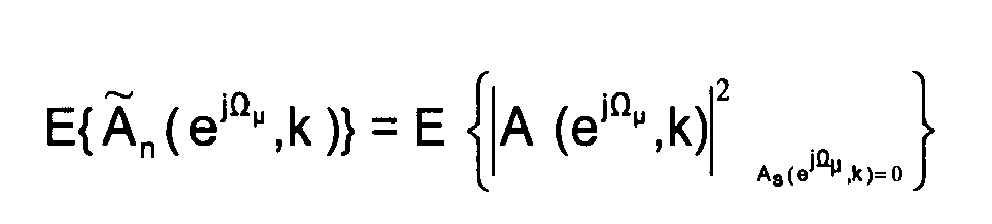
where Ãn (ejΩµ,k), An(ejΩµ,k) and As(ejΩµ,k) denote the estimated power density of the noise contribution (An) of the beamformed signal (A), the noise contribution of the beamformed signal (A) and the portion of the wanted signal of the output of the beamforming means, respectively.
where Ãn (ejΩµ,k), An(ejΩµ,k) and As(ejΩµ,k) denote the estimated power density of the noise contribution (An) of the beamformed signal (A), the noise contribution of the beamformed signal (A) and the portion of the wanted signal of the output of the beamforming means, respectively.
5. The method according to one of the preceding claims, wherein the step of post-filtering
the beamformed signal (A) comprises filtering the beamformed signal (A) by a Wiener
filtering means (H(ejΩµ,k )) to obtain an enhanced beamformed signal (P) according to P(ejΩµ,k) = H(ejΩµ,k) A(ejΩµ,k ), with
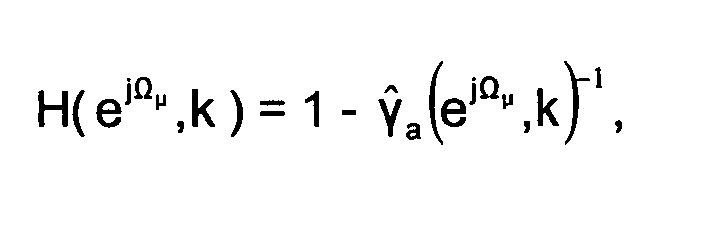
where Ŷ(ejΩµ,k) denotes an estimate for |A(ejΩµ,k)|2|An(ejΩµ,k)|-2, where An(ejΩµ,k) is the noise contribution of the beamformed signal A(ejΩµ,k) at time k for the frequency sub-band Ωµ.
where Ŷ(ejΩµ,k) denotes an estimate for |A(ejΩµ,k)|2|An(ejΩµ,k)|-2, where An(ejΩµ,k) is the noise contribution of the beamformed signal A(ejΩµ,k) at time k for the frequency sub-band Ωµ.
6. The method according to claim 5, wherein Ŷa(ejΩµ,k) , i.e. the estimate for |A(ejΩµ,k)|2|An(ejΩµ,k)|-2, is obtained by optimization according to the maximum a posteriori estimation.
7. Computer program product, comprising one or more computer readable media having computer-executable
instructions for performing the steps of the method according to one of the Claims
1-6.
8. Signal processing means, comprising
a microphone array comprising at least two microphones configured to obtain detect microphone signals (ym);
a beamforming means (11) configured to process the microphone signals (ym) to obtain a beamformed signal (A);
a blocking matrix means (12) configured to process the microphone signals (ym) to obtain power densities (Um) of noise contributions of each of the microphone signals (ym);
a processing means (15) configured to process the power densities (Um) of noise contributions of each of the microphone signals (ym) to obtain an average short-time power density (V) from the power densities (Um) of noise contributions of each of the microphone signals (ym);
a processing means (16) configured to estimate the power density of a noise contribution (An) of the beamformed signal (A) on the basis of the obtained average short-time power density (V) obtained from the power densities (Um) of noise contributions of each of the microphone signals (ym); and
a post-filtering means (14) configured to filter the beamformed signal (A) on the basis of the estimated power density (Ãn) of the noise contribution (An) of the beamformed signal (A) to obtain an enhanced beamformed signal (P).
a microphone array comprising at least two microphones configured to obtain detect microphone signals (ym);
a beamforming means (11) configured to process the microphone signals (ym) to obtain a beamformed signal (A);
a blocking matrix means (12) configured to process the microphone signals (ym) to obtain power densities (Um) of noise contributions of each of the microphone signals (ym);
a processing means (15) configured to process the power densities (Um) of noise contributions of each of the microphone signals (ym) to obtain an average short-time power density (V) from the power densities (Um) of noise contributions of each of the microphone signals (ym);
a processing means (16) configured to estimate the power density of a noise contribution (An) of the beamformed signal (A) on the basis of the obtained average short-time power density (V) obtained from the power densities (Um) of noise contributions of each of the microphone signals (ym); and
a post-filtering means (14) configured to filter the beamformed signal (A) on the basis of the estimated power density (Ãn) of the noise contribution (An) of the beamformed signal (A) to obtain an enhanced beamformed signal (P).
9. The signal processing means according to claim 8, further comprising
an analysis filter bank (10) configured to filter the microphone signals (ym) to obtain sub-band signals Ym(ejΩµ,k) at time k for the frequency sub-band Ωµ; and
a synthesis filter bank (19) configured to filter the enhanced beamformed signal (P) to obtain an enhanced audio signal (p).
an analysis filter bank (10) configured to filter the microphone signals (ym) to obtain sub-band signals Ym(ejΩµ,k) at time k for the frequency sub-band Ωµ; and
a synthesis filter bank (19) configured to filter the enhanced beamformed signal (P) to obtain an enhanced audio signal (p).
10. The signal processing means according to claim 8 or 9, comprising a General Side Lobe
Canceller that comprises the beamforming means (11), the blocking matrix (12) and
a processing means (13) configured to output a noise reduced beamformed signal obtained
by means of the blocking matrix means (12).
11. Speech recognition or speech dialog means comprising the signal processing means according
to one of the claims 8 - 10.
12. Hands-free telephone set comprising the signal processing means according to one of
the claims 8 - 10.
REFERENCES CITED IN THE DESCRIPTION
This list of references cited by the applicant is for the reader's convenience only. It does not form part of the European patent document. Even though great care has been taken in compiling the references, errors or omissions cannot be excluded and the EPO disclaims all liability in this regard.
Non-patent literature cited in the description
- GRIFFITHS, L.J.JIM, C.W.An alternative approach to linearly constrained adaptive beamformingIEEE Transactions on Antennas and Propagation, 1982, vol. 30, 27- [0006]
- M. DEGROOTOptimal Statistical DecisionsMcGraw-Hill19700000 [0021]
- E. HÄNSLERStatistische SignaleSpringer Verlag20010000 [0044]
- EPHRAIMMALAHSpeech Enhancement Using a Minimum Mean-Square Error Short-Time Spectral Amplitude EstimatorIEEE Transactions on Acoustics, Speech and Signal Processing, 1984, vol. ASSP-32, 6 [0052]