|
(11) | EP 2 033 974 A1 |

| (12) | EUROPEAN PATENT APPLICATION |
|
|
|
|
||||||||||||||||||||
| (54) | Conversion method |
| (57) A process is described for the preparation of water-soluble cellulose hydrolysis
products, which comprises admixing cellulose with an ionic liquid capable of solvating
or dissolving at least some of the cellulose, said ionic liquid being a compound comprised
solely of cations and anions and which exists in a liquid state at a temperature at
or below 150°C, the cations in said ionic liquid having the general formula:
in which Z represents a nitrogen or phosphorus atom, R1 represents a methyl or ethyl group, each of R2 and R3, which may be the same or different, is selected from C4-8alkyl, optionally-substituted benzyl, optionally-substituted phenyl, and C5-7cycloalkyl, and R4 represents C1-8 alkyl, optionally-substituted benzyl, optionally-substituted phenyl or C5-7cyclohexyl; in which the optional substituents on a benzyl or phenyl ring are one, two or three substituents selected from C1-4alkyl or alkoxy groups, halogen atoms and nitro groups; and treating the resulting solvate or solution with an acid in the presence of water, said acid having a pKa in water of less than 2 at 25°C. |
[0001] The present invention relates to a method of hydrolysing cellulose to generate water soluble monosaccharide, disaccharide and oligosaccharide derivatives thereof.
[0002] Cellulose is the most abundant biorenewable material on earth. Cellulose consists of polydisperse linear polymeric chains formed by repeated connection of beta-D-glucose building blocks through a 1-4 glycosidic linkage. These linear polymer chains form hydrogen-bonded supramolecular structures that are insoluble in water and most common organic solvents. It is known that hydrolysis of cellulose generates monosaccharide, disaccharide and oligosaccharide products, with glucose usually being the main hydrolysis product. Such products are capable of being fermented to generate alcohols for use as a fuel or a component of a fuel.
[0003] Glucose in particular is an important intermediate for fermentation to ethanol and other chemicals; therefore, saccharification of cellulose is of interest in the development of biofuels.
[0004] Chemical, enzymatic, microbiological and macrobiological catalysts can be used to accelerate the hydrolysis of cellulose under conditions selected to be thermodynamically favourable to product formation. Chemical and enzymatic hydrolysis of cellulose is discussed in "The Encyclopaedia of Polymer Science and Technology", 2nd Ed, J. I. Kroschwitz (Ed in Chief), Wiley (New York), 1985. Thus, cellulose may be hydrolysed using cellulolytic enzymes (cellulase) or harvested filamentous fungi such as Trichoderma sp. However, hydrolysing cellulose by chemical methods presents many problems. In general, such methods have involved one of two approaches: dilute acid treatment at high temperatures and pressures (>100°C) and/or concentrated acid pre-treatment, as described in "Cellulose to Ethanol": A General Review", P. C. Badger, in "Trends in New Crops and New Uses", J. Janick and A. Whipkey (Eds), ASHS Press, Alexandria VA, 2002, 17-21. Dilute acid processes are conducted at high temperature under pressure (for example, using 1% sulphuric acid at 237°C). Concentrated acid processing typically starts with an.initial acid concentration of 10% which is raised to 70% through dewatering at 100°C and ambient pressure.
[0005] Because of the low yields and/or extreme conditions associated with these known processes, there remains the need for an improved method of hydrolysing cellulose by chemical means. Specifically, there is a need for a relatively rapid reaction which may be carried out under relatively mild conditions to give an adequately high conversion to sugars.
[0006] It is known that cellulose can be dissolved in certain ionic liquids. For example, US 6,824,599 discloses that cellulose can be dissolved in a hydrophilic ionic liquid in the substantial absence of water or a nitrogen-containing base to form an admixture, which is then agitated until dissolution is complete, while WO 2005/017001 discloses that wood, straw and other natural lignocellulosic materials can be dissolved in certain ionic liquids under microwave irradiation and/or under pressure. The present inventors have now found that certain ionic liquids containing a certain specific cation can be used in a process for the hydrolysis of cellulose.
[0007] Accordingly, the present invention provides a process for the preparation of water-soluble cellulose hydrolysis products, which comprises admixing cellulose with an ionic liquid capable of solvating or dissolving at least some of the cellulose, said ionic liquid being a compound comprised solely of cations and anions and which exists in a liquid state at a temperature at or below 150°C, the cations in said ionic liquid having the general formula:
in which Z represents a nitrogen or phosphorus atom, R1 represents a methyl or ethyl group, each of R2 and R3, which may be the same or different, is selected from C4-8alkyl, optionally-substituted benzyl, optionally-substituted phenyl, and C5-7cycloalkyl, and R4 represents C1-8 alkyl, optionally-substituted benzyl, optionally-substituted phenyl or C5-7cyclohexyl; in which the optional substituents on a benzyl or phenyl ring are one, two or three substituents selected from C1-4alkyl or alkoxy groups, halogen atoms and nitro groups; and treating the resulting solvate or solution with an acid in the presence of water, said acid having a pKa in water of less than 2 at 25°C.
[0009] It is a characteristic of the ionic liquids used in the process of the present invention that the cation of formula I is asymmetric. Thus, R1, and optionally R4, represents a methyl or ethyl group, while each of R2 and R3, and optionally R4, represents a larger group selected from C4-8alkyl, optionally-substituted benzyl, optionally-substituted phenyl, and cyclohexyl. A benzyl or phenyl ring may be optionally substituted by one, two or three, for example 1 or 2, of the same or different substituents selected from C1-4alkyl or alkoxy, for example methyl or methoxy, groups, halogen atoms, for example chlorine atoms, and nitro groups, but is preferably unsubstituted. Preferably R1 represents a methyl group. Preferably each of R2 and R3 independently represent a C4-8, especially a C4-6, alkyl group. Preferably each of R2 and R3 represents the same group. In one embodiment, R4 represents a methyl or ethyl group, especially methyl, group. In another embodiment, R4 represents a C3-8alkyl, preferably C4-8, especially C4-6, alkyl group. In one preferred embodiment, each of R2, R3 and R4 represents the same group, especially a C4-8, preferably C4-6, alkyl group.
[0010] Throughout this specification and claims, except where the context requires otherwise, the term "cellulose" should be understood to include both cellulose itself and cellulose-containing material, either in raw or purified form. The cellulose that is to be hydrolysed may be either cellulose which has been refined to any desired degree, or it may be raw or partially-treated ceiiuiosic material, such as cellulosic biomass or municipal waste. It may be used in any form that is amenable to being wetted by a liquid. For example, the cellulose may be present in, or derived from, wood (particularly, wood chips and wood pulp), cotton, rayon, cellulose acetate, paper, linters, grasses such as corn stover or switch grass, or bagasse (sugar cane residue).
[0011] The acid used in the process of the invention is a strong acid, having a pKa in water of less than 2, preferably less than 1, preferably 0 or less, at 25°C. An acid with a pKa of 0 is fully dissociated in water, and such acids are preferred for use in the present invention. The acids used in the invention are of the Brönsted (or protonic) type. Suitable acids include for example hydrogen halides, sulfuric acid, nitric acid, strong halocarboxylic acids, halosulfonic acids, tetrafluoroboric acid, heteropolyacids, aryl- and alkyl-sulfonic acids, and halogenated alkyl- and arylsulfonic acids. Examples of suitable acids include, for example, trifluoroacetic acid, p-toluenesulfonic acid, trifluoromethanesulfonic acid (triflic acid), trichloromethanesulfonic acid, hydrochloric acid, hydrobromic acid, hydriodic acid, tetrafluoroboric acid, and sulfuric acid. Preferred acids are trifluoroacetic acid, sulfuric acid, nitric acid, methanesulfonic acid, trifluoromethansulfonic acid, and hydrochloric acid.
[0012] The acid may be added in aqueous form, for example dilute aqueous form, or if desired may be anhydrous. Some water is needed in order for the hydrolysis reaction to occur as explained below, and this may either be present in the reaction mixture and/or added along with the acid. A mixture of acids may be used provided that at least one acid has the required acid strength, or the mixture has the required acid strength. In addition to the protonic acid, a Lewis acid may also be added to the reaction mixture if desired. Suitable Lewis acids include metal salts of strong protic acids (pKa less than about 0), in which the metal is for example lithium, potassium, magnesium, zinc, copper, aluminum, tin, antimony, iron, nickel or lanthanum. Suitable examples of such salts include, for example, metal halides, for example aluminum (III) chloride, gallium (III) chloride, indium (III) chloride and zinc (II) chloride; triflates, for example lithium triflate, sodium triflate, magnesium triflate, zinc triflate, aluminum triflate, tin(II) triflate, and copper(II) triflate; tetrafluoroborates, for example zinc (II) tetrafluoroborate, silver (II) tetrafluoroborate, iron(II) tetrafluoroborate, and nickel(II) tetrafluoroborate; and sulfonates, for example zinc p-toluenesulfonate.
[0013] Preferably, a catalytic amount of the acid is used. For example, the concentration of the acid in the reaction mixture may be from 0.1-10 wt%. If the reaction mixture before addition of the acid contains any basic material, some of the acid initially added will be neutralised, and sufficient acid needs to be added taking this into account.
[0014] The process of the invention is suitably carried out until a desired proportion of the cellulose is converted into water soluble derivatives. Suitably, the treatment with the acid proceeds for up to 96 hours, preferably less than 24 hours, more preferably less than 5 hours, and most preferably less than 1 hour.
[0015] The process of the invention may be carried out at any suitable temperature. Admixture of the cellulose with the ionic liquid must, of course, be carried out at a temperature at which the ionic liquid is in fact liquid. Subsequent reaction with the acid may if desired be accelerated by heating; for example, the reaction may be carried out at a temperature in the range 50 to 200°C, preferably 70 to 150°C, for example 90 to 95°C. Heating can be accomplished by any suitable method, for example using conventional thermal methods, microwave heating or employing other sources such as ultrasound or infrared radiation. Preferably the reaction is carried out under atmospheric pressure.
[0016] The ionic liquid used in the process of the invention is a compound that consists of cations and anions and that is in a liquid state at a temperature at or below 150 °C, preferably at or below 100 °C, for example in the range -100 °C to 150 °C, preferably -10 to 100 °C. It is necessary that the ionic liquid should be capable of dissolving at least some of the cellulose, or should be capable of solvating at least some of the cellulose. Preferably the ionic liquid selected is one in which the cellulose has at least some solubility. When the cellulose is used in the form of biomass, solvation generally leads to swelling of the biomass, and this may be a preferred mode of operation when treating biomass. Alternatively, an ionic liquid may be selected in which the cellulose is readily soluble. On admixture of the cellulose with the ionic liquid, conditions may be chosen such that the cellulose becomes solvated by the ionic liquid; substantially all of the cellulose dissolves to form a homogeneous solution; or some cellulose dissolves while some remains undissolved. Particularly in the latter case, residual solid material may if desired be removed from the solution of cellulose in the ionic liquid by any suitable method. Alternatively, the mixture may be used without further treatment. Suitably, an ionic liquid is selected in which simple solvation or dissolution takes place - i.e. solvation or dissolution without cellulose derivatisation. Naturally, the ionic liquid should be adequately inert in the presence of the strong acid used in the process of the invention; ionic liquids containing basic groups which would neutralise the acid are undesirable.
[0017] Any suitable anion may be present in the ionic liquid. Preferably the anion is selected from halide (chloride, bromide, or iodide), cyanate (OCN-), sulfate, hydrogen sulfate or nitrate. Preferably the anion is halide, most preferably chloride.
[0018] Typically, cellulose is admixed with the ionic liquid in an amount of at least 5% by weight, preferably in an amount of 5 to about 35% weight, for example 5 to 25 % percent by weight, especially 10 to about 25 % percent by weight.
[0019] Stoichiometrically, the hydrolysis reaction requires the presence of one mole equivalent of water for each monomer unit in the cellulose. Cellulose itself contains a certain amount of water, the exact amount depending upon the source and the physical form of the cellulose; usually, prepared cellulose contains at least 10-15% by weight of water. Further water is added to the reaction mixture if aqueous acid is used. However, excessively high amounts of water in the reaction mixture may result in either reduced solubility of the cellulose in the ionic liquid, and/or reduced conversion of cellulose to water-soluble hydrolysis products. Preferably the total water content of the reaction system is such that the weight ratio of water to cellulose is from 1:1 to 1:20, preferably from 1:5 to 1:15, especially about 1:10.
[0020] If desired, an additional co-solvent which is compatible with the ionic liquid may be present in the reaction mixture along with the cellulose and the ionic liquid, for example to modify the viscosity of the reaction mixture. Suitable solvents include non-basic polar solvents, for example dimethylsulfoxide, dimethylformamide and sulfolane.
[0021] As stated above, the cellulose may be either refined or derived directly from cellulosic biomass, municipal waste or other sources. The water-soluble products of the hydrolysis of cellulose include (a) water soluble oligosaccharides having 3 to 10 D-glucose units; (b) cellobiose; (c) monosaccharides such as glucose and fructose; and (d) glucose derivatives such as levoglucosan, levoglucosenone, levulinic acid, formic acid, 2-furtural, 5-hydroxymethyl-2-furfural, 5-methyl-2-furfural, 2,3-butanedione, glycolaldehyde, glyoxal, 2-furyl-hydroxymethylketone and pyruval. In general, the most desired products obtainable using the process of the invention are glucose and/or its water soluble oligomers.
[0022] When the conversion of cellulose to products has proceeded to the required extent, the reaction mixture may be worked up by any suitable method. For example, water or another solvent, for example an alcohol, e.g. ethanol, may be added to the reaction mixture in order to precipitate any residual cellulose or any insoluble hydrolysis products. Where the ionic liquid is hydrophilic and water is added, an aqueous solution of the ionic liquid and the water-soluble hydrolysis products may be produced. Preferably, the ionic liquid used in the process of the invention is at least partially recovered and reused in the process of the invention. If necessary, any solid material, for example comprising undissolved or unconverted cellulose and/or water insoluble cellulose hydrolysis products, may be separated by any suitable method, and if desired, recycled back to the start of the process.
[0023] Alternatively, the reaction mixture or any fraction thereof may be used directly in any subsequent step required to process the products of the reaction.
[0024] In a preferred embodiment of the process of the invention, subsequent processing of the products formed is carried out to produce lower alcohols, particularly ethanol, suitable for use as a biofuel. Thus, in a further embodiment, the invention provides a process for the preparation of water-soluble cellulose hydrolysis products, which comprises admixing cellulose with an ionic liquid capable of solvating or dissolving at least some of the cellulose, said ionic liquid being a compound comprised solely of cations and anions and which exists in a liquid state at a temperature at or below 150°C, the cations in said ionic liquid having the general formula I as defined above; and treating the resulting solvate or solution with an acid in the presence of water, said acid having a pKa in water of less than 2 at 25°C, and converting at least part of the resulting product into one or more alcohols. The water-soluble cellulose hydrolysis products may for example be converted into alcohols by fermentation.
Example 1
[0026] 10 g of tributylmethyl ammonium chloride were placed in a round bottomed flask and heated to 120°C, upon which it melted. 0.1ml concentrated CF3COOH was added dropwise through a syringe, and 0.1g Miscanthus (milled to 0.5mm) was added and stirred, the stirring speed set to maximum in order to effect efficient wetting of the substrate. Samples were taken periodically and analysed by refractive index high performance chromatography. The yield of water-soluble products having glucose end-groups was 8.7% after 150mins.
Examples 2 to 6
[0027] The general method of Example 1 was repeated except that the trifluoroacetic acid was replaced by the same volume of other acids. The results are given in the following Table.
TABLE
| Example No. | Acid used | Yield of product (%) |
| 2 | conc. HCl | 13.8% after 150mins. |
| 3 | conc. H2SO4 | 10.8% after 90mins. |
| 4 | conc. HNO3 | 23.7% after 150mins. |
| 5 | CH3SO3H | 10.3% after 90mins. |
| 6 | CF3SO3H | 9.2% after 90mins. |
1. A process for the preparation of water-soluble cellulose hydrolysis products, which
comprises admixing cellulose with an ionic liquid capable of solvating or dissolving
at least some of the cellulose, said ionic liquid being a compound comprised solely
of cations and anions and which exists in a liquid state at a temperature at or below
150°C, the cations in said ionic liquid having the general formula:
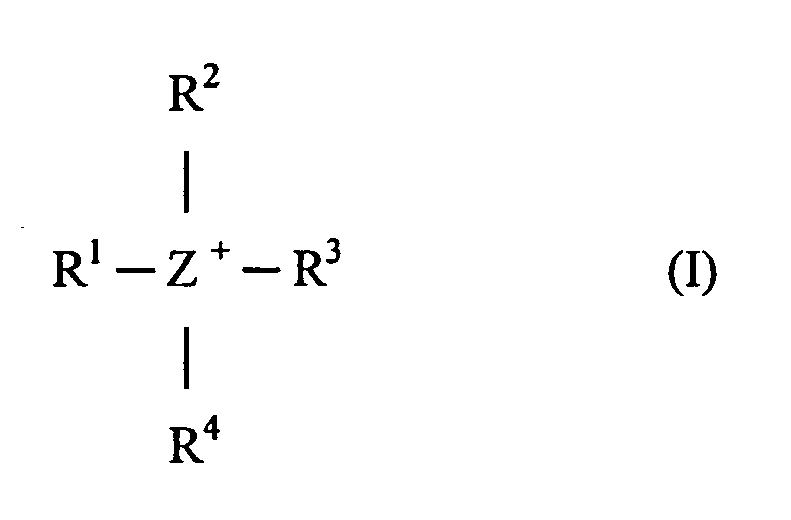
in which Z represents a nitrogen or phosphorus atom, R1 represents a methyl or ethyl group, each of R2 and R3, which may be the same or different, is selected from C4-8alkyl, optionally-substituted benzyl, optionally-substituted phenyl, and C5-7cydoalkyl, and R4 represents C1-8 alkyl, optionally-substituted benzyl, optionally-substituted phenyl or C5-7cyclohexyl; in which the optional substituents on a benzyl or phenyl ring are one, two or three substituents selected from C1-4alkyl or alkoxy groups, halogen atoms and nitro groups; and treating the resulting solvate or solution with an acid in the presence of water, said acid having a pKa in water of less than 2 at 25°C.
in which Z represents a nitrogen or phosphorus atom, R1 represents a methyl or ethyl group, each of R2 and R3, which may be the same or different, is selected from C4-8alkyl, optionally-substituted benzyl, optionally-substituted phenyl, and C5-7cydoalkyl, and R4 represents C1-8 alkyl, optionally-substituted benzyl, optionally-substituted phenyl or C5-7cyclohexyl; in which the optional substituents on a benzyl or phenyl ring are one, two or three substituents selected from C1-4alkyl or alkoxy groups, halogen atoms and nitro groups; and treating the resulting solvate or solution with an acid in the presence of water, said acid having a pKa in water of less than 2 at 25°C.
2. A process as claimed in claim 1, in which said ionic liquid is one in which the cellulose
has at least some solubility.
3. A process as claimed in either claim 1 or claim 2, in which the acid has a pKa in
water of 0 or less at 25°C.
4. A process as claimed in either claim 1 or claim 2, in which the acid is selected from
hydrogen halides, sulfuric acid, nitric acid, halocarboxylic acids, halosulfonic acids,
tetrafluoroboric acid, heteropolyacids, aryl- and alkyl-sulfonic acids, and halogenated
alkyl-and arylsulfonic acids.
5. A process as claimed in claim 4, in which the acid is p-toluenesulfonic acid, trifluoromethanesulfonic
acid, trichloromethanesulfonic acid, trifluoroacetic acid, hydrochloric acid, hydrobromic
acid, hydriodic acid, tetrafluoroboric acid, or sulfuric acid.
6. A process as claimed in claim 5, in which the acid is trifluoroacetic acid, sulfuric
acid, nitric acid, methanesulfonic acid, trifluoromethansulfonic acid, or hydrochloric
acid.
7. A process as claimed in any one of claims 1 to 6, in which the reaction with the acid
is carried out at a temperature in the range of from 50 to 200°C.
8. A process as claimed in any one of the preceding claims, in which Z represents a nitrogen
atom.
9. A process as claimed in any one of the preceding claims, in which R1 represents a methyl group.
10. A process as claimed in any one of the preceding claims, in which each of R2 and R3 independently represent a C4-8 alkyl group.
11. A process as claimed in any one of the preceding claims, in which each of R2 and R3 represents the same group.
12. A process as claimed in any one of the preceding claims, in which R4 represents a C1-8alkyl group.
13. A process as claimed in any one of the preceding claims, in which each of R2, R3 and R4 represents the same group.
14. A process as claimed in claim 12, in which R4 represents a methyl group.
15. A process as claimed in any one of the preceding claims, in which the anion of the
ionic liquid is halide, cyanate, sulfate, hydrogen sulfate or nitrate.
16. A process as claimed in any one of the preceding claims, in which the cellulose is
admixed with the ionic liquid in an amount of from 5 to 35% weight.
17. A process as claimed in any one of the preceding claims, in which the water content
of the reaction system is such that the weight ratio of water to cellulose is from
1:1 to 1:20.
18. A process as claimed in claim 17, in which the water content of the reaction system
is such that the weight ratio of water to cellulose is from 1:5 to 1:15.
19. A process for the preparation of one or more alcohols, which comprises carrying out
a process as claimed in any one of the preceding claims, and converting at least part
of the resulting product into one or more alcohols.
REFERENCES CITED IN THE DESCRIPTION
This list of references cited by the applicant is for the reader's convenience only. It does not form part of the European patent document. Even though great care has been taken in compiling the references, errors or omissions cannot be excluded and the EPO disclaims all liability in this regard.
Patent documents cited in the description
Non-patent literature cited in the description
- The Encyclopaedia of Polymer Science and TechnologyWiley19850000 [0004]
- Cellulose to Ethanol'': A General ReviewP. C. BADGERTrends in New Crops and New UsesASHS Press2002000017-21 [0004]