|
(11) | EP 2 039 803 A1 |

| (12) | EUROPEAN PATENT APPLICATION |
|
|
|
|
|||||||||||||||||||||||
| (54) | Coated cutting tool for turning of heat resistant super alloys (HRSA) |
| (57) The present invention relates to coated cemented carbide inserts, particularly useful
in general turning of superalloys. The inserts are characterized by a composition of the cemented carbide of WC, 5.0-7.0 wt-% Co, 0.22-0.43 wt-% Cr and a coercivity (Hc) of 19-28 kA/m. The coating consists of a single (Tix Al1-x)N-layer, where x is between 0.25 and 0.50, with crystal structure of NaCl type, total thickness of between 3.0 and 5.0 µm, (200)-texture, and compressive residual strain of between 2.5*10-3 and 5.0*10-3, possibly followed by an outermost TiN-layer. |
[0001] The present invention relates to a cutting tool insert consisting of a cemented carbide substrate and a coating, particularly useful for general turning of heat resistant super alloys. Fine grained substrate in combination with a thick PVD-coating with a reduced residual strain level greatly improves the wear resistance.
[0002] Superalloys are a broad range of nickel, iron and cobalt base alloys developed specifically for applications demanding exceptional mechanical and chemical properties at elevated temperatures. The classic use for these alloys is in the hot end of aircraft engines and land based turbines. Almost every metallurgical change made to improve the high temperature properties makes it more difficult to machine these alloys.
[0003] As high temperature strength is increased, the alloys become harder and stiffer at the cutting temperature. It results in increased cutting forces and increased wear on the cutting edge during machining.
[0004] Because stronger materials generate more heat during chip formation and because the thermal heat conductivity of these alloys is relatively low, very high cutting temperatures are generated, which also contributes to an increased wear of the cutting edge.
[0005] To make matters even worse, as the alloys are heat treated to modify the as cast or solution treated properties, abrasive carbide precipitates or other second phase particles often form. These particles also cause rapid wear of the cutting edge.
[0006] It is an object of the present invention to provide a coated cemented carbide, for general wet machining of superalloys, with improved wear resistance.
[0007] It has now surprisingly been found that a cemented carbide with low Co-content and sub micron WC-grain size coated with a single (Ti,Al)N-layer grown using physical vapor deposition greatly improves the productivity in general machining of superalloys under wet conditions.
[0008] Fig 1 shows a fracture surface of a coated cemented carbide substrate according to the present invention in which:
- 1. Cemented carbide body and
- 2. Single layer of (Ti,Al)N.
[0009] According to the present invention there is now provided a coated cutting tool insert consisting of a substrate and a coating. The substrate consists of WC, 5.0-7.0, preferably 5.5-6.5, most preferably 5.8-6.2, wt-% Co, 0.22-0.43, preferably 0.24-0.33, most preferably 0.26-0.29 wt-% Cr with a coercivity (Hc) of 19-28, preferably 21-27, preferably 22.5-26.5 kA/m. Preferably, the edge radius of the inserts before coating is between 15 and 30 µm.
[0010] The coating consists of a single layer of (TixAl1-x)N, where x is between 0.25 and 0.50, preferably between 0.30 and 0.40, most preferably between 0.33 and 0.35. The crystal structure of the (Ti,Al)N-layer is of NaCl type. The total thickness of the layer is between 3.0 and 5.0 µm, preferably between 3.5 and 4.5 µm. The thickness is measured on the middle of the flank face.
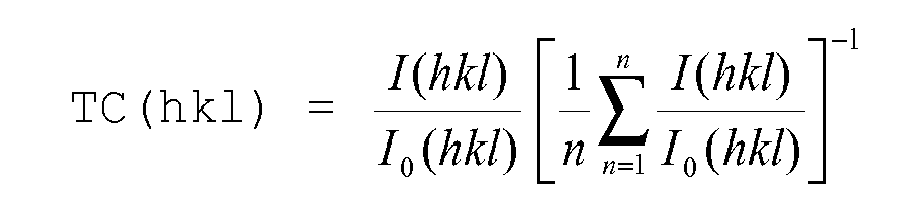
[0011] The layer is strongly textured in the (200)-direction, with a texture coefficient TC(200) of between 1.6 and 2.1.
[0012] The texture coefficient (TC) is defined as follows:
where
I(hkl) = intensity of the (hkl) reflection
IO(hkl) = standard intensity according to JCPDS card no 38-1420
n = number of reflections used in the calculation
(hkl) reflections used are: (111), (200), (220).
[0013] The layer is in compressive residual stress with a strain of 2.5*10-3-5.0*10-3, preferably 3.0*10-3-4.0*10-3.
[0015] The present invention also relates to a method of making a coated cutting tool insert consisting of a substrate and a coating. The substrate is made by conventional powder metallurgical methods milling, pressing and sintering. It has a composition of WC, 5.0-7.0, preferably 5.5-6.5, most preferably 5.8-6.2, wt-% Co, 0.22-0.43, preferably 0.24-0.33, most preferably 0.26-0.29, wt-% Cr with a coercivity (Hc) of 19-28, preferably 21-27, most preferably 22.5-26.5 kA/m.
[0016] Before coating the inserts are edge-honed by wet-blasting to an edge radius of preferably between 15 and 30 µm.
[0017] The method used to grow the layer is based on arc evaporation of an alloyed, or composite cathode, under the following conditions: The Ti+Al cathode composition is 25 to 50 at-% Ti, preferably 30 to 40 at-% Ti, most preferably 33 to 35 at-% Ti.
[0018] Before coating the surface is cleaned preferably by applying a soft ion etching. The ion etching is performed in an Ar atmosphere or in a mixture of Ar and H2.
[0019] The evaporation current is between 50 A and 200 A depending on cathode size and cathode material. When using cathodes of 63 mm in diameter the evaporation current is preferably between 60 A and 100 A. The substrate bias is between -20 V and -35 V. The deposition temperature is between 400°C and 700°C, preferably between 500°C and 600°C.
[0020] The (Ti,Al)N-layer is grown in an Ar+N2 atmosphere consisting of 0-50 vol-% Ar, preferably 0-20 vol-%, at a total pressure of 1.0 Pa to 7.0 Pa, preferably 3.0 Pa to 5.5 Pa.
[0021] On top of the (Ti,Al)N-layer a TiN-layer of between 0.1 and 0.5 µm thickness may be deposited using arc evaporation as known.
[0022] The present invention also relates to the use of inserts according to the above for wet machining of superalloys such as Inconel 718, Inconel 625, Nimonic 81, Waspaloy or Ti6Al4V, at a cutting speed of 20-75 m/min, a cutting depth 0.2-2.5 mm and a feed of 0.05-0.30 mm/rev.
Example 1
[0023] Cemented carbide cutting tool inserts of type CNMG120412-MR3 and CNMG120408-MF1 consisting of a substrate and a coating were prepared. The substrate was made by milling, pressing and sintering. The composition was 5.9 wt-% Co, 0.27 wt-% Cr and rest WC. The coercivity was 24.0 kA/m corresponding to an average WC grain size of about 0.80 µm.
[0025] The coating was grown using arc evaporation of a Ti0.34Al0.66 cathode, 63 mm in diameter. The deposition was carried out in a 99.995% pure N2 atmosphere at a total pressure of 4.5 Pa, using a substrate bias of -30 V for 60 minutes. The deposition temperature was about 530°C. The thickness of the layer was 3.8 µm in the middle of the flank face. X-ray diffraction showed a strong (002)-texture with (TC)=1.8 and a residual strain of 3.5*10-3.
Example 2
[0027] CNMG120412-MR3 coated inserts from Example 1 were tested with regard to wear resistance in longitudinal medium-rough turning at the following conditions.
| Work piece: | Cylindrical bar |
| Material: | Inconel 718 |
| Cutting speed: | 50 m/min |
| Feed: | 0.25 mm/rev |
| Depth of cut: | 2.0 mm |
| Remarks: | Flood coolant |
| Reference: | Seco CP200 |
Results
[0028] The tool life criterion was the maximum time in cut in minutes at a cutting speed of 50 m/min giving a flank wear of 0.2 mm. The results are found in Table 1.
Table 1.
| Grade | Time in cut [min] |
| Invention | 8.50 |
| Seco CP200 | 6.00 |
[0029] This test shows that the inserts according to the invention achieve about 40 % longer tool life than Seco CP200.
Example 3
[0030] CNMG120408-MF1 coated inserts from Example 1 were tested with regard to wear resistance in longitudinal fine turning at the conditions below.
| Work piece: | Cylindrical bar |
| Material: | Inconel 718 |
| Cutting speed: | 55, 70 m/min |
| Feed: | 0.15 mm/rev |
| Depth of cut: | 0.5 mm |
| Remarks: | Flood coolant |
| Reference: | Seco CP200 |
Results
[0031] The time in minutes to a flank wear of 0.2 mm was measured. The results are found in Table 2.
Table 2.
| Cutting speed | 55 | 70 |
| Invention | - | 7.00 |
| Seco CP200 | 7.00 | 5.00 |
[0032] This test shows that the inserts according to the invention increase tool life productivity by 40 % compared to Seco CP200.
Example 4
[0033] CNMG120412-MR3 coated inserts from Example 1 were tested with regard to tool life in a medium-rough boring operation at the conditions below.
| Work piece: | Special component |
| Material: | Inconel 718 |
| Cutting speed: | 37 m/min |
| Feed: | 0.20 mm/rev |
| Depth of cut: | 3.2 mm |
| Remarks: | Flood coolant |
| Reference: | Competitor grade |
Results
1. A cutting tool insert, comprising a cemented carbide body and a coating particularly
useful in general turning of superalloys,
characterized in a composition of the cemented carbide of WC, 5.0-7.0, preferably 5.5-6.5, wt-% Co, 0.22-0.43, preferably 0.24-0.33, wt%-Cr and a coercivity, Hc, of 19-28, preferably 21-27, kA/m,
and a coating of one layer of (Ti1-xAlx)N, where x is between 0.25 and 0.50, preferably between 0.30 and 0.40 with a crystal structure of NaCl type and a total thickness between 3.0 and 5.0 µm, preferably between 3.5 and 4.5 µm measured on the middle of the flank face
with a compressive residual strain of between 2.5*10-3 and 5.0*10-3, preferably between 3.0*10-3 and 4.0*10-3
and with a texture coefficient TC(200) between 1.6 and 2.1, the texture coefficient (TC) being defined as:

where
characterized in a composition of the cemented carbide of WC, 5.0-7.0, preferably 5.5-6.5, wt-% Co, 0.22-0.43, preferably 0.24-0.33, wt%-Cr and a coercivity, Hc, of 19-28, preferably 21-27, kA/m,
and a coating of one layer of (Ti1-xAlx)N, where x is between 0.25 and 0.50, preferably between 0.30 and 0.40 with a crystal structure of NaCl type and a total thickness between 3.0 and 5.0 µm, preferably between 3.5 and 4.5 µm measured on the middle of the flank face
with a compressive residual strain of between 2.5*10-3 and 5.0*10-3, preferably between 3.0*10-3 and 4.0*10-3
and with a texture coefficient TC(200) between 1.6 and 2.1, the texture coefficient (TC) being defined as:
where
I(hkl) = intensity of the (hkl) reflection
IO(hkl) = standard intensity according to JCPDS card no 38-1420
n = number of reflections used in the calculation
(hkl) reflections used are: (111), (200), (220).
2. A cutting tool insert according to claims 1)
characterized in an outermost TiN-layer of between 0.1 and 0.5 µm thickness.
characterized in an outermost TiN-layer of between 0.1 and 0.5 µm thickness.
3. A cutting tool insert according to claims 1) or 2)
characterized in an edge radius between 15 and 30 µm.
characterized in an edge radius between 15 and 30 µm.
4. A method for making a cutting tool insert, comprising a cemented carbide body and
a coating particularly useful in general turning of superalloys, characterized by providing a substrate by conventional powder metallurgical methods milling, pressing
and sintering with a composition of WC, 5.0-7.0, preferably 5.5-6.5 wt-% Co, 0.22-0.43,
preferably 0.24-0.33, wt%-Cr and a coercivity, Hc, of 19-28, preferably 21-27 kA/m
and depositing a single layer of (TixAl1-x)N, where x is between 0.25 and 0.50, preferably between 0.30 and 0.40 with a crystal
structure of NaCl type and a total thickness between 3.0 and 5.0 µm, preferably between
3.5 and 4.5 µm measured on the middle of the flank face
with a compressive residual strain of between 2.5*10-3 and 5.0*10-3, preferably between 3.0*10-3 and 4.0*10-3
and with a texture coefficient TC(200) between 1.6 and 2.1, the texture coefficient (TC) being defined as:
where
with a compressive residual strain of between 2.5*10-3 and 5.0*10-3, preferably between 3.0*10-3 and 4.0*10-3
and with a texture coefficient TC(200) between 1.6 and 2.1, the texture coefficient (TC) being defined as:
where
I(hkl) = intensity of the (hkl) reflection
IO(hkl) = standard intensity according to JCPDS card no 38-1420
n = number of reflections used in the calculation
(hkl) reflections used are: (111), (200), (220).
using arc evaporation of an alloyed, or Ti+Al composite cathode with the composition of 25 to 50 at-% Ti, preferably 30 to 40 at-% Ti and a current between 50 A and 200 A depending on cathode size and cathode material, the substrate bias of between -20 V and -35 V, a deposition temperature of between 400°C and 700°C and grown in an Ar+N2 atmosphere consisting of 0-50 vol-% Ar, preferably 0-20 vol-%, at a total pressure of 1.0 Pa to 7.0 Pa.5. A method according to claim 4) characterized in depositing an outermost TiN-layer of between 0.1 and 0.5 µm thickness using arc evaporation.
6. A method according to claim 4) or 5) characterized in that the insert is edge-honed by wet-blasting to an edge radius of preferably between
15 and 30 µm before coating.
7. Use of an insert according to claims 1)-3) for general machining of superalloys such
as Inconel 718, Inconel 625, Nimonic 81, Waspaloy or Ti6Al4V, at a cutting speed of
20-75 m/min, a cutting depth 0.2-2.5 mm and a feed of 0.05-0.30 mm/rev.