|
(11) | EP 2 060 605 A1 |

| (12) | EUROPEAN PATENT APPLICATION |
| published in accordance with Art. 153(4) EPC |
|
|
|
|
|||||||||||||||||||||||
| (54) | THE COMPOSITION CONTAINING POLYHYDROXYALKANOATE COPOLYMER AND POLYLACTIC ACID USED FOR FOAM |
| (57) A composition used for preparing foaming material comprising a polyhydroxyalkanoate,
a polylactic acid and a foaming agent, which posses certain tensile strength, elongation
in break and expansion ratio as well as full bio-degradability, thus can be used in
packaging industry. |
Technical field
[0001] The present invention relates to the field of technology on polymer, in particular, this invention discloses a composition which comprises biodegradable high molecular polymer and can be used for preparing foam material, it can be broadly applied to packaging industry.
Background Art
[0002] Plastic industry has brought convenience to human life, while it has also caused severe environmental problems. Currently, the total annual plastic production is about 140 million tons, with 50% to 60% of which is abandoned. The most severe environmental pollution in China is concentrated on the usage of disposable products, such as tableware, plastic packaging boxes, bags, films and medical plastic products.
[0003] Nowadays disposable products sold in market are mainly made of foaming materials such as polyethylene-starch blend and polyphenylene, polypropylene-starch blend and polyphenylene, polypropylene/starch blend and polyphenylene, none of these foam disposable products however will completely degrade into CO2 and H2O in biodegradation processes. For example, in polyethylene- starch foam, since starch is physically mixed in polyethylene rather than attached to the large molecular chain of polyethylene, degradation of the starch will not cause the polyethylene to degrade, therefore, though from appearance the foam product is mashed after degradation processes, the large molecular polyethylene is still there and only in smaller geometry size, which would in fact accelerate its influence on soil and cause environmental pollution.
[0004] Polyhydroxyalkanoates, for example poly(3-hydroxylbutyrate-co-4-hydroxylbutyrate) P(3HB-co-4HB), poly(3-hydroxylbutyrate-co-3-hydroxyvalerate) P (3HB-co-3HV), poly(3-hydroxybutyrate-co-3-hydroxyhexanoate) P(3HB-co-3HHx) and poly(3-hydroxybutyrate-co-3-hydroxydecanoate) P(3HB-co-3HD) are all possess good flexibility and will completely degrade into CO2 and water after 3∼6 months under nature environments such as sea water, sewage or soil with high bacteria density. Additionally, these polymers are manufactured in fermentation processes which are clean and environmental friendly.
[0005] However, since the above-mentioned polyhydroxyalkanoates are normally semi-crystalline thermoplastic polyester compound which have low crystallinities and low melting points, the crystallization rate is low and adhesion may occur during cooling, which make it difficult to collect the finished article and the yield is very low. In the meantime, cost for producing these bio-polyesters is relatively high at present.
[0006] Therefore, there is a need to use the bio-degradable characteristics and overcome the defects such as low crystallinities and melting points associated with the above-mentioned polyhydroxyalkanoates to find a cost effective bio-degradable foam which is suitable for batch production by available foam plastic plants on market, and therefore can be widely used in the packaging industry.
Summary of the Invention
[0007] To meet the need, inventors of this invention have done many experiments and gotten a composition by blending a biodegradable polylactic acid (PLA) with the above-mentioned polyhydroxyalkanoate, furthermore, a composition with improved processability can be acquired by adding polyactic acid, foaming agent and other aids into the above-mentioned polyhydroxyalkanoate and blending, foam articles suitable for packaging are produced according to the composition, which is advantageous in that traditional process and method can be employed, finished articles can be biodegraded.
[0008] This invention discloses a composition used for preparing foaming material comprising polyhydroxyalkanoate, polylactic acid and foaming agent, wherein the polyhydroxyalkanoate comprises two randomly repeating monomer units, with a first monomer unit of formula (I)
wherein R1 is one of H, or C1 or C2 alkyl, and n is 1 or 2, and a second monomer unit of formula (II)
wherein R2 is C1-C10 alkyl,
or with the second monomer unit of formula (III)
wherein m is 2-9, and
the mole ratio of the first monomer unit to the second monomer unit is 5□ 95-98□ 2.
[0009] The above-mentioned composition as disclosed in this invention, wherein R1 is -CH3, n is 1 for the first monomer unit of the polyhydroxyalkanoate.
[0010] The above-mentioned composition as disclosed in this invention, wherein the polyhydroxyalkanoate is one of poly(3-hydroxylbutyrate-co-4-hydroxylbutyrate) P(3HB-co-4HB), poly(3-hydroxylbutyrate-co-3-hydroxyvalerate) P (3HB-co-3HV), poly(3-hydroxybutyrate-co-3-hydroxyhexanoate) P(3HB-co-3HHx) and poly(3-hydroxybutyrate-co-3-hydroxydecanoate) P(3HB-co-3HD).
[0011] The above-mentioned composition as disclosed in this invention, wherein the polyhydroxyalkanoate is poly(3-hydroxylbutyrate-co-4-hydroxylbutyrate) P(3HB-co-4HB).
[0012] The above-mentioned composition as disclosed in this invention, wherein the foaming agent is one of azodicarbonamide, butane, CO2, H2O and nitrogen, preferably, it is azodicarbonamide or butane.
[0013] The above-mentioned composition as disclosed in this invention, wherein the parts by weight (pbw) ratio of polyhydroxyalkanoate: polylactic acid : foaming agent is 100:100□700:0.2□1.5.
[0014] The above-mentioned composition as disclosed in this invention which further comprises a organic additive and/or a inorganic additive in nano to macro scale, wherein the organic additive is organic solid which may be starch or degradable fatty acid such as glyceride or protein, the inorganic additive may be one of talcum powder, calcium carbonate, silicon oxide and titanium oxide.
[0015] The above-mentioned composition as disclosed in this invention wherein the pbw ratio of polyhydroxyalkanoate: polylactic acid: foaming agent: organic and/or inorganic additive is 100:100□ 700:0.2□ 1.5:0□ 60.
[0016] The composition as disclosed in this invention which further comprises an aid, wherein the aid is stearic acid or calcium stearate.
[0017] The composition as disclosed in this invention, wherein the pbw ratio of the polyhydroxyalkanoate: the polylactic acid: the foaming agent: the organic and/or the inorganic additive: the aid is 100:100∼700:0.2∼1.5:0∼60:0∼5.
[0018] Main components of the co-mixture disclosed in this invention are biodegradable polyhydroxyalkanoate and biodegradable polylactic acid (PLA). The polyhydroxyalkanoate disclosed in this invention is polyhydroxyalkanoate having two randomly repeating monomer units comprising a first monomer unit of formula (I)
wherein R1 is H, or C1 or C2 alkyl, and n is 1 or 2, and a second monomer unit of formula (II)
wherein R2 is C1-C10 alkyl, or with the second monomer of formula (III)
wherein m is 2-9,
the mole ratio of the first monomer unit to the second monomer unit is 5□ 95-98□ 2.
[0020] The foaming agent is azodicarbonamide, butane, CO2, H2O or nitrogen, wherein azodicarbonamide (AC) is used as chemical foaming agent, and butane, CO2, H2O or nitrogen is used as physical foaming agent.
[0021] In this invention, more preferably, an organic and/or an inorganic additive is added into the composition, the organic and/or the inorganic additive is/are used to improve lubrication and reduce cost, preferably the size of it is nano to macro scale, the organic additive is starch, protein or degradable fatty acid such as glyceride. The inorganic additive is talcum powder, silicon oxide, titanium oxide or calcium carbonate.
[0022] In this invention, more preferably, an aid can be added into the composition, wherein said aid can be stearic acid or calcium sterirate.
[0023] Based on experiments carried out by the inventors of this invention, it is found that a foaming material suitable for different needs in packaging industry can be acquired when the pbw ratio of the polyhydroxyalkanoate, the polylactic acid, the foaming agent, the organic and/or the inorganic additive, and the aid, is 100:100∼700:0.2∼1.5:0∼60:0∼5.
[0024] A method for preparing foaming material from the composition in this invention, which can be carried out by traditional extruders is also disclosed. Firstly, a composition is prepared according to the pbw ratio of the components, then the composition is dry-mixed and extruded into pellets, the pellets are then melt in an extruder at a predetermined temperature and extruded to an auxiliary device where a variety of articles are molded. Foaming sheet can be obtained through plate flow-casting or T-shape extruder head, foam can be obtained through tubular head, cooled by water or through polishing metallic roller, finished articles are then collected.
[0025] Finished articles are then tested by different experiments on impact strength, elongation at break, foam ratio, different foams with different endurances to the impact strength, elongation at break, foam ratio can be gotten by different formulations, those foams have properties as flexibility, strength, adibaticty, resistance to normal solvents, impervious to water, nontoxic etc, and these properties can meet the requirements on packages for hot snack foods and frozen foods. The molding process of the finished articles is simple, having continuous molding cycle, a relatively low energy consumption, a high yield, and can be operated easily and industrialized. Abandoned finished articles manufactured from such foam material 1 are bio-degradable, i.e. can be degraded into CO2 and H2O completely in environments such as sea water/waste water or soil with high bacteria density within several months, which make it secondary contamination free and environmental friendly.
Preferred embodiments
[0026] It shall be understood that examples and embodiments described herein are for illustrative purpose only, they should not, however, be construed as limiting the scope of the invention.
polyhydroxyalkanoate: from Tianjin green biosciences Co. Ltd.
Example: preparation of the foaming material
[0028] All components are count in parts by weight (pbw) and the main component, i.e. polyhydroxyalkanoate, with 100 parts is used as a referenceparts:
| polyhydroxyalkanoate | 100 parts |
| polylactic acid (PLA) | 100∼700 parts |
| foaming agent | 0.2∼1.5 parts |
| organic and/or inorganic additive | 0∼60 parts |
| aid | 0∼5 parts |
Example 1:
[0029] 100 parts of P(3HB-co-5mol%4HB), 700 parts of PLA, 1.5 parts of AC, with all components are counted in part by weight. All components are mixed and extruded into pellets, the pellets are then melt and extruded into foaming sheet, the foaming sheet is then absorb molded into finished articles.
Example 2:
[0030] 100 parts of P(3HB-co-95mol%4HB),400 parts of PLA, 1.0 part of AC, 0.2 parts of calcium stearate, with all components counted in parts by weights. All components are mixed and extruded into pellets, the pellets are then melt and extruded into foaming sheet, the foaming sheet is then absorb molded into finished articles.
Example 3:
[0031] 100 parts of P(3HB-co-10mol%4HB), 700 parts PLA, 1.0 part of AC, 50 parts of maize starch, 3.0 parts of talcum powder, and 4.0 parts of stearic acid, with all components counted in parts by weight. All components are mixed and extruded into pellets, the pellets are then melt and extruded into foaming sheet, the foaming sheet is then absorb molded into finished articles.
Example 4:
[0032] 100 parts of P(3HB-co-10mol%4HB), 500 parts of PLA, 0.6 parts of AC, 2.5 parts of talcum powder, and 0.2 parts of stearic acid, with all components counted in parts by weight. All components are mixed and extruded into pellets, the pellets are then melt and extruded into foaming sheet, the foaming sheet is then plastics absorb molded into finished articles..
Example 5:
[0033] 100 parts of P(3HB-co-40mol%4HB), 500 parts of PLA, 1.0 part of AC, 20 parts of maize starch, 1.0 part of talcum powder, and 0.2 parts of stearic acid, with all components counted in parts by weight. All components are mixed and extruded into pellets, the pellets are then melt and extruded into foaming sheet, the foaming sheet is then plastics absorb molded into finished articles..
Example 6:
[0034] 100 parts of P(3HB-co-40mol%4HB), 200 parts of PLA, 1.0 part of AC, 0.5parts of talcum powder, and 0.2 parts of stearic acid, with all components counted in parts by weight. All components are mixed and extruded into pellets, the pellets are then melt and extruded into foaming sheet, the foaming sheet is then plastics absorb molded into finished articles..
Example 7:
[0035] 100 parts of P(3HB-co-10mol%4HB), 700 parts of PLA, 3.0 parts of talcum powder, 30 parts of maize starch, and 0.2 parts of stearic acid, with all components counted in parts by weight. All components are mixed and extruded into pellets, the pellets are then melt and extruded and added into 0.5 parts of butane and 10 parts of monoglyceride, foaming sheet is then molded which is then plastic absorb molded into finished articles.
Example 8:
[0036] 100 parts of P(3HB-co-40mol%4HB), 600 parts of PLA, 30 parts of starch, 2.5 parts of talcum powder, and 0.2 parts of stearic acid, with all components counted in parts by weight. All components are mixed and extruded into pellets, the pellets are then melt and extruded and added into 1.0 part of butane and 9 parts of monoglyceride, foaming sheet is then molded which is then plastic absorb molded into finished articles.
Example 9:
[0037] 100 parts of P(3HB-co-40mol%4HB), 300 parts of PLA, 10 parts of starch, 1.0 part of talcum powder, and 0.2 parts of stearic acid, with all components counted in parts by weight. All components are mixed and extruded into pellets, the pellets are then melt and extruded and added into 1.5 parts of nitrogen and 8 parts of monoglyceride, foaming sheet is then molded which is then plastic absorb molded into finished articles.
Example 10:
[0038] 100 parts of P(3HB-co-40mol%4HB), 200 parts of PLA, 0.5 parts of talcum powder, and 0.2 parts of stearic acid, with all components counted in parts by weight. All components are mixed and extruded into pellets, the pellets are then melt and extruded and added into 0.2 parts of butane and 1 part of monoglyceride, foaming sheet is then molded which is then plastic absorb molded into finished articles.
Example 11:
[0039] 100 parts of p(3HB-co-3HV), 200 parts of PLA, 1.0 part of talcum powder, and 0.2 parts of stearic acid, with all components counted in parts by weight. All components are mixed and extruded into pellets, the pellets are then melt and extruded and added into 0.8 parts of butane and 1 part of monoglyceride, foaming sheet is then molded which is then plastic absorb molded into finished articles.
Example 12:
[0040] 100 parts of P(3HB-co-3HHx), 200 parts of PLA, 0.5 parts of talcum powder, and 0.2 parts of stearic acid, with all components counted in parts by weight. All components are mixed and extruded into pellets, the pellets are then melt and extruded and added into 1.2 parts of butane and 1 part of monoglyceride, foaming sheet is then molded which is then plastic absorb molded into finished articles.
Example 13:
[0041] 100 parts of P(3HB-co-3HD), 200 parts of PLA, 1.5 parts of talcum powder, and 0.2 parts of stearic acid, with all components counted in parts by weight. All components are mixed and extruded into pellets, the pellets are then melt and extruded and added into 1.0 part of butane and 1 part of monoglyceride, foaming sheet is then molded which is then plastic absorb molded into finished articles.
Experiment:
[0042] The finished articles obtained from example 1 to 13 are tested by tensile strength, elongation in break and degradation, wherein tensile strength and elongation in break are tested according to Chinese national standard GB/T1040□ 92, degradation is done in natural environment (in sewage or sea water or sludge) for 3 to 6 month.
[0043] Results of the experiment are show below:
Physical properties of the finished articles:
tensile strength □ MPa□ ≥:3.45
elongation in break □ □ □ ≥30
degradation: complete degradation
[0044] It thus can be seen from the above-mentioned results that foaming materials disclosed in this invention, which are prepared from compositions containing polyhydroxyalkanoate and polylactic acid, have met the objects such as good tensile strength, good elongation in break, and complete degradation in natural environment,of this invention, and therefore can be broadly used in packaging industry.
1. A composition used for preparing foam material, comprising a polyhydroxyalkanoate,
a polylactic acid and a foaming agent, wherein the polyhydroxyalkanoate comprises
two randomly repeating monomer units with a first monomer unit of formula (I)
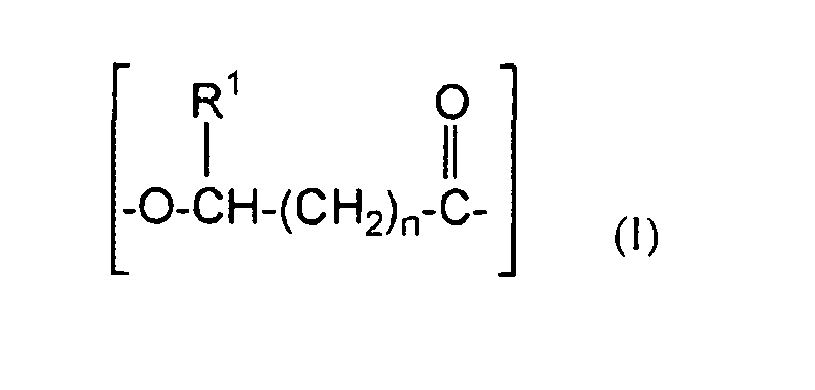
wherein R1 is H, or C1 or C2 alkyl, and n is 1 or 2, and a second monomer of formula (II)
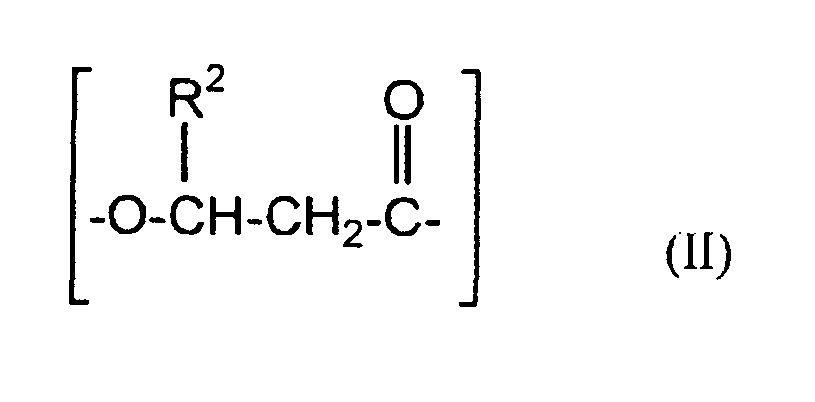
wherein R2 is C1-C10 alkyl,
or with the second monomer unit of formula (III)

wherein m is 2-9,
the mole ratio of the first monomer unit to the second monomer unit is 5□ 95-98□ 2.
wherein R1 is H, or C1 or C2 alkyl, and n is 1 or 2, and a second monomer of formula (II)
wherein R2 is C1-C10 alkyl,
or with the second monomer unit of formula (III)
wherein m is 2-9,
the mole ratio of the first monomer unit to the second monomer unit is 5□ 95-98□ 2.
2. A composition of claim 1, wherein R1 is -CH3□ n is 1 in the first monomer unit of the polyhydroxyalkanoate.
3. A composition of claim 2, wherein polyhydroxyalkanoate is one of
poly(3-hydroxylbutyrate-co-4-hydroxylbutyrate)P(3HB-co-4HB),
poly(3-hydroxylbutyrate-co-3-hydroxyvalerate)P(3HB-co-3HV),
poly(3-hydroxybutyrate-co-3-hydroxyhexanoate)P(3HB-co-3HHx), and
poly(3-hydroxybutyrate-co-3-hydroxydecanoate) P(3HB-co-3HD).
poly(3-hydroxylbutyrate-co-4-hydroxylbutyrate)P(3HB-co-4HB),
poly(3-hydroxylbutyrate-co-3-hydroxyvalerate)P(3HB-co-3HV),
poly(3-hydroxybutyrate-co-3-hydroxyhexanoate)P(3HB-co-3HHx), and
poly(3-hydroxybutyrate-co-3-hydroxydecanoate) P(3HB-co-3HD).
4. A composition according to claim 3, wherein the polyhydroxyalkanoate is
poly(3-hydroxylbutyrate-co-4-hydroxylbutyrate) P(3HB-co-4HB).
poly(3-hydroxylbutyrate-co-4-hydroxylbutyrate) P(3HB-co-4HB).
5. A composition according to claim 1, wherein the foaming agent is one of azodicarbonamide,
butane, CO2, H2O and nitrogen.
6. A composition according to claim 5, wherein the foaming agent is azodicarbonamide.
7. A composition according to claim 5, wherein the foaming agent is butane.
8. A composition according to claim 1, wherein the part by weight ratio of polyhydroxyalkanoate:
polylactic acid : foaming agent is 100:100□ 700:0.2□ 1.5.
9. A composition according to claim 1 which further comprises an organic and/or an inorganic
additive, wherein the organic additive is starch or degradable fatty acid such as
glyceride or protein, the inorganic additive is one of talcum powder, silicon oxide,
titanium oxide, and calcium carbonate.
10. A composition according to claim 9, wherein the part by weight ratio of the polyhydroxyalkanoate:
the polylactic acid : the foaming agent: the organic and/or the inorganic additive
is 100:100□ 700:0.2□ 1.5:0□ 60□
11. A composition according to claim 9 which further comprises an aid, wherein the aid
is stearic acid or calcium stearate.
12. A composition according to claim 11, wherein the part by weight ratio of the polyhydroxyalkanoate:
the polylactic acid : the foaming agent: the organic and/or the inorganic additive:
aid is 100:1000 700:0.2□ 1.5:0□ 60:0□ 5□