|
(11) | EP 2 096 132 A1 |

| (12) | EUROPEAN PATENT APPLICATION |
|
|
|
|
||||||||||||||||||||
| (54) | Monomers issued from renewable resources and process for polymerising them |
| (57) This invention relates to the synthesis of polycarbonates prepared from carbonate
monomers derived from the biomass in the presence of a system comprising an organometallic
transfer agent and alcohol. It also relates to the polymers resulting from these cyclic
compounds. |
[0001] This invention relates to the synthesis of polycarbonates prepared from cyclic monomers derived from the biomass in the presence of a system comprising an organometallic catalyst and a transfer agent. It also relates to the resulting polymers of cyclic monomer.
[0002] Several methods have been developed to prepare polycarbonates. The starting material is selected either from a five- or from a six-membered carbonate monomer. There is an abundant literature describing the synthesis of these compounds.
The synthesis of six-membered carbonates is described for example in Bhanage et al. (Bhanage B.M., Fujita S., Ikushima Y., Arai M., in Green Chemistry, 5, 429, 2003), or in Wang et al. (Wang X.L., Zhuo, R.X., Liu L.J., He F., Liu G., in J. Polym. Sci. Part A, 40, 70, 2002), or in Wolinsky et al. (Wolinsky J.B., Ray III W.C., Colson Y.L., Grinstaff M.W., in Macromolecules, 40, 7065, 2007, or in Gasset et al (EP-A-0,955,298).
The synthesis of five-membered carbonates is described for example in Aresta and Dibenedetto (Aresta M., Dibenedetto A., J. Mol. Catal. A: Chem., 257, 149, 2006) or in Robicki et al. (Robicki G., Rakoczy P., Parzuchowski P., in Green Chem., 7, 529, 2005) or in Ubaghs et al. (Ubaghs L., Fricke N., Keul H., Hôcker H., in Macromol. Rapid Comm., 25, 517, 2004), or in Komura et al. (Komura H., Yoshino T., lshido Y., in Bulletin of the chemical society of Japan, 46, 550, 1973) or in Matsumoto et al. (Matsumoto K., Fuwa S., Shimojo M., Kitajima H., in Bull. Chem. Soc. Jpn, 69, 2977, 1996).
[0003] Polymerisation of carbonates was typically carried out by ring-opening of the five- or six-membered carbonates either by organometallic catalysis or by organic catalysis. The advantage of organometallic catalysis was that it offers a controlled polymerisation. The most frequently used catalytic components were based on
- Sn(Oct)2 as described for example in Kricheldorf and Stricker (Kricheldorf H.R., Stricker A., in Macromol. Chem. Phys. 201, 2557, 2000)
- or biocompatible metals such as Mg, Ca, Fe or Zn as described for example in Darensbourg et al. (Darensbourg D., Wonsook C., Poulomi G., Casseday R., in Macromol. 37, 4374, 2006) or in Dobrzinsky et al. (Dobrzinsky P., Pastusiak M., Bero M., in J. Polym. Sci. Part A Polym. Chem., 43, 1913, 2004) or in Kuran et al. (Kuran W., Sobczak M., Listos T., Debek C., Florjanczyk Z., in Polymer. 41, 8531, 2000)
- or group 3 metal (including the lanthanide series) complexes such as described for example in Palard et al. (Palard I., Schappacher M., Belloncle B., Soum A., Guillaume S., in Chem. Eur. J. 13, 1511, 2007) or in Zhao et al. (Zhao B., Lu C., Shen Q., in J. Appl. Polym. Sci., 25, 517, 2004) or in Sheng et al. (Sheng H., Zhou L., Zhang Y., Yao Y., Shen Q., in J. Polym. Sci. Part A Polym. Chem., 45, 1210, 2007).
- enzymes such as described for example in Bisht et al. (Bisht S.K., Svirkin Y.Y., Henderson L.A., Gross R.A., in Macromolecules, 30, 7735, 1997) or in Gross et al. (Gross R.A., Kumar A., Kalra B., in Chem. Rev., 101, 2109, 2001) or in Koboyashi et al. (Koboyashi S., Uyama H., Kimura S., in Chem. Rev., 101, 3793, 2001).
- organic compounds such as amines or guanidine as described for example in Nederberg et al. (Nederberg F., Lohmeijer G.B., Leibfarth F., Pratt R.C., Choi J., Dove A.P., Waymouth R.M., Heidrich J.L., in Biomacromolecules, 8, 153, 2007) or in Mindemark et al. (Mindemark J., Hilborn J., Bowden T., in Macromolecules, 40, 3515, 2007).
[0004] It is an aim of the present invention to provide a method for polymerising cyclic carbonate compounds using small amounts of a metal catalyst.
[0005] It is another aim of the present invention to use, in combination with the small amounts of the metal catalyst, large amounts of a transfer agent to achieve so-called "immortal" polymerisation of cyclic carbonate compounds.
[0006] It is a further aim of the present invention to control and tune the characteristics and properties of the resulting polycarbonates.
[0007] In particular, it is another aim to prepare functionalised polycarbonates selectively end-capped by a group originating from the transfer agent.
[0008] It is yet another aim of the present invention to apply the method of the immortal ring-opening polymerisation to new cyclic carbonates derived from glycerol.
List of figures.
[0010]
Figure 1 represents the number average molecular weight Mn of poly(trimethylcarbonate) expressed in Da as a function of conversion rate expressed in % for two different alcohols, BnOH and iPrOH respectively.
Figure 2 represents the conversion of trimethylcarbonate expressed in % as a function of time expressed in minutes for two different alcohols, BnOH and iPrOH respectively.
Figure 3 represents the 1H NMR spectrum of the precipitated polymer prepared in example 1.
[0011] Accordingly, the present invention discloses a process for polymerising five- or six-membered cyclic carbonates by ring-opening polymerisation in the presence of a system comprising an organometallic compound and an alcohol, characterised in that the number average molecular weight Mn of the final polymer is controlled by the ratio monomer/alcohol.
[0013] The organometallic compound can be selected from metallic complexes of formula MRn wherein M is a metal Group 2, 3 (including the lanthanide series, hereafter referred as Ln), 8, 12 or 13 of the periodic Table, wherein each R is selected independently from hydrogen, an hydrocarbyl radical having from 1 to 12 carbon atoms, an alkoxide group OR* wherein R* is a linear or branched hydrocarbyl having from 1 to 12 carbon atoms, an amido group NR**2wherein R** is of general formula YR#3 wherein Y is Si or C and each R# is independently selected from hydrogen or hydrocarbyl having from 1 to 12 carbon atoms, a borohydride group or an halide, and wherein n is the valence of M.
[0014] Preferably, M is Mg(II), Ca(II), Y(III), Fe(II), Fe(III), Zn(II), or Al(III).
Preferably each R is selected independently from an amido group such as N(SiMe3)2, N(SiHMe2)2, an alkoxide group OR' such as OiPr, OMe, OBn, ...., or a borohydride group (BH4)...
[0015] The alcohol can be represented by formula R'OH wherein R' is an hydrocarbyl, linear or branched, having from 1 to 20 carbon atoms. Preferably R' is a secondary alkyl residue or benzylic group, more preferably it is isopropyl (iPr) or benzyl (Bn).
[0017] In the present polymerisation scheme, alcohol acts as a reversible transfer agent. During chain propagation, a rapid alkoxide/alcohol exchange takes place. It is observed, for the first time for cyclic carbonate monomers, that, as the ratio alcohol/metal increases, the molecular weight of the polymer chains decreases to the same extent.
[0018] At a constant alcohol/metal ratio, the molecular weight of the polycarbonate depends upon the nature of the alcohol as can be seen in Figure 1 representing the number average molecular weight Mn of poly(trimethylcarbonate) as a function of conversion percentage for two different alcohols, BnOH and iPrOH, respectively. It is also observed that the relationship is linear.
[0019] It is also observed that the nature of the alcohol has an influence on the activity of the system generated from ZnEt2. More generally, we speculate that this might reflect the degree of agregation (m) of the alkoxide-metal species {M(OR)n}m generated from the combination of the MRn precursor and R'OH agent. This can be seen for example in Figure 2 which represents the conversion percentage of trimethylenecarbonate as a function of time for two different alcohols, BnOH and iPrOH, respectively. It can be seen that there is no induction period when BnOH is used as transfer agent whereas the catalytic sytem based on iPrOH shows an important induction period of over 20 minutes.
[0020] In another embodiment according to the present invention the catalyst system used to start the ring-opening polymerisation of cyclic carbonates is a single-site catalyst component based upon a bulky β-diiminate ligands (BDI) as described by Coates et al. (B.M. Chamberlain, M. Cheng, D.R. Moore, T.M. Ovitt, E.B. Lobkovsky, and G.W. Coates, in J. Am. Chem. Soc., 2001, 123, 3229). It is represented by general formula
[0021] Wherein R1, R2, R3, R4, R5, R6 and R7 are each independently selected from hydrogen, unsubstituted or substituted hydrocarbyl, or inert functional group and wherein two or more of said groups can be linked together to form one or more rings, wherein X is an hydrocarbyl radical having from 1 to 12 carbon atoms, an alkoxide group OR*, an amido group NR**2 or a borohydride group (BH4).
[0023] Among the preferred catalytic compounds according to the present invention, one can cite [BDI]Zn(N(SiMe3)2), {[BDI]Zn(OiPr),}2, Zn(N(SiMe3)2), ZnEt2, Y(N(SiMe3)2), "Y(OiPr)3", and Al(OiPr)3.
[0024] In these embodiments, the catalyst system also comprises an alcohol, as described above. This alcohol acts as an activator, eventually transforming in situ the catalyst precursor into an active metal-alkoxide species. Excess alcohol acts as transfer agent, transferring propagating polycarbonate chains from the active metal center to dormant hydroxy-capped polycarbonate chains. Accordingly, it is observed that the number average molecular weight increases when the ratio monomer/alcohol increases.
[0025] This system allows transforming very large amounts of monomer with minute amounts of metal catalyst.
Optionally, the alcohol can contain a functional group which will be selectively capping the terminus of each polycarbonate chain. This functional group can be used for various purposes. As non-limitating examples, one can cite:
- a) vinyl end-groups which can promote further copolymerisation with other monomers;
- b) nitroxide or alkoxyamine end-groups which can promote controlled radical polymerisation and/or ring-opening polymerisations,
- c) fluorinated pony-tails.
[0026] Polymerisation can be carried out in bulk or in solution. Usual aromatic and aliphatic hydrocarbons can be used for that purpose.
[0027] Polymerisation is conducted at a temperature ranging from 20 °C to 180 °C, preferably between 50 and 150 °C. The pressure ranges from 0.5 to 20 atm, preferably it is 1 atm.
[0028] The polycarbonates thus prepared show typically a unimodal molecular weight distribution that ranges from 1.1 to 5.0, more typically from 1.5 to 2.5.
[0029] The number average molecular weight Mn can be tuned by the monomer-to-alcohol ratio and ranges from 1 000 to 1 000 000 g/mol, more typically from 10 000 to 250 000 g/mol.
[0030] This polymerisation process is operative for 5- to 7-membered cyclic carbonates. Preferably, this polymerisation process is operative for 6-membered cyclic carbonates.
[0031] As non-limitative examples, one can cite: trimethylenecarbonate (TMC), 2-benzyloxy-trimethylenecarbonate (BTMC), 2-hydroxy-trimethylenecarbonate (TMCOH), 4-(benzyloxymethyl)-1,3-dioxolan-2-one (BDMC), 4-(hydroxymethyl)-1,3-dioxolan-2-one (DMCOH),
[0032] In particular, one can cite new cyclic carbonates such as 2-oxy-trimethylenecarbonate (OTMC), and dehydrotrimethylenecarbonate (DHTMC).
[0033] Copolymers resulting from any combinations of these monomers are also included in the present invention.
Examples.
[0034] The polymerisation of trimethylenecarbonate (TMC) has been carried out with various catalyst components, alcohol initiators and polymerisation conditions.
Example 1.
[0036] Alcohol ROH was selected from iPrOH or BnOH, the polymerisation temperature was of 60 °C.
The polymerisation time and the ratio TMC/ZnEt2/ROH were varied as indicated in Table I.
The conversion rate expressed in %, the theoretical and experimental number average molecular weight and the polydispersity index D are disclosed in Table I.
[0037] The polydispersity index PI is determined by the ratio Mw/Mn of the weight average molecular weight Mw over the number average molecular weight Mn.
[0038] The theoretical number average molecular weight was calculated as
with MTMC = 102.9 g/mol, MBnOH = 108.14 and M iPr = 60.10 g/mol
TABLE I
| Alcohol | TMC/ZnEt2/ROH | Time min | Conv. % | Mntheo g/mol | Mnexp g/mol | PI |
| iPrOH | 1000/1/2 | 120 | 99 | 51100 | 64400 | 1.65 |
| iPrOH | 1000/1/5 | 150 | 100 | 20500 | 28500 | 1.75 |
| iPrOH | 1000/1/10 | 150 | 100 | 10300 | 21000 | 1.56 |
| iPrOH | 1000/1/20 | 130 | 100 | 5160 | 7600 | 1.3 |
| BnOH | 1000/1/2 | 60 | 99 | 50600 | 65200 | 1.68 |
| BnOH | 1000/1/5 | 60 | 100 | 20500 | 21100 | 1.74 |
| BnOH | 1000/1/10 | 60 | 100 | 10300 | 15000 | 1.48 |
| BnOH | 1000/1/20 | 60 | 100 | 5100 | 6500 | 1.28 |
| BnOH | 1000/1/50 | 150 | 90 | 1950 | 2600 | 1.15 |
[0039] The molecular weights Mn and Mw, and polydispersity index were determined by Size Exclusion Chromatography (SEC) in THF versus PS standards and corrected with a Mark-Houwink factor of 0.73.
[0040] There is an excellent correlation between the theoretical and the experimental (corrected) values of molecular weight Mn. It can be seen also that the molecular weight decreases when the ratio TMC/alcohol decreases, that is when the amount of alcohol increases.
Example 2.
[0042] The polymerisation of trimethylene carbonate was carried out with β-diiminate-Zn-[N(SiMe3)2] and an alcohol.
[0043] In a first step, β-diiminate-Zn[N(SiMe3)2] was prepared according to a method developed by Coates et al. (B.M. Chamberlain, M. Cheng, D.R. Moore, T.M. Ovitt, E.B. Lobkovsky, and G.W. Coates, in J. Am. Chem. Soc., 2001, 123, 3229).
[0045] The alcohol used in all polymerisation experiments was BnOH and the temperature was of 60 °C to 110 °C. The zinc complex and the alcohol were reacted under stirring prior to introduction of the monomer for a period of time of from 15 minutes to 180 minutes. In the absence of preliminary reaction, the observed molecular weight Mn was much larger than the calculated Mn. The experimental conditions and results are displayed in Table II.
TABLE II
| TMC/Zn/ROH | Temp (°C) | Time min | Conv. % | Mntheo g/mol | MnRMN g/mol | Mnexp g/mol | PI |
| 500/1/1 | 60 | 8 | 95 | 48600 | 46300 | 42000 | 1.7 |
| 500/1 /2 | 60 | 8 | 100 | 25600 | 30250 | 27700 | 1.65 |
| 500/1 /5 | 60 | 7 | 99 | 10200 | 10400 | 12400 | 1.55 |
| 500/1/10 | 60 | 30 | 100 | 5200 | 5750 | 7300 | 1.38 |
| 500/1 /20 | 60 | 60 | 99 | 2600 | 2800 | 3500 | 1.35 |
| 1000/1/5 | 60 | 10 | 100 | 2040 | 25600 | 25900 | 1.6 |
| 1000/1/50 | 60 | 20 | 89 | 1920 | 1990 | 2200 | 1.17 |
| 2000/1/5 | 60 | 15 | 79 | 32200 | nd | 35700 | 1.9 |
| 2000/1 /20 | 60 | 30 | 95 | 9800 | 11000 | 13100 | 1.38 |
| 5 000/1/20 | 60 | 75 | 90 | 23060 | nd | 28 760 | 1.70 |
| 10 000/1/20 | 60 | 180 | 89 | 45 500 | nd | 45 900 | 1.67 |
| 25000/1/5 | 110 | 40 | 80 | 408470 | nd | 190000 | 1.70 |
| 25000/1/10 | 110 | 40 | 83 | 211940 | nd | 185200 | 1.63 |
| 25 000/1/20 | 60 | 900 | 75 | 95820 | nd | 93440 | 1.65 |
| 25 000/1/20 | 110 | 30 | 73 | 93 190 | nd | 102200 | 1.69 |
| 25 000/1/20 | 110 | 50 | 96 | 122500 | nd | 110230 | 1.84 |
| 25000/1/50 | 110 | 40 | 80 | 40945 | nd | 50300 | 1.88 |
| 50 000/1/20 | 110 | 120 | 93 | 237 150 | nd | 160600 | 1.68 |
[0046] it can be seen that, in this example also, the number average molecular weight Mn increases with increasing ratio monomer/alcohol.
Minute amounts of zinc, as low as 20 ppm versus the monomer, can be used to convert up to 50,000 equiv. of TMC within short reaction time periods.
Example 3.
[0047] The polymerisation of trimethylenecarbonate was carried out with aluminium tris(isopropoxide) Al(OiPr)3 at a temperature of 60 or 110 °C with and without alcohol, as indicated in table III.
[0048] The experimental conditions and results are displayed in Table III.
TABLE III.
| Alcohol | TMC/Al/ROH | T °C | Time min | Conv. % | Mntheo g/mol | MnRMN g/mol | PI |
| - | 1500/1/0 | 60 | 60 | 5 | 2500 | nd | nd |
| - | 1500/1/0 | 60 | 120 | 26 | 13300 | nd | nd |
| - | 500/1/0 | 110 | 5 | 70 | 17000 | 124000 | 1.66 |
| - | 500/1/0 | 110 | 10 | 100 | 17000 | 118000 | 1.63 |
| - | 500/1/0 | 110 | 10 | 100 | 17000 | 119000 | 1.66 |
| - | 500/1/0 | 110 | 20 | 100 | 17000 | 95100 | 1.89 |
| iPrOH | 500/1/5 | 110 | 10 | 100 | 10260 | 15700 | 1.4 |
| BnOH | 500/1/5 | 110 | 10 | 100 | 10300 | 11300 | 1.47 |
| BnOH | 2000/1/20 | 110 | 30 | 99 | 10200 | 12800 | 1.38 |
[0049] In the absence of alcohol, there is no correlation between the observed and calculated molecular weight Mn and the activity is very low. It can be concluded that the catalyst component is modified by the addition of alcohol.
[0050] Comparing the different catalyst systems used in the polymerisation of carbonates, the following conclusions can be derived.
In the reaction
- wherein [cat] was either Al(iPrO)3 or (BDI)Zn[N(SiMe3)2] and thus wherein a different metal was used
- wherein TMC/(Zn or Al)/BnOH = 2000/1/20
but the polymerisation temperature was much higher for Al than for Zn. Zinc is thus more active than aluminium.
In the reaction
- wherein the same metal was used, but in different metallic compounds, ZnEt2 and (BDI)Zn[N(SiMe3)2] respectively,
- wherein the ratio TMC/Zn/BnOH = 1000/1/50
but polymerisation with (BDI)Zn[N(SiMe3)2] occurred much faster than with ZnEt2, 20 minutes vs 150 minutes respectively.
[0051] In the reaction
- wherein the metallic compound is ZnEt2,
- wherein the polymerisation temperature is of 60 °C, and
- wherein the ration TCM/Zn/ROH = 1000/1/2, but
- wherein different alcohols are used, BnOH vs'PrOH
1. A process for polymerising five- or six- or seven-membered cyclic carbonates by ring-opening
polymerisation in the presence of a system comprising an organometallic compound and
alcohol, said process being characterised in that the number average molecular weight Mn of the final polymer increases with increasing
the monomer/alcohol ratio.
2. The process of claim 1 wherein the organometallic compound is selected from metallic
complexes of formula MRn wherein M is a metal Group 2, 3 (including the lanthanide series), 8, 12 or 13 of
the periodic Table, wherein each R is selected independently from hydrogen, a linear
or branched hydrocarbyl radical having from 1 to 12 carbon atoms, an alkoxide group
OR* wherein R* is a linear or branched hydrocarbyl having from 1 to 12 carbon atoms,
an amido group NR**2 wherein each R** is independently of general formula YR#3 wherein Y is Si or C and each R# is independently selected from hydrogen or hydrocarbyl having from 1 to 12 carbon
atoms, a borohydride group or an halide, and wherein n is the valence of M.
3. The process of claim 1 or claim 2 wherein M is Mg(II), Ca(II), Y(III), Fe(II), Fe(III),
Zn(II), or Al(III).
4. The process of any one of the preceding claims wherein each R is selected independently
from an amido group such as N(SiMe3)2, N(SiHMe2)2, an alkoxide group OR' such as OiPr, OMe, OBn, or a borohydride group (BH4).
5. The process of claim 1 wherein the organometallic compound is a single-site catalyst
component based upon a bulky β-diiminate ligand (BDI) represented by general formula
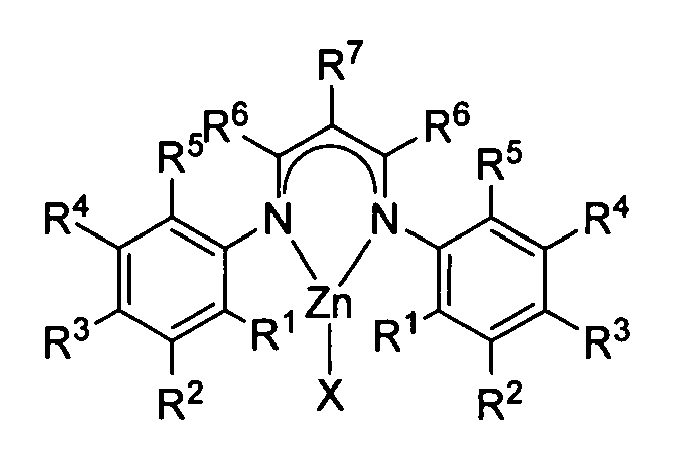
wherein R1, R2, R3, R4, R5, R6 and R7 are each independently selected from hydrogen, unsubstituted or substituted hydrocarbyl, or inert functional group, wherein two or more of said groups can be linked together to form one or more rings, wherein X is an hydrocarbyl radical having from 1 to 12 carbon atoms, an alkoxide group OR*, an amido group NR**2 or a borohydride group (BH4).
wherein R1, R2, R3, R4, R5, R6 and R7 are each independently selected from hydrogen, unsubstituted or substituted hydrocarbyl, or inert functional group, wherein two or more of said groups can be linked together to form one or more rings, wherein X is an hydrocarbyl radical having from 1 to 12 carbon atoms, an alkoxide group OR*, an amido group NR**2 or a borohydride group (BH4).
6. The process of any one of the preceding claims wherein the organometallic compound
is selected from [BDI]Zn(N(SiMe3)2), {[BDI]Zn(OiPr),}2, Zn(N(SiMe3)2), ZnEt2, Y(N(SiMe3)2), "Y(OiPr)3", and Al(OiPr)3.
7. The process of any one of the preceding claims wherein the alcohol is R'OH wherein
R' is an hydrocarbyl, linear or branched, having from 1 to 20 carbon atoms.
8. The process of claim 7 wherein the alcohol is isopropyl (iPr) or benzyl (Bn).
9. The process of any one of the preceding claims wherein the alcohol additionally contains
a functional group that is capping the end of each polycarbonate chain.
10. The process of any one of the preceding claims to prepare homo- or co-polymers of
carbonate and wherein the carbonate is a 5- or 6- membered cyclic carbonate selected
from trimethylenecarbonate (TMC), 2-benzyloxy-trimethylenecarbonate (BTMC), 2-hydroxy-trimethylenecarbonate
(TMCOH), 4-(benzyloxymethyl)-1,3-dioxolan-2-one (BDMC), 4-(hydroxymethyl)-1,3-dioxolan-2-one
(DMCOH), 2-oxy-trimethylenecarbonate (OTMC), dehydrotrimethylenecarbonate (DHTMC),
or a combination thereof.
11. Five- or six-membered carbonates selected from OTMC or DHTMC.
12. Homo- or co-polymers of carbonates obtainable by the process of any one of claims
1 to 10.
REFERENCES CITED IN THE DESCRIPTION
This list of references cited by the applicant is for the reader's convenience only. It does not form part of the European patent document. Even though great care has been taken in compiling the references, errors or omissions cannot be excluded and the EPO disclaims all liability in this regard.
Patent documents cited in the description
Non-patent literature cited in the description
- Bhanage B.M.Fujita S.Ikushima Y.Arai M.Green Chemistry, 2003, vol. 5, 429- [0002]
- Wang X.L.Zhuo, R.X.Liu L.J.He F.Liu G.J. Polym. Sci. Part A, 2002, vol. 40, 70- [0002]
- Wolinsky J.B.Ray III W.C.Colson Y.L.Grinstaff M.W.Macromolecules, 2007, vol. 40, 7065- [0002]
- Aresta M.Dibenedetto A.J. Mol. Catal. A: Chem., 2006, vol. 257, 149- [0002]
- Robicki G.Rakoczy P.Parzuchowski P.Green Chem., 2005, vol. 7, 529- [0002]
- Ubaghs L.Fricke N.Keul H.Hôcker H.Macromol. Rapid Comm., 2004, vol. 25, 517- [0002]
- Komura H.Yoshino T.lshido Y.Bulletin of the chemical society of Japan, 1973, vol. 46, 550- [0002]
- Matsumoto K.Fuwa S.Shimojo M.Kitajima H.Bull. Chem. Soc. Jpn, 1996, vol. 69, 2977- [0002]
- Kricheldorf H.R.Stricker A.Macromol. Chem. Phys., 2000, vol. 201, 2557- [0003]
- Darensbourg D.Wonsook C.Poulomi G.Casseday R.Macromol., 2006, vol. 37, 4374- [0003]
- Dobrzinsky P.Pastusiak M.Bero M.J. Polym. Sci. Part A Polym. Chem., 2004, vol. 43, 1913- [0003]
- Kuran W.Sobczak M.Listos T.Debek C.Florjanczyk Z.Polymer., 2000, vol. 41, 8531- [0003]
- Palard I.Schappacher M.Belloncle B.Soum A.Guillaume S.Chem. Eur. J., 2007, vol. 13, 1511- [0003]
- Zhao B.Lu C.Shen Q.J. Appl. Polym. Sci., 2004, vol. 25, 517- [0003]
- Sheng H.Zhou L.Zhang Y.Yao Y.Shen Q.J. Polym. Sci. Part A Polym. Chem., 2007, vol. 45, 1210- [0003]
- Bisht S.K.Svirkin Y.Y.Henderson L.A.Gross R.A.Macromolecules, 1997, vol. 30, 7735- [0003]
- Gross R.A.Kumar A.Kalra B.Chem. Rev., 2001, vol. 101, 2109- [0003]
- Koboyashi S.Uyama H.Kimura S.Chem. Rev., 2001, vol. 101, 3793- [0003]
- Nederberg F.Lohmeijer G.B.Leibfarth F.Pratt R.C.Choi J.Dove A.P.Waymouth R.M.Heidrich J.L.Biomacromolecules, 2007, vol. 8, 153- [0003]
- Mindemark J.Hilborn J.Bowden T.Macromolecules, 2007, vol. 40, 3515- [0003]
- B.M. ChamberlainM. ChengD.R. MooreT.M. OvittE.B. LobkovskyG.W. CoatesJ. Am. Chem. Soc., 2001, vol. 123, 3229- [0020] [0043]