|
(11) | EP 2 153 853 A1 |

| (12) | EUROPEAN PATENT APPLICATION |
|
|
|
|
||||||||||||||||||||
| (54) | Composition of indicator for detecting sterilization |
| (57) It is an object of the present invention to provide a simple and sanitary composition
of a sterilization indicator for detecting completion of sterilization by clearly
changing the color hue thereof without any bad smell, which is used mainly for high-pressure
steam sterilization and where necessary simply applicable for ethylene oxide gas sterilization.
Thereby the sterilization indicator composition comprises a saccharide and a monoazo
dye. |
Technical Field
[0001] The present invention relates to a composition used for a sterilization indicator that detects completion of high-pressure steam sterilization of pharmaceuticals and ethylene oxide gas sterilization of medical devices.
Background Art
[0002] Because the pharmaceuticals, the medical devices and the like for an intervention are used under an aseptic condition, they are sterilized preliminary. The pharmaceuticals such as infusions and sanitary materials such as gauze are sterilized in an autoclave under high-pressure steam atmosphere, while the medical devices such as a catheter, an injection needle, a probe of an examination equipment are sterilized under ethylene oxide gas atmosphere.
[0003] In order to determine whether the sterilization is fully completed, a chemical indicator discolored upon a reaction with the high-pressure steam or the ethylene oxide gas is arranged with products to be sterilized such as the pharmaceuticals and the medical devices, and the color change of the chemical indicator is visually observed for the determination.
[0004] As a composition for a sterilization indicator discolored upon the reaction with both of the high-pressure steam and the ethylene oxide gas, Japanese Patent Provisional Publication No.03-138864 discloses a composition including a monoazo dye, and an organic acid or a metal salt thereof. When rapid high-pressure steam sterilization is detected using this composition, only the sterilization under a highly-limited condition can be detected. Because the polar organic acid and the metal salt thereof, which are necessary to be included in the composition in large amounts for sublimating the monoazo dye to discolor thereof, are hard to disperse in nonpolar binders and solvents thereof and thus hard to be applied onto a substrate, the composition to be ink cannot be prepared easily.
[0005] As a composition for a sterilization indicator discolored upon a reaction with both of the high-pressure steam and the ethylene oxide gas, Japanese Patent Provisional Publication No.3-138865 discloses a composition including a transition metal compound, a sulfur compound or sulfur, a monoazo dye, and an organic acid or a metal salt thereof, while Japanese Patent Provisional Publication No.2002-322315 discloses a composition including nicotinamide, isonicotinic acid hydrazide, a bismuth compound, sulfur or a sulfur compound, a polyamide-nitrocellulose resin and an acrylic-cellulose resin.
[0006] As a composition for a sterilization indicator discolored upon a reaction not only with high-pressure steam and ethylene oxide gas but also hydrogen peroxide low-temperature plasma and formalin, Japanese Patent Provisional Publication No.2002-323451 discloses a composition including a bismuth compound, a sulfur compound including sulfur, an organic acid compound, an urethane-nitrocellulose resin, a polyamide-nitrocellulose resin and an acrylic-alkyd-nitrocellulose resin. Especially during high-pressure steam sterilization, these compositions disclosed in Japanese Patent Provisional Publication Nos. 3-138865, 2002-322315 and 2002-323451 cause sulfurous smell derived from the sulfur or the sulfur compound included therein. Also, the color hues of these compositions change from chromatic color to between dark color and black color that is relatively difficult to be visually observed.
Disclosure of Invention
[0007] The present invention has been developed to solve the foregoing problems. It is an object of the present invention to provide a simple and sanitary composition of a sterilization indicator for detecting completion of sterilization by clearly changing the color hue thereof without any bad smell, which is used mainly for high-pressure steam sterilization and where necessary simply applicable for ethylene oxide gas sterilization. Also, it is another object of the present invention to provide a sterilization indicator to which the composition is firmly applied.
[0008] The composition of the sterilization indicator for detecting sterilization of the present invention developed for accomplishing the foregoing objects comprises a saccharide and a monoazo dye.
[0009] The monoazo dye of the composition of the sterilization indicator is benzothiazoleazobenzenes and/or azobenzenes.
[0010] The monoazo dye is at least one selected from the group consisting of the benzothiazoleazobenzenes represented by the following chemical formula (I)
(in the chemical formula (I), R1 is selected from the group consisting of a hydrogen atom, a hydroxyl group, an alkylsulfo group having 1 to 4 carbon atoms, an alkoxyl group having 1 to 4 carbon atoms, a halogen group, an aminoacyl group and nitro group; R2 is selected from the group consisting of a hydrogen atom, a hydroxyl group, an alkylsulfo group having 1 to 4 carbon atoms, a nitrate, an alkyl group having 1 to 4 carbon atoms, an acyloxy-substituted alkyl group having a principle-chain thereof of 1 to 4 carbon atoms, a cyano-substituted alkyl group having a principle-chain thereof of 1 to 4 carbon atoms, an alkoxy-substituted alkyl group having a principle-chain thereof of 1 to 4 carbon atoms and a halogen group; R3 and R4 are the same or different to each other and selected from the group consisting of a hydrogen atom, a hydroxyl group, an alkyl group having 1 to 4 carbon atoms, an alkoxyl group having 1 to 4 carbon atoms and an acylamino group; R5 and R6 are the same or different to each other and selected from the group consisting of a hydrogen atom, a hydroxyl group, a nitrate, an alkyl group having 1 to 4 carbon atoms, an acyloxy-substituted alkyl group having a principle-chain thereof of 1 to 4 carbon atoms, a cyano-substituted alkyl group having a principle-chain thereof of 1 to 4 carbon atoms, an alkoxy-substituted alkyl group having a principle-chain thereof of 1 to 4 carbon atoms and a hydroxy-substituted alkyl group having a principle-chain thereof of 1 to 4 carbon atoms),
and the azobenzenes represented by the following chemical formula (II)
(in the chemical formula (II), R7 and R8 are the same or different to each other and selected from the group consisting of a hydrogen atom, a hydroxyl group, a nitro group, a cyano group, a halogen group and an acylamino group; R9 and R10 are the same or different to each other and selected from the group consisting of a hydrogen atom, a hydroxyl group and an alkyl group having 1 to 4 carbon atoms; R11 and R12 are the same or different to each other and selected from the group consisting of a hydrogen atom, a hydroxyl group, an alkyl group having 1 to 4 carbon atoms, a phenyl group, a cyano-substituted alkyl group having a principle-chain thereof of 1 to 4 carbon atoms, a hydroxyl-substituted alkyl group having a principle-chain thereof of 1 to 4 carbon atoms and an acyloxy-substituted alkyl group having a principle-chain thereof of 1 to 4 carbon atoms.)
[0011] The saccharide is a reducing monosaccharide having at least a free aldehyde group or a hemiacetal group, or a polysaccharide having the monosaccharide as a repeating unit.
[0012] The saccharide is selected from the group consisting of starch, dextrin, alginic acid, carrageenan, gum arabic, agar, agarose, galactan, pectin, glucose, galactose, mannose, arabinose and a derivative thereof.
[0016] The sterilization indicator comprises a color-changing layer of the applied composition of the sterilization indicator onto a substrate or a product to be sterilized.
[0017] The substrate is made from paper or plastic and in a shape of a card, a tape, a sheet or a bag.
[0019] The composition of the sterilization indicator of the present invention sensitively and clearly discolors to a different color hue, which can be easily and visually observed, upon a reaction with either high-pressure steam or ethylene oxide gas. Depending on a sterilization condition of sterilization time, temperature of the high-pressure steam or concentration of the ethylene oxide gas, the composition discolors to a certain different color hue. Also, because the composition does not include sulfur and a sulfur compound, it does not cause sulfurous smell derived therefrom. Therefore, the composition is sanitary.
[0020] The sterilization indicator comprising such composition can be used for detecting completion of the sterilization by either of the high-pressure steam or the ethylene oxide gas. Therefore, it is convenient as it is unnecessary to prepare a different indicator for each sterilization method. In addition, by printing with or applying the composition to a substrate, the indicator comprising a firmly formed sterilization color-changing layer can be prepared easily and efficiently. Therefore, it can be prepared with high yield and thus less expensive and economical.
[0021] When the completion of the sterilization is detected by using the indicator, the color-changing layer thereof discolors to a clear and visible color hue having significant color difference with the previous color thereof, depending on sterilization time, temperature of the high-pressure steam sterilization or concentration of the ethylene oxide gas.
Brief Description of Drawings
[0022]
Fig. 1 is a type cross-sectional view of the sterilization indicator of the present invention.
Fig. 2 is a type cross-sectional view of the sterilization indicator of the present invention.
Explanations of Numeral References
[0023] 1 is a sterilization indicator, 4 is a color-changing layer, 5 is a substrate of the indicator, 7 is an adhesive layer, 9 is a plastic protective layer 9.
[0024] Hereunder, embodiments of the present invention are explained in detail. However, it is not intended to be limited to these embodiments.
[0025] Embodiment of preparing the composition of the sterilization indicator to which the present invention is applied is explained.
[0026] The composition of the sterilization indicator is prepared by homogeneously kneading a monoazo dye as colorant and a saccharide, and if necessary a solvent, a resin or an ink vehicle including thereof, using a kneader.
[0027] To 100 parts by weight of the ink vehicle including an ink components such as the solvent and the resin, 0.01 to 50 parts by weight, preferably 0.01 to 5 parts by weight, of the monoazo dye and 0.1 to 50 parts by weight of the saccharide can be used.
[0028] The saccharide can be a reducing monosaccharide having a free aldehyde group or a hemiacetal group, a polysaccharide having the reducing monosaccharide as a repeating unit, or the polysaccharide having the reducing monosaccharide and another monosaccharide as further repeating units.
[0029] Example of the monosaccharide is aldohexose such as glucose, galactose, mannose, arabinose and so on, or a derivative thereof.
[0030] It is preferable that the polysaccharide is soluble a polysaccharide into cold water or hot water and is especially natural polysaccharide. Such water soluble polysaccharide is highly safe. Also, during high-pressure steam sterilization, such polysaccharide acts on keeping the high-pressure steam in the color-changing layer, and within the temperature range thereof, hydrolysis reaction tends to be performed partially.
[0031] Concrete examples of the polysaccharide are a polysaccharide having a group bonding of a reducing group of a monosaccharide and an alcoholic hydroxyl group of another monosaccharide. Concrete examples thereof are starch, dextrin, alginic acid, carrageenan, gum arabic, agar or agarose as one component thereof, galactan and pectin. The polysaccharide can be a derivative thereof.
[0032] It is preferable that the polysaccharide is carrageenan, agar or alginic acid that has a sulfonic group or a carboxyl group as an acidic group within the molecular structure thereof. Even if the organic acid is included in the composition only in small amounts, the acidic group within the molecular structure accomplishes to perform the hydrolysis reaction with the polysaccharide by the high-pressure steam easily. Therefore, the reaction is performed well and thus the composition discolors upon the reaction sensitively.
[0033] The saccharide can be salt or ester. Concrete examples thereof are sodium alginate, potassium alginate, calcium alginate and alginic acid ester.
[0034] The monoazo dye is the colorant that discolors upon the reaction with the monosaccharide comprising the free aldehyde group, the monosaccharide comprising the hemiacetal group or the partially hydrolyzed polysaccharide under the high-pressure steam atmosphere, or is other colorant that discolors upon the reaction with the ethylene oxide gas.
[0035] It is preferable that the monoazo dye is a compound bonded with an aromatic ring and an aromatic ring/a heterocyclic ring by a monoazo group, preferably a compound bonded with a benzene ring that may have a substituent and another benzene ring that may have a substituent or a benzothiazole ring, through a monoazo group. It is furthermore preferable that the monoazo dye is the one represented by the chemical formula (I) and (II). Concrete examples thereof are C.I. (Color Index) Disperse Red 58, C.I. Disperse Red 88, C.I. Disperse Red 110, C.I. Disperse Red 117, C.I. Disperse Red 137, C.I. Disperse Violet 38, C.I. Disperse Violet 43, C.I. Disperse Blue 102, Disperse Red 152, Disperse Red 153 and Disperse Red 154.
[0036] If the amount of the monoazo dye in the composition is less than 0.01 parts by weight, the color hue of the color-changing layer formed by the composition is diluted. On the other hand, if the amount thereof is more than 5 parts by weight, the color hue thereof discolors too thick, and as a result, it is difficult to visually observe a slight change of the color hue.
[0037] As an accelerator agent for a reaction of the monoazo dye and the saccharide and also for a hydrolysis reaction of the polysaccharide, the sterilization indicator may include the organic acid at most of 50 parts by weight. Example of the organic acid is a carboxylic acid that is not a weak acid and has lower acidity compared to that of hydrochloric acid, sulfuric acid and nitric acid.
[0038] Examples of the carboxylic acid are an aliphatic carboxylic acid, an aromatic carboxylic acid, and a derivative thereof. Examples thereof are a saturated or unsaturated aliphatic carboxylic acid having a substituent such as an aryl group, an acyl group, a hydroxy group, an alkoxy group, an amino group and an oxo group, or the salt thereof, or an aromatic carboxylic acid having a substituent such as an alkyl group, an acyl group, a hydroxy group, an alkoxy group, an amino group or an oxo group, or the salt thereof.
[0039] Examples of the aliphatic carboxylic acid or the derivative thereof are acrylic acid, adipic acid, L-asparagine acid, azelaic acid, itaconic acid, undecylenic acid, citric acid, glutaconic acid, diglycol acid, DL-tartaric acid, sebacic acid, sorbic acid, naphthene acid, hippuric acid, barbituric acid, pivalic acid, pyruvic acid, fumaric acid, benzilic acid, maleic acid, malonic acid and methacrylic acid.
[0040] Examples of the aromatic carboxylic acid or the derivative thereof are an aromatic monocarboxylic acid such as benzoic acid, methylbenzoic acid, dimethylbenzoic acid, 2,3-dimethylbenzoic acid, 3,5-dimethylbenzoic acid, 2,3,4-trimethylbenzoic acid, 2,3,5-trimethylbenzoic acid, 2,4,5-trimethylbenzoic acid, 2,4,6-trimethylbenzoic acid, 3,4,5-trimethylbenzoic acid, 2-hydroxybenzoic acid, methoxybenzoic acid, hydroxy(methyl)benzoic acid, 2-hydroxy-3-methylbenzoic acid, 2-hydroxy-4-methylbenzoic acid, 2-hydroxy-5-methylbenzoic acid, 2,3-dihydroxybenzlic acid, 2,4-dihydroxybenzlic acid, 2,5-dihydroxybenzoic acid, 2,6-dihydroxybenzoic acid, 3,4-dihydroxybenzoic acid, 3,5-dihydroxybenzoic acid, 4-hydroxy-3-methoxybenzoic acid, 3-hydroxy-4-methoxybenzoic acid, 3,4-dimethoxybenzoic acid, 2,3-dimethoxybenzoic acid, 2,4-dihydroxy-6-methylbenzoic acid, 3,4,5-trihydroxybenzoic acid, 4-hydroxy-3,5-dimethylbenzoic acid, 2,4,5-trimethoxybenzoic acid, 2-(carboxymethyl)benzoic acid, 3-(carboxymethyl)benzoic acid, 4-(carboxymethyl)benzoic acid, 2-(carboxycarbonyl)benzoic acid, 3-(carboxycarbonyl)benzoic acid, 4-(carboxycarbonyl)benzoic acid, anthranilic acid, salicylic acid, nicotinic acid; an aromatic polycarboxylic acid such as phthalic acid, isophthalic acid, terephthalic acid, hemimellitic acid, trimellitic acid and trimesic acid.
[0041] The ink vehicle includes a resin that does not lose a color-changing property of the indicator and has a sufficient adhesive property to a substrate. Examples thereof are ethyl cellulose, nitrocellulose, a butyral resin, an acrylic resin such as an acrylic ester resin and a methacrylic acid ester resin, a polyamide resin, a phenol resin and a modified rosin maleic acid resin. These may include solvent and be a commercially-available ink vehicle.
[0042] The composition of the sterilization indicator may further comprise an additive used for a general indicator composition such as a colored pigment, a rust inhibitor, a surface-active agent and an auxochrome agent.
[0043] When the composition of the sterilization indicator includes silica, barium sulfate, clay, magnesium carbonate, calcium carbonate and so on as the additive, permeability of the high-pressure steam or the ethylene oxide gas is improved. When the composition comprises the pigment with high heat resistance or gas resistance, the color hue thereof around the sterilization can be easily adjusted for better visual observation.
[0044] If necessary, a solvent is used together with the resin in order for the composition of the sterilization indicator to accomplish better printing performance. The solvent may include an organic solvent such as mineral spirit, solvent naphtha, methyl alcohol, isopropyl alcohol, methyl ethyl ketone, methyl isobutyl ketone, cyclohexanone, ethyl acetate, propyl acetate, isobutyl acetate, isoamyl acetate, butyl cellosolve, toluene, xylene and so on; tung oil, linseed oil, soybean oil, castor oil, a dry oil and the mixture thereof. These can be used solely or plurally.
[0045] The composition of the sterilization indicator can be prepared as an ink by being kneaded using a kneader such as a ball mill, a roll mill, a sand mill and so on.
[0046] Hereunder, examples of manufacturing a sterilization indicator using the composition are explained referring to Fig. 1.
[0047] The composition of the sterilization indicator is printed on an indicator substrate 5 to form a color-changing layer 4, and then a sterilization indicator 1 is obtained.
[0048] The sterilization indicator is printed on the substrate made from paper such as high-quality paper or crepe paper, the substrate made from plastic, synthetic paper, fabric or nonwoven textile such as a card, a tape, a sheet and a bag;
or the substrate for packaging the product to be sterilized made therefrom such as a paper-made packaging sheet and paper-made packaging bag. The sterilization indicator may be directly printed to the product to be sterilized.
[0050] Products to be sterilized are put in an autoclave to set therein, and the sterilization indicator in a shape of a card is placed therein. The autoclave is rocked and filled with high-pressure steam in order to sterilize the products. As a result, the monoazo dye of the color-changing layer is reacted with the high-pressure steam and then discolors.
[0051] When the products are sterilized by the ethylene oxide gas in a tank for sterilization instead of by the high-pressure steam sterilization, the monoazo dye in a color-changing layer of the sterilization indicator is reacted with the ethylene oxide gas and then discolors.
[0052] Although it is still not fully explained about a mechanism that the color-changing layer, to which the composition of the sterilization indicator was printed, changes the color hue under the high-pressure steam atmosphere or the ethylene oxide gas atmosphere, it is assumed as follows.
[0053] A sterilization indicator comprising a color-changing layer prepared by the composition that includes the monoazo dye represented by the chemical formula (I) and the organic acid is explained as an example. When the indicator is exposed to high-pressure steam, proton derived from the organic acid in the presence of steam reacts to the monosaccharide. As a result, nitrogen of a monoazo group of the monoazo dye and an aldehyde group of the monosaccharide react through the proton as a catalyst. It results in changing the density of electrons of the monoazo dye, and therefore the color-changing layer discolors for example from red to green.
[0054] A sterilization indicator comprising a color-changing layer prepared by the composition that includes starch as the polysaccharide having principle components of amylase of alpha-1,4 glycosidical-bonded D-glucose and amylopection of alpha-1,6 glycosidical-bonded D-glucose, the monoazo dye represented by the chemical formula (I), and the organic acid is explained as another example. When the indicator is exposed to high-pressure steam, proton derived from the organic acid in the presence of steam reacts to the polysaccharide. As a result, a glucopyranose group as a glucose cyclic isomer, which is partially polysaccharide, opens circular by being hydrolyzed and then produces an aldehyde group. Nitrogen of a monoazo group of the monoazo dye and the produced aldehyde group react through the proton as a catalyst. It results in changing the density of electrons of the monoazo dye, and therefore the color-changing layer discolors for example from red to green.
[0055] On the other hand, when the indicator is exposed to ethylene oxide gas, the ethylene oxide gas reacts to the monoazo dye that results the change of resonance structure thereof. Moreover, as the change of color is accelerated by proton generated due to the coexistence of the organic acid, the color-changing layer discolors for example from red to blue.
[0056] Incidentally, depending on a sterilization condition of the product to be sterilized, the discolored color hue, thickness of the color and discoloring speed can be adjusted by controlling sorts or concentration of the saccharide, the monoazo dye and the organic acid in the composition.
[0057] A sterilization indicator 1 to which the present invention is applied is shown in Fig. 2. As shown in Fig. 2, a color-changing layer 4 of the sterilization indicator 1 may be covered by a plastic protective layer 9 through an adhesive layer 7 because this enables to prevent the composition of the indicator and the compound of the composition from being contaminated due to a contact with a product to be sterilized.
[0058] Hereunder, examples of preparing the composition of the sterilization indicator of the present invention and the sterilization indicator using thereof are explained. Also, comparative examples of preparing the composition to which the present invention is not applied and the sterilization indicator using thereof are explained.
(Examples 1A to 1I and Comparative Example 1a)
[0059] By kneading the compounds for Examples 1A to 1I and Comparative Example 1a shown in Table 1 in a ball mill for 24 hours, each ink was obtained as a composition for a sterilization indicator used for a screen printing. The sterilization indicators printed with the obtained ink on films were sterilized by high-pressure steam at 134C° for 8 minutes. The color hue of the indicators prepared by the ink of Examples 1A to 1I discolored from red to green.
[0060] The sterilization indicators printed with the obtained ink on films were sterilized in a constant temperature oven at 137C° for 30 minutes. The color hue of the indicators of Examples 1A to 1I and Comparative Example 1a stayed as red.
[0061] Other sterilization indicators similarly printed onto high-quality paper with the obtained ink were sterilized by ethylene oxide gas for 240 minutes. The sterilization condition thereof was the ethylene oxide gas with 20% of carbon dioxide gas; 100kPa of feed gas; 50C° of temperature; 50% of relative humidity. The color hue of the indicators of Examples 1A to 1I and Comparative Example 1a discolored from red to blue after a lapse of 120 to 240 minutes.
(Examples 2A to 2B and Comparative Example 2a)
[0062] By kneading the compounds for Examples 2A, 2B and Comparative Example 2a shown in Table 2 in a ball mill for 24 hours, each ink was obtained as a composition for a sterilization indicator used for a screen printing. The sterilization indicators printed with the obtained ink on films were sterilized by high-pressure steam at 134C° for 1 minute. The color hue of the indicators prepared by the ink of Examples 2A and 2B discolored from red to green.
[0063] The sterilization indicators printed with the obtained ink on films were sterilized in a constant temperature oven at 137C° for 30 minutes. The color hue of the indicators of Examples 2A, 2B and Comparative Example 2a stayed as red.
[0064] Other sterilization indicators similarly printed onto high-quality paper with the prepared ink were sterilized by ethylene oxide gas for 240 minutes. The sterilization condition thereof was ethylene oxide gas with 20% of carbon dioxide gas; 100kPa of feed gas; 50C° of temperature; 50% of relative humidity. The color hue of the indicators of Examples 2A, 2B and Comparative Example 2a discolored from red to blue after a lapse of 120 to 240 minutes.
(Example 3A and Comparative Example 3a)
[0065] By kneading the compounds for Example 3A and Comparative Example 3a shown in Table 3 in a ball mill for 24 hours, each ink was obtained as a composition for a sterilization indicator used for a screen printing. The sterilization indicators printed with the obtained ink on films were sterilized by high-pressure steam at 134C° for 1 minute. The color hue of the indicator prepared by the ink of Example 3A discolored from red to green.
[0066] The sterilization indicators printed with the obtained ink on films were sterilized in a constant temperature oven at 137C° for 30 minutes. The color hue of both the indicators of Example 3A and Comparative Example 3a stayed as red.
[0067] Other sterilization indicators similarly printed onto high-quality paper with the obtained ink were sterilized by ethylene oxide gas for 240 minutes. The sterilization condition thereof was ethylene oxide gas with 20% of carbon dioxide gas; 100kPa of feed gas; 50C° of temperature; 50% of relative humidity. The color hue of the indicator of Example 3A discolored from red to blue after a lapse of 120 to 240 minutes.
[0068] As shown in Table 1 to 3, the color hue of the sterilization indicator to which the present invention is applied, clearly discolors within the prescribed sterilization time by responding to the high-pressure steam and the ethylene oxide gas.
Industrial Applicability
[0069] The composition of the sterilization indicator of the present invention is useful for manufacturing the indicator for detecting the completion of sterilization of pharmaceuticals, medical devices and processed foods such as pouch-packed foods.
1. A composition of a sterilization indicator for detecting sterilization comprising
a saccharide and a monoazo dye.
2. The composition of the sterilization indicator according to Claim 1, wherein the monoazo
dye is benzothiazoleazobenzenes and/or azobenzenes.
3. The composition of the sterilization indicator according to Claim 2, wherein the monoazo
dye is at least one selected from the group consisting of the benzothiazoleazobenzenes
represented by the following chemical formula (I)
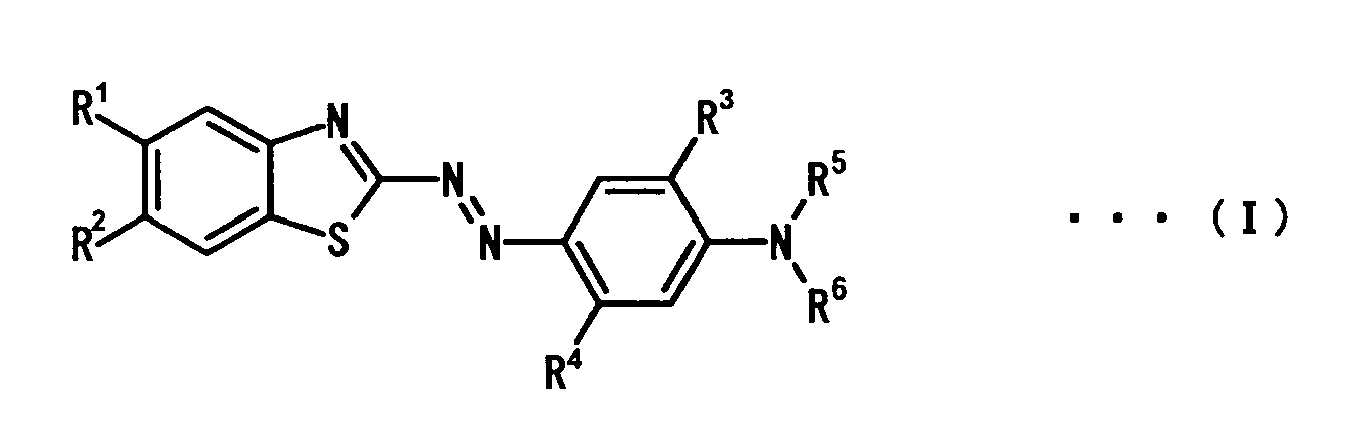
(in the chemical formula (I), R1 is selected from the group consisting of a hydrogen atom, a hydroxyl group, an alkylsulfo group having 1 to 4 carbon atoms, an alkoxyl group having 1 to 4 carbon atoms, a halogen group, an aminoacyl group and nitro group; R2 is selected from the group consisting of a hydrogen atom, a hydroxyl group, an alkylsulfo group having 1 to 4 carbon atoms, a nitrate, an alkyl group having 1 to 4 carbon atoms, an acyloxy-substituted alkyl group having a principle-chain thereof of 1 to 4 carbon atoms, a cyano-substituted alkyl group having a principle-chain thereof of 1 to 4 carbon atoms, an alkoxy-substituted alkyl group having a principle-chain thereof of 1 to 4 carbon atoms and a halogen group; R3 and R4 are the same or different to each other and selected from the group consisting of a hydrogen atom, a hydroxyl group, an alkyl group having 1 to 4 carbon atoms, an alkoxyl group having 1 to 4 carbon atoms and an acylamino group; R5 and R6 are the same or different to each other and selected from the group consisting of a hydrogen atom, a hydroxyl group, a nitrate, an alkyl group having 1 to 4 carbon atoms, an acyloxy-substituted alkyl group having a principle-chain thereof of 1 to 4 carbon atoms, a cyano-substituted alkyl group having a principle-chain thereof of 1 to 4 carbon atoms, an alkoxy-substituted alkyl group having a principle-chain thereof of 1 to 4 carbon atoms and a hydroxy-substituted alkyl group having a principle-chain thereof of 1 to 4 carbon atoms),
and the azobenzenes represented by the following chemical formula (II)
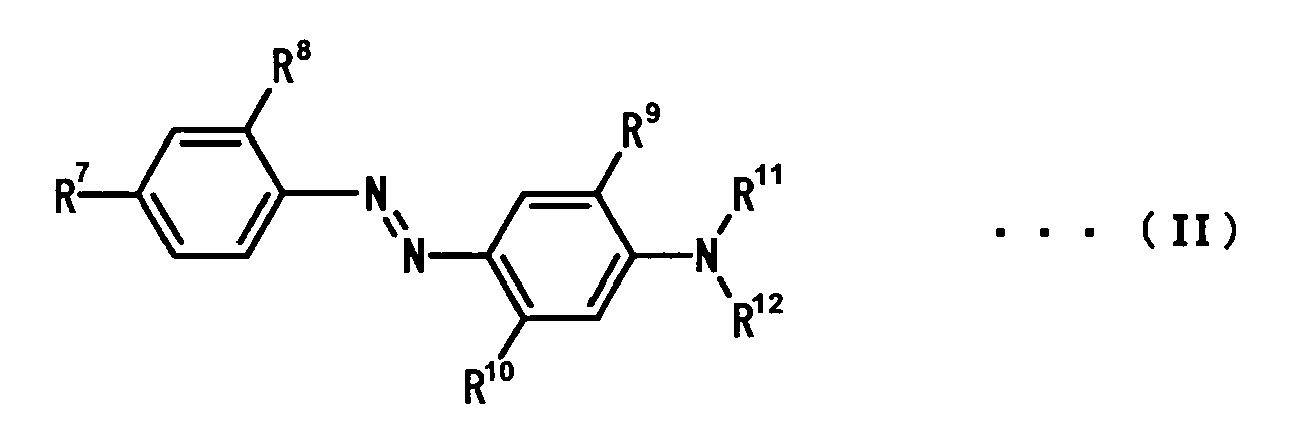
(in the chemical formula (II), R7 and R8 are the same or different to each other and selected from the group consisting of a hydrogen atom, a hydroxyl group, a nitro group, a cyano group, a halogen group and an acylamino group; R9 and R10 are the same or different to each other and selected from the group consisting of a hydrogen atom, a hydroxyl group and an alkyl group having 1 to 4 carbon atoms; R11 and R12 are the same or different to each other and selected from the group consisting of a hydrogen atom, a hydroxyl group, an alkyl group having 1 to 4 carbon atoms, a phenyl group, a cyano-substituted alkyl group having a principle-chain thereof of 1 to 4 carbon atoms, a hydroxyl-substituted alkyl group having a principle-chain thereof of 1 to 4 carbon atoms and an acyloxy-substituted alkyl group having a principle-chain thereof of 1 to 4 carbon atoms.)
(in the chemical formula (I), R1 is selected from the group consisting of a hydrogen atom, a hydroxyl group, an alkylsulfo group having 1 to 4 carbon atoms, an alkoxyl group having 1 to 4 carbon atoms, a halogen group, an aminoacyl group and nitro group; R2 is selected from the group consisting of a hydrogen atom, a hydroxyl group, an alkylsulfo group having 1 to 4 carbon atoms, a nitrate, an alkyl group having 1 to 4 carbon atoms, an acyloxy-substituted alkyl group having a principle-chain thereof of 1 to 4 carbon atoms, a cyano-substituted alkyl group having a principle-chain thereof of 1 to 4 carbon atoms, an alkoxy-substituted alkyl group having a principle-chain thereof of 1 to 4 carbon atoms and a halogen group; R3 and R4 are the same or different to each other and selected from the group consisting of a hydrogen atom, a hydroxyl group, an alkyl group having 1 to 4 carbon atoms, an alkoxyl group having 1 to 4 carbon atoms and an acylamino group; R5 and R6 are the same or different to each other and selected from the group consisting of a hydrogen atom, a hydroxyl group, a nitrate, an alkyl group having 1 to 4 carbon atoms, an acyloxy-substituted alkyl group having a principle-chain thereof of 1 to 4 carbon atoms, a cyano-substituted alkyl group having a principle-chain thereof of 1 to 4 carbon atoms, an alkoxy-substituted alkyl group having a principle-chain thereof of 1 to 4 carbon atoms and a hydroxy-substituted alkyl group having a principle-chain thereof of 1 to 4 carbon atoms),
and the azobenzenes represented by the following chemical formula (II)
(in the chemical formula (II), R7 and R8 are the same or different to each other and selected from the group consisting of a hydrogen atom, a hydroxyl group, a nitro group, a cyano group, a halogen group and an acylamino group; R9 and R10 are the same or different to each other and selected from the group consisting of a hydrogen atom, a hydroxyl group and an alkyl group having 1 to 4 carbon atoms; R11 and R12 are the same or different to each other and selected from the group consisting of a hydrogen atom, a hydroxyl group, an alkyl group having 1 to 4 carbon atoms, a phenyl group, a cyano-substituted alkyl group having a principle-chain thereof of 1 to 4 carbon atoms, a hydroxyl-substituted alkyl group having a principle-chain thereof of 1 to 4 carbon atoms and an acyloxy-substituted alkyl group having a principle-chain thereof of 1 to 4 carbon atoms.)
4. The composition of the sterilization indicator according to Claim 1, wherein the saccharide
is a reducing monosaccharide having at least a free aldehyde group or a hemiacetal
group, or a polysaccharide having the monosaccharide as a repeating unit.
5. The composition of the sterilization indicator according to Claim 1, wherein the saccharide
is selected from the group consisting of starch, dextrin, alginic acid, carrageenan,
gum arabic, agar, agarose, galactan, pectin, glucose, galactose, mannose, arabinose
and a derivative thereof.
6. The composition of the sterilization indicator according to Claim 5, wherein the derivative
is salt or ester.
7. The composition of the sterilization indicator according to Claim 1, further comprising
an organic acid.
8. The composition of the sterilization indicator according to Claim 7, wherein the organic
acid is an aliphatic carboxylic acid or an aromatic carboxylic acid.
9. A sterilization indicator comprising a color-changing layer of the applied composition
of the sterilization indicator according to Claim 1 onto a substrate or a product
to be sterilized.
10. The sterilization indicator according to Claim 9, wherein the substrate is made from
paper or plastic and in a shape of a card, a tape, a sheet or a bag.
11. The sterilization indicator according to Claim 9, wherein the color-changing layer
is covered with a protective layer made of plastic film.
REFERENCES CITED IN THE DESCRIPTION
This list of references cited by the applicant is for the reader's convenience only. It does not form part of the European patent document. Even though great care has been taken in compiling the references, errors or omissions cannot be excluded and the EPO disclaims all liability in this regard.
Patent documents cited in the description