|
(11) | EP 2 155 653 B1 |

| (12) | EUROPEAN PATENT SPECIFICATION |
|
|
| (54) |
PROCESS FOR PREPARING ALKYL ALKOXYBENZOATES IN ONE STEP EINSTUFIGES VERFAHREN ZUR HERSTELLUNG VON ALKOXYBENZOESÄUREALKYLESTER PROCÉDÉ DE PRÉPARATION D'ALKYL-ALCOXYBENZOATES EN UNE ÉTAPE |
|
|
|||||||||||||||||||||||||||||||
| Note: Within nine months from the publication of the mention of the grant of the European patent, any person may give notice to the European Patent Office of opposition to the European patent granted. Notice of opposition shall be filed in a written reasoned statement. It shall not be deemed to have been filed until the opposition fee has been paid. (Art. 99(1) European Patent Convention). |
[0001] The present invention relates to a process for preparing a compound of the formula:
by contacting hydroxy benzoic acid with a compound of the formula RnX, wherein R is an alkyl group having 1 to 6 carbon atoms and X is an acid rest group having a valency n.
[0002] The acid esters are useful as selective inhibitor in stereospecific polymerization. They are also used as starting materials in synthesis of various medicinal or drug compounds.
[0003] Processes for the preparation of said esters are known in the art. For example, in RO 88669 A, Ar(OR)n is alkylated with RX (X= Br, I, sulfate) at 20-30 °C in a polar aprotic solvent like dimethylsulfoxide, dimethylformamide or dimethylacetamide in the presence of 10-15% NaOH or KOH.
[0004] JP 60214753A discloses a one step process for preparing the esters from hydroxyl benzoic acid with several inert solvents, but the yields reported are poor and all below 60%.
[0005] Other processes start from potassium salts of aromatic hydroxy carboxylic acids using a phase transfer catalyst. Preparation of the potassium salts requires evaporation of water or mechanical grinding, which is not viable on industrial scale.
[0006] The known methods have several disadvantages like either use of a large excess of polar aprotic solvents, or use of ammonium salts as phase transfer catalyst that are difficult to break or neutralize, and which hence may pollute waste water. Other methods employ dry reaction at very high temperature, which is also industrially not feasible.
[0007] The main object of the invention is to provide a process for preparing alkyl benzoic acid alkyl ester in one step with a high yield using an organic solvent that can be easily recovered.
[0008] This aim is achieved according to the invention with a process wherein in an organic solvent in the presence of an aqueous solution of a base hydroxy benzoic acid is contacted with a compound of the formula RnX, wherein R is an alkyl group having 1 to 6 C-atoms and X is an acid rest group having a valence n, and wherein the organic solvent is an alkyl substituted aromatic hydrocarbon and in that the reaction is carried out at a pH of 8-10.
[0009] Preferably a xylene, toluene or a mixture thereof is used as solvent. Xylene is understood to be o-xylene, m-xylene, p-xylene or mixtures thereof.
[0010] The process according to the invention allows preparing alkyl alkoxy benzoates in one step, starting from one single raw material, viz. aromatic hydroxyl carboxylic acid, with high yield of over 95% and without having to recover any intermediate or added compound.
[0011] The process comprises the production of a compound having formula (1)
wherein R is an alkyl radical having 1 to 6, preferably 1 to 2 carbon atoms by reacting a compound of the formula (2)
with a compound of the formula RnX, wherein R is an alkyl group having 1 to 6 carbon atoms and X is an acid rest group having a valency n. The OH-group can be in the m-, o- or p- position.
[0013] Preferred acid rest groups are sulfates. Preferably RnX is a dialkylsulfate of the formula (RO)2SO2, in which R has the above meaning.
[0014] The amount of alkyl groups present in the amount of compound RnX is at least equal to the number of alkyl groups to be introduced in the amount of compound (2) and preferably exceeds this last amount by at least 20% and at most 100%. Preferably the excess of alkyl groups is between 25 and 50%.
[0015] The contacting takes place in the presence of an alkyl substituted aromatic hydrocarbon solvent, toluene or xylene being preferred and in the presence of a base in an aqueous solution. The amount of the base is chosen such that the pH value is in the range from 8 to 10 and preferably the process is carried out at a temperature above 70°C, preferably in the range of 80-95°C.
[0016] The benzene ring can be (mono- or di-) substituted with halogen atoms, alkyl groups having 1 to 4 C-atoms and/or alkoxy groups having 1 to 4 C-atoms.
[0017] The process according to invention allows converting hydroxy benzoic acid to corresponding alkoxy benzoic acid alkyl esters in one step with an excellent yield and purity. The reaction can be performed by adding hydroxy benzoic acid to a mixture of the organic solvent and the compound having the formula RnX. An aqueous base solution is added to the mixture and the pH of the reaction is set between 8 and 10. The concentration of the base in the aqueous solution can be 10-50% and is preferably 25-40% and more preferably 30-40%. Sodium and potassium hydroxide are preferred as the base.
[0018] After completion of the base addition, the mass is stirred further for 15 minutes. Then the aqueous phase and the organic solvent phase are separated. The organic solvent layer is washed with water and distilled to give the pure product directly.
[0019] The invention is elucidated by the following illustrative experiments, without being restricted thereto.
Example 1
[0020] 15 g (0.108 mole) of 4-hydroxybenzoic acid and 54.4 g (0.353 mole) of diethylsulfate were introduced into a glass flask containing xylene (75 ml). The mixture was heated to 90 °C. The pH of mass was checked by a calibrated pH electrode immersed in the mass. The pH was maintained between 8-10 by drop wise addition under stirring of a 35% aqueous NaOH solution [13.6 g (0.326 mole) NaOH flakes in 25 ml water] in 90 minutes. The mass is further stirred for 15 minutes after addition of NaOH. Then the mass was cooled to ambient temperature and 75 ml water was added. The upper organic phase containing the formed product was separated from the lower aqueous phase, washed with 2% NaOH aqueous solution (75 ml) and finally with water. Evaporation of solvent gave 20.5 g (97.6%) of p-ethoxy ethylbenzoate having purity 98.6% by HPLC.
Example 2
[0021] 30 g (0.217 mole) of 4-hydroxybenzoic acid and 87.6 g (0.695 mole) of dimethylsulfate were introduced into a glass flask containing xylene (150 ml). The mixture was heated to 85°C. The pH of mass was checked by a calibrated pH electrode immersed in the mass. The pH was maintained between 8-10 by drop wise addition under stirring of a 76 gm (0.665 mole) 35% aqueous NaOH solution in 60 minutes. The mass is further stirred for 15 minutes after addition of NaOH. Then the mass was cooled to ambient temperature and 150 ml water was added. The upper organic phase containing the formed product was separated from the lower aqueous phase, washed with 2% NaOH aqueous solution (75 ml) and finally with water. Evaporation of solvent gave 35.3 g (98.05%) of p-methoxy methylbenzoate having purity 98.42% by HPLC.
Comparative Experiment A
[0022] 15 g (0.108 mole) of 4-hydroxybenzoic acid and 54.4 g (0.353 mole) of diethylsulfate were introduced into a glass flask containing xylene (75 ml). The mixture was heated to 90 °C. The pH of mass was checked by a calibrated pH electrode immersed in the mass. The pH was maintained between 6-7.5 by drop wise addition under stirring of a 35% aqueous NaOH solution [13.6 g (0.326 mole) NaOH flakes in 25 ml water] in 30 minutes. The mass is further stirred for 15 minutes after addition of NaOH. Then the mass was cooled to ambient temperature and 75 ml water was added. The upper organic phase containing the formed product was separated from the lower aqueous phase, washed with 2% NaOH aqueous solution (75 ml) and finally with water. Evaporation of solvent gave 15.3 g (72.8 %) of p-ethoxy ethylbenzoate having purity 99.2 % by HPLC.
[0023] It appears that the lower pH causes the yield to drop with respect to the working Examples, where the pH was kept between 8 and 10.
Comparative Experiment B
[0024] 15 g (0.108 mole) of 4-hydroxybenzoic acid and 54.4 g (0.353 mole) of diethylsulfate were introduced into a glass flask containing xylene (75 ml). The mixture was heated to 90 °C. The pH of mass was checked by a calibrated pH electrode immersed in the mass. The pH was maintained between 10.5 and 12 by drop wise addition of a 35% aqueous NaOH solution [13.6 g (0.326 mole) NaOH flakes in 25 ml water]. The mass is further stirred for 15 minutes and cooled to ambient temperature. The mass was diluted by addition of 75 ml water. The upper organic phase containing the formed product was separated from the lower aqueous phase, washed with 2% NaOH aqueous solution (75 ml) and finally with water. Evaporation of solvent gave 15.0 g (yield: 71.4%) of p-ethoxy ethylbenzoate having purity 96.57% by HPLC.
1. Process for preparing a compound of the formula
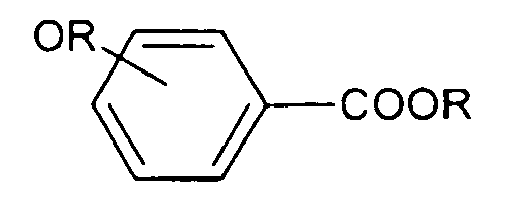
by contacting, in an organic solvent in the presence of an aqueous solution of a base, hydroxy benzoic acid with a compound of the formula RnX, wherein R is an alkyl group having 1 to 6 C-atoms and X is an acid rest group having a valence n, characterized in that the organic solvent is an alkyl substituted aromatic hydrocarbon and in that the reaction is carried out at a pH of 8-10.
by contacting, in an organic solvent in the presence of an aqueous solution of a base, hydroxy benzoic acid with a compound of the formula RnX, wherein R is an alkyl group having 1 to 6 C-atoms and X is an acid rest group having a valence n, characterized in that the organic solvent is an alkyl substituted aromatic hydrocarbon and in that the reaction is carried out at a pH of 8-10.
2. Process according to claim 1, wherein the organic solvent is at least one compound
chosen from the group consisting of toluene and xylenes.
3. Process according to claim 1, wherein X is sulfate.
4. Process according to claim 1, wherein R is methyl or ethyl.
5. Process according to claim 1, wherein X is sulfate and R is methyl or ethyl.
6. Process according to any of claims 1 to 5, wherein the number of alkyl groups present
in the amount of compound RnX is between 25 and 50% in excess to the number of hydroxyl and acid groups to be
substituted.
7. Process according to any of claims 1 to 5, wherein the reaction is carried out at
80-95°C.
1. Verfahren zur Herstellung einer Verbindung der Formel
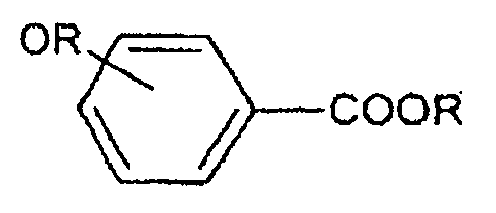
durch Inberührungbringen von Hydroxybenzoesäure mit einer Verbindung der Formel RnX, worin R für eine Alkylgruppe mit 1 bis 6 C-Atomen steht und X für eine Säurerestgruppe mit einer Wertigkeit n steht, in einem organischen Lösungsmittel in Gegenwart einer wäßrigen Lösung einer Base, dadurch gekennzeichnet, daß es sich bei dem organischen Lösungsmittel um einen alkylsubstituierten aromatischen Kohlenwasserstoff handelt und die Umsetzung bei einem pH-Wert von 8-10 durchgeführt wird.
durch Inberührungbringen von Hydroxybenzoesäure mit einer Verbindung der Formel RnX, worin R für eine Alkylgruppe mit 1 bis 6 C-Atomen steht und X für eine Säurerestgruppe mit einer Wertigkeit n steht, in einem organischen Lösungsmittel in Gegenwart einer wäßrigen Lösung einer Base, dadurch gekennzeichnet, daß es sich bei dem organischen Lösungsmittel um einen alkylsubstituierten aromatischen Kohlenwasserstoff handelt und die Umsetzung bei einem pH-Wert von 8-10 durchgeführt wird.
2. Verfahren nach Anspruch 1, bei dem es sich bei dem organischen Lösungsmittel um mindestens
eine Verbindung aus der Gruppe bestehend aus Toluol und Xylolen handelt.
3. Verfahren nach Anspruch 1, bei dem X für Sulfat steht.
4. Verfahren nach Anspruch 1, bei dem R für Methyl oder Ethyl steht.
5. Verfahren nach Anspruch 1, bei dem X für Sulfat steht und R für Methyl oder Ethyl
steht.
6. Verfahren nach einem der Ansprüche 1 bis 5, bei dem die Zahl der Alkylgruppen in der
Menge der Verbindung RnX in einem Überschuß, bezogen auf die Zahl der zu substituierenden Hydroxyl- und Säuregruppen,
zwischen 25 und 50% vorliegt.
7. Verfahren nach einem der Ansprüche 1 bis 5, bei dem man die Umsetzung bei 80-95°C
durchführt.
1. Procédé de préparation d'un composé de formule
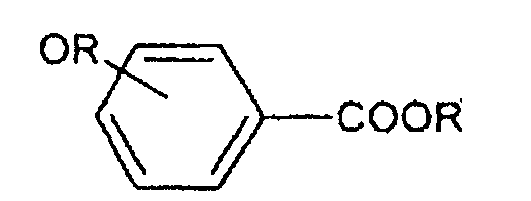
par la mise en contact, dans un solvant organique en présence d'une solution aqueuse d'une base, de l'acide hydroxybenzoïque avec un composé de formule RnX dans laquelle R est un groupement alkyle ayant de 1 à 6 atomes de C et X est un groupement de reste acide ayant une valence n, caractérisé en ce que le solvant organique est un hydrocarbure aromatique substitué par un alkyle et en ce que la réaction est effectuée à un pH de 8-10.
par la mise en contact, dans un solvant organique en présence d'une solution aqueuse d'une base, de l'acide hydroxybenzoïque avec un composé de formule RnX dans laquelle R est un groupement alkyle ayant de 1 à 6 atomes de C et X est un groupement de reste acide ayant une valence n, caractérisé en ce que le solvant organique est un hydrocarbure aromatique substitué par un alkyle et en ce que la réaction est effectuée à un pH de 8-10.
2. Procédé selon la revendication 1, caractérisé en ce que le solvant organique est au moins un composé choisi dans le groupe constitué du toluène
et de xylènes.
3. Procédé selon la revendication 1, caractérisé en ce que X est un sulfate.
4. Procédé selon la revendication 1, caractérisé en ce que R est méthyle ou éthyle.
5. Procédé selon la revendication 1, caractérisé en ce que X est un sulfate et R est méthyle ou éthyle.
6. Procédé selon l'une quelconque des revendications 1 à 5, caractérisé en ce que le nombre de groupements alkyle présents dans la quantité de composé RnX est de 25 à 50% en excès par rapport au nombre de groupements hydroxy et acides
à substituer.
7. Procédé selon l'une quelconque des revendications 1 à 5, caractérisé en ce que la réaction est effectuée à 80-95°C.
REFERENCES CITED IN THE DESCRIPTION
This list of references cited by the applicant is for the reader's convenience only. It does not form part of the European patent document. Even though great care has been taken in compiling the references, errors or omissions cannot be excluded and the EPO disclaims all liability in this regard.
Patent documents cited in the description