| (19) |
 |
|
(11) |
EP 2 162 338 B1 |
| (12) |
EUROPEAN PATENT SPECIFICATION |
| (45) |
Mention of the grant of the patent: |
|
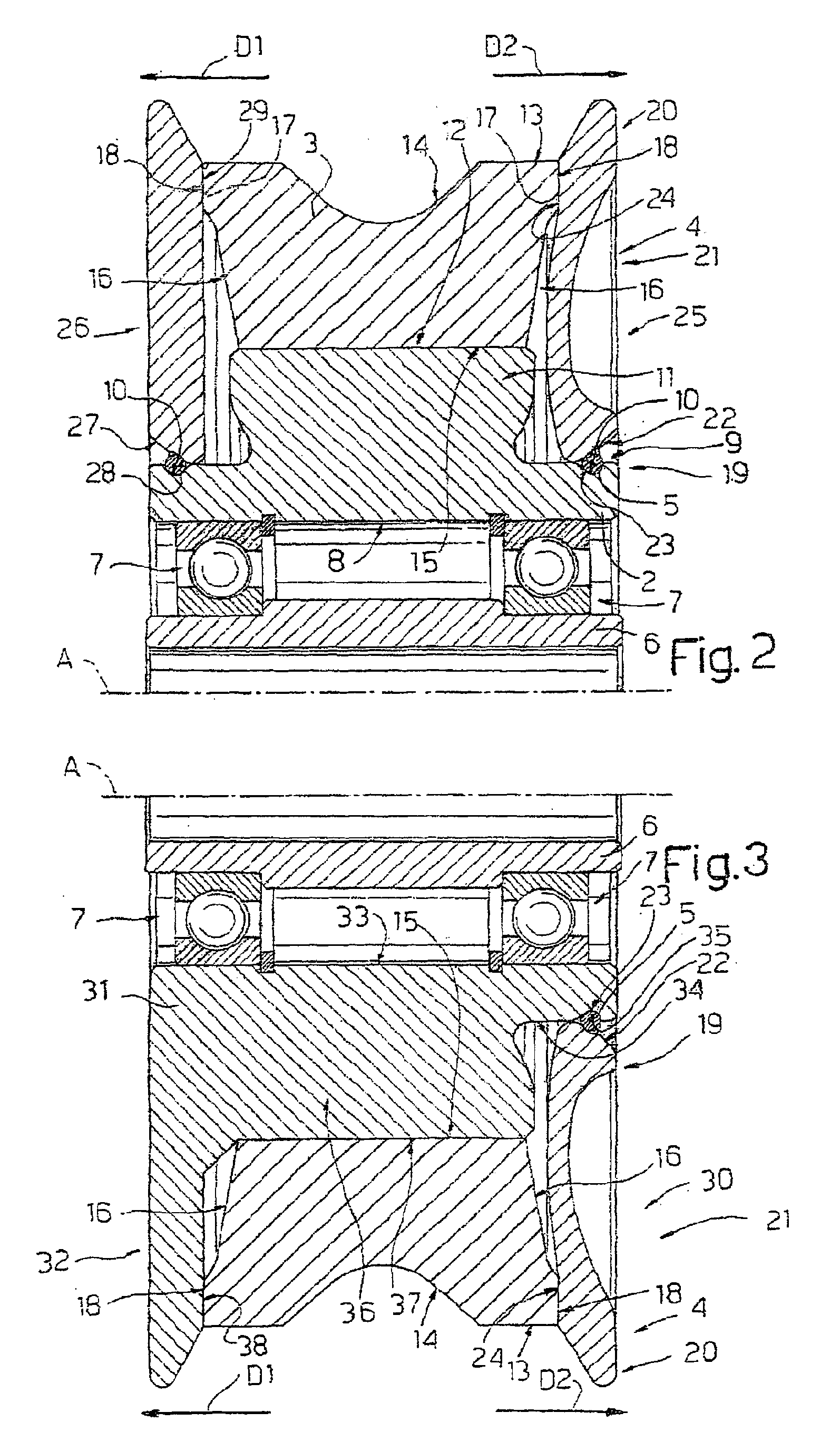
13.03.2013 Bulletin 2013/11 |
| (22) |
Date of filing: 30.05.2008 |
|
| (51) |
International Patent Classification (IPC):
|
| (86) |
International application number: |
|
PCT/EP2008/056726 |
| (87) |
International publication number: |
|
WO 2008/145748 (04.12.2008 Gazette 2008/49) |
|
| (54) |
TRANSPORTATION SYSTEM CABLE ROLLER
KABELROLLE FÜR EIN TRANSPORTSYSTEM
ROULEAU DE CÂBLE DE SYSTÈME DE TRANSPORT
|
| (84) |
Designated Contracting States: |
|
AT BE BG CH CY CZ DE DK EE ES FI FR GB GR HR HU IE IS IT LI LT LU LV MC MT NL NO PL
PT RO SE SI SK TR |
| (30) |
Priority: |
01.06.2007 IT MI20071128
|
| (43) |
Date of publication of application: |
|
17.03.2010 Bulletin 2010/11 |
| (73) |
Proprietor: Rolic Invest S.ar.l. |
|
1724 Luxembourg (LU) |
|
| (72) |
Inventor: |
|
- WIESER, Hartmut
I-39040 Racines (IT)
|
| (74) |
Representative: Eccetto, Mauro et al |
|
Studio Torta S.p.A.
Via Viotti, 9
10121 Torino
10121 Torino (IT) |
| (56) |
References cited: :
EP-B- 1 277 637
DE-U1- 20 118 573
|
DE-A1- 3 131 433
|
|
| |
|
|
|
|
| |
|
| Note: Within nine months from the publication of the mention of the grant of the European
patent, any person may give notice to the European Patent Office of opposition to
the European patent
granted. Notice of opposition shall be filed in a written reasoned statement. It shall
not be deemed to
have been filed until the opposition fee has been paid. (Art. 99(1) European Patent
Convention).
|
TECHNICAL FIELD
[0001] The present invention relates to a transportation system cable roller.
[0002] More specifically, the present invention relates to a transportation system cable
roller comprising an annular body, which rotates about an axis of rotation and has
a central hole, and an outer surface having at least one circumferential groove; a
cable supporting ring made of hard, substantially elastically undeformable material
and located about the annular body; at least one lateral disk located about the annular
body; and an elastic lock ring housed in the circumferential groove and contacting
the lateral disk to prevent axial movement of the lateral disk with respect to the
annular body.
BACKGROUND ART
[0003] The type of roller described above is extremely simple to assemble, but fails to
provide for sufficient grip on the cable supporting ring.
[0004] One solution to the above problem is described in Patent
EP 1,277,637 B1, which describes a roller of the above type, in which a lateral disk or rubber ring
is interposed between the lateral disk and the supporting ring. This solution has
the advantage of compensating for any clearance, ensuring sufficient grip, and preventing
loose connection of the lateral disk and the supporting ring.
[0005] The solution described in Patent
EP 1,277,637 B1, however, has the drawback of requiring replacement of the disks and rubber rings,
which, because of the varying temperatures and severe climatic conditions in general
in which they operate, are subject to rapid wear. Consequently, the type of roller
described in Patent
EP 1,277,637 B1 calls for frequent maintenance to replace the worn disks or rubber rings.
[0006] Document
DE 20 118 573 U1 discloses a toothed wheel for a chain where the toothed wheel is provided elastic
lateral disc for guiding the chain.
DISCLOSURE OF INVENTION
[0007] It is an object of the present invention to provide a transportation system cable
roller of the type described above, designed to eliminate the drawbacks of the known
art, and which, in particular, is cheap to produce, while at the same time being of
long working life.
[0008] According to the present invention, there is provided a cable roller of a cable transportation
system. The roller comprises an annular body, which rotates about an axis of rotation
and has a central hole, and an outer surface having at least one circumferential groove;
a cable supporting ring made of hard, substantially elastically undeformable material
and fitted to the annular body to slide in directions parallel to the axis of rotation;
two lateral disks located about the annular body to lock the supporting ring axially;
and at least one elastic lock ring housed in the circumferential groove and contacting
a lateral disk to prevent axial movement of the lateral disk with respect to the annular
body; the roller being characterized in that at least one of the lateral disks comprises
an inner portion; an outer portion; and an intermediate portion elastically deformable
in said directions to permit relative movement between the outer portion and the inner
portion.
[0009] The roller according to the present invention needs no auxiliary elastic members,
comprises a relatively small number of component parts, and combines easy, slack-free
assembly with an extremely long working life.
BRIEF DESCRIPTION OF THE DRAWINGS
[0010] A number of non-limiting embodiments of the present invention will be described by
way of example with reference to the accompanying drawings, in which:
Figure 1 shows a section, with parts removed for clarity, of a cable roller in accordance
with the present invention;
Figure 2 shows a section, with parts removed for clarity, of a cable roller in accordance
with a first variation of the present invention;
Figure 3 shows a section, with parts removed for clarity, of a cable roller in accordance
with a second variation of the present invention.
BEST DIODE FOR CARRYING OUT THE INVENTION
[0011] With reference to Figure 1, number 1 indicates a cable roller of a transportation
system not shown in the attached drawings.
[0012] Roller 1 comprises an annular body 2; a supporting ring 3 fitted about annular body
2; two annular lateral disks 4 located about annular body 2, on opposite sides of
supporting ring 3; and two elastic lock rings 5 for preventing axial movement of lateral
disks 4 with respect to annular body 2.
[0013] Roller 1 is fitted about a hub 6 by means of two bearings 7, and rotates about an
axis of rotation A.
[0014] Annular body 2 has an inner surface 8; an outer surface 9, along which are formed
two lateral circumferential grooves 10; and an annular projection 11 located between
the two circumferential grooves 10 and having a cylindrical face 12.
[0015] Supporting ring 3 is made of hard, substantially elastically undeformable material,
and is fitted in sliding manner to annular body 2. In the example shown, supporting
ring 3 is fitted in sliding manner to annular body 2 along cylindrical face 12 of
annular projection 11. Supporting ring 3 has an outer face 13, in which is formed
an annular groove 14 housing the cable (not shown in the drawings); an inner cylindrical
face 15 facing cylindrical face 12; two lateral faces 16 converging towards axis of
rotation A; and two lateral projections 17, each defined laterally by a face 18 contacting
a respective lateral disk 4.
[0016] Each lateral disk 4 is annular, is made of metal, is located about annular body 2,
and is elastically deformable in directions D1 and D2 parallel to axis of rotation
A. Each lateral disk 4 has an inside diameter enabling lateral disk 4 to be fitted
onto annular body 2 at circumferential grooves 10; and an outside diameter larger
than the outside diameter of supporting ring 3.
[0017] In the example shown, each lateral disk 4 comprises an inner portion 19, an outer
portion 20, and an intermediate portion 21. Each lateral disk 4 is convex in section,
with its convexity facing supporting ring 3, and intermediate portion 21 is much thinner
than inner portion 19 and outer portion 21.
[0018] This, together with the type of metal from which lateral disks 4 are made, results
in the elastic deformation parallel to axis of rotation A being substantially concentrated
in intermediate portion 21.
[0019] Each lateral disk 4 is fitted to annular body 2, and is fixed between an elastic
lock ring 5 and supporting ring 3. Elastic lock rings 5 are housed partly inside respective
circumferential grooves 10, and prevent withdrawal of lateral disks 4 from annular
body 2.
[0020] In other words, at assembly, lateral disks 4 are precompressed on opposite sides
against supporting ring 3, and are locked on opposite sides by elastic lock rings
5.
[0021] Inner portion 19 of each lateral disk 4 has a face 22 sloping with respect to axis
of rotation A and having a groove 23 partly engaged by one of elastic lock rings 5.
[0022] Outer portion 20 of each lateral disk 4 has a face 24 opposite face 22 and contacting
supporting ring 3. In the example shown, each lateral disk 4 and supporting ring 3
contact each other along respective faces 24 and 18.
[0023] In other words, each lateral disk 4 contacts elastic ring 5 along inner portion 19,
and supporting ring 3 along outer portion 20, and along opposite faces of lateral
disk 4.
[0024] In actual use, when the cable subjects supporting ring 3 to a force parallel to axis
of rotation A, supporting ring 3 pushes the outer portion 20 of one of lateral disks
4 in direction D1, and produces an equal opposite reaction at inner portion 19, at
the contact point between elastic lock ring 5 and lateral disk 4. These two forces
produce a bending moment which deforms intermediate portion 21 elastically and moves
outer portion 20 with respect to inner portion 19 in direction D1.
[0025] Because both lateral disks 4 are mounted with a given precompression, the outer portion
20 of the opposite lateral disk 4 follows the movement of supporting ring 3 and takes
up any slack that would theoretically be formed between supporting ring 3 and lateral
disk 4.
[0026] Number 25 in the Figure 2 variation indicates as a whole a cable roller of a transportation
system not shown in the attached drawings.
[0027] Roller 25 is identical to roller 1, except that one elastic lateral disk 4 is replaced
by a rigid lateral disk 26, which, like lateral disk 4, is fitted about annular body
2 and locked axially by an elastic lock ring 5.
[0028] Except for lateral disk 26, the other component parts of roller 25 are indicated
using the same reference numbers as for roller 1.
[0029] Annular lateral disk 26 is made of metal, and has a face 27 sloping with respect
to axis of rotation A and having a groove 28 partly engaged by one of elastic lock
rings 5.
[0030] The outer portion 20 of lateral disk 26 has a face 29 opposite face 27 and in contact
with supporting ring 3. In the example shown, lateral disk 26 and supporting ring
3 contact each other along respective faces 29 and 18.
[0031] Number 30 in the Figure 3 variation indicates as a whole a cable roller of a transportation
system not shown in the attached drawings.
[0032] Roller 30 is identical to roller 25, except that rigid lateral disk 26 and annular
body 2 are replaced by an annular body 31, from which a rigid lateral disk 32, with
the same function as rigid lateral disk 26, extends in one piece.
[0033] Annular body 31 has an inner surface 33; an outer surface 34, along which a lateral
circumferential groove 35 is formed; and an annular projection 36 located between
lateral disk 32 and circumferential groove 35, and having a cylindrical face 37.
[0034] Lateral disk 32 has a face 38 facing supporting ring 3 and which is positioned contacting
face 18 of supporting ring 3.
1. A cable roller (1; 25; 30) of a cable transportation system comprises an annular body
(2; 31), which rotates about an axis of rotation (A) and has a central hole, and an
outer surface (9) having at least one circumferential groove (10); a cable supporting
ring (3) made of hard, substantially elastically undeformable material and fitted
to the annular body (2) to slide in directions (D1, D2) parallel to the axis of rotation
(A); two lateral disks (4; 4, 26; 4, 32) located about the annular body (2) to lock
the supporting ring (3) axially; and at least one elastic lock ring (5) housed in
the circumferential groove (10) and contacting a lateral disk (4; 4, 26) to prevent
axial movement of the lateral disk (4; 4, 26) with respect to the annular body (2);
the roller (1) being characterized in that at least one of the lateral disks (4; 4, 26; 4, 32) comprises an inner portion (19);
an outer portion (20); and an intermediate portion (21) elastically deformable in
said directions (D1, D2) to permit relative movement between the outer portion (20)
and the inner portion (19).
2. A roller as claimed in Claim 1, characterized in that the intermediate portion (21) of the elastically deformable lateral disk (4) is of
a thickness smaller than the thickness of the inner portion (19) and outer portion
(20); said thicknesses being measured parallel to said directions (D1, D2).
3. A roller as claimed in Claim 1 or 2, characterized in that the inner portion (19) of the elastically deformable lateral disk (4) is positioned
contacting the elastic lock ring (5), and the outer portion (20) of the elastically
deformable lateral disk (4) is positioned contacting the supporting ring (3).
4. A roller as claimed in Claim 3, characterized in that the inner portion (19) of the elastically deformable lateral disk (4) comprises a
first face (22), in which is formed a groove (23) housing the elastic lock ring (5).
5. A roller as claimed in Claim 4, characterized in that the outer portion (20) comprises a second face (24) positioned contacting the supporting
ring (3).
6. A roller as claimed in Claim 5, characterized in that the second face (24) is opposite the first face (22).
7. A roller as claimed in any one of the foregoing Claims, characterized in that the elastically deformable lateral disk (4) has a convex cross section with its convexity
facing the supporting ring (3).
8. A roller as claimed in any one of the foregoing Claims, characterized in that the supporting ring (3) has an outer face (13); an inner face (15); and two lateral
projections (17), each positioned contacting a respective lateral disk (4; 4, 26;
4, 32).
9. A roller as claimed in Claim 8, characterized in that the supporting ring 3) has two lateral faces (16) converging towards the axis of
rotation (A).
10. A roller as claimed in any one of the foregoing Claims, characterized in that the annular body (2; 31) has an annular projection (11; 36) comprising a cylindrical
face (12; 37); the supporting ring (3) being fitted to the annular body (2; 31) along
said cylindrical face (12; 37).
11. A roller as claimed in any one of the foregoing Claims, characterized by comprising two elastically deformable disks (4) located on opposite sides of the
supporting ring (3).
12. A roller as claimed in any one of Claims 1 to 10, characterized by comprising a rigid lateral disk (26; 32); said supporting ring (3) being located
between the elastically deformable lateral disk (4) and the rigid lateral disk (26;
32).
13. A roller as claimed in Claim 12, characterized in that the rigid lateral disk (26) is fixed to the annular body (2) by means of an elastic
lock ring (5).
14. A roller as claimed in Claim 12, characterized in that the rigid lateral disk (32) forms an integral part of the annular body (31).
15. A roller as claimed in any one of Claims 1 to 14, characterized in that each elastically deformable lateral disk (4) is made of metal.
1. Kabelrolle (1; 25; 30) eines Seilbahn- bzw. Kabeltransportsystems, die umfasst: einen
ringförmigen Körper (2; 31), der sich um eine Drehachse (A) dreht und ein Mittelloch
und eine Außenoberfläche (9) mit wenigstens einer Umfangsrille (10) hat; einen Kabelhaltering
(3), der aus hartem, im Wesentlichen elastisch unverformbaren Material gefertigt ist
und auf den ringförmigen Körper (2) aufgesetzt ist, um sich in Richtungen (D1, D2)
parallel zu der Drehachse (A) zu drehen; zwei seitliche Scheiben (4; 4, 26; 4, 32),
die sich um den ringförmigen Körper (2) herum befinden, um den Haltering (3) axial
zu verriegeln; und wenigstens einen elastischen Verriegelungsring (5), der in der
Umfangsrille (10) untergebracht ist und eine seitliche Scheibe (4; 4, 26) berührt,
um die axiale Bewegung der seitlichen Scheibe (4; 4, 26) in Bezug auf den ringförmigen
Körper (2) zu verhindern; wobei die Rolle (1) dadurch gekennzeichnet ist, dass wenigstens eine der seitlichen Scheiben (4; 4, 26; 4, 32) einen inneren Abschnitt
(19), einen äußeren Abschnitt (20) und einen Zwischenabschnitt (21) aufweist, der
in die Richtungen (D1, D2) elastisch verformbar ist, um die Relativbewegung zwischen
dem äußeren Abschnitt (20) und dem inneren Abschnitt (19) zuzulassen.
2. Rolle nach Anspruch 1, dadurch gekennzeichnet, dass der Zwischenabschnitt (21) der elastisch verformbaren seitlichen Scheibe (4) eine
kleinere Dicke hat als die Dicke des inneren Abschnitts (19) und des äußeren Abschnitts
(20); wobei die Dicke parallel zu den Richtungen (D1, D2) gemessen wird.
3. Rolle nach Anspruch 1 oder 2, dadurch gekennzeichnet, dass der innere Abschnitt (19) der elastisch verformbaren seitlichen Scheibe (4) so positioniert
ist, dass er den elastischen Verriegelungsring (5) berührt, und der äußere Abschnitt
(20) der elastisch verformbaren seitlichen Scheibe (4) so positioniert ist, dass er
den Haltering (3) berührt.
4. Rolle nach Anspruch 3, dadurch gekennzeichnet, dass der innere Abschnitt (19) der elastisch verformbaren seitlichen Scheibe (4) eine
erste Seite (22) umfasst, in der eine Rille (23) ausgebildet ist, die den elastischen
Verriegelungsring (5) aufnimmt.
5. Rolle nach Anspruch 4, dadurch gekennzeichnet, dass der äußere Abschnitt (20) einen zweite Seite (24) umfasst, die so positioniert ist,
dass sie den Haltering (3) berührt.
6. Rolle nach Anspruch 5, dadurch gekennzeichnet, dass die zweite Seite (24) entgegengesetzt zu der ersten Seite (22) ist.
7. Rolle nach einem der vorhergehenden Ansprüche, dadurch gekennzeichnet, dass die elastisch verformbare seitliche Scheibe (4) einen konvexen Querschnitt hat, wobei
ihre Konvexität dem Haltering (3) zugewandt ist.
8. Rolle nach einem der vorhergehenden Ansprüche, dadurch gekennzeichnet, dass der Haltering (3) eine Außenseite (13), eine Innenseite (15) und zwei seitliche Vorsprünge
(17) hat, von denen jeder so positioniert ist, dass er eine jeweilige seitliche Scheibe
(4; 4, 26, 4, 32) berührt.
9. Rolle nach Anspruch 8, dadurch gekennzeichnet, dass der Haltering (3) zwei seitliche Seiten (16) hat, die in Richtung der Drehachse (A)
konvergieren.
10. Rolle nach einem der vorhergehenden Ansprüche, dadurch gekennzeichnet, dass der ringförmige Körper (2; 31) einen ringförmigen Vorsprung (11; 36) hat, der eine
zylindrische Seite (12; 37) hat, wobei der Haltering (3) entlang der zylindrischen
Seite (12; 37) auf den ringförmigen Körper (2; 31) aufgesetzt ist.
11. Rolle nach einem der vorangehenden Ansprüche, dadurch gekennzeichnet, dass sie zwei elastisch verformbaren Scheiben (4) umfasst, die auf entgegengesetzten Seiten
des Halterings (3) angeordnet sind.
12. Rolle nach einem der Ansprüche 1 bis 10, dadurch gekennzeichnet, dass sie eine steife seitliche Scheibe (26; 32) umfasst, wobei der Haltering (3) zwischen
der elastisch verformbaren seitlichen Scheibe (4) und der steifen seitlichen Scheibe
(26; 32) angeordnet ist.
13. Rolle nach Anspruch 12, dadurch gekennzeichnet, dass die steife seitliche Scheibe (26) mittels eines elastischen Klemmrings (5) an dem
ringförmigen Körper (2) befestigt ist.
14. Rolle nach Anspruch 12, dadurch gekennzeichnet, dass die steife seitliche Scheibe (32) einen integralen Teil des ringförmigen Körpers
(31) bildet.
15. Rolle nach einem der Ansprüche 1 bis 14, dadurch gekennzeichnet, dass jede elastisch verformbare Scheibe (4) aus Metall gefertigt ist.
1. Poulie de câble (1 ; 25 ; 30) d'un système de transport par câble, ladite poulie comprenant
un corps annulaire (2 ; 31), qui tourne autour d'un axe de rotation (A) et qui possède
un trou central, et une surface extérieure (9) comportant au moins une gorge circonférentielle
(10) ; une bague de support de câble (3) fabriquée en matériau dur sensiblement indéformable
élastiquement et rapportée au corps annulaire (2) pour coulisser dans des directions
(D1, D2) parallèles à l'axe de rotation (A) ; deux disques latéraux (4 ; 4, 26 ; 4,
32) placés autour du corps annulaire (2) pour immobiliser la bague de support (3)
axialement ; et au moins une bague d'immobilisation élastique (5) logée dans la gorge
circonférentielle (10) et en contact avec un disque latéral (4 ; 4, 26) pour empêcher
un mouvement axial du disque latéral (4 ; 4, 26) par rapport au corps annulaire (2)
; la poulie (1) étant caractérisée en ce que l'un des disques latéraux (4 ; 4, 26 ; 4, 32) comprend une portion intérieure (19)
; une portion extérieure (20) ; et une portion intermédiaire (21) déformable élastiquement
dans lesdites directions (D1, D2) pour permettre un mouvement relatif entre la portion
extérieure (20) et la portion intérieure (19).
2. Poulie selon la revendication 1, caractérisé en ce que la portion intermédiaire (21) du disque déformable élastiquement (4) est d'une épaisseur
inférieure à l'épaisseur de la portion intérieure (19) et de la portion extérieure
(20) ; ladite épaisseur étant mesurée parallèlement auxdites directions (D1, D2).
3. Poulie selon la revendication 1 ou 2, caractérisé en ce que la portion intérieure (19) du disque latéral déformable élastiquement (4) est positionnée
au contact de la bague d'immobilisation élastique (5), et la portion extérieure (20)
du disque latéral déformable élastiquement (4) est positionnée au contact de la bague
de support (3).
4. Poulie selon la revendication 3, caractérisé en ce que la portion intérieure (19) du disque latéral déformable élastiquement (4) comprend
une première face (22) dans laquelle est ménagée une gorge (23) logeant la bague d'immobilisation
élastique (5).
5. Poulie selon la revendication 4, caractérisé en ce que la portion extérieure (20) comprend une deuxième face (24) positionnée au contact
de la bague de support (3).
6. Poulie selon la revendication 5, caractérisé en ce que la deuxième face (24) est opposée à la première face (22).
7. Poulie selon l'une quelconque des revendications précédentes, caractérisé en ce que le disque latéral déformable élastiquement (4) a une section convexe dont la convexité
est dirigée vers la bague de support (3).
8. Poulie selon l'une quelconque des revendications précédentes, caractérisé en ce que la bague de support (3) possède une face extérieure (13) ; une face intérieure (15)
; et deux projections latérales (17), chacune étant positionnée au contact d'un disque
latéral respectif (4 ; 4, 26 ; 4, 32).
9. Poulie selon la revendication 8, caractérisé en ce que la bague de support (3) possède deux faces latérales (16) convergeant vers l'axe
de rotation (A).
10. Poulie selon l'une quelconque des revendications précédentes, caractérisé en ce que le corps annulaire (2 ; 31) possède une projection annulaire (11 ; 36) comprenant
une face cylindrique (12 ; 37) ; la bague de support (3) étant rapportée au corps
annulaire (2 ; 31) le long de ladite face cylindrique (12 ; 37).
11. Poulie selon l'une quelconque des revendications précédentes, caractérisé en ce qu'elle comprend deux disques déformables élastiquement (4) placés sur des côtés opposés
de la bague de support (3).
12. Poulie selon l'une quelconque des revendications 1 à 10, caractérisé en ce qu'elle comprend un disque latéral rigide (26 ; 32) ; ladite bague de support (3) étant
placée entre le disque latéral déformable élastiquement (4) et le disque latéral rigide
(26 ; 32).
13. Poulie selon la revendication 12, caractérisé en ce que le disque latéral rigide (26) est fixé au corps annulaire (2) au moyen d'une bague
d'immobilisation élastique (5).
14. Poulie selon la revendication 12, caractérisée en ce que le disque latéral rigide (32) forme une partie intégrante du corps annulaire (31).
15. Poulie selon l'une quelconque des revendications 1 à 14, caractérisé en ce que chaque disque latéral déformable élastiquement (4) est fabriqués en métal.

REFERENCES CITED IN THE DESCRIPTION
This list of references cited by the applicant is for the reader's convenience only.
It does not form part of the European patent document. Even though great care has
been taken in compiling the references, errors or omissions cannot be excluded and
the EPO disclaims all liability in this regard.
Patent documents cited in the description