| (19) |
 |
|
(11) |
EP 2 170 619 B1 |
| (12) |
EUROPEAN PATENT SPECIFICATION |
| (45) |
Mention of the grant of the patent: |
|
10.11.2010 Bulletin 2010/45 |
| (22) |
Date of filing: 04.07.2008 |
|
| (51) |
International Patent Classification (IPC):
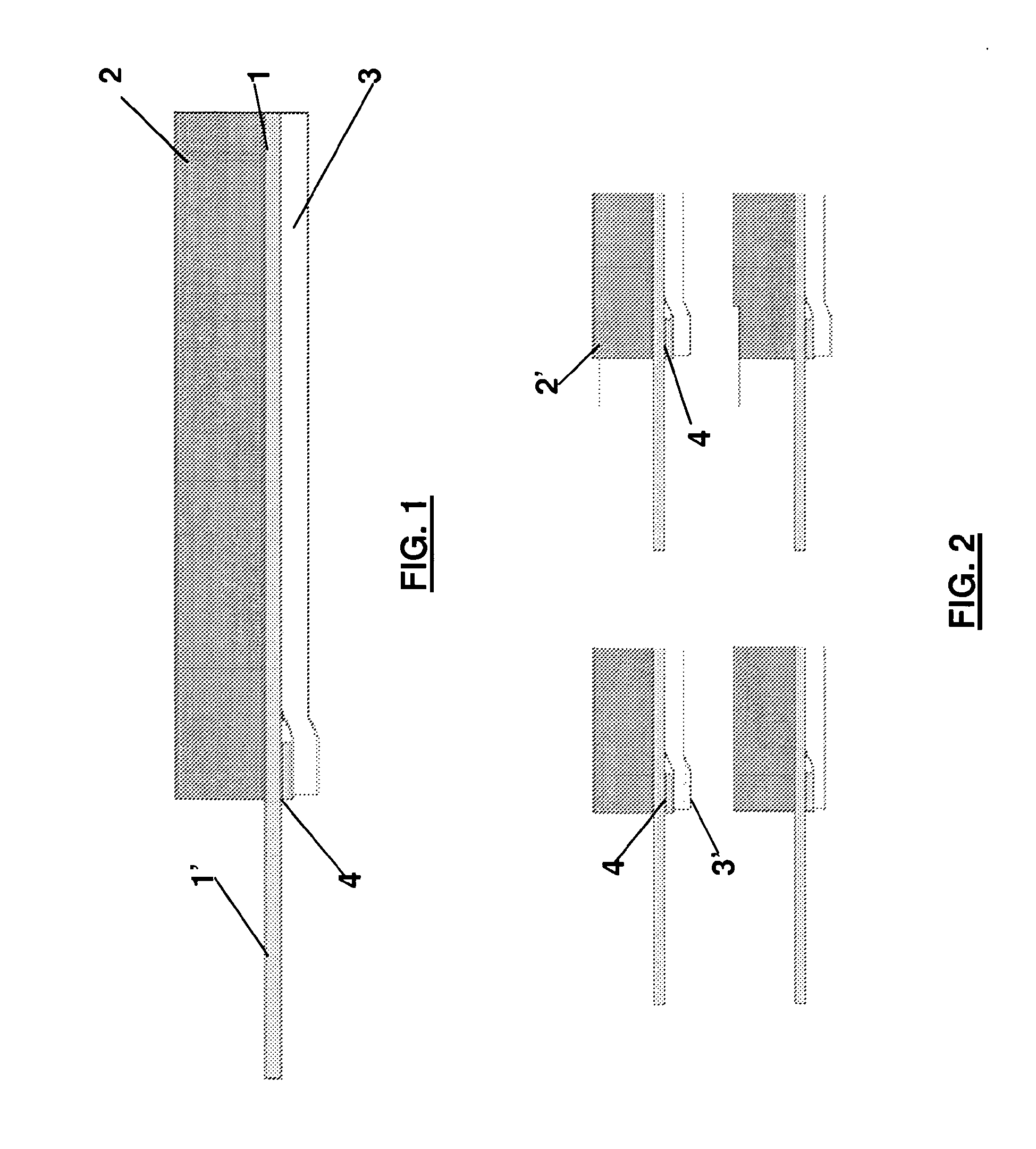
|
| (86) |
International application number: |
|
PCT/IB2008/052697 |
| (87) |
International publication number: |
|
WO 2009/007892 (15.01.2009 Gazette 2009/03) |
|
| (54) |
METHOD FOR OBTAINING A COATING (METAL-BACK PRINTING BLANKET) OF A TYPOGRAPHIC PRINTING
ROLL WITH NON-ADHESIVE PLASTIC SHEET, AND METAL-BACK PRINTING BLANKET THUS OBTAINED
VERFAHREN ZUM ERHALT EINER BESCHICHTUNG (EINES METALLRÜCKEN-DRUCKTUCHS) EINER TYPOGRAPHISCHEN
DRUCKWALZE MIT NICHT KLEBENDER KUNSTSTOFFFOLIE SOWIE SO ERHALTENES METALLRÜCKENSEITEN-DRUCKTUCH
PROCÉDÉ PERMETTANT D'OBTENIR, À L'AIDE D'UNE FEUILLE DE PLASTIQUE NON ADHÉSIVE, UN
REVÊTEMENT (BLANCHET MÉTALLIQUE D'IMPRESSION EN TRANSPARENCE) SUR UN ROULEAU D'IMPRESSION
TYPOGRAPHIQUE, ET BLANCHET MÉTALLIQUE D'IMPRESSION EN TRANSPARENCE AINSI OBTENU
|
| (84) |
Designated Contracting States: |
|
AT BE BG CH CY CZ DE DK EE ES FI FR GB GR HR HU IE IS IT LI LT LU LV MC MT NL NO PL
PT RO SE SI SK TR |
| (30) |
Priority: |
06.07.2007 IT MI20071350
|
| (43) |
Date of publication of application: |
|
07.04.2010 Bulletin 2010/14 |
| (73) |
Proprietor: Trelleborg Engineered Systems Italy S.P.A. |
|
20131 Milano (IT) |
|
| (72) |
Inventors: |
|
- INVERNIZZI, Gianpietro
I-26900 Lodi (IT)
- ZENI, Fausto
I-26826 Secugnago (IT)
|
| (74) |
Representative: Palladino, Saverio Massimo et al |
|
Notarbartolo & Gervasi S.p.A.
Corso di Porta Vittoria, 9
20122 Milano
20122 Milano (IT) |
|
| |
|
| Note: Within nine months from the publication of the mention of the grant of the European
patent, any person may give notice to the European Patent Office of opposition to
the European patent
granted. Notice of opposition shall be filed in a written reasoned statement. It shall
not be deemed to
have been filed until the opposition fee has been paid. (Art. 99(1) European Patent
Convention).
|
[0001] The present invention relates to a method for providing a coating (metal-back printing
blanket) of a typographic printing roll with a non-adhesive plastic sheet, and metal-back
printing blanket thus obtained.
[0002] Offset typographic printing machines are made up of a number of rolls, some of which
simply carry out a driving function in regard to the paper that is passing through,
whilst others are involved, in particular, in the printing process. Amongst the latter
rolls, at least one performs the function of taking the ink from the printing plate-
or matrix and transferring it to the paper. The roll or cylinder that is to receive
the ink from the plate and transfer it to the paper is made of steel coated with a
rubberized fabric referred to in the technical sector as "offset printing blanket"
which must guarantee that the ink is taken up efficiently from the printing matrix
with a consequent good transfer of the ink itself to the paper to be printed.
[0003] An offset printing blanket is typically made up of different layers, generally of
rubber and fabric; its outer part (top part) is made of rubber, and the bottom part
in contact with the printing roll is generally made of fabric.
[0004] In the case, instead, of a coating referred to in the technical sector and in what
follows as «metal-back printing blanket», the bottom part in contact with the printing
roll is constituted by a metal layer made of stainless steel.
[0005] The metal-back printing blanket is wound around the steel roll, which envisages a
transverse slit, referred to as "gap", within which the terminal edges of the metal
base of the metal-back printing blanket are inserted and fixed.
[0006] The printing roll and the metal-back printing blanket wound around it are subject
to phenomena of corrosion and wear due in part to mutual rubbing and in part to the
corrosive action of the chemical substances used both in the printing process and
in the steps of cleaning after use.
[0007] In order to overcome the effects of corrosion and wear it is known from the patent
No.
US-6912955 to coat the bottom surface of the metal-back printing blanket, which must come into
contact with the printing roll, with a plasma treatment.
[0008] It is likewise known to insert between the metal layer of the metal-back printing
blanket and the surface of the printing roll a sheet of plastic material, which can
be wound around the printing roll, or else fixed on the bottom surface of the metal
layer of the blanket. Fixing is obtained with an adhesive of the acrylic PSA (Pressure
Sensitive Adhesive) type.
[0009] The above adhesive, however, presents problems due to the fact that it does not resist
effectively the solvents used in the processes of printing and above all of washing
of the surface, in addition to not presenting a sufficient adhesion at temperatures
higher than 60°C.
[0010] The solvent tends to penetrate from the edges of the plastic sheet and corrode the
adhesive, forming also bubbles and peeling of the coating. The most problematical
consequence is that the plastic sheet tends to slide and displace with respect to
the metal layer of the metal-back printing blanket, with consequent machine downtime
for replacement of the metal-back printing blanket itself and consequent reduction
in productivity.
[0011] Likewise known to the art is to use, in the field of coatings of the classic offset-printing-blanket
type, a plastic sheet without adhesive between the surface of the printing roll and
the offset printing blanket. The sheet is applied underneath the entire surface of
the offset printing blanket, including the terminal edges, and is inserted in the
gap together with said edges, where is then engaged and fixed with purposely provided
stays.
[0012] In the case of the metal-back printing blanket, however, there is no possibility
of anchoring the plastic sheet inside the gap of the printing roll in so far as the
fixing system is different.
[0013] Consequently, the purpose of the present invention is to overcome the aforesaid drawbacks
and indicate a method for providing the coating of the metal-back-printing-blanket
type for a typographic printing roll with a non-adhesive plastic sheet, and a metal-back
printing blanket thus obtained, which prevents penetration of the solvents and guarantees
perfect adhesion of the plastic sheet to the metal-back printing blanket.
[0014] The subject of the present invention is a method for providing a coating for a typographic
printing roll, said coasting, referred to as "metal-back printing blanket", comprising
at least one metal layer, one or more upper layers, and a non-adhesive sheet of plastic
material on the bottom surface of the metal layer, said method being
characterized in that it comprises the step of gluing one or more edges of the non-adhesive sheet of plastic
material to the metal layer by means of an adhesive material applied between the edge
of the plastic sheet and the metal layer.
[0015] A particular subject of the present invention is a method for providing a coating
(metal-back printing blanket) for a typographic printing roll with a non-adhesive
plastic sheet, and a metal-back printing blanket thus obtained, as will be described
more fully in the claims, which form an integral part of the present description.
[0016] Further purposes and advantages of the present invention will emerge clearly from
the ensuing detailed description of an example of embodiment thereof (and of its variants)
and from the annexed plate of drawings, which is provided purely by way of explanatory
and non-limiting example and in which:
figure 1 shows a cross-sectional side view of the metal-back printing blanket provided
with plastic sheet, forming the subject of the present invention;
figure 2 shows a detail of Figure 1 regarding a step of milling.
[0017] With reference to Figure 1, the reference number 1 designates the metal layer of
the metal-back printing blanket, whilst the reference number 2 designates the set
of the upper layers of the metal-back printing blanket (one or more layers) obtained
using a well-known technique.
[0018] The reference number 3 designates a sheet of plastic material, for example, polyester,
set on the bottom surface of the metal layer 1 of the blanket. Preferably, the plastic
sheet 3 occupies a major part of the bottom surface of the metal layer, with the exclusion
of the edge 1', which is folded back and inserted in the gap of the printing roll
not represented in the figure.
[0019] Then according to the main aspect of the present invention, one or more edges of
the plastic sheet 3 are glued to the metal layer 1 by means of an adhesive material,
which, in this example of embodiment, is an adhesive tape 4 applied between the edge
of the plastic sheet 3 and the adjacent metal layer 1.
[0020] Preferably, the adhesive tape is of the thermo-adhesive type, provided with thermoplastic
or thermosetting glue, which is able to undergo vulcanizing and cross-linking, and
proves resistant to the solvents typically used and to the high temperatures, higher
than 60°C, which can develop during normal use of the metal-back printing blanket.
[0021] The adhesive tape can be of a single-layer or multilayer type, even with intermediate
supporting layers, which can be made, for example, of plastic material (polyester,
polyvinyl chloride, polypropylene, polyurethane, etc.), of paper, or else of non-woven
fabric.
[0022] The glue of the adhesive tape can comprise, for example, one or more of the following
materials: thermoplastic polyurethane, polyvinyl chloride, copolymers with vinyl acetate,
thermosetting polyurethane, polyester, polyamide, polyolephin, phenolic resins, epoxy
adhesives, polyurethane adhesives, polyacrylic adhesives, etc.
[0023] According to another example of embodiment, the adhesive material 4 can also present
as fluid or gel layer with a material composition comprising one or more materials,
for example, chosen from amongst the ones referred to above, which is spread or applied
with a purposely provided tool, for example, a paintbrush, a spatula, a roller, a
gun or by spraying.
[0024] Preferably, the adhesive tape 4 is applied only to the edge of the plastic sheet
set at the so-called "leading edge" of the metal-back printing blanket, i.e., the
edge that is in front with respect to the direction of rotation of the printing roll,
at one side of the gap of the printing roll, since in this point there is the highest
stress due to sliding of the plastic sheet 3 with respect to the metal layer 1 and/or
to the printing roll, and it is hence in this point that adhesion by gluing is obtained.
[0025] Obviously, the tape can appropriately be applied on a number or all of the sides
of the plastic sheet, on the side edges and on the so-called "trailing edge", the
edge that is at the back with respect to the direction of rotation of the printing
roll, at the other side of the gap of the printing roll.
[0026] With reference to Figure 2, in order to prevent the thickness of the adhesive tape
4 from creating an undesirable overall thickening of the metal-back printing blanket
in the points in which it is applied, a thickening that could adversely affect proper
rotation of the printing roll and a correct printing process, there is preferably
carried out a milling of the outer edge 3' of the plastic sheet 3 on which the tape
4 is applied so as to render the overall thickness of the stretch that comprises the
edge of the plastic sheet and the adhesive tape uniform. Alternatively, the milling
can be made on the top edge 2' of the metal-back printing blanket.
[0027] "Variants are possible to the non-limiting example described, without this implying
any departure from the sphere of protection of the present invention, said variants
comprising all the embodiments that are equivalent for a person skilled in the branch.
[0028] The advantages deriving from the application of the present invention are clear.
[0029] The application of the adhesive tape 4 guarantees fixing of the plastic sheet to
the metal-back printing blanket, given that it is possible to avoid using the self-adhesive
plastic sheet with adhesive of a PSA (Pressure Sensitive Adhesive) type.
[0030] From the above description the person skilled in the branch is able to reproduce
the object of the invention without introducing any further constructional details.
1. A method for providing a coating for a typographic printing roll, said coating, referred
to in the following as "metal-back printing blanket", comprising at least one metal
layer (1), one or more upper layers (2), and a non-adhesive sheet of plastic material
(3) on the bottom surface of the metal layer (1), said method being characterized in that it comprises a step of gluing one or more edges of the non-adhesive sheet of plastic
material (3) to the metal layer (1) by means of an adhesive material (4) applied between
the edge of the plastic sheet (3) and the metal layer (1).
2. The method according to Claim 1, characterized in that said adhesive material is an adhesive tape (4) of the thermo-adhesive type, provided
with thermoplastic or thermosetting glue.
3. The method according to Claim 1, characterized in that said plastic sheet (3) is applied on a major part of the bottom surface of the metal
layer (1), with the exclusion of the edge (1'), which is folded back and inserted
in a gap provided in the typographic printing roll.
4. The method according to Claim 1, characterized in that said adhesive tape (4) is applied at least to the edge of the plastic sheet set at
the leading edge of the coating.
5. The method according to Claim 1, characterized in that it further comprises a step of milling of said one or more external edges (3') of
said plastic sheet (3) on which said adhesive tape is applied so as to render the
overall thickness of the stretch that comprises the edge of the plastic sheet and
the adhesive tape uniform.
6. The method according to Claim 1, characterized in that it further comprises a step of milling of the top edge (2') of said upper layer (2)
in an area corresponding to the points on which said adhesive tape is applied so as
to render the overall thickness of the stretch that comprises the edge of the plastic
sheet and the adhesive tape uniform.
7. A metal-back printing blanket for a typographic printing roll, comprising at least
one metal layer (1), one or more upper layers (2), and a non-adhesive sheet of plastic
material (3) on the bottom surface of the metal layer (1), said metal-back printing
blanket being characterized in that it comprises an adhesive material (4) applied on one or more edges of the non-adhesive
sheet of plastic material (3), between the edge of the plastic sheet (3) and the metal
layer (1).
8. The metal-back printing blanket according to Claim 7, characterized in that said adhesive material is an adhesive tape (4) of the thermo-adhesive type, provided
with thermoplastic or thermosetting glue.
9. The metal-back printing blanket according to Claim 8, characterized in that said single-layer or multilayer adhesive tape (4) comprises intermediate supporting
layers of plastic material, such as polyester, polyvinyl chloride, polypropylene,
polyurethane, or else paper, or else non-woven fabric.
10. The metal-back printing blanket according to Claim 8, characterized in that said thermoplastic or thermosetting glue comprises one or more of the following materials:
thermoplastic polyurethane, polyvinyl chloride, copolymers with vinyl acetate, thermosetting
polyurethane, polyester, polyamide, polyolephin, phenolic resins, epoxy adhesives,
polyurethane adhesives, polyacrylic adhesives.
11. The metal-back printing blanket according to Claim 7, characterized in that said adhesive material (4) is a fluid or gel layer.
12. The metal-back printing blanket according to Claim 7, characterized in that said plastic sheet (3) is applied on a major part of the bottom surface of the metal
layer, with the exclusion of the edge (1'), which is folded back and inserted in a
gap provided in the typographic printing roll.
13. The metal-back printing blanket according to Claim 7, characterized in that said adhesive tape (4) is applied at least to the edge of the plastic sheet set at
the leading edge of the coating.
14. The metal-back printing blanket according to Claim 7, characterized in that said one or more edges (3') of said plastic sheet (3) are milled in an area corresponding
to the points on which said adhesive tape is applied so as to render the overall thickness
of the stretch that comprises the edge of the plastic sheet and the adhesive tape
uniform.
15. The metal-back printing blanket according to Claim 7, characterized in that the top edge (2') of said upper layer (2) is milled in an area corresponding to the
points on which said adhesive tape is applied so as to render the overall thickness
of the stretch that comprises the edge of the plastic sheet and the adhesive tape
uniform.
1. Verfahren zum Bereitstellen einer Beschichtung für eine typographische Druckwalze,
wobei die Beschichtung (auf die im Folgenden unter dem Begriff "Metall-Rückseiten-Drucktuch"
Bezug genommen wird) umfasst:
wenigstens eine Metallschicht (1), eine oder mehrere obere Schicht(en) (2) und eine
nicht-klebende Schicht aus einem Kunststoffmaterial (3) auf der unteren Fläche der
Metallschicht (1), wobei das Verfahren dadurch gekennzeichnet ist, dass es umfasst einen Schritt des Leimens einer oder mehrerer Kanten der Nicht-Klebeschicht
aus Kunststoffmaterial (3) auf die Metallschicht (1) mittels eines Klebematerials
(4), das zwischen der Kante der Kunststoffschicht (3) und der Metallschicht (1) aufgebracht
wird.
2. Verfahren nach Anspruch 1, dadurch gekennzeichnet, dass das Klebematerial ein Klebeband (4) des wärmeklebenden Typs ist, das mit einem thermoplastischen
oder wärmehärtenden Kleber versehen ist.
3. Verfahren nach Anspruch 1, dadurch gekennzeichnet, dass die Kunststoffschicht (3) auf einem Hauptteil der unteren Fläche der Metallschicht
(1) aufgebracht wird, mit der Ausnahme der Kante (1'), die zurück gefaltet wird und
eingesetzt wird in einen Spalt, der in der typographischen Druckwalze vorgesehen wird.
4. Verfahren nach Anspruch 1, dadurch gekennzeichnet, dass das Klebeband (4) wenigstens auf die Kante der Kunststoffschicht aufgebracht wird,
die an der Vorderkante der Beschichtung gesetzt ist.
5. Verfahren nach Anspruch 1, dadurch gekennzeichnet, dass es weiter einen Schritt des Fräsens einer oder mehrerer äußerer Kante(n) (3') der
Kunststoffschicht (3) umfasst, auf die das Klebeband aufgebracht wird, um die Gesamtdicke
der Strecke, die die Kante der Kunststoffschicht und das Klebeband umfasst, einheitlich
zu machen.
6. Verfahren nach Anspruch 1, dadurch gekennzeichnet, dass es weiter einen Schritt des Fräsens der Oberkante (2') der oberen Schicht (2) in
einem Bereich umfasst, der den Punkten entspricht, auf die das Klebeband aufgebracht
wird, um die Gesamtdicke der Strecke, die die Kante der Kunststoffschicht und das
Klebeband umfasst, einheitlich zu machen.
7. Metallrückseiten-Drucktuch für eine typographische Druckwalze, umfassend wenigstens
eine Metallschicht (1), eine oder mehrere obere Schicht(en) (2) und eine Nicht-Klebeschicht
aus Kunststoffmaterial (3) auf der unteren Fläche der Metallschicht (1), wobei das
Metallrückseiten-Drucktuch dadurch gekennzeichnet ist, dass es umfasst: ein Klebematerial (4), das auf einer oder mehreren Kante(n) der Nicht-Klebeschicht
aus Kunststoffmaterial (3) aufgebracht ist, zwischen der Kante der Kunststoffschicht
(3) und der Metallschicht (1).
8. Metallrückseiten-Drucktuch nach Anspruch 7, dadurch gekennzeichnet, dass das Klebematerial ein Klebeband (4) des wärmehaftenden Typs ist, das mit einem thermoplastischen
oder wärmehärtenden Kleber versehen ist.
9. Metallrückseiten-Drucktuch nach Anspruch 8, dadurch gekennzeichnet, dass das Ein-Schichten- oder Mehr-Schichten-Klebeband (4) Zwischen-Stützschichten aus
Kunststoffmaterial wie beispielsweise aus Polyester, Polyvinylchlorid, Polypropylen,
Polyurethan, andernfalls aus Papier, andernfalls aus einem Faservlies umfasst.
10. Metallrückseiten-Drucktuch nach Anspruch 8, dadurch gekennzeichnet, dass der thermoplastische oder Wärmehärtende Kleber eines oder mehrere der folgenden Material(ien)
umfasst: thermoplastisches Polyurethan, Polyvinylchlorid, Copolymere mit Vinylacetat,
wärmehärtendes Polyurethan, Polyester, Polyamid, Polyolefin, Phenolharze, Epoxy-Kleber,
Polyurethan-Kleber, Polyacryl-Kleber.
11. Metallrückseiten-Drucktuch nach Anspruch 7, dadurch gekennzeichnet, dass das Klebematerial (4) eine Fluid- oder Gel-Schicht ist.
12. Metallrückseiten-Drucktuch nach Anspruch 7, dadurch gekennzeichnet, dass die Kunststoffschicht (3) auf einem Hauptteil der Unterseite der Metallschicht aufgebracht
ist mit Ausnahme der Kante (1'), die zurückgefaltet ist und in einen Spalt eingesetzt
ist, der in der typographischen Druckwalze vorgesehen ist.
13. Metallrückseiten-Drucktuch nach Anspruch 7, dadurch gekennzeichnet, dass das Klebeband (4) wenigstens auf die Kante der Kunststoffschicht aufgebracht ist,
die an der Vorderkante der Beschichtung gesetzt ist.
14. Metallrückseiten-Drucktuch nach Anspruch 7, dadurch gekennzeichnet, dass eine oder mehrere Kante(n) (3') der Kunststoffschicht (3) in einem Bereich gefräst
sind, der den Punkten entspricht, auf die das Klebeband aufgebracht ist, um die Gesamtdicke
der Strecke, die die Kante der Kunststoffschicht und das Klebeband umfasst, einheitlich
zu machen.
15. Metallrückseiten-Drucktuch nach Anspruch 7, dadurch gekennzeichnet, dass die obere Kante (2') der oberen Schicht (2) in einem Bereich gefräst ist, der den
Punkten entspricht, auf die das Klebeband aufgebracht wird, um die Gesamtdicke der
Strecke, die die Kante der Kunststoffschicht und das Klebeband umfasst, einheitlich
zu machen.
1. Procédé pour fournir un revêtement pour un rouleau d'impression typographique, ledit
revêtement, désigné dans la partie suivante sous le terme de « blanchet métallique
d'impression en transparence », comprenant au moins une couche métallique (1), une
ou plusieurs couches supérieures (2), et une feuille non adhésive en matière plastique
(3) sur la surface inférieure de la couche métallique (1), ledit procédé étant caractérisé en ce qu'il comprend une étape consistant à coller un ou plusieurs bords de la feuille non
adhésive en matière plastique (3) sur la couche métallique (1) au moyen d'un matériau
adhésif (4) appliqué entre le bord de la feuille en plastique (3) et la couche métallique
(1).
2. Procédé selon la revendication 1, caractérisé en ce que ledit matériau adhésif est un ruban adhésif (4) du type thermo-adhésif, prévu avec
une colle thermoplastique ou thermodurcissable.
3. Procédé selon la revendication 1, caractérisé en ce que ladite feuille en plastique (3) est appliquée sur une majeure partie de la surface
inférieure de la couche métallique (1), à l'exclusion du bord (1') qui est replié
et inséré dans un espace prévu dans le rouleau d'impression typographique.
4. Procédé selon la revendication 1, caractérisé en ce que ledit ruban adhésif (4) est appliqué au moins sur le bord de la feuille en plastique
placée au niveau du bord d'attaque du revêtement.
5. Procédé selon la revendication 1, caractérisé en ce qu'il comprend en outre une étape consistant à fraiser lesdits un ou plusieurs bords
externes (3') de ladite feuille en plastique (3) sur laquelle ledit ruban adhésif
est appliqué afin de rendre l'épaisseur globale de l'allongement qui comprend le bord
de la feuille en plastique et le ruban adhésif, uniforme.
6. Procédé selon la revendication 1, caractérisé en ce qu'il comprend en outre l'étape consistant à fraiser le bord supérieur (2') de ladite
couche supérieure (2) dans une zone correspondant aux points sur lesquels ledit ruban
adhésif est appliqué afin de rendre l'épaisseur globale de l'allongement qui comprend
le bord de la feuille en plastique et le ruban adhésif, uniforme.
7. Blanchet métallique d'impression en transparence pour un rouleau d'impression typographique,
comprenant au moins une couche métallique (1), une ou plusieurs couches supérieures
(2), et une feuille non adhésive en matière plastique (3) sur la surface inférieure
de la couche métallique (1), ledit blanchet métallique d'impression en transparence
étant caractérisé en ce qu'il comprend un matériau adhésif (4) appliqué sur un ou plusieurs bords de la feuille
non adhésive en matière plastique (3), entre le bord de la feuille en plastique (3)
et la couche métallique (1).
8. Blanchet métallique d'impression en transparence selon la revendication 7, caractérisé en ce que ledit matériau adhésif est un ruban adhésif (4) de type thermo-adhésif, prévu avec
une colle thermoplastique ou thermodurcissable.
9. Blanchet métallique d'impression en transparence selon la revendication 8, caractérisé en ce que ledit ruban adhésif à couche unique ou à plusieurs couches (4) comprend des couches
de support intermédiaires en matière plastique, tel que du polyester, du polychlorure
de vinyle, du polypropylène, du polyuréthane ou bien du papier ou bien un tissu non
tissé.
10. Blanchet métallique d'impression en transparence selon la revendication 8, caractérisé en ce que ladite colle thermoplastique ou thermodurcissable comprend un ou plusieurs des matériaux
suivants : le polyuréthane thermoplastique, le polychlorure de vinyle, les copolymères
avec de l'acétate de vinyle, le polyuréthane thermodurcissable, le polyester, le polyamide,
la polyoléfine, les résines phénoliques, les adhésifs époxy, les adhésifs en polyuréthane,
les adhésifs polyacryliques.
11. Blanchet métallique d'impression en transparence selon la revendication 7, caractérisé en ce que ledit matériau adhésif (4) est une couche de fluide ou de gel.
12. Blanchet métallique d'impression en transparence selon la revendication 7, caractérisé en ce que ladite feuille en plastique (3) est appliquée sur une majeure partie de la surface
inférieure de la couche métallique, à l'exclusion du bord (1') qui est replié et inséré
dans un espace prévu dans le rouleau d'impression typographique.
13. Blanchet métallique d'impression en transparence selon la revendication 7, caractérisé en ce que ledit ruban adhésif (4) est appliqué au moins sur le bord de la feuille en plastique
placée au niveau du bord d'attaque du revêtement.
14. Blanchet métallique d'impression en transparence selon la revendication 7, caractérisé en ce que lesdits un ou plusieurs bords (3') de ladite feuille en plastique (3) sont fraisés
dans une zone correspondant aux points sur lesquels ledit ruban adhésif est appliqué
pour rendre l'épaisseur globale de l'allongement qui comprend le bord de la feuille
en plastique et le ruban adhésif, uniforme.
15. Blanchet métallique d'impression en transparence selon la revendication 7, caractérisé en ce que le bord supérieur (2') de ladite couche supérieure (2) est fraisé dans une zone correspondant
aux points sur lesquels ledit ruban adhésif est appliqué, pour rendre l'épaisseur
globale de l'allongement qui comprend le bord de la feuille en plastique et le ruban
adhésif, uniforme.
REFERENCES CITED IN THE DESCRIPTION
This list of references cited by the applicant is for the reader's convenience only.
It does not form part of the European patent document. Even though great care has
been taken in compiling the references, errors or omissions cannot be excluded and
the EPO disclaims all liability in this regard.
Patent documents cited in the description