| (19) |
 |
|
(11) |
EP 2 191 084 B1 |
| (12) |
EUROPEAN PATENT SPECIFICATION |
| (45) |
Mention of the grant of the patent: |
|
29.06.2016 Bulletin 2016/26 |
| (22) |
Date of filing: 04.08.2008 |
|
| (51) |
International Patent Classification (IPC):
|
| (86) |
International application number: |
|
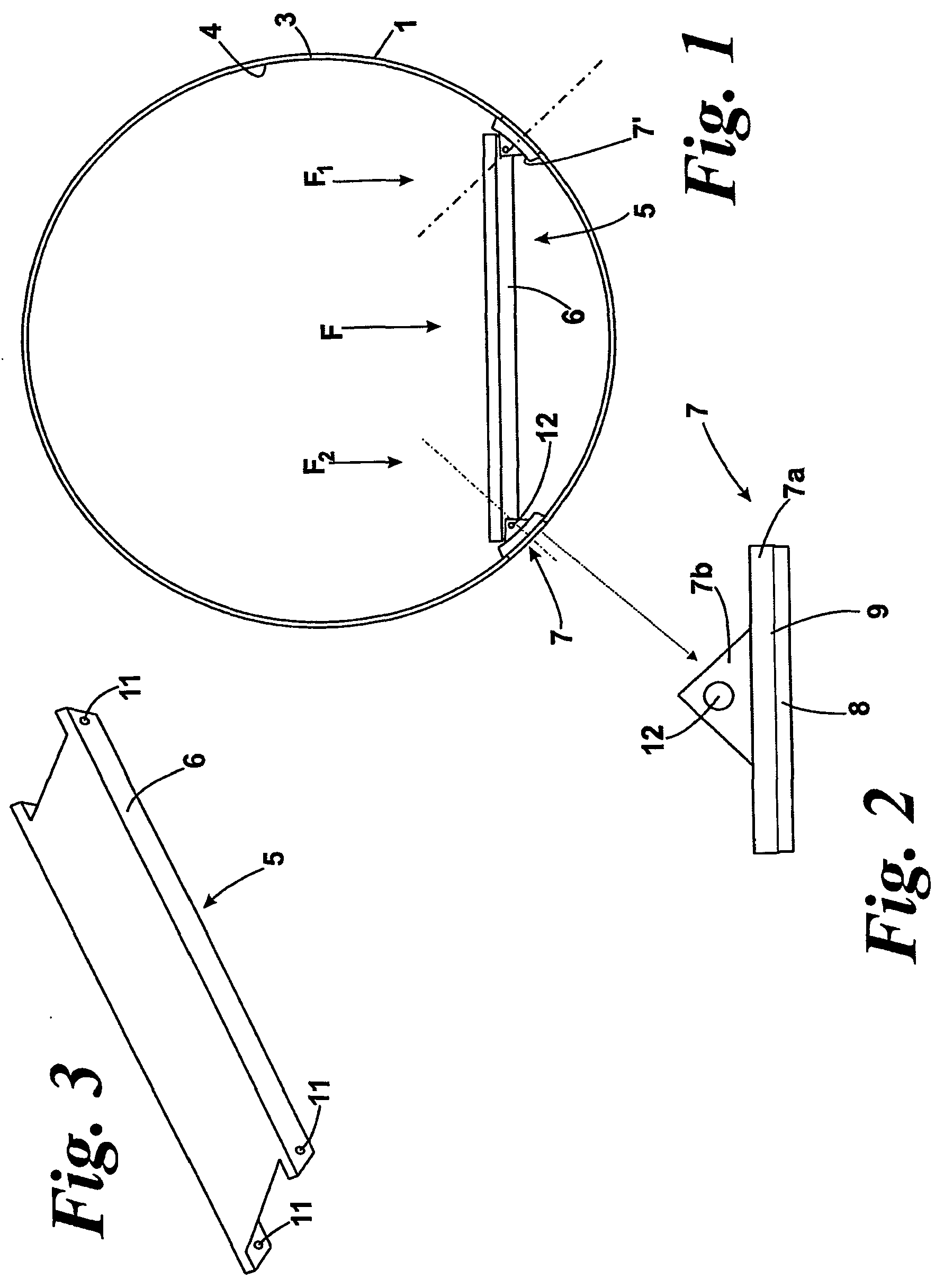
PCT/GB2008/050658 |
| (87) |
International publication number: |
|
WO 2009/016415 (05.02.2009 Gazette 2009/06) |
|
| (54) |
METHOD AND APPARATUS FOR USE IN LINING A CURVED WALL
VERFAHREN UND VORRICHTUNG ZUR VERWENDUNG BEI DER VERKLEIDUNG EINER GEKRÜMMTEN WAND
PROCÉDÉ ET APPAREIL DESTINÉ À ÊTRE UTILISÉ DANS LE REVÊTEMENT D'UNE PAROI INCURVÉE
|
| (84) |
Designated Contracting States: |
|
AT BE BG CH CY CZ DE DK EE ES FI FR GB GR HR HU IE IS IT LI LT LU LV MC MT NL NO PL
PT RO SE SI SK TR |
| (30) |
Priority: |
02.08.2007 GB 0715027
|
| (43) |
Date of publication of application: |
|
02.06.2010 Bulletin 2010/22 |
| (73) |
Proprietors: |
|
- Haritou, Christos Sotirious
Redcar Cleveland TS11 8HS (GB)
- Fada, Alan
Washington, Tyne&Wear NE37 1BU (GB)
- Fada, Ian Gimiel
South Shields, Tyne & Wear NE34 8SB (GB)
- Rhodes, John Harry
Hartlepool Cleveland TS26 9QW (GB)
|
|
| (72) |
Inventors: |
|
- Haritou, Christos Sotirious
Redcar Cleveland TS11 8HS (GB)
- Fada, Alan
Washington, Tyne&Wear NE37 1BU (GB)
- Fada, Ian Gimiel
South Shields, Tyne & Wear NE34 8SB (GB)
- Rhodes, John Harry
Hartlepool Cleveland TS26 9QW (GB)
|
| (74) |
Representative: Elsworth, Dominic Stephen |
|
Hargreaves Elsworth
Cooper's Studios
14-18 Westgate Road
Newcastle-upon-Tyne NE1 3NN
Newcastle-upon-Tyne NE1 3NN (GB) |
| (56) |
References cited: :
GB-A- 2 418 136
US-A- 4 671 382
US-A- 5 950 760
|
US-A- 4 620 612
US-A- 5 249 397
|
|
| |
|
|
|
|
| |
|
| Note: Within nine months from the publication of the mention of the grant of the European
patent, any person may give notice to the European Patent Office of opposition to
the European patent
granted. Notice of opposition shall be filed in a written reasoned statement. It shall
not be deemed to
have been filed until the opposition fee has been paid. (Art. 99(1) European Patent
Convention).
|
Field of the Invention
[0001] This invention relates to an apparatus and method for lining a curved wall, and in
particular to an apparatus and method for lining a tank having a substantially cylindrical
cross-section with a smooth surface lining material.
Background of the Invention
[0002] An apparatus and method for lining a tank is described in United Kingdom patent application
published under number
2413587. This application is concerned with lining
inter alia fuel storage tanks with plastics liners. It is vital that the lining does not leak
and therefore any work done whilst lining the tank must not compromise the plastics
or composite lining material (or individual layers of a composite lining material),
for example where a tank is being lined with a liner of the type described in
GB 0619254.6.
[0003] Tanks can be of a diameter that would preclude the fitting of a lining of the type
described in
GB 2413587 or
GB 0619254.6 without some kind of staging to provide a working platform at a suitable distance
from the tank wall to be lined.
[0004] United Kingdom patent application published under number
2418136 discloses an apparatus for use in lining the curved wall of a tank. Feet rest on
the inner wall of the tank to support the staging and the feet are prevented from
sliding around the tank by magnets attached to the ferrous tank wall.
[0005] The present invention is concerned with the provision of staging, which does not
require the use of magnets, a method of securing the staging in a working environment,
and a method of lining a tank utilising such staging.
Summary of the Invention
[0006] According to a first aspect of the invention there is provide staging apparatus as
specified in Claim 1.
[0007] Each anchor may include an inner edge and the inner edge of each anchor plate lies
inside the pivot to which the anchor is attached
[0008] Each anchor may include an outer edge and the outer edge of each anchor plate lies
outside the pivot to which the anchor is attached.
[0009] Advantageously, in use, the outer edges of the anchors lie outside the ends of the
deck.
[0010] The deck includes bores, through which the anchor plates may be removably attached
to the deck using pins. The pins provide the pivot for anchor plates. The angle at
which the anchors are positioned with respect to the longitudinal plane of the deck,
in use, will vary according to the radius of the tank.
[0011] In use the anchors of the staging may rest on either the inner wall of the tank,
or a lining applied to the inner wall of the tank.
[0012] When the staging is positioned in the tank, the anchors pivot such that the downward
force of the staging and any object supported thereon, and in particular between the
pivot attachment of the anchors to the staging, causes the anchors to adopt a position
in which the force on each anchor is substantially perpendicular to its base. This
provides stability to the staging and prevents the staging from rotating around the
curved wall.
[0013] The anchors may include plates.
[0014] The base surfaces of the anchors may be provided with resilient material.
[0015] Preferably, the anchors are removably attached to the deck by pins, each pin forming
a respective one of the pivots.
[0016] According to the invention, the apparatus includes means to extend the distance between
the surfaces of the anchors engaging the curved wall. The means to extend the distance
between the surfaces of the anchors engaging the curved wall may be provided by an
extendible deck.
[0017] According to a second aspect of the invention there is provided a method of mounting
staging apparatus according to the first aspect of the invention on a curved wall
as specified in Claim 11.
[0018] According to a third aspect of the invention there is provide a method of lining
a tank as specified in Claim 12.
[0019] The invention further comprises a method of supporting an object above a curved wall
having a smooth surface, the method comprising the step of mounting the staging of
the invention in the tank.
Brief Description of the Drawings
[0020] In the drawings, which illustrate a preferred embodiment of the invention, and are
by way of example only:
Figure 1 shows a cross-sectional view of a tank being lined, with staging according
to the invention mounted therein;
Figure 2 is a schematic representation of an anchor plate of the staging of Figure
1; and
Figure 3 is a schematic representation of the deck of the staging of Figure 1.
Detailed Description of the Drawings
[0021] In Figure 1, there is shown a tank comprising a steel shell 1 coated with an epoxy
resin 2. An interstitial space is provided between the inwardly facing surface of
the epoxy layer and a layer 4 of plastics material forming the inner lining ultimately
having contact with fuel stored in the tank. The layer 4 may be a layer of a composite
lining material, for example a layer of lining material as described in
GB 0619254.6.
[0022] Referring now to Figures 1 to 3, the staging 5 comprises a deck 6, the ends of which
are attached to anchors 7 by pins which pass through bores 11 in the deck and bores
12 in brackets 7b of the anchors 7. The deck 6 and anchor 7 may be made of steel,
aluminium, timber or any other suitable material.
[0023] The anchors 7 pivot to form an angle to the longitudinal plane of the deck 6, the
angle being determined by the radius of the curvature of the tank wall.
[0024] In the example illustrated, the anchors 7 comprise plates 7a which are provided with
a cushioned liner 8 formed from a resilient material, such as rubber padding bonded
to the base 9 of each plate 7a. The cushioned liner 8 serves a number of purposes.
First, the cushioned liner deforms under the weight of the staging and any personnel
thereon, thereby providing a greater surface area of material in contact with the
inner surface of the tank than would be the case if the two ends of the plate 7a were
in contact with said surface. The load is therefore distributed over a larger area
and where the plates 7a rest on the lining material 4 the likelihood of damage thereto
is reduced. Second, the liner 8 has a greater coefficient of friction that the material
of the plates 7a, thereby increasing the stability of the staging in the tank.
[0025] One problem with mounting staging on a curved surface is that if a load on the staging
is not located substantially centrally between the anchor points on the curved surface,
there is a risk that the staging will slide around the tank. This would obviously
be exceedingly dangerous. In the prior art this problem was solved by anchoring the
staging in place with magnets.
[0026] The present invention solves this problem by the construction of the anchors 7 and
the manner in which the anchors 7 are attached to the deck 6. By providing for pivotal
movement between the anchors 7 and the deck 6, a force exerted on the deck 6 generates
a reaction force through the pivot point. The anchors 7 are forced against the tank
shell 1. The pivotal attachment of the anchors 7 to the deck 6 allows the staging
to be used in tanks of different diameters. Further, the deck may be extensible in
order to facilitate mounting the staging in curved walls of different diameters, or
to change the working height within a given curved wall. Extension means may comprise
a telescopic deck. What is required for the staging to be functional in tanks of different
diameters is for the pivot 12 to lie to the outside of the inner edge 7' of the anchor
7 and the object on the staging to lie between the pivots 12. As long as this configuration
is maintained, the staging cannot tip with respect to either of the anchors 7 as each
the anchor is always being urged downward by the force F
1
[0027] In the case where a worker stands in the centre of the deck 6 a force F is exerted
thereon, and this force will be distributed evenly over the two anchors 7 so that
F
1 and F
2 are substantially equal. When the worker moves to the right F
1 will increase and F
2 will decrease, and
vice versa when the worker moves to the left of centre. As the worker moves to the right, increasing
F
1, the distance at which the force F
1 is applied to the staging with respect to the pivot mounting of the right hand anchor
decreases such that the moment about the pivot remains substantially constant. Similarly,
F
2 will decrease, but the distance at which F
2 is applied to the left hand pivot is increased such that the moment about the left
hand pivot remains substantially constant, except when all the force is at one or
other ends of the deck 6.
[0028] As the force F
1 increases the friction generated between the surface of the anchor 7 and the curved
wall increases, thereby causing the staging to resist slipping with respect to the
inner wall of the tank. Similarly, if the load moves to the left, increasing F
2 the resistance to slippage between the corresponding anchor 7 and the curved wall
of the tank increases.
[0029] In the present invention, even if the load on the staging is not located centrally
between the anchors 7 the staging has been found not shift.
1. Staging apparatus mountable on a curved inner surface of a wall, which staging includes
a deck (6) and anchors (7) attached at opposing ends of the deck (6), wherein the
anchors (7) are attached to the deck by respective pivots, wherein each anchor (7)
is free to pivot about its respective pivot, wherein the anchors (7) are adapted to
engage with a curved surface associated with, and corresponding to the shape of, the
wall, and wherein, in use, a force transmitted from the deck (6) to the anchors (7)
through the pivots generates friction forces between the anchors (7) and said curved
surface, said friction forces alone supporting the deck (6) with respect to the curved
wall, further comprising means to extend the distance between the surfaces of the
anchors engaging the curved wall.
2. Staging apparatus according to Claim 1, wherein each anchor (7) includes an inner
edge and the inner edge of each anchor (7) lies inside the pivot to which the anchor
plate is attached.
3. Staging apparatus according to Claim 1 or 2, wherein each anchor (7) includes an outer
edge and the outer edge of each anchor (7) lies outside the pivot to which the anchor
(7) is attached.
4. Staging apparatus according to Claim 3, wherein, in use, the outer edges of the anchors
(7) lie outside the ends of the deck.
5. Staging apparatus according to any preceding claim, wherein the surfaces of the anchors
(7) facing the inner wall are provided with a resilient material.
6. Staging apparatus according to any preceding claim, wherein the surfaces of the anchors
(7) are provided with a material having a high co-efficient of friction.
7. Staging apparatus according to any preceding claim, wherein the anchors are removably
attached to the deck by pins, each pin forming a respective one of the pivots.
8. Staging apparatus according to any preceding claim, wherein the means to extend the
distance between the surfaces of the anchors engaging the curved wall is provided
by an extendible deck (6).
9. Staging apparatus according to any preceding claim, wherein each anchor (7) includes
a plate.
10. A method of mounting staging apparatus according to any preceding claim on a curved
wall characterised by mounting the staging on the curved wall and holding the staging in place by friction
forces alone generated between the anchors (7) and the surface on which the anchors
(7) rest.
11. A method of lining a tank utilising the apparatus according to any preceding claim,
characterised by mounting the staging in a tank to be lined according to the method of Claim 10, and
using the staging as a working platform.
1. Gerüstvorrichtung, die an einer gewölbten Innenfläche einer Wand montierbar ist, wobei
das Gerüst eine Plattform (6) und Verankerungen (7) aufweist, die an entgegengesetzten
Enden der Plattform (6) angebracht sind, wobei die Verankerungen (7) an der Plattform
durch jeweilige Zapfen angebracht sind, wobei jede Verankerung (7) frei ist, um ihren
jeweiligen Zapfen zu schwenken, wobei die Verankerungen (7) dazu eingerichtet sind,
mit einer gewölbten Fläche in Eingriff zu kommen, die mit der Wand assoziiert ist
und der Form der Wand entspricht, und wobei im Gebrauch eine Kraft, die von der Plattform
(6) auf die Verankerungen (7) durch die Zapfen übertragen wird, Reibkräfte zwischen
den Verankerungen (7) und der gewölbten Fläche erzeugt, wobei die Reibkräfte allein
die Plattform (6) in Bezug auf die gewölbte Wand tragen, wobei das Gerüst weiterhin
ein Mittel zum Erweitern des Abstands zwischen den Flächen der Verankerungen umfasst,
die die gewölbte Wand in Eingriff nehmen.
2. Gerüstvorrichtung nach Anspruch 1, wobei jede Verankerung (7) eine Innenkante aufweist
und die Innenkante jeder Verankerung (7) innerhalb des Zapfens liegt, an dem die Verankerungsplatte
angebracht ist.
3. Gerüstvorrichtung nach Anspruch 1 oder 2, wobei jede Verankerung (7) eine Außenkante
aufweist und die Außenkante jeder Verankerung (7) außerhalb des Zapfens liegt, an
dem die Verankerung (7) angebracht ist.
4. Gerüstvorrichtung nach Anspruch 3, wobei im Gebrauch die Außenkanten der Verankerungen
(7) außerhalb der Enden der Plattform liegen.
5. Gerüstvorrichtung nach einem vorhergehenden Anspruch, wobei die Flächen der Verankerungen
(7), die der Innenwand zugewandt sind, mit einem elastischen Material versehen sind.
6. Gerüstvorrichtung nach einem vorhergehenden Anspruch, wobei die Flächen der Verankerungen
(7) mit einem Material mit einem hohen Reibungskoeffizienten versehen sind.
7. Gerüstvorrichtung nach einem vorhergehenden Anspruch, wobei die Verankerungen lösbar
an dem Deck durch Stifte angebracht sind, wobei jeder Stift einen jeweiligen der Zapfen
bildet.
8. Gerüstvorrichtung nach einem vorhergehenden Anspruch, wobei das Mittel zum Erweitern
des Abstands zwischen den Flächen der Verankerungen, die die gewölbte Wand in Eingriff
nehmen, durch eine erweiterbare Plattform (6) bereitgestellt wird.
9. Gerüstvorrichtung nach einem vorhergehenden Anspruch, wobei jede Verankerung (7) eine
Platte aufweist.
10. Verfahren zum Montieren einer Gerüstvorrichtung nach einem vorhergehenden Anspruch
an einer gewölbten Wand, gekennzeichnet durch das Montieren des Gerüsts an der gewölbten Wand und das Halten des Gerüsts an Ort
und Stelle durch Reibkräfte allein, die zwischen den Verankerungen (7) und der Fläche, auf der die
Verankerungen (7) aufliegen, erzeugt werden.
11. Verfahren zum Auskleiden eines Tanks unter Nutzung der Vorrichtung nach einem vorhergehenden
Anspruch, gekennzeichnet durch das Montieren des Gerüsts in einem auszukleidenden Tank gemäß dem Verfahren nach
Anspruch 10 und das Verwenden des Gerüsts als eine Arbeitsplattform.
1. Appareil d'échafaudage apte à être monté sur une surface interne incurvée d'une paroi,
cet échafaudage incluant un plateau (6) et des ancrages (7) attachés au niveau d'extrémités
opposées du plateau (6), cas dans lequel les ancrages (7) sont attachés au plateau
par des pivots respectifs, cas dans lequel chaque ancrage (7) est libre de pivoter
autour de son pivot respectif, cas dans lequel les ancrages (7) sont conçus pour se
solidariser avec une surface incurvée associée à la paroi, et correspondant à la forme
de cette dernière, et cas dans lequel, en utilisation, une force transmise à partir
du plateau (6) vers les ancrages (7) par l'intermédiaire des pivots génère des forces
de friction entre les ancrages (7) et ladite surface incurvée, lesdites forces de
friction soutenant à elles seules le plateau (6) par rapport à la paroi incurvée,
comprenant en outre des moyens pour agrandir la distance entre les surfaces des ancrages
se solidarisant avec la paroi incurvée.
2. Appareil d'échafaudage selon la revendication 1, chaque ancrage (7) incluant un bord
interne et le bord interne de chaque ancrage (7) se situant à l'intérieur du pivot
auquel la plaque d'ancrage est attachée.
3. Appareil d'échafaudage selon la revendication 1 ou 2, chaque ancrage (7) incluant
un bord externe et le bord externe de chaque ancrage (7) se situant à l'extérieur
du pivot auquel l'ancrage (7) est attaché.
4. Appareil d'échafaudage selon la revendication 3, en utilisation les bords externes
des ancrages (7) se situant à l'extérieur des extrémités du plateau.
5. Appareil d'échafaudage selon l'une quelconque des revendications précédentes, les
surfaces des ancrages (7) faisant face à la paroi interne étant pourvues d'une matière
élastique.
6. Appareil d'échafaudage selon l'une quelconque des revendications précédentes, les
surfaces des ancrages (7) étant pourvues d'une matière possédant un coefficient de
friction élevé.
7. Appareil d'échafaudage selon l'une quelconque des revendications précédentes, les
ancrages étant attachés de façon amovible au plateau par des broches, chaque broche
formant un pivot respectif parmi les pivots.
8. Appareil d'échafaudage selon l'une quelconque des revendications précédentes, le moyen
pour agrandir la distance entre les surfaces des ancrages se solidarisant avec la
paroi incurvée étant procuré par un plateau télescopique (6).
9. Appareil d'échafaudage selon l'une quelconque des revendications précédentes, chaque
ancrage (7) incluant une plaque.
10. Procédé de montage d'un appareil d'échafaudage, selon l'une quelconque des revendications
précédentes, sur une paroi incurvée caractérisé par les opérations consistant à monter l'échafaudage sur la paroi incurvée et à maintenir
l'échafaudage en place par les seules forces de friction générées entre les ancrages
(7) et la surface sur laquelle reposent les ancrages (7).
11. Procédé de revêtement d'une cuve utilisant l'appareil selon l'une quelconque des revendications
précédentes, caractérisé par les opérations consistant à monter l'échafaudage dans une cuve devant recevoir un
revêtement selon le procédé de la revendication 10, et à utiliser l'échafaudage en
tant que plate-forme de travail.
REFERENCES CITED IN THE DESCRIPTION
This list of references cited by the applicant is for the reader's convenience only.
It does not form part of the European patent document. Even though great care has
been taken in compiling the references, errors or omissions cannot be excluded and
the EPO disclaims all liability in this regard.
Patent documents cited in the description