|
(11) | EP 2 260 034 B9 |

| (12) | CORRECTED EUROPEAN PATENT SPECIFICATION |
| Note: Bibliography reflects the latest situation |
|
|
| (54) |
PROCESS FOR THE PREPARATION OF 2,3,4,9-TETRAHYDRO-1H-BETA-CARBOLIN-3-CARBOXYLIC ACID ESTERS VERFAHREN ZUR HERSTELLUNG VON 2,3,4,9-TETRAHYDRO-1H-BETA-CARBOLIN-3-CARBONSÄUREESTERN PROCÉDÉ DE PRÉPARATION D'ESTERS DE L'ACIDE 2,3,4,9-TÉTRAHYDRO-1H-BÊTA-CARBOLIN-3-CARBOXYLIQUE |
|
|
|||||||||||||||||||||||||||||||
|
||||||||||||||||||||||||||||||||
| Note: Within nine months from the publication of the mention of the grant of the European patent, any person may give notice to the European Patent Office of opposition to the European patent granted. Notice of opposition shall be filed in a written reasoned statement. It shall not be deemed to have been filed until the opposition fee has been paid. (Art. 99(1) European Patent Convention). |
DESCRIPTION OF THE INVENTION
FIELD OF THE INVENTION
[0001] The present invention relates to the synthesis process of 2,3,4,9-tetrahydro-1H-β-carbolin-3-carboxylic acid esters substituted in position 1.
PRIOR ART
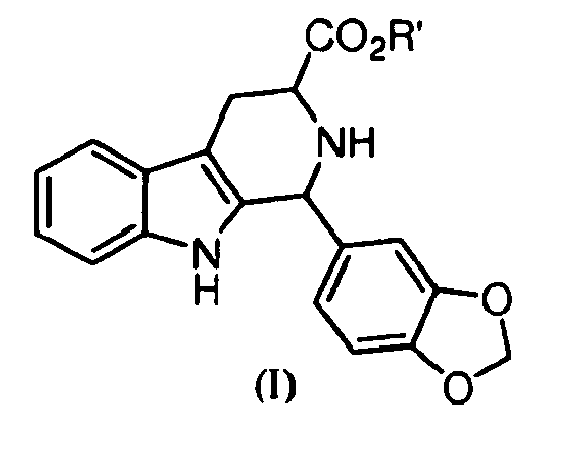
[0002] The compounds of the formula (I)
are extensively used in the synthesis of active ingredients such as alkaloids and drugs. The most well-known intermediate is represented by methyl ester of 2,3,4,9-tetrahydro-1-(3,4-benzodioxolyl)-β-carbolin-3-carboxylic acid in the diastereoisomeric cis form, used ip the synthesis of the drug (6R,12aR)-2,3,6,7,12,12a hexahydro-2-methyl-6-(3,4-methylendioxyphenyl)-pyrazin[1', 2': 1,6]pyrido[3,4-b]indole-1,4-dione; also known as Tadalafil.
[0003] The compounds of the general formula (I) have two stereogenic centres where the substituents different than hydrogen atoms at the asymmetric carbon atoms can be in cis or trans configuration. It is well known that biological active compounds containing at least one asymmetric carbon atom have different biological activity depending on their stereoisomerism, being one steredisomer more active than the other one.
[0004] It is known that the products of the general formula (I) in the suitable configuration cis or trans can be obtained by means of Pictet-Spengler reaction between tryptophan in the suitable configuration D or L and 3,4-(methylendioxy)-benzaldehyde, as described here below :
[0005] In particular, it is extensively described the synthesis of the methyl ester of cis 2,3,4,9-tetrahydro-1-(3,4-benzodioxolyl)-β-carbolin-3- carboxylic acid, intermediaite for the production of Tadalafil.
[0006] US5859006 describes the synthesis of Tadalafil and of its intermediate methyl ester of cis 2,3,4,9-tetrahydro-1-(3,4-benzodioxolyl)-β-carbolin-3-carboxylic acid by reaction between D-tryptophan methyl ester and 3,4-benzodioxole-1-carbaldehyde (piperonal) in dichloromethane and in the presence of trifluoroacetic acid. In this case both the diastereoisomers are obtained and the cis isomer is separated from trans isomer by preparative chromatography. The above described process has the disadvantage of the chromatographic separator, the usage of the highly corrosive trifluoroacetic acid, long reaction times (4-5 days) and low yields In cis isomer (37-42%).
[0007] In the patent application WO2004/011463 the synthesis of Tadalafil and of the methyl ester of cis 2,3,4,9-tetrahydro-1-(3,4-benzodioxolyl)-β-carbolin-3- carboxylic acid is reported by reaction between D-tryptophan methyl ester hydrochloride, and piperonal in anhydrous isopropyl alcohol.
[0008] The process has the disadvantage of using anhydrous isopropyl alcohol being thus of scarce industrial applicability in the patent application WO2005/068464 is described a preparation process where D-tryptophan methyl ester and piperonal are condensed in the presence of trifluoroacetic acid, in a suitable solvent and in the presence of molecular sleves to adsorb water released during the reaction. Both cis and trans diastereoisomers are obtained which, by treatment with aqueous hydrochloric acid, give the hydrochloride salt of the cis isomer, that precipitates in the reaction media and subsequently is isolated and reacted with the suitable reactants to give Tadalafil. The above described process has the disadvantage of using molecular sieves, difficult to be exploited in an industrial scale, and the fact that the reaction is carried out in two steps requiring intermediates isolartion.
[0009] In US6143746 is described a process of preparation where D-tryptophan methyl ester and piperonal are condensed in the presence of trifluoroacetic acid in anhydrous dichloromethane. Trans isomer is obtained by solvent concentration and filtration. The mother liquid, containing mainly cis isomer, is further concentrated and the cis isomer is obtained by crystallization adding isopropyl ether as co-solvent. The above described process has the disadvantage of using a chlorinayed solvent, an extremely corrosive acid as trifluoroacetic acid, long reaction times and separation by fractioned crystallization.
[0010] In US 6143757 is described a process for the preparation of Tadalafil starting from D-tryptophan methyl ester hydrocloride, by Pictet-Spengier reaction in the presence of chlorinated solvents, trifluoroacetic acid and piperonal, giving the methyl ester of 2,3,4,9-tetrahydro-1-(3,4-benzodioxolyl)-β-carbolin-3-carboxylic acid in the diastereoisomeric forms cis and trans. The cis form is then separated by preparative chromatography and the so obtained diastereoisomer is reacted with the proper isocyanate to give Tadalafil. The above described process has the disadvantage of using trifluoroacetic acid, highly corrosive, and the need of separating the two diastereoisomers by preparative chromatography.
[0011] In the patent application WO2006/110893 is described a process to obtain Tadalafil and its precursor, the methyl ester of cis 2,3,4,9-tetrahydro-1-(3,4-benzodioxolyl)- β-carbolin-3-carboxylic acid. The latest is obtained, by reaction of D-tryptophan methyl ester and/or its suitable salt in a solvent chosen among alkyl esters of carboxylic acids such as for example, ethyl acetate in the presence of trifluoroacetic acid, at room temperature pr at 50°C for long reaction times (7 days). The cis diastereoisomer is then obtained by filtration with a yield variable between 32% and 76%. The described process presents the disadvantage of using the highly corrosive trifluoroacetic acid and long reaction times (7 days). In the patent application US2006/0258865 is described a process to obtain Tadalafil and its precursor cis 2,3,4,9-tetrahydro-1-(3,4-benzodioxolyl)-β-carbolin-3-carboxylic acid methyl ester. The latest is prepared by reaction of D-tryptophan methyl ester hydrochloride with piperonal in an aprotic dipolar solvent with a high boiling point such as N,N-dimethyl acetamide (DMA) in the presence of a dehydrating agent such as anhydrous sodium sulfate in considerable quantities and by heating for 30-35 hours. The so-obtained diastereoisomeric mixture is then treated under heating with aqueous hydrochloric acid for further 6-10 hours in order to epimerize the trans diastereoisomer and the cis isomer is separated by crystallization from a mixture toluene/cyclohexane after organic extraction of the acid aqueous solution. The above described process has, by the way, the disadvantage of using an aprotic dipolar solvent having a high boiling point as DMA, which is difficult to recover and a chemical dehydrating agent such as sodium sulfate in considerable quantities, followed by reaction with hydrochloric acid to obtain cis isomer and final crystallization after extraction of the aqueous acid solution.
[0012] In Herralz T. et al., J.Agric. Food Chemistry, 2003, 51, 2168-2173, L-tryptophan is reacted with the suitable aldehyde to give the correspondent tetrahydro- β-carbolin-3-carboxylic acid in a diastereoisomeric mixture in the presence of sulfuric acid for long reaction times (9 days). By using this method starting directly from the amino-acid, the obtained product is represented by carbolin-carboxylic acid only and not by its ester. Moreover the reaction is carried out with long times without separation of different diastereoisomers.
[0013] in Lopez-Rodriguez M. et al., J. Org. Chem. 1994, 59, 1583-1585, is described a process to obtain the suitable 2,3,4,9-tetrahydro- 1H- β-carbolin-3-carboxylic acid substituted in position 1 by reacting L-tryptophan and benzaldehyde in diluted sulfuric acid for 7 hours. Such a product, obtained in racemic form, was then Listed in the following reaction with isocyanate or isothiocyanate. Nothing was reported about obtaining the carboxylic ester starting from tryptophan. In Zhang Y. Et al. Oppi Briefs "Improved Synthesis of Tadalafil" Vol. 37, No. 1 D- Triptophan methyl ester hydrochloride was reacted with piperonal under the catalysis of methanolic hydrochloridric acid, thus precipitating the cis-isomer. The present inventors repeated the synthesis and only 44.9% of the cis-isomer hydrochloride with respect to the 35.2% of the trans isomer was obtained.
[0014] To summarize, the prior art does not report any teaching on how to obtain the appropriate diastereoisomer of 2,3,4,9- tetrahydro- 1H- β-carbolin-3-carboxylic acid esters substituted in position 1 in an only reaction ( one-pot reaction). In fact, it starts directly from the suitable ester of D- or L-tryptophan or, in case it starts from the correspondent amino-acid, the synthesis stops at 2,3,4,9-tetrahydro- 1 H-β-carbolin-3-carboxylic acid substituted in position 1.
[0015] Moreover, the preparation of the 2,3,4,9-tetrahydro- 1 H- β-carbolin-3-carboxylic acid ester substituted in position 1 shows several disadvantages that can be summarized in long times (days) of reaction, need of chromatographic separation, use of dehydrating agents such as molecular sieves or chemical products such as sodium sulfate, separation of the diastereoisomeric mixture and subsequent epimerization to give the desired isomer, use of anhydrous solvents.
SUMMARY
[0016] It has been found now a new process to obtain 2,3,4,9-tetrahydro-1H-β-carbolin-3-carboxylic acid esters substituted in position 1 of the formula (I)
[0017] in the preferred diastereoisomeric form starting directly from tryptophan (D- , L. or racemic), an aminoacid easily available and not expensive through an one pot reaction with 3,4-(methylenedioxy)benzaldehyde (piperonal) in a suitable alcoholic solvent and in the presence of a protic acid. In the mentioned formula (I), R' represents alkyl, cycloalkyl, cycloalkyl containing heteroatoms, aryl, aralkyl, heteroaryl or heteroaralkyl substituent.
[0018] Preferably in R', the alkyl and aralkyl substituents are C1-C8 alkyl e C1-C8 aralkyl; the cycloalkyl substituent is represented by 3-8 member rings; the substituents containing heteroatoms are represented by 4-8 member rings containing 1 to 3 heteroatoms chosen among O, N, S ; moreover all the cyclic substituents can be optionally substituted , in particular , by C1-C8 alkyl , hydroxyl , C1-C8 alkoxy , nitro, halogen groups.
[0019] It is an object of the present invention a process to obtain in an only synthesis step the product (I) starting from tryptophan (II) in acid catalysis conditions as reported in Scheme 1 :
[0020] The reaction is carried out in the suitable alcoholic solvent R'OH (giving R' group) in the presence of an inorganic protic acid in excess relative to the stechiometric amount, that's relative to the tryptophan (II) moles. Preferably the protic acid is used in an excess till to 50% relative to the tryptophan (II) moles; an excess between 5% and 30% is preferred; an excess, betwee 10% and 30% is more preferred.
[0021] In the process shown in scheme 1 two reactions together are involved in the same reactor without any separaftion of the intermediates The first one is the addition of the aldehyde (IV) to position 2 of the indolic ring of tryptophan (II) with subsequent closure of the piperidic ring (Pictet-Spengler reaction); the second one is the esterification of CO2H group.
[0022] The process uses an inorganic acid easily available low cost, industrially applicable and no difficult handling such as for example hydrochloric acid Moreover the process allows the preparation of the ester of the 2,3,4,9-tetrahydro-1H-β-carbolin-3-carboxylic acid substituted in position 1 in accordance with the preferred diastoreoisomeric form through in situ conversion of the no desired diasteroisomeric form to the desired one,
DETAILEB DESCRIPTION OF THE INVENTION
[0023] In the process of the present invention, the starting material tryptophan (II) can be used in racemic form in enantiomeric enriched form or in enantiomers pure form (L- or D-).
[0024] The preferred molar ratio between tryptophan (II) and the compound (IV) (3,4-(methylenedioxy)benzaldehyde) is between 0.8 and 1.5; the more preferred molar ratio is between 0.9 and 1.3; the even more preferred molar ratio is between 0.9 and 1.1; a particularly preferred molar ratio is 1.0.
[0025] The inorganic protic acid is chosen among hydrochloric acid, sulfuric acid, nitric acid. Hydrochloric acid and sulfuric acid are preferred hydrochloric acid is particularly preferred Hydrochloric acid means the aqueous solution of concentrated hydrochloric acid, being the concentration of said hydrochloric acid between 30% and 37% (%w/w). A concentration between 33% and 37% (% w/w) is preferred; a concentration of 37% (%w/w) is particularly preferred.
[0026] The molar ratio between the protic acid (e.g. hydrochloric acid) and tryptophan (II) is between 1.0 and 1.5; the preferred molar ratio is between 1.06 and 1.3; the molar ratio between 1.1 and 1.2 is particularly preferred.
[0027] The solvent R'OH is chosen on the basis of the substituent R' to be introduced in the: compound (I). Illustrative but non-limitting examples are methanol, ethanol, n-propanol, isopropanol, n-butanol and its isomers, n-pentanol and its isomers, n-hexanol and its isomers n-heptanol and its isomers, n-octanol and its isomers, cyclopentanol, cyclohexanol, cycloheptanol, hydroxypiperidine, phenyl alcohol, benzyl alcohol, methylbenzyl alcohol, 4-methoxybenzyl alcohol, 3-methoxybenzyl alcohol, 2-methoxybenzylalcohol, 4-nitrobenzylalcohol, tetrahydrofuranemethanol.
[0028] Methanol, ethanol, n-propanol, Isopropanol, n-butanol, sec-butanol, isobutanol are preferred; methanol is particularly preferred.
[0029] The reaction is carried out at the temperature of reflux of the solvent for a time preferably between 12 and 36 hours, for example 24 hours. During the reaction, water is formed, giving a variation of the boiling point of the pure solvent; the formed hydroalcoholic solution is distilled off and the reaction solution is convenlently added with further fresh R'OH solvent till the solvent boiling point is maintained.
[0030] At the end of the reaction, the mixture is evaporated under vacuum, suitably into the same reaction vessel, recovering the racemic and raw compound (I) as a solid. From this compound (I) the single and pure diastereoisomers cis and/or trans can be recovered by chromatography or by using other systems known to separate diastereoisomers, if needed, coming previously by the appropriate epimerization reactions to increase the yield in the desired diastereoisomeric form.
[0031] In accordance with a preferred procedure of said epimerization, the raw solid compound (I) is treated with a diluted aqueous solution of hyrdrochloric acid, heated to a temperature between 40°C and 70°C, for example between 50°C and 60°C fur further 40-100 hours, for example 60-80 hours. The hydrochloric acid is used in a molar excess (relative to the starting tryptophan (II) ) between 5% and 50%, preferably between 5% and 30%, more preferably between 10% and 20%. The obtained precipitate is the hydrochloric salt of the compound (I) in the cis diastereoisomeric configuration and is separated by filtration, washed with a suitable alcoholic or ethereal solvent such as, for example, isopropanol or isopropyl ether and dried.
[0032] The mother liquids after the precipitation of the hydrochloric salt contain a residue of the cis-compound (I) in solution, the remaining part of the compound (I) as trans form, small amounts of the same compounds as not ester forms and poassible small amounts of no reacted aldehyde (IV) or tryptophan (I). These mother liquids can be conveniently treated in accordance with known systems to recover these products.
[0033] In particular, the aldehyde (IV) can be recovered from the mother liquids by extraction with an organic solvent, for example ethyl or isopropyl ether ; the compounds of the formula (I) can be recovered by precipitation with a suitable base (for example NaHCO3); the recovered compounds can be recycled in a subsequent Pictet-Spengler, esterification and epimerization (recycle) to enrich them again in the desired enantiomeric form and to recover further amounts of said enantiomeric form.
EXPERIMENTAL PART
Example 1
[0035] To a suspension of D-tryptophan (10.20g; 50.0mmoles) in methanol (45ml), an aqueous solution of HCl 37% (5ml) is added.
[0036] Piperonal (7.50g; 50.0 mmoles) is then added to the resulting solution, which is allowed to react at reflux temperature for 25 hrs. The solvent is removed by distillation and continuously replaced with fresh methanol up to a volume of 400 ml of the distilled in total. After the solvent evaporation, an aqueous solution of HCl 0.3M (183ml) is added to the residue and the so-obtained solution is kept at 55°C for 72 hrs. The precipitate is filtered, washed with diisopropyl ether and dried under vacuum to give the cis ester hydrochloride (10.79g; 27.82 mmoles) with a yield of 56%. The aqueous solution is washed with diisopropyl ether (2x90ml) to recover the unreacted piperonal and neutralized with solid NaHCO3 (6,80g) The resulting precipitate is filtered, washed with diisopropyl ether and dried under vacuum to give a solid residue (6.18g). The solid recovered from the aqueous layer is analysed by chromatography and resulted in having the following composition: cis ester (1.90g; 5.41 mmoles); trans ester (1.45g; 4.13 mmoles) ; cis acid (1.58g; 4.68 mmoles); trans acid (1.25g; 3.71 mmoles).
[0037] The total yield of the process is 92% (total yield as esters :75%; total yield as cis ester 67%)
1H NMR (200 MHz, DMSO-d6) δ (ppm): 10.84 (s, NH, 1 H), 7.54 (d, J 6.7 Hz, 1 H), 7.29 (d, J 7.4 Hz, 1 H), 7.17-6.99 (m, 5 H), 6.10 (s, OCH2O, 2 H), 5.87 (s br, CHAr, 1 H), 4.73 (s br, CHCO2CH3, 1 H), 3.84 (s, CO2CH3, 3 H), 3.38-3.26 (m, CH2CHCO2CH3, 2 H).
13C NMR (50.33 MHz, DMSO-d6) δ (ppm): 168.5 (s), 148.5 (s), 147.1 (s), 136.7 (s), 128.9 (s), 127.0 (s), 125.4 (s), 125.0 (d), 122.0 (d), 119.2 (d), 118.2 (d), 111.6 (d), 110.4 (d), 108.3 (d), 106.3 (s), 101.5 (t), 57.6 (d), 55.2 (d), 53,0 (q), 22.2 (t).
Example 2.
[0038] To a suspension of the solid residue recovered as described in example 1 (6.18 g) and D-tryptophan (10.20g; 50.0 mmoles) in methanol (61ml), HCl 37% (6.6ml) is added. Piperonal (7.50g; 50.0 mmoles) is added to the resulting solution, which was allowed two react at reflux temperature for 25 hrs. The solvent is removed by distillation and continuously replaced with fresh methanol up to a volume of 680 ml. of the distilled in total.
[0039] Alter solvent evaporation on aqueous solution of HCl 0.3M (183m) is added to the residue and the so-obtained solution is kept at 55°C for 72hrs. The precipitate is filtered, washed with diisopropyl ether and dried under vacuum to give the cis ester hydrochloride (12.90g; 33.26 mmoles) with a yield of 66.7%.
1. Process for the preparation of the compounds of the formula (I)
comprising the reaction between tryptophan and 3,4-(methylenedioxy)benzaldehyde in an alcoholic solvent of the formula R'OH in the presence of a molar excess , relative to tryptophan, of a inorganic protic acid, where in R'OH and in the formula (I), R' represents a same substituent chosen among alkyl, cycloalkyl, cycloalkyl containing heteroatoms, aryl, heteroaryl or aralkyl.
comprising the reaction between tryptophan and 3,4-(methylenedioxy)benzaldehyde in an alcoholic solvent of the formula R'OH in the presence of a molar excess , relative to tryptophan, of a inorganic protic acid, where in R'OH and in the formula (I), R' represents a same substituent chosen among alkyl, cycloalkyl, cycloalkyl containing heteroatoms, aryl, heteroaryl or aralkyl.
2. Process according to claim 1 wherein tryptophan is D-tryptophan, L-tryptophan or their
mixtures .
3. Process according to anyone of claims 1-2, wherein the acid is hydrochloric acid,
sulfuric acid or nitric acid.
4. Process according to anyone of claims 1-3, wherein the protic acid is present in molar
excess till to 50% relative to tryptophan.
5. Process according to claim 4, wherein the protic acid is present in molar excess between
5% and 30% relative to tryptophan.
6. Process according to claim 5, wherein the protic acid is present in molar excess between
10% and 30% relative to tryptophan.
7. Process according to anyone of claims 1-6, wherein tryptophan and 3,4-(methylenedioxy)benzaldehyde
are used in equimolar amount.
8. Process according to anyone of claims 1-7, wherein the solvent R'OH is chosen among
methanol, ethanol, n-propanol, isopropanol, n-butanol and its isomers, n-pentanol
and its isomers, n-hexanol and its isomers , n-heptanol and its isomers, n-octanol
and its isomers, cyclopentanol, cyclohexanol, cycloheptanol, hydroxypiperidine, phenyl
alcohol, benzyl alcohol, methylbenzyl alcohol, 4-methoxybenzyl alcohol, 3-methoxybenzyl
alcohol, 2-methoxybenzyl alcohol. 4-nitrobenzyl alcohol, tetrahydrofuranemethanol.
9. Process according to anyone of claims 1-8, wherein the reaction among tryptophan,
3,4-(methylenedioxy)benzaldehyde and R'OH is carried out at reflux temperature of
R'OH, for a time between 12 and 36 hours.
10. Process according to anyone of claims 1-9, wherein the obtained product (I) is subsequently
submitted to an epimerization reaction to increase the enrichment in one of its diastereoisomers.
11. Process according to claim 10, where the diastereoisomer is the cis diastereoisomer.
12. Process according to claim 11, where the epimerization is carried out by reacting
the compound (I) at temperature between 40° e 70°C for a time between 40 and 100 hours,
with a molar excess of aqueous hydrochloric acid relative to the starting tryptophan.
1. Verfahren zur Herstellung von Verbindungen der Formel (I)
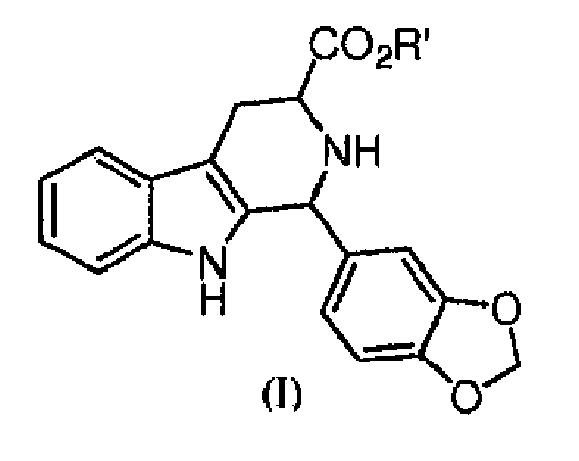
umfassend, die Reaktion zwischen Tryptophan und 3,4-(Methylendioxy)benzaldehyd in einem alkoholischen Lösungsmittel der Formel R'OH in Gegenwart eines auf Tryptophan bezogenen, molaren Überschusses einer anorganischen protischen Säure, wobei R' in R'OH und in der Formel (I) für einen gleichen Substituenten steht, der aus Alkyl, Cycloalkyl, Heteroatome enthaltendem Cycloalkyl, Aryl, Heteroaryl oder Aralkyl ausgewählt wird.
umfassend, die Reaktion zwischen Tryptophan und 3,4-(Methylendioxy)benzaldehyd in einem alkoholischen Lösungsmittel der Formel R'OH in Gegenwart eines auf Tryptophan bezogenen, molaren Überschusses einer anorganischen protischen Säure, wobei R' in R'OH und in der Formel (I) für einen gleichen Substituenten steht, der aus Alkyl, Cycloalkyl, Heteroatome enthaltendem Cycloalkyl, Aryl, Heteroaryl oder Aralkyl ausgewählt wird.
2. Verfahren gemäß Anspruch 1, wobei Tryptophan D-Tryptophan, L-Tryptophan oder deren
Mischungen ist.
3. Verfahren gemäß einem der Ansprüche 1-2, wobei die Säure Salzsäure, Schwefelsäure
oder Salpetersäure ist.
4. Verfahren gemäß einem der Ansprüche 1-3, wobei die protische Säure bezogen auf Tryptophan
in einem molaren Überschuss von bis zu 50 % vorhanden ist.
5. Verfahren gemäß Anspruch 4, wobei die protische Säure bezogen auf Tryptophan in einem
molaren Überschuss zwischen 5 % und 30 % vorhanden ist.
6. Verfahren gemäß Anspruch 5, wobei die protische Säure bezogen auf Tryptophan in einem
molaren Überschuss zwischen 10 % und 30 % vorhanden ist.
7. Verfahren gemäß einem der Ansprüche 1-6, wobei Tryptophan und 3,4-(Methylendioxy)benzaldehyd
in einer äquimolaren Menge eingesetzt werden.
8. Verfahren gemäß einem der Ansprüche 1-7, wobei das Lösungsmittel R'OH aus Methanol,
Ethanol, n-Propanol, Isopropanol, n-Butanol und seinen Isomeren, n-Pentanol und seinen
Isomeren, n-Hexanol und seinen Isomeren, n-Heptanol und seinen Isomeren, n-Octanol
und seinen Isomeren, Cyclopentanol, Cyclohexanol, Cycloheptanol, Hydroxypiperidin,
Phenylalkohol, Benzylalkohol, Methylbenzylalkohol, 4-Methoxybenzylalkohol, 3-Methoxybenzylalkohol,
2-Methoxybenzylalkohol, 4-Nitrobenzylalkohol und Tetrahydrofuranmethanol ausgewählt
wird.
9. Verfahren gemäß einem der Ansprüche 1-8, wobei die Reaktion zwischen Tryptophan, 3,4-(Methylendioxy)benzaldehyd
und R'OH unter Rückflusstemperatur von R'OH über einen Zeitraum zwischen 12 und 36
Stunden durchgeführt wird.
10. Verfahren gemäß einem der Ansprüche 1-9, wobei das erhaltene Produkt (I) anschließend
einer Epimerisierungsreaktion unterzogen wird, um die Anreicherung an einem seiner
Diastereoisomere zu erhöhen.
11. Verfahren gemäß Anspruch 10, wobei das Diastereoisomer das cis-Diastereoisomer ist.
12. Verfahren gemäß Anspruch 11, wobei die Epimerisierung durch Reaktion der Verbindung
(I) bei einer Temperatur zwischen 40 °C und 70 °C über einen Zeitraum zwischen 40
und 100 Stunden mit einem auf das Ausgangstryptophan bezogenen molaren Überschuss
an wässriger Salzsäure ausgeführt wird.
1. Procédé pour la préparation des composés de la formule (I)
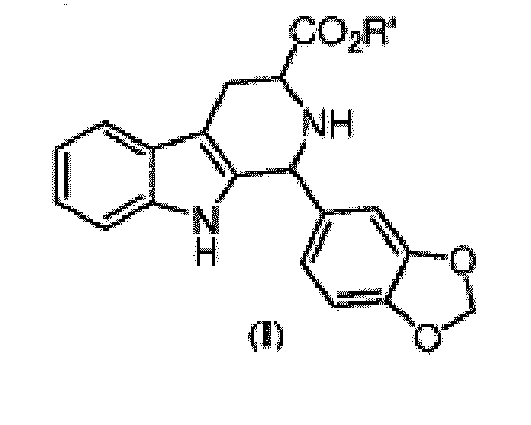
comprenant la réaction entre le tryptophane et 3,4-(méthylènedioxy)benzaldéhyde dans un solvant alcoolique de la formule R'OH en présence d'un excès molaire, relativement au tryptophane, d'un acide protique inorganique, où dans R'OH et dans la formule (I), R' représente le même substituant sélectionné parmi alkyle, cycloalkyle, cycloalkyle contenant des hétéroatomes, aryle, hétéroaryle ou aralkyle.
comprenant la réaction entre le tryptophane et 3,4-(méthylènedioxy)benzaldéhyde dans un solvant alcoolique de la formule R'OH en présence d'un excès molaire, relativement au tryptophane, d'un acide protique inorganique, où dans R'OH et dans la formule (I), R' représente le même substituant sélectionné parmi alkyle, cycloalkyle, cycloalkyle contenant des hétéroatomes, aryle, hétéroaryle ou aralkyle.
2. Procédé selon la revendication 1, dans lequel le tryptophane est D-tryptophane, L-tryptophane
ou leurs mélanges.
3. Procédé selon l'une quelconque des revendications 1-2, dans lequel l'acide est l'acide
chlorhydrique, l'acide sulfurique ou l'acide nitrique.
4. Procédé selon l'une quelconque des revendications 1-3, dans lequel l'acide protique
est présent en excès molaire jusqu'à 50% relativement au tryptophane.
5. Procédé selon la revendication 4, dans lequel l'acide protique est présent en excès
molaire entre 5% et 30% relativement au tryptophane.
6. Procédé selon la revendication 5, dans lequel l'acide protique est présent en excès
molaire entre 10% et 30% relativement au tryptophane.
7. Procédé selon l'une quelconque des revendications 1-6, dans lequel le tryptophane
et le 3,4-(méthylènedioxy) benzaldéhyde sont utilisés en quantités équimolaires.
8. Procédé selon l'une quelconque des revendications 1-7, dans lequel le solvant R'OH
est sélectionné parmi méthanol, éthanol, n-propanol, isopropanol, n-butanol et ses
isomères, n-pentanol et ses isomères, n-hexanol et ses isomères, n-heptanol et ses
isomères, n-octanol et ses isomères, cyclopentanol, cyclohexanol, cycloheptanol, hydroxypipéridine,
alcool phénylique, alcool benzylique, alcool méthylbenzylique, alcool 4-méthoxybenzylique,
alcool 3-méthoxybenzylique, alcool 2-méthoxybenzylique, alcool 4-nitrobenzylique,
tétrahydrofuraneméthanol.
9. Procédé selon l'une quelconque des revendications 1-8, dans lequel la réaction entre
tryptophane, 3,4-(méthylènedioxy)benzaldéhyde et R'OH est exécutée à une température
de reflux de R'OH, pendant une durée entre 12 et 36 heures.
10. Procédé selon l'une quelconque des revendications 1-9, dans lequel le produit obtenu
(I) est ensuite soumis à une réaction d'épimérisation pour augmenter l'enrichissement
dans un de ses diastéréoisomères.
11. Procédé selon la revendication 10, dans lequel le diastéréoisomère est le cis diastéréoisomère.
12. Procédé selon la revendication 11, dans lequel l'épimérisation est exécutée en faisant
réagir le composé (I) à une température entre 40° et 70°C pendant une durée entre
40 et 100 heures, avec un excès molaire de l'acide chlorhydrique aqueux relativement
au tryptophane de départ.
REFERENCES CITED IN THE DESCRIPTION
This list of references cited by the applicant is for the reader's convenience only. It does not form part of the European patent document. Even though great care has been taken in compiling the references, errors or omissions cannot be excluded and the EPO disclaims all liability in this regard.
Patent documents cited in the description
- US5859006A [0006]
- WO2004011463A [0007]
- WO2005068464A [0008]
- US6143746A [0009]
- US6143757A [0010]
- WO2006110893A [0011]
- US20060258865A [0011]
Non-patent literature cited in the description
- HERRALZ T. et al.J.Agric. Food Chemistry, 2003, vol. 51, 2168-2173 [0012]
- LOPEZ-RODRIGUEZ M. et al.J. Org. Chem., 1994, vol. 59, 1583-1585 [0013]
- ZHANG Y. et al.Improved Synthesis of TadalafilOppi Briefs, vol. 37, 1 [0013]