|
(11) | EP 2 280 037 A1 |

| (12) | EUROPEAN PATENT APPLICATION |
| published in accordance with Art. 153(4) EPC |
|
|
|
|
|||||||||||||||||||||||
| (54) | FLUORINE-CONTAINING POLYETHER COMPOUND AND METHOD FOR PRODUCING THE SAME |
| (57) A fluorine-containing polyether compound having the following general formula:
(where R1 is a hydrogen atom, an alkyl group having 1 to 3 carbon atoms, or a phenyl group X is a bromine atom or an iodine atom; 1 and m each are independently an integer of 10 or more; and 1 + m is 30-200) can be produced by reaction of a fluorine-containing dicarboxylic acid fluoride compound having the following general formula: (where 1 and m each are independently an integer of 10 or more, and 1 + m is 30-200) with an aromatic amine compound having the following general formula: [where R1 is a hydrogen atom, an alkyl group having 1 to 3 carbon atoms, or a phenyl group, R2 is a hydrogen atom or a group represented by the general formula -SiR3R4R5 (where R3, R4 and R5 each are independently an alkyl group having 1 to 10 carbon atoms or a phenyl group) ; and X is a bromine atom or an iodine atom] preferably in the presence of pyridine or a tertiary amine compound such as triethylamine, etc. |
TECHNICAL FIELD
[0001] The present invention relates to a fluorine-containing polyether compound and a process for producing the same, and more particularly to a fluorine-containing polyether compound having a halogenophenyl group each at both terminals of polymer main chain as a reactive site, and a process for producing the same.
BACKGROUND ART
[0002] Fluorine-containing polyether compounds having functional groups at the terminals of molecule, for example, represented by the following general formula are known (Patent Document 1):
[0003] More general compounds obtained by oligomerizing the main chain structure of the afore-mentioned compounds and represented by the following general formula are also known (Patent Document 2):
[0004] It is disclosed that a series of compounds represented by these general formulae can give elastomeric moldings having much distinguished characteristics (chemical resistance, heat resistance, and low-temperature characteristics) by curing with a fluorine-containing organo hydrogen siloxane compound having a plurality of Si-H groups in the molecule in the presence of a platinum compound catalyst, and the moldings can be used particularly even at low temperatures such as about 50°C without losing the flexibility. Curable compositions comprising these compounds as the main component have a remarkable molding processability and can undergo even RIM molding. However, the cured products have siloxane bonds in the intramolecular cross-linked structure, and thus may give undesirable effects such as chemical deterioration and the resulting lowered mechanical strength, when used in the presence of an acidic substance such as hydrogen fluoride, etc.
PRIOR ART LITERATURE
PATENT LITERATURE
[0005]
Patent Document 1: JP-A-11-343336
Patent Document 2: JP-B-2990646
Patent Document 3: WO 2008 / 126436 A1
NON-PATENT DOCUMENT
SUMMARY OF THE INVENTION
PROBLEM TO BE SOLVED BY THE INVENTION
[0007] The present inventor previously proposed a fluorine-containing polyether compound represented by the following general formula:
(where R1 is a hydrogen atom, an alkyl group having 1 to 3 carbon atoms, or a phenyl group; X is an iodine atom or a bromine atom; X-substituted position on the phenyl group is at a m- or p- position relative to the position of NR1 bond substituent; 1 and m each are independently an integer of 10 or more; and 1 + m is 30-130) as a fluorine-containing polyether compound capable of curing without using a fluorine-containing organo hydrogen siloxane compound having Si-H bonds, also capable of giving cured products having distinguished heat resistance, low-temperature characteristics and molding processability, and usable even under an acidic condition (Patent Document 3).
[0008] The object of the present invention is to provide a fluorine-containing polyether compound having a more reactive halogenophenyl group each at both terminals of polymer main chain and a process for producing the same.
MEANS FOR SOLVING THE PROBLEM
[0009] The present invention provides a fluorine-containing polyether compound represented by the following general formula:
(where R1 is a hydrogen atom, an alkyl group having 1 to 3 carbon atoms, or a phenyl group; X is a bromine atom or an iodine atom; 1 and m each are independently an integer of 10 or more; and 1 + m is 30-200).
[0010] The fluorine-containing polyether compound can be produced by allowing a fluorine-containing dicarboxylic acid fluoride compound represented by the following general formula:
(where 1 and m each are independently an integer of 10 or more, and 1 + m is 30-200) to react with an aromatic amine compound represented by the following general formula, preferably in the presence of pyridine, or a tertiary amine compound such as triethylamine, etc.
[where R1 is a hydrogen atom, an alkyl group having 1 to 3 carbon atoms, or a phenyl groups R2 is a hydrogen atom, or a group represented by the general formula -SiR3R4R5 (where R3, R4 and R5 each are independently an alkyl group having 1 to 10 carbon atoms or a phenyl group) and X is a bromine atom or an iodine atom] .
EFFECT OF THE INVENTION
[0011] The present fluorine-containing polyether compound has two bromine atoms or two iodine atoms each as substituted for the hydrogen atoms on the phenyl group each at both terminals of polymer main chain, and thus is more reactive. For example, when the present fluorine containing polyether compound is cured under appropriate curing conditions to obtain elastomeric moldings, not only rapid curing can be attained, but also physical properties of final moldings can be improved. The moldings obtained by curing a composition have distinguished low-temperature characteristics, chemical resistance, etc., and thus are suitable for various uses such as seal materials for automobile fuel supply systems, oil seal materials, seal materials for aviation fuel systems and hydraulic systems, seal materials for semi-conductor production systems, etc.
EMBODIMENTS FOR CARRYING OUT THE INVENTION
[0012] In the following general formula of the present fluorine-containing polyether compound:
1 and m each are independently an integer of 10 or more and 1 + m is an integer of 30-200. Particularly, when used as the main raw material for the elastomeric polymer material, 1 + m is preferably 50-150 for producing moldings having a sufficient mechanical strength after the curing. R1 is a hydrogen atom, an alkyl group having 1 to 3 carbon atoms, or a phenyl group, and to avoid formation of intramolecular hydrogen bonds and side reaction during the curing, the alkyl group or the phenyl group is preferable, and a methyl group is particularly preferable from the viewpoint of easy production. X is a bromine atom or an iodine atom.
[0013] The present fluorine-containing polyether compound can be produced through, for example, a series of the following steps:
Remarks)
HFPO: Hexafluoropropene oxide
HFP: Hexafluoropropene
[0014] In the aromatic amine compound [III] used in the final step, R1 is a hydrogen atom, an alkyl group having 1 to 3 carbon atoms, or a phenyl group, R2 is a hydrogen atom or a group represented by the general formula -SiR3R4R5, where R3, R4, and R5 each are independently an alkyl group having 1 to 10 carbon atoms, or a phenyl group, and the alkyl groups of R3, R4, and R5 include, for example, -CH3, -C2H5, -(CH2)2CH3, -CH(CH3)2, -C(CH3)2, -C(CH3)2CH(CH3)2, etc. X is a bromine atom, or an iodine atom.
[0015] The reaction of the fluorine-containing dicarboxylic acid fluoride [II] with the aromatic amine compound [III] can be carried out in the presence of an active hydrogen-free, basic nitrogen-containing heterocyclic compound such as pyridine, etc., or a tertiary amine compound such as triethylamine, etc. in a fluorine-containing solvent such as hydrochlorofluorocarbon, hydrofluorocarbon, hydrofluoroether, etc., or a solvent mixture of the fluorine-containing solvent with an aprotic, non-fluorine-based solvent at a reaction temperature of -50 ° to 150°C, preferably 0° to 100°C. The fluorine-containing solvent includes, for example, HCFC-225, HFE-449 (HFE-7100, a product of Sumitomo 3M Co.), HFE-569 (HFE-7200, a product of Sumitomo 3M Co.), 1,3-bis(trifluoromethyl)benzene, etc. The aprotic, non-fluorine-based solvent includes, for example, diethyl ether, diisopropyl ether, cyclopentyl methyl ether, etc. From the viewpoint of solubility of the aromatic amine compound [III], it is more preferable to use a solvent mixture of the fluorine-containing solvent with the aprotic, non-fluorine-based solvent.
[0016] The present fluorine-containing polyether compound can serve as the main component of curable compositions as will be described later. The present fluorine-containing polyether compound includes, for example, the following compounds:
[0017] One example of curable compositions containing the present fluorine-containing polyether compound [Component (A)] as a main component comprises the following components:
| Parts by weight | ||
| Component (A): | Fluorine-containing polyether compound | 100 |
| Component (B): | Aromatic di- or tri-boronic acid ester compound | 1-10 |
| Component (C): | Zero-valent or divalent organo-palladium compound | 0.0001-1 |
| Component (D): | Basic inorganic or organic compound | 0.5-10 |
| Component (E): | Organophosphorus compound | 0-5 |
EXAMPLES
REFERENCE EXAMPLE 1
[0019] Preparation of fluorine-containing dicarboxylic acid fluoride represented by the following general formula:
A glass reactor vessel having a net capacity of 1L, provided with a stirrer, a temperature sensor, a gas inlet and a dry ice/ethanol cooling condenser, was placed in a low-temperature thermostat tank, and 60g of tetraglyme solution containing 23millimoles of a dialkoxide compound CsOCF2CF(CF3)OCF2CF2OCF(CF3)CF2OCs was charged therein. The inner temperature was adjusted to -33° to -30°C, and then 40g of hexafluoropropene was charged therein through the gas inlet. Then, hexafluoropropene oxide and hexafluoropropene were charged into the reactor vessel at feed rates of 10g/hr and 4g/hr, respectively. 42 hours thereafter, gas feeding was discontinued (total amount of charged hexafluoropropene oxide : 428g), and the inner temperature was further kept at -33° to -30°C for one hour. The hexafluoropropene was removed under reduced pressure, and then the inner temperature was slowly elevated to room temperature and then further to 100°C to remove hexafluoropropene oligomers from the reaction mixture under reduced pressure. In this manner, 478g of a mixture of cesium fluoride, tetraglyme and fluorine-containing dicarboxylic acid fluoride was obtained as a yellowish, viscous suspension, and used in the next step without purification.
[0020] A portion of the above-mentioned mixture was converted to diester compound [A] by methanol and subjected to determination of a number average polymerization degree of hexafluoropropene oxide and a bifunctionality ratio (mole fraction relative to hexafluoropropene oxide oligomer [B]):
s=Fa(-131ppm) Peak integration value
t=Fb(-133ppm) Peak integration value
u=Fc(-146ppm) Peak integration value
Remark) Chemical shift was based on CFCl3Number average polymerization degree of hexafluoropropene
EXAMPLE
[0021] 78g (about 4.5millimoles) of the mixture of fluorine-containing dicarboxylic acid fluoride, cesium fluoride, and tetraglyme obtained in Reference Example 1 was dissolved into 90ml of a fluorine-containing solvent (HFE-7100, a product of Sumitomo 3M Co.), and 2.1g (21millimoles) of triethylamine and 36ml of diethyl ether were added thereto. Then, 3.1g (11millimoles) of 3,5-dibromo-N-methylaniline was added thereto to conduct reaction at 30°C for 2 hours. The resulting reaction mixture was admixed with a saturated saline, and the separated organic layer was dried over anhydrous magnesium sulfate and recovered by filtration. The recovered filtrate was distilled under reduced pressure to remove the fluorine-containing solvent and the diethyl ether. The resulting viscous liquid was washed with diethyl ether several times and then the diethyl ether was completely distilled off under reduced pressure. In this manner, 68g of fluorine-containing polyether compound [PFPE-Br2] represented by the following general formula was obtained as a slightly yellowish, clear liquid. The viscosity was found to be 15Pa · s (25°C), when determined by an E type viscometer (TEV-22, made by Toki Sangyo Co.).
| 19F-NMR (Chemical shift was based on CFCl3: | -124ppm(Fb) |
| -147ppm(Fc) | |
| 1H-NMR (Chemical shift was based on TMS): | 7.6ppm(Ha) |
| 7.3ppm(Hb) | |
| 3.2ppm(Hc) | |
| IR(neat): | 1709cm-1(C=0) |
| 1561cm-1(Ar) | |
| 1583cm-1(Ar) |
REFERENCE EXAMPLE 2
[0022]
| Parts by weight | |
| Fluorine-containing polyether compound of Example 1 | 100 |
| 1-(1H, 1H, 2H, 2H, 3H, 3H-perfluorononan-1-yloxy)-3,5-bis-(4,4,5,5-tetramethyl-1,3,2-dioxabororan-2-yl) benzene | 8 |
|
|
|
| Palladium acetate | 0.032 |
| Triphenylphosphine | 0.073 |
| Potassium phosphate | 7.2 |
[0023] The curable composition was subjected to determination of curing behavior at 130°C for 30 minutes, using a Monsanto disc Rheometer, and the following results were obtained :
ML 0.6 dN · m
MH 6.6 dN · m
t10 0.7 minutes
t50 1.0 minute
t90 1.7 minutes
[0024] The curable composition was compression molded at 130°C for 15 minutes to form P24 O rings, followed by oven vulcanization (secondary vulcanization) in a nitrogen atmosphere at 80°C for 5 hours and at 230°C for 15 hours. The P24 O rings were subjected to determination of compression set (according to ASTM D395 method B : 200°C for 70 hours), and found to have a compression set of 53%.
1. A fluorine-containing polyether compound represented by the following general formula:

(where R1 is a hydrogen atom an alkyl group having 1 to 3 carbon atoms, or a phenyl group X is a bromine atom or an iodine atom; 1 and m each are independently an integer of 10 or more; and 1 + m is 30-200).
(where R1 is a hydrogen atom an alkyl group having 1 to 3 carbon atoms, or a phenyl group X is a bromine atom or an iodine atom; 1 and m each are independently an integer of 10 or more; and 1 + m is 30-200).
2. A fluorine-containing polyether compound according to Claim 1, wherein X is a bromine
atom.
3. A fluorine-containing polyether compound according to Claim 1, wherein R1 is a methyl group.
4. A fluorine-containing polyether compound according to Claim 1, wherein 1 + m is 50-150.
5. A process for producing a fluorine-containing polyether compound according to Claim
1, characterized by allowing a fluorine-containing dicarboxylic acid fluoride compound represented by
the following general formula:

(where 1 and m each are independently an integer of 10 or more, and 1 + m is 30-200) to react with an aromatic amine compound represented by the following general formula:
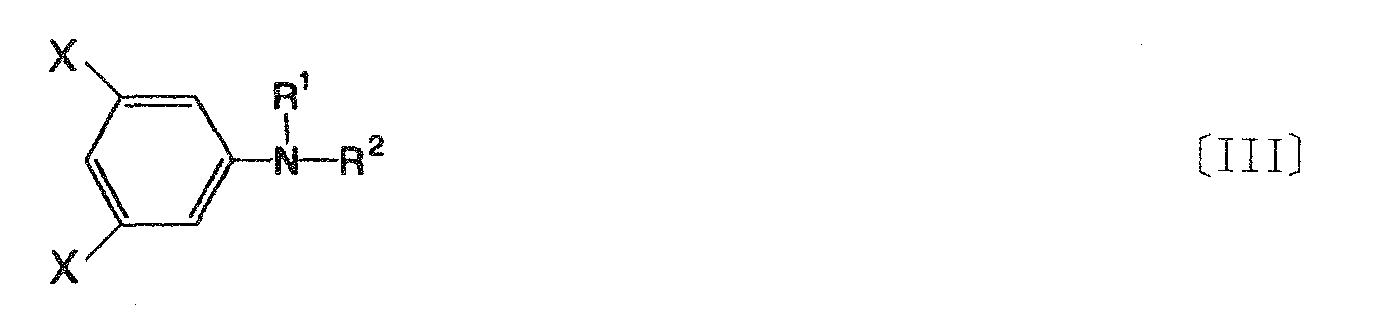
[where R1 is a hydrogen atom, an alkyl group having 1 to 3 carbon atoms, or a phenyl group; R2 is a hydrogen atom or a group represented by the general formula -SiR3R4R5 (where R3, R4 and R5 each are independently an alkyl group having 1 to 10 carbon atoms or a phenyl group); and X is a bromine atom or an iodine atom].
(where 1 and m each are independently an integer of 10 or more, and 1 + m is 30-200) to react with an aromatic amine compound represented by the following general formula:
[where R1 is a hydrogen atom, an alkyl group having 1 to 3 carbon atoms, or a phenyl group; R2 is a hydrogen atom or a group represented by the general formula -SiR3R4R5 (where R3, R4 and R5 each are independently an alkyl group having 1 to 10 carbon atoms or a phenyl group); and X is a bromine atom or an iodine atom].
6. A process for producing a fluorine-containing polyether compound according to Claim
5, wherein the reaction is carried out in the presence of pyridine or a tertiary amine
compound.
REFERENCES CITED IN THE DESCRIPTION
This list of references cited by the applicant is for the reader's convenience only. It does not form part of the European patent document. Even though great care has been taken in compiling the references, errors or omissions cannot be excluded and the EPO disclaims all liability in this regard.
Patent documents cited in the description
Non-patent literature cited in the description
- Chem. Rev., 1995, vol. 95, 2457- [0006]