|
(11) | EP 2 305 771 A1 |

| (12) | EUROPEAN PATENT APPLICATION |
| published in accordance with Art. 153(4) EPC |
|
|
|
|
|||||||||||||||||||||||
| (54) | PHOSPHORESCENCE-EMITTING COMPOSITION, AND LIGHT-EMITTING ELEMENT UTILIZING THE COMPOSITION |
| (57) Disclosed is a composition comprising a compound having residues of at least two
kinds of nitrogenated polycyclic compounds selected from the group consisting of nitrogenated
polycyclic compounds represented by formulae (1-1), (1-2), (1-3) and (1-4) [wherein
R's independently represent a hydrogen atom or a substituent and may be the same as
or different from one another] and a phosphorescence-emitting compound. |
TECHNICAL FIELD
[0001] The present invention relates to a phosphorescent composition and a light-emitting device prepared by using the composition.
BACKGROUND ART
[0002] As a light-emitting material for use in a light-emitting layer of a light-emitting device, a compound emitting light from a triplet excitation state (hereinafter, sometimes referred to as a "phosphorescent compound") is known. The device using this compound in a light-emitting layer is known to have a high luminous efficiency. When a phosphorescent compound is used in a light-emitting layer, usually, a composition prepared by adding the compound to a matrix is used as a light-emitting material. As the matrix, polyvinylcarbazole is used since a thin film can be formed by coating (PATENT DOCUMENT 1).
[0003] However, it is difficult to inject electrons to this compound because the energy level of the lowest unoccupied molecular orbital (hereinafter, referred to as the "LUMO") thereof is high. On the other hand, a conjugated polymer compound such as polyfluorene has a low LUMO. Thus, if it is used as a matrix, a low driving voltage can be realized relatively easily. However, such a conjugated polymer compound, since the lowest triplet excitation energy (hereinafter, referred to as "T1 energy") value thereof is low, is not suitable as a matrix used for emitting light having a shorter wavelength than that of green light, in particular (PATENT DOCUMENT 2). For example, in a light-emitting material composed of polyfluorene as a conjugated polymer and a triplet emission compound, light emission from triplet emission compound is weak. Thus, the luminous efficiency thereof is low (NON-PATENT DOCUMENT 1).
CITATION LIST
PATENT DOCUMENTS
SUMMARY OF THE INVENTION
PROBLEMS TO BE SOLVED BY THE INVENTION
[0006] In the circumstances, an object of the invention is to provide a material providing an excellent luminous efficiency when used in a light-emitting device, etc.
MEANS FOR SOLVING THE PROBLEMS
[0007] The present invention firstly provides a composition containing: a compound having residues of at least two kinds of nitrogen-containing polycyclic compounds selected from the group consisting of nitrogen-containing polycyclic compounds represented by the following formulas (1-1), (1-2), (1-3) and (1-4):
wherein R represents a hydrogen atom or a substituent; and more than one R may be the same or different; and a phosphorescent compound.
The present invention secondly provides a polymer compound: containing residues of at least two kinds of nitrogen-containing polycyclic compounds selected from the group consisting of nitrogen-containing polycyclic compounds represented by the above formulas (1-1), (1-2), (1-3) and (1-4); and a residue of a phosphorescent compound.
The present invention thirdly provides a thin film and a light-emitting device prepared by using the composition or the polymer compound.
The present invention provides fourthly a planar light source, a display and light having the light-emitting device.
ADVANTAGES OF THE INVENTION
[0008] The composition and polymer compound of the present invention (hereinafter, referred to as "the composition, etc. of the present invention") have a high luminous efficiency. Therefore, when the composition, etc. of the present invention, are used in preparation of a light-emitting device, etc., it serves as a light-emitting material excellent in luminous efficiency. Furthermore, the composition, etc. of the present invention usually have a relatively excellent light emitting property when they emit light in a relatively short wavelength region. This is because nitrogen-containing polycyclic compounds contained in the composition of the present invention and the polymer compound of the present invention have large T1 energy values. In addition, the LUMO energy level of the composition, etc. of the present invention is relatively low and thus electrons are easily injected, and the energy level of the highest occupied molecular orbital (hereinafter, referred to as the "HOMO") is relatively high and thus holes are easily injected.
MODE FOR CARRYING OUT THE INVENTION
<Composition>
[0010] The composition of the present invention is a composition containing: a compound (hereinafter, sometimes referred to as the "compound having residues of at least two kinds of nitrogen-containing polycyclic compounds") having residues of at least two kinds of nitrogen-containing polycyclic compounds selected from the group consisting of nitrogen-containing polycyclic compounds represented by the above formulas (1-1), (1-2), (1-3) and (1-4)(hereinafter, referred to as "formulas (1-1) to (1-4)"); and a phosphorescent compound. In the present invention, for example, the residues of compounds represented by the above formulas (1-1) to (1-4) refer to groups provided by removing all or some (in particular 1 to 3 R) of the R from the respective compounds represented by the above formulas (1-1) to (1-4). Furthermore, the "polymer compound" refers to a compound having at least two identical structures (repeating units) therein.
[0011] The compound having residues of at least two kinds of nitrogen-containing polycyclic compounds is more preferably a compound having residues of at least two kinds of nitrogen-containing polycyclic compound selected from the group consisting of the compounds represented by the above formulas (1-1), (1-2) and (1-3), and particularly preferably a compound having residues of at least three nitrogen-containing polycyclic compounds selected from the group consisting of compounds represented by the above formulas (1-1), (1-2) and (1-3).
[0012] The compound having residues of at least two kinds of nitrogen-containing polycyclic compounds may be a polymer compound. In this case, a polymer compound preferably has residues of the nitrogen-containing polycyclic compounds in the main chain and/or a side chain, and a polymer compound having a repeating unit containing residues of nitrogen-containing polycyclic compounds represented by the above formulas (1-1) to (1-4), and a polymer compound having a repeating unit containing any one of the structures selected from an aromatic ring, a heterocyclic ring having at least 5-members containing a hetero atom, aromatic amine and a structure represented by a formula (4) described later, in addition to a repeating unit containing residues of nitrogen-containing polycyclic compounds represented by the above formulas (1-1) to (1-4), are particularly preferable.
[0013] In the above formulas (1-1) to (1-4), R represents a hydrogen atom or a substituent, preferably, at least one of more than one R is a substituent, more preferably, at least two of the more than one R are substituents, and further preferably, all R are substituents. If more than one R is present, they may be the same or different.
[0014] Examples of the substituent include a halogen atom, an alkyl group, an alkoxy group, an alkylthio group, an aryl group that may have a substituent, an aryloxy group, an arylthio group, an arylalkyl group, an arylalkyloxy group, an arylalkylthio group, an acyl group, an acyloxy group, an amide group, an acid imide group, an imine residue, a substituted amino group, a substituted silyl group, a substituted silyloxy group, a substituted silylthio group, a substituted silylamino group, a monovalent heterocyclic group that may have a substituent, a heteroaryl group that may have a substituent, a heteroaryloxy group, a heteroarylthio group, an arylalkenyl group, an arylethynyl group, a substituted carboxyl group and a cyano group, and preferably, include an alkyl group, an alkoxy group, an aryl group that may have a substituent and a heteroaryl group that may have a substituent. Note that the N-valent heterocyclic group (N is 1 or 2) refers to a remaining atomic group provided by removing N hydrogen atoms from a heterocyclic compound; the same applies hereinafter. Note that as a monovalent heterocyclic group, a monovalent aromatic heterocyclic group is preferable.
[0015] At least one of the R is preferably an alkyl group, an alkoxy group, an aryl group that may have a substituent or a heteroaryl group that may have a substituent. At least one of the R is further preferably an alkyl group having 3 to 10 carbon atoms or an alkoxy group having 3 to 10 carbon atoms.
[0016] At least one of the R is preferably a substituent having 3 or more atoms in total except hydrogen, further preferably a substituent having 5 or more atoms in total except hydrogen, and particularly preferably a substituent having 7 or more atoms in total except hydrogen. When two R are present, at least one of the R is preferably a substituent, and more preferably two R are substituents. More than one R may be the same or different.
[0017] Examples of the compound having residues of at least two kinds of nitrogen-containing polycyclic compounds include a compound represented by the following formula (A-1) or (A-2):
wherein Z1 and Z2 each independently represent a residue of a nitrogen-containing polycyclic compound represented by the above formula (1-1), (1-2), (1-3) or (1-4); Y1 represents -C(Ra)(Rb)-, -N(Rc)-, -O-, -Si(Rd)(Re)-, -P(Rf)- or -S-; Ra to Rf each independently represent a hydrogen atom or a substituent; m is an integer of 0 to 5; when more than one Y1 is present, they may be the same or different; Y2 represents an arylene group that may have a substituent; n is an integer of 1 to 5; and when more than one Y2 is present, they may be the same or different, and a compound having a residue of the foregoing compound.
[0018] Examples of the substituents represented by Ra to Rf include an alkyl group, an alkoxy group, an alkylthio group, an aryl group, an aryloxy group, an arylthio group, an arylalkyl group, an arylalkoxy group, an arylalkylthio group, an arylalkenyl group, an arylalkynyl group an amino group, a substituted amino group, a silyl group, a substituted silyl group, a silyloxy group, a substituted silyloxy group, a monovalent heterocyclic group and a halogen atom.
[0019] Examples of the aryl group represented by Ra to Rf include a phenyl group, a C1 to C12 alkoxyphenyl group ("C1 to C12 alkoxy" means that the number of carbon atoms of the alkoxy moiety is 1 to 12. The same applies hereinafter), a C1 to C12 alkylphenyl group ("C1 to C12 alkyl" means that the number of carbon atoms in the alkyl moiety is 1 to 12. The same applies hereinafter), a 1-naphthyl group, a 2-naphthyl group and a pentafluorophenyl group, and preferably include a phenyl group, a C1 to C12 alkoxyphenyl group and a C1 to C12 alkylphenyl group.
[0020] The monovalent heterocyclic group represented by Ra to Rf refers to the remaining atomic group provided by removing a single hydrogen atom from a heterocyclic compound. The heterocyclic compound herein refers to an organic compound having a cyclic structure and containing not only carbon atoms but also hetero atoms such as an oxygen atom, a sulfur atom, a nitrogen atom and a phosphorus atom as elements constituting the ring.
[0021] When the compound having residues of at least two kinds of nitrogen-containing polycyclic compounds is a polymer compound, the compound is preferably a polymer compound having a repeating unit containing a residue of a compound represented by the above formula (A-1) or (A-2), in view of T1 energy.
[0022] Furthermore, the compound having residues of at least two kinds of nitrogen-containing polycyclic compounds, in view of T1 energy, preferably has also a residue of a compound represented by the following formula (A-3):
wherein RING refers to a group formed by combining residues of at least two kinds of nitrogen-containing polycyclic compounds selected from the group consisting of nitrogen-containing polycyclic compounds represented by the above formulas (1-1) to (1-4); Ring Z represents a cyclic structure containing a carbon atom, X1 and X2; X1 and X2 each independently represent -C(R)=; and R is as defined above.
[0023] In the above formula (A-3), as the cyclic structure, an aromatic ring that may have a substituent and a non-aromatic ring that may have a substituent are mentioned. Preferable examples thereof include a benzene ring, a heterocyclic ring, an alicyclic hydrocarbon ring, a ring formed by condensing these rings and these rings whose hydrogen atoms are partly substituted.
[0024] The residues of compounds represented by the above formulas (A-1) to (A-3) each refer to a group provided by removing all or some of the hydrogen atoms and R of the compound.
[0025] The compound having residues of at least two kinds of nitrogen-containing polycyclic compounds, whose energy level can be controlled by using residues of nitrogen-containing polycyclic compounds different in HOMO/LUMO, is excellent in charge injection and transport properties. Furthermore, in a preferable embodiment, in view of improvement in durability in oxidation-reduction by a combination of a donor and an acceptor and symmetry, amorphous nature tends to be improved and a film formation property tends to be improved.
[0026] The compound having residues of at least two kinds of nitrogen-containing polycyclic compounds may contain another type of partial structure. A preferable type of partial structure differs depending upon whether it is present at an end or not.
[0027] When another partial structure is not present at an end, a polyvalent group having a conjugating property is preferable in view of an LUMO energy level or an HOMO energy level. Examples of such a group include a divalent aromatic group and a trivalent aromatic group. The aromatic group herein refers to a group derived from an aromatic organic compound. Examples of such an aromatic group include groups provided by replacing n' (n' is 2 or 3) hydrogen atoms of an aromatic ring, such as benzene, naphthalene, anthracene, pyridine, quinoline and isoquinoline, by bonds.
[0028] Examples of another preferable partial structure that may be included in the compound having residues of at least two kinds of nitrogen-containing polycyclic compounds include a structure represented by the following formula (4):
[0029] In the above formula (4), ring P and ring Q may have a substituent selected from the group consisting of an alkyl group, an alkoxy group, an alkylthio group, an aryl group, an alkenyl group, an alkynyl group, an aryloxy group, an arylthio group, an arylalkyl group, an arylalkoxy group, an arylalkylthio group, an arylalkenyl group, an arylalkynyl group, an amino group, a substituted amino group, a silyl group, a substituted silyl group, a halogen atom, an acyl group, an acyloxy group, an imine residue, an amide group, an acid imide group, a monovalent heterocyclic group, a carboxyl group, a substituted carboxyl group and a cyano group. As the substituent, a substituent selected from the group consisting of an alkyl group, an alkoxy group, an alkylthio group, an aryl group, an aryloxy group, an arylthio group, an arylalkyl group, an arylalkoxy group, an arylalkylthio group, an arylalkenyl group, an arylalkynyl group, an amino group, a substituted amino group, a silyl group, a substituted silyl group, a halogen atom, an acyl group, an acyloxy group, an imine residue, an amide group, an acid imide group, a monovalent heterocyclic group, a carboxyl group, a substituted carboxyl group and a cyano group is preferable.
[0030] In the above formula (4), ring P and ring Q each independently represent an aromatic ring; however, ring P may exist or not. When ring P is present, two bonds are present one on ring P and one on ring Q. When ring P is not present, two bonds are present one on a 5-membered ring or 6-membered ring including Y and one on ring Q. Furthermore, on ring P, ring Q and a 5-membered ring or 6-membered ring including Y, a substituent may be present, which is selected from the group consisting of an alkyl group, an alkoxy group, an alkylthio group, an aryl group, an alkenyl group, an alkynyl group, an aryloxy group, an arylthio group, an arylalkyl group, an arylalkoxy group, an arylalkylthio group, an arylalkenyl group, an arylalkynyl group, an amino group, a substituted amino group, a silyl group, a substituted silyl group, a halogen atom, an acyl group, an acyloxy group, an imine residue, an amide group, an acid imide group, a monovalent heterocyclic group, a carboxyl group, a substituted carboxyl group and a cyano group. As the substituent, a substituent selected from the group consisting of an alkyl group, an alkoxy group, an alkylthio group, an aryl group, an aryloxy group, an arylthio group, an arylalkyl group, an arylalkoxy group, an arylalkylthio group, an arylalkenyl group, an arylalkynyl group, an amino group, a substituted amino group, a silyl group, a substituted silyl group, a halogen atom, an acyl group, an acyloxy group, an imine residue, an amide group, an acid imide group, a monovalent heterocyclic group, a carboxyl group, a substituted carboxyl group and a cyano group is preferable. Y represents -O-, -S-, -Se-, -B(R0)-, -Si(R2)(R3)-, -P(R4)-, -P(R5)(= O)-, -C(R6)(R7)-, -N(R8)- -C(R9)(R10)-C(R11)(R12)-, -O-C(R13)(R14)-, -S-C(R15)(R16)-, -N-C(R17)(R18)-, -Si(R19)(R20)-C(R21)(R22)-, -Si(R23)(R24)-Si(R25)(R26)-, -C(R27) =C(R28)-, -N=C(R29)-, or -Si(R30) = C(R31)-. R0 and R2 to R31 herein each independently represent a hydrogen atom, an alkyl group, an alkoxy group, an alkylthio group, an aryl group, an alkenyl group, an alkynyl group, an aryloxy group, an arylthio group, an arylalkyl group, an arylalkoxy group, an arylalkylthio group, an arylalkenyl group, an arylalkynyl group, an amino group, a substituted amino group, a silyl group, a substituted silyl group, a silyloxy group, a substituted silyloxy group, a monovalent heterocyclic group or a halogen atom. Of them, a hydrogen atom, an alkyl group, an alkoxy group, an alkylthio group, an aryl group, an aryloxy group, an arylthio group, an arylalkyl group, an arylalkoxy group, an arylalkylthio group, an arylalkenyl group, an arylalkenyl group, an amino group, a substituted amino group, a silyl group, a substituted silyl group, a silyloxy group, a substituted silyloxy group, a monovalent heterocyclic group and a halogen atom are preferable; an alkyl group, an alkoxy group, an alkylthio group, an aryl group, an aryloxy group, an arylthio group, an arylalkyl group, an arylalkoxy group and a monovalent heterocyclic group are more preferable; an alkyl group, an alkoxy group, an aryl group and a monovalent heterocyclic group are further preferable; and an alkyl group and an aryl group are particularly preferable.
[0031] Examples of the structure represented by the above formula (4) include a structure represented by the following formula (4-1), (4-2) or (4-3):
wherein ring A, ring B and ring C each independently represent an aromatic ring; formulas (4-1), (4-2) and (4-3) each may have a substituent selected from the group consisting of an alkyl group, an alkoxy group, an alkylthio group, an aryl group, an aryloxy group, an arylthio group, an arylalkyl group, an arylalkoxy group, an arylalkylthio group, an arylalkenyl group, an arylalkynyl group, an amino group, a substituted amino group, a silyl group, a substituted silyl group, a halogen atom, an acyl group, an acyloxy group, an imine residue, an amide group, an acid imide group, a monovalent heterocyclic group, a carboxyl group, a substituted carboxyl group and a cyano group; and Y is as defined above, and a structure represented by the following formula (4-4) or (4-5):
wherein ring D, ring E, ring F and ring G each independently represent an aromatic ring that may have a substituent selected from the group consisting of an alkyl group, an alkoxy group, an alkylthio group, an aryl group, an aryloxy group, an arylthio group, an arylalkyl group, an arylalkoxy group, an arylalkylthio group, an arylalkenyl group an arylalkynyl group, an amino group, a substituted amino group, a silyl group, a substituted silyl group, a halogen atom, an acyl group, an acyloxy group, an imine residue, an amide group, an acid imide group, a monovalent heterocyclic group, a carboxyl group, a substituted carboxyl group and a cyano group; and Y is as defined above.
[0032] In the formulas (4-1), (4-2), (4-3), (4-4) and (4-5), examples of aromatic rings represented by ring A, ring B, ring C, ring D, ring E, ring F and ring G and having no substituents include aromatic hydrocarbon rings such as a benzene ring, a naphthalene ring, an anthracene ring, a tetracene ring, a pentacene ring, a pyrene ring and a phenanthrene ring; and heteroaromatic rings such as a pyridine ring, a bipyridine ring, a phenanthroline ring, a quinoline ring, an isoquinoline ring, a thiophene ring, a furan ring and a pyrrole ring. These aromatic rings may have the aforementioned substituents.
[0033] Furthermore, examples of another preferable partial structure that may be contained in the compound having residues of at least two kinds of nitrogen-containing polycyclic compounds include an aromatic amine structure represented by the following formula:
wherein Ar6, Ar7, Ar8 and Ar9 each independently represent an arylene group or a divalent heterocyclic group; Ar10, Ar11 and Ar12 each independently represent an aryl group or a monovalent heterocyclic group; Ar6 to Ar12 may have a substituent; and x and y each independently represent 0 or 1 and satisfy 0 ≤ x + y ≤ 1.
[0034] The arylene group represented by each of Ar6, Ar7, Ar8 and Ar9 is the remaining atomic group provided by removing two hydrogen atoms from an aromatic hydrocarbon. Examples of the aromatic hydrocarbon include a compound having a condensed ring and a compound having at least two independent benzene rings or condensed rings directly bonded or bonded via e.g., a vinylene group.
[0035] A divalent heterocyclic group represented by each of Ar6, Ar7, Ar8 and Ar9 is the remaining atomic group provided by removing two hydrogen atoms from a heterocyclic compound. The number of carbon atoms of the divalent heterocyclic group is usually 4 to 60. The heterocyclic compound refers to an organic compound having a cyclic structure and containing not only carbon atoms but also hetero atoms such as oxygen, sulfur, nitrogen, phosphorus, boron as elements constituting the ring. As the divalent heterocyclic group, a divalent aromatic heterocyclic group is preferable.
[0036] An aryl group represented by each of Ar10, Ar11 and Ar12 is the remaining atomic group provided by removing a single hydrogen atom from an aromatic hydrocarbon. The aromatic hydrocarbon is as defined above.
[0037] A monovalent heterocyclic group represented by each Ar10, Ar11 and Ar12 refers to as the remaining atomic group provided by removing a single hydrogen atom from a heterocyclic compound. The number of carbon atoms of the monovalent heterocyclic group is usually 4 to 60. The heterocyclic compound is as defined above. As the monovalent heterocyclic group, a monovalent aromatic heterocyclic group is preferable.
[0038] When the compound having residues of at least two kinds of nitrogen-containing polycyclic compounds is a polymer compound, the polystyrene equivalent weight average molecular weight of the compound is preferably 3 × 10² or more in view of film formation property, more preferably, 3 × 10² to 1 × 10⁷, further preferably, 1 × 10³ to 1 × 10⁷, and particularly preferably, 1 × 10⁴ to 1 × 10⁷.
[0039] The compound having residues of at least two kinds of nitrogen-containing polycyclic compounds can be used in a wide emission wavelength region. The T1energy value of the compound is preferably 3.0 eV or more, more preferably 3.2 eV or more, further preferably 3.4 eV or more, and particularly preferably, 3.5 eV or more. Furthermore, the upper limit is usually 5.0 eV.
[0040] The absolute value of the LUMO energy level of the compound having residues of at least two kinds of nitrogen-containing polycyclic compounds is preferably 1.5 eV or more, more preferably, 1.7 eV or more, further preferably 1.9 eV or more, especially preferably 2.0 eV or more, and particularly preferably 2.2 eV or more. Furthermore, the upper limit is usually 4.0 eV
[0041] The absolute value of the HOMO energy level of the compound having residues of at least two kinds of nitrogen-containing polycyclic compounds is preferably 6.2 eV or less, more preferably, 5.9 eV or less, and further preferably 5.6 eV or less. Furthermore, the lower limit is usually 5.0 eV
[0042] In the specification, a T1 energy value of each compound, a value of an LUMO energy level and a value of an HOMO energy level are the values calculated by a computational scientific approach. In the specification, as the computational scientific approach, optimization of a ground state structure was performed by the Hartree-Fock (HF) method using a quantum chemical calculation program, Gaussian03, and then, in the optimized structure, a T1 energy value, a value of an LUMO energy level and a value of an HOMO energy level were obtained by using a B3P86 level time-dependent density functional method. At this time, as a basis function, 6-31g* was used. When 6-31g* cannot be used as a basis function, LANL2DZ is used. In the present invention, the absolute value of the "value of an LUMO energy level" (more specifically, in the case where an LUMO energy level is expressed by a negative value, the absolute value refers to the value provided by eliminating the negative symbol from the negative value) is important.
[0043] In the case where the compound having residues of at least two kinds of nitrogen-containing polycyclic compounds is constituted of single-type repeating units, assuming that the unit is represented by A, the compound having residues of at least two kinds of nitrogen-containing polycyclic compounds is expressed by the following formula:
wherein n represents the number of polymerization units. Herein, a T1 energy value, a value of an LUMO energy level and a value of an HOMO energy level are calculated in the cases of structures given by n = 1, 2 and 3. The T1 energy value and the value of an LUMO energy level calculated are linearly approximated as a function of (1/n). The values of n = ∞ of this case are defined as the T1 energy value, the value of the LUMO energy level and the value of the HOMO energy level of the polymer compound.
[0044] In the case where there is more than one repeating unit for constituting the compound having residues of at least two kinds of nitrogen-containing polycyclic compounds, T1 energy values for all cases assuming that n = ∞ (wherein n is the number of repeating units polymerized) are calculated in the same manner as above. Of them, the lowest T1 energy value is defined as the T1 energy value of the compound. The value of the LUMO energy level of the polymer compound is defined as a value at n = ∞ in the repeating unit providing the lowest T1 energy value.
[0045] The compound having residues of at least two kinds of nitrogen-containing polycyclic compounds preferably has a heterocyclic structure constituting the nitrogen-containing polycyclic compounds and a partial structure adjacent to the heterocyclic structure (where the partial structure has at least two π-conjugated electrons). The dihedral angle between the heterocyclic structure and the partial structure adjacent to the heterocyclic structure is preferably 40° or more, more preferably 55° or more, further preferably 70° or more, and particularly preferably 80° or more.
[0046] Furthermore, in the compound having residues of at least two kinds of nitrogen-containing polycyclic compounds, dihedral angles between aromatic rings and hetero aromatic rings including the heterocyclic structure all are preferably 40° or more, more preferably 55° or more, further preferably 70° or more, and particularly preferably 80° or more. Furthermore, to obtain such dihedral angle, it is preferable to have a partial structure represented by the above formula (A-3).
[0047] Furthermore, in the specification, the dihedral angle refers to an angle calculated from the optimized structure in a ground state. The dihedral angle is defined, for example, by a carbon atom (a1) which is located at a bonding position and the carbon atom or nitrogen atom (a2) located next to a1 in a heterocyclic structure constituting the compound having residues of at least two kinds of nitrogen-containing polycyclic compounds, and an atom (a3) located in the bonding position and an atom (a4) located next to a3 in a structure bonding to the heterocyclic structure. If more than one atom (a2) or atom (a4) can be selected herein, dihedral angles of all cases are calculated. Of them, the lowest value (90° or less) is employed as the dihedral angle. The atoms (a3) and (a4) are atoms having π-conjugated electrons, and more preferably, are carbon atoms, nitrogen atoms, silicon atoms and phosphorus atoms. In the specification, calculation is made from an optimized structure (more specifically, the structure produced with the lowest production energy) at n = 3 (n is the number of polymerization units) in a ground state obtained by a computational scientific approach. In the compound having a heterocyclic structure, there is more than one dihedral angle. In this case, all dihedral angles of the compound preferably satisfy the above conditions.
[0048] As the compound having residues of at least two kinds of nitrogen-containing polycyclic compounds, compounds represented by the following formulas (2-1) to (2-16) are mentioned. In the following formulas (2-1) to (2-16), R* represents a hydrogen atom or a substituent. Examples of the substituent represented by R* include a halogen atom, an alkyl group, an alkoxy group, an alkylthio group, an aryl group that may have a substituent, an aryloxy group, an arylthio group, an arylalkyl group, an arylalkyloxy group, an arylalkylthio group, an acyl group, an acyloxy group, an amide group, an acid imide group, an imide residue, a substituted amino group, a substituted silyl group, a substituted silyloxy group, a substituted silylthio group, a substituted silylamino group, a monovalent heterocyclic group that may have a substituent, an heteroaryl group that may have a substituent, a heteroaryloxy group, a heteroarylthio group, an arylalkenyl group, an arylethynyl group, a substituted carboxyl group and a cyano group. More than one R* may be the same or different. As R*, an alkyl group, an alkoxy group, an aryl group that may have a substituent and a heteroaryl group that may have a substituent are more preferable. More than one R* may be the same or different.
wherein n represents the number of polymerization units.
[0049] Furthermore, as the compound having residues of at least two kinds of nitrogen-containing polycyclic compounds, the following compounds may also be mentioned.
[0050] As the phosphorescent compound, triplet emission complexes and compounds that have been used as a lower-molecular EL emitting material are mentioned. These are disclosed, for example, in Nature, (1998), 395, 151, Appl. Phys. Lett. (1999), 75(1), 4, Proc. SPIE-Int. Soc. Opt. Eng. (2001), 4105 (Organic Light-Emitting Materials and DevicesIV), 119, J. Am. Chem. Soc., (2001), 123, 4304, Appl. Phys. Lett., (1997), 71(18), 2596, Syn. Met., (1998), 94(1), 103, Syn. Met., (1999), 99(2), 1361, Adv. Mater., (1999), 11(10), 852, Inorg. Chem., (2003), 42, 8609, Inorg. Chem., (2004), 43, 6513, Journal of the SID 11/1, 161 (2003), WO2002/066552, WO2004/020504, and WO2004/020448. Of these, the total of a square of an orbital coefficient of the outermost shell d-orbital of the central metal in the HOMO of a metal complex preferably occupies not less than 1/3 ratio of the total of a square of orbital coefficients of all atoms in order to obtain a high luminous efficiency. As the phosphorescent compound, ortho-metalated complexes, which is a transition metal having a central metal belonging to the 6th period, are mentioned.
[0051] The central metal of the triplet emission complex, which is usually a metal atom of an atomic number of 50 or more, having a spin-orbit interaction and capable of causing the intersystem crossing between a singlet state and a triplet state, include preferably atoms such as gold, platinum, iridium, osmium, rhenium, tungsten, europium, terbium, thulium, dysprosium, samarium, praseodymium, gadolinium and ytterbium; more preferably atoms such as gold, platinum, iridium, osmium, rhenium and tungsten; further preferably atoms such as gold, platinum, iridium, osmium and rhenium; particularly preferably atoms such as gold, platinum, iridium and rhenium, and especially preferably atoms such as platinum and iridium.
[0052] Examples of the ligand of the triplet emission complex include 8-quinolinol and a derivative thereof, benzoquinolinol and a derivative thereof, and 2-phenyl-pyridine and a derivative thereof.
[0053] As the phosphorescent compound, in view of solubility, a compound having a substituent such as an alkyl group, an alkoxy group, an aryl group that may have a substituent and a heteroaryl group that may have a substituent are preferable. Furthermore, the substituent preferably has 3 or more atoms in total, except hydrogen, more preferably 5 or more, further preferably 7 or more, and particularly preferably 10 or more. Furthermore, at least one of the substituents is preferably present in each ligand. The types of substituents may be the same or different per ligand.
[0055] The amount of phosphorescent compound in the composition of the present invention varies depending upon the type of compound having residues of at least two kinds of nitrogen-containing polycyclic compounds to be used in combination and the properties to be optimized; however, the amount is usually, 0.01 to 80 parts by weight, based on 100 parts by weight of the compound having residues of at least two kinds of nitrogen-containing polycyclic compounds, preferably, 0.1 to 30 parts by weight, more preferably, 0.1 to 15 parts by weight, and particularly preferably, 0.1 to 10 parts by weight. Note that in the composition of the present invention, the compound having residues of at least two kinds of nitrogen-containing polycyclic compounds and the phosphorescent compound may each be used alone or in combination of two or more thereof.
[0056] The composition of the present invention may contain an optional component other than the compound having residues of at least two kinds of nitrogen-containing polycyclic compounds and the phosphorescent compound as long as the object of the invention is not damaged. As the optional component, for example, a hole transport material, an electron transport material and an antioxidant are mentioned.
[0057] Examples of the hole transport material include well-known hole transport materials for an organic EL device, such as an aromatic amine, a carbazole derivative and a polyparaphenylene derivative.
[0058] Examples of the electron transport material include well-known electron transport materials for an organic EL device, such as metal complexes of an oxadiazole derivative, anthraquinodimethane and a derivative thereof, benzoquinone and a derivative thereof, naphthoquinone and a derivative thereof, anthraquinone and a derivative thereof, tetracyanoanthraquinodimethane and a derivative thereof, a fluorenone derivative, diphenyldicyanoethylene and a derivative thereof, a diphenoquinone derivative, and 8-hydroxyquinoline and a derivative thereof.
[0059] In the composition of the present invention, the T1 energy value (ETH) of the compound having residues of at least two kinds of nitrogen-containing polycyclic compounds and the T1 energy value (ETG) of the phosphorescent compound preferably satisfy the following expression:
ETH > ETG (eV)
in view of highly efficient light emission, more preferably satisfy
ETH> ETG+0.1 (eV)
and further preferably
ETH > ETG+0.2 (eV).
[0060] The thin film of the present invention can be manufactured by using the composition, etc. of the present invention. For preparing the thin film, solution coating, vapor deposition and transfer, etc. can be used. As the solution coating, a spin coating method, a casting method, a microgravure coating method, a gravure coating method, a bar coating method, a roll coating method, a wire-bar coating method, dip coating method, a spray coating method, a screen printing method, a flexo printing method, an off-set printing method and an inkjet printing method etc. may be used.
[0061] As the solvent, a solvent capable of dissolving or uniformly dispersing the composition is preferable. Examples of the solvent include chlorine solvents (chloroform, methylene chloride, 1,2-dichloroethane, 1,1,2-trichloroethane, chlorobenzene, o-dichlorobenzene, etc.), ether solvents (tetrahydrofuran, dioxane, etc.), aromatic hydrocarbon solvents (toluene, xylene, etc.), aliphatic hydrocarbon solvents (cyclohexane, methylcyclohexane, n-pentane, n-hexane, n-heptane, n-octane, n-nonane, n-decane, etc.), ketone solvents (acetone, methyl ethyl ketone, cyclohexanone, etc.), ester solvents (ethyl acetate, butyl acetate, ethyl cellosolve acetate, etc.), polyhydric alcohols and derivatives thereof (ethylene glycol, ethylene glycol monobutyl ether, ethylene glycol monoethyl ether, ethylene glycol monomethyl ether, dimethoxyethane, propylene glycol, diethoxymethane, triethylene glycol monoethyl ether, glycerin, 1,2-hexanediol, etc.), alcohol solvents (methanol, ethanol, propanol, isopropanol, cyclohexanol, etc.), sulfoxide solvents (dimethylsulfoxide, etc.) and amide solvents (N-methyl-2-pyrrolidone, N,N-dimethylformamide, etc.). A solvent can be selected from these and put in use. Furthermore, these organic solvents may be used alone or in combination of two or more thereof.
[0062] When the inkjet printing method is used, to improve ejection property from a head and uniformity, etc., a solvent in a solution and additives can be selected according to known methods. In this case, the viscosity of the solution is preferably 1 to 100 mPa·s at 25°C. Furthermore, if vaporization is significant, it tends to be difficult to repeat ejection from a head. In view of these, examples of a preferable solvent include a single solvent or solvent mixture containing anisole, bicyclohexyl, xylene, tetralin and dodecyl benzene. Generally, a solution for inkjet printing suitable for a composition to be used can be obtained by a method of mixing more than one solvent, a method of controlling the concentration thereof in a solution of a composition and the like.
<Polymer compound>
[0063] The polymer compound of the present invention is a polymer compound containing: residues of at least two kinds of nitrogen-containing polycyclic compounds selected from the group consisting of nitrogen-containing polycyclic compounds represented by the above formulas (1-1), (1-2), (1-3) and (1-4); and a residue of a phosphorescent compound. The phosphorescent compound and the nitrogen-containing polycyclic compound are the same exemplified in the above section of composition. Examples of the polymer compound of the present invention include (1) a polymer having a residue of a phosphorescent compound in the main chain, (2) a polymer compound having a residue of a phosphorescent compound at an end, and (3) a polymer compound having a residue of a phosphorescent compound at a side chain.
<Light-emitting device>
[0064] Next, the light-emitting device of the present invention will be described.
The light-emitting device of the present invention is prepared by using the composition, etc. of the present invention. Usually, the composition, etc. of the present invention are contained in at least a part of the layer provided between electrodes consisting of an anode and a cathode. They are preferably contained as a light-emitting layer in the form of the light-emitting thin film. Furthermore, in view of improving performance such as luminous efficiency and durability, a known layer having another function may be contained. Examples of such a layer include a charge transport layer (more specifically, hole transport layer, electron transport layer), a charge block layer (more specifically, hole block layer, electron block layer), a charge injection layer (more specifically, hole injection layer, electron injection layer), and a buffer layer. Note that in the light-emitting device of the present invention, the light-emitting layer, charge transport layer, charge block layer, charge injection layer and buffer layer, etc. each may be formed of a single layer or two or more layers.
[0065] The light-emitting layer is a layer having a function of emitting light. The hole transport layer is a layer having a function of transporting holes. The electron transport layer is a layer having a function of transporting electrons. The electron transport layer and the hole transport layer are collectively referred to as a charge transport layer. Furthermore, the charge block layer is a layer having a function of confining holes or electrons in the light-emitting layer. The layer for transporting electrons and confining holes is referred to as a hole block layer and a layer for transporting holes and confining electrons is referred to as an electron block layer.
[0066] As the buffer layer, a layer provided in adjacent to an anode and containing a conductive polymer compound is mentioned.
[0067] As specific examples of the light-emitting device of the present invention, the following structures a) to q) are mentioned.
- a) Anode/light-emitting layer/cathode
- b) Anode/hole transport layer/light-emitting layer/cathode
- c) Anode/light-emitting layer/electron transport layer/cathode
- d) Anode/light-emitting layer /hole block layer/cathode
- e) Anode/hole transport layer/light-emitting layer/electron transport layer/cathode
- f) Anode/charge injection layer/light-emitting layer/cathode
- g) Anode/light-emitting layer/charge injection layer/cathode
- h) Anode/charge injection layer/light-emitting layer/charge injection layer/cathode
- i) Anode/charge injection layer/hole transport layer/light-emitting layer/cathode
- j) Anode/hole transport layer/light-emitting layer/charge injection layer/cathode
- k) Anode/charge injection layer/hole transport layer/light-emitting layer/charge injection layer/cathode
- l) Anode/charge injection layer/light-emitting layer/electron transport layer/cathode
- m) Anode/light-emitting layer/electron transport layer/charge injection layer/cathode
- n) Anode/charge injection layer/light-emitting layer/electron transport layer/charge injection layer/cathode
- o) Anode/charge injection layer/hole transport layer/light-emitting layer/electron transport layer/cathode
- p) Anode/hole transport layer/light-emitting layer/electron transport layer/charge injection layer/cathode
- q) Anode/charge injection layer/hole transport layer/light-emitting layer/electron transport layer/charge injection layer/cathode (herein, the symbol "/" means that layers are laminated next to each other. The same applies hereinafter. Note that the light-emitting layer, hole transport layer and electron transport layer may each independently be formed of two or more thereof).
[0068] In the case where the light-emitting device of the present invention has a hole transport layer (usually, the hole transport layer contains a hole transport material), known materials are mentioned as the hole transport material. Examples thereof include polymer hole transport materials such as polyvinylcarbazole and a derivative thereof, polysilane and a derivative thereof, polysiloxane derivative having an aromatic amine in a side chain or the main chain, a pyrazoline derivative, an arylamine derivative, a stilbene derivative, a triphenyldiamine derivative, polyaniline and a derivative thereof, polythiophene and a derivative thereof, polypyrrole and a derivative thereof, poly(p-phenylenevinylene) and a derivative thereof, and poly(2,5-thienylenevinylene) and a derivative thereof; and further include the compounds described in JP 63-70257 A, JP 63-175860 A, JP 2-135359 A, JP 2-135361 A, JP 2-209988 A, JP 3-37992 A and JP 3-152184 A.
[0069] In the case where the light-emitting device of the present invention has an electron transport layer (usually, the electron transport layer contains an electron transport material), known materials are mentioned as the electron transport material. Examples thereof include an oxadiazole derivative, anthraquinodimethane and a derivative thereof, benzoquinone and a derivative thereof, naphthoquinone and a derivative thereof, anthraquinone and a derivative thereof, tetracyanoanthraquinodimethane and a derivative thereof, a fluorenone derivative, diphenyldicyanoethylene and a derivative thereof, a diphenoquinone derivative, 8-hydroxyquinoline and a complex of a derivative thereof, polyquinoline and a derivative thereof, polyquinoxaline and a derivative thereof, and polyfluorene and a derivative thereof
[0070] The film thicknesses of the hole transport layer and electron transport layer, whose optimum values thereof vary depending upon the material to be used, may be appropriately selected so as to obtain an appropriate driving voltage and luminous efficiency; however, the thickness is required to be sufficiently thick such that at least pin holes are not formed. If the film is extremely thick, the driving voltage of the device becomes high and thus not preferable. Therefore, the film thicknesses of the hole transport layer and electron transport layer are usually, 1 nm to 1 µm, preferably 2 nm to 500 nm, and further preferably 5 nm to 200 nm.
[0071] Furthermore, of the charge transport layers provided in adjacent to an electrode, a charge transport layer having a function of improving a charge injection efficiency from the electrode and an effect of reducing the driving voltage of the device, is sometimes called particularly as a charge injection layer (that is, a general name of a hole injection layer, and an electron injection layer. The same applies hereinafter).
[0072] Furthermore, to improve adhesion with an electrode and improve charge injection form an electrode, the charge injection layer or an insulating layer may be provided in adjacent to the electrode (usually, having an average thickness of 0.5 nm to 4 nm. The same applies hereinafter). Furthermore, to improve the adhesion of the interface and prevent contamination, etc., a thin buffer layer may be inserted into the interface of a charge transport layer and a light-emitting layer.
[0073] The lamination order of the layers and number of layers and the thickness of individual layers can be appropriately selected in consideration of luminous efficiency and the life of the device.
[0074] Examples of the charge injection layer include a layer containing a conductive polymer compound, a layer provided between an anode and a hole transport layer and having an intermediate ionization potential between an anode material and a hole transport material contained in the hole transport layer, and a layer provided between a cathode and an electron transport layer and having an intermediate electron affinity value between a cathode material and an electron transport material contained in the hole transport layer.
[0075] The material to be used in the charge injection layer may be appropriately selected in consideration of the materials of electrodes and adjacent layers. Examples thereof include polyaniline and a derivative thereof, polythiophene and a derivative thereof, polypyrrole and a derivative thereof, polyphenylenevinylene and a derivative thereof, polythienylenevinylene and a derivative thereof, polyquinoline and a derivative thereof, polyquinoxaline and a derivative thereof, a conductive polymer compound such as a polymer containing an aromatic amine structure in the main chain or a side chain, a metal phthalocyanine (copper phthalocyanine, etc.) and carbon.
[0076] The insulating layer has a function of facilitating charge injection. Examples of the material for the insulating layer include a metal fluoride, a metal oxide and an organic insulating material. As the light-emitting device having the insulating layer provided therein, for example, a light-emitting device having an insulating layer provided in adjacent to a cathode and a light-emitting device having an insulating layer provided in adjacent to an anode are mentioned.
[0077] The light-emitting device of the present invention is usually formed on a substrate. Any substrate may be used as long as it does not change even if an electrode is formed thereon and an organic material layer is formed thereon. Examples thereof include glass, plastic, a polymer film and silicon. In the case of an opaque substrate, an opposite electrode is preferably transparent or semitransparent.
[0078] At least one of the anode and the cathode present in the light-emitting device of the present invention is usually transparent or semitransparent. Of them, the anode side is preferably transparent or semitransparent.
[0079] As a material for an anode, usually a conductive metal oxide film and a semitransparent metal thin film, etc. are used. Specific examples thereof include films (NESA, etc.) prepared by using conductive inorganic compounds such as indium oxide, zinc oxide, tin oxide, and a complex thereof, namely, indium tin oxide (ITO), indium zinc oxide; gold, platinum, silver and copper. ITO, indium zinc oxide, and tin oxide are preferable. As the preparation method, a vacuum vapor deposition method, a sputtering method, an ion plating method and a plating method, etc. are mentioned. Furthermore, as the anode, an organic transparent conductive film of polyaniline or a derivative thereof, and polythiophene or a derivative thereof etc. may be used. Note that the anode may be formed of a laminate structure of 2 layers or more.
[0080] As a material for the cathode, usually, a material having a small work function is preferable. Examples thereof include metals such as lithium, sodium, potassium, rubidium, cesium, beryllium, magnesium, calcium, strontium, barium, aluminum, scandium, vanadium, zinc, yttrium, indium, cerium, samarium, europium, terbium, ytterbium, and alloys formed from at least two of metals selected from them or alloys of at least one of metals selected from them and at least one of gold, silver, platinum, copper, manganese, titanium, cobalt, nickel, tungsten and tin, graphite or a graphite intercalation compound. Examples of the alloy include a magnesium-silver alloy, a magnesium-indium alloy, a magnesium-aluminum alloy, an indium-silver alloy, a lithium-aluminum alloy, a lithium-magnesium alloy, a lithium-indium alloy, a calcium-aluminum alloy. Note that the cathode may be formed of a laminate structure of 2 layers or more.
[0081] The light-emitting device of the present invention can be used, for example, as a planar light source, a display (for example, a segment display, a dot matrix display, a liquid crystal display) and backlights thereof (for example, a liquid crystal display having the light-emitting device as a backlight).
[0082] To obtain planer emission of light using the light-emitting device of the present invention, a planar anode and cathode are arranged so as to overlap them. Furthermore, to obtain patterned emission of light, there are a method of placing a mask having a patterned window on the surface of the planar light-emitting device, a method of forming an extremely thick organic material layer in a non light-emitting section such that light is not substantially emitted, and a method of forming a patterned electrode as either one of an anode and cathode or both electrodes. Patterns are formed by any one of these methods and electrodes are arranged so as to independently turn ON/OFF. In this manner, a segment-type display device capable of displaying numeric characters and letters, and simple symbols, etc. can be obtained. Furthermore, to obtain a dot matrix device, an anode and a cathode are formed in the form of stripe and arranged so as to cross perpendicularly. A partial color display and multi color display can be provided by a method of distinctively applying more than one light-emitting material different in luminous color and a method of using a color filter or a fluorescence conversion filter. A dot-matrix device can be passively driven or may be actively driven in combination with TFT, etc. These display devices can be used as displays for computers, televisions, mobile terminals, mobile phones, car-navigation and view finders of video cameras, etc.
[0083] Furthermore, the planar light-emitting device is usually an autonomous light-emitting thin device and can be preferably used as a planar light source for a backlight of a liquid crystal display and light (for example, planar light, a light source for planar light), etc. Furthermore, if a flexible substrate is used, the light-emitting device can be used as a curved-surface light source, light and a display, etc.
[0084] The composition, etc. of the present invention can be also used as a semiconductor material such as an organic semiconductor material, a light-emitting material, an optical material and a conductive material (for example, applied by doping). Furthermore, thin films such as light-emitting thin film, a conductive thin film and an organic semiconductor thin film can be prepared by using the composition, etc. of the present invention.
[0085] The composition, etc. of the present invention can be used to form a conductive thin film and a semiconductor thin film in the same manner as in a preparation method for a light-emitting thin film to be used in the light emitting layer of the light-emitting device, and formed into a device. In the semiconductor thin film, a larger value of an electron mobility or hole mobility is preferably not less than 10-5 cm2/V/ second. Furthermore, an organic semiconductor thin film can be used in organic solar batteries and organic transistors, etc.
EXAMPLES
[0086] Hereinafter, Examples will be described to explain the present invention more specifically; however, the present invention is not limited to these.
<Example 1>
[0087] A compound (C-1) represented by the following formula:
had a T1 energy value of 3.3 eV, an absolute value of an LUMO energy level (ELUMO) of 1.6 eV and the smallest dihedral angle of 41°. Calculation of parameters was performed by using the structure of the compound (C-1). To describe more specifically, the structure of the compound (C-1) was optimized by an HF method. At this time, 6-31G* was used as a basis function. Thereafter, a value of an LUMO energy level and a T1 energy value were calculated by a time-dependent density functional method of B3P86 level using the same basis function. Dihedral angles were calculated from an optimized structure by an HF method. Two dihedral angles are present; however, the smallest one alone is described herein.
Furthermore, the value of T1 energy of a phosphorescent compound (MC-1) represented by the following formula:
was calculated by a computational scientific approach. It was 2.8 eV
It can be confirmed that a light-emitting device which is prepared by using a composition containing the compound (C-1) and a phosphorescent compound (MC-1) is excellent in luminous efficiency.
<Example 2>
[0088] A compound (C-2) represented by the following formula:
had a T1 energy value of 3.3 eV, an absolute value of an HOMO energy level (ELUMO) of 6.2 eV, and the smallest dihedral angle of 55°. Parameters were calculated by the computational scientific approach in the same manner as in Example 1 by using the structure of the compound (C-2).
It can be confirmed that a light-emitting device which is prepared by using a composition containing the compound (C-2) and the phosphorescent compound (MC-1) is excellent in luminous efficiency.
<Example 3>
[0089] A compound (C-3) represented by the following formula:
had a T1 energy value of 3.3 eV, an absolute value of an LUMO energy level (ELUMO) of 1.8 eV, and the smallest dihedral angle of 45°. Parameters were calculated by the computational scientific approach in the same manner as in Example 1 by using the structure of the compound (MC-1).
It can be confirmed that a light-emitting device which is prepared by using a composition containing a compound (C-2) and a phosphorescent compound (MC-1) is excellent in luminous efficiency.
<Example 4>
[0090] A compound (C-4) represented by the following formula:
had a T1 energy value of 3.3 eV, an absolute value of an HOMO energy level (ELUMO) of 6.1 eV and the smallest dihedral angle of 54°. Parameters were calculated by the computational scientific approach in the same manner as in Example 1 by using the structure of the compound (C-4).
It can be confirmed that a light-emitting device which is prepared by using a composition containing the compound (C-4) and the phosphorescent compound (MC-1) is excellent in luminous efficiency.
<Example 5>
[0091] A compound (C-5) represented by the following formula:
had a T1 energy value of 3.4 eV, an absolute value of an HOMO energy level (ELUMO) of 6.1 eV and the smallest dihedral angle of 85°. Parameters were calculated by the computational scientific approach in the same manner as in Example 1 by using the structure of the compound (C-5).
It can be confirmed that a light-emitting device which is prepared by using a composition containing the compound (C-5) and the phosphorescent compound (MC-1) is excellent in luminous efficiency.
<Example 6>
[0092] A compound (C-6) represented by the following formula:
had a T1 energy value of 3.3 eV, an absolute value of an HOMO energy level (ELUMO) of 6.0 eV and the smallest dihedral angle of 64°. Parameters were calculated by the computational scientific approach in the same manner as in Example 1 by using the structure of the compound (C-6).
It can be confirmed that a light-emitting device which is prepared by using a composition containing the compound (C-6) and the phosphorescent compound (MC-1) is excellent in luminous efficiency.
<Example 7>
[0093] A compound (C-7) represented by the following formula:
had a T1 energy value of 3.2 eV and an absolute value of an LUMO energy level (ELUMO) of 1.9 eV Parameters were calculated by the computational scientific approach in the same manner as in Example 1 by using the structure of the compound (C-7).
It can be confirmed that a light-emitting device which is prepared by using a composition containing the compound (C-7) and the phosphorescent compound (MC-1) is excellent in luminous efficiency.
<Example 8>
[0094] A compound (C-8) represented by the following formula:
had a T1 energy value of 3.3 eV and an absolute value of an LUMO energy level (ELUMO) of 1.6 eV Parameters were calculated by the computational scientific approach in the same manner as in Example 1 by using the structure of the compound (C-8).
It can be confirmed that a light-emitting device which is prepared by using a composition containing the compound (C-8) and the phosphorescent compound (MC-1) is excellent in luminous efficiency.
<Example 9>
[0095] A compound (C-9) represented by the following formula:
had a T1 energy value of 3.3 eV and an absolute value of an LUMO energy level (ELUMO) of 1.9 eV Parameters were calculated by the computational scientific approach in the same manner as in Example 1 by using the structure of the compound (C-9).
It can be confirmed that a light-emitting device which is prepared by using a composition containing the compound (C-9) and the phosphorescent compound (MC-1) is excellent in luminous efficiency.
<Example 10>
[0096] A compound (C-10) represented by the following formula:
had a T1 energy value of 3.3 eV and an absolute value of an LUMO energy level (ELUMO) of 1.6 eV Parameters were calculated by the computational scientific approach in the same manner as in Example 1 by using the structure of the compound (C-10).
Furthermore, the value of T1 energy of a phosphorescent compound (MC-2) represented by the following formula:
was calculated by the computational scientific approach. It was 2.9 eV
It can be confirmed that a light-emitting device which is prepared by using a composition containing the compound (C-10) and the phosphorescent compound (MC-2) is excellent in luminous efficiency.
<Example 11>
[0097] A compound (C-11) represented by the following formula:
had a T1 energy value of 3.3 eV and an absolute value of an LUMO energy level (ELUMO) of 1.7 eV Parameters were calculated by the computational scientific approach in the same manner as in Example 1 by using the structure of the compound (C-11).
It can be confirmed that a light-emitting device which is prepared by using a composition containing the compound (C-11) and the phosphorescent compound (MC-2) is excellent in luminous efficiency.
<Example 12>
[0098] A compound (C-12) represented by the following formula:
had a T1 energy value of 3.1 eV and an absolute value of an LUMO energy level (ELUMO) of 2.0 eV Parameters were calculated by the computational scientific approach in the same manner as in Example 1 by using the structure of the compound (C-12).
It can be confirmed that a light-emitting device which is prepared by using a composition containing the compound (C-12) and the phosphorescent compound (MC-2) is excellent in luminous efficiency.
<Example 13>
[0099] A compound (C-13) represented by the following formula:
had a T1 energy value of 3.3 eV and an absolute value of an LUMO energy level (ELUMO) of 2.2 eV Parameters were calculated by the computational scientific approach in the same manner as in Example 1 by using the structure of the compound (C-13).
It can be confirmed that a light-emitting device which is prepared by using a composition containing the compound (C-13) and the phosphorescent compound (MC-2) is excellent in luminous efficiency.
<Example 14>
[0100] A compound (C-14) represented by the following formula:
had a T1 energy value of 3.2 eV and an absolute value of an LUMO energy level (ELUMO) of 2.0 eV Parameters were calculated by the computational scientific approach in the same manner as in Example 1 by using the structure of the compound (C-14).
It can be confirmed that a light-emitting device which is prepared by using a composition containing the compound (C-14) and the phosphorescent compound (MC-2) is excellent in luminous efficiency.
<Comparative Example 1>
[0101] A polymer compound (CP-1) represented by the following formula:
wherein n is the number of polymerization units,
had a T1 energy value of 2.6 eV, an absolute value of an LUMO energy level (ELUMO) of 2.1 eV, and an absolute value of an HOMO energy level (EHOMO) of 5.7 eV, which were extrapolation values at n = ∞, and the smallest dihedral angle of 45°. Parameters were calculated by the computational scientific approach in the same manner as in Example 3 by simplifying a repeating unit (CM-1) represented by the following formula (CM-1) in the polymer compound (CP-1) as shown in the following formula (CM-1a).
It can be confirmed that a light-emitting device which is prepared by using a composition containing the compound (CP-1) and the phosphorescent compound (MC-1) or the phosphorescent compound (MC-2) is inferior in luminous efficiency compared to the light-emitting devices of Examples 1 to 14.
INDUSTRIAL APPLICABILITY
1. A composition comprising: a compound having residues of at least two kinds of nitrogen-containing
polycyclic compounds selected from the group consisting of nitrogen-containing polycyclic
compounds represented by formulas (1-1), (1-2), (1-3) and (1-4) given below:
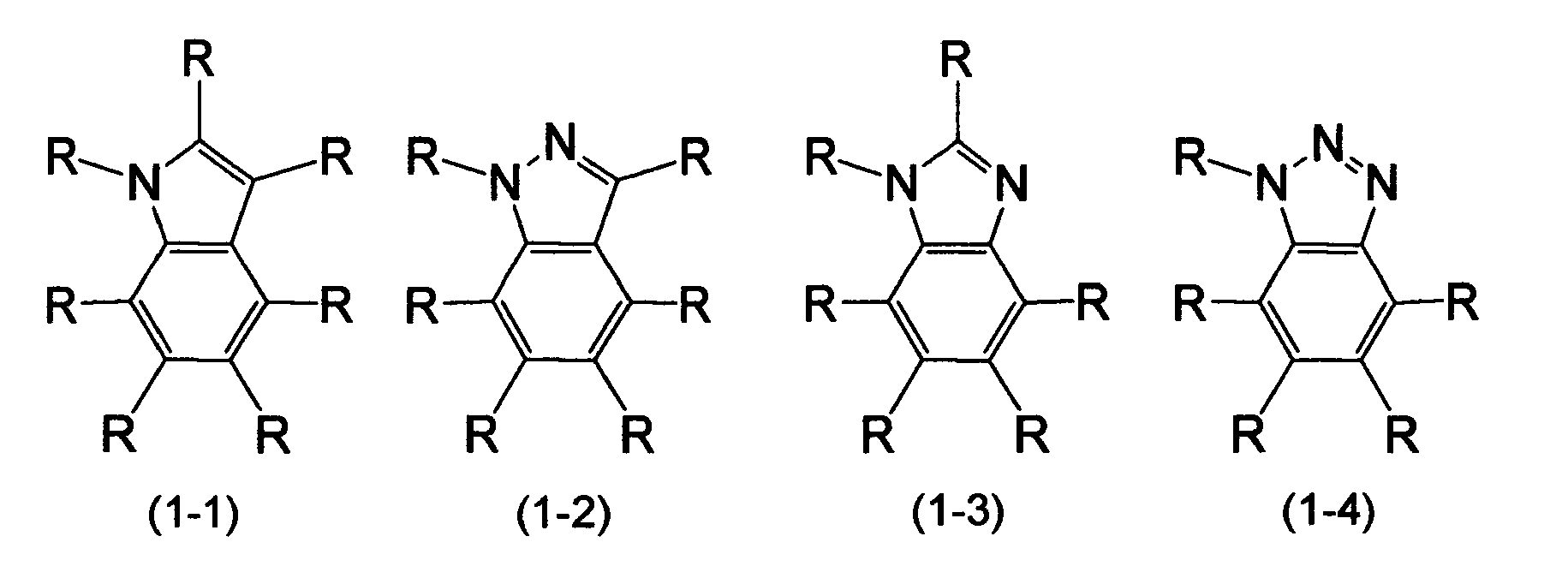
wherein R represents a hydrogen atom or a substituent; and more than one R may be the same or different; and a phosphorescent compound.
wherein R represents a hydrogen atom or a substituent; and more than one R may be the same or different; and a phosphorescent compound.
2. The composition according to claim 1, wherein the compound having residues of at least
two kinds of nitrogen-containing polycyclic compounds is a compound having residues
of at least two kinds of nitrogen-containing polycyclic compounds selected from the
group consisting of nitrogen-containing polycyclic compounds represented by the formulas
(1-2), (1-3) and (1-4) given above.
3. The composition according to claim 1 or 2, wherein at least one of the R is an alkyl
group, an alkoxy group, an aryl group that may have a substituent or a heteroaryl
group that may have a substituent.
4. The composition according to claim 3, wherein at least one of the R is a substituent
having 3 or more atoms in total except hydrogen.
5. The composition according to claim 4, wherein at least one of the R is an alkyl group
having 3 to 10 carbon atoms or an alkoxy group having 3 to 10 carbon atoms.
6. The composition according to any one of claims 1 to 5, wherein the compound having
residues of at least two kinds of nitrogen-containing polycyclic compounds is a compound
represented by formula (A-1) or (A-2) given below:


wherein Z1 and Z2 each independently represent a residue of a nitrogen-containing polycyclic compound represented by the above formula (1-1), (1-2), (1-3) or (1-4); Y1 represents -C(Ra)(Rb)-, -N(Rc)-, -O-, -Si(Rd)(Re)-, -P(Rf)- or -S-; Ra to Rf each independently represent a hydrogen atom or a substituent; m is an integer of 0 to 5; when there is more than one Y1, they may be the same or different; Y2 represents an arylene group that may have a substituent; n is an integer of 1 to 5; and when there is more than one Y2, they may be the same or different, or a compound having a residue of the foregoing compound.
wherein Z1 and Z2 each independently represent a residue of a nitrogen-containing polycyclic compound represented by the above formula (1-1), (1-2), (1-3) or (1-4); Y1 represents -C(Ra)(Rb)-, -N(Rc)-, -O-, -Si(Rd)(Re)-, -P(Rf)- or -S-; Ra to Rf each independently represent a hydrogen atom or a substituent; m is an integer of 0 to 5; when there is more than one Y1, they may be the same or different; Y2 represents an arylene group that may have a substituent; n is an integer of 1 to 5; and when there is more than one Y2, they may be the same or different, or a compound having a residue of the foregoing compound.
7. The composition according to any one of claims 1 to 6, wherein the compound having
residues of at least two kinds of nitrogen-containing polycyclic compounds is a polymer
compound.
8. The composition according to claim 7, wherein the compound having residues of at least
two kinds of nitrogen-containing polycyclic compounds is a polymer compound having
a repeating unit comprising a residue of a compound represented by the above formula
(A-1) or (A-2).
9. The composition according to any one of claims 1 to 8, wherein the lowest triplet
excitation energy value of the compound having residues of at least two kinds of nitrogen-containing
polycyclic compounds as calculated by a computational scientific approach is 3.0 eV
or more.
10. The composition according to any one of claims 1 to 9, wherein the absolute value
of a lowest unoccupied molecular orbital energy level of the compound having residues
of at least two kinds of nitrogen-containing polycyclic compounds as calculated by
a computational scientific approach is 1.5 eV or more.
11. The composition according to any one of claims 1 to 9, wherein the absolute value
of the highest occupied molecular orbital energy level of the compound having residues
of at least two kinds of nitrogen-containing polycyclic compounds as calculated by
a computational scientific approach is 6.2 eV or less.
12. The composition according to any one of claims 1 to 11, wherein the lowest triplet
excitation energy value (ETH) of the compound having residues of at least two kinds
of nitrogen-containing polycyclic compounds and the lowest triplet excitation energy
value (ETG) of the phosphorescent compound satisfy an expression given below:
ETH > ETG (eV).
ETH > ETG (eV).
13. The composition according to any one of claims 1 to 12, wherein the compound having
residues of at least two kinds of nitrogen-containing polycyclic compounds is a compound
having a heterocyclic structure constituting the nitrogen-containing polycyclic compounds
and a partial structure adjacent to the heterocyclic structure, the partial structure
having at least two π-conjugated electrons, wherein the dihedral angle between the
heterocyclic structure and the partial structure is 40° or more.
14. The composition according to any one of claims 1 to 13, wherein the phosphorescent
compound is an iridium complex or a platinum complex.
15. The composition according to claim 14, wherein the phosphorescent compound is a metal
complex having iridium or platinum as a central metal and having 8-quinolinol or a
derivative thereof, benzoquinolinol or a derivative thereof, or 2-phenyl-pyridine
or a derivative thereof as a ligand.
16. A polymer compound comprising: residues of at least two kinds of nitrogen-containing
polycyclic compounds selected from the group consisting of nitrogen-containing polycyclic
compounds represented by formulas (1-1), (1-2), (1-3) and (1-4) given below:

wherein R each represents a hydrogen atom or a substituent; and more than one R may be the same or different; and a residue of a phosphorescent compound.
wherein R each represents a hydrogen atom or a substituent; and more than one R may be the same or different; and a residue of a phosphorescent compound.
17. A thin film prepared by using the composition according to any one of claims 1 to
15 or the polymer compound according to claim 16.
18. A light-emitting device prepared by using the composition according to any one of
claims 1 to 15 or the polymer compound according to claim 16.
19. A planar light source comprising the light-emitting device according to claim 18.
20. A display comprising the light-emitting device according to claim 18.
21. A light comprising the light-emitting device according to claim 18.
REFERENCES CITED IN THE DESCRIPTION
This list of references cited by the applicant is for the reader's convenience only. It does not form part of the European patent document. Even though great care has been taken in compiling the references, errors or omissions cannot be excluded and the EPO disclaims all liability in this regard.
Patent documents cited in the description
- JP2002050483A [0004]
- JP2002241455A [0004]
- WO2002066552A [0050]
- WO2004020504A [0050]
- WO2004020448A [0050]
- JP63070257A [0068]
- JP63175860A [0068]
- JP2135359A [0068]
- JP2135361A [0068]
- JP2209988A [0068]
- JP3037992A [0068]
- JP3152184A [0068]
Non-patent literature cited in the description
- APPLIED PHYSICS LETTERS, 2002, vol. 80, 132308- [0005]
- Nature, 1998, vol. 395, 151- [0050]
- Appl. Phys. Lett., 1999, vol. 75, 14- [0050]
- Proc. SPIE-Int. Soc. Opt. Eng., 2001, 4105- [0050]
- Organic Light-Emitting Materials and Devices, vol. IV, 119- [0050]
- J. Am. Chem. Soc., 2001, vol. 123, 4304- [0050]
- Appl. Phys. Lett., 1997, vol. 71, 182596- [0050]
- Syn. Met., 1998, vol. 94, 1103- [0050]
- Syn. Met., 1999, vol. 99, 21361- [0050]
- Adv. Mater., 1999, vol. 11, 10852- [0050]
- Inorg. Chem., 2003, vol. 42, 8609- [0050]
- Inorg. Chem., 2004, vol. 43, 6513- [0050]
- Journal of the SID, 2003, vol. 11/1, 161- [0050]