|
(11) | EP 2 306 020 A1 |

| (12) | EUROPEAN PATENT APPLICATION |
|
|
|
|
|||||||||||||||||||||||
| (54) | Method in connection with pump drive |
| (57) A method in connection with a pump drive connected to a container (1) or the like,
wherein a frequency converter (2) is arranged to supply power to a pump (3) in such
a manner that the pump flow (Qp) is responsive to an estimated mean incoming flow (Qest) to the container (1). The method comprises the steps of draining the container (1),
allowing the container (1) to fill during a predefined filling time (tfill) while the pump (3) is inactive, draining the container (1) again at a known pump
(3) flow (Qp,nom), defining the drainage time (tdrain), defining an estimated mean incoming flow (Qest) on the basis of the filling time (tfill), drainage time (tdrain) and known pump (3) flow (Qp,nom), setting the power supplied by the frequency converter (2) to the pump (3) to be
such that the pump (3) flow (Qp) corresponds to the produced estimated mean incoming flow (Qest).
|
Background of the invention
[0001] The present invention relates to a method and arrangement in connection with a pump drive connected to a container or the like in accordance with the preambles of the independent claims.
[0002] Pump drives connected to a container or the like are used for many purposes, such as pumping groundwater or service water from a well or pumping other liquid from a container. When the material being pumped is limited, it is possible that the pump cannot be used at constant power all the time. A lengthy use of a pump without a flow through the pump may cause overheating in the pump and the material being pumped and consequently also damage to the pump drive.
[0003] In prior art, pumps are controlled utilising surface measuring techniques, such as measuring sensors based on ultra-sound or pressure. Measuring sensors of this type provide accurate surface data. The flow of the pump is adjusted to provide the required surface level. Pump control may also be done by using a cable float level switch or mounted float level switch. With these, pumping between the top and bottom limits of the surface is often implemented with on/off control without adjustment.
[0004] There is always a risk that measuring sensors break, so they reduce the reliability of the operation of the apparatus. For instance, a float level switch may in time break due to humidity or contact terminal connection problems may occur in it. In addition, measuring sensors, their cabling, and the extra work needed to install and service them cause additional costs.
Brief description of the invention
[0005] It is thus an object of the invention to develop a method and an apparatus implementing the method in such a manner that the above-mentioned problems are solved. The object of the invention is achieved by a method and an apparatus, which are characterized by what is disclosed in the independent claims. Preferred embodiments of the invention are disclosed in the dependent claims.
[0006] The invention is based on the idea that the size of the mean flow into the container of the like is estimated by utilising the known flow of a pump controlled by a frequency converter. On the basis of this estimated size, the pump is set to a required operating point for pumping, that is, a suitable flow is set for the pump. Information on the size of the estimated mean incoming flow is updated by repeating the measuring cycle at regular intervals or as necessary.
[0007] According to a preferred embodiment of the invention, the emptying of the container or the like is detected from the decrease in the torque of the pump measured by the frequency converter as the flow of the pump decreases.
[0008] The method and system of the invention provide the advantage that the inventive arrangement does not need information on the surface level in the container and, therefore, no sensors for determining the level. As no separate devices are required for measuring the surface, the installation of the arrangement of the invention is faster and cheaper than before. The arrangement of the invention is also more reliable in operation, since it only contains parts that are needed for pumping. In addition, the arrangement of the invention is less expensive than arrangements implemented in the previously known ways.
[0009] According to a preferred embodiment, a float level switch is used to generate a top level alarm in the container but not to control the actual pumping process.
Brief description of figures
[0010] The invention will now be explained in greater detail in connection with preferred embodiments and with reference to the attached drawings, in which:
Figure 1 shows a diagram of an arrangement to which the method of the invention may be applied.
Figure 2 shows the effect of the incoming flow Q and the flow Qp exiting through the pump on the quantity v of material in the container.
Figure 3 shows an embodiment of the invention in which the surface level h may be kept at a required level in the container or the like.
Detailed description of the invention
[0011] Figure 1 shows a diagram of an arrangement to which the method of the invention may be applied. Material flows into the container 1 at flow Q and exits from the container 1 through the pump 3 at flow Qp. The surface level h of the material in the container is maintained in response to the difference between the incoming and exiting flow of the container. A frequency converter 2 is connected to control an electric motor coupled mechanically to the pump 3 by providing it with power.
[0012] Figure 2 shows the effect of the incoming flow Q and the flow Qp exiting through the pump on the quantity v of material in the container. Prior to using the method of the invention, the container 1 or the like is drained, if it has not been found empty. When the container 1 or the like is drained, the flow Qp of the pump 3 decreases. In general, the flow of the pump is responsive to the torque of the pump motor. As a result of the decrease in the pump 3 flow Qp, the torque of the pump 3 motor also decreases. The frequency converter 2 comprises means for measuring the torque and detects the decrease in the torque of the pump 3 motor. According to a preferred embodiment of the invention, the container 1 or the like is judged to be empty, if the torque is smaller than a predefined percentage of an assumed torque defined for the set flow Qp of the pump 3. Said predefined percentage may be 20% to 50%, for instance.
[0013] After detecting that the container 1 is empty, it is allowed to fill up during a predefined filling time tfill while the pump 3 is inactive. After this, the container 1 is drained again at a known pump 3 flow Qp,nom, and the time tdrain needed for draining is determined. As above, the draining is now also preferably detected on the basis of the change in the torque used in pumping.
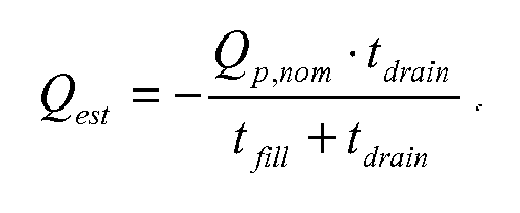
[0014] The container 1 is again empty, like at the start of the measuring cycle, so the same quantity of material has flown through the pump 3 during the measuring cycle as has entered the container 1. Thus, the absolute value of the time integral of the incoming flow Q during the measuring cycle equals the time integral of the nominal flow Qp,nom passing through the pump 3 during the measuring cycle. The values of the incoming flow Q and the nominal pump flow Qp,nom have opposite signs, because their flow directions are opposite to each other in relation to the container 1. Therefore, it is possible to calculate an estimate for the incoming flow Q on the basis of the nominal pump 3 flow Qp,nom. The nominal pump 3 flow Qp,nom may be calculated by using the specific performance curves of the pump 3. The incoming flow Q may be assumed to be of a constant size during the measuring cycle. Thus, the estimated mean incoming flow Qest corresponding to the incoming flow Q is
[0015] At the end of the measuring cycle, the container 1 is allowed to fill to a predefined extent so as to have a flow through the pump 3 after the measuring cycle. After the measuring cycle, the power supplied by the frequency converter 2 to the pump 3 is set to be such that the pump 3 flow Qp corresponds to the produced estimated mean incoming flow Qest. Information on the size of the estimated mean incoming flow Qest is constantly updated by repeating the measuring cycle at predefined measuring intervals tmeas or as necessary when drainage of the container is detected.
[0016] If the drainage time tdrain during the measuring cycle is too short, that is, the estimated mean incoming flow Qest is lower than the predefined minimum limit value Qp,min, the frequency converter 2 goes into sleep mode in accordance with the preferred embodiment of the invention. The pump 3 is then not in use. The system may return from sleep mode to normal mode due to top limit detection from a measuring sensor, such as float level switch, or a new measuring cycle. An example of the embodiment of the invention is a rain water pump station. When it does not rain, the well is empty and the frequency converter is in sleep mode. When rain begins, water level rises and top limit detection from the measuring sensor returns the frequency converter to normal mode.
[0017] According to an embodiment of the invention, the surface level h may be kept at a required level in the container or the like. The container 1 is then drained for the first time during the measuring cycle by using the nominal flow of the pump 3. In the manner shown in Figure 3, the drainage time tdrain,0 is measured and the obtained time is used together with the nominal flow Qp,nom of the pump 3 and the estimated mean incoming flow Qest to estimate the material volume vest in the container 1 or the like as follows:
[0018] The above equation produces the volume of material in the container 1 before the measuring cycle. The estimated mean incoming flow Qest is calculated earlier with said equation by using the measuring results of the present measuring cycle.
[0019] At the end of the measuring cycle, the material volume v in the container 1 is returned to the desired level by allowing the container to fill while the pump is inactive for the time of a second filling time tfill, 1. The second filling time is obtained from equation
[0020] If the volume of the container 1 is known, its filling factor may be calculated by dividing the produced estimated material volume vest by the nominal material volume of the container 1. The filling factor data may be utilised in an adjustment where the surface level h is kept at a desired level.
1. A method in connection with a pump drive connected to a container (1) or the like,
wherein a frequency converter (2) is arranged to supply power to a pump (3) in such
a manner that the pump flow (Qp) is responsive to an estimated incoming flow (Qest) to the container (1), characterised in that the method comprises the steps of
draining the container (1),
allowing the container (1) to fill during a predefined filling time (tfíll) while the pump (3) is inactive,
draining the container (1) again at a known pump 3 flow (Qp,nom), defining a drainage time (tdrain),
defining an estimated mean incoming flow (Qest) on the basis of the drainage time (tdrain) and known flow (Qp,nom) of the pump,
setting the power supplied by the frequency converter (2) to the pump (3) to be such that the pump (3) flow (Qp) corresponds to the produced estimated mean incoming flow (Qest).
draining the container (1),
allowing the container (1) to fill during a predefined filling time (tfíll) while the pump (3) is inactive,
draining the container (1) again at a known pump 3 flow (Qp,nom), defining a drainage time (tdrain),
defining an estimated mean incoming flow (Qest) on the basis of the drainage time (tdrain) and known flow (Qp,nom) of the pump,
setting the power supplied by the frequency converter (2) to the pump (3) to be such that the pump (3) flow (Qp) corresponds to the produced estimated mean incoming flow (Qest).
2. A method as claimed in claim 1, characterised in that the estimation of the emptiness of the container (1) or the like comprises the steps
of
defining a motor torque from the power supplied by the frequency converter (2) to the pump (3) motor,
judging that the container (1) or the like is empty, if the torque is smaller than a predefined percentage of an assumed torque defined for the set flow (Qp) of the pump (3).
defining a motor torque from the power supplied by the frequency converter (2) to the pump (3) motor,
judging that the container (1) or the like is empty, if the torque is smaller than a predefined percentage of an assumed torque defined for the set flow (Qp) of the pump (3).
3. A method as claimed in claim 1 or 2, characterised by determining the estimated mean incoming flow (Qest) on the basis of the filling time (tfill) and drainage time (tdrain) and known flow (Qp,nom) of the pump (3) as follows:
4. A method as claimed in any one of claims 1 to 3, characterised by constantly updating the information on the size of the estimated mean incoming flow
(Qest) by repeating the measuring cycle of the method at predefined measuring intervals
(tmeas) or as necessary when drainage of the container is detected.
5. A method as claimed in any one of claims 1 to 4, characterised by activating the sleep mode of the frequency converter (2), during which the pump (3)
is not in use, if the estimated mean incoming flow (Qest) is lower than a predefined minimum limit value (Qp,min).
6. A method as claimed in claim 5, characterised by returning from the sleep mode due to a new measuring cycle.
7. A method as claimed in claim 5 or 6, wherein the container (1) or the like comprises
a measuring sensor indicating top limit data of material level, characterised by returning from the sleep mode to normal operation due to a top limit indication from
the measuring sensor.
8. A method as claimed in any one of claims 1 to 7, characterised by
draining the container (1) for the first time during the measuring cycle of the method by using a nominal flow of the pump (3),
measuring the drainage time (tdrain,0), and
using the obtained time together with the nominal flow (Qp,nom) of the pump (3) and the estimated mean incoming flow (Qest) to estimate the material volume (vest) in the container (1) or the like before the measuring cycle of the method as follows:

wherein the estimated mean incoming flow Qest is defined in accordance with the method by using the measuring results according to the present measuring cycle of the method.
draining the container (1) for the first time during the measuring cycle of the method by using a nominal flow of the pump (3),
measuring the drainage time (tdrain,0), and
using the obtained time together with the nominal flow (Qp,nom) of the pump (3) and the estimated mean incoming flow (Qest) to estimate the material volume (vest) in the container (1) or the like before the measuring cycle of the method as follows:
wherein the estimated mean incoming flow Qest is defined in accordance with the method by using the measuring results according to the present measuring cycle of the method.
9. A method as claimed in claim 8, characterised by returning, at the end of the measuring cycle according to the method, the material
volume (v) in the container (1) to a desired level by allowing the container to fill while
the pump is inactive for the time of a second filling time (tfill, 1), wherein the second filling time (tfill, 1) is obtained using the equation

10. A method as claimed in claim 8 or 9, characterised by calculating the filling factor of the container (1) by dividing the estimated material
volume (vest) by the known nominal material volume of the container (1).