|
(11) | EP 2 308 853 A1 |

| (12) | EUROPEAN PATENT APPLICATION |
|
|
|
|
|||||||||||||||||||||||
|
||||||||||||||||||||||||
| (54) | Process for the preparation of aminopyrimidines |
| (57) The present invention provides a process for the preparation of a compound of formula
(I):
wherein X is halogen; Y is ZR1; Z is oxygen or sulphur; and R1 is C1-6 alkyl, C1-6 haloalkyl or C3-7 cycloalkyl; the process comprising conducting a one-pot hydrogenation of a compound of formula (III): wherein R2 is phenyl optionally substituted by chloro, C1-6 alkyl, C1-6 alkoxy or (C1-6 alkyl)2N; firstly at about 20°C to form a compound of formula (TV): and then at about 40°C; both steps (i) and (ii) being carried out in the presence of a suitable catalyst and in the presence of a suitable solvent. |
[0001] The present invention concerns a process for the preparation of 5-aminopyrimidines which are useful intermediates in the preparation of pharmaceutically active triazolo[4,5-d]pyrimidine cyclopentanes.
[0002] The compound [1S-(1α, 2α, 3β .(1S*,2R*),5β)]-3-[7-[2-(3,4-difluorophenyl)-cyclopropyl]amino]-5-(propylthio)-3H 1,2,3-triazolo[4,5-d]pyrimidin-3-yl)-5-(2-hydroxyethoxy)-cyclopentane-1,2-diol (Compound A), and similar such compounds, are disclosed in WO 00/34283 and WO 99/05143 as pharmaceutically active P2T (which is now usually referred to as P2Y12) receptor antagonists. Such antagonists can be used as, inter alia, inhibitors of platelet activation, aggregation or degranulation.
[0003] Compounds of formula (I) (see below) are useful in the preparation of Compound A and analogues thereof (see example 3 of WO 01/92263).
[0005] The present invention provides a process for the preparation of a compound of formula (I):
wherein X is halogen; Y is ZR1; Z is oxygen or sulphur; and R1 is C1-6 alkyl, C1-6 haloalkyl or C3-7 cycloalkyl; the process comprising either:
- a. hydrogenating a compound of formula (II):
with a suitable transition metal catalyst in a C1-6 aliphatic alcohol, an ether, an ester or a hydrocarbon as solvent;
or, - b. conducting a one-pot hydrogenation of a compound of formula (III):
- c.
wherein R2 is phenyl optionally substituted by chloro, C1-6 alkyl, C1-6 alkoxy or (C1-6 alkyl)2N;- i. firstly at about 20°C to form a compound of formula (IV):
- ii. and then at about 40°C;
- i. firstly at about 20°C to form a compound of formula (IV):
[0006] Alkyl groups and moieties are straight or branched chain and comprise, for example, 1 to 6 (such as 1 to 4) carbon atoms. Examples of alkyl groups are methyl, ethyl, n-propyl, iso-propyl or tert-butyl.
[0007] Haloalkyl groups and moieties are straight or branched chain and comprise, for example, 1 to 6 (such as 1 to 4) carbon atoms, and 1 to 6 halogen atoms (for example fluorine or chlorine atoms). Examples of haloalkyl are CH2F, CHF2, CF3, CH2CF3 and 3,3,3-trifluoroprop-1-yl.
[0009] In one particular aspect the present invention provides a process for the preparation of a compound of formula (I):
wherein Xis halogen; Y is ZR1; Z is oxygen or sulphur; and R1 is C1-6 alkyl, C1-6 haloalkyl or C3-7 cycloalkyl; the process comprising hydrogenating a compound of formula (II):
with a suitable transition metal catalyst in C1-6 aliphatic alcohol, an ether, an ester or a hydrocarbon as solvent.
[0010] Suitable transition metal catalyst for the hydrogenation of a compound of formula (II) is, for example, platinum or palladium, or a combination of platinum with another transition metal such as vanadium, iron or manganese. In a further aspect of the invention the transition metal catalyst is on a suitable support, for example carbon.
[0011] A suitable solvent for the hydrogenation of a compound of formula (II) is a C1-6 aliphatic alcohol (such as ethanol and iso-propyl alcohol), an ether (for example a di(C1-6 alkyl) ether, such as diethylether or methyl tert-butyl ether; or a cyclic ether such as tetrahydrofuran), an ester (for example ethyl acetate) or a hydrocarbon solvent (such as an aromatic hydrocarbon, for example benzene, toluene or a xylene).
[0012] In another aspect the hydrogenation of a compound of formula (II) is conducted at a temperature in the range 10 to 90°C, for example 20 to 40°C.
[0013] In yet another aspect the hydrogenation of a compound of formula (II) is conducted at a pressure of 1 to 10 bar, for example 2 to 4 bar.
[0014] In a further aspect the present invention provides a process for the preparation of a compound of formula (I):
wherein X is halogen; Y is ZR1; Z is oxygen or sulphur; and R1 is C1-6 alkyl, C1-6 haloalkyl or C3-7 cycloalkyl; the process comprising conducting a one-pot hydrogenation of a compound of formula (III):
wherein R2 is phenyl optionally substituted by chloro, C1-6 alkyl, C1-6 alkoxy or (C1-6 alkyl)2N;
- i. firstly at 10 to 25°C to form a compound of formula (IV):
- ii. and then hydrogenating at about 35 to 50°C;
[0015] Highly effective mixing (for example stirring) is used during the one-pot hydrogenation as this aids effective mass transfer during the process. Highly effective mixing is used to obtain good contact between the gaseous hydrogen, the solid catalyst and the compound of formula (III) or (IV).
[0016] A suitable catalyst for the one-pot hydrogenation is either a single transition metal or a mixture of two or more transition metals. Suitable catalysts are platinum or a mixture of platinum and vanadium. It is usual for the catalyst to be on a suitable support (for example carbon). Examples of these catalysts are platinum on carbon 5-15%w/w; platinum 2-10%w/w (for example 3-7%w/w) and vanadium 0.2-3%w/w on carbon.
[0017] A suitable solvent for the one-pot hydrogenation is a C1-6 aliphatic alcohol (for example ethanol or iso-propyl alcohol), an ester (for example ethyl acetate), an ether (such as tetrahydrofuran or methyl tert-butyl ether), a hydrocarbon (such as an aromatic hydrocarbon, for example benzene, toluene or a xylene) or a ketone (such as acetone).
[0018] In yet another aspect the hydrogenation of a compound of formula (III) or (IV) is conducted at a pressure of 0.5 to 10 bar, for example 2 to 4 bar.
[0019] In a still further aspect the present invention provides a process as hereinbefore described wherein X is chloro.
[0020] In another aspect the present invention provides a process as hereinbefore described wherein Z is sulphur.
[0021] In yet another aspect the present invention provides a process as hereinbefore described wherein R1 is C1-4 alkyl (such as n-propyl) or C1-4haloalkyl (such as 3,3,3-trifluoroprop-1-yl).
[0022] In yet another aspect the present invention provides a process as herein described where in 5-15%w/w catalyst is used based on compound of formula (II) or (III).
EXAMPLE 1
[0024] This Example illustrates a process for the preparation of 4,6-dichloro-2-(propylthio)pyrimidin-5-amine.
[0025] A Pt/V/C catalyst (available from Degussa; about 3% Pt and 0.6% V adsorbed on charcoal, 30g) was charged to a vessel and the vessel was purged with nitrogen. 4,6-Dichloro-5-nitro-2-(propylthio)pyrimidine (302g) dissolved in tert-butyl methyl ether (31) was charged to the vessel and agitation was started. The resulting mixture was heated to an initial temperature of 30°C and then the vessel was pressurised with hydrogen to 3 bar for 3 hours. After the completion of the hydrogenation the catalyst was filtered off. The filtrate was concentrated under reduced pressure to provide the title compound (254g).
EXAMPLE 2
[0026] This Example illustrates a process for the preparation of 4,6-dichloro-2-(propylthio)pyrimidin-5-amine from 4,6-dichloro-5-[(E)-(4-methylphenyl)diazenyl]-2-(propylsulfanyl)pyrimidine
[0027] The Pt/C catalyst (33.3g, 10% w/w) was added to a reaction vessel that had been purged with nitrogen and maintained under an atmosphere of nitrogen. The solution of 4,6-dichloro-5-[(E)-2-(4-methylphenyl)diazenyl]-2-(propylsulfanyl)pyrimidine (150g, 430.1 mmol) in ethyl acetate (3000ml) was added to the reaction vessel containing the catalyst and agitation was initiated. The inner temperature was adjusted to 20°C, the nitrogen atmosphere was evacuated, and the vessel was pressurized with 3 bar of hydrogen (hydrogen pressure of 3 bar was maintained throughout the reaction). The temperature was maintained at 20°C for about 30 minutes and then it was increased to 40°C and maintained for 150 minutes. When the reaction was complete (full conversion) the reaction solution was cooled to 20°C and the catalyst filtered off under a nitrogen atmosphere. The catalyst was washed with ethyl acetate (300ml) and the filtered wash-solution was combined with the filtered reaction solution. The ethyl acetate solution was concentrated to 5ml (ethyl acetate)/g (amine) under vacuum at a maximum temperature of 40°C. The resulting solution was extracted twice with aqueous hydrochloric acid (about 3M; 700ml and 375ml) until a pH of 1.5-2 was obtained. The concentration of the ethyl acetate layer, under vacuum, yielded about 93g of the 4,6-dichloro-2-(propylthio)pyrimidin-5-amine as a yellow oil.
1. A process for the preparation of a compound of formula (I):
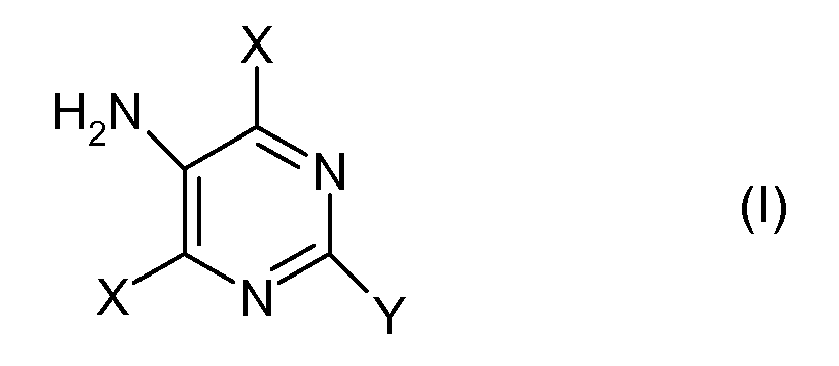
wherein X is halogen; Y is ZR1; Z is oxygen or sulphur; and R1 is C1-6 alkyl, C1-6 haloalkyl or C3-7 cycloalkyl; the process comprising conducting a one-pot hydrogenation of a compound of formula (III):
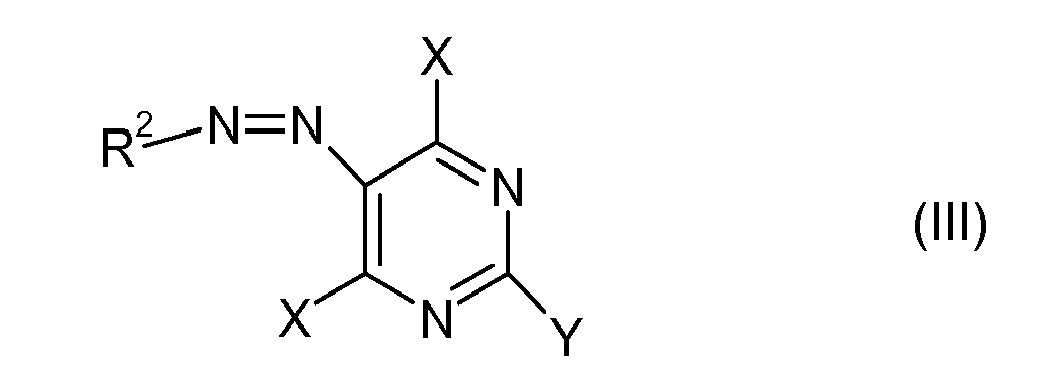
wherein R2 is phenyl optionally substituted by chloro, C1-6 alkyl, C1-6 alkoxy or (C1-6 alkyl)2N;
wherein X is halogen; Y is ZR1; Z is oxygen or sulphur; and R1 is C1-6 alkyl, C1-6 haloalkyl or C3-7 cycloalkyl; the process comprising conducting a one-pot hydrogenation of a compound of formula (III):
wherein R2 is phenyl optionally substituted by chloro, C1-6 alkyl, C1-6 alkoxy or (C1-6 alkyl)2N;
(i) firstly at about 20°C to form a compound of formula (IV):
(ii) and then at about 40°C;
both steps (i) and (ii) being carried out in the presence of a suitable catalyst and in the presence of a suitable solvent.2. A process as claimed in claim 1wherein X is chloro.
3. A process as claimed in claim 1 or 2 wherein Z is sulphur.
4. A process as claimed in claim 1, 2 or 3 wherein R1 is C1-4 alkyl or C1-4 haloalkyl.
5. A process as claimed in claim 1, 2, 3 or 4wherein Y is ZR1; Z is sulphur; and R1 is n-propyl.
6. A process as claimed in any one of claims 1 to 5 wherein the catalyst for the one-pot
hydrogenation is selected from platinum and a mixture of platinum and vanadium.
7. A process as claimed in claim 6 wherein the catalyst for the one-pot hydrogenation
is selected from platinum on carbon 5-15%w/w; platinum 2-10%w/w and vanadium 0.2-3%w/w
on carbon.
8. A process as claimed in claim 6 or 7 wherein the solvent for the one-pot hydrogenation
is selected from a C1-6 aliphatic alcohol, an ester, an ether, a hydrocarbon and a ketone.
9. A process as claimed in claim 6, 7 or 8 wherein the hydrogenation of a compound of
formula (III) or (IV) is conducted at a pressure of 2 to 4 bar.
10. A process as claimed in claim 1 for the preparation of a compound of formula (I) in
which X is chloro, Y is ZR1; Z is sulphur; and R1 is n-propyl ; the process comprising a one-pot hydrogenation of a compound of formula
(III) wherein the hydrogenation is conducted in a solvent of ethyl acetate at a pressure
of 2 to 4 bar and using a Pt/C catalyst.
REFERENCES CITED IN THE DESCRIPTION
This list of references cited by the applicant is for the reader's convenience only. It does not form part of the European patent document. Even though great care has been taken in compiling the references, errors or omissions cannot be excluded and the EPO disclaims all liability in this regard.
Patent documents cited in the description