|
(11) | EP 2 343 300 A1 |

| (12) | EUROPEAN PATENT APPLICATION |
|
|
|
|
||||||||||||||||
| (54) | Anionic isosorbide derivatives and their use (II) |
| (57) Disclosed are isosorbide derivatives according to the following general formula
wherein R and R' independently from each other represent an isosorbide moiety or and hydrogen atom, or an alkyl group with 6 to 22 C-atoms, and A stands for a hydrogen atom or an alkali metal atom or an ammonium or an alkylammonium ion, with the proviso that at least one group R or R' stands for a isosorbide group and the use of said derivatives for the preparation of cleansers, detergents, personal care compositions, or cosmetic or pharmaceutical compositions. |
[0001] The present application pertains to specific anionic derivatives of isosorbide, and the use thereof in household products, like detergents or in cosmetic applications, preferably in personal cleaning applications, detergents and manual dish detergents.
[0002] The most widely used anionic surfactants in cleansing compositions are alkyl sulphates, polyoxyethylene alkyl sulphates and alkyl benzene sulphonates. These compounds are known to have a good foaming and deterging power. Due to their harshness, however, they are not desirable as components for cleansing compositions topically applied to human skin and hair. Their damaging effect particularly where young, tender or damaged skin is involved, has been the subject of intense study for many years.
[0003] On the other hand milder surfactants often suffer from the drawback that they do not provide high foam which is very important for the consumer. Therefore, there is a strong need for products which are not only very mild but also possess an excellent foaming power.
[0005] Upon heating sorbitol for example with concentrated sulfuric or hydrochloric acid, two molecules of water are eliminated with the formation of isosorbide. So far, these compounds are also known generally as dianhydrohexitols (including besides isosorbide also the isomers isomannide and isoidide).
[0006] Certain derivatives of isosorbide are known, especially esters or ethers thereof. Furthermore it is known to use isosorbide derivatives as additives in various applications, like detergents, cleansers or cosmetic compositions. US 2002/0174596 A1 discloses various isosorbide ethers as detergent for fuels. WO 01/0191949 A1 describes dimethylisosorbide as compound of a personal cleansing composition.
[0007] It was an objection of the present invention to find new additives, useful in detergents and cleansers, and based on isosorbide chemistry. It was found that certain anionic derivatives of isosorbide could be used with advantage in detergent, cleansers and related products, but preferably in personal cleaning applications.
[0008] The present application pertains in a first embodiment to isosorbide derivatives according to general formula (1)
wherein R and R' independently from each other represent a isosorbide moiety or and hydrogen atom, or an alkyl group with 6 to 22 C-atoms, and A stands for a hydrogen atom or an alkali metal atom or an ammonium or an alkylammonium ion, with the proviso that at least one group R or R' stands for an isosorbide group.
[0009] Compounds according to formula (I) are sulfosuccinate mono- or -diesters of isosorbide. Sulfosuccinates as such are well-known compounds, and a broad variety is described including the synthesis in GB 1,523,644. Synthesis of sulfosuccinates takes place for example by reaction of maleic anhydride in the presences of acid catalysts together with the alcohol component. Subsequently, through addition of hydrogen sulfite or sodium sulfite the transformation into the sulfosuccinate esters occurs.
[0011] Wherein one of the hydroxyl-groups of the isosorbide skeleton is linked with at least one of the carboxylic acid groups in the sulfosuccinates via an ester linkage. R" represents either an hydrogen atom, or an alkyl ―or alkenyl group with 1 to 22 C-atoms.
[0012] The sulfosuccinates according to this invention may be esterified in both carboxylic acid groups with an isosorbide moiety, but preferably only one of the groups R or R' in general formula (I) represents such a group (II). It is preferred that besides one compelling isosorbide moiety, the compounds according to formula (I) contain either a free carboxylic acid group (R or R' then stand for a hydrogen atom), or a long chain alkyl (or alkenyl) group with 6 to 22 C-atoms. This group could be linear or branched. Preferred are monoesters i.e. one isosorbide moiety and the other group R or R' is hydrogen.
[0013] A further preferred embodiment pertains to such derivatives according to formula (I) wherein R or R' stand for one isosorbide group according to formula (II), and the other group R or R' is a hydrogen atom, whereby in formula (II) R" preferably represents an alkyl- or alkenyl group with 1 to 22 C-atoms, and in particular 6 to 18 C-atoms, which could be linear or branched, saturated or unsaturated. These compounds according to formula (II) are isosorbide ether moieties.
[0014] The compounds following to formula (I) are useful for the preparation of all kind of detergents, cleansers and the like (solid, liquid or gel-like ones) or the use of this compounds in cosmetic or pharmaceutical compositions. Preferred is the use of compounds according to formula (I) in cleaners and here in particular for cleaners for hard surfaces, like kitchen or bathroom cleaner or dish washing detergents (manual and automatic), as well as cosmetic compositions or personal care applications too.
[0015] The isosorbide derivatives according to formula (I) then may be present in amounts from 0.1 up to 25 % by weight, dependent on the particular formulation. Preferably those detergents or cleansers will contain the isosorbide derivatives in amounts of 1 to 15 wt%, and most preferred from 5 to 10 wt%, based on the total weight of the cleanser or detergent.
[0016] The isosorbide derivatives according to formula (I) are particularly useful in home care applications, like detergents, and all kind of cleaners (kitchen, bathroom, hard surface, automotive or car cleansers, and multipurpose cleansers), as well as in dishwashing compositions (hand and automatic dish washing) and in personal care compositions, especially in hair and body cleansing formulations, but can also used with advantage in cosmetic compositions, for example in shampoos, creams and the like.
[0017] Preferred is the use of the isosorbide derivatives inter alia in personal care compositions such as a liquid soap, shampoo, foam bath, shower bath and the like or a solid form such as a bar which can illustratively be a soap or syndet composition. The isosorbide derivatives could also be used in toothpaste and related compositions, like mouth wash. In addition to surfactants or surfactant combinations, the cosmetic products in question typically contain such constituents as emulsifiers, oil components, solubilizers, thickeners, superfatting agents, biogenic agents, film formers, fragrances, dyes, pearlescers, foam stabilizers, preservatives and pH regulators. Accordingly, the preparations according to the invention may contain additional components and auxiliaries as known from the prior art.
[0018] Any detergent or cleanser compositions according to the invention may contain, besides the isosorbide derivatives other surfactants, builders, salts, bleaching agents, bleach activators, optical brighteners, redeposition inhibitors, soil repellants, solubilizers, foam inhibitors, perfumes, buffers, non-aqueous solvents, dyes and enzymes as auxiliaries and additives.
[0019] The cleaners according to the invention may further contain, for example, solubilizers, such as ethanol, isopropyl alcohol, ethylene glycol, diethylene glycol or preferably butyl diglycol, foam regulators, for example soap, soluble builders, for example citric acid or sodium citrate, EDTA or NTA, and abrasives as auxiliaries. In many cases, an additional bactericidal effect is required so that the multipurpose cleaners may contain cationic surfactants or biocides, for example glucoprotamine. The cleaners according to the invention may be both alkaline (pH>7.5) and acidic (pH<6.5). The isosorbide derivatives may be formulated with other surfactants, like anionic, nonionic, amphoteric and/or cationic surfactants.
[0020] Anionic surfactants according to the present invention include aliphatic sulfates, such as fatty alcohol sulfates, fatty alcohol ether sulfates, fatty acid polyglycol ester sulfates, dialkyl ether sulfates, monoglyceride sulfates and aliphatic sulfonates, such as alkane sulfonates, olefin sulfonates, ether sulfonates, n-alkyl ether sulfonates, ester sulfonates, and lignin sulfonates. Fatty acid cyanamides, sulfosuccinic acid esters, fatty acid isethionates, acylaminoalkane sulfonates (fatty acid taurides), fatty acid sarcosinates, ether carboxylic acids and alkyl (ether) phosphates may also be used for the purposes of the invention, but are not preferred. Preferred anionic surfactants in the sense of the present invention are selected from the group of fatty alcohol sulfates, fatty alcohol ether sulfates and/or fatty acid polyglycol ester sulfates, and mixtures thereof.
[0021] Typical examples of nonionic surfactants are alkoxylates of alkanols, end-capped alkoxylates of alkanols with no free OH groups, alkoxylated fatty acid lower alkyl esters, amine oxides, alkylphenol polyglycol ethers, fatty acid polyglycol esters, fatty acid amide polyglycol ethers, fatty amine polyglycol ethers, alkoxylated triglycerides, mixed ethers and mixed formals, fatty acid-N-alkyl glucamides, protein hydrolyzates (more particularly wheat-based vegetable products), polyol fatty acid esters, sugar esters, sorbitan esters and polysorbates. If the nonionic surfactants contain polyglycol ether chains, they may have a conventional homolog distribution although they preferably have a narrow homolog distribution. The other nonionic surfactants are preferably selected from the group consisting of alkoxylates of alkanols, more particularly fatty alcohol polyethylene glycol/polypropylene glycol ethers or fatty alcohol polypropylene glycol/polyethylene glycol ethers, end-capped alkoxylates of alkanols, more particularly end-capped fatty alcohol polyethylene glycol/polypropylene glycol ethers or end-capped fatty alcohol polypropylene glycol/polyethylene glycol ethers, and fatty acid lower alkyl esters and amine oxides.
Alkyl and alkenyl oligoglycosides are known, and preferred, nonionic surfactants which correspond to formula R-O-[G]p in which R is an alkyl and/or alkenyl group containing 6 to 22 carbon atoms, G is a sugar unit containing 5 or 6 carbon atoms and p is a number of 1 to 10. They may be obtained by the relevant methods of preparative organic chemistry. The alkyl and/or alkenyl oligoglycosides may be derived from aldoses or ketoses containing 5 or 6 carbon atoms, preferably glucose. Accordingly, the preferred alkyl and/or alkenyl oligoglycosides are alkyl and/or alkenyl oligoglucosides. The index p in general formula (V) indicates the degree of oligomerization (DP), i.e. the distribution of mono- and oligoglycosides, and is a number of 1 to 10. Whereas p in a given compound must always be an integer and, above all, may assume a value of 1 to 6, the value p for a certain alkyl oligoglycoside is an analytically determined calculated quantity which is generally a broken number. Alkyl and/or alkenyl oligoglycosides having an average degree of oligomerization p of 1.1 to 3.0 are preferably used. Alkyl and/or alkenyl oligoglycosides having a degree of oligomerization of less than 1.7 and, more particularly, between 1.2 and 1.4 are preferred from the applicational point of view. The alkyl or alkenyl group R may be derived from primary alcohols containing 4 to 11 and preferably 8 to 10 carbon atoms.
Typical examples of cationic surfactants are quaternary ammonium compounds and quaternized fatty acid trialkanolamine esters. Typical examples of amphoteric or zwitterionic surfactants are alkyl betaines, alkyl amidobetaines, aminopropionates, aminoglycinates, imidazolinium betaines and sulfobetaines.
[0022] A further preferred embodiment of the present invention pertains to the use of the isosorbide derivatives according to formula (I) in the presence of electrolyte salts as thickening agent for aqueous systems, and especially for those surfactant mixes, which are difficult to thicken. In this regard "thickening" simply means any increase of viscosity of the aqueous compositions. The isosorbide derivatives will act in combination with an electrolyte salt, like sodium potassium or magnesium salts, ammonium salts or anorganic sulfates. Suitable inorganic electrolyte salts are any water-soluble alkali metal, ammonium and alkaline earth metal salts, for example the fluorides, chlorides, bromides, sulfates, phosphates and nitrates and hydrogen carbonates, providing they are soluble in water in a quantity of at least 1% by weight at 20 °C. The chlorides or sulfates of an alkali metal, ammonium or magnesium are preferably used, sodium chloride and magnesium chloride being particularly preferred.
[0023] The sulfosuccinates according to the invention show, besides the good detergency, also superior foaming properties, compared with other known surfactants, like alkoxylated ether sulfates. Foam properties of interest here are foam volume and tactile properties of the foam. The latter one is of specific advantage for the formulation of hand detergents, manual dish detergents, and personal care as well as cosmetic compositions. Preferred applications for this isosorbides may be in shampoos or shower gels and the like.
[0024] As further embodiment a liquid, gel-like or solid cleaner composition is mentioned, comprising at least 0.1 wt% of an isosorbide derivative according to the above description as surfactant.
Examples
Preparation of an isosorbide sulfosuccinate
[0025] Example 1: Synthesis of isosorbide lauroylester sulfosuccinate: Isosorbide mono-lauroylester (1 mol) and sodium carbonate (0.05 mol) are heated to 65-70°C under inert atmosphere. Maleic anhydride is added portionwise and the mixture is heated to 80°C for 2h. The hot reaction mixture is then poured into a cold sodium sulfite aqueous solution (1 mol, 0,4 mol/L) and the resulting mixture is stirred for 2 more hours at 75°C under inert atmosphere. 500 mL water is added to yield a white viscous liquid containing 30% of active substance.
Performance tests of the isosorbide sulfosuccinates
[0026] The foam quality and volume of this surfactant was tested. 2.5 % active substance (AS) of the surfactant is dissolved in water and stirred to foam. According to a visually evaluation this surfactant has a foam quality of 4-5 in a scale of 1 (small bubbles, high cushion, stable foam) to 5 (large bubbles, unstable foam) and a foam volume equal to 32% of the foam for a standard surfactant (see Figure 1)
1. Isosorbide derivatives according to general formula (I)
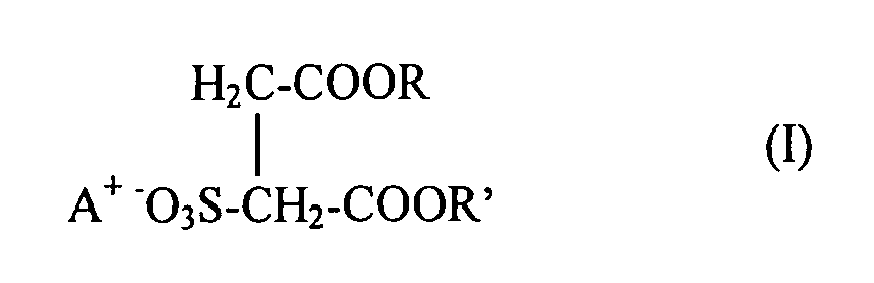
wherein R and R' independently from each other represent an isosorbide moiety or and hydrogen atom, or an alkyl group with 6 to 22 C-atoms, and A stands for a hydrogen atom or an alkali metal atom or an ammonium or an alkylammonium ion, with the proviso that at least one group R or R' stands for an isosorbide group.
wherein R and R' independently from each other represent an isosorbide moiety or and hydrogen atom, or an alkyl group with 6 to 22 C-atoms, and A stands for a hydrogen atom or an alkali metal atom or an ammonium or an alkylammonium ion, with the proviso that at least one group R or R' stands for an isosorbide group.
2. Isosorbide derivative according to claim 1, characterized in that only one group R or R' in formula (I) represents an isosorbide group (II)
3.
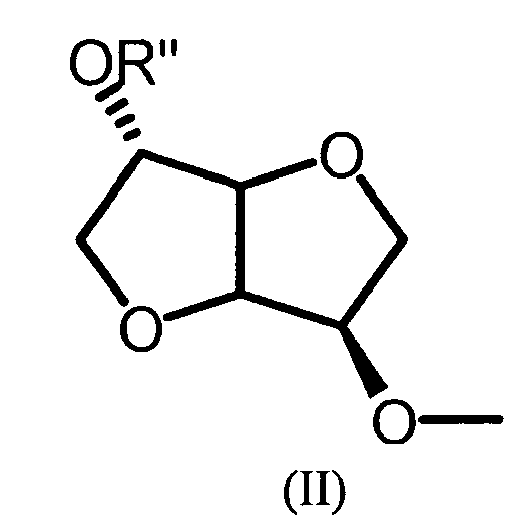
wherein R" stand for an hydrogen atom or an alkyl- or alkenyl group with 1 to 22 C-atoms.
wherein R" stand for an hydrogen atom or an alkyl- or alkenyl group with 1 to 22 C-atoms.
4. The use of isosorbide derivatives according to general formula (I) in claim 1, for
the preparation of cleaners, detergents, personal care, cosmetic or pharmaceutical
compositions, preferably in cleaners, personal care and cosmetic compositions.
5. The use according to claim 3 characterized in that the isosorbide derivative is present in amounts from 0.1 to 25 wt%, preferably 1
to 15 wt%, and most preferred from 5 to 10 wt%, based on the total weight of the cleanser
or detergent or personal care or cosmetic or pharmaceutical compositions.
6. Liquid, gel-like or solid cleaner composition, comprising at least 0.1 wt% of an isosorbide
derivative according to the description in claim 1 as surfactant.
REFERENCES CITED IN THE DESCRIPTION
This list of references cited by the applicant is for the reader's convenience only. It does not form part of the European patent document. Even though great care has been taken in compiling the references, errors or omissions cannot be excluded and the EPO disclaims all liability in this regard.
Patent documents cited in the description