| (19) |
 |
|
(11) |
EP 2 364 008 B1 |
| (12) |
EUROPEAN PATENT SPECIFICATION |
| (45) |
Mention of the grant of the patent: |
|
09.05.2012 Bulletin 2012/19 |
| (22) |
Date of filing: 26.02.2010 |
|
| (51) |
International Patent Classification (IPC):
|
|
| (54) |
Method to assign a customer premises equipment to a subscriber's data record, demarcation
point unit, and network element
Verfahren zur Zuweisung von Teilnehmerendgeräten an die Datenaufzeichnung eines Teilnehmers,
Vermarkungspunkteinheit und Netzwerkelement
Procédé pour attribuer un équipement sur le site d'un client à un registre de données
d'un abonné, une unité de point de délimitation et un élément de réseau
|
| (84) |
Designated Contracting States: |
|
AT BE BG CH CY CZ DE DK EE ES FI FR GB GR HR HU IE IS IT LI LT LU LV MC MK MT NL NO
PL PT RO SE SI SK SM TR |
| (43) |
Date of publication of application: |
|
07.09.2011 Bulletin 2011/36 |
| (73) |
Proprietor: Alcatel Lucent |
|
75007 Paris (FR) |
|
| (72) |
Inventors: |
|
- Hehmann, Joerg
71263, Weil der Stadt (DE)
- Straub, Michael
75433, Maulbronn (DE)
|
| (74) |
Representative: Brose, Gerhard |
|
Alcatel-Lucent Deutschland AG
Intellectual Property & Corporate Standards
Lorenzstrasse 10
70435 Stuttgart
70435 Stuttgart (DE) |
| (56) |
References cited: :
EP-A1- 1 748 580
EP-A1- 2 015 480
|
EP-A1- 1 986 351
WO-A1-2007/048226
|
|
| |
|
|
|
|
| |
|
| Note: Within nine months from the publication of the mention of the grant of the European
patent, any person may give notice to the European Patent Office of opposition to
the European patent
granted. Notice of opposition shall be filed in a written reasoned statement. It shall
not be deemed to
have been filed until the opposition fee has been paid. (Art. 99(1) European Patent
Convention).
|
[0001] The invention relates to a method to assign a customer premises equipment to a subscriber's
data record according to the preamble of claim 1, to a demarcation point unit according
to the preamble of claim 4, and to a network element for a central office, according
to the preamble of claim 5.
[0003] Both, optical and wireless access networks normally are point-to-multipoint networks.
Each customer has a connection point, where he or she can connect whatever customer
premises equipment like simple telephones, servers, or multimedia devices. Such connecting
equipment is being done by the customer himself or herself and can also be changed
at whatever time. There is a need to register the used equipment in the central office
of the network operator and to unambiguously assign it to a subscriber's data record.
[0004] To this end it is known that the customer performs a certain procedure, in the course
of which a code received from the operator is to be entered. Such registration procedure
is time consuming, cumbersome and error-prone.
[0005] The invention deals with the problem of providing a method and respective devices
to assign a customer premises equipment to a subscriber's data record registered in
the central office of the network operator.
[0006] This problem according to the invention is solved by a method according to the teaching
of claim 1, by a network terminating unit according to the teaching of claim 4, and
by a network element for a central office, according to the teaching of claim 5.
[0007] The invention makes use of two circumstances:
On the one hand network operators often insist on terminating their network with each
customer by a device being separated from any customer's devices and being in their
own responsibility. It is known also that such units, then called demarcation point
units, also are assigned unambiguous and individual identifiers. Such demarcation
point units are installed under the responsibility of the network operator, who thus
knows the customer in whose location such demarcation point unit is installed. The
classical network terminating elements called Network Termination thus is separated
into two parts. One part, the Optical Network Termination, physically is terminating
the network, but is in the responsibility of the subscriber; the other part, the Demarcation
Point Unit, is terminating the responsibility of the operator.
[0008] On the other hand any customer premises equipment foreseen for connecting two an
optical access line nowadays is built such that, when in operation, it regularly reports
the received signal amplitude to the central office, to which it is connected.
[0009] The inventors' idea now to impose the demarcation point unit's identifier the signal
coming from the central office to the customer's device by influencing the signal
amplitude of this signal and have it reported to the central office. Of course the
chronological sequence of the imposing of the identifier has to be adapted to the
reporting intervals of the customer's device.
[0010] Further embodiments of the invention can be found in the subclaims and in the accompanying
description.
[0011] In the following the invention will be described with reference to the accompanying
drawling, in which
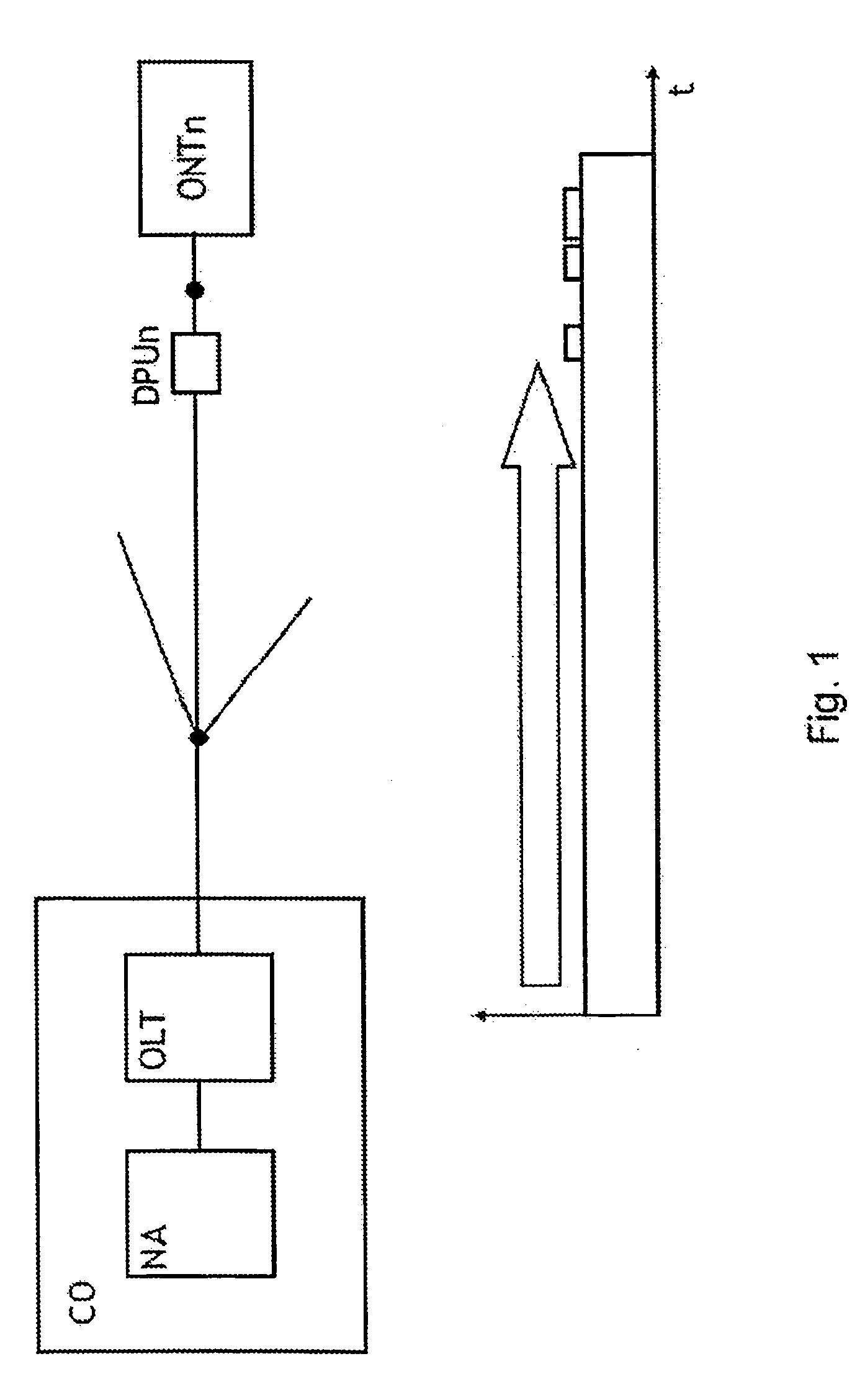
- Figure 1
- shows a telecommunication's network, in which a method according to the invention
can be performed.
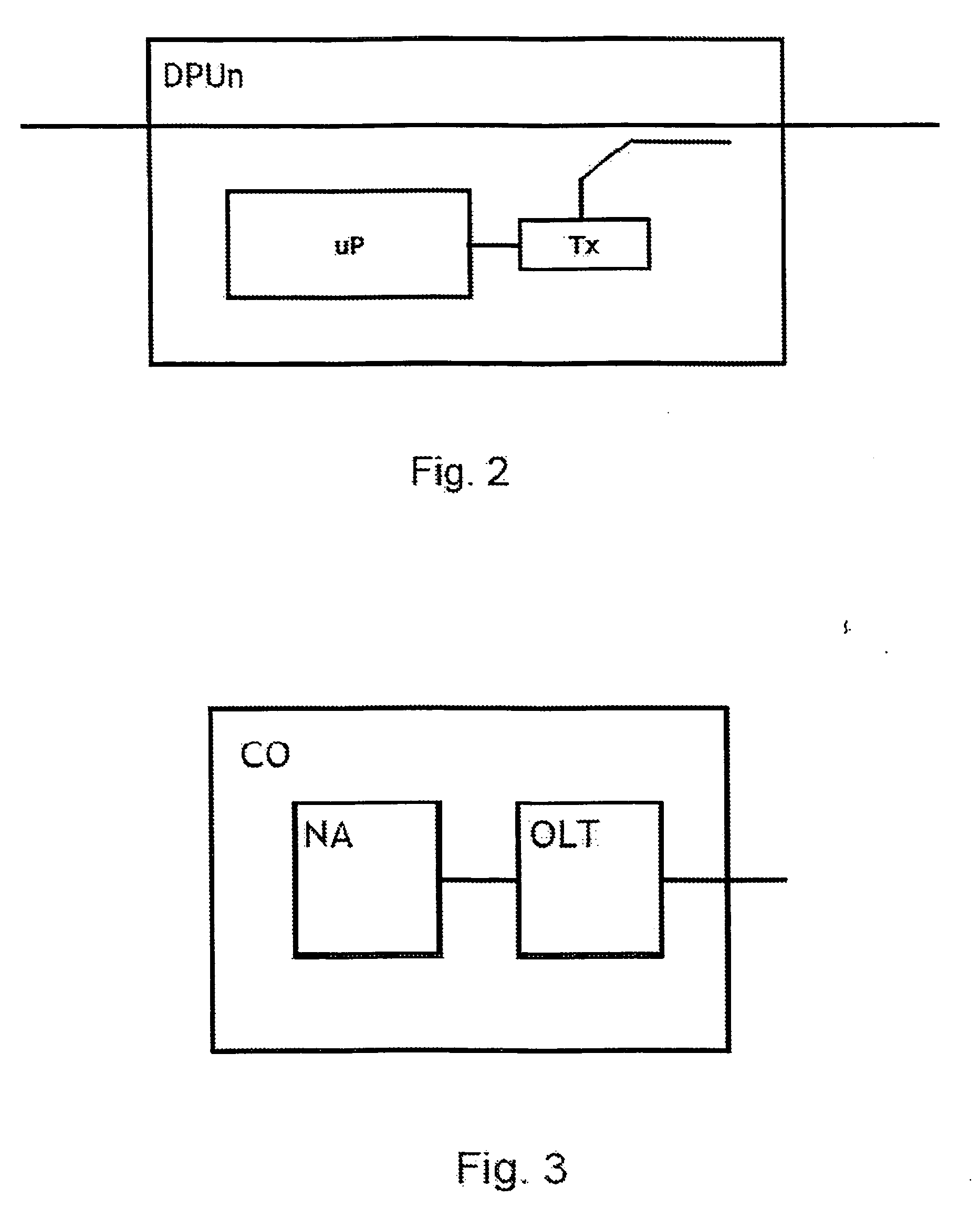
- Figure 2
- shows a demarcation point unit according to the invention.
- Figure 3
- shows a central office including a network analyser as an example of a network element
according to the invention.
[0012] Figure 1 shows both, a telecommunication's network, and a diagram representing the
signal flow therein.
[0013] The telecommunication's network includes a central office CO, an access network,
not labeled, a demarcation point unit DPUn representing one of a multiple of network
terminating units, and an optical network termination unit ONTn representing a subscriber's
customer premises equipment.
[0014] The central office CO here is shown as including an optical line termination unit
OLT and a network analyser NA.
[0015] The optical line termination unit OLT performs the conversion between optical and
electrical part and the transmission technological functions like adapting power levels.
[0016] The network analyzer NA performs some kind of network operation tasks.
[0017] It is to be noticed, that in practical realization the network analyzer NA as mentioned
above often is spatially separated from the optical line termination unit OLT and
then mostly is a network element in common to more than one optical line termination
unit OLT. This does not influence the idea of the invention.
[0018] The signal flow represented thereunder is a signal flow from the optical line termination
unit OLT within the central office CO to the optical network termination unit ONTn.
From the demarcation point unit DPUn on additional signal elements are added imposed
by the demarcation point unit DPUn.
[0019] This signal flow representation is by no means to scale : The duration of either
of the imposed signal elements has nothing to do with the propagation time it undergoes.
The clock of the signal from the optical line termination unit OLT is such high in
relation to the clock of the imposed signal elements from the demarcation point unit
DPUn, that it is not even represented. The relation between the amplitude of the signal
from the optical line termination unit OLT to the imposed signal elements from the
demarcation point unit DPUn is small, namely in the range of some few percents, not
more than 20% but rather in the range of 5%. The attenuation of the signal its way
from the optical line termination unit OLT to the optical network termination unit
ONTn is not represented either.
[0020] The additional signal elements imposed by the demarcation point unit DPUn represent
the unambiguous and individual identifier assigned to exactly this demarcation point
unit DPUh. It thus represents a digital signature proper to this demarcation point
unit DPUn.
[0021] The amplitude of these additional signal elements on the one hand has to be chosen
such that it can be clearly detected by a transceiver parameter monitor allegedly
being part of the network termination unit ONTn. On the other hand this amplitude
is to be kept such low that the regular data flow between the optical line termination
unit OLT and the optical network termination unit ONTn is not disturbed.
[0022] The same considerations concerning the relation between the amplitude of the signal
from the optical line termination unit OLT and the imposed signal elements from the
demarcation point unit DPUn apply when the signal elements from the demarcation point
unit DPUn are imposed by attenuating the signal from the optical line termination
unit OLT within the demarcation point unit DPUn.
[0023] Increasing the overall signal amplitude requires an optical signal source like a
laser or a light emitting diode. Reducing the overall signal amplitude requires some
kind of a switchable attenuator like a coupler with a coupling factor that can be
influenced or either of the terminations of which can be switched.
[0024] The clock with which such signature is to be imposed onto the signal flow has to
be such low, that it is ensured that the transceiver parameter monitor in the optical
network termination unit ONTn while performing its monitoring and reporting task for
sure also monitors and reports the variations recognized. This clock therefor has
to be adapted to the reporting intervals of such transceiver parameter monitor such
that the reporting intervals are not shorter than one bit of the signature imposed.
[0025] Figure 2 shows an example of such demarcation point unit DPUn according to the invention.
The optical line between the central office CO and the network termination unit ONTn
within the subscriber's customer premises equipment is looped through through this
demarcation point unit DPUn, shown as draw through line. The demarcation point unit
DPUn further includes a control element, here designated as uP, a usual abbreviation
of a microprocessor, an optical transmitter Tx, and an optical coupler coupling the
optical transmitter Tx to the looped through optical line.
[0026] The use of a microprocessor uP as control element is justified by other tasks such
demarcation point unit DPUn normally is to perform. To this end it might also be coupled
to the looped through optical line with receiving means for receiving data from either
of both directions or with means for also transmitting towards the central office.
[0027] In principle the invention works, when the demarcation point unit DPUn continuously
imposes its signature on the signal flow. Depending on the intelligence provided by
the control element and on the way it is coupled to the optical line, the imposing
the signature could be limited to short periods at the beginning of communications
or on demand from the central office.
[0028] Figure 3 shows a central office CO including a network analyzer NA as an example
of a network element according to the invention.
[0029] As already previously mentioned the central office CO here is shown as including
an optical line termination unit OLT and network analyzer NA.
[0030] The optical line termination unit OLT performs the conversion between optical and
electrical part and the transmission technological functions like adapting power levels.
[0031] The network analyzer NA performs some kind of network operation tasks.
[0032] The optical line termination unit OLT needs not to vary from known such optical line
termination units. There is only a need to adapt the network analyzer NA in the central
office, such that from the parameters reported from the customer premises' equipment,
especially the received power levels, the signature of the assigned known demarcation
point unit DPUn can be derived and whereby the customer premises equipment can be
assigned to the respective subscriber's data record.
[0033] As already mentioned it is to be noticed, that in practical realization the network
analyser NA as mentioned above often is spatially separated from the optical line
termination unit OLT and then mostly is a network element in common to more than one
optical line termination unit OLT and more than one central office.
1. Method for a telecommunication's network with a central office (CO), access network,
a multiple of demarcation point its (DPUn) and customer premises equipment (ONTn)
connected thereto, to assign a customer premises equipment (ONTn) to a subscriber's
data record register in the central office (CO), characterized in, that when a customer premises equipment (ONTn) rep ts received signal amplitudes in regular
reporting intervals to the central office (CO), a customer premises equipment (ONTn)
is assigned to a subscriber's data record by uniquely influencing the signal amplitude
by the demarcation point unit (DPUn) assigned to the customer premises equipment (ONTn),
the assignment of which to a certain subscriber's data record is known in the central
office (CO), where the influencing of the signal amplitude is performed such that
a digital signature individually assigned to the demarcation point unit (DPUn) is
imprinted on the signal amplitude, where the bit clock underlying the signature is
such that one bit of the signature imposed is at the longest as long as a reporting
interval, and that the central office (CO) recovers the signature of the demarcation
point unit (DPUn) from the sequence of signal amplitudes reported from the customer
premises equipment (ONTn) and derives therefrom the assignment between customer premises
equipment (ONTn) and subscriber's data record.
2. Method according to claim 1, characterized in, that the demarcation point unit (DPUn) influences the signal amplitude by additively adding
the signature as supplementary signal with an amplitudes being small compared to the
signal amplitudes.
3. Method according to claim 1, characterised in, that the demarcation point unit (DPUn), influences the signal amplitude by attenuating
the signal amplitude by small amount according to the signature.
4. Demarcation point unit (DPUn) for a telecommunication's network with a central office
(CO), an access network, a multiple of demarcation point units (DPUn) and customer
premises equipment (ONTn) connected thereto, where customer premises equipment (ONTn)
reports received signal amplitudes in regular reporting intervals to the central office
(CO), characterized in, that the demarcation point unit (DPUn) is built such that the demarcation point unit (DPUn)
is in position to uniquely influence the amplitude of a signal from the central office
(CO) to a customer premises equipment (ONTn) connected to the demarcation point unit,
where the influencing of the signal amplitude is performed such that a digital signature
individually assigned to the demarcation point unit (DPUn) is imprinted on the signal
amplitude using a bit clock underlying the signature that is such that one bit of
the signature imposed is at the longest as long as a reporting interval.
5. Network element (NA) for a central office (CO) for a telecommunication's network with
a central office (CO), an access network, a multiple of demarcation point units (DPUn)
and customer premises equipment (ONTn) connected thereto, characterized in, that the network element (NA) is built such that the network element (NA) is in position
to recover a signature of a demarcation point unit (DPUn) from the sequence of signal
amplitudes reported from a customer premises equipment (ONTn), where the signature
imprinted is such that one bit of the signature is at the longest as long as a reporting
interval, and to derive therefrom the assignment between customer premises equipment
(ONTn) and subscriber's data record.
1. Verfahren für ein Telekommunikationsnetzwerk mit einer Vermittlungsstelle (CO), einem
Zugangsnetzwerk, mehrfachen Abgrenzungspunkteinheiten (DPUn) und an diese angeschlossenen
Teilnehmerendgeräten (ONTn) für die Zuweisung eines Teilnehmerendgeräts (ONTn) an
eine in der Vermittlungsstelle (CO) registrierte Datenaufzeichnung eines Teilnehmers,
dadurch gekennzeichnet, dass, wenn ein Teilnehmerendgerät (ONTn) empfangene Signalamplituden in regelmäßigen Intervallen
an die Vermittlungsstelle (CO) meldet, ein Teilnehmerendgerät (ONTn) der Datenaufzeichnung
eines Teilnehmers durch eindeutiges Beeinflussen der Signalamplitude durch die dem
Teilnehmergerät (ONTn) zugewiesene Abgrenzungspunkteinheit (DPUn) zugewiesen wird,
dessen Zuweisung an eine Datenaufzeichnung eines bestimmten Teilnehmers in der Vermittlungsstelle
(CO) bekannt ist, wobei das Beeinflussen der Signalamplitude derart erfolgt, dass
der Signalamplitude eine der Abgrenzungspunkteinheit (DPUn) individuell zugewiesene
digitale Signatur aufgeprägt wird, wobei der der Signalamplitude der der Signatur
zugrunde liegende Bittakt aufgeprägt wird, wobei der der Signatur zugrunde liegende
Bittakt derart ist, dass ein Bit der aufgezwungenen Signatur höchstens so lang wie
eine Meldeintervall ist, und dass die Vermittlungsstelle (CO) die Signatur der Abgrenzungspunkteinheit
(DPUn) aus der von dem Teilnehmerendgerät (ONTn) gemeldeten Folge von Signalamplituden
rückgewinnt und daraus die Zuweisung zwischen dem Teilnehmerendgerät (ONTn) und der
Datenaufzeichnung eines Teilnehmers ableitet.
2. Verfahren nach Anspruch 1, dadurch gekennzeichnet, dass die Abgrenzungspunkteinheit (DPUn) die Signalamplitude durch additives Hinzufügen
der Signatur als Zusatzsignal, dessen Amplitude im Vergleich zur Signalamplitude klein
ist, beeinflusst.
3. Verfahren nach Anspruch 1, dadurch gekennzeichnet, dass die Abgrenzungspunkteinheit (DPUn) die Signalamplitude durch Dämpfen der Signalamplitude
um eine kleine Menge gemäß der Signatur beeinflusst.
4. Abgrenzungspunkteinheit (DPUn) für ein Telekommunikationsnetzwerk mit einer Vermittlungsstelle
(CO), einem Zugangsnetzwerk, mehrfachen Abgrenzungspunkteinheiten (DPUn) und an diese
angeschlossenen Teilnehmerendgeräten (ONTn), wobei das Teilnehmerendgerät (ONTn) empfangene
Signalamplituden in regelmäßigen Intervallen an die Vermittlungsstelle (CO) meldet,
dadurch gekennzeichnet, dass die Abgrenzungspunkteinheit (DPUn) derart gestaltet ist, dass die Abgrenzungspunkteinheit
(DPUn) in der Lage ist, die Amplitude eines Signals von der Vermittlungsstelle (CO)
an ein an die Abgrenzungspunkteinheit angeschlossenes Teilnehmerendgerät (ONTn) eindeutig
zu beeinflussen, wobei das Beeinflussen der Signalamplitude derart erfolgt, dass der
Signalamplitude eine der Abgrenzungspunkteinheit (DPUn) individuelle zugewiesene digitale
Signatur unter Verwendung eines der Signatur zugrunde liegenden Bittaktes, welcher
derart ist, dass ein Bit der aufgezwungenen Signatur höchstens so lang wie eine Meldeintervall
ist, aufgeprägt wird.
5. Netzwerkelement (NA) für eine Vermittlungsstelle (CO) für ein Telekommunikationsnetzwerk
mit einer Vermittlungsstelle (CO), einem Zugangsnetzwerk, mehrfachen Abgrenzungspunkteinheiten
(DPUn) und an diese angeschlossenen Teilnehmerendgeräten (ONTn), dadurch gekennzeichnet, dass das Netzwerkelement (NA) derart gestaltet ist, dass das Netzwerkelement (NA) in der
Lage ist, eine Signatur einer Abgrenzungspunkteinheit (DPUn) aus der von einem Teilnehmerendgerät
(ONTn) gemeldeten Folge von Signalamplituden rückzugewinnen, wobei die aufgeprägte
Signatur derart ausgebildet ist, dass ein Bit der Signatur höchstens so lang wie ein
Meldeintervall ist, und daraus die Zuweisung zwischen dem Teilnehmerendgerät (ONTn)
und der Datenaufzeichnung eines Teilnehmers abzuleiten.
1. Procédé pour un réseau de télécommunication avec un central (CO), un réseau d'accès,
de multiples unités de point de démarcation (DPUn) et un équipement des locaux d'abonné
(ONTn) connecté à celles-ci, pour affecter un équipement des locaux d'abonné (ONTn)
à un enregistrement de données d'abonné enregistré dans le central (CO), caractérisé en ce que lorsqu'un équipement des locaux d'abonné (ONTn) rapporte les amplitudes du signal
reçu dans des intervalles de rapport réguliers au central (CO), un équipement des
locaux d'abonné (ONTn) est affecté à un enregistrement de données d'abonné en exerçant
une influence exclusivement sur l'amplitude de signal par l'unité de point de démarcation
(DPUn) affectée à l'équipement des locaux d'abonné (ONTn), dont l'affectation à un
enregistrement de données d'un certain abonné est connue dans le central (CO), l'influence
sur l'amplitude de signal étant exercée de sorte qu'une signature numérique affectée
individuellement à l'unité de point de démarcation (DPUn) soit imprimée sur l'amplitude
de signal, l'horloge de bit sous-jacente à la signature étant telle qu'un bit de la
signature imposée est, au maximum, aussi longue qu'un intervalle de rapport, et que
le central (CO) récupère la signature de l'unité de point de démarcation (DPUn) à
partir de la séquence d'amplitudes de signal rapportées par l'équipement des locaux
d'abonné (ONTn) et en déduit l'affectation entre l'équipement des locaux d'abonné
(ONTn) et l'enregistrement de données d'abonné.
2. Procédé selon la revendication 1, caractérisé en ce que l'unité de point de démarcation (DPUn) exerce une influence sur l'amplitude de signal
en ajoutant de manière additive la signature comme signal supplémentaire avec une
amplitude faible par rapport à l'amplitude de signal.
3. Procédé selon la revendication 1, caractérisé en ce que l'unité de point de démarcation (DPUn) exerce une influence sur l'amplitude de signal
en atténuant l'amplitude de signal selon une faible quantité en fonction de la signature.
4. Unité de point de démarcation (DPUn) pour un réseau de télécommunication avec un central
(CO), un réseau d'accès, de multiples unités de point de démarcation (DPUn) et un
équipement des locaux d'abonné (ONTn) connecté à celles-ci, l'équipement des locaux
d'abonné (ONTn) rapportant les amplitudes du signal reçu dans des intervalles de rapport
réguliers au central (CO), caractérisée en ce que l'unité de point de démarcation (DPUn) est construite de sorte que l'unité de point
de démarcation (DPUn) soit en position pour exercer une influence exclusivement sur
l'amplitude d'un signal entre le central (CO) et un équipement des locaux d'abonné
(ONTn) connecté à l'unité de point de démarcation, l'influence sur l'amplitude de
signal étant exercée de sorte qu'une signature numérique affectée individuellement
à l'unité de point de démarcation (DPUn) soit imprimée sur l'amplitude de signal en
utilisant une horloge de bit sous-jacente à la signature qui est telle qu'un bit de
la signature imposée est, au maximum, aussi longue qu'un intervalle de rapport.
5. Élément de réseau (NA) pour un central (CO) pour un réseau de télécommunication avec
un central (CO), un réseau d'accès, de multiples unités de point de démarcation (DPUn)
et un équipement des locaux d'abonné (ONTn) connecté à celles-ci, caractérisé en ce que l'élément de réseau (NA) est construit de sorte que l'élément de réseau (NA) soit
en position pour récupérer une signature d'une unité de point de démarcation (DPUn)
à partir de la séquence d'amplitudes de signal rapportées par un équipement des locaux
d'abonné (ONTn), la signature imprimée étant telle qu'un bit de la signature est,
au maximum, aussi longue qu'un intervalle de rapport, et pour en déduire l'affectation
entre l'équipement des locaux d'abonné (ONTn) et l'enregistrement de données d'abonné.
REFERENCES CITED IN THE DESCRIPTION
This list of references cited by the applicant is for the reader's convenience only.
It does not form part of the European patent document. Even though great care has
been taken in compiling the references, errors or omissions cannot be excluded and
the EPO disclaims all liability in this regard.
Patent documents cited in the description