|
(11) | EP 2 367 275 A1 |

| (12) | EUROPEAN PATENT APPLICATION |
|
|
|
|
||||||||||||||||||||
| (54) | Non-isolated DC - DC converter for solar power plant |
| (57) A non-isolated DC - DC converter for a solar power plant, the non-isolated DC - DC
converter being adapted to be connected to a full-bridge inverter.
|
FIELD OF THE INVENTION
[0001] The present invention relates to an electronic power converter, and more particularly to a non-isolated DC - DC converter.
[0002] It is known in the art to use a grounded non-isolated DC - DC converter in a power plant in order to avoid circulation of common mode current via a parasitic capacitance existing between a power supply and ground.
[0003] Examples of known non-isolated DC - DC converters suitable for a solar power plant are described in publications US2004/0164557 and W02009/010025.
[0004] One of the problems associated with the above mentioned known non-isolated DC - DC converters is that each one of them requires a half-bridge inverter to create a link between a DC-link capacitor and a network to be supplied. A half-bridge inverter is able to apply only half of the total DC-link voltage to the load, requiring 100% higher DC-link voltage than a full-bridge inverter. As a consequence, a DC - DC converter connected to a half-bridge inverter must have 100% higher gain than a DC - DC converter connected to a full-bridge inverter. Higher gain induces extra stress on the components of a DC - DC converter.
BRIEF DESCRIPTION OF THE INVENTION
[0005] An object of the present invention is thus to provide a non-isolated DC - DC converter that allows using a full-bridge inverter for the interface to the electrical network to be supplied. This object of the invention is achieved by a non-isolated DC - DC converter which is characterized by what is stated in the independent claim 1. The preferred embodiments of the invention are disclosed in the dependent claims.
[0006] An advantage of the non-isolated DC - DC converter of the invention is that it can be connected to an electrical network to be supplied through a full-bridge inverter. Another advantage is that the non-isolated DC - DC converter of the invention include a buck-boost characteristic that allows using components with lower blocking voltage in an inverter connected between the non-isolated DC - DC converter and an electrical network to be supplied. Further advantage of the non-isolated DC - DC converter of the invention is that it allows, when connected to an electrical network to be supplied through a full-bridge inverter, reducing an inductance of a filter between the inverter and the electrical network when operating with a three-level modulation. Only two-level modulation can be used in connection with above mentioned known non-isolated DC - DC converters. Yet another advantage is that an electronic power converter system comprising a non-isolated DC - DC converter of the invention and a full-bridge inverter allows to ground at the same time the negative input terminal of the DC - DC converter and an electrical network fed by the full-bridge inverter.
DETAILED DESCRIPTION OF THE INVENTION
[0007] In the following the invention will be described in greater detail by means of preferred embodiments with reference to the attached Figure 1 which shows a connecting diagram of a solar power plant comprising a non-isolated DC - DC converter according to an embodiment of the invention.
[0008] The solar power plant shown in Figure 1 comprises photovoltaic cell means PV connected to an electrical network ENW through an electronic power converter system comprising a non-isolated DC - DC converter and a full-bridge inverter FIB. The photovoltaic cell means PV are adapted to convert solar energy into direct current.
[0009] The non-isolated DC - DC converter has a positive input terminal IT+, a negative input terminal IT-, a positive output terminal OT+, and a negative output terminal OT-. The negative input terminal IT- is grounded. The non-isolated DC - DC converter is adapted to convert an input DC voltage uin present between the positive input terminal IT+ and the negative input terminal IT- into a converted DC voltage u1 present between the positive output terminal OT+ and the negative output terminal OT-.
[0010] The non-isolated DC - DC converter comprises a first switch S1, a second switch S2, a third switch S3, a first diode D1, a second diode D2, a third diode D3, a first inductor L1 and a first capacitor C1. The non-isolated DC - DC converter further comprises control means CTRL adapted to control each of the first switch S1, the second switch S2, and the third switch S3 selectively into a closed state or into an open state, the closed state being a conductive state and the open state being a non-conductive state. The first switch S1, the second switch S2 and the third switch S3 may be for example IGBTs or MOSFETs.
[0011] The first switch S1, the first inductor L1 and the second diode D2 are connected in series between the positive input terminal IT+ and the positive output terminal OT+ such that the first inductor L1 is connected between the first switch S1 and the anode of the second diode D2, the cathode of the second diode D2 facing the positive output terminal OT+. The second switch S2 and the third diode D3 are connected in series between the negative input terminal IT- and the negative output terminal OT- such that the cathode of the third diode D3 is facing the second switch S2, and the anode of the third diode D3 is facing the negative output terminal OT-. The cathode of the first diode D1 is connected between the first switch S1 and the first inductor L1, and the anode of the first diode D1 is connected between the second switch S2 and the cathode of the third diode D3. The third switch S3 is connected between a point located between the first inductor L1 and the anode of the second diode D2, and a point located between the second switch S2 and the cathode of the third diode D3. The first capacitor C1 is connected between the cathode of the second diode D2 and the anode of the third diode D3.
[0012] The control means CTRL are adapted to provide: a first switching stage where the first switch S1, the second switch S2 and the third switch S3 are in a closed state, a second switching stage where the first switch S1, the second switch S2 and the third switch S3 are in an open state, and a converting operation by alternating between the first switching stage and the second switching stage. In the first switching stage the photovoltaic cell means PV are conductively connected to the first inductor L1 allowing a current to flow between the photovoltaic cell means PV and the first inductor L1, wherein energy is transferred from the photovoltaic cell means PV into the first inductor L1. In the second switching stage the first inductor L1 is conductively connected to the first capacitor C1, allowing a current to flow between the first inductor L1 and the first capacitor C1, wherein energy is transferred from the first inductor L1 into the first capacitor C1.
[0013] The first capacitor C1 is never directly connected to the photovoltaic cell means PV. In other words, during operation of the non-isolated DC - DC converter a current flowing between the positive input terminal IT+ and the negative input terminal IT- never flows through the first capacitor C1. Consequently, the first capacitor C1 is a floating capacitor.
[0014] The control means CTRL are adapted to regulate, during the converting operation, the converted DC voltage u1 by adjusting the ratio of duration of the first switching stages to duration of the second switching stages. Since the first switch S1, the second switch S2 and the third switch S3 are opened and closed simultaneously, they have a common duty cycle. The common duty cycle DS for the first switch S1, the second switch S2 and the third switch S3 may be calculated with equation { 1 }.
[0015] In equation { 1 } τ1 is the duration of the first switching stage, and Tc is the cycle time. The cycle time Tc is equal to a sum of a duration of the first switching stage τ1 and a duration of the second switching stage τ2. Therefore the equation for the common duty cycle DS may be written as
[0016] According to equations { 1 } and { 2 } the common duty cycle DS is the proportion of time during which the controllable switches S1 to S3 are in the closed state. Hence adjusting the ratio of duration of the first switching stages to duration of the second switching stages means adjusting the duty-cycle DS of the first switch S1, the second switch S2 and the third switch S3. Based on the input DC voltage uin and the common duty-cycle DS, the converted DC voltage u1 may be calculated with equation
[0017] Equation { 3 } shows that the non-isolated DC - DC converter is able to boost or buck the input DC voltage uin. Boosting a DC voltage means increasing the magnitude of the DC voltage, and bucking a DC voltage means decreasing the magnitude of the DC voltage.
[0018] The non-isolated DC - DC converter depicted in Figure 1 further comprises an input voltage sensor SRIN adapted to determine a magnitude of the input DC voltage uin. The control means CTRL are communicatively connected to the input voltage sensor SRIN for receiving data relating to the magnitude of the input DC voltage uin. The control means CTRL are adapted to adjust the ratio of duration of the first switching stages to duration of the second switching stages responsive to the data relating to the magnitude of the input DC voltage uin.
[0019] The full-bridge inverter FIB comprises four switches denoted with S4, S5, S6, and S7. The full-bridge inverter FIB is connected to the electrical network ENW through a second inductor L2, which acts as a filter inductor. The electrical network ENW is grounded. The full-bridge inverter FIB may be operated with a three-level modulation, and therefore the rating of the second inductor L2 may be reduced compared with the rating required when using a half-bridge inverter. When operated with a three-level modulation, the full-bridge inverter FIB is able to apply to the electrical network ENW a voltage +u1 by closing switches S4 and S7, a voltage -u1 by closing switches S5 and S6, and a zero voltage by closing switches S4 and S5.
[0020] Use of a non-isolated DC - DC converter according to the present invention is not limited to a solar power plant. In alternative embodiments, the photovoltaic cell means of a solar power plant may be replaced with a different type of power supply having a positive supply terminal and a negative supply terminal, the power supply being adapted to generate a direct current and to feed the direct current out of the power supply via the positive and negative supply terminals.
1. A non-isolated DC - DC converter for solar power plant, the non-isolated DC - DC converter
comprising a positive input terminal (IT+), a negative input terminal (IT-), a positive
output terminal (OT+), and a negative output terminal (OT-), the non-isolated DC -
DC converter being adapted to convert an input DC voltage (uin) present between the positive input terminal (IT+) and the negative input terminal
(IT-) into a converted DC voltage (u1) present between the positive output terminal (OT+) and the negative output terminal
(OT-), characterized in that the non-isolated DC - DC converter comprises a first switch (S1), a second switch (S2), a third switch (S3), a first diode (D1), a second diode (D2), a third diode (D3), a first inductor (L1) and a first capacitor (C1);
the first switch (S1), the first inductor (L1) and the second diode (D2) being connected in series between the positive input terminal (IT+) and the positive output terminal (OT+) such that the first inductor (L1) is connected between the first switch (S1) and the anode of the second diode (D2), the cathode of the second diode (D2) facing the positive output terminal (OT+);
the second switch (S2) and the third diode (D3) being connected in series between the negative input terminal (IT-) and the negative output terminal (OT-) such that the cathode of the third diode (D3) is facing the second switch (S2), and the anode of the third diode (D3) is facing the negative output terminal (OT-);
the cathode of the first diode (D1) being connected between the first switch (S1) and the first inductor (L1), and the anode of the first diode (D1) being connected between the second switch (S2) and the cathode of the third diode (D3);
the third switch (S3) being connected between a point located between the first inductor (L1) and the anode of the second diode (D2), and a point located between the second switch (S2) and the cathode of the third diode (D3); and
the first capacitor (C1) being connected between the cathode of the second diode (D2) and the anode of the third diode (D3).
the first switch (S1), the first inductor (L1) and the second diode (D2) being connected in series between the positive input terminal (IT+) and the positive output terminal (OT+) such that the first inductor (L1) is connected between the first switch (S1) and the anode of the second diode (D2), the cathode of the second diode (D2) facing the positive output terminal (OT+);
the second switch (S2) and the third diode (D3) being connected in series between the negative input terminal (IT-) and the negative output terminal (OT-) such that the cathode of the third diode (D3) is facing the second switch (S2), and the anode of the third diode (D3) is facing the negative output terminal (OT-);
the cathode of the first diode (D1) being connected between the first switch (S1) and the first inductor (L1), and the anode of the first diode (D1) being connected between the second switch (S2) and the cathode of the third diode (D3);
the third switch (S3) being connected between a point located between the first inductor (L1) and the anode of the second diode (D2), and a point located between the second switch (S2) and the cathode of the third diode (D3); and
the first capacitor (C1) being connected between the cathode of the second diode (D2) and the anode of the third diode (D3).
2. A non-isolated DC - DC converter according to claim 1, characterized in that the non-isolated DC - DC converter further comprises control means (CTRL) adapted
to control each of the first switch (S1), the second switch (S2) and the third switch (S3) selectively into a closed state or into an open state.
3. A non-isolated DC - DC converter according to claim 2, characterized in that the control means (CTRL) are adapted
to provide a first switching stage where the first switch (S1), the second switch (S2) and the third switch (S3) are in a closed state;
to provide a second switching stage where the first switch (S1), the second switch (S2) and the third switch (S3) are in a open state; and
to provide an converting operation by alternating between the first switching stage and the second switching stage.
to provide a first switching stage where the first switch (S1), the second switch (S2) and the third switch (S3) are in a closed state;
to provide a second switching stage where the first switch (S1), the second switch (S2) and the third switch (S3) are in a open state; and
to provide an converting operation by alternating between the first switching stage and the second switching stage.
4. A non-isolated DC - DC converter according to claim 3, characterized in that the first capacitor (C1) is adapted to be a floating capacitor such that during operation of the non-isolated
DC - DC converter a current flowing between the positive input terminal (IT+) and
the negative input terminal (IT-) never flows through the first capacitor (C1).
5. A non-isolated DC - DC converter according to claim 4, characterized in that in the second switching stage the first inductor (L1) is conductively connected to the first capacitor (C1) allowing a current to flow between the first inductor (L1) and the first capacitor (C1).
6. A non-isolated DC - DC converter according to any of claims 3 - 5, characterized in that the control means (CTRL) are adapted to regulate, during the converting operation,
the converted DC voltage (u1) by adjusting the ratio of duration of the first switching stages to duration of
the second switching stages.
7. A non-isolated DC - DC converter according to claim 6, characterized in that the control means (CTRL) are adapted to regulate the converted DC voltage (u1) according to equation
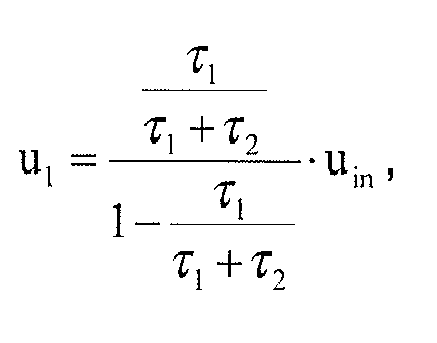
where u1 is the converted DC voltage, τ1 is a duration of the first switching stage, τ2 is a duration of the second switching stage, and uin is an input DC voltage present between the positive input terminal (IT+) and the negative input terminal (IT-).
where u1 is the converted DC voltage, τ1 is a duration of the first switching stage, τ2 is a duration of the second switching stage, and uin is an input DC voltage present between the positive input terminal (IT+) and the negative input terminal (IT-).
8. A non-isolated DC - DC converter according to claim 6 or 7, characterized in that the non-isolated DC - DC converter further comprises a input voltage sensor (SRin) adapted to determine a magnitude of the input DC voltage (uin), the control means (CTRL) being communicatively connected to the input voltage sensor
(SRin) for receiving data relating to the magnitude of the input DC voltage (uin), the control means (CTRL) being adapted to adjust the ratio of duration of the first
switching stages to duration of the second switching stages responsive to the data
relating to the magnitude of the input DC voltage (uin).
9. An electronic power converter system comprising a DC-DC converter adapted to supply
an output DC voltage and an inverter adapted to invert the output DC voltage supplied
by the DC-DC converter, characterized in that the inverter is a full-bridge inverter, and the DC-DC converter is a non-isolated
DC - DC converter according to any preceding claim.
10. A power plant comprising a power supply, the power supply having a positive supply
terminal and a negative supply terminal, the power supply being adapted to generate
a direct current and to feed the direct current out of the power supply via the positive
and negative supply terminals, characterized in that the power plant comprises an electronic power converter system according to claim
9, the positive supply terminal of the power supply being connected to the positive
input terminal (IT+) of the non-isolated DC - DC converter, and the negative supply
terminal of the power supply being connected to the negative input terminal (IT-)
of the non-isolated DC - DC converter.
11. A power plant according to claim 10, characterized in that the negative supply terminal of the power supply is grounded.
12. A power plant according to claim 10 or 11, characterized in that the power plant is a solar power plant, wherein the power supply comprises photovoltaic
cell means adapted to convert solar energy into direct current.
REFERENCES CITED IN THE DESCRIPTION
This list of references cited by the applicant is for the reader's convenience only. It does not form part of the European patent document. Even though great care has been taken in compiling the references, errors or omissions cannot be excluded and the EPO disclaims all liability in this regard.
Patent documents cited in the description