| (19) |
 |
|
(11) |
EP 2 405 081 A2 |
| (12) |
EUROPEAN PATENT APPLICATION |
| (43) |
Date of publication: |
|
11.01.2012 Bulletin 2012/02 |
| (22) |
Date of filing: 26.05.2005 |
|
| (51) |
International Patent Classification (IPC):
|
|
| (84) |
Designated Contracting States: |
|
DE ES FR IT PL PT |
| (30) |
Priority: |
03.06.2004 ES 200401355
|
| (62) |
Application number of the earlier application in accordance with Art. 76 EPC: |
|
05380107.2 / 1602791 |
| (71) |
Applicant: Sistemas Técnicos De Encofrados, S.A. |
|
08150 Parets Del Valles (Barcelona) (ES) |
|
| (72) |
Inventor: |
|
- Ubiñana Felix, Jose Luis
08150 Parets del Valles (Barcelona) (ES)
|
| (74) |
Representative: Durán Moya, Carlos et al |
|
DURAN-CORRETJER
Còrsega, 329
08037 Barcelona
08037 Barcelona (ES) |
|
| |
|
|
|
Remarks: |
|
This application was filed on 30-09-2011 as a divisional application to the application
mentioned under INID code 62. |
|
| (54) |
Improvements in props for construction work |
(57) The improvements in construction props provide the formation of the foot and the
top part of the prop by means of plates pressed directly to the corresponding tubular
member being the plates featured by cold-cramping deformation and pressing forming
a cramp zone of substantially doughnut structure cramped at the edge of the central
opening of the corresponding plate.
|
|
[0002] The aim of this divisional application is to protect improvements in the props for
construction work concerning the upper and lower plates of the telescopic tubular
member forming the prop.
[0003] According to this invention, the upper and lower plates attached to the extremities
of the tubular body of the prop are secured simply by means of cold deformation of
the material of the plate and tubular member by cold deformation by cramping and swaging.
The improvements refer to the formation of a fold at the top and bottom ends of the
prop, avoiding welding, which is at the present time the usual way of securing the
upper and lower plates of a prop with a tubular body. Said welding operations are
rather expensive and to ensure the proper results the welding should be submitted
to costly inspection processes. To prevent these drawbacks now present in the props
for construction according to the state of the art, the present invention provides
a particular form of direct pressing of each plate onto the corresponding tubular
member. The bottom and top plates of the prop have respective central openings in
which the corresponding ends of the tubular members are firmly secured by cold cramping
deformation and pressing forming a cramped zone of substantially doughnut structure,
cramped at the edge of the central opening of each plate, supplemented with an outwardly
transversely bent zone in the form of a flange bearing against the upper area of the
edge formed at the central opening of the plate. This makes it possible to apply loads
between each plate and the corresponding tube. The present invention permits the plates
for the bottom and top part of the prop to be formed without any need for welding
and with great strength and durability.
[0004] The formation of the securement of both bottom and top plates by cold deformation
to the corresponding tubular members of the prop is technically the same, although
its position in space will be inverted as the bottom plate is aimed at engaging the
ground and the upper plate is aimed at engaging an upper structure such as a beam
or similar.
[0005] To better understand the invention, drawings of a preferred embodiment are appended
by way of an explanatory but not restrictive example.
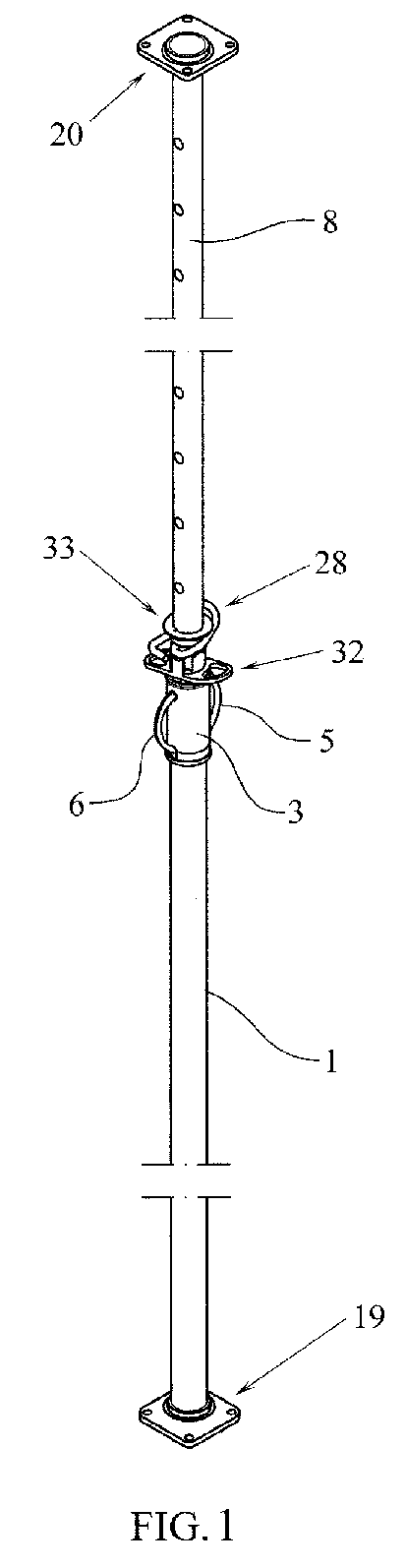
Figure 1 shows a perspective view of a prop constructed according to this invention.
Figure 2 shows a detailed cross-section of the base of the prop.
[0006] The improvements of the present invention are aimed at the safe securement of the
bottom and top plates of a prop by cold deformation operations, which permits dispensing
with the usual welding operations presently known in the props according to the state
of the art.
[0007] The improvements in construction props to which this invention relates provide for
the formation of the foot (19) and the top part (20) of the same in a new and rational
way which makes it possible to avoid welding, through plates pressed directly onto
the tubular member, as may be seen in detail in Figure 2 which shows the bottom part
of a tubular member (1) comprising a base plate (21) having a central opening in which
the bottom end of tubular member (1) is fitted by cold cramping deformation and pressing
forming a cramped zone (22) of substantially doughnut structure cramped at the edge
(23) of the central opening end plate (21), supplemented with an outwardly transversely
bent zone in the form of a flange (24) which bears against the upper zone of the said
edge (23), making it possible to apply loads between the plate and the tube. Through
this arrangement the base plates can be formed without any need for welding and with
great strength and durability.
[0008] As will be understood, the invention is not limited to the embodiment as shown, but
it will cover as well the variations which an expert in the matter may derive from
the present disclosure within the limits of the following claims.
1. Improvements in props for construction work characterised in that both the top and bottom base members (19,20) are each constructed of plates (21)
attached to the extremities of the corresponding tubes (1,8) by cold cramping and
deformation.
2. Improvements according to claim 1 characterised in that each plate (21) has a central opening onto which the extremity of the tubular member
(1,8) is conformed into a partly doughnut shape (22), a flange (24) formed by transverse
deformation of the tubular member (1,8) by transverse bending, coinciding with the
upper part of the edge (23) of the said central opening in order to permit axial pressure
between the tubular member and the plate.

REFERENCES CITED IN THE DESCRIPTION
This list of references cited by the applicant is for the reader's convenience only.
It does not form part of the European patent document. Even though great care has
been taken in compiling the references, errors or omissions cannot be excluded and
the EPO disclaims all liability in this regard.
Patent documents cited in the description