|
(11) | EP 2 414 314 B1 |

| (12) | EUROPEAN PATENT SPECIFICATION |
|
|
| (54) |
HYDROFORMYLATION PROCESS WITH TRIPHENYLPHOSPHINE AND A DOUBLY OPEN-ENDED BISPHOSPHITE LIGAND HYDROFORMYLIERUNGSVERFAHREN MIT TRIPHENYLPHOSPHIN UND DOPPELT OFFENENDIGEM BISPHOSPHITLIGANDEN PROCEDE D'HYDROFORMYLATION AVEC TRIPHÉNYLPHOSPHINE ET UN LIGAND BISPHOSPHITE A DOUBLE EXTREMITE OUVERTE |
|
|
|||||||||||||||||||||||||||||||
| Note: Within nine months from the publication of the mention of the grant of the European patent, any person may give notice to the European Patent Office of opposition to the European patent granted. Notice of opposition shall be filed in a written reasoned statement. It shall not be deemed to have been filed until the opposition fee has been paid. (Art. 99(1) European Patent Convention). |
BACKGROUND OF THE INVENTION
[0001] This disclosure pertains to an improved process for hydroformylating an olefinically-unsaturated compound to produce one or more aldehyde products.
[0002] It is well known in the art that one or more aldehyde products can be produced by contacting under reaction conditions an olefinically-unsaturated compound with carbon monoxide and hydrogen in the presence of a metal-organophosphorus ligand complex catalyst. One such process, as exemplified in US 4,148,830, US 4,717,775, and US 4,769,498, involves continuous hydroformylation with recycle of a solution containing the metal-organophosphorus ligand complex catalyst, more preferably, a Group VIII-organophosphorus ligand complex catalyst. Rhodium is a preferred Group VIII metal. Organophosphines and organopolyphosphites are preferred organophosphorus ligands. Aldehydes produced by hydroformylation processes have a wide range of utility, for example, as intermediates for hydrogenation to aliphatic alcohols, for amination to aliphatic amines, for oxidation to aliphatic acids, and for aldol condensation to produce plasticizers.
[0003] While the benefits attendant with rhodium-organopolyphosphite ligand complexes for hydroformylation processes are well known, the stability of the organophosphite ligand remains a primary concern. Degradation of the organophosphite ligand can lead to catalyst poisons, inhibitors, or acidic byproducts that can lower catalyst activity or increase the rate of ligand loss. Because rhodium is extremely expensive, significant loss of catalytic activity can have a dramatic impact on process economics. Moreover, organopolyphosphite ligands are manufactured through multi-step syntheses, and are often quite expensive in their own right. In order for a rhodium-organopolyphosphite-based industrial hydroformylation process to be economically feasible, the ligand must be stabilized against the rigors of process conditions.
[0004] Numerous methods have been proposed to maintain catalyst and/or organophosphite stability through the addition of a second phosphorous-based compound. For instance, US 6,153,800 (EP0839787) describes adding sterically-hindered phosphines (e.g. tri(ortho-tolyl)phosphine) to stabilize a phosphite ligand against oxidative degradation. While less costly than the organophosphite ligand, the addition of tri(ortho-tolyl)phosphine) would significantly impact industrial process economics. Although less expensive, less sterically-hindered phosphines (e.g. triphenylphosphine; hereafter TPP) are effective in protecting the organophosphite, US 6,153,800 (EP0839787) teaches that they also significantly decrease the hydroformylation rate of the catalyst.
[0005] Organophosphite ligand stabilization is discussed in CN 1986055 A, which features the addition of tri(aryl)phosphines (e.g. TPP) to a rhodium/bisphosphite system. Although the bisphosphite ligand/TPP combination is more stable than the bisphosphite alone, the hydroformylation reaction rate is significantly reduced. The loss in reaction rate can be recaptured by increasing the reaction temperature, but higher temperatures are known to increase the formation of aldehyde oligomer "heavies," which lowers the overall reaction efficiency.
[0006] US 5,874,651 relates to a process for the preparation of a terminal aldehyde by hydroformylation by reacting an ethylenically unsaturated organic compound with carbon monoxide and hydrogen in the presence of a catalyst system comprising iridium or rhodium and a bidentate organic phosphite ligand.
[0008] US 5,910,600 relates to bisphosphite compound, process for its production and hydroformylation process employing the bisphosphite compound.
[0009] Accordingly, it would be desirable to have a hydroformylation process employ a relatively inexpensive method for the stabilization of a rhodium/organophosphite ligand system that would not significantly reduce the inherent hydroformylation reaction rate of the system.
SUMMARY OF THE INVENTION
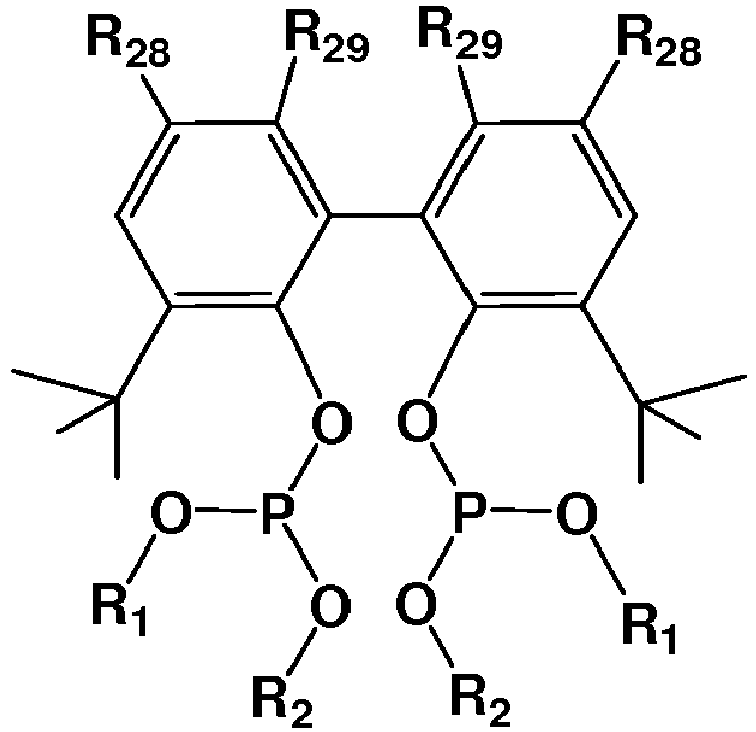
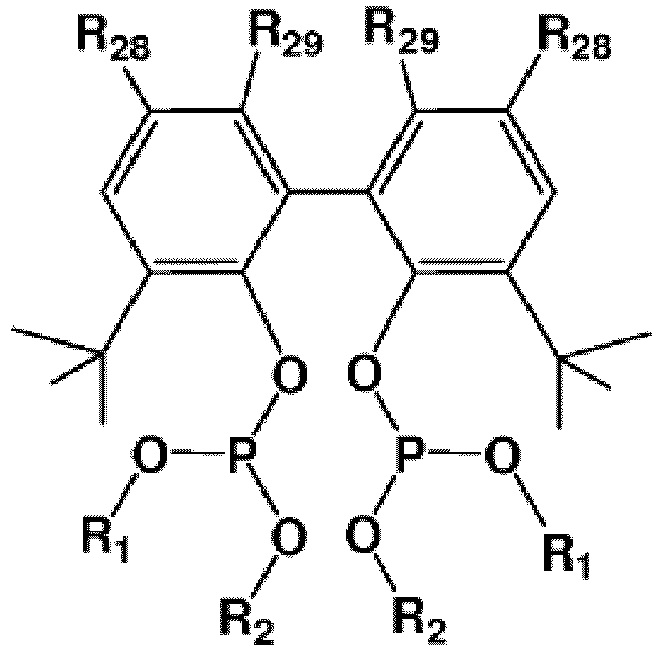
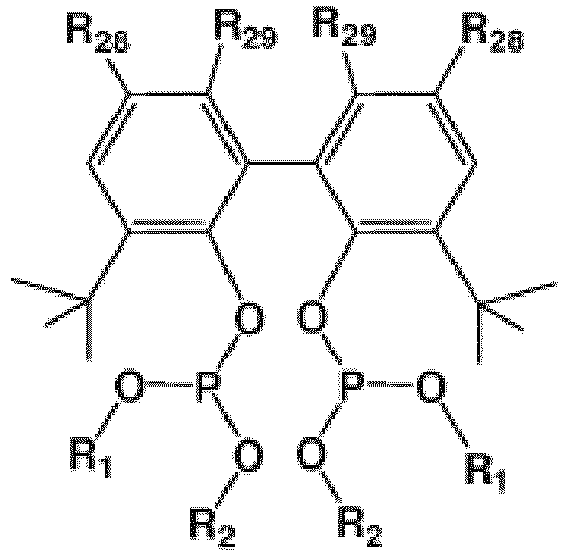
[0010] In one embodiment, the disclosure pertains to a hydroformylation process for continuous production of at least one aldehyde product, the process comprising the steps of: contacting under continuous reaction conditions in a hydroformylation reaction fluid, one or more olefinically-unsaturated compounds, carbon monoxide, and hydrogen in the presence of a mixture of a doubly open-ended organopolyphosphite ligand and an organomonophosphine ligand, at least one of said ligands being bonded to a transition metal to form a transition metal-ligand complex hydroformylation catalyst; the contacting being conducted in a manner such that the molar ratio of both the organomonophosphine ligand and the organopolyphosphite ligand to the metal is at least 1, i.e. the ratio of organomonophosphine to the metal is at least 1 and the ratio of organopolyphosphite to the metal is at least 1, wherein the concentration of either ligand in the hydroformylation reaction fluid is increased or maintained by supplying additional organopolyphosphite ligand(s) and/or organomonophosphine ligand to the reaction fluid to make up for such ligand lost through degradation; wherein the organomonophosphine ligand is triphenylphosphine and the organopolyphosphite ligand is of the formula:
where R1 and R2 are the same or different and each represents an aryl radical end group containing from 6 to 40 carbon atoms, and R28 is a C1-20 alkyl or cycloalkyl radical or an alkoxy radical; R29 is a hydrogen atom, a C1-20 alkyl or cycloalkyl radical or an alkoxy radical.
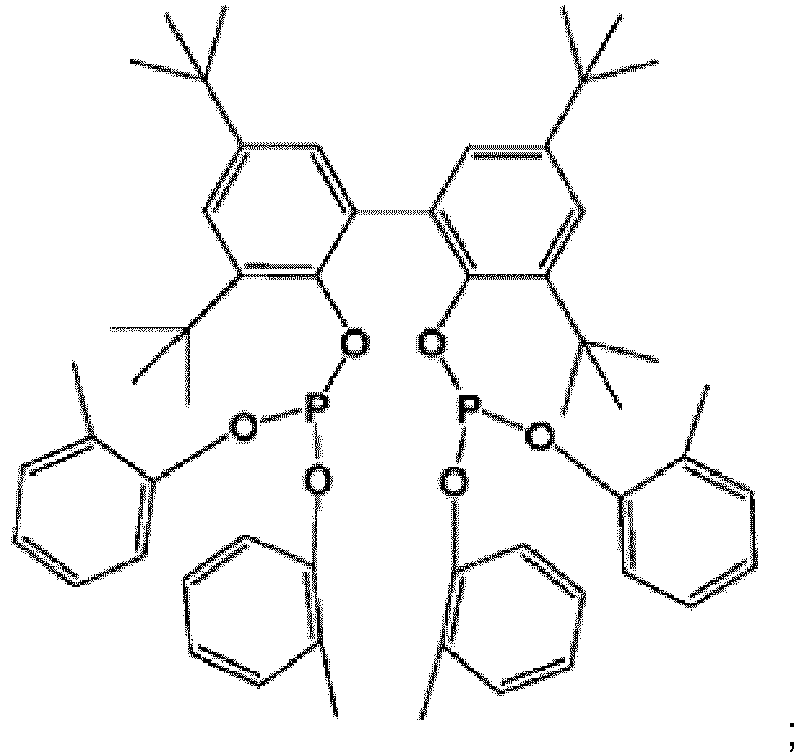
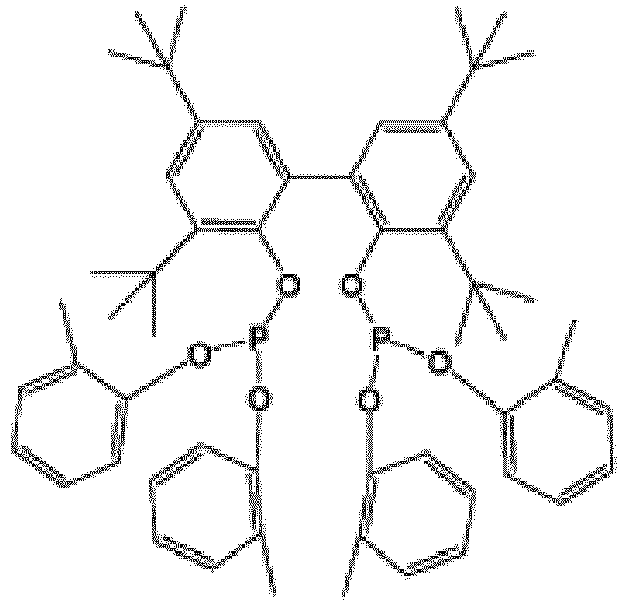
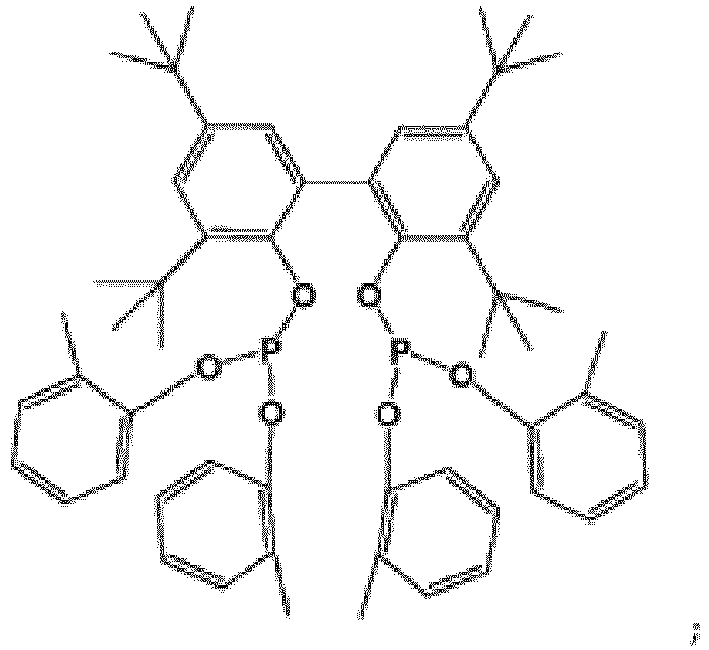
[0011] In a further aspect of the present invention, there is provided a hydroformylation process for continuous production of at least one aldehyde product, the process comprising the steps of: contacting under continuous reaction conditions in a hydroformylation reaction fluid, one or more C2-4 achiral olefins, carbon monoxide, and hydrogen in the presence of a mixture of Ligand A and triphenylphosphine, at least one of said ligands being bonded to a transition metal to form a transition metal-ligand complex hydroformylation catalyst wherein the metal comprises rhodium, the contacting being conducted in a manner such that the molar ratio of both the organomonophosphine ligand and the organopolyphosphite ligand to the metal is at least 1, the process temperature is greater than -25°C and less than 200°C, and the total gas pressure comprising carbon monoxide, hydrogen, and olefinic reactant(s) is greater than 172 kPa (25 psia) and less than 13,790 kPa (2,000 psia); wherein the concentration of either ligand in the hydroformylation reaction fluid is increased or maintained by supplying additional organopolyphosphite ligand(s) and/or organomonophosphine ligand to the reaction fluid to make up for such ligand lost through degradation; wherein Ligand A is:
and
wherein the organomonophosphine ligand is triphenylphosphine.
Surprisingly, the addition of the phosphine compound to the Rh/organopolyphosphite catalyst improves the stability of the organopolyphosphite ligand, but does not significantly adversely impact the selectivity (N:I ratio) or reaction rate of the system.
DETAILED DESCRIPTION OF THE INVENTION
[0012] The hydroformylation process of this disclosure for producing one or more aldehydes employs one or more olefinically-unsaturated compounds, carbon monoxide, hydrogen, and a mixture of a doubly open-ended organopolyphosphite ligand and an organomonophosphine ligand, at least one of said ligands being bonded to a transition metal to form a transition metal-ligand complex hydroformylation catalyst, wherein the organopolyphosphite ligand is of the formula:
where R1 and R2 are the same or different and each represents an aryl radical end group containing from 6 to 40 carbon atoms, and R28 is a C1-20 alkyl or cycloalkyl radical or an alkoxy radical; R29 is a hydrogen atom, a C1-20 alkyl or cycloalkyl radical or an alkoxy radical; and wherein the organomonophosphine ligand is triphenylphosphine.
[0013] As described in detail hereinafter, the process of this disclosure comprises contacting under continuous reaction conditions in a hydroformylation reaction fluid, one or more olefinically-unsaturated compounds, carbon monoxide, and hydrogen in the presence of a mixture of the organopolyphosphite ligand and an organomonophosphine ligand, at least one of said ligands being bonded to a transition metal to form a transition metal-ligand complex hydroformylation catalyst, wherein the organopolyphosphite ligand is of the formula:
where R1 and R2 are the same or different and each represents an aryl radical end group containing from 6 to 40 carbon atoms, and R28 is a C1-20 alkyl or cycloalkyl radical or an alkoxy radical; R29 is a hydrogen atom, a C1-20 alkyl or cycloalkyl radical or an alkoxy radical; and wherein the organomonophosphine ligand is triphenylphosphine. The contacting is further conducted such that the molar ratio of both the organopolyphosphite ligand and the organomonophosphine ligand to transition metal is at least 1.
[0014] The hydroformylation process of this disclosure may be asymmetric or non-asymmetric, the preferred process being non-asymmetric, and is conducted in any continuous or semi-continuous fashion, and may involve any conventional catalyst-containing hydroformylation reaction fluid and/or gas and/or extraction recycle operation, as desired. As used herein, the term "hydroformylation" is contemplated to include all operable asymmetric and non-asymmetric processes that involve converting one or more substituted or unsubstituted olefinic compounds or a reaction mixture comprising one or more substituted or unsubstituted olefinic compounds, in the presence of carbon monoxide, hydrogen, and a hydroformylation catalyst, to a product comprising at least one substituted or unsubstituted aldehyde.
[0015] The substituted or unsubstituted olefinic compound employable in the hydroformylation process of this disclosure can include both optically active (prochiral and chiral) and non-optically active (achiral) unsaturated compounds containing from 2 to 40, preferably 3 to 20, carbon atoms and one or more carbon-carbon double bonds (C=C). Such olefinic compound can be terminally or internally unsaturated and be of straight-chain, branched chain, or cyclic structures. Olefin mixtures, such as obtained from the oligomerization of propene, butene, and isobutene, (such as, so called dimeric, trimeric or tetrameric propylene, as disclosed, for example, in US s 4,518,809 and US 4,528,403) may also be employed, as well as mixed butenes, for example, raffinate I and raffinate II known to the skilled person. Such olefinic compounds and the corresponding aldehyde products derived therefrom may also contain one or more groups or substituents that do not adversely affect the hydroformylation process of this disclosure; suitable groups or substituents being described, for example, in US 3,527,809, and US 4,769,498.
[0016] Most preferably the process of the subject disclosure is especially useful for the production of non-optically active aldehydes, by hydroformylating achiral alpha-olefins containing from 2 to 30, preferably 3 to 20, carbon atoms, and achiral internal olefins containing from 4 to 20 carbon atoms as well as starting material mixtures of such alpha olefins and internal olefins.
[0017] Illustrative alpha and internal olefins include, for example, ethylene, propylene, 1-butene, 1-pentene, 1-hexene, 1-heptene, 1-octene, 1-nonene, 1-decene, 1-undecene, 1-dodecene, 1-tridecene, 1-tetradecene, 1-pentadecene, 1-hexadecene, 1-heptadecene, 1-octadecene, 1-nonadecene, 1-eicosene, 2-butene, 2-methyl propene (isobutylene), 2-methylbutene, 2-pentene, 2-hexene, 3-hexene, 2-heptene, 2-octene, cyclohexene, propylene dimers, propylene trimers, propylene tetramers, butadiene, piperylene, isoprene, 2-methyl-1-hexene, styrene, 4-methyl styrene, 4-isopropyl styrene, 4-tert-butyl styrene, alpha-methyl styrene, 4-tert-butyl-alpha-methyl styrene, 1,3-diisopropenylbenzene, 3-phenyl-1-propene, 1,4-hexadiene, 1,7-octadiene, 3-cyclohexyl-1-butene, and the like, as well as, 1,3-dienes, butadiene, alkyl alkenoates, for example, methyl pentenoate; alkenyl alkanoates, alkenyl alkyl ethers, alkenols, for example, pentenols; alkenals, for example, pentenals; such species to include allyl alcohol, allyl butyrate, hex-1-en-4-ol, oct-1-en-4-ol, vinyl acetate, allyl acetate, 3-butenyl acetate, vinyl propionate, allyl propionate, methyl methacrylate, vinyl ethyl ether, vinyl methyl ether, allyl ethyl ether, n-propyl-7-octenoate, 3-butenenitrile, 5-hexenamide, eugenol, iso-eugenol, safrole, iso-safrole, anethol, 4-allylanisole, indene, limonene, beta-pinene, dicyclopentadiene, cyclooctadiene, camphene, linalool, oleic acid and esters thereof, such as methyl oleate, and homologous unsaturated fatty acids and unsaturated fatty acid esters. Illustrative of suitable substituted and unsubstituted olefinic starting materials include those olefinic compounds described in Kirk-Othmer, Encyclopedia of Chemical Technology, Fourth Edition, 1996.
[0018] Hydrogen and carbon monoxide are also required for the process of this disclosure. These gases may be obtained from any available source, including petroleum cracking and refinery operations. Synthesis gas mixtures are preferably employed. The H2:CO molar ratio of gaseous hydrogen to carbon monoxide may range, preferably, from 1:10 to 100:1, the more preferred H2:CO molar ratio being from 1:10 to 10:1.
[0019] In the process of this disclosure, two different organophosphorus ligands are required, both of which are capable of bonding to a transition metal to form a transition metal-organophosphorus ligand complex catalyst capable of catalyzing the hydroformylation process. One organophosphorus ligand is required to be an organopolyphosphite ligand of the formula:
where R1 and R2 are the same or different and each represents an aryl radical end group containing from 6 to 40 carbon atoms, and R28 is a C1-20 alkyl or cycloalkyl radical or an alkoxy radical; R29 is a hydrogen atom, a C1-20 alkyl or cycloalkyl radical or an alkoxy radical, while the other organophosphorus ligand is required to be an organomonophosphine ligand, wherein the organomonophosphine ligand is triphenylphosphine. As the organopolyphosphite ligand, one such ligand or a mixture of such ligands may be used.
[0020] The hydroformylation processing techniques applicable to this disclosure may correspond to any of the processing techniques known and described in the art. Preferred processes are those involving catalyst liquid recycle hydroformylation processes, as described in US 4,668,651; US 4,774,361; US 5,102,505; US 5,110,990; US 5,288,918; US 5,874,639; and US 6,090,987; and extractive hydroformylation processes, as described in US 5,932,772; US 5,952,530; US 6,294,700; US 6,303,829; US 6,303,830; US 6,307,109; and US 6,307,110.
[0021] Generally, such catalyzed liquid hydroformylation processes involve production of aldehydes by contacting an olefinic unsaturated compound with carbon monoxide and hydrogen in the presence of a transition metal-organophosphorus ligand complex catalyst in a liquid phase that may also contain an organic solvent for the catalyst and ligand. Free organophosphorus ligand is also present in the liquid phase. In this disclosure, the generic term "organophosphorus ligand" embraces both types of ligands: organopolyphosphite and organomonophosphine. Both ligands are required; but no inference is made that both ligands are always complexed to the transition metal. Rather, the ligands may be complexed or unbound as catalytic cycling and competition between ligands for transition metal may dictate. By "free organophosphorus ligand" is meant an organophosphorus ligand that is not complexed with (tied to or bound to) the metal, for example, rhodium atom, of the complex catalyst. Generally, the hydroformylation process may include a recycle method, wherein a portion of the liquid reaction fluid containing the catalyst and aldehyde product is withdrawn from the hydroformylation reactor (which may include one reaction zone or a plurality of reaction zones, for example, in series), either continuously or intermittently; and the aldehyde product is separated and recovered therefrom by techniques described in the art; and then a metal catalyst-containing residue from the separation is recycled to the reaction zone as disclosed, for example, in US 5,288,918. If a plurality of reaction zones is employed in series, the reactant olefin may, in one embodiment of the disclosure, be fed to the first reaction zone only; while the catalyst solution, carbon monoxide, and hydrogen may be fed to each of the reaction zones, or, in another embodiment, the olefin may be fed into more than one of the reaction zones.
[0022] As used hereinafter, the term "reaction fluid" or "reaction product fluid" is contemplated to include, but is not limited to, a reaction mixture comprising: (a) an organopolyphosphite ligand, (b) an organomonophosphine ligand, (c) a transition metal-ligand complex catalyst wherein the ligand is selected from a mixture in the fluid of the organopolyphosphite ligand and the organomonophosphine ligand, (d) at least one aldehyde product formed in the reaction, (e) optionally, unconverted reactants including unreacted olefin, and (f) an organic solubilizing agent for said metal-ligand complex catalyst and said free ligand. It is to be understood that the hydroformylation reaction fluid may contain minor amounts of additional ingredients, such as those that have either been deliberately added or formed in situ during the process. Examples of such additional ingredients include carbon monoxide and hydrogen gases, and in situ formed products, such as saturated hydrocarbons, and/or unreacted isomerized olefins corresponding to the olefin starting materials, and/or high boiling liquid aldehyde condensation byproducts, and/or one or more degradation products of the catalyst and/or organophosphorus ligands, including by-products formed by hydrolysis of the organophosphorus ligands, as well as inert co-solvents or hydrocarbon additives, if employed.
[0023] Suitable metals that make up the transition metal-ligand complex catalyst include Group VIII metals selected from rhodium (Rh), cobalt (Co), iridium (Ir), ruthenium (Ru), iron (Fe), nickel (Ni), palladium (Pd), platinum (Pt), osmium (Os) and mixtures thereof, with the preferred metals being rhodium, cobalt, iridium and ruthenium, more preferably rhodium, cobalt and ruthenium, and most preferably, rhodium. Other permissible metals include Group VIB metals selected from chromium (Cr), molybdenum (Mo), tungsten (W), and mixtures thereof. Mixtures of metals from Groups VIB and VIII may also be used.
[0024] The term "complex" as used herein means a coordination compound formed by the union of one or more electronically rich molecules or atoms (i.e., ligand) with one or more electronically poor molecules or atoms (i.e., transition metal). For example, the organomonophosphine ligand employable herein possesses one phosphorus (III) donor atom having one unshared pair of electrons, which is capable of forming a coordinate covalent bond with the metal. The organopolyphosphite ligand employable herein possesses two or more phosphorus (III) donor atoms, each having one unshared pair of electrons, each of which is capable of forming a coordinate covalent bond independently or possibly in concert (for example, via chelation) with the transition metal. Carbon monoxide can also be present and complexed with the transition metal. The ultimate composition of the complex catalyst may also contain an additional ligand, for example, hydrogen or an anion satisfying the coordination sites or nuclear charge of the metal. Illustrative additional ligands include, for example, halogen (Cl, Br, I), alkyl, aryl, substituted aryl, acyl, CF3, C2F5, CN, (R)2PO and RP(O)(OH)O (wherein each R is the same or different and is a substituted or unsubstituted hydrocarbon radical, for example, alkyl or aryl), acetate, acetylacetonate, SO4, PF4, PF6, NO2, NO3, CH3O, CH2=CHCH2, CH3CH=CHCH2, C2H5CN, CH3CN, NH3, pyridine, (C2H5)3N, mono-olefins, diolefins and triolefins and tetrahydrofuran.
[0025] The number of available coordination sites on the transition metal is well known in the art and depends upon the particular transition metal selected. The catalytic species may comprise a complex catalyst mixture in their monomeric, dimeric or higher nuclearity forms, which preferably are characterized by at least one organophosphorus-containing molecule complexed per one molecule of metal, for example, rhodium. For instance, it is considered that the catalytic species of the preferred catalyst employed in the hydroformylation reaction may be complexed with carbon monoxide and hydrogen in addition to either the organopolyphosphite ligand or the organomonophosphine ligand.
[0026] The organopolyphosphite ligands employable in the process of this disclosure are organobisphosphite ligands of the formula:
where R1 and R2 are as defined below, and R28 is a C1-20 alkyl or cycloalkyl radical or an alkoxy radical; R29 is a hydrogen atom, a C1-20 alkyl or cycloalkyl radical or an alkoxy radical.
[0027] R1 and R2 are the same or different and each represents an aryl radical end group containing from 6 to 40 carbon atoms, preferably from 6 to 24 carbon atoms, most preferably from 6 to 20 carbon atoms. These end group pairs are by definition open-ended.
[0028] Mixtures of such ligands having the above formula may be employed if desired.
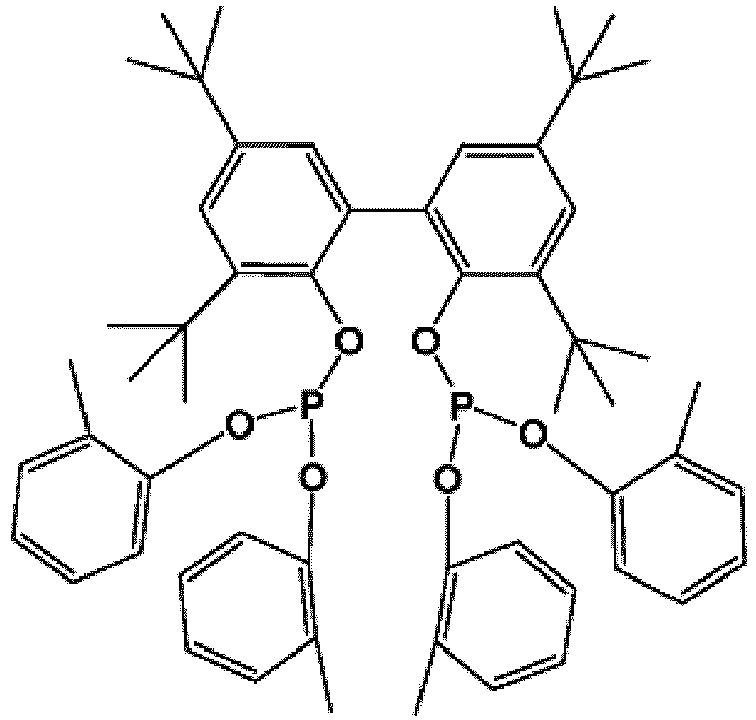
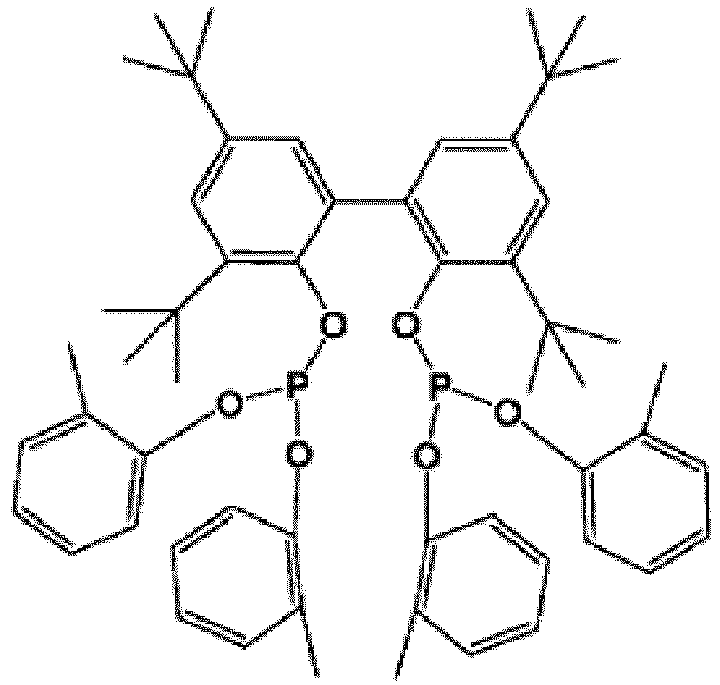
In a most preferred embodiment, the organobisphosphite ligand is Ligand A:
[0030] The concentration of metal-ligand complex(es) present in the reaction fluid of the hydroformylation process of this disclosure need only be that minimum amount necessary to provide a metal concentration necessary to catalyze the desired hydroformylation process. Generally, in the hydroformylation of propylene, the metal concentration, preferably, rhodium concentration, is greater than 1 part per million (ppm), and preferably, greater than 20 ppm, based on the weight of the hydroformylation reaction fluid. Generally, in the hydroformylation of propylene, the metal concentration is less than 500 parts per million (ppm), preferably, less than 120 ppm, and more preferably less than 95 ppm, based on the weight of the hydroformylation reaction fluid. For C4+ olefins, such as butene and those of higher molecular weights, suitable concentrations of metal may be higher, because higher olefins exhibit reduced activity as compared with propylene.
[0031] Both the organopolyphosphite and the organomonophosphine ligand employable in the process of this disclosure, including free and complexed forms, are provided to the process in a quantity such that the molar ratio of each ligand to the transition metal present in the hydroformylation reaction fluid is at least 1 (i.e., at least 1 mole of each ligand per mole transition metal). Preferably the quantity of each ligand is at least 2 moles per mole of transition metal.
[0032] The concentrations of transition metal, organopolyphosphite ligand, and organomonophosphine ligand in the hydroformylation reaction fluid can be readily determined by well known analytical methods. From these concentration analyses, the required molar ratios can be readily calculated and tracked. The transition metal, preferably rhodium, is best determined by atomic absorption or inductively coupled plasma (ICP) techniques. The ligands are best quantized by 31P nuclear magnetic resonance spectroscopy (NMR) or by high pressure liquid phase chromatography (HPLC) of aliquots of the reaction fluid. On-line HPLC can also be used to monitor the concentrations of the ligands and the transition metal-ligand complexes. The different ligands should be characterized separately (e.g., without the presence of transition metal in the reaction fluid) in a quantitative manner to establish chemical shifts and/or retention times using appropriate internal standards as needed. The transition metal-organopolyphosphite ligand and transition metal-organomonophosphine ligand complexes can be observed via any of the above-identified analytical methods to enable quantification of the complexed ligand(s).
[0033] The concentration of either ligand in the hydroformylation reaction fluid can be increased or maintained in any suitable manner, for example, by adding a quantity of ligand all at one time or in incremental additions to the hydroformylation reactor. In one embodiment of the disclosure, the ligand concentration can be increased or maintained by continuously or intermittently adding a quantity of ligand in a solubilizing agent as a liquid feed to the reactor. Alternatively, additional ligand can be added into a recycle stream (or a unit that produces a recycle stream) at any point downstream of the hydroformylation reactor for cycling back to said reactor. At any time during the continuous hydroformylation process, additional organopolyphosphite and/or organomonophosphine ligand(s) can be supplied to the reaction fluid to make-up for such ligand lost through degradation.
[0034] In general, the hydroformylation process of this disclosure can be conducted at any operable reaction temperature. Preferably, the reaction temperature is greater than -25°C, more preferably, greater than about 50°C. Preferably, the reaction temperature is less than 200°C, preferably, less than 120°C.
[0035] In general, the hydroformylation process of this disclosure can be conducted at any operable reaction pressure. Preferably, the reaction is conducted at a total pressure of at least 103.4 kPa (15 psia), more preferably at least 172.4 kPa (25 psia). Preferably, the reaction pressure is not more than 13,789.6 kPa (2,000 psia), more preferably not more than 2,068.4 kPa (300 psia).
[0036] The hydroformylation reactor is preferably equipped with an impeller, impeller shaft, olefin feed line and flow control, syngas feed line and flow control, a vent line and vent flow control, a total pressure sensor for sensing pressure within the reactor, an exit line for removing product fluid from the reactor, and an entry line for feeding recovered catalyst back to the reactor. The syngas feed line typically terminates in the reactor with a sparger. Optionally, the reactor may include one or more baffles that separate the inner chamber of the reactor into a plurality of reaction zones. Typically, each baffle is attached to the inner wall of the reactor and extends into the reactor perpendicular to the impeller shaft; and each baffle contains an opening or hole of sufficient size for passage of the impeller shaft as well as passage of reaction fluid and gases. Typically, each chamber or zone in the reactor formed by such baffles contains an impeller as well as a gas sparger for circulating and mixing the reaction fluid in that chamber or zone.
[0037] The syngas feed flow rate may be any operable flow rate sufficient to obtain the desired hydroformylation process. Typically, the syngas feed flow rate can vary widely depending upon the specific form of catalyst, olefin feed flow rate, and other operating conditions. Suitable syngas feed flow rates and vent flow rates are described in the following reference: "Process Economics Program Report 21D: Oxo Alcohols 21d," SRI Consulting, Menlo Park, California, Published December 1999.
SPECIFIC EMBODIMENTS OF THE INVENTION
[0038] The process of this disclosure will be further clarified by a consideration of the following examples, which are intended to be purely exemplary of the use of the invention. Other embodiments of the disclosure will be apparent to those skilled in the art from a consideration of this specification or practice of the process as disclosed herein.
[0039] In the examples that follow, reaction rate is reported as moles of aldehyde produced per liter of reaction fluid volume per hour (gmole/l/hr). The purities of propylene and syngas feeds (1:1 molar CO:H2 unless otherwise stated) are greater than 99.8 percent.
General Procedure for Hydroformylation Process
[0040] Two stock solutions are prepared in dry, degassed toluene: one containing a rhodium catalyst precursor (dicarbonylacetylacetonato rhodium (I)) and a doubly open-ended bisphosphite Ligand A, as shown hereinabove, and another containing triphenylphosphine. The solutions are transferred via vacuum into a 100 ml Parr mini-reactor. The resulting catalyst solution is then pre-heated under syngas for 20 -30 minutes. Liquid propylene is charged to a feed system that is closable with valves at either end above the reactor, and precise amounts of propylene are pressured in to the reactor with syngas. Previously generated data regarding olefin/toluene vapor pressure at various temperatures is used to determine the actual syngas pressure. The propylene is introduced into the reactor and the reactor is brought to the desired pressure, which is maintained during the reaction by feeding more syngas as needed. Liquid reaction samples are taken periodically and analyzed on an Agilent Technologies 6890 Gas Chromatograph, equipped with a DB-1 30 m x 0.32 mm, 1µm film column. Component analysis is based on GC area percent exclusive of solvent.
Comparative Experiment 1
[0041] Using the General Procedure for Hydroformylation Process described hereinabove, the hydroformylation reactor is loaded with a catalyst comprising rhodium (75 ppm, as rhodium dicarbonyl acetylacetonate) and doubly open-ended bisphosphite Ligand A (4 equivalent/Rh) in toluene (20 ml). After pre-heating the catalyst solution to 80 °C under 1:1 syngas, propylene (4.7 g) is pressurized into the reactor with 1:1 syngas sufficient to give a total reaction pressure of 2.1 MPa gauge (300 psig) (1.17 MPa gauge (167 psig) syngas pressure)). The reaction solution is analyzed at 30 and 60 minutes as described above. The results are shown in Table 1.
Example 2
[0042] The procedure of Comparative Experiment 1 is repeated, with the exception of the addition of triphenylphosphine (4 equivalents/Rh). The results are shown in Table 1.
Example 3
[0043] A procedure identical to that described in Example 2 is conducted, except that the reaction temperature employed is 90 °C. The results are shown in Table 1.
Table 1.
| Temp (°C) | Total syngas uptake (cc) | Conversion % | Max rate (g mol/l-hr) | Final N:I | |
| Comparative Ex. 1 | 80 | 2404 | 75.8 | 1.8 | 45.0 |
| Example 2 | 80 | 2243 | 75.0 | 2.0 | 49.0 |
| Example 3 | 90 | 3351 | 84.9 | 3.1 | 53.0 |
[0044] The n:i ratio refers to the relative amounts of normal butyraldehyde product (n) to isobutyraldehyde product (i) in the mixture of aldehyde products. From Table 1 it is seen that the addition of triphenylphosphine did not adversely impact the reaction rate or product regioselectivity (N:I ratio) to the linear aldehyde.
Comparative Experiments 4-5 and Examples 6-7
[0045] Stability data are obtained in a small-scale continuous reaction system. Catalyst solutions consisting of 75 ppm Rh (as rhodium dicarbonyl acetylacetonate), and 4 equivalents of Ligand A per Rh in 25 ml tetraglyme are charged to each of four heavy-walled glass tubes, and remain there throughout the run. Two of the tubes are additionally charged with 4 equivalents of triphenylphosphine per Rh dissolved in 1 ml of toluene. Carbon monoxide, hydrogen, nitrogen and 1-butene are continuously fed into the 90° C reactors. Volatiles, including the toluene and products are continually stripped out of the reactors with excess feed gases, and are analyzed via an in-line gas chromatograph. Reactor liquid levels are manually controlled by carefully balancing the reaction and feed rates. Total gas flow through the reactors is 15 - 20 standard liters/hr. Conversion rates are 20 -30 %, total pressure is maintained at 1.05 MPa gauge (150 psig).
[0046] Data for reactions with Rh/doubly open-ended bisphosphite Ligand A (Comparative Experiments 4 and 5) and Rh/doubly open-ended bisphosphite Ligand A/triphenylphosphine (examples 6 and 7) appear in Table 2.
Table 2.
| Day | Comp. Ex. 4 (N:I) | Com. Ex. 5 (N:I) | Example 6 (N:I) | Example 7 (N:I) |
| 1 | 88 | 102 | NA | NA |
| 2 | 92 | 106 | 74 | 80 |
| 3 | 97 | 95 | 75 | 77 |
| 4 | 96 | 108 | 74 | 78 |
| 5 | 98 | 102 | 74 | 83 |
| 8 | 97 | 95 | 83 | 81 |
| 9 | 89 | 96 | 81 | 89 |
| 10 | 94 | 98 | 77 | 84 |
| 11 | 83 | 38 | 82 | 85 |
| 12 | 40 | 33 | 83 | 85 |
| 15 | 27 | 24 | 85 | 96 |
| 16 | 25 | 22 | 94 | 95 |
| 17 | 23 | 20 | 78 | 90 |
| 18 | 22 | 19 | 81 | 97 |
| 19 | 20 | 18 | 82 | 86 |
| 22 | 17 | 14 | 79 | 92 |
[0047] Product selectivity is an indicator of the nature of the catalyst complex, and the change of selectivity over time is an indicator of ligand stability. Comparative Experiments 4 and 5 without triphenylphosphine present clearly show signs of degradation after 11 - 12 days, while Examples 6 and 7 show no signs of degradation after 22 days.
1. A hydroformylation process for continuous production of at least one aldehyde product,
the process comprising the steps of: contacting under continuous reaction conditions
in a hydroformylation reaction fluid, one or more olefinically-unsaturated compounds,
carbon monoxide, and hydrogen in the presence of a mixture of a doubly open-ended
organopolyphosphite ligand and an organomonophosphine ligand, at least one of said
ligands being bonded to a transition metal to form a transition metal-ligand complex
hydroformylation catalyst; the contacting being conducted in a manner such that the
molar ratio of both the organomonophosphine ligand and the organopolyphosphite ligand
to the metal is at least 1; wherein the concentration of either ligand in the hydroformylation
reaction fluid is increased or maintained by supplying additional organopolyphosphite
ligand(s) and/or organomonophosphine ligand to the reaction fluid to make up for such
ligand lost through degradation; wherein the organomonophosphine ligand is triphenylphosphine
and the organopolyphosphite ligand is of the formula:
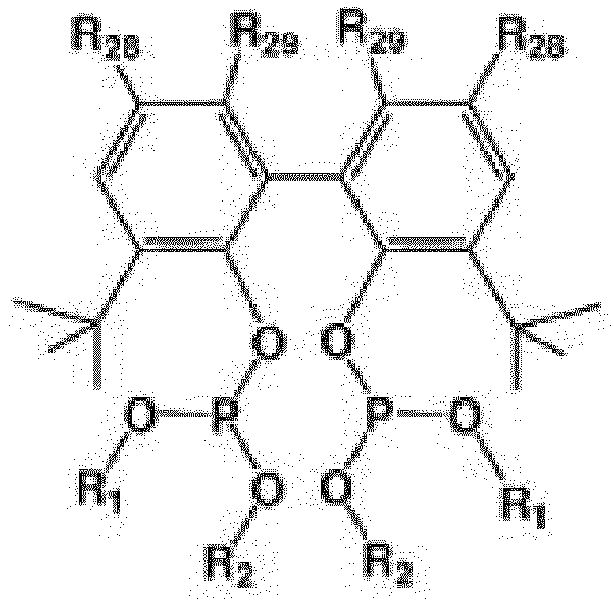
where R1 and R2 are the same or different and each represents an aryl radical end group containing from 6 to 40 carbon atoms, and R28 is a C1-20 alkyl or cycloalkyl radical or an alkoxy radical; R29 is a hydrogen atom, a C1-20 alkyl or cycloalkyl radical or an alkoxy radical.
where R1 and R2 are the same or different and each represents an aryl radical end group containing from 6 to 40 carbon atoms, and R28 is a C1-20 alkyl or cycloalkyl radical or an alkoxy radical; R29 is a hydrogen atom, a C1-20 alkyl or cycloalkyl radical or an alkoxy radical.
2. The process of Claim 1 wherein the molar ratio of organopolyphosphite ligand to transition
metal is increased or maintained by adding organopolyphosphite ligand to the reaction
fluid.
3. The process of Claim 1 or 2 wherein concentration of the transition metal is greater
than 1 part per million (ppm) and less than 500 ppm, based on the weight of the hydroformylation
reaction fluid.
4. The process of any one of Claims 1 to 3 wherein the process temperature is greater
than -25°C and less than 200°C.
5. The process of any one of Claims 1 to 4 wherein the total gas pressure comprising
carbon monoxide, hydrogen, and olefinic reactant(s) is greater than 172 kPa (25 psia)
and less than 13,790 kPa (2,000 psia).
6. The process of any one of Claims 1 to 5 wherein the olefin is an achiral alpha-olefin
having from 2 to 30 carbon atoms or an achiral internal olefin having from 4 to 20
carbon atoms.
7. The process of any one of Claims 1 to 6 wherein carbon monoxide and hydrogen are present
in quantities that provide an H2:CO molar ratio ranging from 1:10 to 100:1.
8. The process of any one of Claims 1 to 7 wherein the transition metal is a Group VIII
metal selected from rhodium, cobalt, iridium, ruthenium, and mixtures thereof.
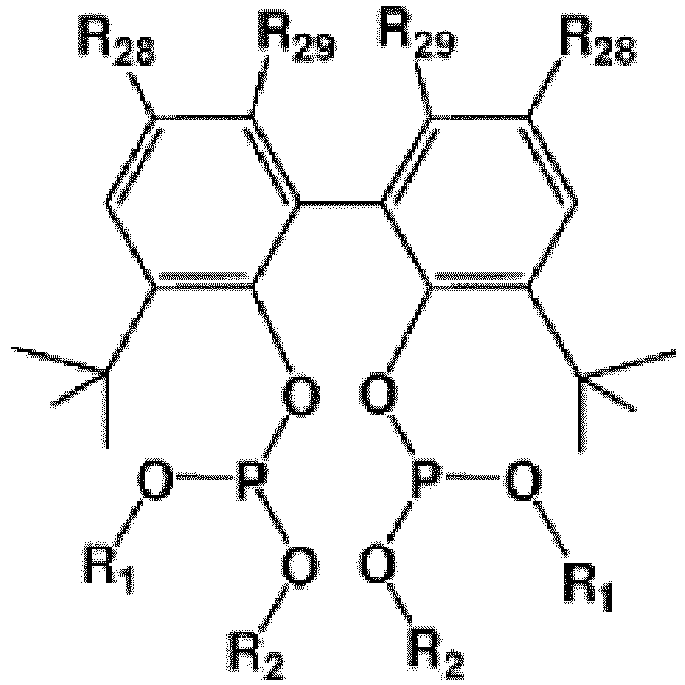
9. The process of any one of Claims 1 to 8 wherein a mixture of organopolyphosphite ligands
of the formula:
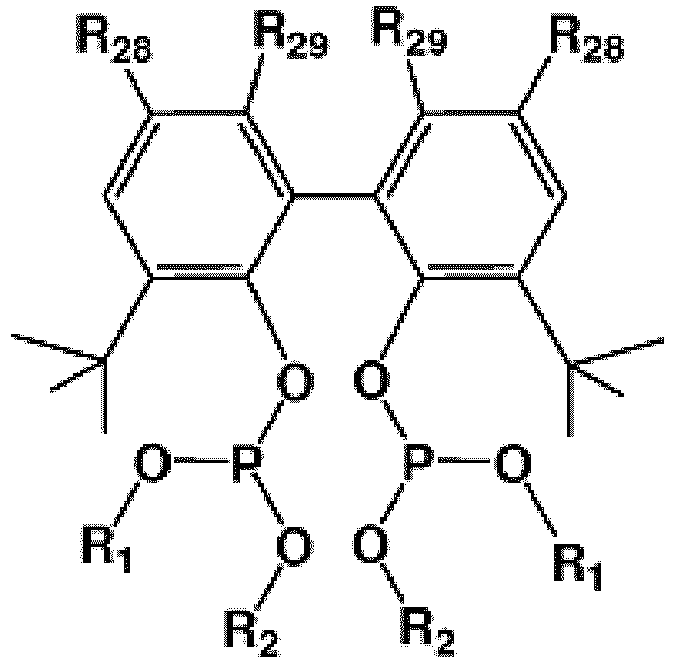
is employed, where R1 and R2 are the same or different and each represents an aryl radical end group containing from 6 to 40 carbon atoms, and R28 is a C1-20 alkyl or cycloalkyl radical or an alkoxy radical; R29 is a hydrogen atom, a C1-20 alkyl or cycloalkyl radical or an alkoxy radical.
is employed, where R1 and R2 are the same or different and each represents an aryl radical end group containing from 6 to 40 carbon atoms, and R28 is a C1-20 alkyl or cycloalkyl radical or an alkoxy radical; R29 is a hydrogen atom, a C1-20 alkyl or cycloalkyl radical or an alkoxy radical.
10. The process of any one of Claims 1 to 9 wherein the organopolyphosphite ligand is
Ligand A:
11. A hydroformylation process according to claim 1 for continuous production of at least
one aldehyde product, the process comprising the steps of: contacting under continuous
reaction conditions in a hydroformylation reaction fluid, one or more C2-4 achiral olefins, carbon monoxide, and hydrogen in the presence of a mixture of Ligand
A and triphenylphosphine, at least one of said ligands being bonded to a transition
metal to form a transition metal-ligand complex hydroformylation catalyst wherein
the metal comprises rhodium, the contacting being conducted in a manner such that
the molar ratio of both the organomonophosphine ligand and the organopolyphosphite
ligand to the metal is at least 1, the process temperature is greater than -25°C and
less than 200°C, and the total gas pressure comprising carbon monoxide, hydrogen,
and olefinic reactant(s) is greater than 172 kPa (25 psia) and less than 13,790 kPa
(2,000 psia); wherein the concentration of either ligand in the hydroformylation reaction
fluid is increased or maintained by supplying additional organopolyphosphite ligand(s)
and/or organomonophosphine ligand to the reaction fluid to make up for such ligand
lost through degradation; wherein Ligand A is:
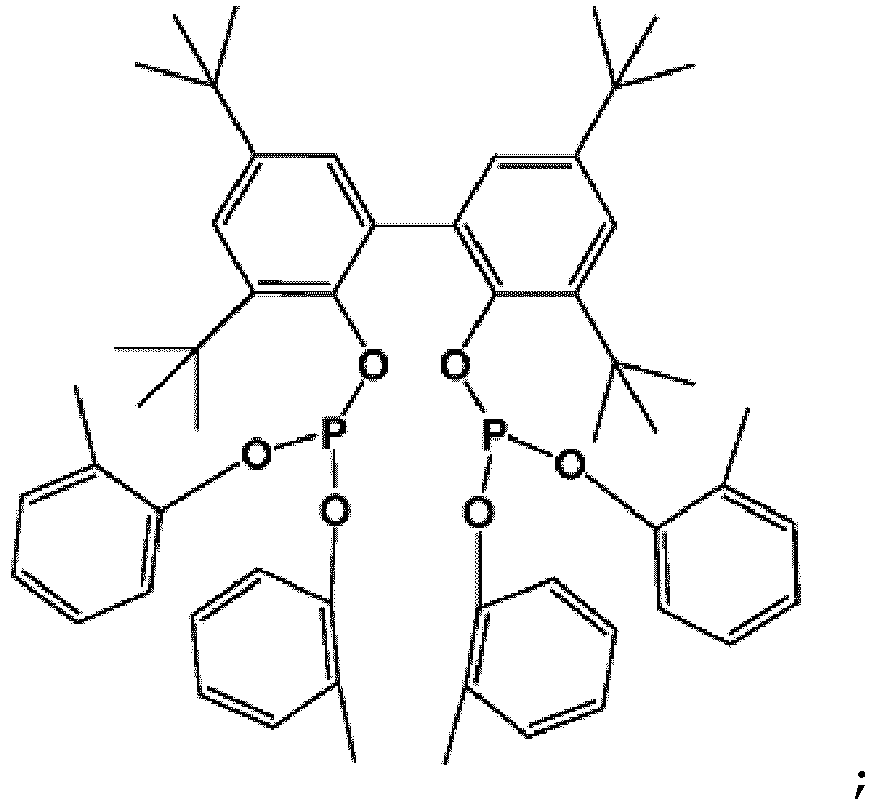
and
wherein the organomonophosphine ligand is triphenylphosphine.
and
wherein the organomonophosphine ligand is triphenylphosphine.
1. Ein Hydroformylierungsverfahren zur kontinuierlichen Produktion mindestens eines Aldehydproduktes,
wobei das Verfahren die folgenden Schritte beinhaltet: In-Kontakt-Bringen, unter Bedingungen
einer kontinuierlichen Reaktion in einem Hydroformylierungsreaktionsfluid, von einer
oder mehreren olefinisch ungesättigten Verbindungen, Kohlenmonoxid und Wasserstoff
in Gegenwart einer Mischung eines doppelt offenendigen Organopolyphosphitliganden
und eines Organomonophosphinliganden, wobei mindestens einer der Liganden an ein Übergangsmetall
gebunden ist, um einen Übergangsmetall-Liganden-Komplex-Hydroformylierungskatalysator
zu bilden; wobei das In-Kontakt-Bringen auf eine derartige Weise durchgeführt wird,
dass das Molverhältnis sowohl des Organomonophosphinliganden als auch des Organopolyphosphitliganden
zu dem Metall mindestens 1 beträgt; wobei die Konzentration jedes Liganden in dem
Hydroformylierungsreaktionsfluid erhöht oder konstant gehalten wird, indem dem Reaktionsfluid
zusätzlicher Organopolyphosphitligand/zusätzliche Organopolyphosphitliganden und/oder
Organomonophosphinligand zugeführt werden, um solchen durch Abbau verlorenen Liganden
zu ersetzen; wobei der Organomonophosphinligand Triphenylphosphin ist und der Organopolyphosphitligand
die folgende Formel aufweist:
wobei R1 und R2 gleich oder verschieden sind und jeweils eine Arylrest-Endgruppe, die 6 bis 40 Kohlenstoffatome enthält, darstellen, und R28 ein C1-20-Alkyl- oder -Cycloalkylrest oder ein Alkoxyrest ist; R29 ein Wasserstoffatom, ein C1-20-Alkyl- oder -Cycloalkylrest oder ein Alkoxyrest ist.
wobei R1 und R2 gleich oder verschieden sind und jeweils eine Arylrest-Endgruppe, die 6 bis 40 Kohlenstoffatome enthält, darstellen, und R28 ein C1-20-Alkyl- oder -Cycloalkylrest oder ein Alkoxyrest ist; R29 ein Wasserstoffatom, ein C1-20-Alkyl- oder -Cycloalkylrest oder ein Alkoxyrest ist.
2. Verfahren gemäß Anspruch 1, wobei das Molverhältnis des Organopolyphosphitliganden
zum Übergangsmetall durch Zugabe von Organopolyphosphitligand zu dem Reaktionsfluid
erhöht oder konstant gehalten wird.
3. Verfahren gemäß Anspruch 1 oder 2, wobei die Konzentration des Übergangsmetalls mehr
als 1 Teil pro Million (ppm) und weniger als 500 ppm beträgt, bezogen auf das Gewicht
des Hydroformylierungsreaktionsfluids.
4. Verfahren gemäß einem der Ansprüche 1 bis 3, wobei die Verfahrenstemperatur mehr als
-25 °C und weniger als 200 °C beträgt.
5. Verfahren gemäß einem der Ansprüche 1 bis 4, wobei der Gesamtgasdruck, welcher Kohlenmonoxid,
Wasserstoff und olefinisches Reagenz/olefinische Reagenzien beinhaltet, mehr als 172
kPa (25 psia) und weniger als 13 790 kPa (2 000 psia) beträgt.
6. Verfahren gemäß einem der Ansprüche 1 bis 5, wobei das Olefin ein achirales alpha-Olefin
mit 2 bis 30 Kohlenstoffatomen oder ein achirales internes Olefin mit 4 bis 20 Kohlenstoffatomen
ist.
7. Verfahren gemäß einem der Ansprüche 1 bis 6, wobei Kohlenmonoxid und Wasserstoff in
Mengen vorhanden sind, die ein H2:CO-Molverhältnis im Bereich von 1 : 10 bis 100 : 1 bereitstellen.
8. Verfahren gemäß einem der Ansprüche 1 bis 7, wobei das Übergangsmetall ein Gruppe-VIII-Metall
ist, ausgewählt aus Rhodium, Kobalt, Iridium, Ruthenium und Mischungen davon.
9. Verfahren gemäß einem der Ansprüche 1 bis 8, wobei eine Mischung von Organopolyphosphitliganden
der Formel:
eingesetzt wird, wobei R1 und R2 gleich oder verschieden sind und jeweils eine Arylrest-Endgruppe, die 6 bis 40 Kohlenstoffatome enthält, darstellen, und R28 ein C1-20-Alkyl- oder -Cycloalkylrest oder ein Alkoxyrest ist; R29 ein Wasserstoffatom, ein C1-20-Alkyl- oder -Cycloalkylrest oder ein Alkoxyrest ist.
eingesetzt wird, wobei R1 und R2 gleich oder verschieden sind und jeweils eine Arylrest-Endgruppe, die 6 bis 40 Kohlenstoffatome enthält, darstellen, und R28 ein C1-20-Alkyl- oder -Cycloalkylrest oder ein Alkoxyrest ist; R29 ein Wasserstoffatom, ein C1-20-Alkyl- oder -Cycloalkylrest oder ein Alkoxyrest ist.
10. Verfahren gemäß einem der Ansprüche 1 bis 9, wobei der Organopolyphosphitligand Ligand
A ist:
11. Hydroformylierungsverfahren gemäß Anspruch 1 zur kontinuierlichen Produktion mindestens
eines Aldehydproduktes, wobei das Verfahren die folgenden Schritte beinhaltet: In-Kontakt-Bringen,
unter Bedingungen einer kontinuierlichen Reaktion in einem Hydroformylierungsreaktionsfluid,
von einem oder mehreren achiralen C2-4-Olefinen, Kohlenmonoxid und Wasserstoff in Gegenwart einer Mischung von Ligand A
und Triphenylphosphin, wobei mindestens einer der Liganden an ein Übergangsmetall
gebunden ist, um einen Übergangsmetall-Liganden-Komplex-Hydroformylierungskatalysator
zu bilden, wobei das Metall Rhodium beinhaltet, wobei das In-Kontakt-Bringen auf eine
derartige Weise durchgeführt wird, dass das Molverhältnis sowohl des Organomonophosphinliganden
als auch des Organopolyphosphitliganden zu dem Metall mindestens 1 beträgt, wobei
die Verfahrenstemperatur mehr als -25 °C und weniger als 200 °C beträgt und der Gesamtgasdruck,
welcher Kohlenmonoxid, Wasserstoff und olefinisches Reagenz/olefinisches Reagenzien
beinhaltet, mehr als 172 kPa (25 psia) und weniger als 13 790 kPa (2 000 psia) beträgt;
wobei die Konzentration jedes Liganden in dem Hydroformylierungsreaktionsfluid erhöht
oder konstant gehalten wird, indem dem Reaktionsfluid zusätzlicher Organopolyphosphitligand/zusätzliche
Organopolyphosphitliganden und/oder Organomonophosphinligand zugeführt werden, um
solchen durch Abbau verlorenen Liganden zu ersetzen; wobei Ligand A Folgendes ist:
und
wobei der Organomonophosphinligand Triphenylphosphin ist.
und
wobei der Organomonophosphinligand Triphenylphosphin ist.
1. Un procédé d'hydroformylation pour la production continue d'au moins un produit aldéhyde,
le procédé comprenant les étapes consistant à : mettre en contact dans des conditions
de réaction continues dans un fluide réactionnel d'hydroformylation, un ou plusieurs
composés oléfiniquement insaturés, du monoxyde de carbone, et de l'hydrogène en présence
d'un mélange d'un ligand organopolyphosphite aux deux extrémités ouvertes et d'un
ligand organomonophosphine, au moins l'un desdits ligands étant lié à un métal de
transition afin de former un catalyseur d'hydroformylation complexe métal de transition-ligand
; la mise en contact étant menée d'une manière telle que le rapport molaire des deux
ligands, le ligand organomonophosphine et le ligand organopolyphosphite, au métal
soit d'au moins 1 ; dans lequel la concentration de l'un ou l'autre ligand dans le
fluide réactionnel d'hydroformylation est accrue ou maintenue en apportant un ou des
ligands organopolyphosphite et/ou un ligand organomonophosphine supplémentaires au
fluide réactionnel afin de compenser ce ligand perdu au cours de la dégradation ;
dans lequel le ligand organomonophosphine est la triphénylphosphine et le ligand organopolyphosphite
est de la formule :
où R1 et R2 sont identiques ou différents et chacun représente un groupe terminal radical aryle contenant de 6 à 40 atomes de carbone, et R28 est un radical cycloalkyle ou alkyle en C1-20 ou un radical alcoxy ; R29 est un atome d'hydrogène, un radical cycloalkyle ou alkyle en C1-20 ou un radical alcoxy.
où R1 et R2 sont identiques ou différents et chacun représente un groupe terminal radical aryle contenant de 6 à 40 atomes de carbone, et R28 est un radical cycloalkyle ou alkyle en C1-20 ou un radical alcoxy ; R29 est un atome d'hydrogène, un radical cycloalkyle ou alkyle en C1-20 ou un radical alcoxy.
2. Le procédé de la revendication 1 dans lequel le rapport molaire du ligand organopolyphosphite
au métal de transition est accru ou maintenu en ajoutant du ligand organopolyphosphite
au fluide réactionnel.
3. Le procédé de la revendication 1 ou de la revendication 2 dans lequel la concentration
du métal de transition est supérieure à 1 partie par million (ppm) et inférieure à
500 ppm, rapporté au poids du fluide réactionnel d'hydroformylation.
4. Le procédé de n'importe laquelle des revendications 1 à 3 dans lequel la température
de procédé est supérieure à -25 °C et inférieure à 200 °C.
5. Le procédé de n'importe laquelle des revendications 1 à 4 dans lequel la pression
totale de gaz comprenant du monoxyde de carbone, de l'hydrogène, et un ou des réactifs
oléfiniques est supérieure à 172 kPa (25 psia) et inférieure à 13 790 kPa (2 000 psia).
6. Le procédé de n'importe laquelle des revendications 1 à 5 dans lequel l'oléfine est
une alpha-oléfine achirale ayant de 2 à 30 atomes de carbone ou une oléfine interne
achirale ayant de 4 à 20 atomes de carbone.
7. Le procédé de n'importe laquelle des revendications 1 à 6 dans lequel le monoxyde
de carbone et l'hydrogène sont présents dans des quantités qui fournissent un rapport
molaire H2/CO compris dans la gamme allant de 1/10 à 100/1.
8. Le procédé de n'importe laquelle des revendications 1 à 7 dans lequel le métal de
transition est un métal du Groupe VIII sélectionné parmi le rhodium, le cobalt, l'iridium,
le ruthénium, et des mélanges de ceux-ci.
9. Le procédé de n'importe laquelle des revendications 1 à 8 dans lequel un mélange de
ligands organopolyphosphite de la formule :
est employé, où R1 et R2 sont identiques ou différents et chacun représente un groupe terminal radical aryle contenant de 6 à 40 atomes de carbone, et R28 est un radical cycloalkyle ou alkyle en C1-20 ou un radical alcoxy ; R29 est un atome d'hydrogène, un radical cycloalkyle ou alkyle en C1-20 ou un radical alcoxy.
est employé, où R1 et R2 sont identiques ou différents et chacun représente un groupe terminal radical aryle contenant de 6 à 40 atomes de carbone, et R28 est un radical cycloalkyle ou alkyle en C1-20 ou un radical alcoxy ; R29 est un atome d'hydrogène, un radical cycloalkyle ou alkyle en C1-20 ou un radical alcoxy.
10. Le procédé de n'importe laquelle des revendications 1 à 9 dans lequel le ligand organopolyphosphite
est le Ligand A :
11. Un procédé d'hydroformylation selon la revendication 1 pour la production continue
d'au moins un produit aldéhyde, le procédé comprenant les étapes consistant à : mettre
en contact dans des conditions de réaction continues dans un fluide réactionnel d'hydroformylation,
une ou plusieurs oléfines achirales en C2-4, du monoxyde de carbone, et de l'hydrogène en présence d'un mélange de Ligand A et
de triphénylphosphine, au moins l'un desdits ligands étant lié à un métal de transition
afin de former un catalyseur d'hydroformylation complexe métal de transition-ligand
dans lequel le métal comprend du rhodium, la mise en contact étant menée d'une manière
telle que le rapport molaire des deux ligands, le ligand organomonophosphine et le
ligand organopolyphosphite, au métal soit d'au moins 1, la température de procédé
est supérieure à -25 °C et inférieure à 200 °C, et la pression totale de gaz comprenant
du monoxyde de carbone, de l'hydrogène, et un ou des réactifs oléfiniques est supérieure
à 172 kPa (25 psia) et inférieure à 13 790 kPa (2 000 psia) ; dans lequel la concentration
de l'un ou l'autre ligand dans le fluide réactionnel d'hydroformylation est accrue
ou maintenue en apportant un ou des ligands organopolyphosphite et/ou un ligand organomonophosphine
supplémentaires au fluide réactionnel afin de compenser ce ligand perdu au cours de
la dégradation ; dans lequel le ligand A est :
et dans lequel le ligand organomonophosphine est la triphénylphosphine.
et dans lequel le ligand organomonophosphine est la triphénylphosphine.
REFERENCES CITED IN THE DESCRIPTION
This list of references cited by the applicant is for the reader's convenience only. It does not form part of the European patent document. Even though great care has been taken in compiling the references, errors or omissions cannot be excluded and the EPO disclaims all liability in this regard.
Patent documents cited in the description
- US4148830A [0002]
- US4717775A [0002]
- US4769498A [0002] [0015]
- US6153800A [0004] [0004]
- EP0839787A [0004] [0004]
- CN1986055A [0005]
- US5874651A [0006]
- JP2006143653A [0007]
- US5910600A [0008]
- US4518809A [0015]
- US4528403A [0015]
- US3527809A [0015]
- US4668651A [0020]
- US4774361A [0020]
- US5102505A [0020]
- US5110990A [0020]
- US5288918A [0020] [0021]
- US5874639A [0020]
- US6090987A [0020]
- US5932772A [0020]
- US5952530A [0020]
- US6294700B [0020]
- US6303829B [0020]
- US6303830B [0020]
- US6307109B [0020]
- US6307110B [0020]
Non-patent literature cited in the description
- KIRK-OTHMEREncyclopedia of Chemical Technology19960000 [0017]
- Process Economics Program Report 21D: Oxo Alcohols 21dSRI Consulting19991200 [0037]