|
(11) | EP 2 468 814 A1 |

| (12) | EUROPEAN PATENT APPLICATION |
|
|
|
|
|||||||||||||||||||||||
| (54) | Novel Phosphorus Compound, Method of Preparing the Same and Flame Retardant Thermoplastic Resin Composition Including the Same |
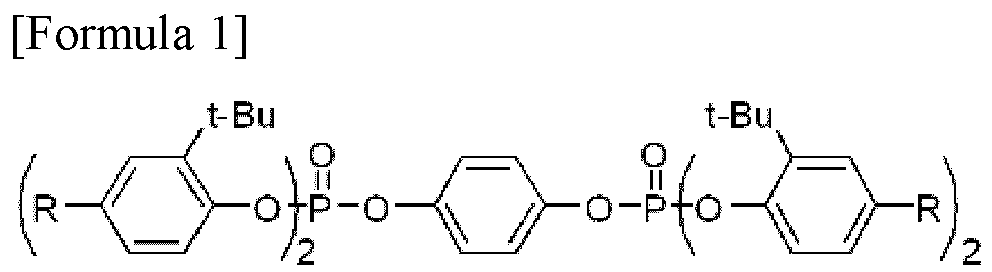
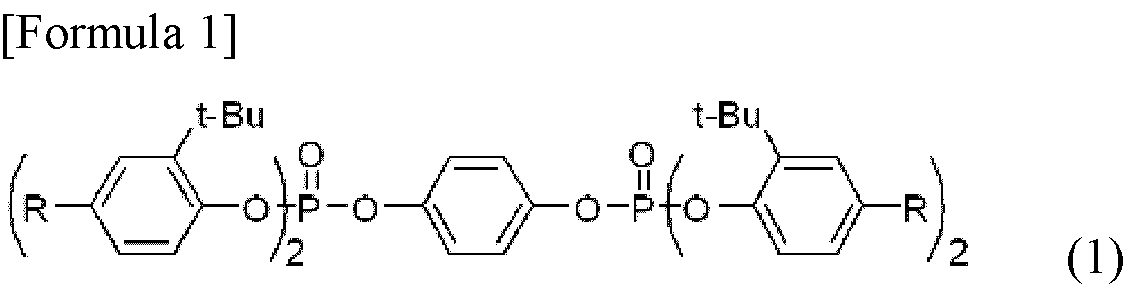
| (57) Disclosed herein is a phosphorus compound represented by Formula 1:
wherein each R is a hydrogen atom, a C1-C6 alkyl group or a C6-C12 aryl group. |
[0001] The present invention relates to a novel phosphorus compound, a method of preparing the same, and a flame retardant thermoplastic resin composition including the same. More particularly, the present invention relates to a novel phosphorus compound containing phenol moieties, each having a tert-butyl group in a particular position of the phenol ring, and a hydroquinone linker to achieve improved flame retardancy, heat resistance and impact strength, a method of preparing the phosphorus compound, and a flame retardant thermoplastic resin composition including the phosphorus compound.
[0002] In recent years, plastic polymers and synthetic resins have been widely used in a variety of applications, including vehicles, construction materials, aircraft, railroads and home appliances. In addition, the rapid development of various kinds of functional additives leads to an explosive increase in the application of plastic polymers and synthetic resins. Plastics are easily combustible on account of their inherent characteristics and have no resistance to fire. Accordingly, plastics may tend to be combustible by external ignition sources and allow fire to propagate faster. In view of this, governmental agencies in many countries, including the United States, Japan and Europe, have enacted laws and regulations concerning the use of polymeric resins meeting flame retardancy requirements in order to guarantee the safety of electronic products against fire.
[0003] Many methods are known to impart flame retardancy to polymers. Such methods include, for example, synthesis of thermally stable resins via molecular structure design, chemical modification of conventional polymers (reactive type), physical addition of flame retardants by blending or compounding (additive type), and coating or painting with flame retardants. The addition of flame retardants to polymeric resins is known as a method that is most widely applied to impart flame retardancy to the resins. Additive type flame retardants are classified into halogen, phosphorus, nitrogen, silicon and inorganic flame retardants by their constituent components.
[0004] Halogen flame retardants react with gas-phase radicals generated during combustion of polymers in resins to inhibit chain reactions of combustion. Typical halogen flame retardants are polybromodiphenyl ether, tetrabromobisphenol A, brominated epoxy compounds and chlorinated polyethylene. Typical antimony flame retardants are antimony trioxide and antimony pentaoxide. Brominated flame retardants are most widely used in electrical and electronic fields due to their outstanding physical properties, low prices and superior flame retardancy. However, environmental problems associated with the use of brominated flame retardants remain controversial. Under such circumstances, Restriction of Hazardous Substances (RoHS) Directive in electrical and electronic products was taken effect to ban the use of some of the general-purpose brominated flame retardants, called 'Deca.' Since then, the amounts of brominated flame retardants used have been drastically reduced.
[0005] Phosphorus flame retardants have emerged as representative environmentally friendly non-halogen flame retardants that are capable of complying with recent environmental regulations. Such phosphorus flame retardants exhibit excellent flame retardant effects in solid-phase reactions and are particularly effective in plastics containing a large amount of oxygen. Phosphorus flame retardants are divided into phosphate, phosphine oxide, phosphite, phosphonate flame retardants, and others. Aromatic phosphoric acid esters, such as resorcinol bisphenol phosphate and bisphenol bisdiphenyl phosphate, are commonly used at present.
[0006] The use of phosphorus flame retardants leads to an improvement in flame retardancy and an increase in the flowability of resins, which are advantageous in terms of ease of processing, but is liable to deteriorate the heat resistance of resins.
[0007] As the application of synthetic resins has been extended to vehicles, aircraft, etc and the degree of integration of electronic materials has become high, there is an increasing need for highly heat resistant resins. Conventional phosphoric acid ester flame retardants cause many problems during processing, such as gas evolution, degradation and poor appearance because of their low heat resistance.
[0008] Japanese Patent No. 1991-211293 discloses a flame retardant having a structure in which resorcinol linking two phosphate moieties is substituted with hydroquinone or biphenol. However, an increase in thermal deformation temperature is little and hydrolysis tends to occur.
[0009] United Kingdom Patent No. 2325933 reported a flame retardant in which 2,4-di-tert-butylphenol groups are introduced to achieve improved heat resistance and impact strength while maintaining good flame retardancy. However, the complicated synthesis procedure of the flame retardant limits the practical application of the flame retardant. It was also found that the flame retardant does not substantially contribute to improvements of flame retardancy and heat resistance, causes poor flowability, and readily undergoes hydrolysis.
[0010] As a result of extensive research to solve the problems of the prior art, the present inventors have succeeded in synthesizing novel phosphorus compounds with improved flame retardancy, heat resistance, impact strength and hydrolysis resistance without deteriorating flowability in an easy way when compared to conventional phosphorus compounds. The present inventors also have succeeded in developing environmentally friendly flame retardant thermoplastic resin compositions that have superior heat resistance and impact strength while possessing good flame retardancy without causing problems during processing, such as gas evolution, degradation and poor appearance.
[0011] It is the object of the present invention to provide a phosphorus compound that has improved thermal stability and hydrolysis resistance compared to conventional aromatic phosphoric acid esters, exhibits superior flame retardancy, heat resistance and impact strength without deteriorating flowability, does not cause problems during processing, such as gas evolution, degradation and poor appearance, is environmentally friendly because it does not release halogenated gases, which are causes of environmental pollution during resin processing or combustion, possesses improved hydrolysis resistance, and can achieve a good balance of physical properties, such as flame retardancy, impact strength, resistance, flowability and hydrolysis resistance, when applied to a thermoplastic resin. The present invention also provides a thermoplastic resin composition using the phosphorus compound that can find application in electrical/electronic fields and as a molded material for vehicles, aircraft, etc. due to its excellent flame retardancy, hydrolysis resistance and heat resistance.
[0012] Above objects of the present invention have been achieved by the provision of a novel phosphorus compound. In one embodiment, the phosphorus compound is represented by Formula 1:
wherein each R is a hydrogen atom, a C1-C6 alkyl group or a C6-C12 aryl group.
[0013] In an embodiment, the difference in the acid value of a 75% solution of the phosphorus compound in water before and after stirring at 93 °C for 48 hours may be less than about 0.5 mg KOH/g, and the difference in the acid value of the phosphorus compound before and after standing at 280 °C for 1 hour may be less than about 0.1 mg KOH/g.
[0014] The phosphorus compound may have a weight loss of about 5.5% or less, as determined by thermogravimetric analysis at 350 °C.
[0015] Another aspect of the present invention provides a method of preparing the phosphorus compound. In one embodiment, the phosphorus compound may be prepared by the reaction of phosphorus oxychloride, hydroquinone and a compound represented by Formula 2:
wherein R is a hydrogen atom, a C1-C6 alkyl group or a C6-C12 aryl group.
[0016] In an alternative embodiment, the method may include reacting phosphorus oxychloride with the compound of Formula 2 and reacting the reaction product with hydroquinone.
[0017] The phosphorus compound exhibits excellent flame retardancy, heat resistance and impact strength, thus being suitable for use as a flame retardant for a thermoplastic resin.
[0018] Another aspect of the present invention provides a flame retardant thermoplastic resin composition. In one embodiment, the thermoplastic resin composition includes the phosphorus compound.
[0019] In an embodiment, the thermoplastic resin composition may include about 100 parts by weight of a thermoplastic resin and about 0.1 to about 50 parts by weight of the phosphorus compound.
[0020] Examples of thermoplastic resins suitable for use in the thermoplastic resin composition may include polystyrene (PS) resins, acrylonitrile-butadiene-styrene (ABS) copolymer resins, rubber modified polystyrene (HIPS) resins, acrylonitrile-styrene-acrylate (ASA) copolymer resins, acrylonitrile-styrene (SAN) copolymer resins, methyl methacrylate-butadiene-styrene (MBS) copolymer resins, acrylonitrile-ethyl acrylate-styrene (AES) copolymer resins, polycarbonate (PC) resins, polyphenylene ether (PPE) resins, polyphenylene sulfide (PPS) resins, polyethylene (PE) resins, polypropylene (PP) resins, polyethylene terephthalate (PET) resins, polybutylene terephthalate (PBT) resins, poly(meth)acrylic resins, polyamide (PA) resins and the like.
[0021] In an embodiment, the thermoplastic resin may be a polycarbonate resin. In this embodiment, the phosphorus compound may be included in an amount of about 1 to about 10 parts by weight, based on about 100 parts by weight of the polycarbonate resin.
[0022] In an alternative embodiment, the thermoplastic resin may be a blend of a polycarbonate resin and a rubber modified aromatic vinyl polymer resin. In this embodiment, the phosphorus compound may be included in an amount of about 10 to about 25 parts by weight, based on about 100 parts by weight of the blend.
[0023] The thermoplastic resin composition may further include one or more additives selected from the group consisting of flame retardants, flame retardant assistants, lubricants, plasticizers, heat stabilizers, anti-drip agents, antioxidants, compatibilizers, light stabilizers, pigments, dyes, and inorganic additives.
[0024] The above and other aspects, features and advantages of the invention will become apparent from the following detailed description in conjunction with the accompanying drawing, in which:
Fig. 1 is an H-NMR spectrum of a phosphorus compound prepared in Example 1.
[0026] Aspects of the present invention provide a phosphorus compound represented by Formula 1:
wherein each R is a hydrogen atom, a C1-C6 alkyl group or a C6-C12 aryl group.
[0027] In Formula 1, each R is preferably a hydrogen atom or a linear alkyl group, more preferably a hydrogen atom, a methyl group or an ethyl group, most preferably a hydrogen atom.
[0028] The phosphorus compound is characterized by the introduction of tert-butyl groups in the ortho positions of the phenol rings and the presence of a hydroquinone linker. The introduction of tert-butyl groups in the ortho positions can offer superior flame retardancy, heat resistance and hydrolysis resistance, compared to the introduction of tert-butyl groups in the 2,4-, 2,6-, 2,4,6-, 2,3,5,6-, 3,5-, 4- and 2,3,4,5,6-positions. It is preferred that tert-butyl groups be introduced in the 2-positions of the phenol rings, as in the phosphorus compound of Formula 1.
[0029] In the case of a flame retardant having alkyl groups, such as methyl, ethyl, propyl or n-butyl groups, other than t-butyl groups introduced in the ortho positions of the phenol rings, sufficient flame retardancy cannot be achieved. In this case, the flame retardant may also be volatile during processing and good hydrolysis resistance of the flame retardant is difficult to obtain.
[0030] The difference in the acid value of a 75% solution of the phosphorus compound in water before and after stirring at 93 °C for 48 hours is less than about 0.5 mg KOH/g, preferably less than about 0.3 mg KOH/g, for example, from about 0.01 to about 0.25 mg KOH/g.
[0031] The acid value is measured by dissolving about 0.5 to about 20 g of the sample in 50 ml of dimethyl sulfoxide, adding about 1 to about 2 ml of a BTB solution thereto and titrating the resulting mixture with an about 0.1 N NaOH solution, and is calculated by the following equation:
[0032] The difference in the acid value of the phosphorus compound before and after standing at 280 °C for 1 hour is less than about 0.1 mg KOH/g, preferably less than about 0.05 mg KOH/g, for example, from about 0 to about 0.01 mg KOH/g.
[0033] The phosphorus compound has a weight loss of about 5.5% or less, preferably from 0.1 to 5%, more preferably from 0.1 to 3%, as determined by thermogravimetric analysis at 350°C.
[0034] The phosphorus compound may be prepared by the reaction of phosphorus oxychloride, hydroquinone and a compound represented by Formula 2:
wherein R is a hydrogen atom, a C1-C6 alkyl group or a C6-C12 aryl group.
[0035] In an alternative embodiment, the method may include reacting phosphorus oxychloride with the compound of Formula 2 and reacting the reaction product with hydroquinone.
[0036] For example, the method may include reacting phosphorus oxychloride with 2-tert-butylphenol to prepare di-2-tert-butylphenyl chlorophosphate and reacting the di-2-tert-butylphenyl chlorophosphate with hydroquinone.
[0037] In an embodiment, the reaction between the phosphorus chloride compound and the tert-butylphenol may be carried out in the presence of a Lewis acid catalyst or a base catalyst.
[0038] The Lewis acid catalyst may be a metal chloride or oxide. Examples of such metal chlorides may include, but are not necessarily limited to, magnesium chloride, aluminum chloride and calcium chloride. The Lewis acid catalyst is used in an amount of about 0.1 to about 10 mol%. The Lewis acid catalyst used within this range increases the reaction rate and is readily removed after reaction. The amount of the Lewis acid catalyst used is preferably from about 0.5 to about 5 mol%, more preferably from about 1 to about 2 mol%.
[0039] The base catalyst is an organic amine compound. Examples of preferred organic amine compounds may include aromatic amines, such as pyridine and lutidine, and tertiary amines, such as trialkylamines. Of these, pyridine or triethylamine is preferred. The amount of the base catalyst used is from about 1 to about 3 equivalents, preferably from about 1.1 to about 2 equivalents, more preferably from about 1.2 to about 1.5 equivalents relative to the amount of the chlorine elements of the raw material. Given the equivalent ratio, the completeness of the reaction can be increased while minimizing the formation of by-products.
[0040] A solvent can be used for the reaction. The solvent may be an aprotic organic solvent that has a boiling point of about 110 to about 200 °C and does not possess a hydroxyl group. Examples of preferred aprotic organic solvents may include aromatic compounds, such as toluene, xylene, chlorobenzene and dichlorobenzene. These solvents may be used alone or as a mixture of two or more thereof. Toluene, xylene or chlorobenzene is more preferred. A solvent having a boiling point lower than about 110 °C makes the reaction rate very slow. Meanwhile, a solvent having a boiling point higher than about 200 °C is not completely removed by drying after reaction and disadvantageously causes a color change of the reaction product.
[0041] The phosphorus chloride compound may be reacted with the tert-butylphenol compound at a temperature of about 80 to about 170 °C. The reaction temperature is preferably from about 100 to about 160 °C.
[0042] The reaction between the phosphorus chloride compound and the tert-butylphenol compound yields a tert-butylphenyl chlorophosphate compound as an intermediate. Thereafter, hydroquinone is added to and reacted with the intermediate. The hydroquinone is preferably used in an amount of about 0.5 to about 2 equivalents with respect to about 1 equivalent of the phosphorus chloride compound. Given the equivalent ratio, the completeness of the reaction can be increased while minimizing the formation of by-products.
[0043] The phosphorus compound exhibits excellent flame retardancy, hydrolysis resistance, heat resistance and impact strength, thus being suitable for use as a flame retardant for a thermoplastic resin, particularly, an oxygen-containing thermoplastic resin.
[0044] Aspects of the present invention provide a flame retardant thermoplastic resin composition including the phosphorus compound. The thermoplastic resin composition may include about 100 parts by weight of a thermoplastic resin and about 0.1 to about 50 parts by weight of the phosphorus compound. The thermoplastic resin composition may achieve a Flame retardancy of V-1 or V-0 at a thickness of 1.5 mm, as determined by the UL-94 vertical test, and may have a thermal deformation temperature of at least about 90 °C. The thermal deformation temperature of the thermoplastic resin composition is preferably from about 90.5 to about 135 °C.
[0045] Examples of thermoplastic resins suitable for use in the thermoplastic resin composition may include, but are not limited to, aromatic vinyl resins, (meth)acrylate resins, polyolefin resins, polyester resins, polyamide resins, polyvinyl chloride resins, polyether resins, and polycarbonate resins. In an embodiment, the thermoplastic resin may be selected from the group consisting of, but not necessarily limited to, polystyrene (PS) resins, acrylonitrile-butadiene-styrene (ABS) copolymer resins, rubber modified polystyrene (HIPS) resins, acrylonitrile-styrene-acrylate (ASA) copolymer resins, acrylonitrile-styrene (SAN) copolymer resins, methyl methacrylate-butadiene-styrene (MBS) copolymer resins, acrylonitrile-ethyl acrylate-styrene (AES) copolymer resins, polycarbonate (PC) resins, polyphenylene ether (PPE) resins, polyphenylene sulfide (PPS) resins, polyethylene (PE) resins, polypropylene (PP) resins, polyethylene terephthalate (PET) resins, polybutylene terephthalate (PBT) resins, poly(meth)acrylic resins, and polyamide (PA) resins. These thermoplastic resins may be used alone or as a mixture of two or more thereof.
[0046] In an embodiment, the thermoplastic resin may be a polycarbonate resin. When the polycarbonate resin is used as a base resin, the thermoplastic resin composition may include about 100 parts by weight of the polycarbonate resin and about 1 to about 10 parts by weight of the phosphorus compound. The phosphorus compound is preferably included in an amount of about 3 to about 6 parts by weight.
[0047] In an alternative embodiment, the thermoplastic resin may be a blend of a polycarbonate resin and a rubber modified aromatic vinyl polymer resin. When the blend is used as a base resin, the thermoplastic resin composition may include about 100 parts by weight of the blend and about 10 to about 25 parts by weight of the phosphorus compound. The phosphorus compound is preferably included in an amount of about 10 to about 20 parts by weight.
[0048] The thermoplastic resin composition may further include one or more additives according to intended applications. Examples of additives suitable for use in the thermoplastic resin composition include, but are not necessarily limited to, flame retardants, flame retardant assistants, lubricants, plasticizers, heat stabilizers, anti-drip agents, antioxidants, compatibilizers, light stabilizers, pigments, dyes, and inorganic additives. These additives may be used alone or as a mixture of two or more thereof. Examples of preferred inorganic additives may include asbestos, glass fibers, talc, ceramics and sulfates. The additives may be used in a total amount of about 30 parts by weight or less, based on about 100 parts by weight of the base resin. The flame retardants and the flame retardant assistants are added for the purpose of improving the flame retardancy of the thermoplastic resin composition. The flame retardants and the flame retardant assistants may be those well-known and widely used in the art, for example, halogen-containing organic compounds, cyanurate compounds, metal salts and fluorinated polyolefin resins.
[0049] Examples of metal salts suitable for use as the flame retardant assistants include sulfonic acid metal salts and sulfone sulfonic acid metal salts, which are commonly widely known in the art. Examples of fluorinated polyolefin resins suitable for use as the anti-drip agents may include polytetrafluoroethylene, polyvinylidene fluoride, tetrafluoroethylene/vinylidene fluoride copolymers, tetrafluoroethylene/hexafluoropropylene copolymers, and ethylene/tetrafluoroethylene copolymers. These polyolefin resins may be used either individually or in combination of two or more kinds thereof.
[0050] The flame retardant thermoplastic resin composition may be prepared by any suitable method known in the art. For example, the flame retardant thermoplastic resin composition may be prepared by mixing the constituent components and the optional additives simultaneously, and melt-extruding the mixture in an extruder to produce pellets or chips.
[0051] The thermoplastic resin composition has excellent physical properties in terms of flame retardancy and heat resistance. Due to these advantages, the thermoplastic resin composition can be widely used for the production of, for example, housings of electrical and electronic appliances, such as TVs, audio devices, mobile phones, digital cameras, navigation systems, washing machines, computers, monitors, MP3 players, video players, CD players and washers, and other large-sized injection molded articles, such as office automation devices.
[0052] There is no particular restriction on the molding method of the thermoplastic resin composition for the production of a plastic molded article. The molding method may be, for example, extrusion, injection molding or casting. The thermoplastic resin composition can easily be molded by those skilled in the art to which the invention pertains.
[0053] Hereinafter, the constitution and functions of the present invention will be explained in more detail with reference to the following examples. These examples are provided for illustrative purposes only and are not to be in any way construed as limiting the present invention.
Examples
Example 1
[0055] 2 equivalents of phosphorus oxychloride (Aldrich), 4 equivalents of 2-t-butylphenol (Aldrich) and 4.4 equivalents of triethylamine were added to toluene (in an amount of 10 times that of the phosphorus oxychloride) in a reactor. The mixture was reacted by heating to 130 °C with stirring for at least 10 hr. After completion of the reaction, the reaction mixture was allowed to cool to room temperature. To the reaction mixture were added 1 equivalent of hydroquinone, 2.2 equivalents of triethylamine and toluene (in an amount of one half of the amount initially added), all of which were purchased from Samchun Chemical (Korea). The reactor was heated to 130 °C, followed by stirring for at least 10 hr. After the reaction was finished, the reaction mixture was allowed to cool to room temperature and washed three times with water (in an amount of one half of the total amount of the toluene added). The aqueous layer was discarded and the organic solvent was removed under reduced pressure. The residue was completely dissolved in methanol as a recrystallization solvent by heating to 70 °C and was then cooled to 0 °C or less. Filtration afforded a phosphorus compound as a white solid in a yield of 97%. The phosphorus compound was confirmed to have the structure of Formula 1-1 by H-NMR spectroscopy (300 MHz, Bruker). The H-NMR spectrum is shown in Fig. 1.
[0056] The hydrolysis resistance and heat resistance of the phosphorus compound were evaluated by the following methods:
- (1) Hydrolysis resistance: 75 g of the phosphorus compound was dissolved in 25 g of
distilled water. The acid values (mg KOH/g) of the solution before and after stirring
at 93 °C for 48 hr were compared. For the measurement of acid value, 0.5-20 g of the
sample was dissolved in dimethyl sulfoxide (50 ml), 1-2 ml of a BTB solution was added
thereto, and the resulting mixture was titrated with a 0.1 N NaOH solution. The acid
value was calculated by the following equation:
- (2) Heat resistance:
- (a) The heat resistance of the phosphorus compound was evaluated by comparing the acid values of 10 g of the phosphorus compound before and after standing at 280 °C for 1 hr. The acid values were calculated in accordance with the same method as described above.
- (b) The weight losses (%) of the phosphorus compound were determined by thermogravimetric analysis at 200 °C, 250 °C, 300 °C and 350 °C.
Comparative Example 1
[0057] The hydrolysis resistance and heat resistance of bisphenol bisdiphenyl phosphate (BDP, Yoke (China)) were evaluated by the same methods as described in Example 1.
Comparative Example 2
[0058] The hydrolysis resistance and heat resistance of PX-200 (Daihachi, Japan) were evaluated by the same methods as described in Example 1.
TABLE 1
| Example 1 | Comparative Example 1 | Comparative Example 2 | ||
| Hydrolysis resistance | 0.24 | 0.91 | 2.20 | |
| (Acid value difference: mg KOH/g) | ||||
| Heat resistance | 0.00 | 0.89 | 1.19 | |
| (Acid value difference: mg KOH/g) | ||||
| Weight losses (%) | 200 °C | 0.6 | 1.0 | 0.4 |
| 250 °C | 0.6 | 1.6 | 0.7 | |
| 300 °C | 1.3 | 4.1 | 4.2 | |
| 350 °C | 4.9 | 17.6 | 19.5 | |
Example 2
[0059] 5 parts by weight of the phosphorus compound of Formula 1-1 and about 100 parts by weight of a bisphenol A type polycarbonate (PANLITE L-1250W, Teijin (Japan)) having a weight average molecular weight of 25,000 g/mol were extruded using a general twin-screw extruder to produce pellets. The pellets were dried at 80 °C for 2 hr and molded using a 10 oz injection molding machine at 200-280 °C to produce a specimen. The mold temperature was 40-80 °C.
Comparative Example 3
[0060] A specimen was produced in the same manner as in Example 2, except that PX-200 (Daihachi, Japan) was used instead of the phosphorus compound.
TABLE 2
| Example 2 | Comparative Example 3 | |
| Flame retardancy(UL94, 1/8") | V-0 | V-1 |
| Heat resistance rating (VST, °C) | 130.4 | 128.1 |
| IZOD (1/8", kgf·cm/cm) | 13.2 | 11.4 |
| * VST (Vicat softening temperature) was measured in accordance with ISO R 306. A weight
weighing 5 kg was used. * IZOD (kgf·cm/cm) was measured at a thickness of 1/8" in accordance with ASTM D-256. |
[0061] As can be seen from the results in Table 2, the specimen using the phosphorus compound (Example 2) showed much improved flame retardancy, heat resistance and impact strength compared to the specimen using the compound PX-200 (Comparative Example 3).
Examples 3-6
[0062] The procedure of Example 1 was repeated, except that the phosphorus compound of Formula 1-1 and a blend of a bisphenol A type polycarbonate (PANLITE L-1250W, Teijin (Japan)) having a weight average molecular weight of 25,000 g/mol and a rubber reinforced styrene resin (CHT, Cheil Industries Inc. (Korea)) as a base resin were mixed in compliance with the compositions shown in Table 3.
TABLE 3
| Examples | ||||
| 3 | 4 | 5 | 6 | |
| Polycarbonate resin | 80 | 80 | 80 | 80 |
| Rubber reinforced aromatic vinyl polymer | 20 | 20 | 20 | 20 |
| Phosphorus compound of Formula 1-1 | 12 | 14 | 16 | 18 |
| Flame retardancy(UL94, 2 mm) | V-0 | V-0 | V-0 | V-0 |
| Flame retardancy(UL94, 1.5 mm) | V-1 | V-0 | V-0 | V-0 |
| Heat resistance rating (HDT, °C) | 96.2 | 93.2 | 91.2 | 90.6 |
Comparative Examples 4-7
[0063] The procedure of Examples 3-6 was repeated, except that bisphenol bisdiphenyl phosphate (BDP, Yoke (China)) was used instead of the phosphorus compound of Formula 1-1. The results are shown in Table 4.
TABLE 4
| Comparative Examples | ||||
| 4 | 5 | 6 | 7 | |
| Polycarbonate resin | 80 | 80 | 80 | 80 |
| Rubber reinforced aromatic vinyl polymer | 20 | 20 | 20 | 20 |
| Phosphorus compound (BDP) | 12 | 14 | 16 | 18 |
| Flame retardancy(UL94, 2 mm) | V-0 | V-0 | V-0 | V-0 |
| Flame retardancy(UL94, 1.5 mm) | V-2 | V-1 | V-0 | V-0 |
| Heat resistance rating (HDT, °C) | 92.5 | 87.7 | 84.2 | 81.5 |
Comparative Examples 8-11
[0064] The procedure of Examples 3-6 was repeated, except that PX-200 (Daihachi, Japan) was used instead of the phosphorus compound of Formula 1-1. The results are shown in Table 5.
TABLE 5
| Comparative Examples | ||||
| 8 | 9 | 10 | 11 | |
| Polycarbonate resin | 80 | 80 | 80 | 80 |
| Rubber reinforced aromatic vinyl polymer | 20 | 20 | 20 | 20 |
| Phosphorus compound (BDP) | 12 | 14 | 16 | 18 |
| Flame retardancy (UL94, 2 mm) | V-0 | V-0 | V-0 | V-0 |
| Flame retardancy (UL94, 1.5 mm) | V-1 | V-0 | V-0 | V-0 |
| Heat resistance (HDT, °C) | 90.6 | 87.2 | 85.2 | 83.2 |
[0065] As can be seen from the results in Tables 3-5, despite the use of the rubber reinforced aromatic vinyl polymer, the compositions of Examples 3-6 including the phosphorus compound of Formula 1-1 had better heat resistance and flame retardancy than those of Comparative Examples 4-11.
Methods for evaluation of physical properties
[0066]
- (1) Flame retardancy was evaluated on 2 mm and 1.5 mm thick specimens by the UL-94 vertical test.
- (2) Heat resistance was evaluated by measuring heat distortion temperature (HDT) in accordance with ASTM D648 (1/4", 18.5 kgf/cm2, 120 °C/hr).
[0067] Although some embodiments have been disclosed herein, it should be understood by those skilled in the art that these embodiments are provided by way of illustration only, and that various modifications, changes, and alterations can be made without departing from the spirit and scope of the invention. Therefore, the scope of the invention should be limited only by the accompanying claims and equivalents thereof.
1. A phosphorus compound represented by Formula 1:
wherein each R is a hydrogen atom, a C1-C6 alkyl group or a C6-C12 aryl group.
wherein each R is a hydrogen atom, a C1-C6 alkyl group or a C6-C12 aryl group.
2. The phosphorus compound of claim 1, wherein the difference in the acid value of a
75% solution of the phosphorus compound in water before and after stirring at 93 °C
for 48 hours is less than about 0.5 mg KOH/g, and the difference in the acid value
of the phosphorus compound before and after standing at 280 °C for 1 hour is less
than about 0.1 mg KOH/g.
3. The phosphorus compound of claim 1 or 2, wherein said phosphorus compound has a weight
loss of about 5.5% or less, as determined by thermogravimetric analysis at 350°C.
4. A method of preparing a phosphorus compound represented by Formula 1:
wherein each R is a hydrogen atom, a C1-C6 alkyl group or a C6-C12 aryl group, the method comprising
reacting phosphorus oxychloride with a compound represented by Formula 2:


wherein R is a hydrogen atom, a C1-C6 alkyl group or a C6-C12 aryl group, and reacting the reaction product with hydroquinone.
wherein each R is a hydrogen atom, a C1-C6 alkyl group or a C6-C12 aryl group, the method comprising
reacting phosphorus oxychloride with a compound represented by Formula 2:
wherein R is a hydrogen atom, a C1-C6 alkyl group or a C6-C12 aryl group, and reacting the reaction product with hydroquinone.
5. A flame retardant thermoplastic resin composition obtainable from the phosphorus compound
according to any one of claims 1 to 3.
6. The flame retardant thermoplastic resin composition of claim 5, wherein said thermoplastic
resin composition comprises about 100 parts by weight of a thermoplastic resin and
about 0.1 to about 50 parts by weight of the phosphorus compound.
7. The flame retardant thermoplastic resin composition of claim 5 or 6, wherein said
thermoplastic resin is at least one of polystyrene (PS) resins, acrylonitrile-butadiene-styrene
(ABS) copolymer resins, rubber modified polystyrene (HIPS) resins, acrylonitrile-styrene-acrylate
(ASA) copolymer resins, acrylonitrile-styrene (SAN) copolymer resins, methyl methacrylate-butadiene-styrene
(MBS) copolymer resins, acrylonitrile-ethyl acrylate-styrene (AES) copolymer resins,
polycarbonate (PC) resins, polyphenylene ether (PPE) resins, polyphenylene sulfide
(PPS) resins, polyethylene (PE) resins, polypropylene (PP) resins, polyethylene terephthalate
(PET) resins, polybutylene terephthalate (PBT) resins, poly(meth)acrylic resins and
polyamide (PA) resins.
8. The flame retardant thermoplastic resin composition of any of claims 5 to 7, wherein
said phosphorus compound is present in an amount of about 1 to about 10 parts by weight,
based on about 100 parts by weight of a polycarbonate resin as the thermoplastic resin.
9. The flame retardant thermoplastic resin composition of any of claims 5 to 8, wherein
the phosphorus compound is present in an amount of about 10 to about 25 parts by weight,
based on about 100 parts by weight of a blend of a polycarbonate resin and a rubber
modified aromatic vinyl polymer resin as the thermoplastic resin.
10. The flame retardant thermoplastic resin composition of any of claims 5 to 9, further
comprising one or more additives selected from the group consisting of flame retardants,
flame retardant assistants, lubricants, plasticizers, heat stabilizers, anti-drip
agents, antioxidants, compatibilizers, light stabilizers, pigments, dyes, and inorganic
additives.
REFERENCES CITED IN THE DESCRIPTION
This list of references cited by the applicant is for the reader's convenience only. It does not form part of the European patent document. Even though great care has been taken in compiling the references, errors or omissions cannot be excluded and the EPO disclaims all liability in this regard.
Patent documents cited in the description