|
(11) | EP 2 473 551 B1 |

| (12) | EUROPEAN PATENT SPECIFICATION |
|
|
| (54) |
SYNTHESIS OF FLUOROSILICONES AND THEIR DERIVATIVES SYNTHESE VON FLUORSILIKONEN UND IHREN DERIVATEN SYNTHÈSE DE FLUOROSILICONES ET LEURS DÉRIVÉS |
|
|
|||||||||||||||||||||||||||||||
| Note: Within nine months from the publication of the mention of the grant of the European patent, any person may give notice to the European Patent Office of opposition to the European patent granted. Notice of opposition shall be filed in a written reasoned statement. It shall not be deemed to have been filed until the opposition fee has been paid. (Art. 99(1) European Patent Convention). |
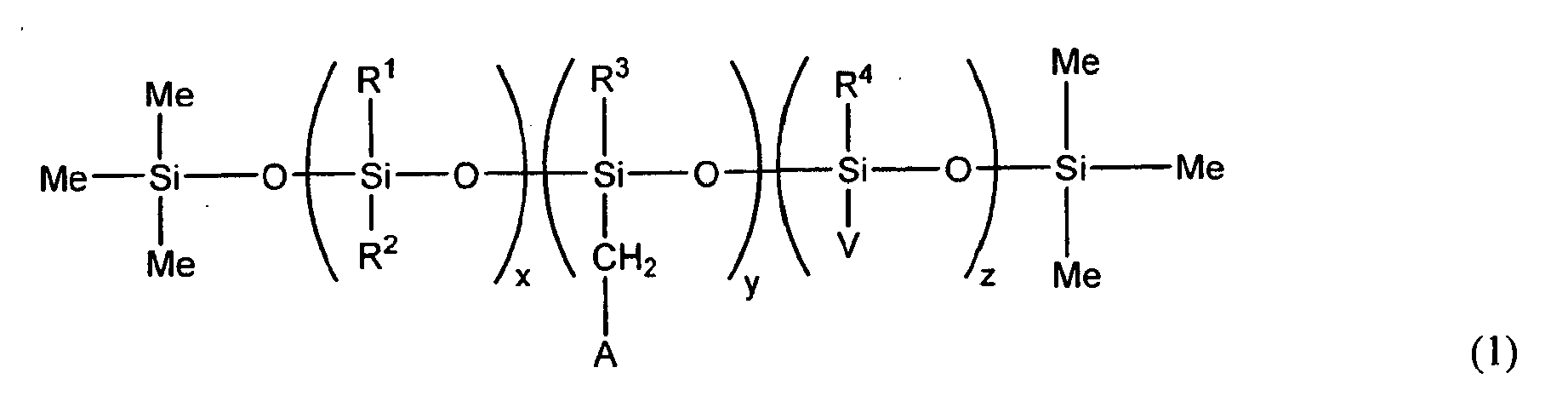
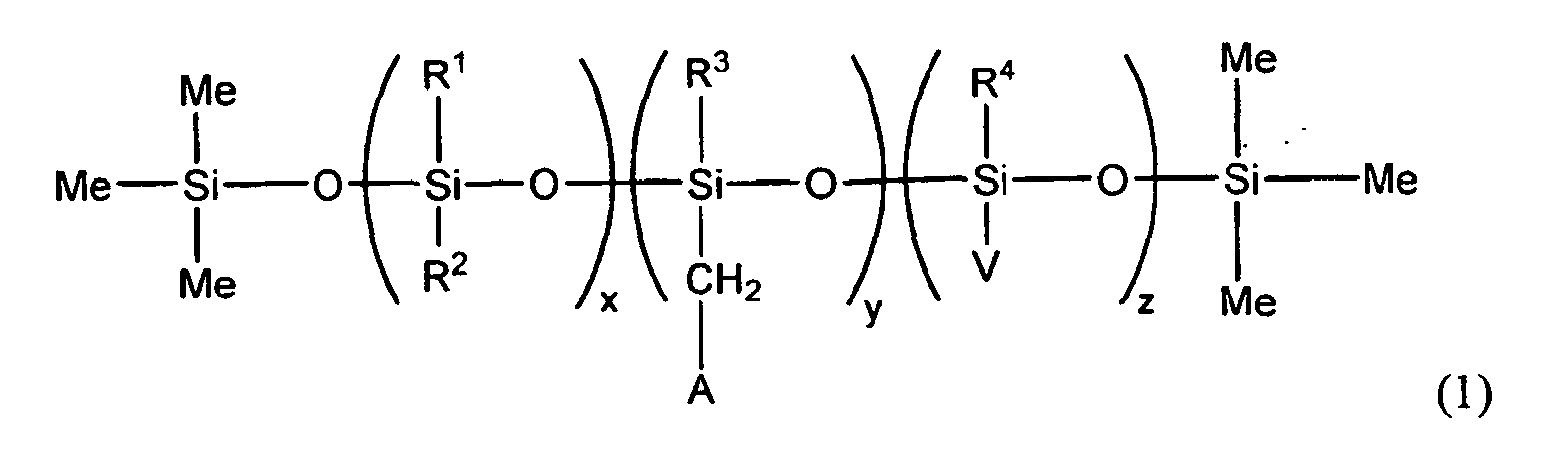
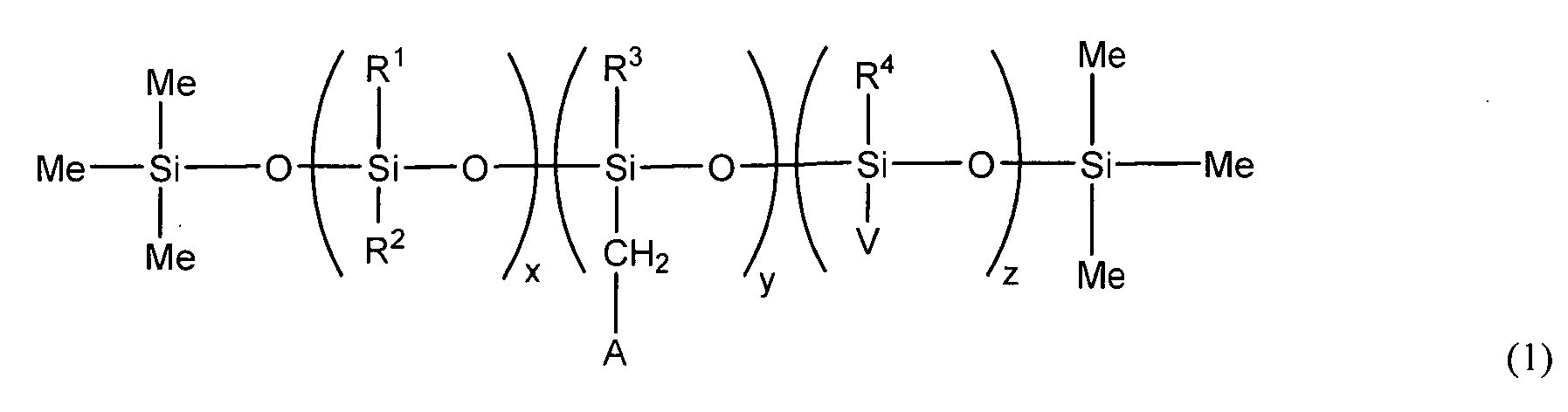
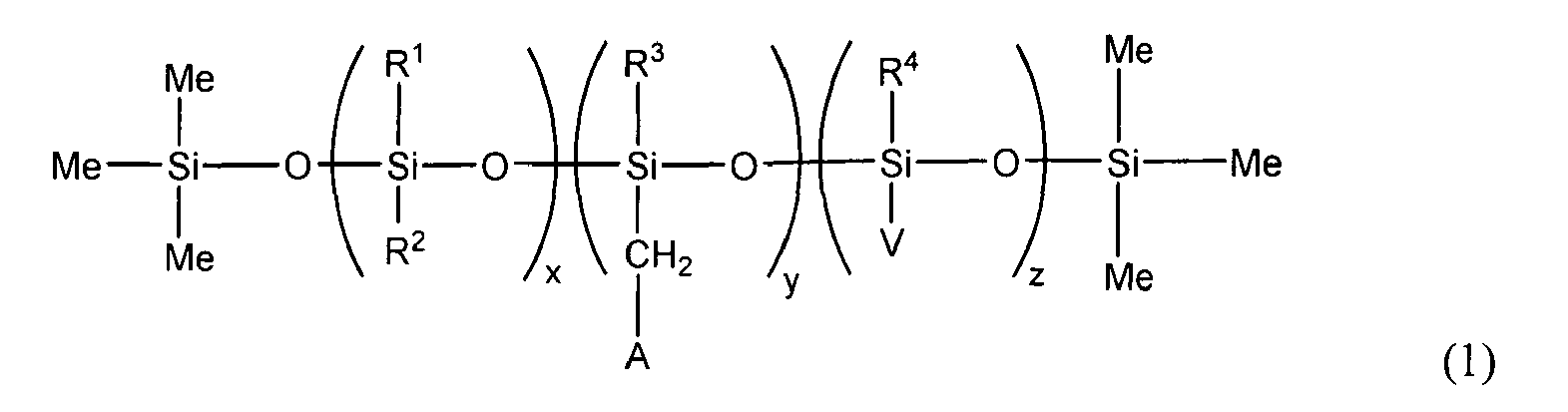
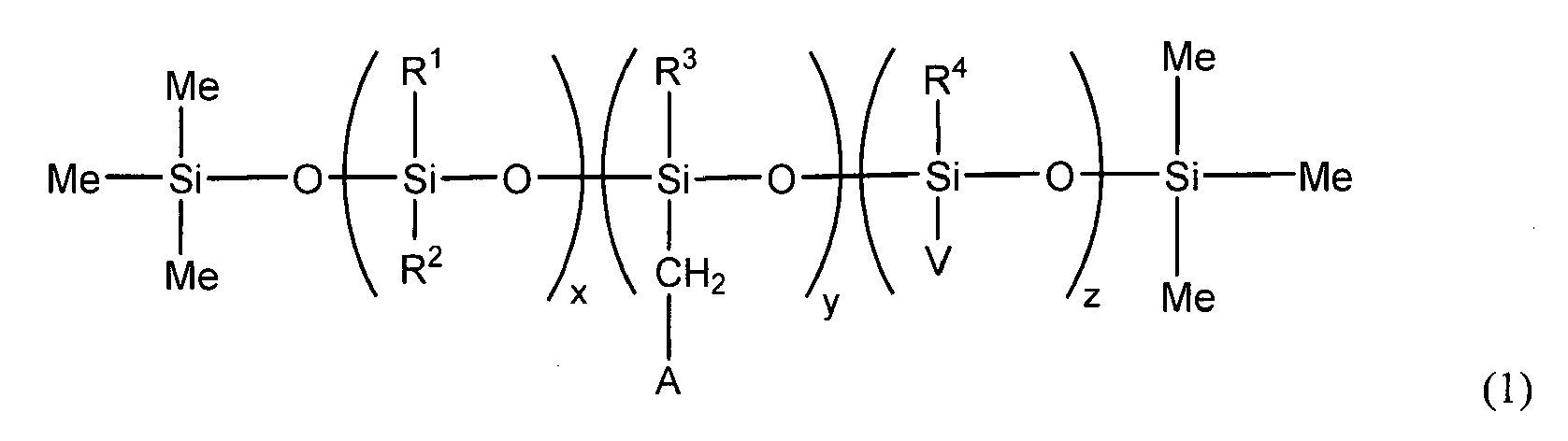
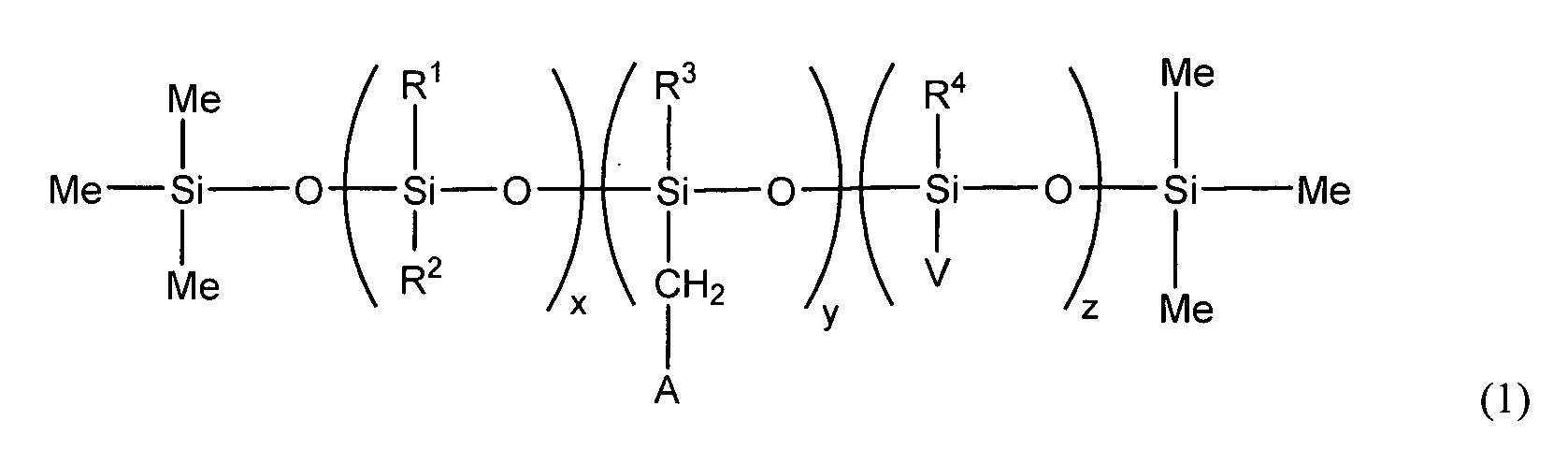
[0001] The subject of invention is the method of synthesis of fluorosilicone copolymers of an arbitrary topology and the general formula 1
[0002] Organosilicon derivatives containing fluorine are of interest for production of new materials.
[0003] Fluorosiloxanes are valuable substrates in many areas of industry because of their unique properties including very low surface tension, chemical inertness, thermal stability, low light refraction index and low friction factor. For example they are used for production of elastomers resistant to organic solvents for automotive industry, as antifoaming agents for organic solvents, as agents modifying friction in lubricants, as optical fibre coating and surface modifiers.
[0004] Hitherto three methods of synthesis of fluorosilicones have been used: the first one based on hydrolytic condensation of fluorocarbofunctional dichloroalkylsilanes, the second one based on ring opening polymerisation of cyclic siloxanes containing fluoroalkyl substituents and the third one based on hydrosilylation of fluorinated olefins with poly(hydromethyl, dimethyl) siloxanes. These methods are described in (1).
[0005] The British patent GB2443626 and the paper by L. Zhang-xiong (2) describe the synthesis of fluorosilicones in the process of hydrolytic condensation of fluoroalkyl-dichlorosilanes. For example, the condensation of trifluoroethyloxypropyl-methyldichlorosilane was conducted in ethyl acetate environment and in the presence of zinc oxide whose function was to bind chlorine liberated in the process, at 5°C. The products were a mixture of cyclosiloxanes that were distilled from the reaction mixture and small amounts of fluorosilicones of different length chains. At the next stage of the process the ring opening polymerisation of the cyclosiloxanes obtained is performed in the presence of trifluoromethylsulfonic acid as a catalyst. The above multistage and time consuming method does not ensure getting selectively a single product as at the first stage of condensation and at the second stage of polymerisation; mixtures of cyclic and linear fluorosilicones of different length chains are obtained.
[0006] Kobayashi (3) proposed the method of obtaining fluorosiloxanes by ring opening polymerisation of cyclic siloxanes 1,3,5-tris(trifluoropropyl)-1,3,5-trimethylo-cyclotrisiloxane. Furukawa (4) proposed an alternative method based on ring opening polymerisation of 1,3,5-tris(nonafluorohexyl)-1,3,5- trimethylocyclotrisiloxane with trifluoromethylsulfonic acid as a catalyst taking place at 60-100°C for 12-24 hours. These methods are not selective as lead to a mixture of polysiloxanes of different length chains and not uniform molecular mass. The third group of methods of fluorosiloxane synthesis includes those based on hydrosilylation of fluorinated olefins with polyhydrosiloxanes.
[0007] Y. Furukawa (5) describes the synthesis of fluorosilicones by hydrosilylation of heptadecafluoroundecene with poly(hydromethyl, dimethyl)siloxanes containing different amounts of Si-H groups, in the presence of hexachloroplatinic acid as a catalyst at 100°C. On the industrial scale fluorinated olefins are obtained from fluoroalkyl iodide as a precursor, which means that the olefin contains small amount of iodide ions having negative effect on hydrosilylation as they poison the catalyst. In the majority of methods the catalyst is dissolved in the olefin and hydrosiloxane is introduced into this mixture. Therefore, if the iodide ions poison the catalyst, then the reaction does not take place and the mixture of expensive substrates cannot be reused.
[0008] The patent US 5639845 describes the method based on addition of polyhydrosiloxane to fluorinated alkenes in the presence of Karstedt catalyst (platinum) in the environment of bis(trifluoromethyl)benzene as a solvent. The reaction is performed at 110°C for 19-24h. Fluorinated olefins containing the vinyl group - CH=CH2 react less efficiently than those containing the allyl group -CH2CH=CH2, so the presence of the latter is recommended. Moreover, the solvent had to be removed after the reaction, which implied the need of another stage of the reaction and made the process more complex.
[0009] The subject of invention is the cheap and effective method of synthesis of fluorosilicones of an arbitrary topology and the general formula 1
in which
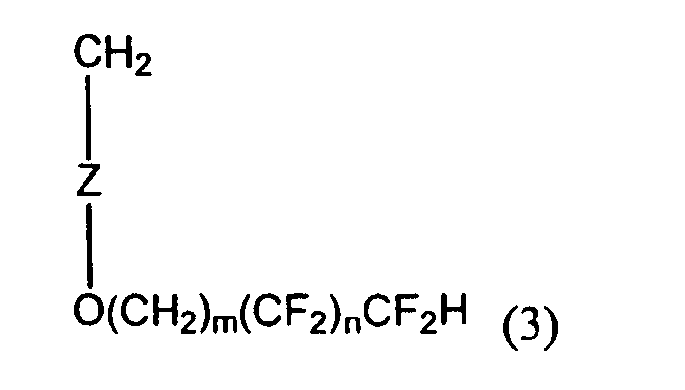
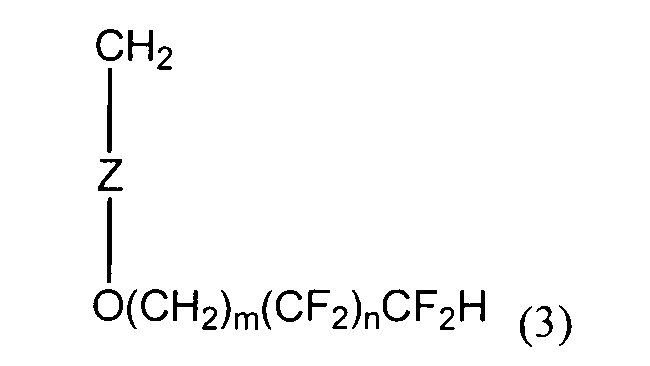
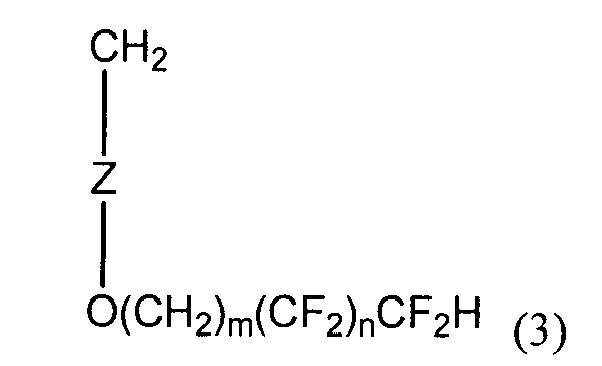
- A stands for a group of formula 2 or 3
CH2-O(CH2)m(CF2)nCF2H (2)
in which n=1-12 and m=1-4 - and if A is a group of formula 2,
then- x=0-100, y = 1-50 and z=0;
- R1, R2, and R3 can be the same or different and stand for an alkyl group containing C=1-25 or an aryl group,
- if A is a group of formula 3,
then- x=0-100, y = 1-50, z=0-50,
- R1, R2, R3 and R4 can be the same or different and stand for an alkyl group containing C = 1-12 or aryl group,
- V is an alkyl group containing C = 1-12, an aryl group or any organic functional group not reacting with an epoxy group,
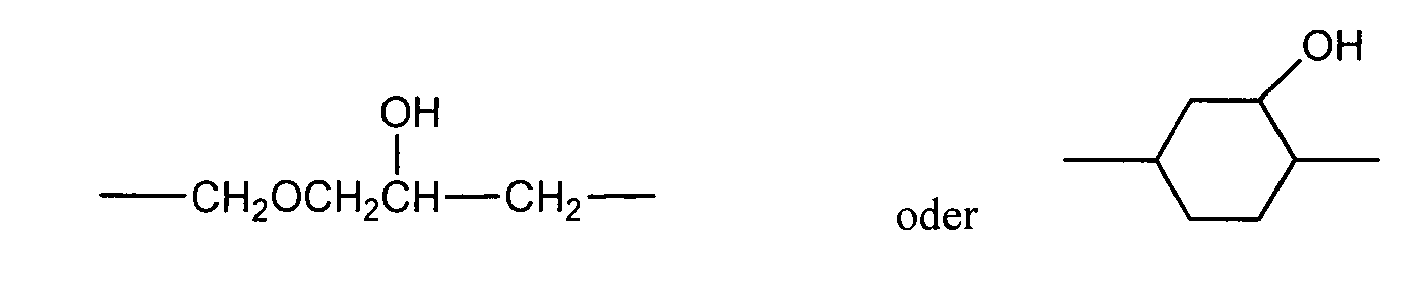
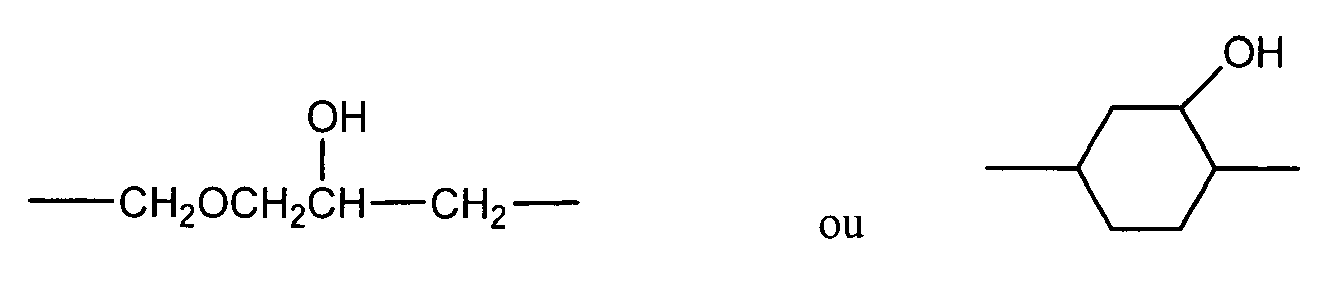
- Z stands for a divalent group of the formulas
[0010] The first version of the method being the subject of this invention is aimed at synthesis of fluorosiloxanes of an arbitrary topology and general formula 1 in which A stands for a group of formula 2, x, y , z and R1, R2, R3 have the meaning specified above for this case, by hydrosilylation of an appropriate fluoroalkyl-allyl ether of general formula 4
HCF2(CF2)n(CH2)mOCH2CH=CH2, (4)
where m =1-4, n= 1-12
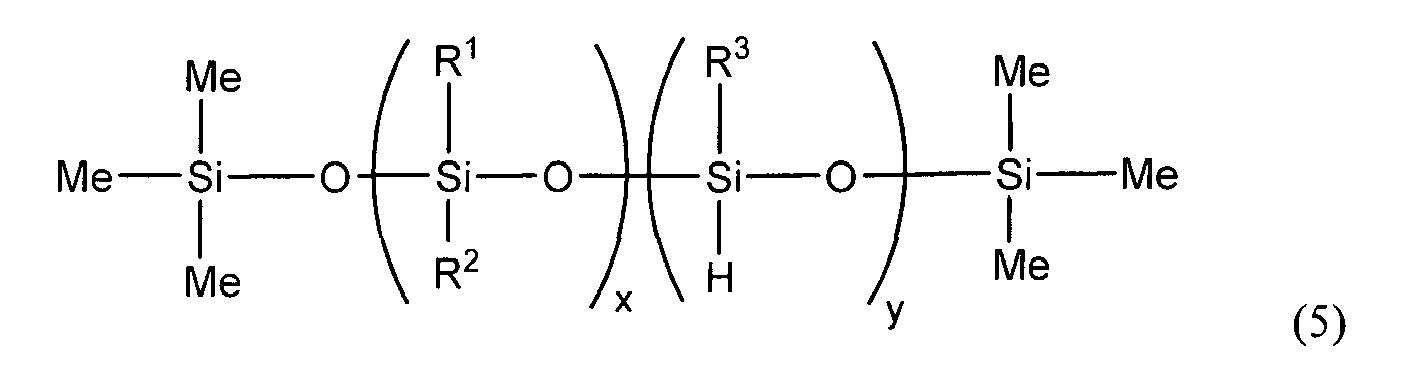
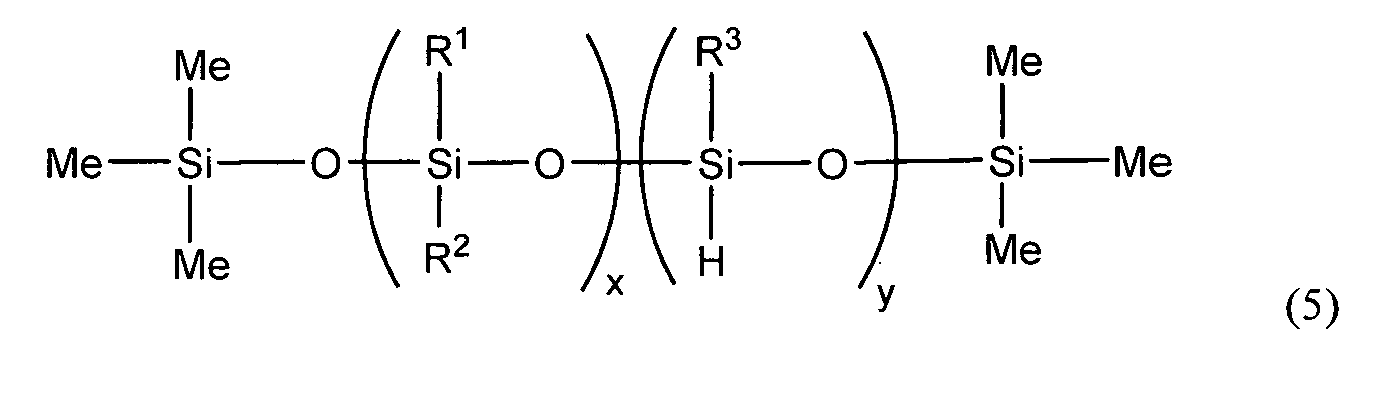
with polyhydrosiloxanes containing at least one Si-H group and of general formula 5
in which R1, R2, R3 and x, y have the meaning specified above, in the presence of siloxide rhodium complex [{Rh(OSiMe3)(cod)}2] as a catalyst.
[0011] The reaction is performed at temperatures from the range 20 -150°C, preferably at temperatures from 25 to 60°C, until the reaction completion, which usually takes 0.5 -2 hours, in an open system and under atmospheric pressure.
[0012] It is recommended but not necessary to use fluoroalkyl-allyl ether in excess over the appropriate polyhydrosiloxane to ensure complete consumption of Si-H groups, as their presence has adverse effect on the stability of the product. The preferable excess of fluoroalkyl-allyl ether is from 1.1 to 1.4 mol per each mol of Si-H groups present in polyhydrosiloxane; the best results are obtained at the excess of 1.1.
[0013] The catalyst is applied in the amount from 10-4 to 10-6 mol Rh per 1 mol of Si-H groups present in polyhydrosiloxane; the best results are obtained for its amount of 5x10⁻⁵ mol.
[0014] In the first version of the method proposed, an appropriate fluoroalkyl-allyl ether and the catalyst [{Rh(OSiMe3)(cod)}2], in the amount corresponding to the concentration of 10-4 - 10-6 mol Rh per 1 mol of Si-H groups present in the polyhydrosiloxane, are introduced into the reactor and stirred to get a homogenous system. To the mixture obtained an appropriate polyhydrosiloxane is added dropwise. After introducing the whole load of the polyhydrosiloxane, the content of the reactor is stirred on heating to a temperature from the range 20- 150°C till the reaction completion, which usually takes 1-4 hours. The product obtained can be used directly in many applications but when its high purity is needed the post-reaction mixture is subjected to evaporation of the remains of unreacted fluoroalkyl-allyl ether. When the products are low molecular siloxanes their purification can be made by fractional distillation under reduced pressure and collecting the fraction corresponding to the target product. High-molecular products are purified exclusively by evaporation of the unreacted ether.
[0015] The method proposed permits obtaining fluorocarbofunctional polysiloxanes in a single-stage process.
[0016] The use of siloxide rhodium complex as a catalyst in the reaction of fluoroalkyl-allyl ether hydrosilylation permitted a reduction of the temperature of the process and shortening its time, hence preventing the occurrence of side reactions (e.g. isomerization of fluoroalkyl-allyl ether) and improving the yield and selectivity of the process. In contrast to the hitherto used platinum catalysts, the rhodium catalysts show greater resistance to poisoning and hence are less susceptible to the impurities contained in the substrates. The siloxide rhodium catalyst permits a single-stage synthesis of various fluorosilicone derivatives with no need to modify the method for each group of derivatives. Fluoroalkyl-allyl ether used is obtained by the Williamson method from fluorinated alcohols that are much more accessible and cheaper than fluoroalkyl iodides used in the earlier proposed methods.
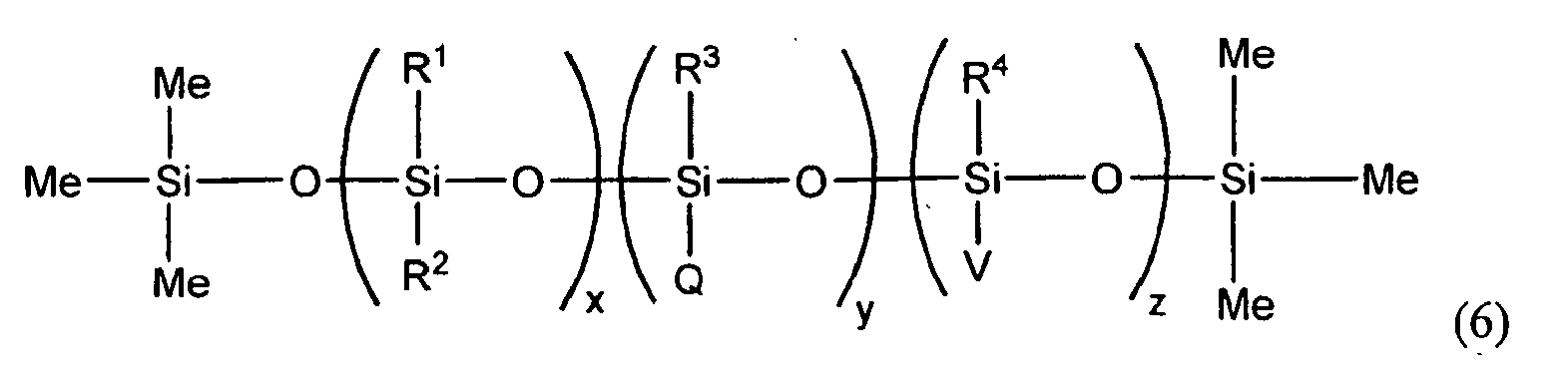
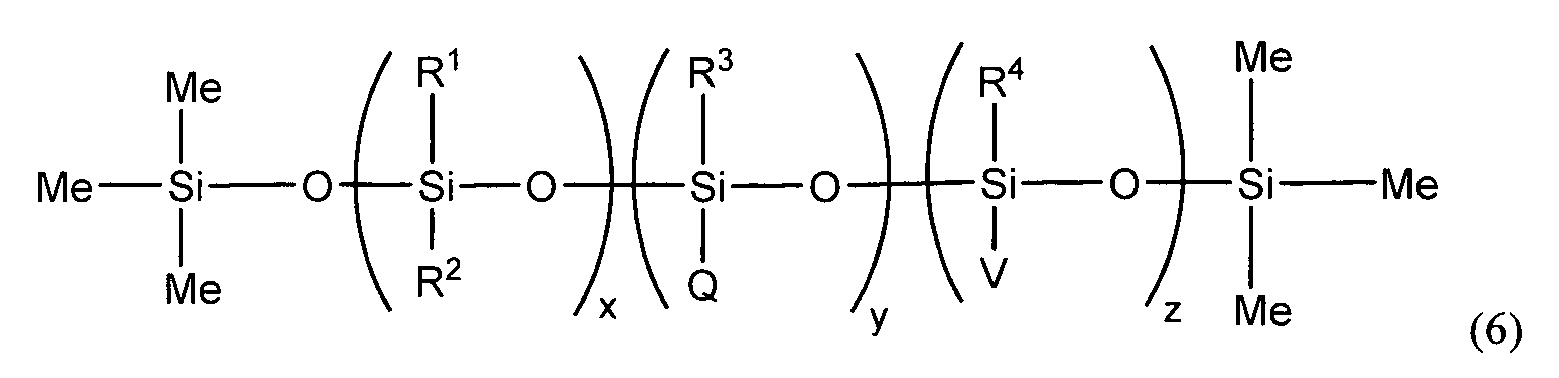
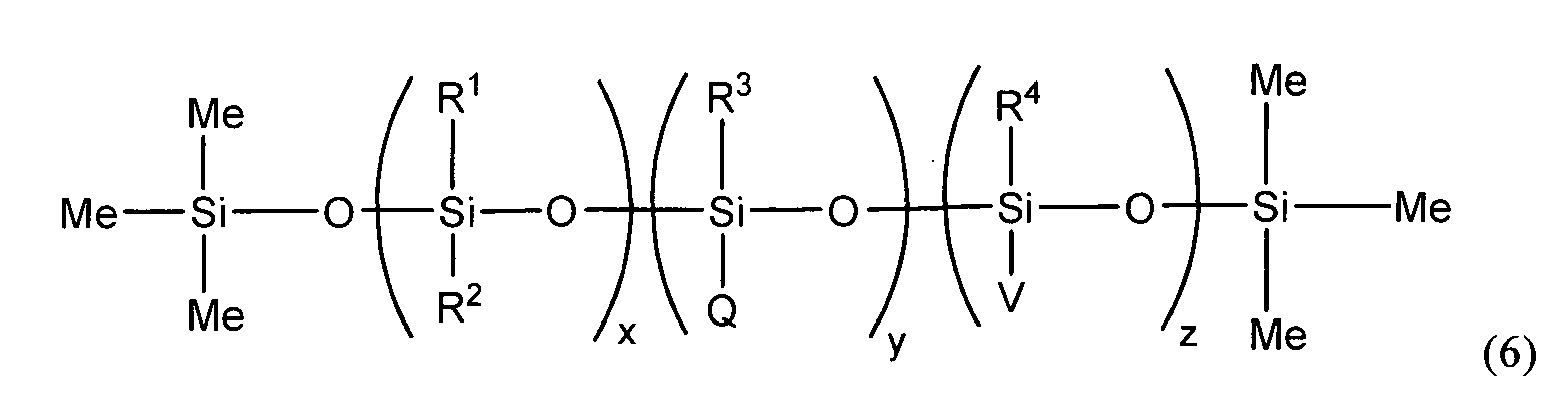
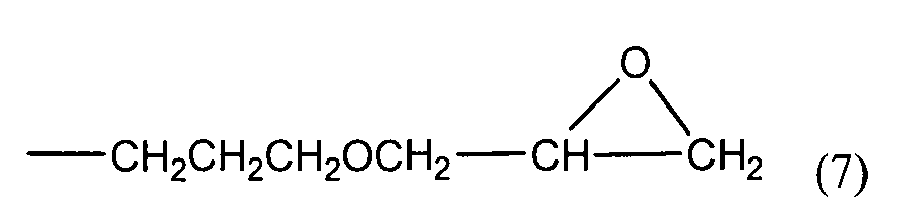
[0017] The second version of the method being the subject of this invention is aimed at synthesis of fluorosiloxanes of an arbitrary topology and general formula 1 in which A stands for a group of formula 3; x, y, z and R1, R2, R3, R4, V and Z have the meaning specified above for this case, is aimed at the nucleophilic opening of the oxirane ring in the appropriate epoxyfunctional co-polysiloxanes of an arbitrary topology and general formula 6
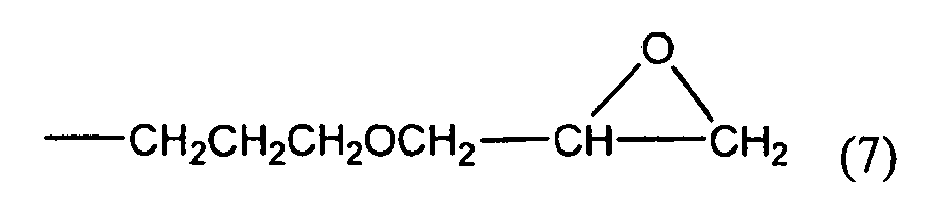
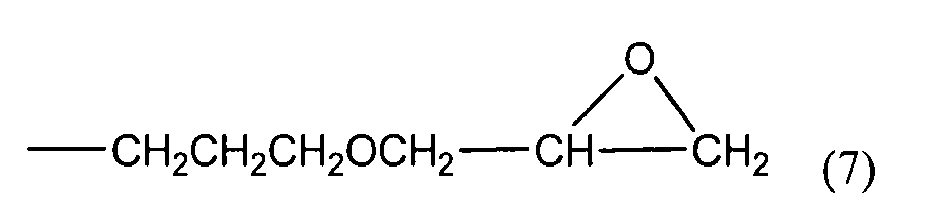
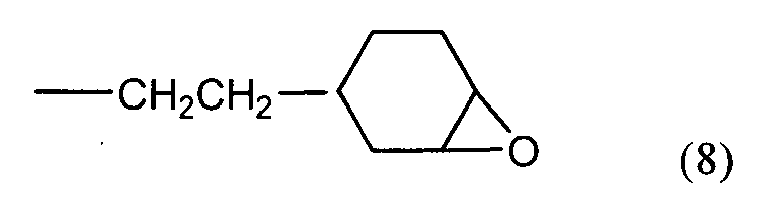
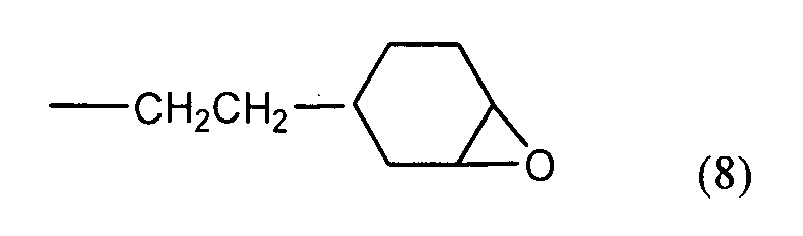
where R1, R2, R3, R4, V and x, y, z have the meaning specified above and Q is the glycidyloxypropyl group of formula 7 or the 2-(3,4-epoxycyclohexyl)ethyl group of formula 8
with the help of fluorinated alcohols of general formula 9
HO(CH2)m(CF2)nCF2H (9)
in which n and m take the above specified values, in acidic environment of pH from 1 to 4.5. The desired pH value is achieved by addition of any inorganic or organic acids. The use of orthophosphoric acid is most recommended.
[0018] The process is performed in a single stage in an open system and under atmospheric pressure. The appropriate epoxyfunctional siloxane and fluorinated alcohol are introduced into the reactor, in the amounts corresponding to the ratio of 0.1-1 mol of the fluorinated alcohol per each mol of the epoxy groups contained in the epoxyfunctional siloxane used. The substrates are stirred. To the mixture obtained the selected acid is introduced until getting pH from the range 1-4.5, preferably 2-4. Then the content of the reactor is heated to temperatures from the range 80-130°C, till the reaction completion, which usually takes 1- 4h.
[0019] The equimolar amounts of the reagents ensure full consumption of epoxy groups, while introduction of smaller amounts of fluorinated alcohol permits obtaining polysiloxanes with mixed groups (fluorocarbofunctional and epoxyfunctional). By choosing the ratio of the reagents it is possible to control the contents of the epoxy and fluorocarbofunctional groups in the polysiloxane chains to meet the specific needs of particular application. The presence of epoxy groups besides fluorocarbofunctional ones permits further transformations of these epoxy groups into hybrid materials or curing by chemical or photochemical methods.
[0020] The method being the subject of this invention is based on the opening of oxirane ring in the epoxyfunctional siloxanes with the help of fluorinated alcohols in acidic environment. In the hitherto known methods of synthesis of fluorosilicones, the substrates were fluorinated olefins, which are not only hardly accessible and expensive but also contain impurities that can poison the hydrosilylation catalysts used. In the method proposed the substrates are fluorinated alcohols that are much cheaper and easier accessible and their possible impurities have no influence on the catalysts used. The opening of oxirane ring is catalysed by acids, which are much cheaper and are not poisoned in contrast to the transient metal compounds used in hydrosilylation. The catalysts can be various inorganic and organic acids that would permit getting pH = 1-4.5. In this pH range the opening of oxirane ring is effective and with high yield. The most recommended is orthophosphoric acid, which is cheap and ensures the pH desired. The epoxyfunctional (poly)siloxanes used in the method presented can be easily obtained with high yield by the method described in PL-198290 or P-380737, and many of them are produced on industrial scale. The synthesis which is the subject of this invention is illustrated by the following examples that do not limit the scope of its application.
Example I.
[0021] Portions of 15 g (45 mmol) of 3-(glycidyloxypropyl)-1,1,1,3,5,5,5-heptamethyltrisiloxane and 10.4 g (45 mmol) of octafluoropentyl alcohol were placed in a flask equipped with a magnetic stirrer and reflux. Then 35 µl of orthophosphoric acid H3PO4 was added. The content of the flask was heated to 80°C and kept at this temperature for 2 hours on stirring. The course of the reaction was chromatographically controlled. After the time of 2 hours the substrates were observed to disappear and one product was formed. The product was clear, bright yellow 3-[3-{3-octafluoropentoxy-2-hydroxypropoxy}propyl]heptamethyltrisiloxane in the amount of 23.1 g, which corresponds to the yield of 99%. The identity of the product was confirmed by NMR analysis.
1H NMR (C6D6, 298K, 300MHz) δ (ppm): 0,05 (3H, -SiCH3); 0,14 (18H, -Si(CH3)3); 0,56 (2H, -SiCH2-); 1,69 (2H, -CH2-); 3,25 (2H, -CHCH2O-); 3,48 (1H, -OH); 3,54 (2H, -CH2CF2); 3,68 (1H, -CH-); 4,81 (4H, -CH2O); 5,44 (1H, -CF2H)
13C NMR (C6D6, 298K, 75,5MHz) δ (ppm): -0,21 (-OSiCH3O-); 1,96 (-OSi(CH3)); 13,91 (-SiCH2-); 23,65 (-CH2-); 70,05 (-CH-); 71,02 (-OCH2-); 72,30 (-CH2O-); 74,28 (-CH2O-); 105,18, 108,55, 111,91 (-CF2-); 119,49(-CF2H)
29Si NMR (C6D6, 298K, 59,6MHz) δ (ppm): -21,92 (-OSiCH3O-); 7,36 (Si(CH3)3)
Example II.
[0022] Synthesis was performed as in example I, but instead of 3-(glycidyloxypropyl)-1,1,1,3,5,5,5-heptamethyltrisiloxane the amount of 15,5g (45 mmol) of 3-{2-(3,4-epoxycyclohexyl)ethyl}-)-1,1,1,3,5,5,5-heptamethyltrisiloxane was used. The product was clear and yellow 3-{2-(3-hydroxy - 4-octafluoropentoxy-cyclohexyl)ethyl}-heptamethyltrisiloxane in the amount of 23.9 g, which corresponds to the yield of 98%. The identity of the product was confirmed by NMR analysis.
1H NMR (C6D6, 298K, 300MHz) δ (ppm): 0,02 (3H, -SiCH3); 0,05 (18H, -Si(CH3)3); 0,56 (2H, -SiCH2-); 0,75-1,85 (18H, cyclo-hexylo), 3,23 (2H, -CHO-); 3,72 (1H, -OH); 3,54 (2H, -CH2CF2); 4,85 (4H, -CH2O); 5,34 (1H, -CF2H)
Example III.
[0023] Synthesis was performed as in example I but instead of octafluoropentyl alcohol, a portion of 5.9g (45mmol) of tetrafluoropropyl alcohol was added. The reaction was conducted at 80°C for 1 hour. The product was 3-[3-{3-tetrafluoropropoxy-2-hydroxypropoxy}propyl]heptamethyltrisiloxane in the amount of 19.6 g, which makes 94% of the theoretical yield..
Example IV
[0024] Synthesis was conducted as in example I but instead of octafluoropentyl alcohol, a portion of 14.9g (45mmol) of dodecafluoroheptyl alcohol was added. The reaction was performed at 120°C for 4 hours. The product was 3-[3-{3-dodecafluoroheptyloxy-2-hydroxypropoxy}propyl]heptamethyltrisiloxane obtained in the amount of 26.9 g, which makes 90% of the theoretical yield.
Example V
[0025] Portions of 8.2 g (1 mmol) poly{(glycidyloxypropyl)methyl, dimethyl)siloxane described by formula 2 with x=50, y=25 and 5.8 g (25 mmol) of octafluoropentyl alcohol were placed in a flask equipped with a magnetic stirrer and reflux. Then 35 µl of orthophosphoric acid H3PO4 was added. The content of the flask was heated to 120°C and kept at this temperature for 4 hours on stirring. The course of the reaction was controlled by FT-IR analysis; the loss of intensity of the band at 980cm-1 assigned to the epoxy group was compared. The product was clear and bright yellow poly([3-{3-octafluoropentyloxy-2-hydroxypropoxy}propyl]methyl, dimethyl)siloxane, described by formula 1 with x=50, y=25 of high viscosity and in the amount of 13.9 g, which corresponds to 99% theoretical yield. The identity of the product was confirmed by FT-IR and NMR results.
FT-IR: 1011 cm-1 (Si-O-Si), 1259 cm-1 (Si-CH3), 2961 cm-1 (CH2CH2CH2), 3446cm-1 (-OH), disappearance of the band assigned to epoxy groups and occurring at 912 cm-1
1H NMR (CD30D, 298K, 300MHz) δ (ppm): 0,06 (m, -OSi(CH3)-), 0,56 (m, -SiCH2-), 1,56 (m, -SiCH2CH2-), 3,23-3,33 (m, -CH2O-) 3,47 (m, -CH2OCH2-), 3,89 (m, CH(OH)), 5,9-6,3 (tt, CF2H); disappearance of the signals assigned to epoxy groups at 2.58-2.75 ppm.
Example VI.
[0026] Synthesis was performed as in example V but instead of poly{(glycidyloxypropyl) methyl, dimethyl)siloxane a potion of 8.5g (1 mmol) of poly({2-(3,4-epoxycyclohexyl)ethyl}methyl, dimethyl)siloxane described by formula 2 with x=50, y=25 was used. The product was poly(3-{2-(3-hydroxy - 4-octafluoro-pentoxy-cyclohexyl)ethyl}methyl, dimethyl)siloxane described by formula 1 in the amount of 12.9 g with x=50, y=25, which makes 91% of the theoretical yield.
Example VII
[0027] Synthesis was performed as in example V but instead of poly{(glycidyloxypropyl)methyl, dimethyl)siloxane a portion of 11.3g (1 mmol) of poly{(glycidyloxypropyl)methyl, phenylmethyl)siloxane described by formula 2 with x=50, y=25 was used. The product was poly([3-{3-octafluoropentyloxy-2-hydroxypropoxy}propyl]-methyl, phenylmethyl)siloxane described by formula 1 with x=50, y=25 in the amount of 15.1g, which makes 88% of the theoretical yield.
Example VIII
[0028] Portions of 14.7 g (1 mmol) poly{(glycidyloxypropyl)methyl, dimethyl)siloxane described by formula 2 with x=100, y=50 and 11.6 g(50 mmol) of octafluoropentyl alcohol were placed in a flask equipped with a magnetic stirrer and reflux. Then 70 µl of orthophosphoric acid H3PO4 was added. The content of the flask was heated to 140°C and kept at this temperature for 4 hours on stirring. The course of the reaction was controlled by FT-IR analysis, comparing the loss of intensity of the band assigned to the epoxy group, present at 912cm-1. The product was clear poly([3-{3-octafluoropentyloxy-2-hydroxypropoxy}propyl]methyl, dimethyl)siloxane, described by formula 1, with x=100, y=50, showing very high viscosity, in the amount of 22.3 g, which corresponds to the theoretical yield of 85%. The identity of the product was confirmed by NMR analysis.
1H NMR (CD3OD, 298K, 300MHz) δ (ppm): 0,05 (m, -OSi(CH3)-), 0,48 (m, -SiCH2-), 1,54 (m, -SiCH2CH2-), 3,41 (m, -CH2O-) 3,56 (m, -CH2OCH2-), 4,02 (m, CH(OH)), 5,9-6,3 (tt, CF2H); disappearance of the signals assigned to epoxy groups at 2.58, 2.76 and 2.62 ppm.
Example IX
[0029] Portions of 9.5 g (1 mmol) of poly({2-(3,4-epoxycyclohexyl)ethyl}methyl, dimethyl)siloxane described by formula 2, with x=82, y=18 and 4.9 g (18 mmol) of octafluoropentyl alcohol were placed in a flask equipped with a magnetic stirrer and reflux. Then 35 µl of orthophosphoric acid H3PO4 was added. The content of the flask was heated to 130°C and kept at this temperature for 4 hours on stirring. The course of the reaction was controlled by FT-IR by observing the loss of intensity of the band assigned to epoxy group, present at 930cm-1. The product was clear poly(3-{2-(3-hydroxy - 4-octafluoropentoxy-cyclohexyl)ethyl}methyl, dimethyl)siloxane described by formula 1, with x=82, y=18, showing very high viscosity, in the amount of 13.7 g, which corresponds to the theoretical yield of 95%.
Example X
[0030] Portions of 20.4g (75 mmol) of octafluoropentyl-allyl ether and 0.22 µg (10-5 mol Rh/1 mol Si-H) of siloxide rhodium complex [{Rh(OSiMe3)(cod)}2 were placed in a flask equipped with a magnetic stirrer, reflux and dropping funnel. Then 15.5 g (70 mmol) of heptamethyltrisiloxane was introduced dropwise to the flask on stirring its contents. After introducing the whole load of silane the contents of the flask were stirred for 1 hour at 25°C. The post-reaction mixture was subjected to distillation under reduced pressure and the fraction boiling at 108-110°C/2 mmHg was collected. The product was 3-(octafluoropentyloxypropyl)-heptamethyltrisiloxane in the amount of 32.8g, which makes 95% of the theoretical yield.
Example XI.
[0031] Synthesis was conducted as in example X but instead of octafluoropentyl-allyl ether a portion of 12.9 g (75 mmol) of tetrafluoropropyl-allyl ether was added. After completion of the reaction the post-reaction mixture was subjected to distillation under reduced pressure and the fraction boiling at 90-92°C/2 mm Hg was collected. The product was 3-(tetrafluoropropoxypropyl)-heptamethyltrisiloxane obtained in the amount of 26.7 g, which corresponds to 94% of the theoretical yield.
Example XII
[0032] Portions of 53.6 g (10 mmol) of poly(hydromethyl, dimethyl)siloxane Me3Si-[OSiMe2]50-[OSiMeH]25-OSiMe3, 74.8g (275 mmol) of octafluoropentyl-allyl ether and 5.5 µg (10-5 mol Rh/1 mol Si-H) of siloxy rhodium complex [{Rh(OSiMe3)(cod)}2] were placed in a flask equipped with a magnetic stirrer and reflux. The content was heated to 60°C and kept at this temperature for 4 hours on stirring. After this time, the excess of octafluoropentyl-allyl ether was evaporated. FT-IR analysis confirmed total conversion of Si-H evidenced by the disappearance of the band at 2180 cm-1. The product was poly({octafluoropentyloxypropyl}methyl, dimethyl)siloxane (x=50, y=25) obtained in the amount of 121g, which corresponds to 99% of the theoretical yield. The identity of the product was confirmed by NMR analysis.
1H NMR (CD30D, 298K, 300MHz) δ (ppm): 0,03 (m, -OSi(CH3)-), 0,66 (m, -SiCH2-), 1,48 (m, -SiCH2CH2-), 3,28-3,38 (m, -CH2O-), 3,52 (m, -CH2OCH2-), 6.0-6,4 (tt, CF2H);
Example XIII.
[0033] Synthesis was performed as in example XII but poly(hydromethyl, phenylmethyl)-siloxane Me3Si-[OSiMe2]82-[OSiPhH]18-OSiMe3, 86,7g (10 mmol) was used to which 53.8g (198 mmol) of octafluoropentyl-allyl ether was added. The product was poly({octafluoropentyloxypropyl}methyl, methylphenyl)siloxane (x=82, y=18) obtained in the amount of 134.5 g, which corresponds to 99% of the theoretical yield. The identity of the product was confirmed by NMR analysis.
1H NMR (CD3OD, 298K, 300MHz) δ (ppm): 0,05 (m, -OSi(CH3)-), 0,54 (m, -SiCH2-), 1,67 (m, -SiCH2CH2-), 3,34-3,48 (m, -CH2O-) 3,73 (m, -CH2OCH2-), 5,9-6,3 (tt, CF2H); 7,80 (d, Ph), 7,50-7,61 (m, Ph)
List of references
1. Method of synthesis of fluorosiloxanes of an arbitrary topology and general formula
1
in which
x=0-100, y = 1-50, z=0,
R1, R2, R3 and R4 can be the same or different and stand for an alkyl group containing C=1-25 or aryl group
A stands for a group of formula 2
CH2-O(CH2)m(CF2)nCF2H (2)
in which n=1-12, m=1-4
based on the reaction of hydrosilylation of an appropriate fluoroalkyl-allyl ether of general formula 4
HCF2(CF2)n(CH2)mOCH2CH=CH2, (4)
where m =1-4, n= 1-12,
with appropriate polyhydrosiloxanes containing at least one Si-H group, of general formula 5

in which R1, R2 and R3, x and y have the meaning specified above, in the presence of siloxide rhodium complex [{Rh(OSiMe3)(cod)}2] as a catalyst.
in which
x=0-100, y = 1-50, z=0,
R1, R2, R3 and R4 can be the same or different and stand for an alkyl group containing C=1-25 or aryl group
A stands for a group of formula 2
CH2-O(CH2)m(CF2)nCF2H (2)
in which n=1-12, m=1-4
based on the reaction of hydrosilylation of an appropriate fluoroalkyl-allyl ether of general formula 4
HCF2(CF2)n(CH2)mOCH2CH=CH2, (4)
where m =1-4, n= 1-12,
with appropriate polyhydrosiloxanes containing at least one Si-H group, of general formula 5
in which R1, R2 and R3, x and y have the meaning specified above, in the presence of siloxide rhodium complex [{Rh(OSiMe3)(cod)}2] as a catalyst.
2. Method of synthesis as in claim 1 wherein the catalyst is used in the amount ranging
from 10-4 to 10-6 mol Rh per 1 mol silane.
3. Method of synthesis as in claim 2 wherein the catalyst is used in the amount of 5x10⁻⁵ mol Rh per 1 mol silane.
4. Method of synthesis of fluorosilicone copolymers of an arbitrary topology and general
formula 1
in which
x=0-100, y = 1-50, z=0-50,
R1, R2, R3 and R4 can be the same or different and stand for an alkyl group containing C = 1-12 or aryl group,
V is an alkyl group containing C = 1-12, an aryl group or any organic functional group not reacting with the epoxy group,
A stands for a group of formula 3
in which n=1-12, m=1-4, Z stands for a divalent group either

based on the reaction of nucleophilic opening of oxirane ring in appropriate epoxyfunctional co-polysiloxanes of an arbitrary topology and general formula 6
where R1, R2 , R3, R4, V, x, y and z have the meaning specified above and Q is the glycidyloxypropyl group of formula 7
or the 1-etyleno-3,4-epoxycyclohexyl group of formula 8,

with the help of fluorinated alcohols of general formula 9
HO(CH2)m(CF2)nCF2H (9)
in which n and m have the meaning specified above, in an acidic medium of pH from 1 to 4.5.
in which
x=0-100, y = 1-50, z=0-50,
R1, R2, R3 and R4 can be the same or different and stand for an alkyl group containing C = 1-12 or aryl group,
V is an alkyl group containing C = 1-12, an aryl group or any organic functional group not reacting with the epoxy group,
A stands for a group of formula 3
in which n=1-12, m=1-4, Z stands for a divalent group either
based on the reaction of nucleophilic opening of oxirane ring in appropriate epoxyfunctional co-polysiloxanes of an arbitrary topology and general formula 6
where R1, R2 , R3, R4, V, x, y and z have the meaning specified above and Q is the glycidyloxypropyl group of formula 7
or the 1-etyleno-3,4-epoxycyclohexyl group of formula 8,
with the help of fluorinated alcohols of general formula 9
HO(CH2)m(CF2)nCF2H (9)
in which n and m have the meaning specified above, in an acidic medium of pH from 1 to 4.5.
5. Method of synthesis as in claim 4 wherein the reaction is performed at pH from 2 to
4.
6. Method of synthesis as in claim 4 or 5 wherein inorganic or organic acids are used
for acidification.
7. Method of synthesis as in claim 6 wherein orthophosphoric acid is used for acidification.
8. Method of synthesis as in claim 4 or 5 or 6 or 7 wherein the reaction is performed
at a temperature from the range 80-130°C.
1. Verfahren zur Synthese von Fluorsiloxane einer beliebigen Topologie und der allgemeinen
Formel 1
wobei
x=0-100, y = 1-50, z=0,
R1 , R2, R3 und R4 können gleich oder verschieden sein können und stehen für eine Alkylgruppe mit C=1-25 oder Arylgruppe
A steht für eine Gruppe der Formel 2
CH2-O(CH2)m(CF2)nCF2H (2)
in der n=1-12, m=1-4
basierend auf der Reaktion der Hydrosilylierung eines geeigneten Fluoralkyl-allyl-ether der allgemeinen Formel 4
HCF2(CF2)n(CH2)mOCH2CH=CH2, (4)
wobei m =1-4, n= 1-12,
mit geeigneten Polyhydrosiloxane enthaltend mindestens eine Si-H-Gruppe der allgemeinen Formel 5
wobei
x=0-100, y = 1-50, z=0,
R1 , R2, R3 und R4 können gleich oder verschieden sein können und stehen für eine Alkylgruppe mit C=1-25 oder Arylgruppe
A steht für eine Gruppe der Formel 2
CH2-O(CH2)m(CF2)nCF2H (2)
in der n=1-12, m=1-4
basierend auf der Reaktion der Hydrosilylierung eines geeigneten Fluoralkyl-allyl-ether der allgemeinen Formel 4
HCF2(CF2)n(CH2)mOCH2CH=CH2, (4)
wobei m =1-4, n= 1-12,
mit geeigneten Polyhydrosiloxane enthaltend mindestens eine Si-H-Gruppe der allgemeinen Formel 5
2. in denen R1, R2 und R3, x und y die oben angegebene Bedeutung in Gegenwart Siloxid Rhodiumkomplex [{Rh(OSiMe3)(cod)}2] als Katalysator. Verfahren zur Synthese nach Anspruch 1, wobei der Katalysator in
der Menge verwendet wird, im Bereich von 10-4 bis 10-6 mol Rh je 1 mol Silan.
3. Verfahren zur Synthese nach Anspruch 2, wobei der Katalysator in der Menge verwendet
wird, im Bereich von 5x10⁻⁵ Rh je 1 mol Silan.
4. Verfahren zur Synthese von Fluorsiloxane einer beliebigen Topologie und der allgemeinen
Formel 1
wobei
x=0-100, y = 1-50, z=0,
R1 , R2, R3 und R4 können gleich oder verschieden sein können und stehen für eine Alkylgruppe mit C=1-25 oder Arylgruppe
V ist eine Alkylgruppe mit C = 1-12, eine Arylgruppe oder über organische funktionelle Gruppe reagiert nicht mit der Epoxy-Gruppe,
A steht für eine Gruppe der Formel 3
wobei n = 1-12, m = 1-4, Z steht für eine zweiwertige Gruppe, entweder
basierend auf der Reaktion der nucleophilen Öffnung des Oxiran-Ringes in geeigneter epoxyfunktionelle Copolysiloxane mit-einer beliebigen Topologie und der allgemeinen Formel 6
wobei R1, R2 , R3, R4, V, x, y und z die oben angegebene Bedeutung hat und Q die Gruppe glycidyloxypropyl Formel 7
oder die 1-etyleno-3 ,4-epoxycyclohexyl Gruppe der Formel 8,
mit der Hilfe von fluorierten Alkoholen der allgemeinen Formel 9HO(CH2)m(CF2)nCF2H (9)
in denen n und m die oben angegebene Bedeutung, in einem sauren Medium mit pH von 1 bis 4,5.
wobei
x=0-100, y = 1-50, z=0,
R1 , R2, R3 und R4 können gleich oder verschieden sein können und stehen für eine Alkylgruppe mit C=1-25 oder Arylgruppe
V ist eine Alkylgruppe mit C = 1-12, eine Arylgruppe oder über organische funktionelle Gruppe reagiert nicht mit der Epoxy-Gruppe,
A steht für eine Gruppe der Formel 3
wobei n = 1-12, m = 1-4, Z steht für eine zweiwertige Gruppe, entweder
basierend auf der Reaktion der nucleophilen Öffnung des Oxiran-Ringes in geeigneter epoxyfunktionelle Copolysiloxane mit-einer beliebigen Topologie und der allgemeinen Formel 6
wobei R1, R2 , R3, R4, V, x, y und z die oben angegebene Bedeutung hat und Q die Gruppe glycidyloxypropyl Formel 7
oder die 1-etyleno-3 ,4-epoxycyclohexyl Gruppe der Formel 8,
mit der Hilfe von fluorierten Alkoholen der allgemeinen Formel 9HO(CH2)m(CF2)nCF2H (9)
in denen n und m die oben angegebene Bedeutung, in einem sauren Medium mit pH von 1 bis 4,5.
5. Verfahren zur Synthese nach Anspruch 4, wobei die Reaktion bei pH-Wert von 2 bis 4
durchgeführt.
6. Verfahren zur Synthese nach Anspruch 4 oder 5, wobei anorganische oder organische
Säuren zur Ansäuerung verwendet..
7. Verfahren zur Synthese nach Anspruch 6, wobei Orthophosphorsäure zur Säuerung verwendeten.
8. Verfahren zur Synthese nach Anspruch 4 oder 5 oder 6 oder 7, wobei die Reaktion bei
einer Temperatur von zwischen 80-130°C durchgeführt.
1. Procédé de synthèse de fluorosiloxanes d'une topologie arbitraire et la formule générale
1
dans lequel
x=0-100, y= 1-50, z=0,
R1, R2, R3 et R4 peuvent être identiques ou différents et représentent un groupe alkyle contenant de C= 1 à 25 ou aryleA représente un groupe de formule 2
CH2-O(CH2)m(CF2)nCF2H (2)
dans laquelle n=1-12, m=1-4
sur la base de la réaction d'hydrosilylation d'un éther fluoroalkyl-allyl approprié de formule générale 4
HCF2(CF2)n(CH2)mOCH2CH=CH2, (4)
où m =1-4, n= 1-12,
avec polyhydrosiloxanes appropriés contenant au moins un groupe Si-H, de formule générale 5
dans laquelle R1, R2 et R3, x et y ont la signification indiquée ci-dessus, en présence d'un complexe de rhodium siloxydes [{Rh(OSiMe3)(cod)}2] en tant que catalyseur.
dans lequel
x=0-100, y= 1-50, z=0,
R1, R2, R3 et R4 peuvent être identiques ou différents et représentent un groupe alkyle contenant de C= 1 à 25 ou aryleA représente un groupe de formule 2
CH2-O(CH2)m(CF2)nCF2H (2)
dans laquelle n=1-12, m=1-4
sur la base de la réaction d'hydrosilylation d'un éther fluoroalkyl-allyl approprié de formule générale 4
HCF2(CF2)n(CH2)mOCH2CH=CH2, (4)
où m =1-4, n= 1-12,
avec polyhydrosiloxanes appropriés contenant au moins un groupe Si-H, de formule générale 5
dans laquelle R1, R2 et R3, x et y ont la signification indiquée ci-dessus, en présence d'un complexe de rhodium siloxydes [{Rh(OSiMe3)(cod)}2] en tant que catalyseur.
2. Procédé de synthèse selon la revendication 1, dans lequel le catalyseur est utilisé
en une quantité allant de 10-4 à 10-6 mole pour 1 mole de Rh silane..
3. Procédé de synthèse selon la revendication 2, dans lequel le catalyseur est utilisé
en une quantité de 5x10⁻⁵ moles Rh pour 1 mole de silane.
4. Procédé de synthèse de fluorosiloxanes d'une topologie arbitraire et la formule générale
1
dans lequel
x=0-100, y=1-50, z=0,
R1, R2, R3 et R4 peuvent être identiques ou différents et représentent un groupe alkyle contenant de C= 1 à 25 ou aryleV est un groupe alkyle contenant C= 1 - 12, un groupe aryle ou tout groupe fonctionnel organique ne réagissant pas avec le groupe époxy,
A représente un groupe de formule 3
dans laquelle n = 1-12, m = 1-4, Z représente un groupe divalent, soit
sur la base de la réaction de l'ouverture nucléophile du cycle oxirane en co-polysiloxanes époxy fonctionnels appropriés d'une topologie arbitraire et de la formule générale 6
où R1, R2, R3, R4, V, x, y et z ont la signification indiquée ci-dessus et Q est le groupe de formule glycidyloxypropyle 7
ou le groupe 1-etyleno-3 ,4-époxycyclohexyl de formule 8,
avec une aide d'alcools fluorés de formule générale 9
HO(CH2)m(CF2)nCF2H (9)
dans laquelle n et m ont la signification indiquée ci-dessus, dans un milieu acide de pH de 1 à 4.5.
dans lequel
x=0-100, y=1-50, z=0,
R1, R2, R3 et R4 peuvent être identiques ou différents et représentent un groupe alkyle contenant de C= 1 à 25 ou aryleV est un groupe alkyle contenant C= 1 - 12, un groupe aryle ou tout groupe fonctionnel organique ne réagissant pas avec le groupe époxy,
A représente un groupe de formule 3
dans laquelle n = 1-12, m = 1-4, Z représente un groupe divalent, soit
sur la base de la réaction de l'ouverture nucléophile du cycle oxirane en co-polysiloxanes époxy fonctionnels appropriés d'une topologie arbitraire et de la formule générale 6
où R1, R2, R3, R4, V, x, y et z ont la signification indiquée ci-dessus et Q est le groupe de formule glycidyloxypropyle 7
ou le groupe 1-etyleno-3 ,4-époxycyclohexyl de formule 8,
avec une aide d'alcools fluorés de formule générale 9
HO(CH2)m(CF2)nCF2H (9)
dans laquelle n et m ont la signification indiquée ci-dessus, dans un milieu acide de pH de 1 à 4.5.
5. Procédé de synthèse selon la revendication 4, dans lequel la réaction est effectuée
à pH 2-4.
6. Procédé de synthèse selon la revendication 4 ou 5, dans lequel les acides minéraux
ou organiques sont utilisés pour l'acidification.
7. Procédé de synthèse selon la revendication 6, dans lequel l'acide ortho-phosphorique
est utilisé pour l'acidification.
8. Procédé de synthèse selon la revendication 4 ou 5 ou 6 ou 7, dans lequel la réaction
est effectuée à une température dans la gamme 80-130°C.
REFERENCES CITED IN THE DESCRIPTION
This list of references cited by the applicant is for the reader's convenience only. It does not form part of the European patent document. Even though great care has been taken in compiling the references, errors or omissions cannot be excluded and the EPO disclaims all liability in this regard.
Patent documents cited in the description
Non-patent literature cited in the description
- R.G. JONESJ. CHOJNOWSKIW. ANDOSilicon-Containing PolymersKluwer20000000 [0034]
- L. ZHANGxiong e-Polymers, 2008, vol. 3, 1- [0034]
- H. KOBAYASHIM. OWENMacromolecules, 1990, vol. 23, 4929- [0034]
- Y. FURUKAWAS. SHIN-YAH. MIYAKEH. KISHINOM. YAMADAH. KATOM. SATOJ. Appl. Polym. Sci., 2001, vol. 82, 3333- [0034]
- Y. FURUKAWAT. YONEDAJ. Polym. Sci., A: Polym Chem., 2003, vol. 41, 2704- [0034]