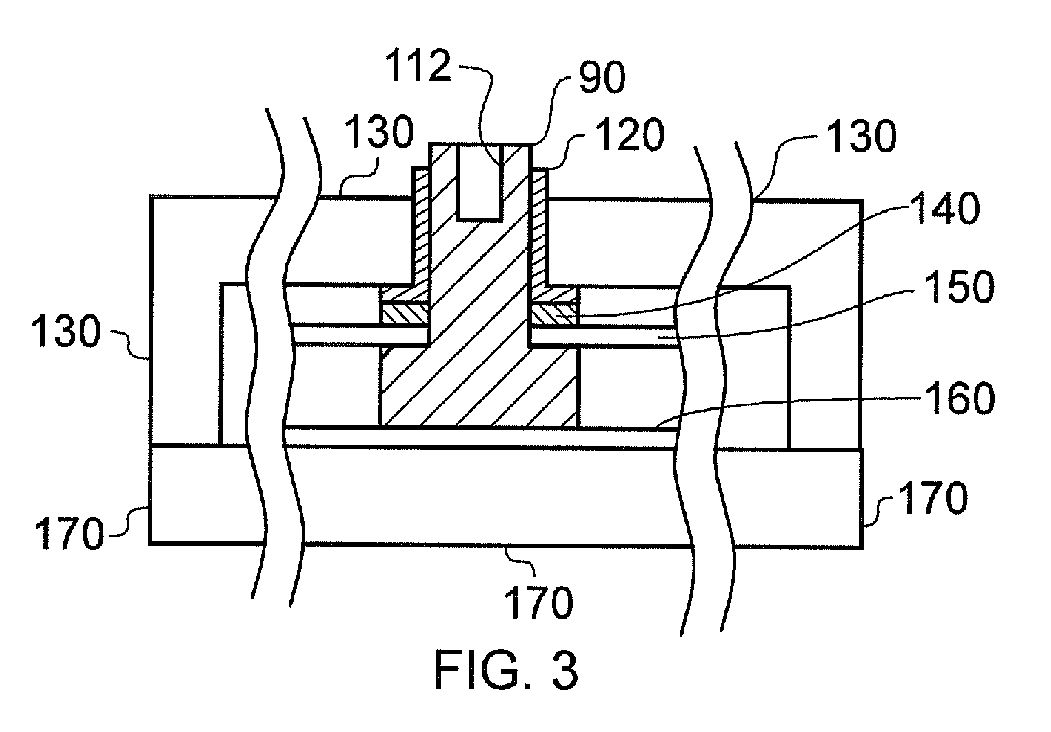
(57) A power switching circuitry is provided for generating an output power supply from
a source power supply. The power switching circuitry has a heat absorbing structure,
and a heat conductive substrate having power switching components provided on a first
surface, and having a second surface adjacent to the heat absorbing structure. A plurality
of electrically conductive members are located on the first surface of the heat conductive
substrate, with each electrically conductive member extending along a first axis orthogonal
to the heat conductive substrate and comprising a first portion and a second portion.
The second portion is more remote from the heat conductive substrate than the first
portion, and has a smaller cross-sectional area than the cross-sectional area of the
first portion in order to define a shoulder region orthogonal to the first axis. A
circuit board is then located on the shoulder region of each electrically conductive
member, with the second portion of each electrically conductive member extending through
the circuit board. An urging mechanism then urges the circuit board against the shoulder
region, whereby the electrically conductive members provide a current path between
the heat conductive substrate and the circuit board, and urge the heat conductive
substrate into thermal contact with the heat absorbing structure. This provides a
particularly simple and efficient mechanism for achieving good electrical contact
between the circuit board and the heat conductive substrate, as well as ensuring good
thermal contact between the heat conductive substrate and the heat absorbing structure.
|
|
