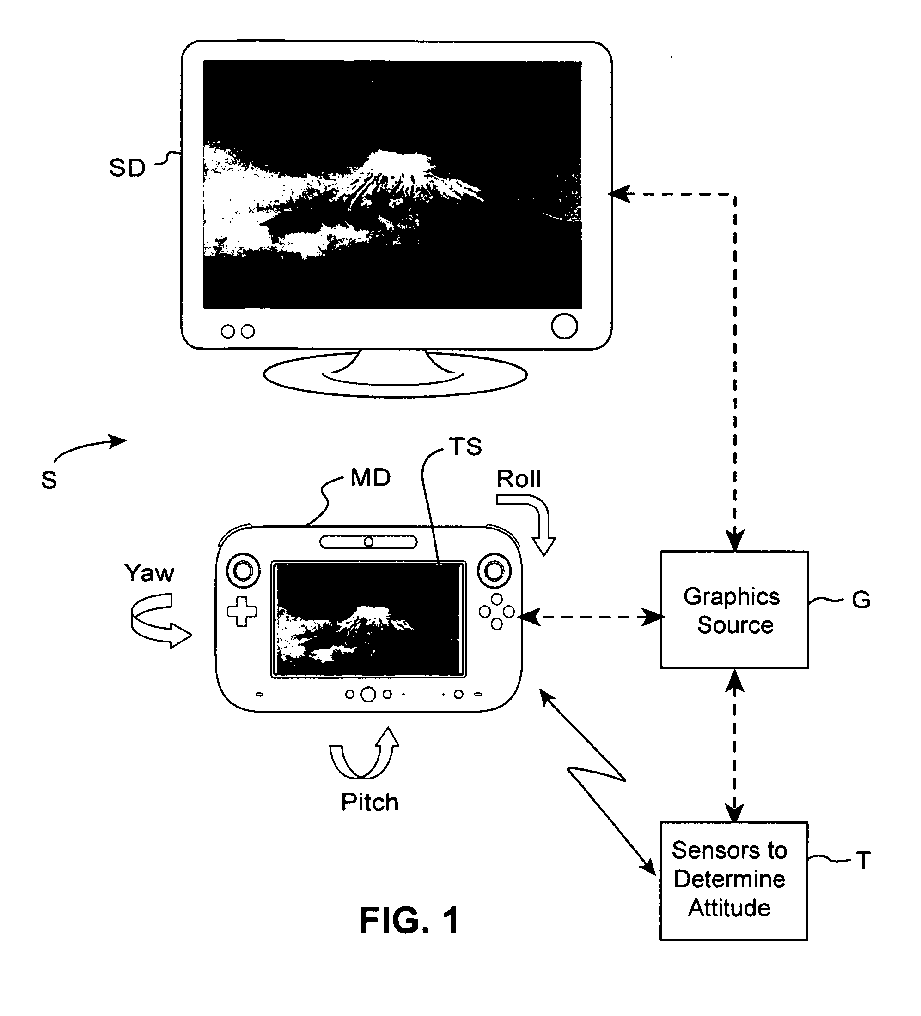
(57) A human-machine interface involves plural spatially-coherent visual presentation
surfaces at least some of which are movable by a person. Plural windows or portholes
into a virtual space, at least some of which are handheld and movable, are provided
by using handheld and other display devices. Aspects of multi-dimensional spatiality
of the moveable window (e.g., relative to another window) are determined and used
to generate images. As one example, the moveable window can present a first person
perspective "porthole" view into the virtual space, this porthole view changing based
on aspects of the moveable window's spatiality in multi-dimensional space relative
to a stationary window. A display can present an image of a virtual space, and an
additional, moveable display can present an additional image of the same virtual space.
Technology is used to determine aspects of the spatiality of the display devices in
the physical world, and use the determined spatiality to affect the images displayed
on the displays. For example, determined spatiality of the movable display relative
to another display can be used to provide relative spatiality of images the two displays
present to enhance the user's immersive perception. The movable display can context-switch
between pointer functionality and spatial functionality depending on whether it is
pointing toward a stationary display.
|
|
