| (19) |
 |
|
(11) |
EP 2 490 930 B1 |
| (12) |
EUROPEAN PATENT SPECIFICATION |
| (45) |
Mention of the grant of the patent: |
|
21.09.2016 Bulletin 2016/38 |
| (22) |
Date of filing: 20.10.2010 |
|
| (51) |
International Patent Classification (IPC):
|
| (86) |
International application number: |
|
PCT/NL2010/050696 |
| (87) |
International publication number: |
|
WO 2011/049445 (28.04.2011 Gazette 2011/17) |
|
| (54) |
A FRAME COMPRISING A SEAT TUBE THAT EXTENDS AT A DIFFERENT ANGLE THAN THE STEERING
HEAD SHAFT, AND AN ADAPTER SUITABLE FOR USE THEREWITH
RAHMEN MIT EINEM SITZROHR MIT VERLAUF IN EINEM ANDEREN WINKEL ALS DIE LENKKOPFACHSE
UND DAFÜR GEEIGNETER ADAPTER
CADRE COMPRENANT UN TUBE DE SELLE S'ÉTENDANT SUIVANT UN ANGLE DIFFÉRENT DE CELUI DE
L'ARBRE DU TUBE DE DIRECTION, ET ADAPTATEUR ADAPTÉ À ÊTRE UTILISÉ AVEC LEDIT CADRE
|
| (84) |
Designated Contracting States: |
|
AL AT BE BG CH CY CZ DE DK EE ES FI FR GB GR HR HU IE IS IT LI LT LU LV MC MK MT NL
NO PL PT RO RS SE SI SK SM TR |
| (30) |
Priority: |
24.10.2009 NL 2003703
|
| (43) |
Date of publication of application: |
|
29.08.2012 Bulletin 2012/35 |
| (73) |
Proprietor: Enjoy Services & Development B.V. |
|
8239 AD Lelystad (NL) |
|
| (72) |
Inventor: |
|
- DE KREEK, Pieter Samuël
NL-8243 VZ Lelystad (NL)
|
| (74) |
Representative: Klavers, Cornelis |
|
Octrooibureau Klavers B.V.
Markerkant 1201.20
1314 AJ Almere
1314 AJ Almere (NL) |
| (56) |
References cited: :
EP-A1- 0 668 209
WO-A1-86/05457
DE-A1- 3 703 312
DE-U1- 20 010 137
US-B1- 6 719 257
|
EP-A1- 1 792 813
WO-A2-2005/035346
DE-A1- 19 620 964
US-A- 2 623 573
|
|
| |
|
|
|
|
| |
|
| Note: Within nine months from the publication of the mention of the grant of the European
patent, any person may give notice to the European Patent Office of opposition to
the European patent
granted. Notice of opposition shall be filed in a written reasoned statement. It shall
not be deemed to
have been filed until the opposition fee has been paid. (Art. 99(1) European Patent
Convention).
|
[0001] The present invention relates to a vehicle, viz. a two-wheeled or multi-wheeled vehicle,
such as a bicycle, a mountain bike, a tricycle, a moped, a motorcycle according to
the preamble of claim 1.
[0002] The present invention also relates to a frame suitable for use in such a vehicle
according to the preamble of claim 8.
[0003] Such a vehicle, for example in the form of a bicycle, is generally known.
[0004] In order to make known bicycles more suitable for use by taller riders, the saddle
is adjusted for height in the longitudinal direction of the seat tube, parallel to
the steering head shaft, thereby creating a greater freedom of movement.
[0005] A vehicle and frame according to the preambles of claims 1 and 8 are known from
WO 2005/035346 A2, which discloses a bicycle having a frame. The frame is provided with a seat tube
between a saddle to be fitted and a crank axle, and with a down tube between the crank
axle and a steering head in which a rotatable steering head shaft is to be mounted.
The steering head shaft makes an angle of A degrees with the horizontal through the
crank axle, whereby the angle which the seat tube makes with the aforesaid horizontal
is between 4 and 10 degrees, or more than 6 degrees smaller than the angle A. The
down tube, or the central axis of the down tube, is shown to be located at the crank
axle, or the central axis of the crank axle, and as described the down tube is connected
to the chain stay, and in particular to its chain stay horn.
[0006] Means for adjusting the saddle in height are not disclosed therein.
[0007] The object of the present invention is to provide a vehicle in which even more space
is gained by height adjustment of the saddle.
[0008] In order to accomplish that object, the vehicle and frame according to the invention
is characterised by the features of claims 1 and 8 respectively.
[0009] The advantage of the vehicle and the frame according to the invention is that the
receding seat tube provides the rider of the vehicle with more legroom - not only
in upward direction but also to the front in relation to the handlebars - upon adjustment
in longitudinal direction of the saddle mounted thereon. This is important in particular
in the case of larger and taller people, in order to prevent said people being squeezed
in between the handlebars and the saddle, also in a high position of the saddle, and
having too little freedom of movement when rotating the pedals on the crank axle or
even touching the handlebars with their knees. Thus the receding seat tube will automatically
provide more freedom of movement upon height adjustment of the saddle.
[0010] The advantage of the forward location is that it provides an improved setup and also
enables in particular taller cyclists to assume a straighter position. It has been
found that this also leads to an improved power transfer to the pedals.
[0011] The advantage of using the adapter is that it prevents the occurrence of play of
the saddle and the saddle pillar on which the - possibly spring-loaded - saddle is
mounted, resulting in an enhanced mechanical stability and an increased capacity to
take up forces.
[0012] Further possible embodiments as defined in the other claims and their concomitant
advantages will be discussed in more detail in the description below.
[0013] The vehicle according to the present invention will now be explained in more detail
with reference to the figures below, in which like parts are indicated by the same
numerals. In the drawings:
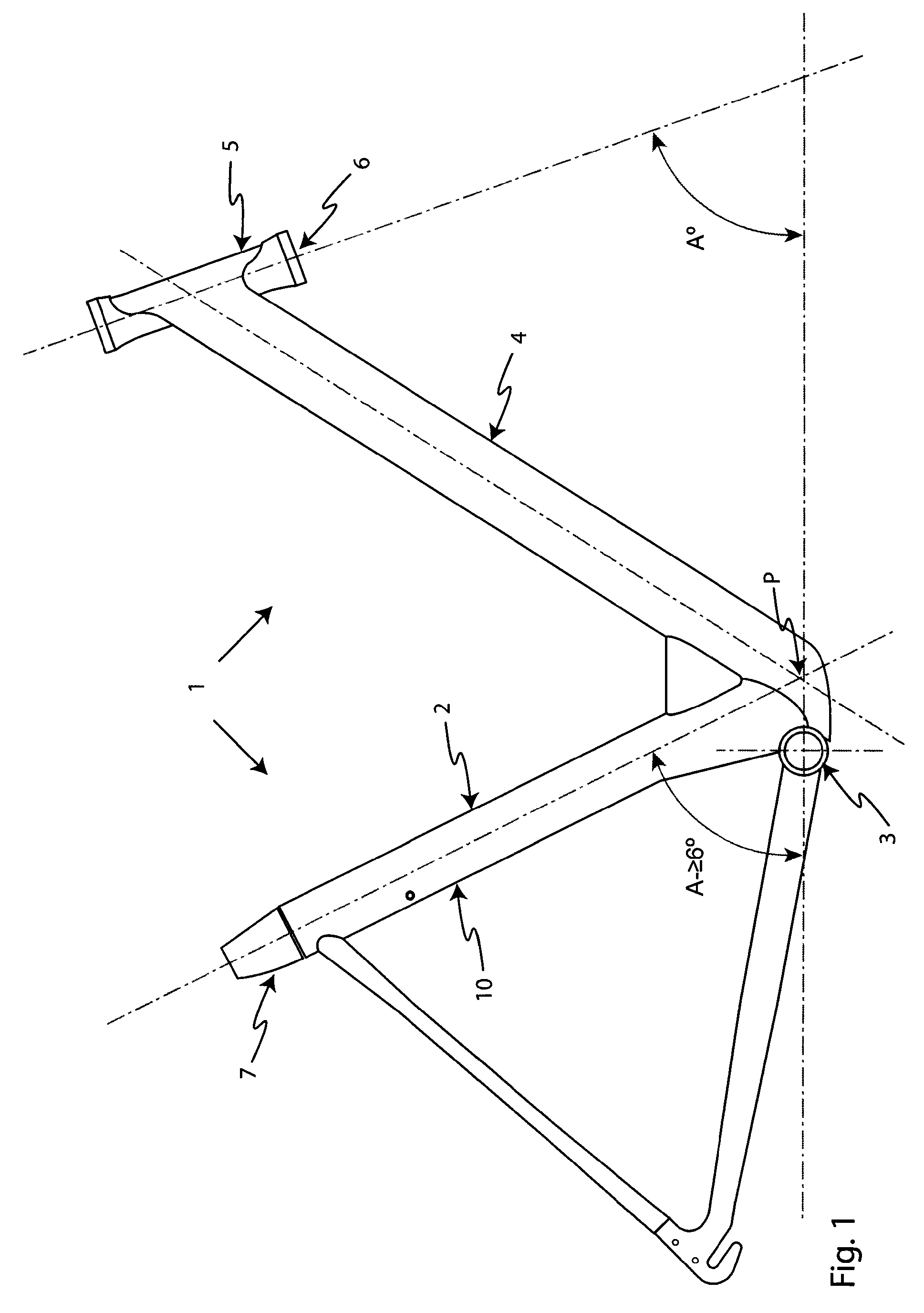
Figure 1 shows a combination of possible embodiments of the bare frame provided with
an adapter, which frame is suitable for use in the vehicle according to the invention;
and
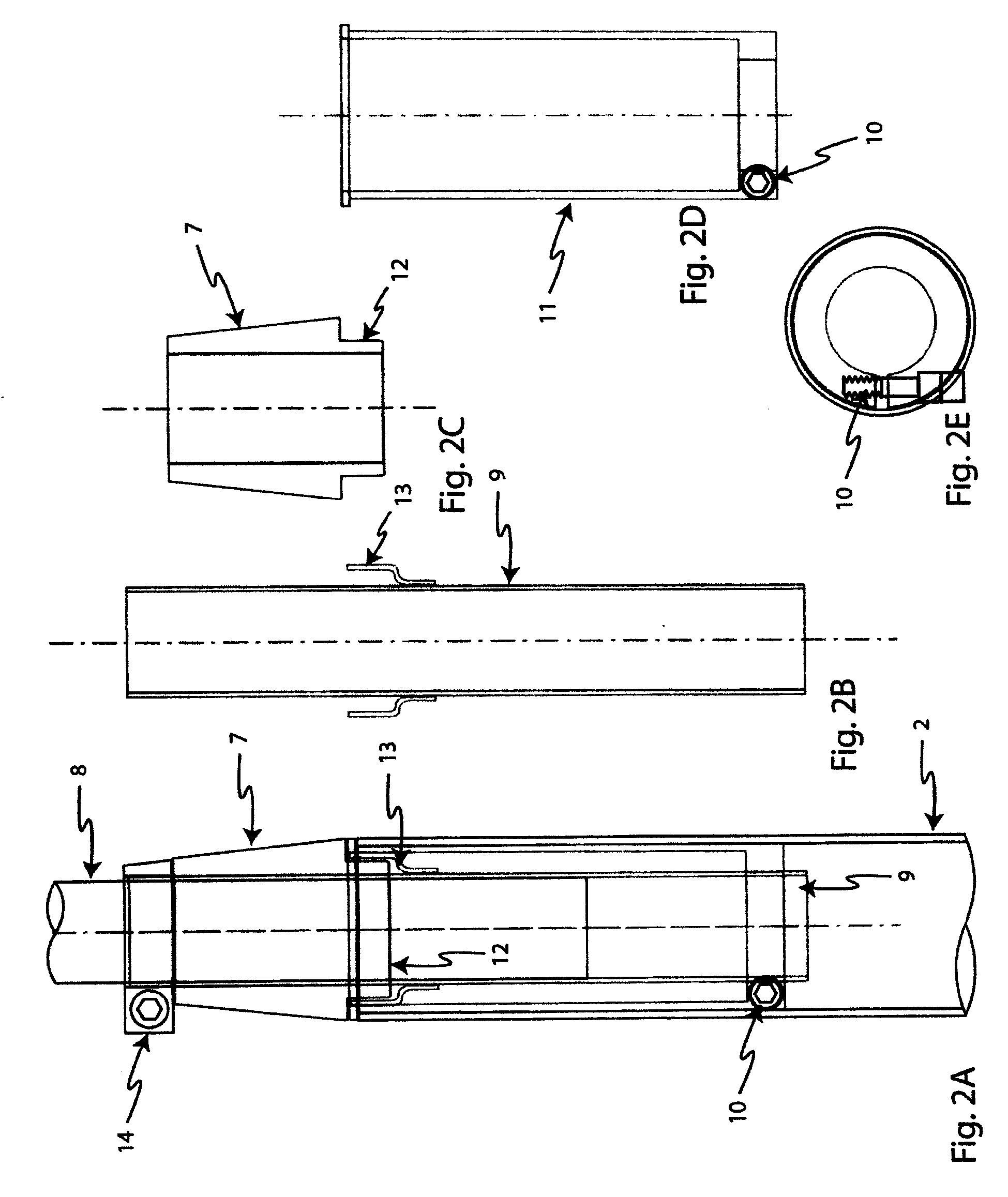
Figures 2A, 2B, 2C, 2D and 2E are views of the assembled components and of the individual
components of said assembly, respectively, that are relevant as regards the joining
together of the adapter and the frame.
[0014] Figure 1 shows a frame 1, in this case a possible two-wheeled vehicle, such as a
bicycle, a mountain bike, a moped, a motor scooter or a motorcycle. In principle the
vehicle may also be a multi-wheeled vehicle, such as a three-wheeled or a four-wheeled
vehicle. As is shown, the frame 1, for example of a bicycle (not shown), comprises
a seat tube 2, which is disposed between a saddle (not shown) and a crank axle 3 (schematically
indicated). The frame 1 further comprises a down tube 4, which extends between the
crank axle 3 and a steering head 5. The steering head 5 is made up of a tube provided
with bearings, in which a rotatable steering head shaft 6 with handlebars connected
thereto is to be mounted. The steering head shaft 6, whose central axis is shown,
makes an angle of A degrees with the horizontal through the crank axle 3. The angle
which the seat tube 2, in particular the central axis of said seat tube, makes with
the aforesaid horizontal is between 4 and 10 degrees, in particular between 5 and
8 degrees, more in particular about 6 degrees, smaller than the angle A. In the illustrated
embodiment, the aforesaid angle is more than 6 degrees smaller than the angle A. As
a result, additional space is created in upward direction when the aforesaid saddle
is moved upwards, which space can be useful used by the rider, so that the latter's
knees will less easily bump against the handlebars while pedalling.
[0015] In another embodiment, which also has advantages for smaller people, because, on
the contrary, the space that is available in forward direction is additionally limited
in lower positions of the saddle, the lower crank axle end of the seat tube 2 is mounted
forward of the crank axle 3, in particular against the down tube 4. In practice it
generally suffices if the seat tube 2, or the central axis of said seat tube 2, is
located more than 25 mm, in particular more than 40 mm, forward of the crank axle
3 or the central axis of the crank axle 3.
[0016] In a special embodiment shown in figure 1, the down tube 4, in particular the central
axis of the down tube 4, intersects the horizontal forward of the crank axle 3 or
the central axis thereof. In this way some additional space is nevertheless created
also for smaller people, if desired. As the figure furthermore shows, the central
axes of the seat tube 2 and the down tube 4 even intersect forward of the central
axis of the crank axle 3 at one point, viz. point P.
[0017] The embodiments described in the foregoing provide additional freedom of design as
regards the manner in which the technical functional requirements as regards the required
dimensions and space can be realised.
[0018] Figures 2A, 2B, 2C, 2D and 2E are views of the assembled components at the saddle
end of the seat tube 2 and of the individual components of said assembly, respectively.
The frame 1 is provided with an adapter 7 mounted between the saddle and the seat
tube 2, which adapter is exchangeable and whose length depends on the length along
which the saddle with its saddle pillar 8 extends above the saddle end of the seat
tube 2, and thus on the length of the rider. The conical shape (in upward direction)
of the adapter 7, which is generally made of plastic material, gives the bicycle as
a whole a more acceptable appearance. The length of the adapter 7 is usually selected
in dependence on the amount of legroom between the saddle and the handlebars that
the rider needs.
[0019] Disposed within the hollow seat tube 2 is a saddle pillar clamping sleeve 9, which
is fixed therein by means of a first clamping element 10, for example a bolt or an
expandable ring. Figure 2A shows an embodiment in which first a seat tube clamp 11
has been inserted into the saddle pillar end of the seat tube 2 and subsequently the
saddle pillar clamping sleeve 9 has been inserted into the seat tube clamp 11, after
which the two have been fixed in position in the seat tube 2 by means of the clamping
element 10. The adapter 7, which is conical in shape in this embodiment, has subsequently
been placed over the saddle pillar clamping sleeve 9 on the seat tube 2, with an adapter
portion 12 having a limited diameter engaging hooks 13 (schematically indicated),
for example in the form of a ring which is open on one side. The saddle pillar 8 slips
into the saddle pillar clamping sleeve 9 and a second clamping element 14 clamps the
selected adapter 7 with the end of the saddle pillar clamping sleeve 9 firmly onto
the saddle pillar 8.
1. A vehicle, viz. a two-wheeled or multi-wheeled vehicle, such as a bicycle, a mountain
bike, a tricycle, a moped, a motorcycle, which vehicle comprises a frame (1) provided
with a seat tube (2) between a saddle to be fitted and a crank axle (3), and with
a down tube (4) between the crank axle (3) and a steering head (5) in which a rotatable
steering head shaft (6) is to be mounted, which steering head shaft (6) makes an angle
of A degrees with the horizontal through the crank axle (3), whereby the angle which
the seat tube (2) makes with the aforesaid horizontal is between 4 and 10 degrees,
in particular between 5 and 8 degrees, more in particular about 6 degrees, smaller
than the angle A, or more than 6 degrees smaller than the angle A, characterised in that the down tube (4), or the central axis of the down tube, is located forward of the
crank axle (3), or the central axis of the crank axle, that the frame (1) is provided
with an exchangeable adapter (7) to be fitted between the saddle and the seat tube
(2), that the seat tube (2) is provided with a first clamping element (10) by means
of which a saddle pillar clamping sleeve (9) inserted into the seat tube (2) can be
fixed in position, and that the seat tube (2) accommodates a seat tube clamp (11)
together with the saddle pillar clamping sleeve (9) inserted therein, which are both
fixed in position in the seat tube (2) by means of the first clamping element (10).
2. A vehicle according to claim 1, characterised in that the seat tube (2) is mounted against the down tube (4), forward of the crank axle
(3), in particular in that the central axis of the seat tube (2) is located more than 25 mm, more in particular
more than 40 mm, forward of the crank axle (3) or the central axis of the crank axle
(3).
3. A vehicle according to claim 1 or 2, characterised in that that the central axes of the seat tube (2) and the down tube (4) intersect at one
point (P) forward of the central axis of the crank axle (3).
4. A vehicle according to either one of claims 1-3, characterised in that the adapter (7) is configured as an adapter that can be detached from the seat tube
(2) and/or from the saddle or the saddle pillar (8) connected thereto.
5. A vehicle according to either one of claims 1-4, characterised in that the length of the adapter (7) has been selected in dependence on the amount of legroom
between the saddle and the handlebars that the driver needs.
6. A vehicle according to either one of claims 1-5, characterised in that the adapter (7) mounted on the seat tube (2), and a saddle pillar (8) inserted therein,
on which saddle pillar (8) the saddle may be mounted, can be fixed to the saddle pillar
clamping sleeve (9) inserted into the seat tube (2) by means of a second clamping
element (14).
7. A vehicle according to any one of claims 1-6, characterised in that said adapter (7) is made of plastic material.
8. A frame (1) suitable for use in a vehicle according to any one of claims 1-7, the
frame (1) is provided with a seat tube (2) between a saddle to be fitted and a crank
axle (3), and with a down tube (4) between the crank axle (3) and a steering head
(5) in which a rotatable steering head shaft (6) is to be mounted, which steering
head shaft (6) makes an angle of A degrees with the horizontal through the crank axle
(3), whereby the angle which the seat tube (2) makes with the aforesaid horizontal
is between 4 and 10 degrees, in particular between 5 and 8 degrees, more in particular
about 6 degrees, smaller than the angle A, or more than 6 degrees smaller than the
angle A, characterised in that the down tube (4), or the central axis of the down tube, is located forward of the
crank axle (3), or the central axis of the crank axle, that the frame (1) is provided
with an exchangeable adapter (7) to be fitted between the saddle and the seat tube
(2), that the seat tube (2) is provided with a first clamping element (10) by means
of which a saddle pillar clamping sleeve (9) inserted into the seat tube (2) can be
fixed in position, and that the seat tube (2) accommodates a seat tube clamp (11)
together with the saddle pillar clamping sleeve (9) inserted therein, which are both
fixed in position in the seat tube (2) by means of the first clamping element (10).
1. Fahrzeug, das heißt, ein zwei- oder mehrrädriges Fahrzeug, wie beispielsweise ein
Fahrrad, ein Mountainbike, ein Dreirad, ein Moped, ein Motorrad, wobei das Fahrzeug
einen Rahmen (1) umfasst, der mit einem Sitzrohr (2) zwischen einem anzubauenden Sattel
und einer Kurbelachse (3) versehen ist und mit einem Unterrohr (4) zwischen der Kurbelachse
(3) und einem Steuerkopf (5), in den ein drehbarer Steuerkopfschaft (6) zu montieren
ist, wobei der Steuerkopfschaft (6) zur Horizontalen durch die Kurbelachse (3) einen
Winkel von A Grad bildet, wobei der Winkel, den das Sitzrohr (2) mit der zuvor genannten
Horizontalen bildet, zwischen 4 und 10 Grad, speziell zwischen 5 und 8 Grad, spezieller
etwa 6 Grad kleiner als der Winkel A oder mehr als 6 Grad kleiner als der Winkel A
ist, dadurch gekennzeichnet, dass das Unterrohr (4) oder die Mittelachse des Unterrohrs vor der Kurbelachse (3) oder
der Mittelachse der Kurbelachse angeordnet ist, dass der Rahmen (1) mit einem austauschbaren
Adapter (7) versehen ist, der zwischen dem Sattel und dem Sitzrohr (2) einzubauen
ist, dass das Sitzrohr (2) mit einem ersten Klemmelement (10) versehen ist, mit dem
eine Sattelstützen-Spannhülse (9), die in das Sitzrohr (2) eingesetzt ist, in einer
Position fixiert werden kann, und dass das Sitzrohr (2) eine Sitzrohrklemme (11) zusammen
mit der in diese eingesetzten Sattelstützen-Spannhülse (9) beherbergt, wobei beide
mittels des ersten Klemmelements (10) im Sitzrohr (2) in Position fixiert sind.
2. Fahrzeug nach Anspruch 1, dadurch gekennzeichnet, dass das Sitzrohr (2) vor der Kurbelachse (3) an das Unterrohr (4) montiert ist, speziell
dadurch, dass die Mittelachse des Sitzrohres (2) mehr als 25 mm, spezieller mehr als
40 mm vor der Kurbelachse (3) oder der Mittelachse der Kurbelachse (3) angeordnet
ist.
3. Fahrzeug nach Anspruch 1 oder 2, dadurch gekennzeichnet, dass sich die Mittelachse des Sitzrohres (2) und die des Unterrohres (4) an einem Punkt
(P) vor der Mittelachse der Kurbelachse (3) schneiden.
4. Fahrzeug nach einem der Ansprüche 1 bis 3, dadurch gekennzeichnet, dass der Adapter (7) als ein Adapter gestaltet ist, der vom Sitzrohr (2) und/oder dem
Sattel oder der Sattelstütze (8) gelöst werden kann, die damit verbunden sind.
5. Fahrzeug nach einem der Ansprüche 1 bis 4, dadurch gekennzeichnet, dass die Länge des Adapters (7) abhängig vom Umfang des vom Fahrer benötigten Beinraumes
zwischen dem Sattel und der Lenkstange gewählt ist.
6. Fahrzeug nach einem der Ansprüche 1 bis 5, dadurch gekennzeichnet, dass der Adapter (7), der an das Sitzrohr (2) montiert ist, und eine darin eingesetzte
Sattelstütze (8), an die der Sattel montiert werden kann, mittels eines zweiten Klemmelements
(14) an der Sattelstützen-Spannhülse (9) fixiert werden können, die in das Sitzrohr
(2) eingesetzt ist.
7. Fahrzeug nach einem der Ansprüche 1 bis 6, dadurch gekennzeichnet, dass der Adapter (7) aus Kunststoff angefertigt ist.
8. Rahmen (1), geeignet zur Verwendung in einem Fahrzeug nach einem der Ansprüche 1 bis
7, wobei der Rahmen (1) mit einem Sitzrohr (2) zwischen einem anzubauenden Sattel
und einer Kurbelachse (3) versehen ist und mit einem Unterrohr (4) zwischen der Kurbelachse
(3) und einem Steuerkopf (5), in den ein drehbarer Steuerkopfschaft (6) zu montieren
ist, wobei der Steuerkopfschaft (6) zur Horizontalen durch die Kurbelachse (3) einen
Winkel von A Grad bildet, wobei der Winkel, den das Sitzrohr (2) mit der zuvor genannten
Horizontalen bildet, zwischen 4 und 10 Grad, speziell zwischen 5 und 8 Grad, spezieller
etwa 6 Grad kleiner als der Winkel A oder mehr als 6 Grad kleiner als der Winkel A
ist, dadurch gekennzeichnet, dass das Unterrohr (4) oder die Mittelachse des Unterrohrs vor der Kurbelachse (3) oder
der Mittelachse der Kurbelachse angeordnet ist, dass der Rahmen (1) mit einem austauschbaren
Adapter (7) versehen ist, der zwischen dem Sattel und dem Sitzrohr (2) einzubauen
ist, dass das Sitzrohr (2) mit einem ersten Klemmelement (10) versehen ist, mit dem
eine Sattelstützen-Spannhülse (9), die in das Sitzrohr (2) eingesetzt ist, in einer
Position fixiert werden kann, und dass das Sitzrohr (2) eine Sitzrohrklemme (11) zusammen
mit der in diese eingesetzten Sattelstützen-Spannhülse (9) beherbergt, wobei beide
mittels des ersten Klemmelements (10) im Sitzrohr (2) in Position fixiert sind.
1. Véhicule, à savoir véhicule à deux roues ou à roues multiples, tel qu'une bicyclette,
un mountain bike, un tricycle, un cyclomoteur, une motocyclette, lequel véhicule comprend
un châssis (1) pourvu d'un tube de siège (2) entre une selle à ajuster et un axe de
manivelle (3), et comportant un tube descendant (4) entre l'axe de manivelle (3) et
une tête de direction (5) dans laquelle un arbre de tête de direction rotatif (6)
doit être monté, lequel arbre de tête de direction (6) décrit un angle de A degrés
par rapport à l'horizontale à travers l'axe de manivelle (3), ce qui a pour effet
que l'angle que le tube de siège (2) décrit par rapport l'horizontale précitée est
de 4 à 10 degrés, en particulier de 5 à 8 degrés, plus particulièrement d'environ
6 degrés, inférieur à l'angle A, ou de plus de 6 degrés inférieur à l'angle A, caractérisé en ce que le tube descendant (4) ou l'axe central du tube descendant est situé à l'avant de
l'axe de manivelle (3) ou de l'axe central de l'axe de manivelle, que le châssis (1)
est pourvu d'un adaptateur échangeable (7) à ajuster entre la selle et le tube de
siège (2), que le tube de siège (2) est pourvu d'un premier élément de serrage (10)
au moyen duquel un manchon de serrage de colonne de siège (9) inséré dans le tube
de siège (2) peut être fixé en position et que le tube de siège (2) abrite un serre-tube
de siège (11) en même temps que le manchon de serrage de colonne de siège (9) inséré
dedans qui sont tous deux fixés en position dans le tube de siège (2) au moyen du
premier élément de serrage (10).
2. Véhicule selon la revendication 1, caractérisé en ce que le tube de siège (2) est monté contre le tube descendant (4), à l'avant de l'axe
de manivelle (3), en particulier en ce que l'axe central du tube de siège (2) se situe plus de 25 mm, plus particulièrement
plus de 40 mm, à l'avant de l'axe de manivelle (3) ou de l'axe central de l'axe de
manivelle (3).
3. Véhicule selon la revendication 1 ou 2, caractérisé en ce que les axes centraux du tube de siège (2) et du tube descendant (4) se coupent à un
point (P) à l'avant de l'axe central de l'axe de manivelle (3).
4. Véhicule selon l'une quelconque des revendications 1-3, caractérisé en ce que l'adaptateur (7) est conçu sous forme d'un adaptateur qui peut être détaché du tube
de siège (2) et/ou de la selle ou de la colonne de selle (8) qui lui est connecté.
5. Véhicule selon l'une quelconque des revendications 1-4, caractérisé en ce que la longueur de l'adaptateur (7) a été sélectionnée en fonction de l'espace pour les
jambes entre la selle et les manettes dont le conducteur a besoin.
6. Véhicule selon l'une quelconque des revendications 1-5, caractérisé en ce que l'adaptateur (7) monté sur le tube de siège (2) et une colonne de siège (8) insérée
dedans, sur laquelle colonne de siège (8) la selle peut être montée, peut être fixé
au manchon de serrage de colonne de selle (9) inséré dans le tube de siège (2) au
moyen d'un second élément de serrage (14).
7. Véhicule selon l'une quelconque des revendications 1-6, caractérisé en ce que ledit adaptateur (7) est composé de matière plastique.
8. Châssis (1) susceptible d'être utilisé dans un véhicule selon l'une quelconque des
revendications 1-7, ce châssis (1) étant pourvu d'un tube de siège (2) entre une selle
à ajuster et un axe de manivelle (3), et comportant un tube descendant (4) entre l'axe
de manivelle (3) et une tête de direction (5) dans laquelle un arbre de tête de direction
rotatif (6) doit être monté, lequel arbre de tête de direction (6) décrit un angle
de A degrés par rapport à l'horizontale à travers l'axe de manivelle (3), ce qui a
pour effet que l'angle que le tube de siège (2) décrit par rapport à l'horizontale
précitée est de 4 à 10 degrés, en particulier de 5 à 8 degrés, plus particulièrement
d'environ 6 degrés inférieur à l'angle A, ou de plus de 6 degrés inférieur à l'angle
A, caractérisé en ce que le tube descendant (4) ou l'axe central du tube descendant se situe à l'avant de
l'axe de manivelle (3) ou de l'axe central de l'axe de manivelle, que le châssis (1)
est pourvu d'un adaptateur échangeable (7) à ajuster entre la selle et le tube de
siège, que le tube de siège (2) est pourvu d'un premier élément de serrage (10) au
moyen duquel un manchon de serrage de prendre de siège (9) inséré dans le tube de
siège (2) peut être fixé en position et que le tube de siège (2) abrite un serre-tube
de siège (11) en même temps que le manchon de serrage de colonne de siège (9) inséré
dedans qui sont tous deux fixés en position dans le tube de siège (2) au moyen du
premier élément de serrage (10).
REFERENCES CITED IN THE DESCRIPTION
This list of references cited by the applicant is for the reader's convenience only.
It does not form part of the European patent document. Even though great care has
been taken in compiling the references, errors or omissions cannot be excluded and
the EPO disclaims all liability in this regard.
Patent documents cited in the description