|
(11) | EP 2 525 424 A1 |

| (12) | EUROPEAN PATENT APPLICATION |
|
|
|
|
|||||||||||||||||||||||
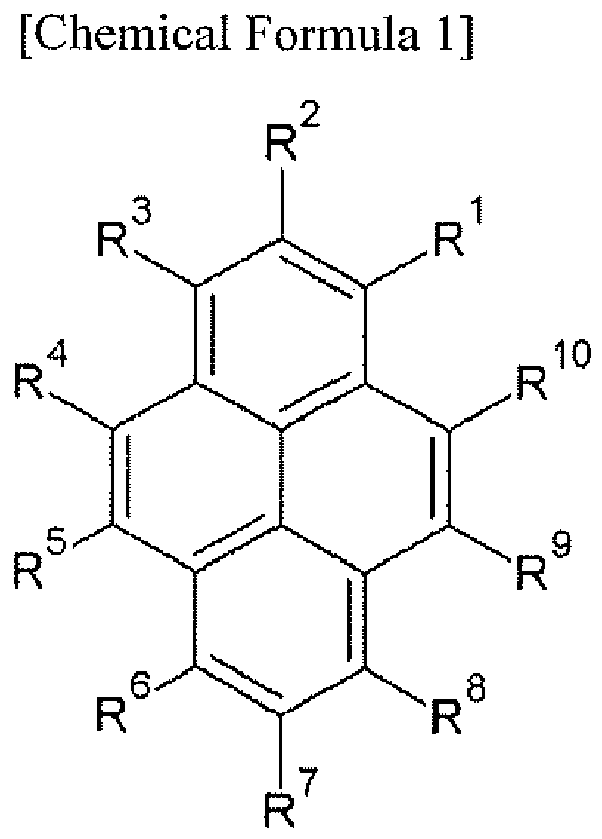
| (54) | Organic light emitting diode device |
| (57) The present invention provides an organic light emitting diode device that includes
a first electrode, a second electrode facing the first electrode, an emission layer
interposed between the first electrode and the second electrode and an auxiliary layer
interposed between either one of the first electrode and the second electrode and
the emission layer, wherein the auxiliary layer includes a substituted or unsubstituted
pyrene-based compound having at least one appended phenyl group is provided. |
BACKGROUND
Field
Description of the Related Technology
[0002] Recently, an organic light emitting diode (OLED) device has been finding utility as a display device and a luminous device.
[0003] An organic light emitting diode device includes two electrodes and an emission layer interposed therebetween, and emits light when electrons injected from one electrode are combined with holes injected from another electrode in an emission layer to generate excitons that release energy.
[0004] Since the organic light emitting diode device emits light without a particular light source, it has excellent response speed, viewing angle, and contrast ratio as well as low power consumption.
[0005] It is preferable that an organic light emitting diode device has increased luminous efficiency and life-span.
SUMMARY
[0006] The present invention provides an organic light emitting diode device having an excellent luminous efficiency and life-span characteristics.
[0007] According to one embodiment, an organic light emitting diode device is provided that includes a first electrode, a second electrode facing the first electrode, an emission layer interposed between the first electrode and the second electrode, and an auxiliary layer interposed between either one of the first electrode and the second electrode and the emission layer, wherein the auxiliary layer includes a substituted or unsubstituted pyrene-based compound including at least one appended phenyl group.
[0008] In preferred embodiments, the pyrene-based compound may include a compound represented by the following Chemical Formula 1.
[0009] wherein R1, R2, R3, R4, R5, R6, R7, R8 R9, and R10 are each independently hydrogen, a substituted or unsubstituted C1 to C20 alkyl group, a substituted or unsubstituted C2 to C20 alkenyl group, a substituted or unsubstituted C2 to C20 alkynyl group, a substituted or unsubstituted C1 to C20 alkoxy group, a substituted or unsubstituted C3 to C30 cycloalkyl group, a substituted or unsubstituted C3 to C30 cycloalkenyl group, a substituted or unsubstituted C3 to C30 cycloalkynyl group, a substituted or unsubstituted C6 to C30 aryl group, a substituted or unsubstituted C6 to C30 aryl amine group, a substituted or unsubstituted C1 to C30 heterocycloalkyl group, a substituted or unsubstituted C1 to C30 heterocycloalkenyl group, a substituted or unsubstituted C1 to C30 heterocycloalkynyl group, a substituted or unsubstituted C3 to C30 heteroaryl group, a substituted or unsubstituted silane group, an amine group, a nitrile group, a nitro group, a halogen, an amide group, an ester group, a sulfonyl group, a sulfoxide group, a sulfonamide group, a sulfonate group, or a trifluoromethyl group, or one or more of the forgoing groups optionally forms a condensed cyclic group with an adjacent group, and at least one of R1, R2, R3, R4, R5, R6, R7, R8, R9, and R10 is a substituted or unsubstituted phenyl group.
[0010] In preferred embodiments, at least one of R1, R2, R3, R4, R5, R6, R7, R8, R9, and R10 in above Chemical Formula 1 is a phenyl group, and at least one thereof is a benzofuran group, dibenzofuran group, carbazole group, naphthyl group, pyridine group, quinoline group, isoquinoline group, benzimidazole group, phenanthroline group, acridine group, imidazole group, triazole group, bipyridine group, or benzoxazole group. In preferred embodiments, R1 is a phenyl group and at least one of R2, R3, R4, R5, R6, R7, R8, R9, and R10 is a benzofuran group, dibenzofuran group, carbazole group, naphthyl group, pyridine group, quinoline group, isoquinoline group, benzimidazole group, phenanthroline group, acridine group, imidazole group, triazole group, bipyridine group, or benzoxazole group. In preferred embodiments, R2 is a phenyl group and at least one of R1, R3, R4, R5, R6, R7, R8, R9, and R10 is a benzofuran group, dibenzofuran group, carbazole group, naphthyl group, pyridine group, quinoline group, isoquinoline group, benzimidazole group, phenanthroline group, acridine group, imidazole group, triazole group, bipyridine group, or benzoxazole group. In preferred embodiments, R4 is a phenyl group and at least one of R1, R2, R3, R5, R6, R7, R8, R9, and R10 is a benzofuran group, dibenzofuran group, carbazole group, naphthyl group, pyridine group, quinoline group, isoquinoline group, benzimidazole group, phenanthroline group, acridine group, imidazole group, triazole group, bipyridine group, or benzoxazole group.
[0011] In preferred embodiments, the auxiliary layer may further include an inorganic compound or a metal.
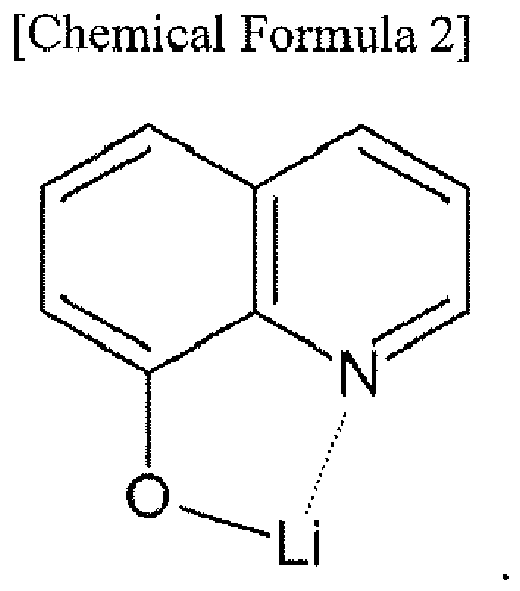
[0012] In preferred embodiments, the inorganic compound may include a Liq compound represented by the following Chemical Formula 2, LiF, NaF, KF, RbF, CsF, FrF, MgF2, CaF2, SrF2, BaF, LiCl, NaCl, KCl, RbCl, CsCl, FrCl, Li2O, Li2O2, Na2O, K2O, RbO, Rb2O2, Cs2O, Cs2O2, LiAlO2, LiBO2, LiTaO3, LiNbO3, LiWO4, Li2CO, NaWO4, K2SiO3, BO, Al2O3, SiO2 or combination thereof, and the metal may include Li, Na, K, Cs, Be, Mg, Ca, Sr, Ba, Y, La, Ce, Sm, Gd, Eb, Yb, Al-Li alloy, a Mg-Sr alloy, In-Li alloy, or a combination thereof. In a preferred embodiment it is a compound of chemical formula 2.
[0013] In preferred embodiments, the substituted or unsubstituted pyrene-based compound including at least one phenyl group and the inorganic compound or metal is mixed in a weight ratio of 1:100 to 100:1, for example, a weight ratio of 1:1 to 1:2.
[0015] The organic light emitting diode device may have excellent luminous efficiency and life-span characteristic.
BRIEF DESCRIPTION OF THE DRAWINGS
[0016] FIG. 1 is the schematic cross-sectional view of an organic light emitting diode device according to one embodiment of the present invention.
[0017] FIG. 2 is the schematic cross-sectional view of an organic light emitting diode device according to another embodiment of the present invention.
[0018] FIG. 3 is the graph of a luminance change of organic light emitting diode devices obtained from Example 1 and Comparative Example 1 according to a lapse of time.
DETAILED DESCRIPTION
[0019] The present disclosure will be described more fully hereinafter with reference to the accompanying drawings, in which embodiments of this disclosure are shown. This disclosure may, however, be embodied in many different forms and is not construed as limited to the embodiments set forth herein.
[0020] In the drawings, the thickness of layers, films, panels, regions, etc., are exaggerated for clarity, i.e. they are purely schematic. Like reference numerals designate like elements throughout the specification. It will be understood that when an element such as a layer, film, region, or substrate is referred to as being "on" another element, it can be directly on the other element or intervening elements may also be present. In contrast, when an element is referred to as being "directly on" another element, there are no intervening elements present.
[0021] As used herein, when a specific definition is otherwise provided, the term "amine group" refers to NRR' (wherein R and R' are the same or different and are hydrogen, a substituted or unsubstituted C1 to C20 alkyl group, preferably a C1 to C5 alkyl group, a substituted or unsubstituted C1 to C20 alkoxy group, preferably a C1 to C5 alkoxy group, a substituted or unsubstituted C6 to C30 aryl group, preferably a C6 to C10 aryl group, or a substituted or unsubstituted C6 to C30 aryloxy group, preferably a C6 to C10 aryloxy group.
[0022] As used herein, the term "amide group" refers to CONRR' (wherein R and R' are the same or different and are hydrogen, a substituted or unsubstituted C1 to C20 alkyl group, preferably a C1 to C5 alkyl group, a substituted or unsubstituted C1 to C20 alkoxy group, preferably a C1 to C5 alkoxy group, a substituted or unsubstituted C6 to C30 aryl group, preferably a C6 to C10 aryl group, or a substituted or unsubstituted C6 to C30 aryloxy group, preferably a C6 to C10 aryloxy group).
[0023] As used herein, the term "ester group" refers to COOR (wherein R is hydrogen, a substituted or unsubstituted C1 to C20 alkyl group, preferably a C1 to C5 alkyl group, a substituted or unsubstituted C1 to C20 alkoxy group, preferably a C1 to C5 alkoxy group, a substituted or unsubstituted C6 to C30 aryl group, preferably a C6 to C10 aryl group, or a substituted or unsubstituted C6 to C30 aryloxy group, preferably a C6 to C10 aryloxy group).
[0024] As used herein, the term "sulfonyl group" refers to SO2R (wherein R is hydrogen, a substituted or unsubstituted C1 to C20 alkyl group, preferably a C1 to C5 alkyl group, a substituted or unsubstituted C1 to C20 alkoxy group, preferably a C1 to C5 alkoxy group, a substituted or unsubstituted C6 to C30 aryl group, preferably a C6 to C10 aryl group, or a substituted or unsubstituted C6 to C30 aryloxy group, preferably a C6 to C10 aryloxy group).
[0025] As used herein, the term "sulfoxide group" refers to SOR (wherein R is hydrogen, a substituted or unsubstituted C1 to C20 alkyl group, preferably a C1 to C5 alkyl group, a substituted or unsubstituted C1 to C20 alkoxy group, preferably a C1 to C5 alkoxy group, a substituted or unsubstituted C6 to C30 aryl group, preferably a C6 to C10 aryl group, or a substituted or unsubstituted C6 to C30 aryloxy group, preferably a C6 to C10 aryloxy group).
[0026] As used herein, the term "sulfonamide group" refers to SO2NRR' (wherein R and R' are the same or different and hydrogen atom, a substituted or unsubstituted C1 to C20 alkyl group, preferably a C1 to C5 alkyl group, a substituted or unsubstituted C1 to C20 alkoxy group, preferably a C1 to C5 alkoxy group, a substituted or unsubstituted C6 to C30 aryl group, preferably a C6 to C 10 aryl group, or substituted or unsubstituted C6 to C30 aryloxy group, preferably a C6 to C10 aryloxy group).
[0027] As used herein, the term "sulfonate group" refers to SO3R (wherein R is hydrogen, a substituted or unsubstituted C1 to C20 alkyl group, preferably a C1 to C5 alkyl group, a substituted or unsubstituted C1 to C20 alkoxy group, preferably a C1 to C5 alkoxy group, a substituted or unsubstituted C6 to C30 aryl group, preferably a C6 to C10 aryl group, or a substituted or unsubstituted C6 to C30 aryloxy group, preferably a C6 to C 10 aryloxy group).
[0028] As used herein, when a specific definition is otherwise provided, the term "substituted" refers to one substituted with a substituent selected from a halogen, preferably chlorine or fluorine, a C1 to C20 alkyl group, preferably a C1 to C5 alkyl group, a C1 to C20 haloalkyl group, preferably a C1 to C5 haloalky group preferably containing at least one fluorine and/or chlorine atom, a C1 to C20 alkoxy group, preferably a C1 to C5 alkoxy group, a C6 to C30 aryl group, preferably a C6 to C 10 aryl group, or a C6 to C30 aryloxy group, preferably a C6 to C10 aryloxy group.
[0029] The present invention provides an organic light emitting diode device comprising a first electrode, a second electrode facing the first electrode, an emission layer interposed between the first electrode and the second electrode, and an auxiliary layer interposed between either one of the first electrode and the second electrode and the emission layer, wherein the auxiliary layer includes a substituted or unsubstituted pyrene-based compound including at least one appended phenyl group.
[0030] The organic light emitting diode of the present invention may preferably comprise a substrate layer.
[0031] In a preferred embodiment the organic light emitting diode device includes a substrate, a first electrode disposed on the substrate, an emission layer disposed on the first electrode, an auxiliary layer disposed on the emission layer, and a second electrode disposed on the auxiliary layer. In a preferred embodiment the first electrode is disposed directly on the substrate. In a preferred embodiment the emission layer is disposed directly on the first electrode. In a preferred embodiment the auxiliary layer is disposed directly on the emission layer. In a preferred embodiment the second electrode is disposed directly on the auxiliary layer.
[0032] In preferred embodiments, the substrate includes a substrate commonly used for an organic light emitting diode device, and in particular, a glass substrate, a plastic substrate, and the like is used.
[0033] In preferred embodiments, the first electrode is an anode, which is a transparent electrode in a bottom emission device, and a reflective electrode in a top emission device.
[0034] When the first electrode is a transparent electrode, ITO (indium tin oxide), IZO (indium zinc oxide), TO (tin oxide), or ZnO (zinc oxide) preferably may be used. When the first electrode is a reflective electrode, a laminated reflective layer/transparent electrode preferably may be used as a reflective electrode. The reflective layer includes silver (Ag), magnesium (Mg), aluminum (Al), platinum (Pt), palladium (Pd), gold (Au), nickel (Ni), neodymium (Nd), iridium (Ir), chromium (Cr), or a combination thereof and the transparent electrode includes ITO, IZO, TO or ZnO.
[0035] The material for the emission layer is not specifically limited, but it preferably may include a material randomly selected from the known host materials and dopant materials.
[0036] Examples of the host material preferably include 4,4'-N,N'-dicarbazol-biphenyl (CBP), bis(2-methyl-8-quinolinato)-4-phenylphenolate aluminum (BAlq), 2,9-dimethyl-4,7-diphenyl-1,10-phenanthroline (BCP), N,N'-dicarbazolyl-1,4-dimethene-benzene (DCB), rubrene, 9,10-bis(2-naphthyl)antracene (AND), and the like.
[0037] In preferred embodiments, the dopant material may include 4,4'-bis(2,2'-diphenyl vinyl)-1,1'-biphenyl (DPVBi), a distyrylamine derivative, a pyrene derivative, a perylene derivative, a distyrylbiphenyl (DSBP) derivative, a 10-(1,3-benzothiazol-2-yl)-1,1,7,7-tetramethyl-2,3,6,7-tetrahydro-1H,5H,11H-pyrano-(2,3-f)pyrido-(3,2,1-ij)quinoline-11-one (C545T), quinacridone derivative, tris(2-phenylpyridine)iridium (Ir(PPy)), PQIr, Btp2Ir(acac), 4-(dicyanomethylene)-2-tert-butyl-6-(1,1,7,7-tetramethyljulolydyl-9-enyl)-4H-pyran (DCJTB), 4-(dicyanomethylene)-2-methyl-6-(p-dimethylaminostyryl)-4H-pyrane (DCM), 2,3,7,8,12,13,17,18-octaethyl-21H, 23H-porphyrin-platinum complex (PtOEP), Ir(piq)2(acac), EK8 (manufactured by Kodak), RD3 (manufactured by Kodak) or the like.
[0038] In preferred embodiments, the organic light emitting diode device may further include at least one of hole injection layer (HIL) and hole transport layer (HTL) between the first electrode and the emission layer. Preferably the at least one of hole injection layer (HIL) and hole transport layer (HTL) is disposed directly on the first electrode and the emission layer is disposed directly on the at least one of hole injection layer (HIL) and hole transport layer (HTL).
[0039] In preferred embodiments, the hole injection layer (HIL) is formed according to a vacuum deposit or a solution process. In preferred embodiments, the hole injection layer (HIL) can be made by vacuum deposit, and the hole injection layer (HIL) material may include at least one of an aryl amine-based compound and a starburst-based compound which facilitates the hole injection.
[0040] Examples thereof may include a low molecular material such as CuPc (cupper phthalocyanine), TNATA, TCTA, TDAPB, TDAT, m-MTDATA or the like, or PANI (polyaniline), polyaniline/dodecylbenzenesulfonic acid (Pani/DBSA), poly(3,4-ethylenedioxythiophene)/poly(4-styrenesulfonate) (PEDOT/PSS) or the like, but is not limited thereto.
[0041] In preferred embodiments, the hole transport layer (HTL) can be a layer facilitating the hole transport toward the emission layer. The material thereof is not specifically limited.
[0042] In preferred embodiments, the hole transport layer (HTL) material may include 1,3,5-tricarbazolylbenzene, 4,4'-biscarbazolylbiphenyl, polyvinylcarbazole, m-biscarbazolylphenyl, 4,4'-biscarbazolyl-2,2'-dimethylbiphenyl, 4,4',4"-tri(N-carbazolyl)triphenylamine, 1,3,5-tri(2-carbazolylphenyl)benzene, 1,3,5-tris(2-carbazolyl-5-methoxyphenyl)benzene, bis(4-carbazolylphenyl)silane, N,N'-bis(3-methylphenyl)-N,N'-diphenyl-(1,1-biphenyl)-4,4'diamine, N,N'-di(naphthalen-1-yl)-N,N'-diphenyl benzidine (a-NPD), N,N'-diphenyl-N,N'-bis(1-naphthyl)-(1,1'-biphenyl)-4,4'-diamine (NPB), poly(9,9-dioctylfluorene-co-N-(4-butylphenyl)diphenylamine) (TFB) or poly(9,9-dioctylfluorene-co-bis(4-butylphenyl-bis-N,N-phenyl-1,4-phenylenediamine, (PFB), and the like, but is not limited thereto.
[0043] In preferred embodiments, the hole transport layer (HTL) material may include a low molecular material such as a-NPB N,N'-bis(naphthalen-1-yl)-N,N'-bis(phenyl)benzidine), TPD (N,N'-bis (3-methylphenyl)-N,N'-bis(phenyl)benzidine), spiro-TAD, MTDATA (4,4',4"-tris(N-3-methylphenyl-N-phenyl-amino)-triphenylamine) or the like, or a polymer material such as PVK (polyvinyl carbazole) or the like.
[0044] In preferred embodiments, the auxiliary layer is prepared by including substituted or unsubstituted pyrene-based compounds having at least one appended phenyl group.
[0045] In preferred embodiments, the pyrene-based compound may have the following Chemical Formula 1.
wherein R1, R2, R3, R4 R5, R6 R7, R8, R9 and R10 can each separately be hydrogen, a substituted or unsubstituted C1 to C20 alkyl group, preferably an unsubstituted C1 to C5 alky group, a substituted or unsubstituted C2 to C20 alkenyl group, preferably an unsubstituted C2 to C5 alkynyl group, a substituted or unsubstituted C2 to C20 alkenyl group, preferably an unsubstituted C2 to C5 alkynyl group, a substituted or unsubstituted C1 to C20 alkoxy group, preferably an unsubstituted C1 to C5 alkoxy group, a substituted or unsubstituted C3 to C30 cycloalkyl group preferably an unsubstituted C3 to C6 cycloalky group, a substituted or unsubstituted C3 to C30 cycloalkenyl group, preferably an unsubstituted C3 to C6 cycloalkenyl group, a substituted or unsubstituted C7 to C30 cycloalkynyl group, preferably an unsubstituted C7 to C10 cycloalkynyl group a substituted or unsubstituted C6 to C30 aryl group, preferably an unsubstituted C6 to C10 aryl group, a substituted or unsubstituted C6 to C30 aryl amine group, preferably an unsubstituted C6 to C10 aryl amine group, a substituted or unsubstituted C3 to C30 heterocycloalkyl group, preferably an unsubstituted C3 to C10 heterocycloalkyl group, a substituted or unsubstituted C3 to C30 heterocycloalkenyl group, preferably an unsubstituted C3 to C10 heterocycloalkenyl group, a substituted or unsubstituted C3 to C30 heterocycloalkynyl group, preferably an unsubstituted C3 to C10 heterocycloalkynyl group, a substituted or unsubstituted C2 to C30 heteroaryl group, preferably an unsubstituted C3 to C 15 heteroaryl group, a substituted or unsubstituted silane group, an amine group, a nitrile group, a nitro group, a halogen, an amide group, an ester group, a sulfonyl group, a sulfoxide group, a sulfonamide group, a sulfonate group, or a trifluoromethyl group, or one or more of the forgoing groups optionally forms a condensed cyclic group with an adjacent group, and at least one of R1, R2, R3, R4, R5, R6, R7, R8, R9, and R10 is a substituted or unsubstituted phenyl group, preferably an unsubstituted phenyl group.
[0046] The heterocycloalkyl group, heterocycloalkenyl group, heterocycloalkynyl group, and heteroaryl group mentioned above preferably contains at least one heteroatom selected from the group consisting of O, N (can also be NH, if necessary) and S and combinations thereof in addition to the number of carbon atoms mentioned above. Preferably, the at least one heteroatom is O or N or a combination thereof. Preferably, the groups contain one or two heteroatoms. In respect of the heterocycloalkynyl group there are enough heteroatoms present to ensure that the ring is stable, preferably the total number of atoms (i.e. carbon atoms plus heteroatoms) present in the heterocycloalkynyl group is equal to or more than 7.
[0047] The heteroaryl group is preferably a C5 to C12 heteroaryl group. Preferred heteroaryl groups are a benzofuran group, dibenzofuran group, carbazole group, naphthyl group, quinoline group, isoquinoline group, benzimidazole group, phenanthroline group, acridine group, imidazole group, triazole group, bipyridine group, or benzoxazole group.
[0048] When one or more of R1, R2, R3, R4, R5, R6, R7, R8, R9, and R10 optionally forms a condensed cyclic group with an adjacent group it is preferably a C6 to C10 aryl group, a C6 to C10 cycloalky group, a C6 to C10 cycloalkenyl group, a C3 to C10 heterocycloalkyl group, C3 to C10 heterocycloalkenyl group, or a C3 to C10 heteroaryl group. The carbon atom range recited includes any carbon atoms present in the pyrene-ring which are used to form the condensed cyclic group. The heterocyclic groups preferably contain at least one heteroatom selected from the group consisting of O, N (can also be NH, if necessary) and S or combinations therefore in addition to the number of carbon atoms mentioned above. Preferably, the at least one heteroatom is O or N or a combination thereof. Preferably, the groups contain one or two heteroatoms. If present, preferably the cyclic group is formed between R1 and R2, R2 and R3, R6 and R7, and/or R7 and R8.
[0049] In a preferred embodiment, R1, R2, R3, R4, R5, R6, R7, R8, R9, and R10 can each separately be hydrogen, a substituted or unsubstituted C1 to C20 alkyl group, preferably an unsubstituted C1 to C5 alky group, a substituted or unsubstituted C1 to C20 alkoxy group, preferably an unsubstituted C1 to C5 alkoxy group, a substituted or unsubstituted C3 to C30 cycloalkyl group preferably an unsubstituted C3 to C6 cycloalky group, a substituted or unsubstituted C6 to C30 aryl group, preferably an unsubstituted C6 to C10 aryl group, a substituted or unsubstituted C2 to C30 heteroaryl group, preferably an unsubstituted C3 to C15 heteroaryl group, a nitrile group, a nitro group, a halogen, a sulfonyl group, a sulfoxide group, a sulfonate group, a sulfonamide group, or a trifluoromethyl group, and at least one of R1, R2, R3, R4, R5, R6, R7, R8, R9, and R10 is a substituted or unsubstituted phenyl group, preferably an unsubstituted phenyl group.
[0050] In a preferred embodiment, at least five of R1, R2, R3, R4, R5, R6, R7, R8, R9, and R10 are a hydrogen, preferably at least seven and most preferably nine are a hydrogen.
[0051] In a preferred embodiment, one of R4, R5, R9, and R10 is the substituted or unsubstituted phenyl group.
[0052] In a preferred embodiment, one of R4, R5, R9, and R10 is the substituted or unsubstituted phenyl group and all other groups are hydrogen.
[0053] In preferred embodiments, at least one of R1, R2, R3, R4, R5, R6, R7, R8, R9, and R10 in above Chemical Formula 1 is a phenyl group, and simultaneously, at least other one may include benzofuran group, dibenzofuran group, carbazole group, naphthyl group, pyridine group, quinoline group, isoquinoline group, benzimidazole group, phenanthroline group, acridine group, imidazole group, triazole group, bipyridine group, or benzoxazole group. Preferably, one of R4, R5, R9, and R10 is the phenyl group.
[0054] In preferred embodiments, the auxiliary layer is formed by further including an inorganic compound or metal other than the pyrene-based compound.
[0055] In preferred embodiments, the inorganic compound may include a Liq compound represented by the following Chemical Formula 2, LiF, NaF, KF, RbF, CsF, FrF, MgF2, CaF2, SrF2, BaF, LiCl, NaCl, KCl, RbCl, CsCl, FrCl, Li2O, Li2O2, Na2O, K2O, RbO, Rb2O2, Cs2O, Cs2O2, LiAlO2, LiBO2, LiTaO3, LiNbO3, LiWO4, Li2CO, NaWO4, K2SiO3, BO, Al2O3, SiO2, or combination thereof.
[0056] In preferred embodiments, the metal may include lithium (Li), sodium (Na), potassium (K), cesium (Cs), beryllium (Be), magnesium (Mg), calcium (Ca), strontium (Sr), barium (Ba), yttrium (Y), lanthanum (La), cerium (Ce), samarium (Sm), gadolinium (Gd), erbium (Eb), ytterbium (Yb), an Al-Li alloy, an Mg-Sr alloy, an In-Li alloy, or a combination thereof.
[0057] In preferred embodiments, the pyrene-based compound and the inorganic compound or metal is mixed in a weight ratio of about 1:100 to about 100:1, for example, a weight ratio of 10:1 1 to 1:10, preferably a weight ratio of 5:1 to 1:5, more preferably a weight ratio of 3:1 to 1:3, more preferably a weight ratio of 1.5:1 to 1:2.5, most preferably a weight ratio of 1:1 to 1:2. The electron mobility is changed according to the ratio of two materials and affects on the recombination of hole and electron in the emission layer, so as to change the charge balance. When they are mixed in the ratio range, the charge balance of hole and electron is the suitable to further improve the luminous efficiency and the life-span characteristic of organic light emitting diode device.
[0058] In preferred embodiments, the auxiliary layer is formed by mixing the pyrene-based compound and the inorganic compound or metal and carrying out a co-deposition.
[0059] In preferred embodiments, the second electrode is a cathode. In preferred embodiments, the second electrode can be a front light emitting type, where it is fabricated by providing a transflective cathode and laminating a transmission cathode. In preferred embodiments, it is fabricated by providing a transflective cathode using a metal having a low work function, for example, at least one material of Li, Ca, LiF/Ca, LiF/Al, Al, Mg, and an Mg alloy and additionally laminating a layer using ITO, IZO or the like having a resistance characteristics.
[0060] In preferred embodiments, the auxiliary layer is at least one of electron transport layer (ETL) and electron injection layer (EIL), for example, an electron transport layer (ETL).
[0061] The organic light emitting diode device according to another embodiment includes a substrate, a first electrode disposed on the substrate, an auxiliary layer disposed on the first electrode, an emission layer disposed on the auxiliary layer, and a second electrode disposed on the emission layer. In a preferred embodiment the first electrode is disposed directly on the substrate. In a preferred embodiment the auxiliary layer is disposed directly on the first electrode. In a preferred embodiment the emission layer is disposed directly on the auxiliary layer. In a preferred embodiment the second electrode is disposed directly on the emission layer.
[0062] In preferred embodiments of this embodiment, the first electrode is a cathode. In preferred embodiments, the first electrode can be the front light emitting type, where it can have a structure where the transmission cathode can be laminated after providing the transflective cathode. In preferred embodiments, it is formed by providing a transflective cathode using one material of Li, Ca, LiF/Ca, LiF/Al, Al, Mg, and Mg alloy which has a low work function and additionally laminating a layer of ITO, IZO or the like having a low resistance characteristic.
[0063] In preferred embodiments, the auxiliary layer and the emission layer can be the same as described in the auxiliary layer and the emission layer described above.
[0064] In preferred embodiments, the second electrode is an anode. For example, when it is a bottom light emission type, it is used as a transparent electrode, when it is a front light emission type, it is used as a reflective electrode.
[0065] In preferred embodiments, the second electrode can be used as a transparent electrode, where it may include ITO (indium tin oxide), IZO (indium zinc oxide), TO (tin oxide), or ZnO (zinc oxide). In preferred embodiments, the second electrode 240 can be used as a reflective electrode, where the reflective electrode is formed by providing a reflective layer of silver (Ag), magnesium (Mg), aluminum (Al), platinum (Pt), palladium (Pd), gold (Au), nickel (Ni), neodymium (Nd), iridium (Ir), chromium (Cr), or a combination thereof, and laminating a transparent electrode of ITO, IZO, TO, or ZnO thereon.
[0066] In preferred embodiments, the organic light emitting diode device may further include at least one of a hole injection layer (HIL) and a hole transport layer (HTL) between the second electrode and the emission layer. Preferably the at least one of hole injection layer (HIL) and hole transport layer (HTL) is disposed directly on the second electrode and the emission layer is disposed directly on the at least one of hole injection layer (HIL) and hole transport layer (HTL).
[0067] In preferred embodiments, hole injection layer (HIL) and the hole transport layer (HTL) can be the same as in above.
[0068] FIG. 1 is a schematic cross-sectional view showing an organic light emitting diode device according to one embodiment.
[0069] Referring to FIG. 1, the organic light emitting diode device according to one embodiment includes a substrate 100, a first electrode 110 disposed on the substrate, an emission layer 120 disposed on the first electrode, an auxiliary layer 130 disposed on the emission layer, and a second electrode 140 disposed on the auxiliary layer 130.
[0070] FIG. 2 is the schematic cross-sectional view of an organic light emitting diode device according to another embodiment.
[0071] Referring to FIG. 2, the organic light emitting diode device according to another embodiment includes a substrate 200, a first electrode 210 disposed on the substrate, an auxiliary layer 220 disposed on the first electrode 210, an emission layer disposed on the auxiliary layer, and a second electrode 240 disposed on the emission layer 230.
[0072] The present embodiments are described in more detail according to Examples and Comparative Examples below. The following examples are for illustrative purposes only and are not intended to limit the scope of the one or more embodiments.
Fabricating Organic Light Emitting Diode Device
Example 1
[0073] ITO (indium tin oxide) was laminated in a thickness of 1400Å on a glass substrate and patterned to provide a first electrode and vacuum-deposited with MTDATA (4,4',4"-tris(N-3-methylphenyl-N-phenyl-amino)-triphenylamine) in a thickness of 500Å to provide a hole injection layer (HIL) and vacuum-deposited with N,N'-di(naphthalen-1-yl)-N,N'-diphenyl benzidine(a-NPD) in a thickness of 200Å to provide a hole transport layer (HTL). Then a blue emission layer was formed with a host material of 9,10-bis(2-naphthyl)anthracene and a dopant material of EK8 (manufactured by Kodak) in a thickness of 400Å. A pyrene-based compound represented by the following Chemical Formula 3 and a Liq compound represented by the following Chemical Formula 2 were mixed in a weight ratio of 1:1 weight ratio according to co-deposition to provide an auxiliary layer having a thickness of 400Å. Then it was vacuum-deposited with Al in a thickness of 1000Å as a second electrode to provide an organic light emitting diode device.
Example 2
[0074] An organic light emitting diode device was fabricated in accordance with the same procedure as in Example 1, except that a pyrene-based compound represented by Chemical Formula 3 and a Liq compound represented by Chemical Formula 2 were mixed in a weight ratio of 1:2.
Comparative Example 1
[0075] An organic light emitting diode device was fabricated in accordance with the same procedure as in Example 1, except that a pyrene-based compound represented by the following Chemical Formula 5 was used instead of a pyrene-based compound represented by Chemical Formula 3.
Evaluation 1
[0076] The organic light emitting diode devices obtained from Examples 1 and 2 and Comparative Example 1 were measured for the luminous efficiency and the life-span characteristics according to the following methods, and the results are shown in the following Table 1 and FIG. 3.
[0077] The luminance was measured using a CRTM 620 device, and the voltage and current were measured using a Keithley 236 source measure unit (Keithley Instruments). Current and luminance was measured by increasing voltage to calculate current density, current efficiency, and electric power efficiency.
[0078] The conversion efficiency is obtained by dividing current efficiency by color coordinate Y.
Table 1
| Driving voltage | Current density | Current efficiency | Electric power efficiency | Luminance | |||
| color coordinate | color coordinate | Conversion efficiency | |||||
| (V) | (mA/cm2) | (cd/A) | (Im/W) | (X) | (Y) | (%) | |
| Ex. 1 | 3.9 | 10.7 | 3.3 | 2.7 | 0.145 | 0.041 | 81.1 |
| Ex. 2 | 3.8 | 10.0 | 3.7 | 3.1 | 0.144 | 0.044 | 85 |
| Comp. Ex. 1 | 5.0 | 26.0 | 1.3 | 0.8 | 0.148 | 0.038 | 33.3 |
[0079] Referring to Table 1, compared to Comparative Example 1 including a pyrene-based compound having no phenyl group, Examples 1 and 2 including an auxiliary layer including a substituted or unsubstituted pyrene-based compound having at least one phenyl group according to one embodiment decreased the driving voltage in 1V or more and remarkably increased the current efficiency and the electric power efficiency and significantly improved the conversion efficiency, so it is confirmed that the luminous efficiency was improved.
[0080] In addition, it is confirmed that the luminous efficiency was enhanced in Examples 1 and 2 according to one embodiment that a substituted or unsubstituted pyrene-based compound having at least one phenyl group and an inorganic compound or metal were mixed in a weight ratio of 1:1 to 1:2.
[0081] FIG. 3 is a graph of luminance change of the organic light emitting device obtained from Example 1 and Comparative Example 1 depending upon a lapse of time.
[0082] Referring to FIG. 3, it is confirmed that the luminance change was decreased in Examples 1 and 2 including an auxiliary layer including a substituted or unsubstituted pyrene-based compound having at least one phenyl group according to one embodiment, compared to Comparative Example 1 including a pyrene-based compound having no phenyl group, thereby, the life-span characteristic was enhanced.
[0083] While this disclosure has been described in connection with what is presently considered to be practical exemplary embodiments, it is to be understood that the invention is not limited to the disclosed embodiments, but, on the contrary, is intended to cover various modifications and equivalent arrangements included within the spirit and scope of the appended claims.
1. An organic light emitting diode device, comprising a first electrode;
a second electrode facing the first electrode;
an emission layer interposed between the first electrode and the second electrode; and
an auxiliary layer interposed between either one of the first electrode and the second electrode and the emission layer,
wherein the auxiliary layer includes a substituted or unsubstituted pyrene-based compound including at least one appended substituted or unsubstituted phenyl group.
a second electrode facing the first electrode;
an emission layer interposed between the first electrode and the second electrode; and
an auxiliary layer interposed between either one of the first electrode and the second electrode and the emission layer,
wherein the auxiliary layer includes a substituted or unsubstituted pyrene-based compound including at least one appended substituted or unsubstituted phenyl group.
2. The organic light emitting diode device of claim 1, wherein the pyrene-based compound
comprises a compound represented by the following Chemical Formula 1:
wherein in Chemical Formula 1,
R1, R2, R3, R4, R5, R6, R7, R8, R9, and R10 are each separately a hydrogen, a substituted or unsubstituted C1 to C20 alkyl group, a substituted or unsubstituted C2 to C20 alkenyl group, a substituted or unsubstituted C2 to C20 alkynyl group, a substituted or unsubstituted C1 to C20 alkoxy group, a substituted or unsubstituted C3 to C30 cycloalkyl group, a substituted or unsubstituted C3 to C30 cycloalkenyl group, a substituted or unsubstituted C7 to C30 cycloalkynyl group, a substituted or unsubstituted C6 to C30 aryl group, a substituted or unsubstituted C6 to C30 aryl amine group, a substituted or unsubstituted C3 to C30 heterocycloalkyl group, a substituted or unsubstituted C3 to C30 heterocycloalkenyl group, a substituted or unsubstituted C3 to C30 heterocycloalkynyl group, a substituted or unsubstituted C2 to C30 heteroaryl group, a substituted or unsubstituted silane group, an amine group, a nitrile group, a nitro group, a halogen, an amide group, an ester group, a sulfonyl group, a sulfoxide group, a sulfonamide group, a sulfonate group, or a trifluoromethyl group, or one or more of the forgoing groups optionally forms a condensed cyclic group with an adjacent group, and at least one of R1, R2, R3, R4, R5, R6, R7, R8, R9, and R10 is a substituted or unsubstituted phenyl group.
wherein in Chemical Formula 1,
R1, R2, R3, R4, R5, R6, R7, R8, R9, and R10 are each separately a hydrogen, a substituted or unsubstituted C1 to C20 alkyl group, a substituted or unsubstituted C2 to C20 alkenyl group, a substituted or unsubstituted C2 to C20 alkynyl group, a substituted or unsubstituted C1 to C20 alkoxy group, a substituted or unsubstituted C3 to C30 cycloalkyl group, a substituted or unsubstituted C3 to C30 cycloalkenyl group, a substituted or unsubstituted C7 to C30 cycloalkynyl group, a substituted or unsubstituted C6 to C30 aryl group, a substituted or unsubstituted C6 to C30 aryl amine group, a substituted or unsubstituted C3 to C30 heterocycloalkyl group, a substituted or unsubstituted C3 to C30 heterocycloalkenyl group, a substituted or unsubstituted C3 to C30 heterocycloalkynyl group, a substituted or unsubstituted C2 to C30 heteroaryl group, a substituted or unsubstituted silane group, an amine group, a nitrile group, a nitro group, a halogen, an amide group, an ester group, a sulfonyl group, a sulfoxide group, a sulfonamide group, a sulfonate group, or a trifluoromethyl group, or one or more of the forgoing groups optionally forms a condensed cyclic group with an adjacent group, and at least one of R1, R2, R3, R4, R5, R6, R7, R8, R9, and R10 is a substituted or unsubstituted phenyl group.
3. The organic light emitting diode device of claim 2, wherein at least one of R1, R2, R3, R4, R5, R6, R7, R8, R9, and R10 in Chemical Formula 1 is a substituted or unsubstituted phenyl group; and at least
one is a benzofuran group, a dibenzofuran group, a carbazole group, a naphthyl group,
a pyridine group, a quinoline group, an isoquinoline group, a benzimidazole group,
a phenanthroline group, an acridine group, an imidazole group, a triazole group, a
bipyridine group, or a benzoxazole group.
4. The organic light emitting diode device of any of claims 1 to 3, wherein the auxiliary
layer further comprises an inorganic compound or a metal.
5. The organic light emitting diode device of claim 4, wherein the inorganic compound
comprises a Liq compound, wherein the Liq compound is Chemical Formula 2, LiF, NaF,
KF, RbF, CsF, FrF, MgF2, CaF2, SrF2, BaF, LiCl, NaCl, KCl, RbCl, CsCl, FrCl, Li2O, Li2O2, Na2O, K2O, RbO, Rb2O2, Cs2O, Cs2O2, LiAlO2, LiBO2, LiTaO3, LiNbO3, LiWO4, Li2CO, NaWO4, K2SiO3, BO, Al2O3, SiO2 or combination thereof, and the metal comprises Li, Na, K, Cs, Be, Mg, Ca, Sr, Ba,
Y, La, Ce, Sm, Gd, Eb, Yb, an Al-Li alloy, an Mg-Sr alloy, an In-Li alloy, or a combination
thereof, wherein Chemical Formula 2 has the structure:
6. The organic light emitting diode device of claim 4 or claim 5, wherein the substituted
or unsubstituted pyrene-based compound including at least one phenyl group and the
inorganic compound or metal are mixed in a weight ratio of about 1:100 to about 100:1.
7. The organic light emitting diode device of claim 6 wherein the substituted or unsubstituted
pyrene-based compound including at least one phenyl group and the inorganic compound
or metal are mixed in a weight ratio of 1:1 to 1:2.
8. The organic light emitting diode device of any of claims 1 to 7, wherein the auxiliary
layer is an electron transport layer (ETL).
9. The organic light emitting diode device of any of claims 2 to 8 wherein R1 is a substituted or unsubstituted phenyl group and at least one of R2, R3, R4, R5, R6, R7, R8, R9, and R10 is a benzofuran group, dibenzofuran group, carbazole group, naphthyl group, pyridine
group, quinoline group, isoquinoline group, benzimidazole group, phenanthroline group,
acridine group, imidazole group, triazole group, bipyridine group, or benzoxazole
group.
10. The organic light emitting diode device of any of claims 2 to 8, wherein, R2 is a substituted or unsubstituted phenyl group and at least one of R1, R3, R4, R5, R6, R7, R8, R9, and R10 is a benzofuran group, dibenzofuran group, carbazole group, naphthyl group, pyridine
group, quinoline group, isoquinoline group, benzimidazole group, phenanthroline group,
acridine group, imidazole group, triazole group, bipyridine group, or benzoxazole
group.
11. The organic light emitting diode device of any of claims 2 to 8, wherein R4 is a substituted or unsubstituted phenyl group and at least one of R1, R2, R3, R5, R6, R7, R8, R9, and R10 is a benzofuran group, dibenzofuran group, carbazole group, naphthyl group, pyridine
group, quinoline group, isoquinoline group, benzimidazole group, phenanthroline group,
acridine group, imidazole group, triazole group, bipyridine group, or benzoxazole
group.
12. The organic light emitting diode device of any of claims 2 to 8, wherein at least
five of R1, R2, R3, R4, R5, R6, R7, R8, R9, and R10 are a hydrogen, preferably at least seven and most preferably nine are a hydrogen.
13. The organic light emitting diode device of any of claims 2 to 8, wherein one of R4, R5, R9, and R10 is the substituted or unsubstituted phenyl group.
14. The organic light emitting diode device of any of claims 2 to 8, wherein one of R4, R5, R9, and R10 is the substituted or unsubstituted phenyl group and all other groups are hydrogen.
15. The organic light emitting diode device of any of claims 1 to 8 and 12 to 14, wherein
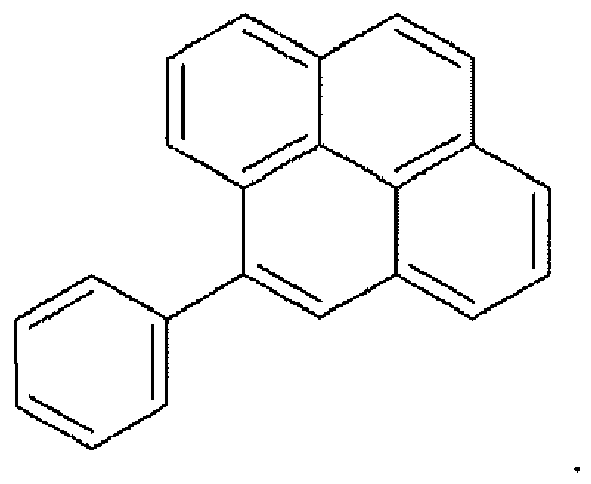
the pyrene-based compound has the structure: