(57) The invention pertains to a method and apparatus to separate and quantify particles
using time-variable force fields. The force fields can be for dielectrophoresis (positive
or negative), electrophoresis or electrohydrodinamic. In a first aspect of the method,
the fields are translated and/or modified in space at a speed substantially comparable
to the speed of translation of the fastest particles in the sample so that only these
follow by changing position, while the slowest particles are not affected.
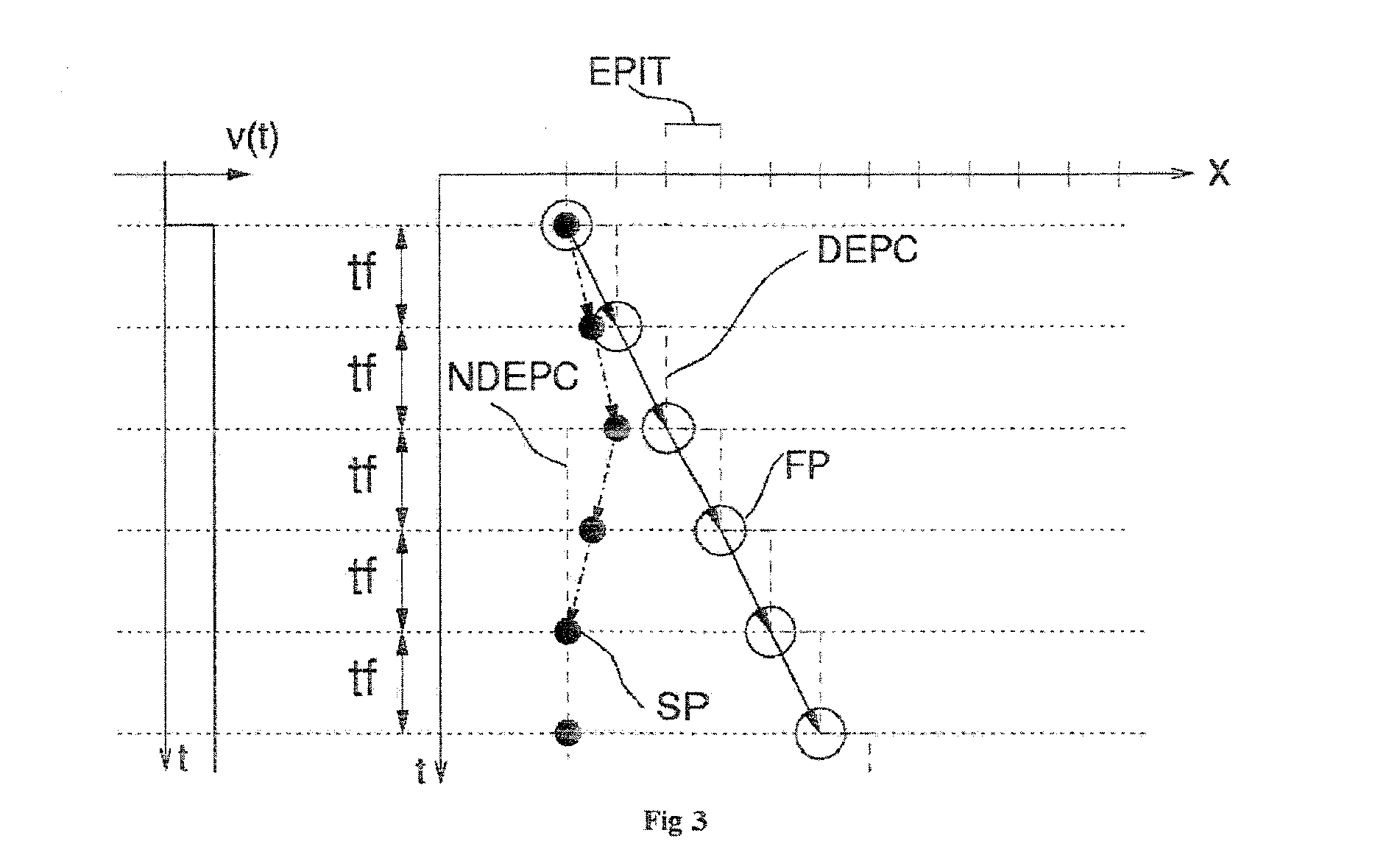
According to the invention the translation and/or modification of the force field
can also occur with varying speed, which is especially useful when this happens with
periodic law on a field with spatial periodicity. In one aspect of the method, a force
field with spatial periodicity is translated and/or modified in a first direction
at high speed, for such a period of time as to cause a movement equal to the spatial
period of the field, and at low speed in a second direction, opposite to the first
one, for such a period of time as to cancel the overall movement of the field, causing
the translation of the slowest particles in the second direction and no movement of
the fastest particles.
In an additional aspect of the method, the field is translated and/or modified in
a first direction at high speed, for such a period of time as to cause a movement
equal to the spatial period of the field minus a quantity corresponding to the period
of the electrodes generating it, causing the translation of the fastest particles
in the first direction and of the slowest particles in the opposite direction.
In another aspect of the method, the quantity or size of the particles is determined
by an indirect measurement of the speed of movement after varying the force field
by means of a relationship between the speed of movement and the volume of the particles.
This invention also pertains to an apparatus to produce appropriate field configurations
that are necessary for the selective movement of particles
|
|
