|
(11) | EP 2 540 698 A1 |

| (12) | EUROPEAN PATENT APPLICATION |
|
|
|
|
|||||||||||||||||||||||
|
||||||||||||||||||||||||
| (54) | Method for making phenylethylamine compounds |
| (57)
A method of making a phenylethylamine of formula (B): wherein R2, R3, R4, R5, R6, Rα, Rβ and Rn are each independently selected from hydrogen, alkyl, acyl, aryl, amido, amino acids, sugars and nucleotides. The method includes the reduction of a compound of formula (A) in the absence of base: wherein R2, R3, R4, R5, R6, Rα, Rβ and Rn are as defined above. |
FIELD OF THE INVENTION
[0001] The present invention relates to a method for making phenylethylamine compounds, and a group of novel phenylethylamine intermediates.
BACKGROUND OF THE INVENTION
[0002] The present invention relates to a method for making phenylethylamine compounds, and a group of novel phenylethylamine intermediates.
[0003] Amphetamine is commonly considered to be the most important phenylethylamine, and to date amphetamine has been made by many different methods. Only a few of these methods have been practiced commercially, and each of these methods has its disadvantages.
[0004] The classic method used to make amphetamines is the reduction of a derivative of norephedrine or norpseudoephedrine. The advantage this method has is that the resulting stereochemistry of the amphetamine product is controlled by the stereochemistry of the starting material. However, the reduction of norephedrine is difficult and can give rise to by-products that are difficult to remove. Various derivatives of norephedrine have been prepared to facilitate the reduction. For example, converting norephedrine to the benzylic chloride (Noggle F T, DeRuiter J, Clark C R, J. Chem. Sci. 1997, 25, 38-42) improves the ease of the reduction and has been known for some time, however the preparation of the chloride requires the use of hazardous, corrosive reagents. In another approach (US 6,399,828) norephedrine in converted to the benzylic acetate, which also improves the ease of the reduction, however the preparation of the acetate gives rise to undesired acetamide by-products.
[0005] Many of the other methods that are used to make amphetamines start with phenyl-2-propanone, a highly flammable liquid, which is a Schedule II controlled substance, i.e. its use is strictly regulated. The Schedule II designation and flammability impose a need for special storage and handling. These limitations complicate and add cost to the use of phenyl 2-propanone as a starting material. The condensation between phenylacetone and ammonia or an ammonia derivative typically uses Raney Nickel to reduce the resulting imine derivative (Haskelberg L, J. Am. Chem. Soc., 1948, 70, 2811-2812). This approach produces various by-products and impurities, while Raney Nickel itself is pyrophoric and therefore requires careful handling. The Leukart-Wallach reaction between formamide or ammonium formate and phenylacetone requires high temperatures and produces many by-products and impurities (Moore M L in "The Leukart Reaction", Adams R, Bachman, W E, Blatt A H, Fieser L F, Johnson J R, Synder H R, Eds. Organic Reactions, Vol. V; Wiley & Sons: New York, 1949, 301-330; Sinnema A, Verweij A M A, Bull. Narcotics, 1981, 33, 37-54). Additionally, the reaction times of methods progressing via this route are variable, as is the complexity of the necessary workup of impure product.
[0006] Amphetamines may also be manufactured from phenylalanine (Repke D B, Bates D K, Ferguson W J, J. Pharm. Sci., 1978, 67, 1167-1168), which enables the stereochemistry of the amphetamine product to be controlled by the stereochemistry of the amino acid used. These syntheses, however, involve many steps and require the use of hydride reagents or multiple catalytic hydrogenations, some of which use Raney Nickel thereby incurring the disadvantages mentioned above.
[0007] Dextroamphetamine may be obtained by the resolution of the racemate through the tartrate salt (US 6,399,828). However, this is a labour-intensive, low yield process.
[0008] The hydrogenation of 1,3-oxazolidin-2-ones has been reported in Effenburger et al (Chem. Eur. J., 1997, 3(8), 1370). The method involves the use of triethylamine which must be later removed in high vacuo before an amphetamine hydrochloride salt can be precipitated. The authors appear to believe that the presence of triethylamine is essential in order to facilitate the hydrogenation reaction. The inventors, however, believe that the addition of triethylamine prevents the hydrogenation reaction being commercially viable as the separation of the amine from the amphetamine would be extremely difficult and expensive on a commercial scale.
SUMMARY OF THE INVENTION
[0009] We have developed a method for the manufacture of phenylethylamines, including amphetamine, that avoids the use of bases, avoids the use of toxic and dangerous reagents, requires mild reaction conditions, produces essentially no by-products or impurities in the final products thereby eliminating the need for separate purification steps, is short, does not use controlled substances, is very robust and is suited to large-scale manufacture. This method also takes advantage of the innate stereochemistry of the starting materials, thereby eliminating the need for resolution steps.
DETAILED DESCRIPTION OF THE INVENTION
[0010] According to a first aspect, the invention provides a method of making a phenylethylamine of formula B:
wherein R2, R3, R4, R5, R6, Rα, Rβ and Rn are each independently selected from hydrogen, alkyl, acyl, aryl, amido, amino acids, sugars and nucleotides;
said method comprising the reduction of a compound of formula A in the absence of base:
wherein R2, R3, R4, R5, R6, Rα, Rβ and Rn are as defined above.
[0011] The compounds of formulae A and B can contain one or more chiral centres. The present invention therefore relates to all enantiomers, diastereomers and mixtures thereof.
[0012] As used herein, the term "alkyl" refers to an optionally substituted cyclic, branched or straight chain saturated hydrocarbon group preferably having 1 to 20 carbon atoms. Examples of C1-C20 alkyl groups include, but are not limited to, methyl, ethyl, n-propyl, isopropyl, n-butyl, t-butyl, n-pentyl, cyclopentyl, n-hexyl, cyclohexyl and the like. The alkyl group may be substituted with one or more groups independently selected from alkyl, acyl, aryl, aralkyl, alkoxy, amido, halo, -OH and -CN. Acyl, aryl, aralkyl, alkoxy, amido and halo are as defined herein.
[0013] The term "acyl" refers to an optionally substituted group of the formula -C(O)R' preferably having 1 to 20 carbon atoms, wherein R' is a substituent selected from hydrogen, alkyl, acyl, aryl, aralkyl, alkoxyl, amido, halo, -OH and the like. More preferably, R' is a substituent selected from hydrogen, alkyl, acyl, aryl, aralkyl, alkoxyl, amido, -OH and the like. The R' group may be substituted with one or more groups independently selected from alkyl, acyl, aryl, aralkyl, alkoxy, amido, halo, -OH and -CN. Preferably, R' is an optionally substituted alkyl or aryl group. Alkyl, acyl, aryl, aralkyl, alkoxy, amido and halo are as defined herein.
[0014] The term "aryl" refers to an optionally substituted aromatic carbocyclic group preferably having 6 to 20 carbon atoms. The aryl group may have a single ring or multiple condensed rings. Examples of C6-C20 aryl groups include, but are not limited to, phenyl, naphthyl, anthracenyl and the like. The aryl group may be substituted with one or more groups independently selected from alkyl, acyl, aryl, aralkyl, alkoxy, amido, halo, -OH and -CN. Unless otherwise specified, the aryl group may be attached at any suitable carbon atom and, if substituted, may be substituted at any suitable carbon atom. Alkyl, acyl, aryl, aralkyl, alkoxy, amido and halo are as defined herein.
[0015] The term "aralkyl" refers to an optionally substituted group of the formula -alkyl-aryl, where aryl and alkyl are as defined above. When Rn is -CH2Ph (i.e. benzyl), a debenzylation reaction may occur prior to, concomitantly with or after the reduction of the compound of formula A.
[0016] The term "alkoxy" refers to an optionally substituted group of the formula -O-alkyl. Alkyl is as defined above. Examples of alkoxy groups include, but are not limited to, methoxy, ethoxy, isopropoxy, n-butoxy, isobutoxy, t-butoxy, n-pentoxy, cyclopentoxy, n-hexyloxy and the like.
[0017] The term "amido" refers to an optionally substituted group of the formula -C(O)NR'R" preferably having 1 to 20 carbon atoms, wherein R' and R" are substituents independently selected from hydrogen, alkyl, acyl, aryl, aralkyl, alkoxy, amido, halogen, -OH, -CN and the like. More preferably, R' and R" are substituents independently selected from hydrogen, alkyl, acyl, aryl, aralkyl, alkoxy, amido, -OH, - CN and the like. The R' and R" groups may be substituted with one or more groups independently selected from alkyl, acyl, aryl, aralkyl, alkoxy, amido, halo, -OH or -CN. Preferably, R' and R" are independently optionally substituted alkyl or aryl groups. Alkyl, acyl, aryl, aralkyl, alkoxy, amido and halo are as defined herein.
[0019] The term "amino acid" refers to a substituent comprising an amino and a carboxylic acid group. Amino acids and their nomenclature are well-known in the art, for example, see Biochem. J. 1984, vol. 219, p.345; Eur. J. Chem., 1984, vol. 138, p.9; Eur. J. Chem., 1985, vol. 152, p.1; Eur. J. Chem., 1993, vol. 213, p.2; Internal. J. Pep. Prot. Res., 1984, vol. 24, p.84; J. Biol. Chem., 1985, vol. 260, p.14; Pure Applied Chem., 1984, vol. 56, p. 595; Amino Acids and Peptides, 1985, vol. 16, p.387, which are incorporated herein by reference. Unless otherwise specified, the amino acid may be attached at any suitable atom.
[0020] The term "sugar" refers to carbohydrates of general formula CnH2nOn, which may be optionally derivatised. Sugars and their nomenclature are well-known in the art, for example, see A. D. MacNaught and A. Wilkinson, "Compendium of Chemical Terminology: IUPAC Recommendations", 1997, Oxford; Adv. Carbohydr. Chem. Biochem., 1997, vol. 52, p.43; Carbohydr. Res., 1997, vol. 297, p.10; J. Carbohydr. Chem., 1997, vol. 16, p.1191; Pure Appl. Chem. 1996, vol. 68, p.1919, which are incorporated herein by reference. Unless otherwise specified, the sugar may be attached at any suitable atom.
[0021] The term "nucleotide" refers to a substituent comprising a purine or pyrimidine base, a pentose sugar and a phosphate group. Nucleotides and their nomenclature are well-known in the art, for example, see Arch. Biochem. Biophys. 1971, vol. 145, p.425; Biochem. J., 1971, vol. 120, p.449; Biochemistry, 1971, vol. 9, p.4022; Biochim. Biophys. Acta 1971, vol. 247, p.1; Eur. J. Biochem., 1970, vol. 15, p.203; Eur. J. Biochem., 1972, vol. 25, p.1; J. Biol. Chem., 1970, vol. 245, p.5171; J. Mol. Biol., 1971, vol. 55,p.299; Pure Appl. Chem., 1974, vol. 40, p.277, which are incorporated herein by reference. Unless otherwise specified, the nucleotide may be attached at any suitable atom.
[0022] Functional groups in the amino acid, sugar or nucleotide may be protected from participating in unwanted reactions by one or more suitable protecting groups which are known to the person skilled in the art and as described by, for example, P. G. M. Wuts and T. Greene, "Greene's Protective Groups in Organic Synthesis", John Wiley & Sons.
[0023] The method of the present invention is carried out in the absence of base. This offers the processing advantage in that the compounds of formula B can be isolated as the free amine by simple solvent minimisation.
[0024] In one embodiment, the reduction is carried out using gaseous hydrogen and a catalyst. Conveniently, the reduction will be carried out using gaseous hydrogen at atmospheric pressure or above (e.g. 5-25 psig). In a preferred embodiment, the catalyst is palladium on carbon. However, there are alternative means of carrying out the reducing step. Such means may include carrying out transfer hydrogenolysis using hydrogen donor agents such as readily dehydrogenatable hydrocarbons, (e.g. methyl cyclohexene), formic acid, ammonium or potassium formate, and hydrazine (Brieger G, Nestrick T, J. Chem. Rev., 1974, 74, 567-580). The skilled person will appreciate that other means of carrying out the reduction may also be used.
[0025] T e reduction is commonly carried out at a temperature of from about 0°C to about 30°C, conveniently from about 20°C to about 25°C.
[0026] The method of the present invention may be carried out in the absence of acid. The advantage of carrying out the reaction in such a way is that the phenylethylamine of formula B may be prepared as the free base. If lesired, the phenylethylamine of formula B as the free base may then be treated directly with an acid to prepare a salt. In this instance, there is no requirement for an exchange of salts to be performed to obtain a desired pharmaceutically acceptable salt once the reduction reaction has taken place. Moreover, if the salt exchange requires the intermediate preparation of the phenylethylamine of formula B as a free base, a solvent switch may also be necessary if the solvent or solvent mixtures present are not amenable to the freebasing operation. When carried out in the absence of an acid, therefore, the method of the present invention may additionally avoid the necessity of a solvent switch.
[0027] A variety of solvents or solvent mixtures may be used with the method of the present invention, including those comprising alcohols and/or aromatic hydrocarbons. Preferably, the alcoholic solvent is methanol, ethanol, butanol or SDA-3A (a solvent constituting 95% ethanol and 5% methanol). More preferably, the alcohol is butanol or SDA-3A. When the solvent is an aromatic hydrocarbon, it is preferably, benzene or toluene.
[0028] As explained above the method disclosed herein may be used to manufacture a range of phenylethylamines. Such phenylethylamines include amphetamine, i.e. when the R groups of formulae A and B are defined as follows: R2, R3, R4, R5, R6, Rβ and Rn are hydrogen, and Rα is a -CH3 group, and methamphetamine, i.e. when the R groups of formulae A and B are defined as follows R2, R3, R4, R5, R6 and Rβ are hydrogen, and Rα and Rn are -CH3 groups. More complex phenylethylamines may also be manufactured, such as those when the R groups of formulae A and B are defined as follows: R2, R3, R4, R5, R6 and Rβ are hydrogen, and Rn is an aryl group, amino acid, sugar or nucleotide, and wherein the amino acid, sugar or nucleotide is optionally protected. The inventors believe that any of the known amino acids may be used.
[0029] The method of the present invention further comprises the preparation of a pharmaceutically acceptable salt of the compound of formula B. By "pharmaceutically acceptable salt" we mean a therapeutically active, non-toxic salt which may be derived from organic or inorganic counterions. Pharmaceutically acceptable salts are well known in the art, for example, see "Pharmaceutical Sciences: The Science and Practice of Pharmacy (Remington: The Science and Practice of Pharmacy)", Lippincott Williams and Wilkins, which is incorporated herein by reference. Examples of pharmaceutically acceptable salts include, but are not limited to, hydrochloride, hydrobromide, sulphate, saccharate, aspartate, mesylate, dimesylate and the like.
[0030] In one embodiment, the compound of formula B is recovered prior to the preparation of the pharmaceutically acceptable salt.
[0031] In another embodiment, the pharmaceutically acceptable salt is prepared by the direct addition of the acid to the reaction mixture once the reduction is complete. In this case, the once the reduction is complete, the reaction mixture may be heated if required and the catalyst removed (e.g. by filtering through Celite). An aqueous acid solution is added (e.g. aqueous sulphuric acid, aqueous saccharic acid solution or aqueous aspartic acid solution) and excess water removed. Preferably, the pharmaceutically acceptable salt of the compound of formula B is recovered, for example, by filtering or decanting, and optionally dried.
[0032] When the compound of formula B is amphetamine, the pharmaceutically acceptable salt is preferably sulphate or aspartate. When the compound of formula B is methamphetamine, the pharmaceutically acceptable salt is preferably hydrochloride. When the compound of formula B is dextroamphetamine, the pharmaceutically acceptable salt is preferably sulphate, aspartate or saccharate and more preferably, sulfate.
[0033] In order that the invention may be more fully understood, the following Examples are provided by way of illustration only:
Example 1
Dextroamphetamine
[0034] A mixture of 6.00 g (33.9 mmol) (4S,5R)-(-)-4-methyl-5-phenyl-2-oxazolidinone, 0.34 g 10% palladium-on-carbon (50% water wet), and 60 mL SDA-3A (a solvent constituting 95% Ethanol and 5% Methanol) was stirred under a hydrogen filled balloon at ambient temperature (approximately 20°C) until no more oxazolidinone was detected by HPLC, 4 h. The reaction mixture was then filtered through a pad of Celite to remove the catalyst. For the purposes of isolating the free base, a filtered reaction mixture was carefully concentrated under reduced pressure to leave 4.47 g of a crystalline semi-solid, which was found to be a mixture of 96% dextroamphetamine and 4% ethanol by 1H NMR. Some dextroamphetamine was detected in the distillate. Yield = 94%. 400 MHz 1H NMR (CDCl3) 7.34-7.20 (m, 5), 3.22-3.17 (m, 1), 2.76-2.72 (d of d, J = 13.2 Hz, J' = 5.4 Hz, 1), 2.57-2.52 (d of d, J = 13.2 Hz, J' = 8.1 Hz, 1), 1.16-1.14 (d, J = 6.3 Hz, 3).
Example 2
Amphetamine
[0035] A mixture of 6.00 g (33.9 mmol) rac-cis-4-methyl-5-phenyl-2-oxazolidinone, 0.34 g 10% palladium-on-carbon (50% water wet), and 60 mL SDA-3A was stirred under a hydrogen filled balloon at ambient temperature until no more oxazolidinone was detected by HPLC (7 h). The reaction mixture was then filtered through a pad of Celite to remove the catalyst.
Example 3
Methamphetamine
[0036] A mixture of 1.00 g (5.23 mmol) (4S,5R)-3,4-dimethyl-5-phenyl-2-oxazolidinone, 0.0530 g 10% palladium-on-carbon (50% water wet), and 10 mL SDA-3A was stirred under a hydrogen filled balloon at ambient temperature overnight. The reaction had no detectable oxazolidinone by HPLC in the morning.
Example 4
N-Acetyl-d-amphetamine
[0037] A mixture of 1.00 g (4.56 mmol) (4S,5R)-3-Acetyl-4-methyl-5-phenyl-2-oxazolidinone, 0.0460 g 10% palladium-on-carbon (51% water wet), and 10 mL SDA-3A was stirred under a hydrogen filled balloon at ambient temperature overnight. The reaction had no detectable oxazolidinone by HPLC in the morning. The reaction mixture was then filtered through a pad of Celite to remove the catalyst. The filtrate was carefully concentrated under reduced pressure to leave 0.98 g of a liquid, which proved to be a mixture of 81%, N-acetyl-d-amphetamine, 19% ethanol, and 1% methanol. Yield = 98%. 400 MHz 1H NMR (CDCl3) 7.34-7.18 (m, 5), 4.30-4.26 (m, 1), 2.87-2.83 (d of d, J = 13.5 Hz, J' = 5.7 Hz, 1), 2.76-2.71 (d of d, J = 13.5 Hz, J' = 7.2 Hz, 1), 1.95 (s, 3), 1.13-1.11 (d, J = 6.7 Hz, 3).
Example 5
Dextroamphetamine Sulfate
[0038] The method of Example 1 was followed until the catalyst was filtered away whereupon a total of 7 mL 25% H2SO4 (aq) was added dropwise to the filtrate over 3 min. After cooling in an ice/water bath for 15 min, the mixture was filtered to collect the dextroamphetamine sulfate using cold SDA-3A as a flask and cake rinse. After drying, a total of 5.79g of dextroamphetamine sulfate was obtained, 93% yield. This material was assayed at 100% by HPLC.
Example 6
Dextroamphetamine Saccharate
[0039] A mixture of (4S,5R)-4-Methyl-5-phenyl-2-oxazolidinone (20.00 g, 112.9 mmol), 210 mL 1-Butanol, and 1.14 g Water wet 10% Palladium-on-Carbon was made. The Palladium-on-Carbon was about 50% Water wet. The mixture was hydrogenated at 20-25 °C, 20-25 psig until there was not more than 0.09% remaining Oxazolidinone when normalized to the Dextroamphetamine by HPLC. This took approximately 5.5 h. The reaction mixture was heated to 30-35 °C and filtered through Celite to remove the catalyst using 42 mL 1-Butanol as a flask and cake rinse. An aqueous Saccharic Acid solution (132 mL, 0.09 g/mL, 56.5 mmol) was then added to the filtrate. The resulting solution was then concentrated under reduced pressure at a temperature of not more than 65 °C to a volume of about 180 mL to remove Water by azeotropic distillation. A total of 105 mL 1-Butanol was added and the distillation repeated. The addition of 1-Butanol and subsequent distillation was repeated until the Water content was less than or equal to 2.0%. To the resulting solution was added 358 mL Acetone, the mixture cooled to -5-0 °C, and the Dextroamphetamine Saccharate was then collected by vacuum filtration. After drying, 22.93 g (85%) of Dextroamphetamine Saccharate was obtained.
Example 7
Amphetamine Aspartate
[0040] A mixture of rac-cis-4-Methyl-5-phenyl-2-oxazolidinone (38.00 g, 214.4 mmol), 380 mL 1-Butanol, and 2.15 g Water wet 10% Palladium-on-Carbon was made. The Palladium-on-Carbon was about 50% Water wet. The mixture was hydrogenated at 20-25 °C, 20-25 psig until there was not more than 0.09% remaining Oxazolidinone when normalized to the Amphetamine by HPLC. The mixture was then heated to 30-35 °C and filtered through Celite using 1-Butanol as a flask and cake rinse. The filtrate was heated to 40-50 °C and added to an aqueous solution of Aspartic Acid (28.50 g, 214.1 mmol, dissolved in 410 mL Water) also at 40-50 °C. The resulting mixture was then polish filtered at 55-60 °C. The filtrate was vacuum distilled at less than 65 °C to bring the Water content to not more than 1.0%. The final target volume was 431 mL. The distillation was repeated several times in order to achieve this by adding 1-Butanol and then distilling. Once the desired Water content was achieved, the target volume was attained by either continuing the distillation or adding more 1-Butanol. The resulting mixture was cooled to 0-5 °C and 232 mL SDA-3A was added. The Amphetamine Aspartate was then collected and dried to give 47.72 g (83%).
Example 8
Amphetamine Sulfate
[0041] A mixture of rac-cis-4-Methyl-5-phenyl-2-oxazolidinone (40.00 g, 225.7 mmol), 400 mL SDA-3A, and 2.27 g Water wet 10% Palladium-on-Carbon was made. The Palladium-on-Carbon was about 50% Water wet. The mixture was hydrogenated at 20-25 °C, 5-10 psig until there was not more than 0.09% remaining Oxazolidinone when normalized to the Amphetamine by HPLC. The mixture was then filtered through Celite to remove the catalyst and 37.53 mL Water was added. The temperature was brought to 68-75 °C and 44.28 g 25% Sulfuric Acid (aq) was added maintaining 68-75 °C. The mixture was then cooled to 0-5 °C and the Amphetamine Sulfate was then collected to give 33.35 g (80%).
1. A method of making a phenylethylamine of formula B:
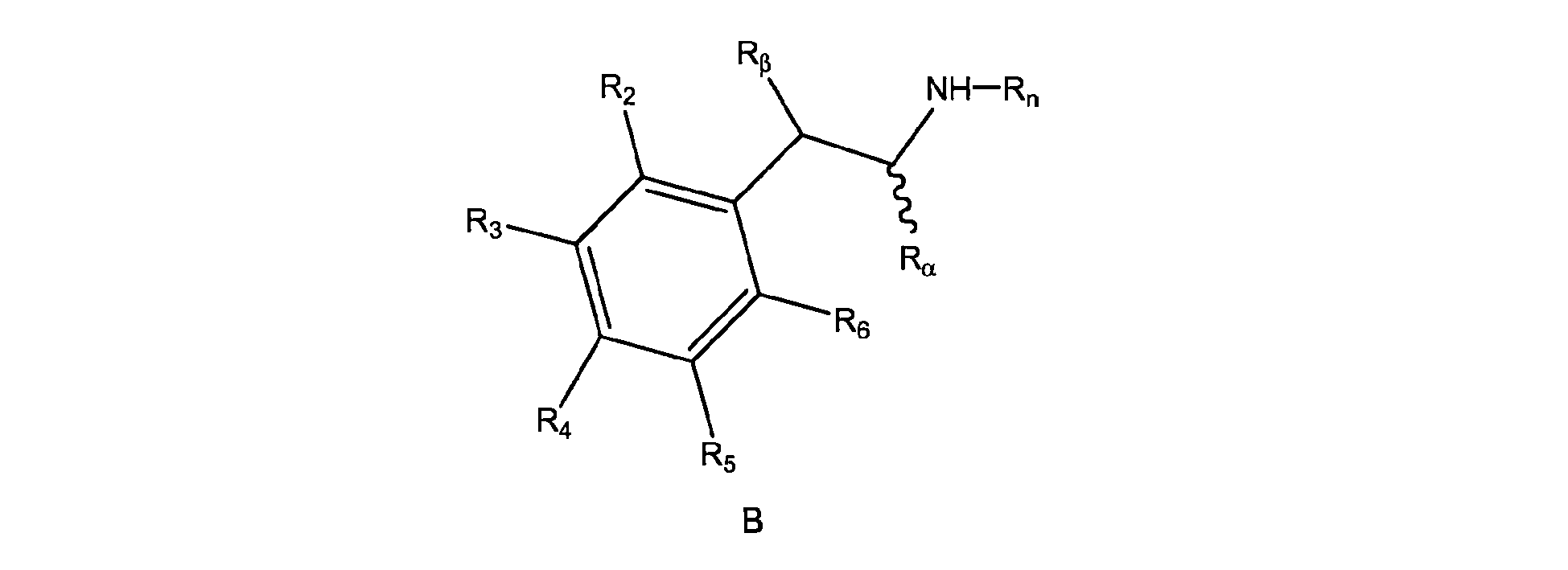
wherein R2, R3, R4, R5, R6, Rα, Rβ and Rn are each independently selected from hydrogen, alkyl, acyl, aryl, amido, amino acids, sugars and nucleotides;
said method comprising the reduction of a compound of formula A in the absence of base:
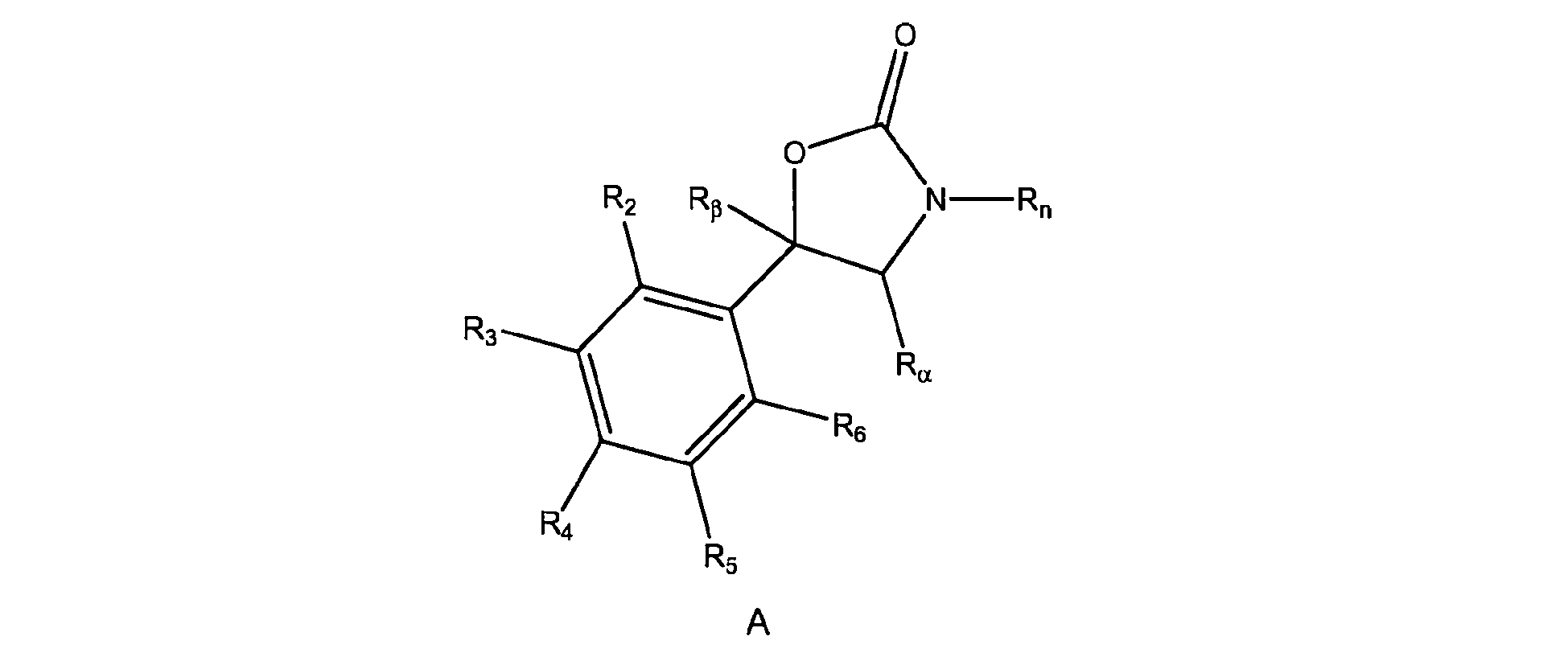
wherein R2, R3, R4, R5, R6, Rα, Rβ and Rn are as defined above.
wherein R2, R3, R4, R5, R6, Rα, Rβ and Rn are each independently selected from hydrogen, alkyl, acyl, aryl, amido, amino acids, sugars and nucleotides;
said method comprising the reduction of a compound of formula A in the absence of base:
wherein R2, R3, R4, R5, R6, Rα, Rβ and Rn are as defined above.
2. A method according to claim 1, wherein the reduction is carried out using (a) gaseous
hydrogen and a catalyst or (b) a hydrogen transfer agent.
3. A method according to claim 2, wherein the reduction is carried out using gaseous
hydrogen at atmospheric pressure or above.
4. A method according to claim 2, wherein the catalyst is palladium on carbon.
5. A method according to any one of the preceding claims, wherein the reduction is carried
out at a temperature of from about 0°C to about 30°C.
6. A method according to claim 5, wherein the temperature is from about 20°C to about
25°C.
7. A method according to any one of the preceding claims, wherein the reduction is carried
out in the absence of acid.
8. A method according to any one of the preceding claims, wherein the reduction is carried
out in the presence of at least one solvent selected from the group consisting of
alcohols and aromatic hydrocarbons.
9. A method according to any one of the preceding claims, wherein R2, R3, R4, R5, R6, Rβ and Rn are hydrogen, and Rα is a -CH3 group.
10. A method according to any one of claims 1 to 8, wherein R2, R3, R4, R5, R6 and Rβ are hydrogen, and Rα and Rn are -CH3 groups.
11. A method according to any one of claims 1 to 8, wherein R2, R3, R4, R5, R6 and Rβ are hydrogen, and Rn is a aryl group, amino acid, sugar or nucleotide, and wherein the amino acid, sugar
or nucleotide is optionally protected.
12. A method according to any one of the preceding claims, further comprising the preparation
of a pharmaceutically acceptable salt of the compound of formula B.
13. A compound of formula A, wherein R2, R3, R4, R5, R6 and Rβ are hydrogen, and Rn is a aryl group, amino acid, sugar, or nucleotide, and wherein the amino acid, sugar
or nucleotide is optionally protected.
14. A phenylethylamine of formula B:
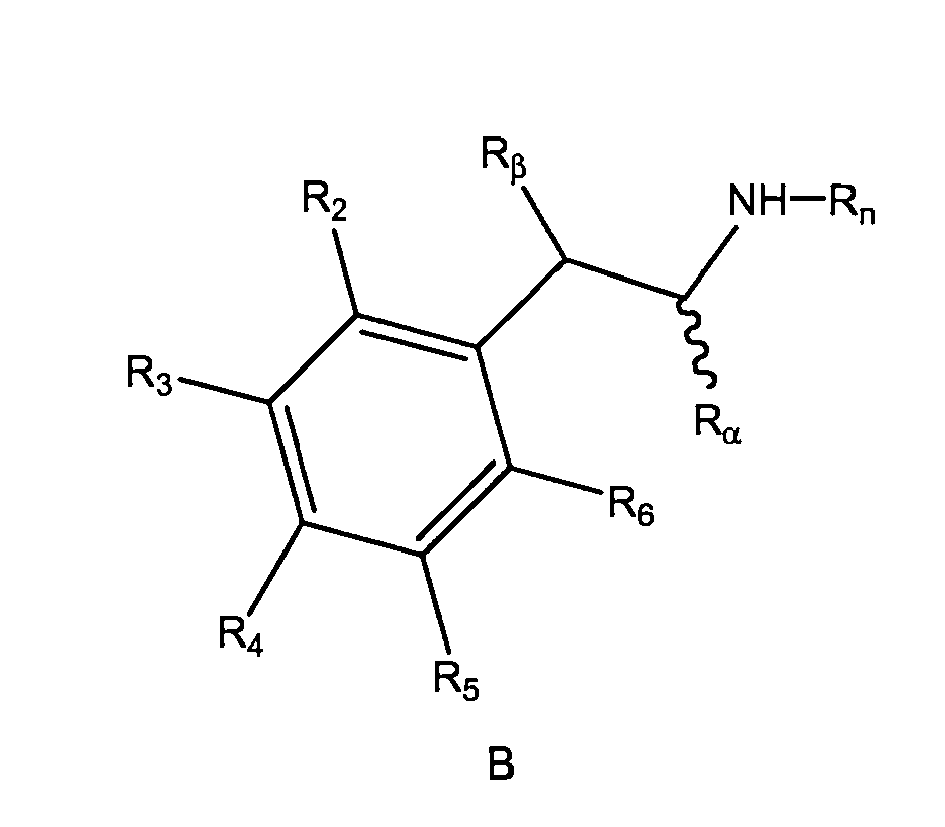
wherein R2, R3, R4, R5, R6, Rα, Rβ and Rn are each independently selected from hydrogen, alkyl, acyl, aryl, amido, amino acids, sugars and nucleotides; prepared by the method of any one of claims 1 to 12.
wherein R2, R3, R4, R5, R6, Rα, Rβ and Rn are each independently selected from hydrogen, alkyl, acyl, aryl, amido, amino acids, sugars and nucleotides; prepared by the method of any one of claims 1 to 12.
REFERENCES CITED IN THE DESCRIPTION
This list of references cited by the applicant is for the reader's convenience only. It does not form part of the European patent document. Even though great care has been taken in compiling the references, errors or omissions cannot be excluded and the EPO disclaims all liability in this regard.
Patent documents cited in the description
Non-patent literature cited in the description
- NOGGLE F TDERUITER JCLARK C RJ. Chem. Sci., 1997, vol. 25, 38-42 [0004]
- HASKELBERG LJ. Am. Chem. Soc., 1948, vol. 70, 2811-2812 [0005]
- The Leukart ReactionMOORE M LOrganic ReactionsWiley & Sons19490000vol. V, 301-330 [0005]
- SINNEMA AVERWEIJ A M ABull. Narcotics, 1981, vol. 33, 37-54 [0005]
- REPKE D BBATES D KFERGUSON W JJ. Pharm. Sci., 1978, vol. 67, 1167-1168 [0006]
- EFFENBURGER et al.Chem. Eur. J., 1997, vol. 3, 81370- [0008]
- Biochem. J., 1984, vol. 219, 345- [0019]
- Eur. J. Chem., 1984, vol. 138, 9- [0019]
- Eur. J. Chem., 1985, vol. 152, 1- [0019]
- Eur. J. Chem., 1993, vol. 213, 2- [0019]
- Internal. J. Pep. Prot. Res., 1984, vol. 24, 84- [0019]
- J. Biol. Chem., 1985, vol. 260, 14- [0019]
- Pure Applied Chem., 1984, vol. 56, 595- [0019]
- Amino Acids and Peptides, 1985, vol. 16, 387- [0019]
- A. D. MACNAUGHTA. WILKINSONCompendium of Chemical Terminology: IUPAC Recommendations, 1997, [0020]
- Adv. Carbohydr. Chem. Biochem., 1997, vol. 52, 43- [0020]
- Carbohydr. Res., 1997, vol. 297, 10- [0020]
- J. Carbohydr. Chem., 1997, vol. 16, 1191- [0020]
- Pure Appl. Chem., 1996, vol. 68, 1919- [0020]
- Arch. Biochem. Biophys., 1971, vol. 145, 425- [0021]
- Biochem. J., 1971, vol. 120, 449- [0021]
- Biochemistry, 1971, vol. 9, 4022- [0021]
- Biochim. Biophys. Acta, 1971, vol. 247, 1- [0021]
- Eur. J. Biochem., 1970, vol. 15, 203- [0021]
- Eur. J. Biochem., 1972, vol. 25, 1- [0021]
- J. Biol. Chem., 1970, vol. 245, 5171- [0021]
- J. Mol. Biol., 1971, vol. 55, 299- [0021]
- Pure Appl. Chem., 1974, vol. 40, 277- [0021]
- P. G. M. WUTST. GREENEGreene's Protective Groups in Organic SynthesisJohn Wiley & Sons [0022]
- BRIEGER GNESTRICK TJ. Chem. Rev., 1974, vol. 74, 567-580 [0024]
- Pharmaceutical Sciences: The Science and Practice of Pharmacy (Remington: The Science and Practice of PharmacyLippincott Williams and Wilkins [0029]