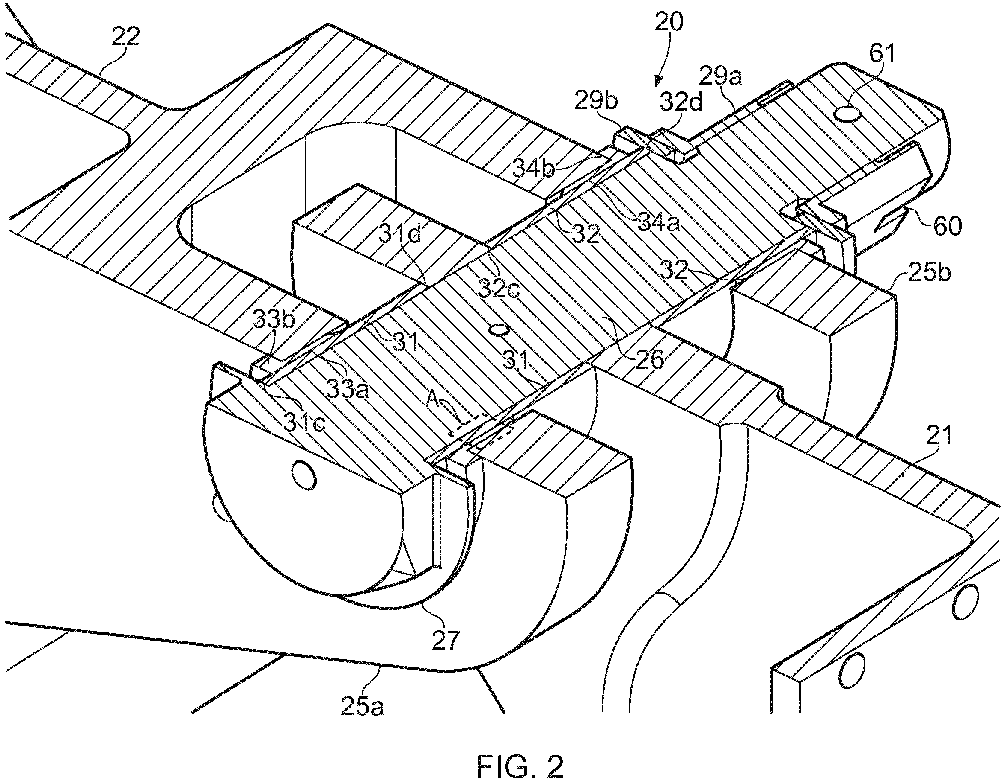
(57) A plain journal bearing (20) coupling a first component (21) to a second component
(22). A pin (26, 27) passes through the first component (21) and the second component
(22). A clamping bush (31, 32) surrounds the pin and has a cylindrical inner surface
and a cylindrical outer surface. A clamping member (29a) is mounted on the pin and
provides a clamping force to urge the clamping bush (31, 32) into clamping engagement
with the first component. The bearing (20) has a primary slip path between the outer
surface of the clamping bush (31, 32) and the second component (22) which is arranged
to operate such that during normal operation of the bearing, when the first and second
component rotate relative to each other, the second component (22) and the clamping
bush (31, 32) rotate relative to each other about the primary slip path and the clamping
bush (31, 32) remains in clamping engagement with the first component (21). The pin
(26, 27) also has a cylindrical outer surface which provides a subsidiary slip path
which is arranged to operate such that during degraded operation of the bearing (20),
when the first (21) and second (22) component rotate relative to each other and the
coefficient of friction of the primary slip path has increased to overcome the clamping
force, the pin (26, 27) and the clamping bush (31, 32)or the pin (26, 27) and the
first component (21) rotate relative to each other about the subsidiary slip path.
|
|
