|
(11) | EP 2 598 470 B1 |

| (12) | EUROPEAN PATENT SPECIFICATION |
|
|
| (54) |
FORMULATIONS FORMULIERUNGEN PRÉPARATIONS |
|
|
|||||||||||||||||||||||||||||||
| Note: Within nine months from the publication of the mention of the grant of the European patent, any person may give notice to the European Patent Office of opposition to the European patent granted. Notice of opposition shall be filed in a written reasoned statement. It shall not be deemed to have been filed until the opposition fee has been paid. (Art. 99(1) European Patent Convention). |
[0001] This invention relates to the use of certain fumarate compounds as solvents, especially in formulations, particularly in agrochemical formulations and in environmentally friendly formulations; and to certain novel compounds. The solvents of the present invention are found to be particularly effective at forming stable emulsions in water.
[0002] Nowadays, the Formulation Chemist is required to address a number of environmental criteria when developing new formulations. Ideally, a suitable solvent will display many or all of the following properties: a low water solubility; an excellent dissolving power for pesticides or other organic molecules; made from plant or animal renewable resources; low skin irritation; low ecotoxicity, for example to daphnia; low volatile organic content; and a high flash point. The compounds of the present invention each display all or many of these properties, in particular they form stable emulsions in water; the compounds may be used effectively as solvents. JP-8-175909 discloses aqueous suspensions comprising fumarate esters and a fungicidal compound.
[0003] Accordingly, the present invention provides a formulation comprising an agrochemical and a compound of formula (I)
where R1 is butyl and R2 is propyl or butyl; characterised in that the formulation is an emulsifiable concentrate or emulsion.
[0005] The present invention encompasses all isomers, or mixtures of isomers, of compounds of formula (I) and also encompasses mixtures of two or more different compounds of formula (I).
[0006] The selection of solvents for an (agricultural) emulsion concentrate or water-dispersed emulsion formulation is complicated. Often there is a requirement for two different solvents. A solvent which has an aqueous solubility of at least 0.1% w/w [at the relevant temperature] may dissolve appreciably in an agrochemical spray tank full of water, under normal dilution or dispersion conditions [for example, at temperatures of from just above freezing to 35°C]. Such a solvent will not form stable emulsions in water when formulated with surfactants however it may be an effective solvent for dissolving pesticides. Such a solvent is normally also formulated with an oil of much lower water solubility. Solvents which have aqueous solubility values below 0. 1%w/w [at the relevant temperature] are used along with a solvent with the above higher aqueous solubility in order to be able to prepare stable emulsions. The solvent with the low water solubility is normally a poor solvent for dissolving pesticides. The surprising finding about the fumarate solvents used in the present invention is that they have a low water solubility yet they are also good solvents for pesticides. This fact is amply displayed in the data given in the Examples.
[0007] Table 1 provides structures of suitable compounds of formula (I).
Table 1
| Compound Number | R1 | R2 |
| 1.3 | CH3CH2CH2CH2 | CH3CH2CH2CH2 |
| 1.4 | (CH3)2CHCH2 | (CH3)2CHCH2 |
[0008] Suitably the invention provides the use of a compound of formula (I) in an agrochemical formulation.
[0009] The compounds used in the invention may be used in a variety of agrochemical formulations, particularly as solvents. These solvents may be used with a wide variety of materials, including herbicides, fungicides, acaricides, nematicides, insecticides and plant growth regulators.
[0010] The compounds used in the invention may be used to formulate solutions of a variety of materials, including agrochemicals, which may be formulated as emulsion or dispersion concentrates, emulsions in water or oil, microencapsulated formulations, aerosol sprays or fogging formulations; and these may be further formulated into granular materials or powders, for example for dry application or as water-dispersible formulations. Any solutions so formed may also be used directly on soil or plants or in other non-agrochemical applications.
[0011] The compounds used in the present invention have exceptional dissolving power for a wide variety of agrochemicals, pharmaceuticals and other commercially valuable compounds, plus the dissolving power also extends to dissolution of dirt, grease or waxes.
[0012] The invention is illustrated by the following Examples in which: g = grammes, °C = degrees centigrade and N/A = not available
EXAMPLE 1
[0014] This Example demonstrates the low water solubility of (E)-but-2-enedioic acid di n-butyl ester. Typically, solvents which have aqueous solubilities of about (or at least) 0.1% w/w [at the relevant temperature] can dissolve appreciably in agrochemical spray tanks under normal dilution conditions [for example, temperatures of from just above freezing to 35°C]. These solvents do not form stable emulsions in water when used by themselves. Solvents such as acetophenone are normally formulated with an oil of much lower water solubility. For example, solvents which have aqueous solubility values typically below 0. 1%w/w [at the relevant temperature] are suitable for preparing emulsions. Table 2 provides water solubilities for a number of solvents at 25°C. Saturated solutions of each solvent in deionised water were prepared by leaving excess solvent in contact with water for a period of at least two weeks. After this time a sample of the water was analysed chromatographically to determine the concentration of solvent present.
Table 2
| Solvent | % water solubility [by weight at 25°C] |
| Dodecylbenzene (1-phenyldodecane) | 0.000026 |
| Dicaprylyl carbonate (Cetiol™ CC) | 0.000039 |
| Exxsol™ D-80 (Dodecane) | 0.00089 |
| (E)-But-2-enedioic acid dibutyl ester | 0.04 |
| Jeffsol™ AG-1723 | 0.04 |
| Dipentene (limonene) | 0.098 |
| Tetralin™ (tetrahydronaphthalene) | 0.18 |
| Norpar™ 15 | 0.4 |
| Decalin (decahydronaphthalene) | 0.7 |
| Genagen™ 4166 (dimethyl heptamide) | 0.7 |
| Diethyl fumarate | 0.8 |
| Acetophenone (methyl phenyl ketone) | 0.9 |
| Benzyl alcohol, benzene methanol | 4.4 |
| Triacetin (glycerol triacetate) | 7.7 |
EXAMPLE 2
[0015] In this Example several solvents useful in the present invention and others were used to dissolve isopyrazam. The results show that some of these are effective solvents for this agrochemical. A glass vial was approximately one eighth filled with an active ingredient and then solvent was added until the vial was approximately one third full. The resultant sample was mixed with a Whirlimixer™ and was then stored at 25°C. The sample was checked every few days; if there was no solid active ingredient present then additional active ingredient was added; if there was no liquid remaining then additional solvent was added. This procedure was repeated until the sample had equilibrated for 4 weeks following the final addition of either active ingredient or solvent. The supernatant liquid layer was then analysed by gas chromotography for active ingredient concentration; the solubilities of isopyrazam in several solvents are given in Table 3:
Table 3
| Solvent | Isopyrazam % w/w |
| (E)-But-2-enedioic acid dibutyl ester | 5.0 |
| (E)-But-2-enedioic acid diisopropyl ester | 6.0 |
| (E)-But-2-enedioic acid diisobutyl ester | 4.8 |
| (E)-But-2-enedioic acid dipentyl ester | 4.6 |
| (E)-But-2-enedioic acid bis(1-methyl-butyl) ester | 3.5 |
| (E)-But-2-enedioic acid bis(3-methyl-butyl) ester | 3.7 |
| (E)-But-2-enedioic acid dihexyl ester | 3.7 |
| (E)-But-2-enedioic acid bis(2-methyl-pentyl) ester | 3.0 |
| (E)-But-2-enedioic acid bis(3-methyl-pentyl) ester | 3.1 |
| (E)-But-2-enedioic acid bis(4-methyl-pentyl) ester | 2.3 |
EXAMPLE 3
[0016] This Example shows that the solvents of the present invention are particularly effective at solubilising pesticides. Tables 4a and 4b show the solubility of the pesticides azoxystrobin, difenoconazole, isopyrazam, cyproconazole, chlorothalonil and bicyclopyrone in the solvent (E)-but-2-enedioic acid dibutyl ester. For comparison the solubilities in a series of commonly used, low water solubility solvents are also tabulated. The data show that in most cases the (E)-but-2-enedioic acid dibutyl ester was a more effective solvent. Solubilities are quoted as percentage w/w at 20°C.
Table 4a
| Solvent | Azoxystrobin | Cyproconazole | Difenoconazole |
| Dipentene | 0.14 | 1 | 5.9 |
| Norpar™ 15 | 0.16 | 0.1 | 0.4 |
| Decalin | 0.03 | 0.4 | 1.8 |
| Exxsol™ D-80 | 0.13 | 0.5 | 0.9 |
| Jeffsol™ AG-1723 | 0 | 0.9 | N/A |
| Dodecylbenzene | 0 | 0.9 | N/A |
| (E)-But-2-enedioic acid dibutyl ester | 1.4 | 6.5 | 18 |
| Dicaprylyl carbonate | 0 | 2.6 | N/A |
| Tetralin | 1.85 | 5.2 | N/A |
Table 4b
| Solvent | Chlorothalonil | Bicyclopyrone | Isopyrazam |
| Dipentene | 0.18 | 7.4 | 0.8 |
| Norpar™ 15 | N/A | 0.3 | 0.3 |
| Decalin | N/A | 1.8 | 0.3 |
| Exxsol™ D-80 | N/A | 0.97 | 0.3 |
| Jeffsol™ AG-1723 | N/A | N/A | 0.39 |
| Dodecylbenzene | N/A | N/A | 0.6 |
| (E)-But-2-enedioic acid dibutyl ester | 0.6 | 16 | 5.0 |
| Dicaprylyl carbonate | N/A | N/A | 1.9 |
| Tetralin | N/A | N/A | 2.6 |
EXAMPLE 4
[0017] This Example shows that (E)-but-2-enedioic acid dibutyl ester may act as an adjuvant to enhance significantly the biological performance of a pesticide. The weed species Setaria Viridis (SETVI), Lolium Perenne (LOLPE), Avena Fatua (AVEFA) and Alopecurus Myosuroides (ALOMY) were grown under glass house conditions and sprayed with the herbicide pinoxaden at a rate of 7.5 grams of pesticide per hectare. Weeds were treated with pinoxaden in the absence of (E)-but-2-enedioic acid dibutyl ester (as a control) and also with (E)-but-2-enedioic acid dibutyl ester added to the spray-tank at a concentration of 0.2% by volume. After both 14 and 21 days the efficacy of the herbicide was assessed based on the percentage of the weeds that had been killed. Three replicates were used in all cases. The average percentage of weeds killed is quoted in Table 5 for each weed species either with the adjuvant or without (control). Results have been averaged across three replicates. The standard deviation for each result is shown in brackets after the result. The results in Table 5 show that at a confidence level of 95% the solvent-containing system was found to be more efficacious than the adjuvant-free formulation.
Table 5
| Adjuvant | Days after application | ALOMY | AVEFA | LOLPE | SETVI |
| (E)-But-2-enedioic acid dibutyl ester | 14 | 20(17.3) | 20(10) | 13.3(5.8) | 20(0) |
| None | 14 | 1.7(2.9) | 0(0) | 6.7(5.8) | 0(0) |
| (E)-But-2-enedioic acid dibutyl ester | 21 | 33.3(15.3) | 16.7(5.8) | 6.7(5.8) | 20(10) |
| None | 21 | 0(0) | 0(0) | 0(0) | 0(0) |
EXAMPLE 5
[0018] This Example shows that (E)-but-2-enedioic acid dibutyl ester can act as an adjuvant to enhance significantly the biological performance of a pesticide. The weed species Polygonum Convolvulus, Digitaria Sanguinalis, Brachiaria Decumbens and Amaranthus Tuberculatus were grown under glass house conditions and sprayed with the herbicide mesotrione at rate of 45 grams of pesticide per hectare. Weeds were treated with the mesotrione in the absence of (E)-but-2-enedioic acid dibutyl ester (as a control) and also with (E)-but-2-enedioic acid dibutyl ester added to the spray-tank at a concentration of 0.2%v/v. After 14 and 21 days the efficacy of the herbicide was assessed based on the percentage of the weeds that had been killed. Three replicates were used in all cases. The performance of the solvent was assessed by averaging the three replicates at each time period and for each weed. The standard deviation for each result is shown in brackets after the average percentage weed kill. The results in Table 6 show that at a confidence level of 95% the solvent-containing system was found to be more efficacious than the adjuvant-free formulation.
Table 6
| Adjuvant | Days after application | AMATU | BRADE | DIGSA | POLCO |
| (E)-But-2-enedioic acid dibutyl ester | 21 | 94(3.6) | 40(0) | 41.7(7.6) | 80(10) |
| None | 21 | 85(5) | 16.7(11.5) | 10(0) | 76.7(5.8) |
| (E)-But-2-enedioic acid dibutyl ester | 14 | 76.7(5.8) | 43.3(5.8) | 36.7(2.9) | 80(10) |
| None | 14 | 63.3(5.8) | 20(10) | 13.3(5.8) | 66.7(15.3) |
1. A formulation comprising an agrochemical and a compound of formula (I)
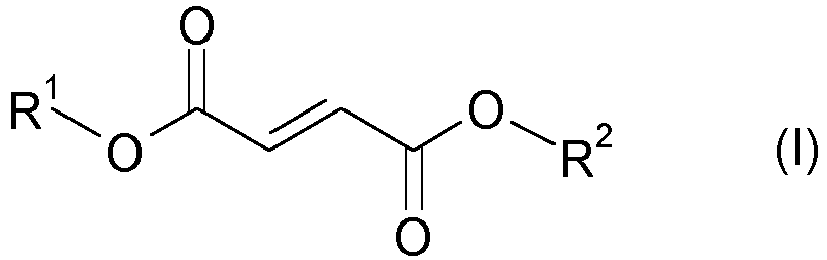
where R1 is butyl and R2 is propyl or butyl; characterised in that the formulation is an emulsifiable concentrate or emulsion.
where R1 is butyl and R2 is propyl or butyl; characterised in that the formulation is an emulsifiable concentrate or emulsion.
2. A formulation as claimed in claim 1 where R2 is butyl.
3. A formulation as claimed in claim 1 where both R1 and R2 are n-butyl.
1. Formulierung, umfassend eine Agrochemikalie und eine Verbindung der Formel (I)
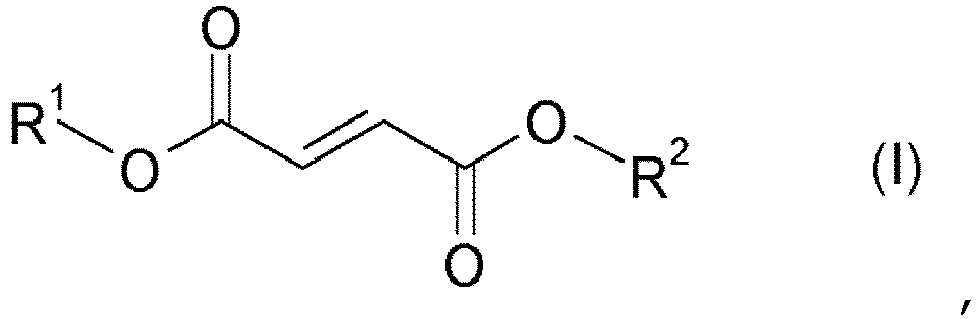
wobei R1 für Butyl steht und R2 für Propyl oder Butyl steht, dadurch gekennzeichnet, dass es sich bei der Formulierung um ein Emulsionskonzentrat oder eine Emulsion handelt.
wobei R1 für Butyl steht und R2 für Propyl oder Butyl steht, dadurch gekennzeichnet, dass es sich bei der Formulierung um ein Emulsionskonzentrat oder eine Emulsion handelt.
2. Formulierung nach Anspruch 1, wobei R2 für Butyl steht.
3. Formulierung nach Anspruch 1, wobei sowohl R1 als auch R2 für n-Butyl stehen.
1. Formulation comprenant un composé agrochimique et un composé de formule (I)
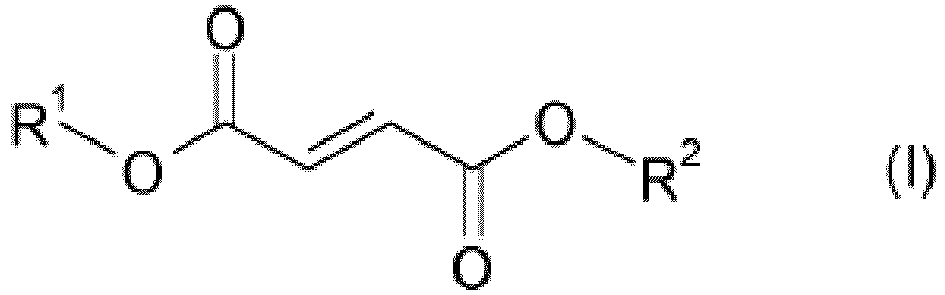
R1 étant butyle et R2 étant propyle ou butyle ; caractérisée en ce que la formulation est un concentré émulsifiable ou une émulsion.
R1 étant butyle et R2 étant propyle ou butyle ; caractérisée en ce que la formulation est un concentré émulsifiable ou une émulsion.
2. Formulation selon la revendication 1, R2 étant butyle.
3. Formulation selon la revendication 1, à la fois R1 et R2 étant n-butyle.
REFERENCES CITED IN THE DESCRIPTION
This list of references cited by the applicant is for the reader's convenience only. It does not form part of the European patent document. Even though great care has been taken in compiling the references, errors or omissions cannot be excluded and the EPO disclaims all liability in this regard.
Patent documents cited in the description