|
(11) | EP 2 602 250 A1 |

| (12) | EUROPEAN PATENT APPLICATION |
| published in accordance with Art. 153(4) EPC |
|
|
|
|
|||||||||||||||||||
| (54) | METHOD FOR PREPARING ROSUVASTATIN CALCIUM INTERMEDIATE |
| (57) Disclosed is a method for preparing rosuvastatin calcium intermediate of formula
I, which comprises hydrolyzing an ester compound of formula II (R is C1-C5 alkyl)
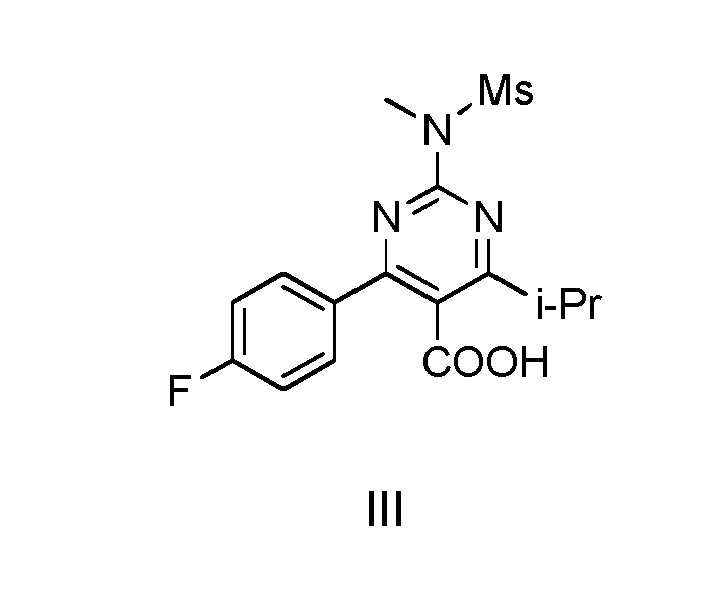
in the presence of a metal compound to obtain a carboxylic acid compound of formula
III, and then reducing the carboxylic acid compound under a specific reduction condition
to obtain rosuvastatin calcium intermediate of formula I.
|
[0001] This invention relates to a method for preparing a rosuvastatin calcium intermediate, and more particularly to a method for preparing a compound of formula I.
[0002] Rosuvastatin calcium, with chemical name of (3R,5S,6E)-7-[4-(4 -fluorophenyl)-6-isopropyl-2-(N-methyl-N-mesyl amino)-5-pyrimidine]-3,5 -dihydroxyl-6-heptenoic acid calcium, is a new statin drug including a single enantiomer prepared by total synthesis, and belongs to HMG-CoA reductase inhibitors. Rosuvastatin calcium can lower rising LDL-cholesterol, total cholesterol, triglyceride, and apoprotein B, and increase HDL-cholesterol. Rosuvastatin calcium is used for comprehensive treatment of patients with primary hypercholesterolemia, combined hyperlipidemia, or homozygous familial hypercholesterolemia. Its chemical structural formula is as follows:
[0003] The compound of formula I is an important intermediate for preparing rosuvastatin calcium. A preparation method of rosuvastatin calcium is disclosed in EP 521471, in which, the preparation of the intermediate thereof is taught, main process of the preparation of the intermediate is as follows:
[0004] However, the process is disadvantageous in the following aspects: 1. DDQ (2,3-dichloro-5,6-dicyano-1,4-benzoquinone) is necessary in the process, but DDQ is extremely toxic; 2. raw materials, such as 4-methylmorpholine-N-oxide, TPAP (tetrapropylammonium perruthenate), and DIBAL-H, are expensive; 3. DIBAL-H reacts at a low temperature about minus 70 degrees centigrade to minus 40 degrees centigrade, thereby resulting in a high energy consumption and production costs, which is not suitable for large-scale industrial production; and 4. the yield in the reaction is low.
[0005] In view of the above-described problems, it is one objective of the invention to provide a method for preparing a rosuvastatin calcium intermediate that is low in cost and suitable for industrial production, and overcomes the disadvantages in the prior arts.
[0007] Compared with the conventional method comprising using expensive DIBAL-H as a reductant to directly reduce an ester compound represented by formula II to an alcohol compound, the method of the invention comprise hydrolyzing, and reducing in the presence of a more common reductant to obtain the compound presented by formula I.
[0008] The method for preparing a rosuvastatin calcium intermediate of the invention specifically comprises the following steps:
[0009] a) hydrolyzing an ester compound represented by formula II in the presence of a metallic compound to obtain a carboxylic acid compound represented by formula III,
in which, R represents a C1-C5 alkyl; and
[0010] b) reducing the carboxylic acid compound in the presence of a reductant to obtain the rosuvastatin calcium intermediate.
[0013] The hydroboron and Lewis acid reduction system is selected from the group consisting of a system comprising potassium borohydride and boron trifluoride diethyl etherate; a system comprising sodium borohydride and boron trifluoride diethyl etherate; a system comprising lithium borohydride and boron trifluoride diethyl etherate; a system comprising potassium borohydride and H2SO4; a system comprising potassium borohydride and ZnCl2; a system comprising potassium borohydride and AlCl3; a system comprising potassium borohydride and I2; a system comprising potassium borohydride and CF3COOH; a system comprising potassium borohydride and HCOOH; a system comprising potassium borohydride and MsOH; a system comprising potassium borohydride and CH3COOH; a system comprising potassium borohydride and NiCl2; a system comprising zinc borohydride and H2SO4; a system comprising zinc borohydride and ZnCl2; a system comprising zinc borohydride and AlCl3; a system comprising zinc borohydride and I2; a system comprising zinc borohydride and CF3COOH; a system comprising zinc borohydride and HCOOH; a system comprising zinc borohydride and MsOH; a system comprising zinc borohydride and CH3COOH; a system comprising zinc borohydride and NiCl2; a system comprising sodium borohydride and H2SO4; a system comprising sodium borohydride and ZnCl2; a system comprising sodium borohydride and AlCl3; a system comprising sodium borohydride and I2; a system comprising sodium borohydride and CF3COOH; a system comprising sodium borohydride and HCOOH; a system comprising sodium borohydride and MsOH; a system comprising sodium borohydride and CH3COOH; a system comprising sodium borohydride and NiCl2; a system comprising lithium borohydride and H2SO4; a system comprising lithium borohydride and ZnCl2; a system comprising lithium borohydride and AlCl3; a system comprising lithium borohydride and I2; a system comprising lithium borohydride and CF3COOH; a system comprising lithium borohydride and HCOOH; a system comprising lithium borohydride and MsOH; a system comprising lithium borohydride and CH3COOH; and a system comprising lithium borohydride and NiCl2.
[0014] Furthermore, the invention provides a compound represented by formula III, which is a new compound and is critical to achieve the method of the invention.
[0015] The compound represented by formula III has a fusion point of 211.0-212.35°C, and NMR data of the compound are as follows: 1HNMR(CDCl3, 600MHz): δ7.66 - 7.68 (m, 2H ), δ7.06 - 7.09 (m,2H ),δ3.53 (s, 3H), δ3.45 (s, 3H), δ3.25 - 3.29 (m, 1 H), δ1.28 (s, 3H), δ1.27 (s, 3H).
[0016] For further illustrating the invention, experiments detailing a method for preparing a rosuvastatin calcium intermediate are described below. It should be noted that the following examples are intended to describe and not to limit the invention.
Example 1
[0018] 38.1 g of a compound represented by formula II-1 (HPLC: 99.5%), 3.2 g of LiOH, 150 g of pure water, and 150 g of tetrahydrofuran were added one after another into a 500 mL three mouth flask, stirred, and heated to a temperature of 60-70°C for reaction. The reaction was monitored by thin-layer chromatography (TLC) until a complete reaction of the raw materials. Thereafter, a dissolvent was removed by vacuum distillation at a temperature of 30-35°C and a vacuum degree of 250-350 Pa. Then, 150 mL of pure water was added to a remaining solid, PH value was adjusted to 2-3 by a diluted chlorhydric acid. After that, extraction was carried out three times with 600 mL of ethyl acetate. An organic phase was then washed by 100 mL of saturated salt water, and desiccated by anhydrous sodium sulfate. Thereafter, the organic phase was concentrated at the temperature of 30-35°C and the vacuum degree of 250-350 Pa to obtain an off-white powder, i. e., and a crude product of a compound represented by formula III. The crude product was recrystallized by methyl tert-butyl ether to obtain 33.2 g of a white crystalline solid, its purity detected by HPLC was 99.5%, and its yield was 90.5%.
[0019] NMR data of the compound represented by formula III were as follows: 1 HNMR (CDCl3, 600 MHz): δ7.66-7.68 (m, 2H), δ7.06-7.09 (m, 2H), δ3.53 (s, 3H), δ3.45 (s, 3H), δ3.25-3.29 (m, 1 H), δ1.28 (s, 3H), δ1.27 (s, 3H).
Example 2
[0021] 70 mL of tetrahydrofuran and 2.2 g of sodium borohydride were added into a 500 mL three mouth flask, a temperature was lowered to between -5 and 5°C.18 g of boron trifluoride diethyl etherate was slowly dripped into the flask while stirring. After stirring for 30 min-1 h, 7.2 g of a compound represented by formula III (HPLC: 99.5%) was added at the temperature of between -5 and 5°C. The temperature was kept at between -5 and 5°C for 2-4 h for reaction, then, the temperature was increased to 20-30°C for reaction. After a complete reaction of the compound represented by formula III, methanol was slowly dripped for quenching the reaction. Thereafter, vacuum distillation was carried out at a temperature of 30-35°C and a vacuum degree of 250-350 Pa to remove a dissolvent; then, a remaining solid was added with 40 mL of water and stirred, PH value was adjusted to 2-3. After that, extraction was carried out three times with 200 mL of methyl tert-butyl ether. A vacuum concentration was carried out at the temperature of 30-35°C and the vacuum degree of 250-350 Pa to obtain a white solid, i. e., a crude product of a compound represented by formula I. The crude product was recrystallized by a mixture of methyl tert-butyl ether and n-hexane (1: 10 of a volume ratio) to obtain 6.7 g of a product, its purity was 99.0%, and its yield was 96.4%.
Example 3
[0023] 39.5 g of a compound represented by formula II-2 (HPLC: 99.5%), 4.6 g of LiOH·H2O, 150 g of pure water, and 130 g of methanol were added one after another into a 500 mL three mouth flask, stirred, and heated to a temperature of 60-70°C for reaction. The reaction was monitored by TLC until a complete reaction of the raw materials. Thereafter, a dissolvent was removed by vacuum distillation at a temperature of 30-35°C and a vacuum degree of 250-350 Pa. Then, 150 mL of pure water was added to a remaining solid, PH value was adjusted to 2-3 by a diluted chlorhydric acid. After that, extraction was carried out three times with 600 mL of ethyl acetate. An organic phase was then washed by 100 mL of saturated salt water, and desiccated by anhydrous sodium sulfate. Thereafter, the organic phase was concentrated at the temperature of 30-35°C and the vacuum degree of 250-350 Pa to obtain an off-white powder, i. e., and a crude product of a compound represented by formula III. The crude product was recrystallized by methyl tert-butyl ether to obtain 32.9 g of a white crystalline solid, its purity detected by HPLC was 99.4%, and its yield was 89.6%.
Example 4
[0025] 70 mL of tetrahydrofuran and 3.1 g of potassium borohydride were added into a 500 mL three mouth flask, a temperature was lowered to between -5 and 5°C. 18 g of boron trifluoride diethyl etherate was slowly dripped into the flask while stirring. After stirring for 30 min-1 h, 7.2 g of a compound represented by formula III (HPLC: 99.4%) was added at the temperature of between -5 and 5°C. The temperature was kept at between -5 and 5°C for 2-4 h for reaction, then, the temperature was increased to 15-25°C for reaction. After a complete reaction of the compound represented by formula III, methanol was slowly dripped for quenching the reaction. Thereafter, vacuum distillation was carried out at a temperature of 30-35°C and a vacuum degree of 250-350 Pa to remove a dissolvent; then, a remaining solid was added with 40 mL of water and stirred, PH value was adjusted to 2-3. After that, extraction was carried out three times with 200 mL of methyl tert-butyl ether. A vacuum concentration was carried out at the temperature of 30-35°C and the vacuum degree of 250-350 Pa to obtain a white solid, i. e., a crude product of a compound represented by formula I. The crude product was recrystallized by a mixture of methyl tert-butyl ether and n-hexane (1: 10 of a volume ratio) to obtain 6.6 g of a product, its purity was 99.3%, and its yield was 95.2%.
Example 5
[0027] 40.9 g of a compound represented by formula II-3 (HPLC: 99.5%), 3.3 g of LiOH, 150 g of pure water, and 130 g of 1,4-dioxane were added one after another into a 500 mL three mouth flask, stirred, and heated to a temperature of 60-70°C for reaction. The reaction was monitored by TLC until a complete reaction of the raw materials. Thereafter, a dissolvent was removed by vacuum distillation at a temperature of 30-35°C and a vacuum degree of 250-350 Pa. Then, 150 mL of pure water was added to a remaining solid, PH value was adjusted to 2-3 by a diluted chlorhydric acid. After that, extraction was carried out three times with 600 mL of ethyl acetate. An organic phase was then washed by 100 mL of saturated salt water, and desiccated by anhydrous sodium sulfate. Thereafter, the organic phase was concentrated at the temperature of 30-35°C and the vacuum degree of 250-350 Pa to obtain an off-white powder, i. e., and a crude product of a compound represented by formula III. The crude product was recrystallized by methyl tert-butyl ether to obtain 33.0 g of a white crystalline solid, its purity detected by HPLC was 99.2%, and its yield was 89.7%.
Example 6
[0029] 70 mL of tetrahydrofuran and 1.3 g of lithium borohydride were added into a 500 mL three mouth flask, a temperature was lowered to between -5 and 5°C. 18 g of boron trifluoride diethyl etherate was slowly dripped into the flask while stirring. After stirring for 30 min-1 h, 7.2 g of a compound represented by formula III (HPLC: 99.2%) was added at the temperature of between -5 and 5°C. The temperature was kept at between -5 and 5°C for 2-4 h for reaction, then, the temperature was increased to 10-20°C for reaction. After a complete reaction of the compound represented by formula III, methanol was slowly dripped for quenching the reaction. Thereafter, vacuum distillation was carried out at a temperature of 30-35°C and a vacuum degree of 250-350 Pa to remove a dissolvent; then, a remaining solid was added with 40 mL of water and stirred, PH value was adjusted to 2-3. After that, extraction was carried out three times with 200 mL of methyl tert-butyl ether. A vacuum concentration was carried out at the temperature of 30-35°C and the vacuum degree of 250-350 Pa to obtain a white solid, i. e., a crude product of a compound represented by formula I. The crude product was recrystallized by a mixture of methyl tert-butyl ether and n-hexane (1: 10 of a volume ratio) to obtain 6.8 g of a product, its purity was 99.0%, and its yield was 97.8%.
Example 7
[0031] 70 mL of tetrahydrofuran and 3.3 g of potassium borohydride were added into a 500 mL three mouth flask, a temperature was lowered to between -5 and 5°C. 50 g of concentrated sulfuric acid was slowly dripped into the flask while stirring. After stirring for 30 min-1 h, 7.2 g of a compound represented by formula III (HPLC: 99.2%) was added at the temperature of between -5 and 5°C. The temperature was kept at between -5 and 5°C for 2-4 h for reaction, then, the temperature was increased to 10-20°C for reaction. After a complete reaction of the compound represented by formula III, methanol was slowly dripped for quenching the reaction. Thereafter, vacuum distillation was carried out at a temperature of 30-35°C and a vacuum degree of 250-350 Pa to remove a dissolvent; then, a remaining solid was added with 40 mL of water and stirred, PH value was adjusted to 2-3. After that, extraction was carried out three times with 200 mL of methyl tert-butyl ether. A vacuum concentration was carried out at the temperature of 30-35°C and the vacuum degree of 250-350 Pa to obtain an off-white solid, i. e., a crude product of a compound represented by formula I. The crude product was recrystallized by a mixture of methyl tert-butyl ether and n-hexane (1: 10 of a volume ratio) to obtain 6.5 g of a product, its purity was 99.3%, and its yield was 93.8%.
Example 8
[0033] 70 mL of tetrahydrofuran and 3.3 g of potassium borohydride were added into a 500 mL three mouth flask, a temperature was lowered to between -5 and 5°C. 33.3 g of zinc chloride was slowly dripped into the flask while stirring. After stirring for 30 min-1 h, 7.2 g of a compound represented by formula III (HPLC: 99.2%) was added at the temperature of between -5 and 5°C. The temperature was kept at between -5 and 5°C for 2-4 h for reaction, then, the temperature was increased to 10-20°C for reaction. After a complete reaction of the compound represented by formula III, methanol was slowly dripped for quenching the reaction. Thereafter, vacuum distillation was carried out at a temperature of 30-35°C and a vacuum degree of 250-350 Pa to remove a dissolvent; then, a remaining solid was added with 40 mL of water and stirred, PH value was adjusted to 2-3. After that, extraction was carried out three times with 200 mL of methyl tert-butyl ether. A vacuum concentration was carried out at the temperature of 30-35°C and the vacuum degree of 250-350 Pa to obtain an off-white solid, i. e., a crude product of a compound represented by formula I. The crude product was recrystallized by a mixture of methyl tert-butyl ether and n-hexane (1: 10 of a volume ratio) to obtain 6.6 g of a product, its purity was 99.1 %, and its yield was 95.1%.
Example 9
[0035] 70 mL of tetrahydrofuran and 3.3 g of potassium borohydride were added into a 500 mL three mouth flask, a temperature was lowered to between -5 and 5°C. 32.6 g of zinc chloride was slowly dripped into the flask while stirring. After stirring for 30 min-1 h, 7.2 g of a compound represented by formula III (HPLC: 99.2%) was added at the temperature of between -5 and 5°C. The temperature was kept at between -5 and 5°C for 3-5 h for reaction, then, the temperature was increased to 10-20°C for reaction. After a complete reaction of the compound represented by formula III, methanol was slowly dripped for quenching the reaction. Thereafter, vacuum distillation was carried out at a temperature of 30-35°C and a vacuum degree of 250-350 Pa to remove a dissolvent; then, a remaining solid was added with 40 mL of water and stirred, PH value was adjusted to 2-3. After that, extraction was carried out three times with 200 mL of methyl tert-butyl ether. A vacuum concentration was carried out at the temperature of 30-35°C and the vacuum degree of 250-350 Pa to obtain an off-white solid, i. e., a crude product of a compound represented by formula I. The crude product was recrystallized by a mixture of methyl tert-butyl ether and n-hexane (1: 10 of a volume ratio) to obtain 6.6 g of a product, its purity was 99.2%, and its yield was 95.2%.
Example 10
[0037] 70 mL of tetrahydrofuran and 3.3 g of potassium borohydride were added into a 500 mL three mouth flask, a temperature was lowered to between -5 and 5°C. 32.6 g of zinc chloride was slowly dripped into the flask while stirring. After stirring for 30 min-1 h, 7.2 g of a compound represented by formula III (HPLC: 99.2%) was added at the temperature of between -5 and 5°C. The temperature was kept at between -5 and 5°C for 3-5 h for reaction, then, the temperature was increased to 10-20°C for reaction. After a complete reaction of the compound represented by formula III, methanol was slowly dripped for quenching the reaction. Thereafter, vacuum distillation was carried out at a temperature of 30-35°C and a vacuum degree of 250-350 Pa to remove a dissolvent; then, a remaining solid was added with 40 mL of water and stirred, PH value was adjusted to 2-3. After that, extraction was carried out three times with 200 mL of methyl tert-butyl ether. A vacuum concentration was carried out at the temperature of 30-35°C and the vacuum degree of 250-350 Pa to obtain an off-white solid, i. e., a crude product of a compound represented by formula I. The crude product was recrystallized by a mixture of methyl tert-butyl ether and n-hexane (1: 10 of a volume ratio) to obtain 6.6 g of a product, its purity was 99.2%, and its yield was 95.2%.
1. A method for preparing a rosuvastatin calcium intermediate represented by formula
I,
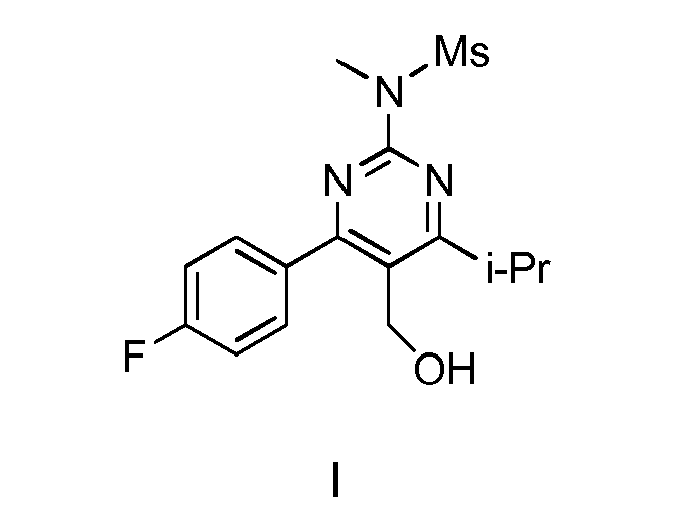
the method comprising the following steps:
the method comprising the following steps:
a) hydrolyzing an ester compound represented by formula II in the presence of a metallic
compound to obtain a carboxylic acid compound represented by formula III,
in which, R represents a C1-C5 alkyl; and
b) reducing the carboxylic acid compound in the presence of a reductant to obtain the rosuvastatin calcium intermediate.
2. The method of claim 1, characterized in that in step a), the metallic compound is LiOH or a hydrate thereof.
3. The method of claim 1, characterized in that in step b), the reductant is a borane or a hydroboron and Lewis acid reduction system.
4. The method of claim 3, characterized in that the hydroboron and Lewis acid reduction system is selected from the group consisting
of a system comprising potassium borohydride and boron trifluoride diethyl etherate;
a system comprising sodium borohydride and boron trifluoride diethyl etherate; a system
comprising lithium borohydride and boron trifluoride diethyl etherate; a system comprising
potassium borohydride and H2SO4; a system comprising potassium borohydride and ZnCl2; a system comprising potassium borohydride and AlCl3; a system comprising potassium borohydride and I2; a system comprising potassium borohydride and CF3COOH; a system comprising potassium borohydride and HCOOH; a system comprising potassium
borohydride and MsOH; a system comprising potassium borohydride and CH3COOH; a system comprising potassium borohydride and NiCl2; a system comprising zinc borohydride and H2SO4; a system comprising zinc borohydride and ZnCl2; a system comprising zinc borohydride and AlCl3; a system comprising zinc borohydride and I2; a system comprising zinc borohydride and CF3COOH; a system comprising zinc borohydride and HCOOH; a system comprising zinc borohydride
and MsOH; a system comprising zinc borohydride and CH3COOH; a system comprising zinc borohydride and NiCl2; a system comprising sodium borohydride and H2SO4; a system comprising sodium borohydride and ZnCl2; a system comprising sodium borohydride and AlCl3; a system comprising sodium borohydride and I2; a system comprising sodium borohydride and CF3COOH; a system comprising sodium borohydride and HCOOH; a system comprising sodium
borohydride and MsOH; a system comprising sodium borohydride and CH3COOH; a system comprising sodium borohydride and NiCl2; a system comprising lithium borohydride and H2SO4; a system comprising lithium borohydride and ZnCl2; a system comprising lithium borohydride and AlCl3; a system comprising lithium borohydride and I2; a system comprising lithium borohydride and CF3COOH; a system comprising lithium borohydride and HCOOH; a system comprising lithium
borohydride and MsOH; a system comprising lithium borohydride and CH3COOH; and a system comprising lithium borohydride and NiCl2.
5. A compound represented by formula III:
REFERENCES CITED IN THE DESCRIPTION
This list of references cited by the applicant is for the reader's convenience only. It does not form part of the European patent document. Even though great care has been taken in compiling the references, errors or omissions cannot be excluded and the EPO disclaims all liability in this regard.
Patent documents cited in the description