| (19) |
 |
|
(11) |
EP 2 602 458 B1 |
| (12) |
EUROPEAN PATENT SPECIFICATION |
| (45) |
Mention of the grant of the patent: |
|
31.03.2021 Bulletin 2021/13 |
| (22) |
Date of filing: 05.12.2012 |
|
| (51) |
International Patent Classification (IPC):
|
|
| (54) |
Multiple turboshaft engine control method and system for helicopters
Steuerungsverfahren und -system mehrerer Wellenleistungstriebwerke für Hubschrauber
Procédé de contrôle et système de plusieurs turbomoteurs pour hélicoptères
|
| (84) |
Designated Contracting States: |
|
AL AT BE BG CH CY CZ DE DK EE ES FI FR GB GR HR HU IE IS IT LI LT LU LV MC MK MT NL
NO PL PT RO RS SE SI SK SM TR |
| (30) |
Priority: |
06.12.2011 US 201113312232
|
| (43) |
Date of publication of application: |
|
12.06.2013 Bulletin 2013/24 |
| (73) |
Proprietor: PRATT & WHITNEY CANADA CORP. |
|
Longueuil, Quebec J4G 1A1 (CA) |
|
| (72) |
Inventor: |
|
- Morgan, Keith
Westmount, Québec H3Y 3G3 (CA)
|
| (74) |
Representative: Dehns |
|
St. Bride's House
10 Salisbury Square
London EC4Y 8JD
London EC4Y 8JD (GB) |
| (56) |
References cited: :
US-A- 3 869 862
US-A1- 2006 225 431
US-A1- 2010 058 731
|
US-A- 3 938 320
US-A1- 2008 276 620
|
|
| |
|
|
|
|
| |
|
| Note: Within nine months from the publication of the mention of the grant of the European
patent, any person may give notice to the European Patent Office of opposition to
the European patent
granted. Notice of opposition shall be filed in a written reasoned statement. It shall
not be deemed to
have been filed until the opposition fee has been paid. (Art. 99(1) European Patent
Convention).
|
TECHNICAL FIELD
[0001] The application relates generally to the management of a multiple turboshaft arrangement
in a helicopter, more particularly, involving electrical power transfer between engines.
BACKGROUND OF THE ART
[0002] Helicopters are often provided with at least two turboshaft engines. Both engines
are connected to the main rotor via a common reduction gearbox, and each of the engines
is sized to account for the worst-case scenario of the other engine failing at takeoff.
Accordingly, the power of each engine is significantly greater than what is required
for cruising.
[0003] In cruising conditions, operating a single engine at a relatively high regime instead
of both at a lower regime can allow significantly better fuel efficiency. However,
once a turboshaft is stopped, there is a significant delay in starting it back up
again. This delay is associated with the required amount of time to get the engine
running at a sufficient RPM (and draw in a sufficient amount of air) for engine operation
to begin.
[0004] Hence, for safety purposes, the typical approach was not to shut down the second
engine completely, but to keep it idling, which limited the gain in fuel efficiency.
[0005] Accordingly, there remains room for improvement in addressing the fuel consumption
of helicopters.
SUMMARY
[0007] In one aspect, there is provided a method of controlling operation of an arrangement
for a helicopter as defined in claim 1
[0008] In a second aspect, there is provided a system for a helicopter having least two
turboshaft engines as defined in claim 7.
[0009] Further details of these and other aspects of the present invention will be apparent
from the detailed description and figures included below.
DESCRIPTION OF THE DRAWINGS
[0010] Reference is now made to the accompanying figures, in which:
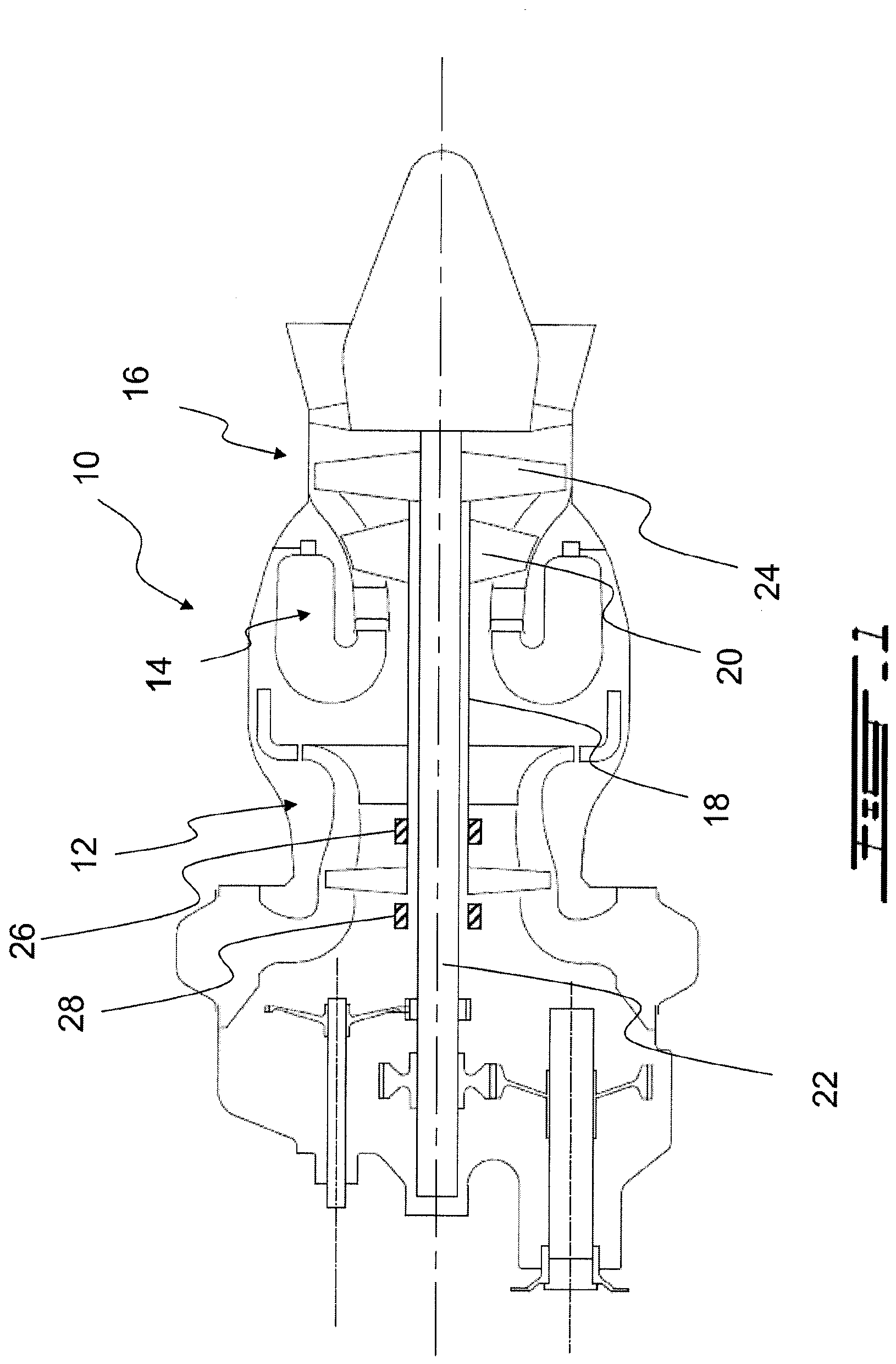
Fig. 1 is a schematic cross-sectional view of a gas turbine engine;
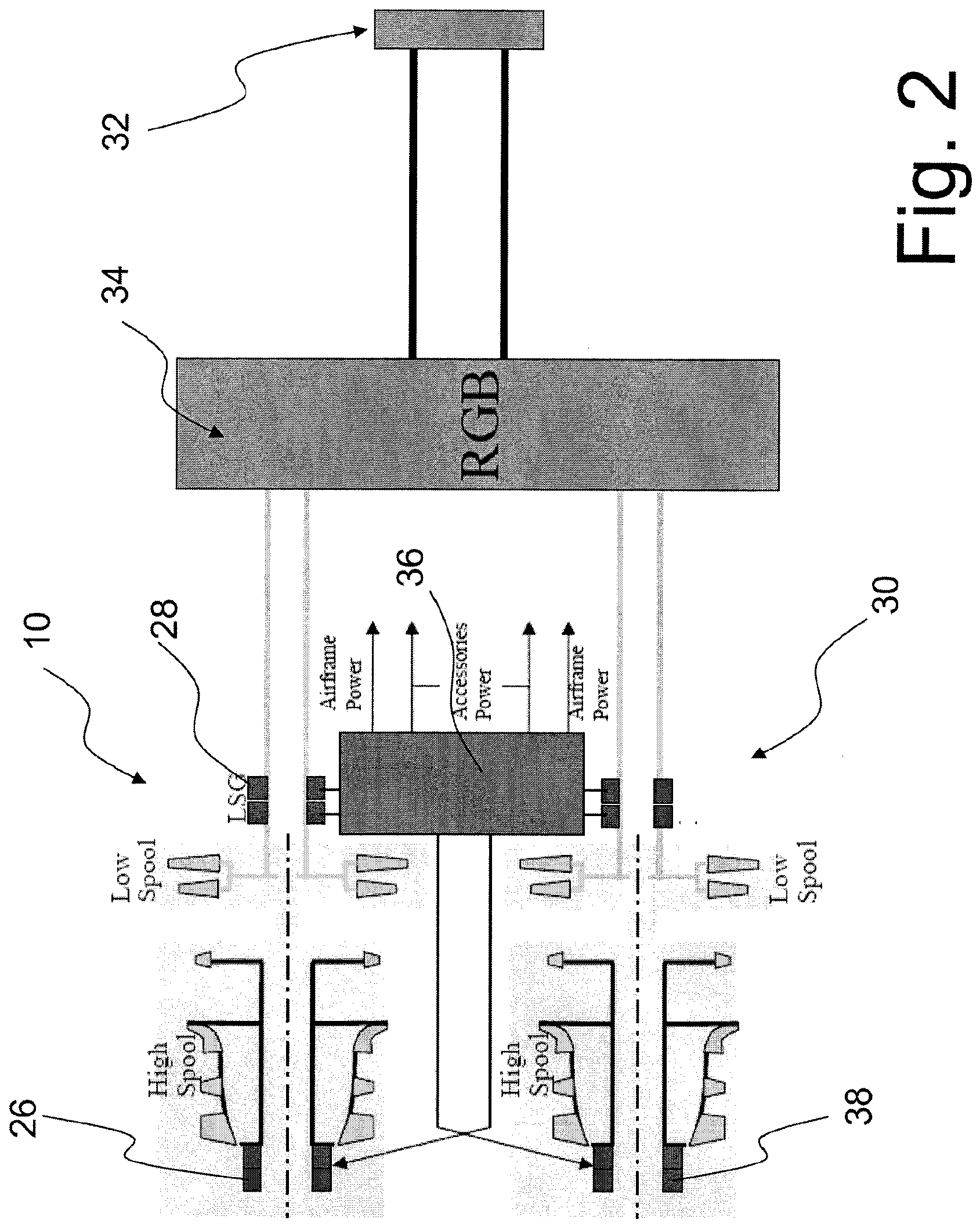
Fig. 2 is a schematic view showing two turboshaft engines in a twin-pac helicopter
arrangement.
DETAILED DESCRIPTION
[0011] Fig.1 illustrates an example of a turbine engine. In this example, the turbine engine
10 is a turboshaft engine generally comprising in serial flow communication, a multistage
compressor 12 for pressurizing the air, a combustor 14 in which the compressed air
is mixed with fuel and ignited for generating an annular stream of hot combustion
gases, and a turbine section 16 for extracting energy from the combustion gases.
[0012] The turbine engine 10 in this example can be seen to include a high pressure spool
18, including a multistage compressor 12 and a high-pressure turbine stage 20, and
a low pressure spool 22, including a low-pressure turbine stage 24. The low spool
22 leads to a power shaft via a gear arrangement. The high spool 18 can be referred
to herein as a compressor spool, given that it contains at least one compressor stage,
and the low spool 22 can be referred to herein as the power spool.
[0013] In this example, the turbine engine 10 is of the more-electric engine type which
uses spool-mounted electric machines to power aircraft equipement. A first electric
machine 26 is provided on the high spool 18 and a second electric machine 28 is on
the low spool 22.
[0014] The first electric machine 26 can be of the spool-mounted permanent magnet type and
be referred to as an integrated starter/generator (ISG). The first electric machine
26 is used in starting the turbine engine 10 to drive the high spool 18, and hence
the multistage compressor 12 to cause a flow of air to enter the combustor, thereby
allowing subsequent fuel admission and ignition. The first electric machine 26 may
also operate in generator mode.
[0015] The second electric machine 28 can also be of the spool-mounted permanent magnet
type. Although the construction of the second electric machine 28 can typically allow
its use in either one of generator or motor mode it is typically only used in generator
mode and can thereby be referred to as a low spool generator (LSG). The power capacity
of the low spool generator is typically at least one order of magnitude higher than
the power capacity of the integrated starter/generator.
[0016] Fig. 2 shematically shows an arrangement of two turboshaft engines in a twin-pac
arrangement. Both turboshaft engines 10, 30 may be the same and are both connected
to the helicopter main rotor 32 via a common reduction gearbox 34.
[0017] When the helicopter is cruising, a first one 10 of the two turboshaft engines is
operated to provide flight power at the main rotor 32, whereas the second one 30 of
the two turboshaft engines can be idling. In these conditions, the twin-pac arrangement
has a system by which a controller 36 associated with power electronics can transfer
electric power extracted by the low spool generator 28 of the operating engine to
the integrated starter/generator 38 of the idling engine 30 to assist in driving the
high spool thereof, and therefore the compressor. This can allow gaining further fuel
efficiency than having the idling engine 30 run entirely on fuel power. It will be
understood that the operating engine and idling engine were selected arbitrarily in
this example and that the controller can provide the same power transfer function
independently of which engine is being operated.
[0018] The system can also be used to transfer electrical energy in a comparable manner
(i.e. from the low spool generator of one engine to the integrated starter/generator
of the other) in a scenario where there is a significant difference in the RPM of
both engines and there is a rapid rise in power requirement, independently of whether
the second engine is idling or not. In fact, driving the compressor spool with an
external power source such as electrical energy diverted from the low spool generator
of the other engine can favourably affect the surge line, thereby increasing the compressor
stall margin, and allowing for better acceleration time. This can be particularly
useful during landing, for instance.
[0019] The above description is meant to be exemplary only, and one skilled in the art will
recognize that changes may be made to the embodiments described without departing
from the scope of the invention disclosed. For example, a helicopter can have more
than two engines, in which case the power can be transferred between any two engines
of the helicopter as desired. Further, although turboshaft engines have only one spool
leading to the power shaft (referred to herein as the low spool or power spool), alternate
embodiments can have more than one compressor spool (i.e. a spool having at least
one stage of compressor blades in addition to turbine blades), such as an intermediate
spool and a high spool for instance, in which case, the electric machine to which
the electrical power is transferred to can be on either one of the compressor spools,
depending on design requirements. Also, the electric machines referred to in the description
provided above can either be unitary electric machines, or dual redundant electric
machines to provide additional safety.
1. A method of controlling operation of an arrangement for a helicopter having at least
a first turboshaft engine (10) and a second turboshaft engine (30), each turboshaft
engine (10,30) having a first electric machine (26) on a compressor spool (18), the
compressor spool (18) having both at least one turbine stage (20) and at least one
compressor stage (12), and a second electric machine (28) on a power spool (22), the
power spool (22) having a low-pressure turbine stage (24), the method is
characterised by comprising :
determining an increase in power requirement,
upon determining, extracting electrical power from the power spool (22) of the first
turboshaft engine (10) using the second electric machine (28) of the first turboshaft
engine (10), and
the first electric machine (26) of the second turboshaft engine (30) imparting mechanical
rotation power to the corresponding compressor spool (18) using a portion of the extracted
electrical power.
2. The method of claim 1 wherein the second turboshaft engine (30) is maintained in idle
operation at least in part by the first electric machine (26).
3. The method of claim 1 or 2 further comprising transferring a portion of the extracted
electrical power to the first electric machine (26) of the second turboshaft engine
(30), wherein said transferring is preferably effected upon determining that one of
said turboshaft engines (10,30) is active and the other one of the turboshaft engines
(10,30) is idling.
4. The method of claim 3 further comprising reducing a rate of fuel feed to said idling
engine (10,30) during said transferring.
5. The method of claim 3 or 4 wherein said transferring is effected upon determining
an increase in engine power requirement.
6. The method of any preceding claim wherein said extracting and imparting are done upon
additionally determining a difference in revolutions per minute between the first
turboshaft engine and the second turboshaft engine.
7. A system for a helicopter having at least two turboshaft engines (10,30), the system
comprising, for each turboshaft engine (10,30), a first electric machine (26) on a
compressor spool (18) linking at least one turbine stage (20) to at least one compressor
stage (12), a second electric machine (28) on a power spool (22) having a low-pressure
turbine stage (24),
characterised by comprising a controller (36) connected to each electric machine (26,28), the controller
(36) being operable to determine an increase in power requirement and, upon determining,
extract electrical power from the power spool (22) of the first turboshaft engine
(10) using the second electric machine (28) of the first turboshaft engine (10) to
impart mechanical rotation power with the first electric machine (26) of the second
turboshaft engine (30) to the corresponding compressor spool (18).
8. The system of claim 7 wherein the power capacity of the second electric machine (28)
is greater than the power capacity of the first electric machine (26) by at least
an order of magnitude.
9. The system of claim 7 or 8 wherein both power spools (22) are connected to a main
rotor (32) via a common reduction gearbox (34).
10. The system of claim 7, 8 or 9 wherein each turboshaft engine (10,30) has two compressor
spools (18) including an intermediate spool and a high-pressure spool, the first electric
machine (26) being on one of the intermediate spool and the high-pressure spool.
11. The system of any of claims 7 to 10 wherein each electric machine (26,28) includes
two electric machines positioned adjacent one another along the corresponding spool.
12. The system of any of claims 7 to 11 wherein the controller (36) is integrated to power
electronics.
13. The system of any of claims 7 to 12 wherein the controller (36) is operable to transfer
at least a portion of electrical power obtained from the second electric machine (28)
of either one of the two turboshaft engines (10, 30) to the first electric machine
(26) of the other turboshaft engine (10, 30).
14. The system of claim 13 wherein the controller (36) has a function to operate said
transfer upon determining that one of said turboshaft engines (10,30) is active and
the other one of the turboshaft engines (10,30) is idling, and optionally further
has a function to reduce a rate of fuel feed to said idling engine (10,30) upon effecting
said transfer.
15. The system of any of claims 7 to 14 wherein the controller (36) has a function to
operate said extracting and imparting upon additionally determining a difference in
revolutions per minute between the first turboshaft engine and the second turboshaft
engine.
1. Verfahren zur Betriebssteuerung einer Anordnung eines Helikopters, der zumindest ein
erstes Wellenleistungstriebwerk (10) und ein zweites Wellenleistungstriebwerk (30)
aufweist, wobei jedes Wellenleistungstriebwerk (10, 30) eine erste elektrische Maschine
(26) an einer Verdichterspule (18), wobei die Verdichterspule (18) sowohl zumindest
eine Turbinenstufe (20) als auch zumindest eine Verdichterstufe (12) aufweist, und
eine zweite elektrische Maschine (28) an einer Leistungsspule (22) aufweist, wobei
die Leistungsspule (22) eine Niederdruckturbinenstufe (24) aufweist, wobei das Verfahren
dadurch gekennzeichnet ist, das es Folgendes umfasst:
Bestimmen eines Anstiegs einer Leistungsanforderung,
bei Bestimmen, Extrahieren einer elektrischen Leistung von der Leistungsspule (22)
des ersten Wellenleistungstriebwerks (10) unter Verwendung der zweiten elektrischen
Maschine (28) des ersten Wellenleistungstriebwerks (10), und
wobei die erste elektrische Maschine (26) des zweiten Wellenleistungstriebwerks (30)
unter Verwendung eines Teils der extrahierten elektrischen Leistung eine mechanische
Drehkraft auf die entsprechende Verdichterspule (18) ausübt.
2. Verfahren nach Anspruch 1, wobei das zweiten Wellenleistungstriebwerk (30) zumindest
teilweise durch die erste elektrische Maschine (26) im Leerlaufbetrieb gehalten wird.
3. Verfahren nach Anspruch 1 oder 2, ferner umfassend Übertragen eines Teils der extrahierten
elektrischen Leistung an die erste elektrische Maschine (26) des zweiten Wellenleistungstriebwerks
(30), wobei das Übertragen vorzugsweise bei Bestimmen, dass eines der Wellenleistungstriebwerke
(10, 30) aktiv ist und sich das andere der Wellenleistungstriebwerke (10, 30) im Leerlauf
befindet, bewirkt wird.
4. Verfahren nach Anspruch 3, ferner umfassend Verringern einer Rate der Kraftstoffzufuhr
zu dem Triebwerk (10, 30) im Leerlauf während der Übertragung.
5. Verfahren nach Anspruch 3 oder 4, wobei das Übertragen bei Bestimmen eines Anstiegs
einer Triebwerksleistungsanforderung bewirkt wird.
6. Verfahren nach einem der vorangehenden Ansprüche, wobei das Extrahieren und Ausüben
bei zusätzlichem Bestimmen einer Differenz aus Umdrehungen pro Minute zwischen dem
ersten Wellenleistungstriebwerk und dem zweiten Wellenleistungstriebwerk durchgeführt
werden.
7. System für einen Helikopter, der zumindest zwei Wellenleistungstriebwerke (10, 30)
aufweist, wobei das System für jedes Wellenleistungstriebwerk (10, 30) eine erste
elektrische Maschine (26) an einer Verdichterspule (18), die zumindest eine Turbinenstufe
(20) mit zumindest einer Verdichterstufe (12) verbindet, und eine zweite elektrische
Maschine (28) an einer Leistungsspule (22) umfasst, die eine Niederdruckturbinenstufe
(24) aufweist,
gekennzeichnet durch umfassend eine Steuerung (36), die mit jeder elektrischen Maschine (26, 28) verbunden
ist, wobei die Steuerung (36) betrieben werden kann, um einen Anstieg einer Leistungsanforderung
zu bestimmen und bei Bestimmen elektrische Leistung von der Leistungsspule (22) des
ersten Wellenleistungstriebwerks (10) unter Verwendung der zweiten elektrischen Maschine
(28) des ersten Wellenleistungstriebwerks (10) zu extrahieren, um eine mechanische
Drehkraft mit der ersten elektrischen Maschine (26) des zweiten Wellenleistungstriebwerks
(30) auf die entsprechende Verdichterspule (18) auszuüben.
8. System nach Anspruch 7, wobei die Leistungskapazität der zweiten elektrischen Maschine
(28) zumindest um eine Größenordnung größer ist als die Leistungskapazität der ersten
elektrischen Maschine (26).
9. System nach Anspruch 7 oder 8, wobei beide Leistungsspulen (22) über ein gemeinsames
Untersetzungsgetriebe (34) mit einem Hauptrotor (32) verbunden sind.
10. System nach Anspruch 7, 8 oder 9, wobei jedes Wellenleistungstriebwerk (10, 30) zwei
Verdichterspulen (18) aufweist, einschließlich einer Zwischenspule und einer Hochdruckspule,
wobei es sich bei der ersten elektrischen Maschine (26) um eine von der Zwischenspule
und der Hochdruckspule handelt.
11. System nach einem der Ansprüche 7 bis 10, wobei jede elektrische Maschine (26, 28)
zwei elektrische Maschinen beinhaltet, die entlang der entsprechenden Spule benachbart
zueinander positioniert sind.
12. System nach einem der Ansprüche 7 bis 11, wobei die Steuerung (36) in eine Leistungselektronik
integriert ist.
13. System nach einem der Ansprüche 7 bis 12, wobei die Steuerung (36) betrieben werden
kann, um zumindest einen Teil der elektrischen Leistung, die von der zweiten elektrischen
Maschine (28) einer beliebigen der zwei Wellenleistungstriebwerke (10, 30) erhalten
wurde, an die erste elektrische Maschine (26) des anderen Wellenleistungstriebwerks
(10, 30) zu übertragen.
14. System nach Anspruch 13, wobei die Steuerung (36) eine Funktion aufweist, um die Übertragung
bei Bestimmen, dass eine der Wellenleistungstriebwerke (10, 30) aktiv ist und sich
die andere der Wellenleistungstriebwerke (10, 30) im Leerlauf befindet, durchzuführen,
und wobei diese gegebenenfalls ferner eine Funktion aufweist, um bei Bewirken der
Übertragung eine Rate der Kraftstoffzufuhr zu dem Triebwerk (10, 30) im Leerlauf zu
verringern.
15. System nach einem der Ansprüche 7 bis 14, wobei die Steuerung (36) eine Funktion aufweist,
um das Extrahieren und Ausüben bei zusätzlichem Bestimmen einer Differenz aus Umdrehungen
pro Minute zwischen dem ersten Wellenleistungstriebwerk und dem zweiten Wellenleistungstriebwerk
durchzuführen.
1. Procédé de contrôle du fonctionnement d'un agencement pour un hélicoptère ayant au
moins un premier turbomoteur (10) et un second turbomoteur (30), chaque turbomoteur
(10, 30) ayant une première machine électrique (26) sur un corps de compresseur (18),
le corps de compresseur (18) ayant à la fois au moins un étage de turbine (20) et
au moins un étage de compresseur (12), et une seconde machine électrique (28) sur
un corps de puissance (22), le corps de puissance (22) ayant un étage de turbine basse
pression (24), le procédé étant
caractérisé en ce qu'il comprend :
la détermination d'une augmentation de la puissance requise,
lors de la détermination, l'extraction de la puissance électrique du corps de puissance
(22) du premier turbomoteur (10) en utilisant la seconde machine électrique (28) du
premier turbomoteur (10), et
la première machine électrique (26) du second turbomoteur (30) transmettant une puissance
de rotation mécanique au corps de compresseur (18) correspondant en utilisant une
partie de la puissance électrique extraite.
2. Procédé selon la revendication 1, dans lequel le second turbomoteur (30) est maintenu
au ralenti au moins en partie par la première machine électrique (26).
3. Procédé selon la revendication 1 ou 2, comprenant en outre le transfert d'une partie
de la puissance électrique extraite à la première machine électrique (26) du second
turbomoteur (30), dans lequel ledit transfert est de préférence réalisé lors de la
détermination qu'un desdits turbomoteurs (10, 30) est actif et l'autre des turbomoteurs
(10, 30) fonctionne au ralenti.
4. Procédé selon la revendication 3, comprenant en outre la réduction d'un débit d'alimentation
en carburant dudit moteur au ralenti (10,30) pendant ledit transfert.
5. Procédé selon la revendication 3 ou 4, dans lequel ledit transfert est réalisé lors
de la détermination d'une augmentation de la puissance moteur requise.
6. Procédé selon une quelconque revendication précédente, dans lequel ladite extraction
et ladite transmission sont réalisées lors de la détermination supplémentaire d'une
différence de tours par minute entre le premier turbomoteur et le second turbomoteur.
7. Système pour un hélicoptère ayant au moins deux turbomoteurs (10, 30), le système
comprenant, pour chaque turbomoteur (10, 30), une première machine électrique (26)
sur une corps de compresseur (18) reliant au moins un étage de turbine (20) à au moins
un étage de compresseur (12), une seconde machine électrique (28) sur un corps de
puissance (22) ayant un étage de turbine basse pression (24),
caractérisé en ce qu'il comprend un dispositif de contrôle (36) connecté à chaque machine électrique (26,
28), le dispositif de contrôle (36) pouvant être utilisé pour déterminer une augmentation
de la puissance requise et, lors de la détermination, extraire une puissance électrique
du corps de puissance (22) du premier turbomoteur (10) en utilisant la seconde machine
électrique (28) du premier turbomoteur (10) pour transmettre une puissance de rotation
mécanique avec la première machine électrique (26) du second turbomoteur (30) au corps
de compresseur (18) correspondant.
8. Système selon la revendication 7, dans lequel la capacité de puissance de la seconde
machine électrique (28) est supérieure à la capacité de puissance de la première machine
électrique (26) d'au moins un ordre de grandeur.
9. Système selon la revendication 7 ou 8, dans lequel les deux corps de puissance (22)
sont connectés à un rotor principal (32) via un réducteur de vitesse à engrenages
(34) commun.
10. Système selon la revendication 7, 8 ou 9, dans lequel chaque turbomoteur (10, 30)
a deux corps de compresseur (18) comportant un corps intermédiaire et un corps haute
pression, la première machine électrique (26) reposant sur un du corps intermédiaire
et du corps haute pression.
11. Système selon l'une quelconque des revendications 7 à 10, dans lequel chaque machine
électrique (26, 28) comporte deux machines électriques positionnées de manière adjacente
l'une à l'autre le long du corps correspondant.
12. Système selon l'une quelconque des revendications 7 à 11, dans lequel le dispositif
de contrôle (36) est intégré à une électronique de puissance.
13. Système selon l'une quelconque des revendications 7 à 12, dans lequel le dispositif
de contrôle (36) peut être utilisé pour transférer au moins une partie de la puissance
électrique obtenue à partir de la seconde machine électrique (28) de l'un ou l'autre
des deux turbomoteurs (10, 30) à la première machine électrique (26) de l'autre turbomoteur
(10, 30).
14. Système selon la revendication 13, dans lequel le dispositif de contrôle (36) a une
fonction permettant d'exécuter ledit transfert lors de la détermination qu'un desdits
turbomoteurs (10, 30) est actif et l'autre des turbomoteurs (10, 30) est au ralenti,
et a éventuellement en outre une fonction permettant de réduire un débit d'alimentation
en carburant dudit moteur au ralenti (10, 30) lors de la réalisation dudit transfert.
15. Système selon l'une quelconque des revendications 7 à 14, dans lequel le dispositif
de contrôle (36) a une fonction permettant d'exécuter ladite extraction et ladite
transmission lors de la détermination supplémentaire d'une différence de tours par
minute entre le premier turbomoteur et le second turbomoteur.
REFERENCES CITED IN THE DESCRIPTION
This list of references cited by the applicant is for the reader's convenience only.
It does not form part of the European patent document. Even though great care has
been taken in compiling the references, errors or omissions cannot be excluded and
the EPO disclaims all liability in this regard.
Patent documents cited in the description