|
(11) | EP 2 648 266 B1 |

| (12) | EUROPEAN PATENT SPECIFICATION |
|
|
| (54) |
LITHIUM SECONDARY BATTERY LITHIUMSEKUNDÄRBATTERIE BATTERIE SECONDAIRE AU LITHIUM |
|
|
|||||||||||||||||||||||||||||||
|
||||||||||||||||||||||||||||||||
| Note: Within nine months from the publication of the mention of the grant of the European patent, any person may give notice to the European Patent Office of opposition to the European patent granted. Notice of opposition shall be filed in a written reasoned statement. It shall not be deemed to have been filed until the opposition fee has been paid. (Art. 99(1) European Patent Convention). |
TECHNICAL FIELD
[0001] The present disclosure relates to a lithium secondary battery, and more particularly to a lithium secondary battery with excellent cycle characteristics and output characteristics.
BACKGROUND ART
[0002] In recent years, there has been increasing interest in energy storage technologies. As the application fields of energy storage technologies have been extended to mobile phones, camcorders, notebook computers and even electric cars, there has been a growing demand for high energy-density batteries as power sources for such electronic devices. In response to this demand, research on lithium secondary batteries is being actively undertaken.
[0003] Many companies have produced a variety of lithium secondary batteries with different safety characteristics. It is very important to evaluate and ensure safety of such lithium secondary batteries. The most important consideration for safety is that operational failure or malfunction of lithium secondary batteries should not cause injury to users. For this purpose, safety regulations strictly restrict the possibilities of dangers (such as fire and smoke) of lithium secondary batteries.
[0004] Lithium-containing metal oxides and carbon materials are usually used at present as cathode and anode active materials of lithium secondary batteries, respectively. However, a lithium secondary battery fabricated using the electrode active materials suffers from safety problems, for example: overcharge/overdischarge resulting from malfunction of a protective device; internal short circuits caused by an external impact or defects of a separator; exothermic reactions between a charged cathode and an electrolyte solution under abnormal conditions, such as during high-temperature storage, to cause decomposition of the cathode; heat emission arising from short circuits between the cathode and an anode; and decomposition reactions of the electrolyte solution at the electrode interface.
[0005] In an effort to solve the above safety problems caused by electrode active materials, a technique has been proposed in which a metal oxide is coated on the surface of at least one electrode layer or the surfaces of electrode active material particles. This metal oxide coating is known to be effective in inhibiting a change in the volume of the electrode active material during charge and discharge and in blocking an electrolyte solution from being in direct contact with the electrode active material to prevent side reactions of the electrolyte solution.
[0006] On the other hand, as the charge/discharge cycles of a battery proceed, metal ions (typically transition metal ions) other than lithium are also dissolved from a lithium-containing metal oxide as a cathode active material. A metal oxide coating layer can inhibit dissolution of the metal ions to some extent but cannot completely block the electrode active material. Further, passages through which lithium ions pass are present in the metal oxide coating layer. Therefore, dissolution of the metal ions is unavoidable. The dissolved metal ions cause decomposition reactions of an electrolyte solution.
[0007] Along with the recent increasing demand for high-capacity lithium secondary batteries, high voltages are required as conditions for battery operation. However, high-voltage operating conditions primarily increase side reactions of electrolyte solutions and also induce rapid dissolution of metal ions from lithium metal oxides as cathode active materials. The dissolved metal ions further promote side reactions of electrolyte solutions.
DISCLOSURE
Technical Problem
[0008] The present disclosure is designed to solve the problems of the prior art, and therefore it is an object of the present disclosure to provide a lithium secondary battery in which side reactions of an electrolyte solution can be inhibited despite the use of at least one electrode including a metal oxide coating layer to achieve excellent cycle characteristics and output characteristics.
[0009] It is another object of the present disclosure to provide a lithium secondary battery that has good ability to inhibit side reactions of an electrolyte solution, particularly under high voltage operating conditions, achieving excellent cycle characteristics and output characteristics even under high voltage conditions.
Technical Solution
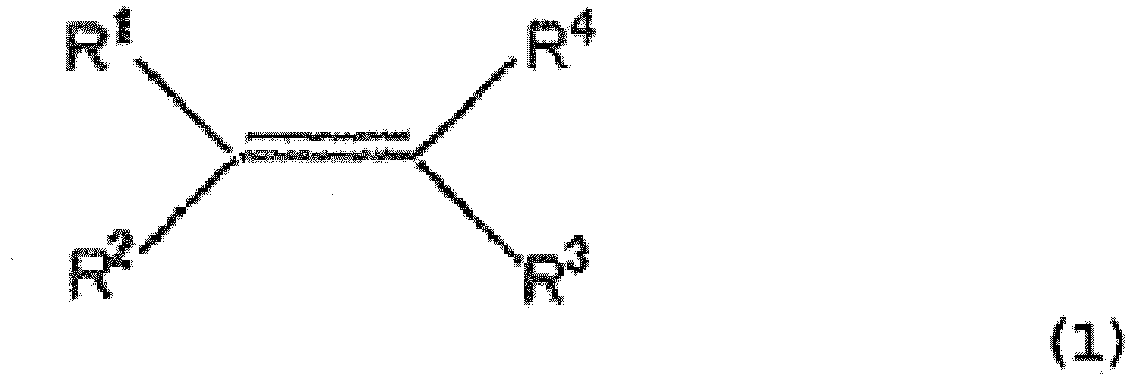
[0010] In order to achieve the above objects, there is provided a lithium secondary battery according to claim 1 including a cathode, an anode, a separator and a non-aqueous electrolyte solution, wherein either the cathode or the anode or both include metal oxide coating layers on electrode active material particles forming the electrode or a metal oxide coating layer on the surface of an electrode layer formed on a current collector, and the non-aqueous electrolyte solution contains an ionizable lithium salt, an organic solvent and a dinitrile compound represented by Formula 1:
wherein one of R1 and R2 and one of R3 and R4 are -R-CN (wherein each R is independently C1-C12 alkylene, C1-C12 haloalkylene, C2-C12 alkenylene, C2-C12 alkynylene, C7-C18 benzylene, C7-C18 halobenzylene, C6-C18 arylene or C6-C18 haloarylene), and the remainders of R1, R2, R3 and R4 are independently hydrogen, C1-C12 alkyl, C1-C12 haloalkyl, C1-C12 alkoxy, C2-C12 alkenyl, C3-C18 aryl, C3-C18 haloaryl, C7-C18 benzyl, C7-C18 halobenzyl or halogen.
[0011] More specific examples of dinitrile compounds suitable for use in the non-aqueous electrolyte solution include, but are not limited to, 1,4-dicyano-2-butene, 1,4-dicyano-2-methyl-2-butene, 1,4-dicyano-2-ethyl-2-butene, 1,4-dicyano-2,3-dimethyl-2-butene, 1,4-dicyano-2,3-diethyl-2-butene, 1,6-dicyano-3-hexene, 1,6-dicyano-2-methyl-3-hexene and 1,6-dicyano-2-methyl-5-methyl-3-hexene. These dinitrile compounds may be used alone or as a mixture of two or more thereof. The nitrile groups of the dinitrile compound may be in cis or trans positions around the double bond. Preferably, the nitrile groups are in trans positions.
[0012] The dinitrile compound may be included in an amount of 0.1 to 10 parts by weight, based on 100 parts by weight of the lithium salt and the organic solvent. 0.1 to 5 parts by weight is preferred and 0.1 to 2 parts by weight is more preferred.
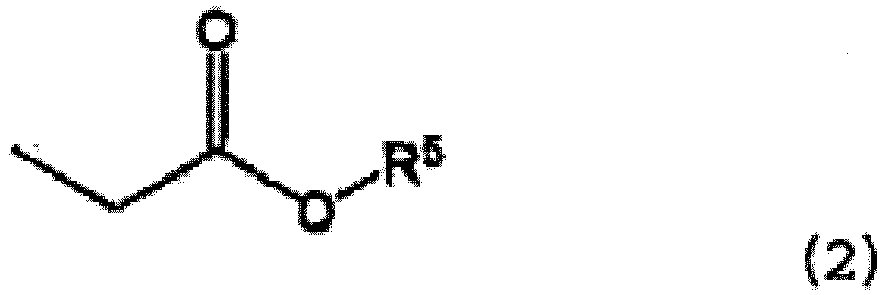
[0013] The lithium salt and the organic solvent of the non-aqueous electrolyte solution may be those known in the art. For example, the organic solvent may be an ether, an ester, an amide, a linear carbonate, a cyclic carbonate or a mixture thereof. Preferably, the organic solvent is a propionate ester represented by Formula 2:
wherein R5 is a C1-C5 alkyl group.
[0014] In the cathode and/or the anode, the metal oxide may be a oxide of a metal selected from the group consisting of Mg, Al, Co, K, Na, Ca, Si, Ti, Zr, Sn, Y, Sr, Mo, Mn, and V, or mixtures thereof.
Advantageous Effects
[0015] In the lithium secondary battery of the present disclosure, degradation of an electrode active material and side reactions of the electrolyte solution can be prevented due to the formation of a metal oxide coating layer on the electrode to achieve improved cycle life and output performance.
[0016] In addition, in the lithium secondary battery of the present disclosure, acceleration of side reactions of the electrolyte solution caused by metal ions dissolved from a cathode active material when operated under high voltage condition can be effectively inhibited. Therefore, the lithium secondary battery of the present disclosure can exhibit excellent cycle life and output performance characteristics even when operated under high voltage conditions.
MODE FOR DISCLOSURE
[0017] Hereinafter, preferred embodiments of the present disclosure will be described in detail with reference to the accompanying drawing. Prior to the description, it should be understood that the terms used in the specification and the appended claims should not be construed as limited to general and dictionary meanings, but interpreted based on the meanings and concepts corresponding to technical aspects of the present disclosure on the basis of the principle that the inventor is allowed to define terms appropriately for the best explanation.
[0018] As explained above, the formation of a metal coating layer in an electrode can inhibit a change in the volume of an electrode active material to prevent degradation of the electrode and can block direct contact between an electrolyte solution and the electrode active material to partially suppress side reactions of the electrolyte solution.
[0019] However, the metal coating layer cannot completely block dissolution of metal ions, particularly transition metal ions, from a cathode active material, which causes the occurrence of side reactions of the electrolyte solution.
[0020] Particularly, the present inventors have found that a metal oxide present in a metal oxide coating layer provides a site where side reactions of an electrolyte solution occur, and accelerates the side reactions. Specifically, as the charge/discharge cycles of a battery proceed, transition metal ions are dissolved from a lithium transition metal oxide as a cathode active material and the exposed metal oxide of the metal oxide coating layer introduced into the electrode provides a site where the transition metal is deposited from the transition metal ions. The deposited transition metal acts as a catalyst to accelerate side reactions of an electrolyte solution. Therefore, the introduction of the metal oxide coating layer is determined to considerably increase the side reactions of the electrolyte solution. Particularly, larger amounts of the transition metal ions are dissolved when the battery is operated under high voltage conditions. This brings about an increase in the amount of the transition metal deposited on the metal oxide to considerably accelerate the side reactions of the electrolyte solution.
[0021] In order to solve the above problems, the present disclosure provides a lithium secondary battery according to claim 1 including a cathode, an anode, a separator and a non-aqueous electrolyte solution, wherein either the cathode or the anode or both include metal oxide coating layers on electrode active material particles forming the electrode or a metal oxide coating layer on the surface of an electrode layer formed on a current collector, and the non-aqueous electrolyte solution contains an ionizable lithium salt, an organic solvent and a dinitrile compound represented by Formula 1:
wherein one of R1 and R2 and one of R3 and R4 are -R-CN (wherein each R is independently C1-C12 alkylene, C1-C12 haloalkylene, C2-C12 alkenylene, C2-C12 alkynylene, C7-C18 benzylene, C7-C18 halobenzylene, C6-C18 arylene or C6-C18 haloarylene), and the remainders of R1, R2, R3 and R4 are independently hydrogen, C1-C12 alkyl, C1-C12 haloalkyl, C1-C12 alkoxy, C2-C12 alkenyl, C3-C18 aryl, C3-C18 haloaryl, C7-C18 benzyl, C7-C18 halobenzyl or halogen.
[0022] The nitrile groups at both ends of the dinitrile compound are bonded to transition metal ions dissolved from the cathode to prevent the transition metal ions from being deposited on the surfaces of the metal oxide on the electrode. The bonding between the dinitrile compound and the transition metal leads to the formation of a bulkier metallic compound. The increased volume of the metallic compound impedes its mobility in the electrolyte solution, which also becomes a cause of inhibiting side reactions of the electrolyte solution caused by the transition metal. Furthermore, the presence of the unsaturated double bond in the dinitrile compound further increases the bonding strength between the terminal nitrile groups and the transition metal, thus being very effective in capturing the transition metal and preventing the transition metal from separating.
[0023] Particularly, the dinitrile compound has good ability to capture the transition metal even under high voltage conditions to effectively prevent side reactions of the electrolyte solution. That is, the use of the dinitrile compound not only ensures safety of the battery but also is very useful in improving the cycle performance and output performance of the battery.
[0024] Exemplary examples of dinitrile compounds suitable for use in the non-aqueous electrolyte solution include, but are not limited to, 1,4-dicyano-2-butene, 1,4-dicyano-2-methyl-2-butene, 1,4-dicyano-2-ethyl-2-butene, 1,4-dicyano-2,3-dimethyl-2-butene, 1,4-dicyano-2,3-diethyl-2-butene, 1,6-dicyano-3-hexene, 1,6-dicyano-2-methyl-3-hexene and 1,6-dicyano-2-methyl-5-methyl-3-hexene. These dinitrile compounds may be used alone or as a mixture of two or more thereof.
[0025] The nitrile groups of the dinitrile compound may be in cis or trans positions around the double bond. Preferably, the nitrile groups are in trans positions.
[0026] The dinitrile compound may be included in an amount of 0.1 to 10 parts by weight, based on 100 parts by weight of the lithium salt and the organic solvent. 0.1 to 5 parts by weight is preferred and 0.1 to 2 parts by weight is more preferred. If the content of the dinitrile compound is less than 0.1 parts by weight, the ability of the dinitrile compound to capture transition metal ions may deteriorate. Meanwhile, if the content of the dinitrile compound exceeds 10 parts by weight, the viscosity of the electrolyte solution may increase excessively.
[0027] The lithium salt and the organic solvent of the non-aqueous electrolyte solution may be those commonly used in the art.
[0028] Examples of anions of lithium salts suitable for use in the non-aqueous electrolyte solution include, but are not limited to, F-, Cl-, Br-, I-, NO3-, N(CN)2-, BF4-, ClO4-, AlO4-, AlCl4-, PF6-, SbF6-, AsF6-, BF2C2O4-, BC4O8-, (CF3)2PF4-, (CF3)3PF3-, (CF3)4PF2-, (CF3)5PF-, (CF3)6P-, CF3SO3-, CF4CF9SO3-, CF3CF2SO3-, (CF3SO2)2N-, (FSO2)2N-, CF3CF2(CF3)2CO-, (CF3SO2)2CH-, (SF5)3C-, (CF3SO2)3C-, CF3(CF2)7SO3-, CF3CO2-, CH3CO2-, SCN-, and (CF3CF2SO2)2N-.
[0029] Non-limiting examples of organic solvents suitable for use in the non-aqueous electrolyte solution include, but are not limited to, ether, ester, amide, linear carbonate and cyclic carbonate. These organic solvents may be used alone or as a mixture of two or more thereof.
[0030] The non-aqueous electrolyte solution may include a carbonate compound, such as a cyclic carbonate, a linear carbonate or a mixture thereof, as a representative example of the organic solvent. Specifically, the cyclic carbonate compound may be selected from the group consisting of ethylene carbonate (EC), propylene carbonate (PC), 1,2-butylene carbonate, 2,3-butylene carbonate, 1,2-pentylene carbonate, 2,3-pentylene carbonate, vinylene carbonate, halides thereof, and mixtures thereof. The linear carbonate compound may be selected from the group consisting of, but not limited to, dimethyl carbonate (DMC), diethyl carbonate (DEC), dipropyl carbonate, ethyl methyl carbonate (EMC), methyl propyl carbonate, ethyl propyl carbonate, and mixtures thereof.
[0031] Ethylene carbonate and propylene carbonate, which are highly viscous and high dielectric constants cyclic carbonates, are particularly preferred because of their good ability to dissociate the lithium salt present in the electrolyte solution. A mixture of such a cyclic carbonate and a linear carbonate whose viscosity and dielectric constant are low, such as dimethyl carbonate or diethyl carbonate, in a suitable ratio is more preferably used because it can be used to prepare an electrolyte solution having a high electrical conductivity.
[0032] Examples of the ether include, but are not limited to, dimethyl ether, diethyl ether, dipropyl ether, methyl ethyl ether, methyl propyl ether and ethyl propyl ether. These ethers may be used alone or as a mixture of two or more thereof.
[0033] Examples of the ester include, but are not limited to, methyl acetate, ethyl acetate, propyl acetate, methyl propionate, ethyl propionate, γ-butyrolactone, γ-valerolactone, γ-caprolactone, σ-valerolactone and ε-caprolactone. These esters may be used alone or as a mixture of two or more thereof. Preferred is a propionate represented by Formula 2:
wherein R5 is a C1-C5 alkyl group.
[0034] The propionate of Formula 2 may be advantageous when used under high-voltage operating conditions.
[0035] Specifically, as the propionate of Formula 2, there can be exemplified methyl propionate, ethyl propionate or propyl propionate.
[0036] The non-aqueous electrolyte solution for the lithium secondary battery of the present disclosure may further include at least one additive for the formation of a solid electrolyte interface (SEI) layer. The additive may be any of those known in the art so long as it does not detract from the objects of the present disclosure. The additive may be selected from the group consisting of, but not limited to, cyclic sulfites, saturated sultones, unsaturated sultones, acyclic sulfones, and mixtures thereof. One of the cyclic carbonates described above, for example, vinylene carbonate and vinyl ethylene carbonate, may also be used as the additive for the formation of an SEI layer to improve the life characteristics of the battery.
[0037] As the cyclic sulfites, there may be exemplified ethylene sulfite, methyl ethylene sulfite, ethyl ethylene sulfite, 4,5-dimethyl ethylene sulfite, 4,5-diethyl ethylene sulfite, propylene sulfite, 4,5-dimethyl propylene sulfite, 4,5-diethyl propylene sulfite, 4,6-dimethyl propylene sulfite, 4,6-diethyl propylene sulfite and 1,3-butylene glycol sulfite. As the saturated sultones, there may be exemplified 1,3-propane sultone and 1,4-butane sultone. As the unsaturated sultones, there may be exemplified ethene sultone, 1,3-propene sultone, 1,4-butene sultone and 1-methyl-1,3-propene sultone. As the acyclic sulfones, there may be exemplified divinyl sulfone, dimethyl sulfone, diethyl sulfone, methyl ethyl sulfone and methyl vinyl sulfone.
[0038] The content of the additive for the formation of a SEI layer used may suitably vary depending on the specific kind of the additive. For example, the additive may be included in an amount of 0.01 to 10 parts by weight, based on 100 parts by weight of the lithium salt and the organic solvent.
[0039] The non-aqueous electrolyte solution may be used without further processing as a liquid electrolyte for the lithium secondary battery. Alternatively, the non-aqueous electrolyte solution may be impregnated into a polymer to prepare a gel polymer electrolyte before use in the lithium secondary battery.
[0040] The lithium secondary battery of the present disclosure can be fabricated by injecting the non-aqueous electrolyte solution into an electrode structure consisting of the cathode, the anode and the separator interposed between the two electrodes.
[0041] The cathode and the anode may be those commonly used to fabricate lithium secondary batteries. The lithium secondary battery of the present disclosure uses a lithium-containing transition metal oxide as a cathode active material. Examples of such lithium-containing transition metal oxides include LixCoO2 (0.5 < x < 1.3), LixNiO2 (0.5 < x < 1.3), LixMnO2 (0.5 < x < 1.3), LixMn2O4 (0.5 < x < 1.3), Lix(NiaCObMnc)O2 (0.5 < x < 1.3, 0 < a < 1, 0 < b < 1, 0 < c < 1, a + b + c = 1), LixNi1-yCoyO2 (0.5 < x < 1.3, 0 < y < 1), LixCo1-yMnyO2 (0.5 < x < 1.3, 0 ≤ y < 1), LixNi1-yMnyO2 (0.5 < x < 1.3, O ≤ y < 1), Lix(NiaCobMnc)O4 (0.5 < x < 1.3, 0 < a < 2, 0 < b < 2, 0 < c < 2, a + b + c = 2), LixMn2-zNizO4 (0.5 < x < 1.3, 0 < z < 2), LixMn2-zCozO4 (0.5 < x < 1.3, 0 < z < 2), LixCoPO4 (0.5 < x < 1.3) and LixFePO4 (0.5 < x < 1.3). These lithium-containing transition metal oxides may be used alone or as a mixture of two or more thereof. Lithium-containing transition metal sulfides, selenides and halides may also be used.
[0042] A mixture of LixCoO2 (0.5 < x < 1.3) and Lix(NiaCobMnc)O2 (0.5 < x < 1.3, 0 < a < 1, 0 < b < 1, 0 < c < 1, a + b + c = 1) is preferably used as the cathode active material. Lix(NiaCobMnc)O2 (0.5 < x < 1.3, 0 < a < 1, 0 < b < 1, 0 < c < 1, a + b + c = 1) is particularly preferred in that it can exhibit high output characteristics under high voltage conditions.
[0043] As an active material of the anode, there is used a carbon material, lithium metal, silicon or tin capable of intercalating/de intercalating lithium ions. A metal oxide whose potential for lithium is less than 2 V, such as TiO2 or SnO2, may also be used as the anode active material. The use of a carbon material is preferred. The carbon material may be one having low crystallinity or high crystallinity. Representative examples of suitable low-crystallinity carbon materials include soft carbon and hard carbon. Examples of suitable high-crystallinity carbon materials include natural graphite, Kish graphite, pyrolytic carbon, mesophase pitch based carbon fiber, meso-carbon microbeads, mesophase pitches, and high-temperature sintered carbon materials, such as petroleum or coal tar pitch derived cokes.
[0044] The cathode and/or the anode may include a binding agent. The binding agent may be selected from various kinds of binder polymers, such as vinylidene fluoride-hexafluoropropylene copolymers (PVDF-co-HFP), polyvinylidene fluoride, polyacrylonitrile and polymethyl methacrylate.
[0045] The cathode and/or the anode includes metal oxide coating layers on the surfaces of the individual electrode active material particles. Alternatively, the cathode and/or the anode includes a metal oxide coating layer on the surface of an electrode layer formed by applying an electrode slurry on a current collector.
[0046] The metal oxide is not particularly limited in the present disclosure and may be any of those used to coat electrode layers or electrode active materials in the art. For example, the metal oxide may be a oxide of a metal selected from the group consisting of, but not limited to, Mg, Al, Co, K, Na, Ca, Si, Ti, Zr, Sn, Y, Sr, Mo, Mn, and V, or mixtures thereof.
[0047] The metal oxide can be coated by general methods known in the art, including: chemical methods, such as solvent evaporation, coprecipitation, precipitation, sol-gel coating, filtration after adsorption, sputtering and CVD; and coating methods under mechanical stress, such as mechano-fusion. After coating, annealing may also optionally be conducted to make the metal oxide amorphous.
[0048] That is, the metal oxide in the coating layer (s) may be in a particle or amorphous phase depending on the coating method of the metal oxide.
[0049] The separator may be a porous polymer film commonly used in the art. Examples of materials for the porous polymer film include polyolefin polymers, such as ethylene homopolymers, propylene homopolymers, ethylene/butane copolymers, ethylene/hexane copolymers and ethylene/methacrylate copolymers. The separator may be a laminate of two or more porous polymer films. The separator may be a porous non-woven fabric. Examples of materials for the porous non-woven fabric include, but are not limited to, high melting-point glass fiber and polyethylene terephthalate fiber.
[0050] The lithium secondary battery of the present disclosure can be fabricated by injecting the non-aqueous electrolyte solution into an electrode structure consisting of the cathode, the anode and the separator interposed between the two electrodes.
[0051] There is no particular restriction on the shape of the lithium secondary battery of the present disclosure. For example, the lithium secondary battery of the present disclosure may be cylindrical or prismatic depending on the shape of a can it employs. Alternatively, the lithium secondary battery of the present disclosure may be of pouch or coin type.
[0052] Hereinafter, embodiments of the present disclosure will be described in detail. The embodiments of the present disclosure, however, may take several other forms, and the scope of the present disclosure should not be construed as being limited to the following examples. The embodiments of the present disclosure are provided to more fully explain the present disclosure to those having ordinary knowledge in the art to which the present disclosure pertains.
EXAMPLES
Example 1
Preparation of non-aqueous electrolyte solution
[0053] Ethylene carbonate (EC), fluoroethylene carbonate (FEC) and dimethyl carbonate (DMC) as organic solvents were mixed in a volume ratio of 2:1:7, and LiPF6 as a lithium salt was dissolved therein until the concentration reached 1 M. To 100 parts by weight of the solution were added 0.5 parts by weight of 1,4-dicyano-2-butene, 2 parts by weight of vinylene carbonate (VC) and 3 parts by weight of 1,3-propane sultone (PS) to prepare a non-aqueous electrolyte solution.
Fabrication of secondary battery
[0054] A cathode active material containing LiCoO2 coated with alumina was applied to an aluminum current collector, and a cathode tab was attached to one end of the current collector so as to protrude upward to produce a cathode. An anode active material containing artificial graphite was applied to a copper current collector, and an anode tab was attached to one end of the current collector so as to protrude upward to produce an anode.
[0055] Thereafter, in accordance with a known general procedure, a separator was interposed between the cathode and the anode to construct an electrode assembly, and the non-aqueous electrolyte solution was injected into the electrode assembly to fabricate a lithium secondary battery.
Example 2
Preparation of non-aqueous electrolyte solution
[0056] Ethylene carbonate (EC), fluoroethylene carbonate (FEC) and methyl propionate (MP) as organic solvents were mixed in a volume ratio of 2:1:7, and LiPF6 as a lithium salt was dissolved therein until the concentration reached 1 M. To 100 parts by weight of the solution were added 0.5 parts by weight of 1,4-dicyano-2-butene, 2 parts by weight of vinylene carbonate (VC) and 3 parts by weight of 1,3-propane sultone (PS) to prepare a non-aqueous electrolyte solution.
Fabrication of secondary battery
[0057] A cathode active material containing LiCoO2 coated with alumina was applied to an aluminum current collector, and a cathode tab was attached to one end of the current collector so as to protrude upward to produce a cathode. An anode active material containing artificial graphite was applied to a copper current collector, and an anode tab was attached to one end of the current collector so as to protrude upward to produce an anode.
[0058] Thereafter, in accordance with a known general procedure, a separator was interposed between the cathode and the anode to construct an electrode assembly, and the non-aqueous electrolyte solution was injected into the electrode assembly to fabricate a lithium secondary battery.
Example 3
[0059] A non-aqueous electrolyte solution was prepared and a lithium secondary battery was fabricated in the same manner as in Example 2, except that 1,4-dicyano-2-butene was used in an amount of 1.0 part by weight.
Example 4
[0060] A non-aqueous electrolyte solution was prepared and a lithium secondary battery was fabricated in the same manner as in Example 2, except that 1,4-dicyano-2-butene was used in an amount of 3.0 parts by weight.
Comparative Example 1
[0061] A non-aqueous electrolyte solution was prepared and a lithium secondary battery was fabricated in the same manner as in Example 2, except that 1,4-dicyano-2-butene was not used.
Comparative Example 2
[0062] A non-aqueous electrolyte solution was prepared and a lithium secondary battery was fabricated in the same manner as in Example 2, except that 2 parts by weight of succinonitrile was used instead of 0.5 parts by weight of 1,4-dicyano-2-butene.
Evaluation of initial efficiencies
[0063] The lithium secondary batteries fabricated in Examples 1-4 and Comparative Examples 1-2 were aged for 2 days. Thereafter, each of the lithium secondary batteries was charged at a constant current of 600 mA at 23 °C until the voltage reached 4.35 V, and thereafter, the lithium secondary battery was charged at a constant voltage of 4.35 V. Charging was stopped when the charged current reached 150 mA. Then, the lithium secondary battery was allowed to stand for 10 min and was discharged at a constant current of 600 mA until the voltage reached 3.0 V. The charge and discharge cycles were repeated twice.
[0064] The rate (%) of the discharge capacity of the battery after the first cycle relative to the charge capacity of the battery after the first cycle was defined as initial efficiency. The results are shown in Table 1.
Evaluation of high-temperature cycle capacity retentions
[0065] After completion of the initial efficiency evaluation, each of the lithium secondary batteries fabricated in Examples 1-4 and Comparative Examples 1-2 was charged at a constant current of 2,100 mA at 55 °C until the voltage reached 4.35 V, and thereafter, the lithium secondary battery was charged at a constant voltage of 4.35 V. Charging was stopped when the charged current reached 150 mA. Then, the lithium secondary battery was allowed to stand for 10 min and was discharged at a constant current of 1,500 mA until the voltage reached 3.0 V. The charge and discharge cycles were repeated 300 times. The rate (%) of the discharge capacity of the battery after 300 cycles relative to the discharge capacity of the battery after the first cycle was defined as high-temperature cycle capacity retention (%). The results are shown in Table 1.
TABLE 1
| Initial efficiency (%) | High-temperature cycle capacity retention (%) | |
| Example 1 | 91 | 72 |
| Example 2 | 92 | 76 |
| Example 3 | 91 | 84 |
| Example 4 | 91 | 83 |
| Comparative Example 1 | 92 | 7 |
| Comparative Example 2 | 91 | 34 |
[0066] As can be seen from the results in Table 1, the lithium secondary batteries of Examples 1-4, each of which includes the non-aqueous electrolyte solution containing the dinitrile compound with a carbon-carbon double bond, had initial efficiencies similar to the lithium secondary batteries of Comparative Examples 1 and 2 but showed markedly improved high-temperature cycle capacity retentions compared to the lithium secondary batteries of Comparative Examples 1 and 2.
1. A lithium secondary battery comprising a cathode, an anode, a separator and a non-aqueous
electrolyte solution,
wherein either the cathode or the anode or both include metal oxide coating layers on electrode active material particles forming the electrode or a metal oxide coating layer on the surface of an electrode layer formed on a current collector, and
the non-aqueous electrolyte solution comprises an ionizable lithium salt, an organic solvent and a dinitrile compound represented by Formula 1:
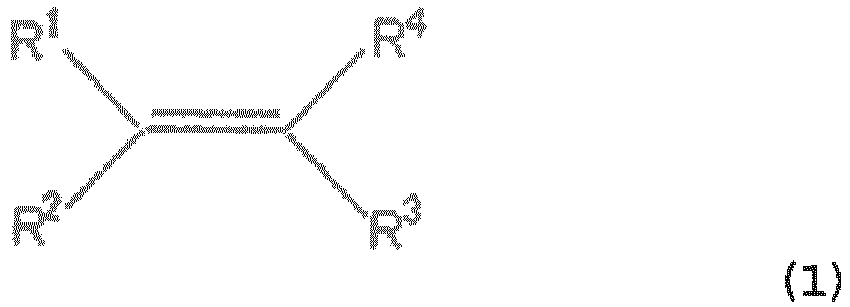
wherein one of R1 and R2 and one of R3 and R4 are -R-CN (wherein each R is independently C1-C12 alkylene, C1-C12 haloalkylene, C2-C12 alkenylene, C2-C12 alkynylene, C7-C18 benzylene, C7-C18 halobenzylene, C6-C18 arylene or C6-C18 haloarylene), and the remainders of R1, R2, R3 and R4 are independently hydrogen, C1-C12 alkyl, C1-C12 haloalkyl, C1-C12 alkoxy, C2-C12 alkenyl, C3-C18 aryl, C3-C18 haloaryl, C7-C18 benzyl, C7-C18 halobenzyl or halogen,
wherein the electrode active material particles forming the cathode is a lithium-containing transition metal oxide,
wherein the electrode active material particles forming the anode is a carbon material, lithium metal, silicon or tin capable of intercalating/deintercalating lithium ions,
wherein the metal oxide in the coating layer is an oxide of a metal selected from the group consisting of Mg, Al, Co, K, Na, Ca, Si, Ti, Zr, Sn, Y, Sr, Mo, Mn, and V, or mixtures thereof,
wherein the dinitrile compound is bonded to transition metal ions dissolved from the cathode to prevent the transition metal ions from being deposited on the surfaces of the metal oxide on the electrode, and
wherein the dinitrile compound is present in an amount of 0.1 to 10 parts by weight, based on 100 parts by weight of the lithium salt and the organic solvent.
wherein either the cathode or the anode or both include metal oxide coating layers on electrode active material particles forming the electrode or a metal oxide coating layer on the surface of an electrode layer formed on a current collector, and
the non-aqueous electrolyte solution comprises an ionizable lithium salt, an organic solvent and a dinitrile compound represented by Formula 1:
wherein one of R1 and R2 and one of R3 and R4 are -R-CN (wherein each R is independently C1-C12 alkylene, C1-C12 haloalkylene, C2-C12 alkenylene, C2-C12 alkynylene, C7-C18 benzylene, C7-C18 halobenzylene, C6-C18 arylene or C6-C18 haloarylene), and the remainders of R1, R2, R3 and R4 are independently hydrogen, C1-C12 alkyl, C1-C12 haloalkyl, C1-C12 alkoxy, C2-C12 alkenyl, C3-C18 aryl, C3-C18 haloaryl, C7-C18 benzyl, C7-C18 halobenzyl or halogen,
wherein the electrode active material particles forming the cathode is a lithium-containing transition metal oxide,
wherein the electrode active material particles forming the anode is a carbon material, lithium metal, silicon or tin capable of intercalating/deintercalating lithium ions,
wherein the metal oxide in the coating layer is an oxide of a metal selected from the group consisting of Mg, Al, Co, K, Na, Ca, Si, Ti, Zr, Sn, Y, Sr, Mo, Mn, and V, or mixtures thereof,
wherein the dinitrile compound is bonded to transition metal ions dissolved from the cathode to prevent the transition metal ions from being deposited on the surfaces of the metal oxide on the electrode, and
wherein the dinitrile compound is present in an amount of 0.1 to 10 parts by weight, based on 100 parts by weight of the lithium salt and the organic solvent.
2. The lithium secondary battery according to claim 1, wherein the dinitrile compound
is selected from the group consisting of 1,4-dicyano-2-butene, 1,4-dicyano-2-methyl-2-butene,
1,4-dicyano-2-ethyl-2-butene, 1,4-dicyano-2,3-dimethyl-2-butene, 1,4-dicyano-2,3-diethyl-2-butene,
1,6-dicyano-3-hexene, 1,6-dicyano-2-methyl-3-hexene, 1,6-dicyano-2-methyl-5-methyl-3-hexene,
and mixtures thereof.
3. The lithium secondary battery according to claim 1, wherein the nitrile groups of
the dinitrile compound are in trans positions.
4. The lithium secondary battery according to claim 1, wherein the anion of the lithium
salt is selected from the group consisting of F-, Cl-, Br-, I-, NO3-, N(CN)2-, BF4-, ClO4-, AlO4-, AlCl4-, PF6-, SbF6-, AsF6-, BF2C2O4-, BC4O8-, (CF3)2PF4-, (CF3)3PF3-, (CF3)4PF2-, (CF3)5PF-, (CF3)6P-, CF3SO3-, CF4CF9SO3-, CF3CF2SO3-, (CF3SO2)2N-, (FSO2)2N-, CF3CF2 (CF3)2Co)-, (CF3SO2)2CH-, (SF5)3C-, (CF3SO2)3C-, CF3(CF2)7SO3-, CF3CO2-, CH3CO2-, SCN-, and (CF3CF2SO2)2N-.
5. The lithium secondary battery according to claim 1, wherein the organic solvent is
selected from the group consisting of ether, ester, amide, linear carbonate, cyclic
carbonate, and mixtures thereof.
6. The lithium secondary battery according to claim 5, wherein the ester is a propionate
ester represented by Formula 2:
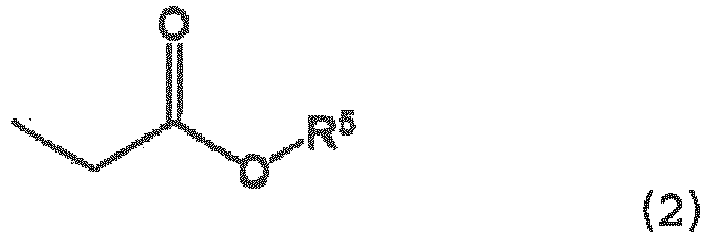
wherein R5 is a C1-C5 alkyl group.
wherein R5 is a C1-C5 alkyl group.
7. The lithium secondary battery according to claim 1, wherein the metal oxide in the
coating layer is in a particle phase.
8. The lithium secondary battery according to claim 1, wherein the metal oxide in the
coating layer is in an amorphous phase.
1. Lithiumsekundärbatterie, umfassend eine Kathode, eine Anode, einen Separator und eine
nicht-wässrige Elektrolytlösung,
wobei entweder die Kathode oder die Anode oder beide Metalloxidbeschichtungsschichten auf Elektrodenaktivmaterialteilchen ausbildend die Elektrode oder eine Metalloxidbeschichtungsschicht auf der Oberfläche einer auf einem Stromsammler gebildeten Elektrodenschicht einschließen, und
die nicht-wässrige Elektrolytlösung ein ionisierbares Lithiumsalz, ein organisches Lösungsmittel und eine durch Formel 1 dargestellte Dinitrilverbindung umfasst:
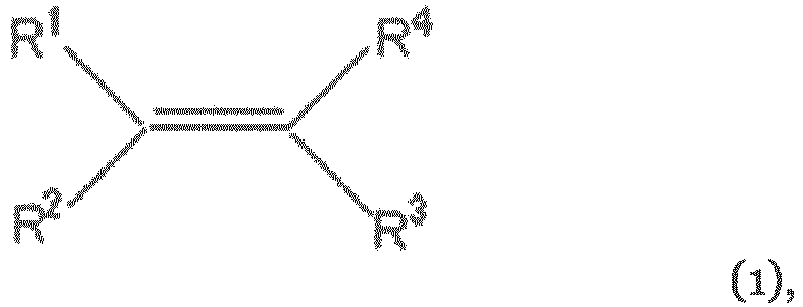
wobei eines von R1 und R2 und eines von R3 und R4 -R-CN ist (wobei jedes R unabhängig C1-C12-Alkylen, C1-C12-Halogenalkylen, C2-C12-Alkenylen, C2-C12-Alkinylen, C7-C18-Benzylen, C7-C18-Halogenbenzylen, C6-C18-Arylen oder C6-C18-Halogenarylen ist), und wobei die Verbleibenden von R1, R2, R3 und R4 unabhängig Wasserstoff, C1-C12-Alkyl, C1-C12-Halogenalkyl, C1-C12-Alkoxy, C2-C12-Alkenyl, C3-C18-Aryl, C3-C18-Halogenaryl, C7-C18-Benzyl, C7-C18-Halogenbenzyl oder Halogen sind,
wobei die Elektrodenaktivmaterialteilchen ausbildend die Kathode ein Lithiumenthaltendes Übergangsmetalloxid sind, wobei die Elektrodenaktivmaterialteilchen ausbildend die Anode ein Kohlenstoffmaterial, Lithiummetall, Silizium oder Zinn mit der Fähigkeit zum Interkalieren/Deinterkalieren von Lithiumionen sind,
wobei das Metalloxid in der Beschichtungsschicht ein Oxid eines Metalls ist, ausgewählt aus der Gruppe bestehend aus Mg, Al, Co, K, Na, Ca, Si, Ti, Zr, Sn, Y, Sr, Mo, Mn und V oder Mischungen derselben,
wobei die Dinitrilverbindung an Übergangsmetallionen aufgelöst aus der Kathode angebunden ist, um zu verhindern, dass die Übergangsmetallionen auf den Oberflächen des Metalloxids auf der Elektrode abgeschieden werden, und wobei die Dinitrilverbindung in einer Menge von 0,1 bis 10 Gewichtsteilen, basierend auf 100 Gewichtsteilen des Lithiumsalzes und des organischen Lösungsmittels, vorhanden ist.
wobei entweder die Kathode oder die Anode oder beide Metalloxidbeschichtungsschichten auf Elektrodenaktivmaterialteilchen ausbildend die Elektrode oder eine Metalloxidbeschichtungsschicht auf der Oberfläche einer auf einem Stromsammler gebildeten Elektrodenschicht einschließen, und
die nicht-wässrige Elektrolytlösung ein ionisierbares Lithiumsalz, ein organisches Lösungsmittel und eine durch Formel 1 dargestellte Dinitrilverbindung umfasst:
wobei eines von R1 und R2 und eines von R3 und R4 -R-CN ist (wobei jedes R unabhängig C1-C12-Alkylen, C1-C12-Halogenalkylen, C2-C12-Alkenylen, C2-C12-Alkinylen, C7-C18-Benzylen, C7-C18-Halogenbenzylen, C6-C18-Arylen oder C6-C18-Halogenarylen ist), und wobei die Verbleibenden von R1, R2, R3 und R4 unabhängig Wasserstoff, C1-C12-Alkyl, C1-C12-Halogenalkyl, C1-C12-Alkoxy, C2-C12-Alkenyl, C3-C18-Aryl, C3-C18-Halogenaryl, C7-C18-Benzyl, C7-C18-Halogenbenzyl oder Halogen sind,
wobei die Elektrodenaktivmaterialteilchen ausbildend die Kathode ein Lithiumenthaltendes Übergangsmetalloxid sind, wobei die Elektrodenaktivmaterialteilchen ausbildend die Anode ein Kohlenstoffmaterial, Lithiummetall, Silizium oder Zinn mit der Fähigkeit zum Interkalieren/Deinterkalieren von Lithiumionen sind,
wobei das Metalloxid in der Beschichtungsschicht ein Oxid eines Metalls ist, ausgewählt aus der Gruppe bestehend aus Mg, Al, Co, K, Na, Ca, Si, Ti, Zr, Sn, Y, Sr, Mo, Mn und V oder Mischungen derselben,
wobei die Dinitrilverbindung an Übergangsmetallionen aufgelöst aus der Kathode angebunden ist, um zu verhindern, dass die Übergangsmetallionen auf den Oberflächen des Metalloxids auf der Elektrode abgeschieden werden, und wobei die Dinitrilverbindung in einer Menge von 0,1 bis 10 Gewichtsteilen, basierend auf 100 Gewichtsteilen des Lithiumsalzes und des organischen Lösungsmittels, vorhanden ist.
2. Lithiumsekundärbatterie nach Anspruch 1, wobei die Dinitrilverbindung ausgewählt ist
aus der Gruppe bestehend aus 1,4-Dicyano-2-buten, 1,4-Dicyano-2-methyl-2-buten, 1,4-Dicyano-2-ethyl-2-buten,
1,4-Dicyano-2,3-dimethyl-2-buten, 1,4-Dicyano-2,3-diethyl-2-buten, 1,6-Dicyano-3-hexen,
1,6-Dicyano-2-methyl-3-hexen, 1,6-Dicyano-2-methyl-5-methyl-3-hexen und Mischungen
derselben.
3. Lithiumsekundärbatterie nach Anspruch 1, wobei die Nitrilgruppen der Dinitrilverbindung
in trans-Positionen sind.
4. Lithiumsekundärbatterie nach Anspruch 1, wobei das Anion des Lithiumsalzes ausgewählt
ist aus der Gruppe bestehend aus F-, Cl-, Br-, I-, NO3-, N(CN)2-, BF4-, ClO4-, AlO4-, AlCl4-, PF6-, SbF6-, AsF6-, BF2C2O4-, BC4O8-, (CF3)2PF4-, (CF3)3PF3-, (CF3)4PF2-, (CF3)5PF-, (CF3)6P-, CF3SO3-, CF4CF9SO3-, CF3CFSO3-, (CF3SO2)2N-, (FSO2)2N-, CF3CF2(CF3)2CO-, (CF3SO2)2CH-, (SF5)3C-, (CF3SO2)3C-, CF3(CF2)7SO3-, CF3CO2, CH3CO2-, SCN- und (CF3CF2SO2)2N-.
5. Lithiumsekundärbatterie nach Anspruch 1, wobei das organische Lösungsmittel ausgewählt
ist aus der Gruppe bestehend aus Ether, Ester, Amid, linearem Carbonat, zyklischem
Carbonat und Mischungen derselben.
6. Lithiumsekundärbatterie nach Anspruch 5, wobei der Ester ein Propionatester ist, dargestellt
durch Formel 2:
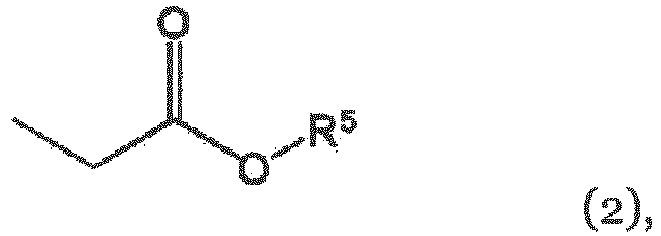
wobei R5 eine C1-C5-Alkylgruppe ist.
wobei R5 eine C1-C5-Alkylgruppe ist.
7. Lithiumsekundärbatterie nach Anspruch 1, wobei das Metalloxid in der Beschichtungsschicht
in einer partikulären Phase ist.
8. Lithiumsekundärbatterie nach Anspruch 1, wobei das Metalloxid in der Beschichtungsschicht
in einer amorphen Phase ist.
1. Batterie secondaire au lithium comprenant une cathode, une anode, un séparateur et
une solution électrolytique non aqueuse,
dans laquelle soit la cathode, soit l'anode ou les deux contiennent des couches de revêtement d'oxyde de métal posées sur des particules de matériau actif d'électrode formant l'électrode ou une couche de revêtement d'oxyde de métal posée sur la surface d'une couche électrolytique formée sur un collecteur de courant, et
la solution électrolytique non aqueuse comprend un sel de lithium ionisable, un solvant organique et un composé dinitrile représenté par la formule 1 ;
dans laquelle l'un de R1 et de R2 et l'un de R3 et de R4 représentent -R-CN (où chaque R représente indépendamment un alkylène en C1 à C12, un haloalkylène en C1 à C12, un alkénylène en C2 à C12, un alkynylène en C2 à C12, un benzylène en C7 à C18, un halobenzylène en C7 à C18, un arylène en C6 à C18 ou un haloarylène en C6 à C18, et les R1, R2, R3 et R4 restants représentent indépendamment l'hydrogène, un alkyle en C1 à C12, un haloalkyle en C1 à C12, un alcoxy en C1 à C12, un alcényle en C2 à C12, un aryle en C3 à C18, un haloaryle en C3 à C18, un benzyle en C7 à C18, un halobenzyle en C7 à C18 ou un halogène),
dans laquelle les particules de matériau actif d'électrode formant la cathode sont constituées d'un oxyde de métal de transition contenant du lithium,
dans laquelle les particules de matériau actif d'électrode formant l'anode sont constituées d'un matériau de carbone, de métal de lithium, de silicium ou d'étain aptes à intercaler/désintercaler des ions de lithium,
dans laquelle l'oxyde de métal dans la couche de revêtement est un oxyde de métal sélectionné dans le groupe constitué de Mg, Al, Co, K, Na, Ca, Si, Ti, Zr, Sn, Y, Sr, Mo, Mn et V ou de mélanges de ceux-ci,
dans laquelle le composé dinitrile est lié à des ions de métal de transition dissous à partir de la cathode afin d'empêcher les ions de métal de transition de se déposer sur les surfaces de l'oxyde de métal présent sur l'électrode, et
dans laquelle le composé dinitrile est présent en une quantité de 0,1 à 10 parties en poids, par rapport à 100 parties en poids du sel de lithium et du solvant organique.
dans laquelle soit la cathode, soit l'anode ou les deux contiennent des couches de revêtement d'oxyde de métal posées sur des particules de matériau actif d'électrode formant l'électrode ou une couche de revêtement d'oxyde de métal posée sur la surface d'une couche électrolytique formée sur un collecteur de courant, et
la solution électrolytique non aqueuse comprend un sel de lithium ionisable, un solvant organique et un composé dinitrile représenté par la formule 1 ;
dans laquelle l'un de R1 et de R2 et l'un de R3 et de R4 représentent -R-CN (où chaque R représente indépendamment un alkylène en C1 à C12, un haloalkylène en C1 à C12, un alkénylène en C2 à C12, un alkynylène en C2 à C12, un benzylène en C7 à C18, un halobenzylène en C7 à C18, un arylène en C6 à C18 ou un haloarylène en C6 à C18, et les R1, R2, R3 et R4 restants représentent indépendamment l'hydrogène, un alkyle en C1 à C12, un haloalkyle en C1 à C12, un alcoxy en C1 à C12, un alcényle en C2 à C12, un aryle en C3 à C18, un haloaryle en C3 à C18, un benzyle en C7 à C18, un halobenzyle en C7 à C18 ou un halogène),
dans laquelle les particules de matériau actif d'électrode formant la cathode sont constituées d'un oxyde de métal de transition contenant du lithium,
dans laquelle les particules de matériau actif d'électrode formant l'anode sont constituées d'un matériau de carbone, de métal de lithium, de silicium ou d'étain aptes à intercaler/désintercaler des ions de lithium,
dans laquelle l'oxyde de métal dans la couche de revêtement est un oxyde de métal sélectionné dans le groupe constitué de Mg, Al, Co, K, Na, Ca, Si, Ti, Zr, Sn, Y, Sr, Mo, Mn et V ou de mélanges de ceux-ci,
dans laquelle le composé dinitrile est lié à des ions de métal de transition dissous à partir de la cathode afin d'empêcher les ions de métal de transition de se déposer sur les surfaces de l'oxyde de métal présent sur l'électrode, et
dans laquelle le composé dinitrile est présent en une quantité de 0,1 à 10 parties en poids, par rapport à 100 parties en poids du sel de lithium et du solvant organique.
2. Batterie secondaire au lithium selon la revendication 1, dans laquelle le composé
dinitrile est sélectionné dans le groupe constitué de 1,4-dicyano-2-butène, 1,4-dicyano-2-méthyl-2-butène,
1,4-dicyano-2-éthyl-2-butène, 1,4-dicyano-2,3-diméthyl-2-butène, 1,4-dicyano-2,3-diéthyl-2-butène,
1,6-dicyano-3-hexène, 1,6-dicyano-2-méthyl-3-hexène, 1,6-dicyano-2-méthyl-5-méthyl-3-hexène
et de mélanges de ceux-ci.
3. Batterie secondaire au lithium selon la revendication 1, dans laquelle les groupes
nitrile du composé dinitrile sont en transpositions.
4. Batterie secondaire au lithium selon la revendication 1, dans laquelle l'anion du
sel de lithium est sélectionné dans le groupe constitué de F-, Cl-, Br-, I-, NO3-, N(CN)2-, BF4-, ClO4-, AlO4-, AlCl4-, PF6-, SbF6-, AsF6-, BF2C2O4-, BC4O8-, (CF3)2PF4-, (CF3)3PF3-, (CF3)4PF2-, (CF3)5PF-, (CF3)6P-, CF3SO3-, CF4CF9SO3-, CF3CF2SO3-, (CF3SO2)2N-, (FSO2)2N-, CF3CF2(CF3)2CO-,, (CF3SO2)2CH-, (SF5)3C-, (CF3SO2)3C-, CF3(CF2)7SO3-, CF3CO2-, CH3CO2-, SCN-, et (CF3CF2SO2)2N-.
5. Batterie secondaire au lithium selon la revendication 1, dans laquelle le solvant
organique est sélectionné dans le groupe constitué d'éther, d'ester, d'amide, de carbonate
linéaire, de carbonate cyclique et de mélanges de ceux-ci.
6. Batterie secondaire au lithium selon la revendication 5, dans laquelle l'ester est
un ester de propionate représenté par la formule 2 :
dans laquelle R5 représente un groupe alkyle en C1 à C5.
dans laquelle R5 représente un groupe alkyle en C1 à C5.
7. Batterie secondaire au lithium selon la revendication 1, dans laquelle l'oxyde de
métal dans la couche de revêtement est dans une phase particulaire.
8. Batterie secondaire au lithium selon la revendication 1, dans laquelle l'oxyde de
métal dans la couche de revêtement est dans une phase amorphe.