|
(11) | EP 2 650 277 A1 |

| (12) | EUROPEAN PATENT APPLICATION |
| published in accordance with Art. 153(4) EPC |
|
|
|
|
|||||||||||||||||||
| (54) | METHOD FOR PRODUCING 2-BROMO-4,5-DIALKOXY BENZOIC ACID |
| (57) Provided is a method for effectively producing a 4,5-dialkoxy-2-hydroxybenzoic acid
from an inexpensive raw material. A method for producing a 2-bromo-4,5-dialkoxybenzoic acid represented by the following formula (2): (wherein each of R1 and R2 represents a lower alkyl group), the method including causing a 3,4-dialkoxybenzoic acid represented by the following formula (1): (wherein R1 and R2 have the same meanings as defined above) to react with bromine in concentrated hydrochloric acid. |
Technical Field
[0001] The present invention relates to a method for producing a 2-bromo-4,5-dialkoxybenzoic acid which is useful as a synthesis intermediate for pharmaceuticals, etc.
Background Art
[0002] 4,5-Dialkoxy-2-hydroxybenzoic acid (3) is known as a raw material or synthesis intermediate of various pharmaceuticals and agricultural chemicals. In a known method for producing 4,5-dialkoxy-2-hydroxybenzoic acid (3), as shown in the following reaction scheme:
[0004] (wherein each of R1 and R2 represents a lower alkyl group), the methoxy group at the 2-position of 2,4,5-trialkoxybenzoic acid (a) is selectively demethylated by causing the acid to react with a Lewis acid in an ester, ketone, or amide solvent (Patent Document 1).
Prior Art Document
Patent Document
Summary of the Invention
Problems to be Solved by the Invention
[0006] However, the aforementioned method involves a problem in that production of 2,4,5-trialkoxybenzoic acid, serving as a raw material, requires an intricate process, resulting in cost increase. In addition, the method requires employment of a metal-containing reagent (e.g., titanium tetrachloride or aluminum chloride) in a stoichiometric amount or more. Since such a metal-containing reagent exhibits low resistance to water, the method must be carried out in a non-aqueous system; i.e., the method requires careful control of the reaction system. The method also involves a problem in that an organic solvent must be used in a large amount.
In view of the foregoing, an object of the present invention is to provide a method for effectively producing a 4,5-dialkoxy-2-hydroxybenzoic acid from an inexpensive raw material.
Means for Solving the Problems
[0007] In order to achieve the aforementioned object, the present inventor has focused on a 3,4-dialkoxybenzoic acid serving as an inexpensive raw material, and has conducted studies on means for selectively introducing a hydroxyl group to the 6-position of the compound. Specifically, the present inventor has conducted studies on a method including halogenation of the 6-position of a 3,4-dialkoxybenzoic acid serving as an inexpensive raw material, and hydrolysis of the halogenated compound. In a known method, halogenation reaction of the 6-position of a 3,4-dialkoxybenzoic acid is carried out in an organic solvent such as a halogenated hydrocarbon, an ether, a carboxylic acid, or an ester (Patent Document 2). However, in the case of this method, halogenation also proceeds at a position other than the 6-position of the benzoic acid, and the resultant by-products are difficult to remove, resulting in an unsatisfactory yield (about 78%). Thus, the present inventor has conducted further studies, and as a result has found that, quite unexpectedly, when this halogenation reaction is carried out by use of bromine in concentrated hydrochloric acid, highly selective bromination is achieved at the 6-position of a 3,4-dialkoxybenzoic acid at high yield. The present inventor has also found that when the resultant 2-bromo-4,5-dialkoxybenzoic acid is hydrolyzed in the presence of a copper compound and an amine compound, a high-purity 4,5-dialkoxy-2-hydroxybenzoic acid is produced at high yield. The present invention has been accomplished on the basis of these findings.
[0008] Accordingly, the present invention provides a method for producing a 2-bromo-4,5-dialkoxybenzoic acid represented by the following formula (2):
[0010] (wherein each of R1 and R2 represents a lower alkyl group), the method comprising causing a 3,4-dialkoxybenzoic acid represented by the following formula (1):
[0012] (wherein R1 and R2 have the same meanings as defined above) to react with bromine in concentrated hydrochloric acid.
[0013] The present invention also provides a method for producing a 4,5-dialkoxy-2-hydroxybenzoic acid represented by the following formula (3):
[0015] (wherein R1 and R2 have the same meanings as defined above), the method comprising causing a 3,4-dialkoxybenzoic acid represented by the following formula (1):
[0017] (wherein R1 and R2 have the same meanings as defined above) to react with bromine in concentrated hydrochloric acid; and hydrolyzing the resultant 2-bromo-4,5-dialkoxybenzoic acid represented by the following formula (2):
[0019] (wherein R1 and R2 have the same meanings as defined above) in the presence of a copper compound and an amine compound.
Effects of the Invention
[0020] According to the method of the present invention, high-purity 2-bromo-4,5-dimethoxybenzoic acid is produced, under industrially advantageous reaction conditions, from 3,4-dimethoxybenzoic acid, which is an inexpensive raw material, at high yield, and also high-purity 4,5-dimethoxy-2-hydroxybenzoic acid is produced in an industrially advantageous manner.
Modes for Carrying Out the Invention
[Step 1]
[0024] In step 1, a 3,4-dialkoxybenzoic acid represented by formula (1) (hereinafter the acid may be referred to as "compound (1)") is caused to react with bromine in concentrated hydrochloric acid, to thereby produce a 2-bromo-4,5-dialkoxybenzoic acid represented by formula (2) (hereinafter the acid may be referred to as "compound (2)").
[0025] In formulas (1) to (3), each of R1 and R2 represents a lower alkyl group. Examples of the lower alkyl group include C1 to C6 linear or branched alkyl groups. Specific examples of the lower alkyl group include methyl, ethyl, n-propyl, isopropyl, and n-butyl. Particularly preferably, both R1 and R2 are a methyl group.
[0026] Compound (1), serving as a raw material, is readily available. Particularly, 3,4-dimethoxybenzoic acid, in which both R1 and R2 are a methyl group, is available at low cost.
[0027] In the present invention, the reaction corresponding to step 1 is carried out in concentrated hydrochloric acid. Currently, this reaction is carried out in an organic solvent such as ethyl acetate (see Patent Document 2), and it has not been known that the reaction is carried out in an inorganic solvent such as concentrated hydrochloric acid. The hydrogen chloride content of the concentrated hydrochloric acid employed is preferably 30% or more, more preferably 33% or more, even more preferably 33 to 40%.
[0028] The amount of bromine employed is preferably 1.0 to 2.0 equivalents, more preferably 1.0 to 1.5 equivalents, particularly preferably 1.0 to 1.1 equivalents, with respect to compound (1). This reaction sufficiently proceeds even when the amount of bromine employed is as small as 1.0 to 1.1 equivalents, and produces small amounts of by-products.
[0029] The reaction temperature is preferably 10 to 45°C, particularly preferably 10 to 35°C. The aforementioned reaction proceeds at such a temperature (i.e., ambient temperature) without requiring application of any energy.
The reaction time, which may vary with reaction scale, etc., is 2 to 10 hours or 4 to 8 hours. When the reaction time falls within such a range, satisfactory results are obtained.
[0030] The aforementioned reaction selectively produces a high-purity 2-bromo-4,5-dialkoxybenzoic acid. According to this reaction, bromination of the 6-position proceeds in a highly selective manner. Therefore, small amounts of by-products are produced, and a high-purity product of interest is produced at high yield.
[Step 2]
[0031] In step 2, compound (2) is hydrolyzed in the presence of a copper compound and an amine compound, to thereby produce a 4,5-dialkoxy-2-hydroxybenzoic acid represented by formula (3) (hereinafter the acid may be referred to as "compound (3)").
[0032] Examples of the copper compound employed include copper sulfate, cuprous chloride, cupric chloride, cuprous bromide, cupric bromide, cuprous oxide, cupric oxide, copper acetate, and copper powder. Of these, copper sulfate is particularly preferred. Examples of the amine compound include secondary amines, tertiary amines, and aromatic amines. Specific examples of the amine compound include pyridine, dialkylamine, morpholine, piperidine, pyrrolidine, piperazine, and trialkylamine. Of these amine compounds, pyridine is particularly preferred.
[0033] The amount of the copper compound employed is preferably 0.01 to 1.0 equivalent, particularly preferably 0.05 to 0.1 equivalents, with respect to compound (2). The amount of the amine compound employed is preferably 0.1 to 5.0 equivalents, particularly preferably 0.5 to 1 equivalent, with respect to compound (2).
[0034] The hydrolysis reaction is preferably carried out in the presence of an alkali. Examples of the alkali employed include sodium carbonate, potassium carbonate, sodium hydrogencarbonate, potassium hydrogencarbonate, sodium hydroxide, and potassium hydroxide. The amount by mole of the alkali employed is preferably 1.0 to 3.0 times, particularly preferably 1.25 to 1.5 times, that of compound (2).
[0035] The hydrolysis reaction is carried out in an aqueous solution at preferably 50 to 100°C, particularly preferably at 90 to 100°C. The reaction time is preferably 1 to 8 hours, particularly preferably 1 to 3 hours.
[0036] After completion of the reaction, a product of interest can be purified through a common technique such as washing, recrystallization, or any chromatography technique.
[0037] According to the method of the present invention, a high-purity 4,5-dialkoxy-2-hydroxybenzoic acid (compound (3)) is produced from an inexpensive raw material through a simple process at high yield. Through, for example, the method described in WO2006/022252, compound (3) can be formed into compound (8), which is useful as a drug such as an enterokinesis-improving agent.
[0039] (In the aforementioned scheme, R3 represents a lower alkyl group, and R1 and R2 have the same meanings as defined above.)
[0040] Specifically, compound (3) is caused to react with phenol or triphenyl phosphite, to thereby produce compound (4); compound (4) is caused to react with compound (5), to thereby produce compound (6); and compound (6) is caused to react with compound (7), to thereby produce compound (8) or a salt thereof. In this case, R3 is preferably a C1 to C6 alkyl group.
Examples
[0041] The present invention will next be described in more detail by way of examples, which should not be construed as limiting the invention thereto.
Example 1
(Compound (1) → Compound (2))
[0042] 3,4-Dimethoxybenzoic acid (25.0 g) was suspended in concentrated hydrochloric acid (35%) (500 mL), and bromine (23.0 g, 1.05 equivalents) was added dropwise to the resultant suspension at 25°C. Subsequently, the resultant mixture was stirred for seven hours. Water (500 mL) was added to the mixture, and the mixture was stirred for one hour. Thereafter, the precipitated crystals were filtrated, and then dried under reduced pressure, to thereby produce crude crystals of 2-bromo-4,5-dimethoxybenzoic acid (34.47 g)
(yield: 96.2%).
1H-NMR (DMSO-d6, δ): 3.79(s,3H), 3.84(s,3H), 7.21 (s, 1H),
7.37 (s, 1H), 13.08 (bs, 1H).
[0043] The same reaction as described above was carried out under different reaction conditions (i.e., the amount of bromine, the reaction temperature, and the reaction time were varied). Table 1 shows the relationship between reaction conditions and yield. In Table 1, "A" represents 3-bromo-4,5-dimethoxybenzoic acid; "B" 3,4-dimethoxybenzoic acid; "C" 1,2-dibromo-4,5-dimethoxybenzene; "E" 2,3-dibromo-4,5-dimethoxybenzoic acid; and "F" 2,6-dibromo-4,5-dimethoxybenzoic acid.
[0044]
[Table 1]
| (eq) | (hr) | (%) | Compound (2) | |||||
| Amount of bromine | Temperature | Time | A | B | C | Yield (%) | E | F |
| 2.0 | Room temperature | 3 | 1.8 | 0.6 | 1.3 | 85.5 | 4.3 | 6.5 |
| 1.1 | Room temperature | 7 | 1.8 | 1.4 | 3.2 | 90.3 | 2.0 | 1.3 |
| 1.05 | Room temperature | 7 | 0.8 | 1.0 | 1.9 | 92.5 | 2.3 | 1.4 |
| 1.05 | 20 to 30°C | 5 | - | 1.4 | - | 92.1 | - | - |
| 1.05 | 40 to 45°C | 5 | - | 4.6 | - | 82.6 | - | - |
[0045] As is clear from Table 1, when compound (1) is caused to react with bromine in concentrated hydrochloric acid, high-purity compound (2) is produced at high yield under mild reaction conditions. As is also clear from Table 1, when the amount of bromine employed is 1.0 to 1.1 equivalents, satisfactory results are obtained.
According to the Example of Patent Document 2, bromine (1.8 equivalents) is added to compound (1) in ethyl acetate, and reaction is allowed to proceed at 65°C for seven hours, to thereby produce compound (2) at a yield of 78%. These data indicate that the method of the present invention is more industrially advantageous than the method described in Patent Document 2.
[0046] For evaluation of the effect of concentrated hydrochloric acid concentration, the aforementioned reaction was carried out under the following conditions (amount of bromine: 1.1 equivalents, reaction temperature: 20 to 30°C, and reaction time: three hours), while the concentration of concentrated hydrochloric acid employed was varied. The results are shown in Table 2.
[0047]
[Table 2]
| (Yield %) | ||||||
| Product | Concentrated hydrochloric acid concentration | |||||
| 30% | 31% | 32% | 33% | 34% | 35% | |
| A | 1.13 | 1.24 | 1.37 | 1.25 | 1.09 | 1.05 |
| B | 8.65 | 4.6 | 4.17 | 4.04 | 2.16 | 0.47 |
| C | 10.83 | 6.12 | 4.4 | 3.13 | 2.79 | 1.84 |
| Compound (2) | 75.55 | 82.37 | 85.39 | 89.14 | 91.11 | 95.64 |
| E | 1.77 | 2.47 | 1.78 | 1.16 | 1.19 | 0.75 |
| F | 2.07 | 3.22 | 2.89 | 1.28 | 1.66 | 0.25 |
[0048] As is clear from Table 2, the higher the concentrated hydrochloric acid concentration, the higher the yield of compound (2). Even in the case where 30% concentrated hydrochloric acid is employed, when the reaction time is prolonged, the yield of compound (2) is further increased. These data indicate that the concentrated hydrochloric acid concentration is preferably 33% or more.
Example 2
(Compound (2) → Compound (3))
[0049] Water (80 mL) was added to the crude crystals of 2-bromo-4,5-dimethoxybenzoic acid produced in Example 1 (20.0 g) and sodium carbonate (10.1 g). The resultant mixture was stirred under heating at 80°C, and a copper sulfate solution prepared from copper sulfate pentahydrate (1.91 g), water (20 mL), and pyridine (3.1 mL) was added to the mixture. The resultant mixture was further heated and stirred at 90 to 100°C for one hour. The mixture was cooled to 50°C, and concentrated hydrochloric acid (16.0 g) was added dropwise thereto. After cooling of the mixture, the precipitated crystals were filtrated, and then dried under reduced pressure, to thereby produce crude crystals of 2-hydroxy-4,5-dimethoxybenzoic acid (15.08 g) (yield: 99.3%). 1H-NMR (DMSO-d6, δ): 3.71 (s, 3H), 3.81 (s, 3H), 6.56 (s, 1H), 7.17 (s, 1H), 11.22 (bs, 1H), 13.58 (bs, 1H).
[0050] The reaction of Example 2 was repeated, except that copper sulfate was replaced with the same equivalent of a copper compound. The same reaction conditions as described above were employed, except that the amount of pyridine employed was changed to 5 equivalents. Table 3 shows the results in terms of yield of compound (2).
[0051]
[Table 3]
| Copper catalyst | Yield of compound (2) |
| Copper sulfate | 96.80% |
| Copper powder | 92.20% |
| Cuprous bromide | 98.80% |
| Cupric bromide | 93.40% |
| Cuprous chloride | 98.30% |
| Cuprous oxide | 97.20% |
| Cupric oxide | 98.60% |
| Copper acetate | 97.10% |
[0052] When the reaction of Example 2 was repeated, except that the amount of pyridine employed was changed to 0.1 equivalents (0.62 mL), compound (2) was produced at a yield of 83.4% (reaction time: eight hours). When the reaction of Example 2 was repeated, except that the amount of pyridine employed was changed to 1.0 equivalent (6.2 mL), compound (2) was produced at a yield of 91.5% (reaction time: three hours).
Referential Example
[0053] (1) Toluene (1.5 g) was mixed with P(OPh)3 (2.35 g), 2-hydroxy-4,5-dimethoxybenzoic acid (1.5 g), and H2SO4 (40.3 µL) under a stream of argon, and the resultant reaction mixture was refluxed with stirring for 2.5 hours. The reaction mixture was cooled, and methanol (5 g) was added, followed by stirring for 30 minutes. Subsequently, water (2.5 g) was added to the mixture, and the mixture was stirred for 30 minutes. The precipitated crystals were filtrated, and then dried under reduced pressure, to thereby produce phenyl 2-hydroxy-4,5-dimethoxybenzoate (2.0 g) at a yield of 96%.
[0054] (2) Phenyl 2-hydroxy-4,5-dimethoxybenzoate (5.0 g), methyl 2-amino-1,3-thiazole-4-carboxylate (3.75 g), and (PhO)3B (5.49 g) were suspended in toluene (25 g) under a stream of argon, and the resultant suspension was stirred under heating at 100°C for three hours. Methanol (25 g) was added dropwise to the reaction mixture at 70°C, and then the resultant mixture was refluxed for one hour. The mixture was cooled, and stirred at 30°C or lower for one hour. Thereafter, the precipitated crystals were filtrated, and then dried at 60°C under reduced pressure, to thereby produce 2-[(2-hydroxy-4,5-dimethoxybenzoyl)amino]-1,3-thiazole-4-carboxylic acid methyl ester monomethanol solvate (6.49 g) at a yield of 96%. The 2-[(2-hydroxy-4,5-dimethoxybenzoyl)amino]-1,3-thiazole-4-carboxylic acid methyl ester monomethanol solvate was found to have a purity of 99.78% as determined through HPLC (i.e., very high purity). 1H-NMR (DMSO-d6, δ): 3.19(s,3H), 3.79(s,3H), 3.83 (s, 3H), 3.84(s,3H), 4.05-4.15 (bs, 1H), 6.61 (s, 1H), 7.63 (s, 1H), 8.13 (s, 1H), 11.77 (s, 1H), 12.40 (s, 1H).
Furthermore, drying was carried out at 100°C under reduced pressure, to thereby produce 2-[(2-hydroxy-4,5-dimethoxybenzoyl)amino]-1,3-thiazole-4-carboxylic acid methyl ester.
1H-NMR(DMSO-d6, δ): 3.79(s,3H), 3.83(s,3H), 3.84(s,3H), 6.61 (s, 1H), 7.63 (s, 1H), 8.13 (s, 1H), 11.77 (s, 1H), 12.40 (s, 1H).
[0055] (3) The 2-[(2-hydroxy-4,5-dimethoxybenzoyl)amino]-1,3-thiazole-4-carboxylic acid methyl ester (10.81 g) was suspended in toluene (30 mL), and diisopropylethylenediamine was added dropwise at 70°C under a stream of argon. Thereafter, the resultant mixture was stirred under heating at 100°C for five hours. The resultant reaction mixture was cooled, and 10% (w/w) aqueous sodium chloride solution (20 mL) was added to the mixture at 75°C, followed by extraction operation. This operation was carried out once again. After removal of the resultant aqueous layer, toluene was distilled off under reduced pressure, and the residue was diluted with 80% (v/v) 2-propanol-water (38 mL). 35% Hydrochloric acid (9.22 g) was added dropwise to the diluted residue, to thereby precipitate N-[2-(diisopropylamino)ethyl]-2-[(2-hydroxy-4,5-dimethoxybenzoyl)amino]-1,3-thiazole-4-carboxamide hydrochloride. The precipitated crystals were filtrated and washed with 2-propanol, and then dried at 50°C under reduced pressure, to thereby produce N-[2-(diisopropylamino)ethyl]-2-[(2-hydroxy-4,5-dimethoxybenzoyl)amino]-1,3-thiazole-4-carboxamide hydrochloride (14.45 g) at a yield of 97%.
1H-NMR (DMSO-d6, δ): 1.32 (d, 6H, J=6.4Hz), 1.35 (d, 6H, J=6.4Hz), 3.16-3.19(m,2H), 3.59-3.67(m,4H), 3.78(s,3H), 3.82(s,3H), 6.89 (s, 1H), 7.50 (s, 1H), 7.91 (s, 1H), 8.74 (t, 1H, J=5.9Hz), 9.70 (s, 1H), 11.80 (s, 1H), 12.05-12.15 (bs, 1H).
1. A method for producing a 2-bromo-4,5-dialkoxybenzoic acid represented by the following
formula (2):
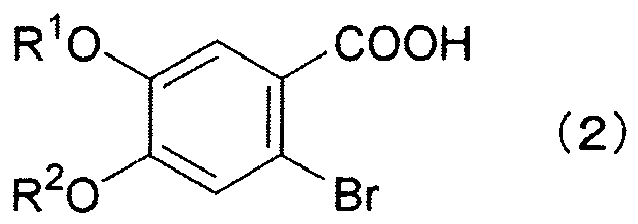
(wherein each of R1 and R2 represents a lower alkyl group), the method comprising causing a 3,4-dialkoxybenzoic acid represented by the following formula (1):
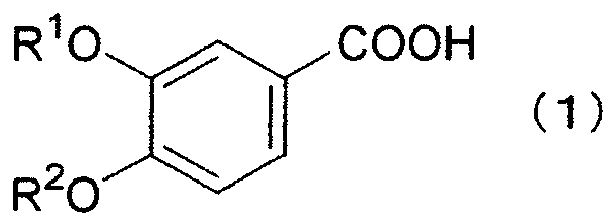
(wherein R1 and R2 have the same meanings as defined above) to react with bromine in concentrated hydrochloric acid.
(wherein each of R1 and R2 represents a lower alkyl group), the method comprising causing a 3,4-dialkoxybenzoic acid represented by the following formula (1):
(wherein R1 and R2 have the same meanings as defined above) to react with bromine in concentrated hydrochloric acid.
2. The production method according to claim 1, wherein the concentrated hydrochloric
acid has a hydrogen chloride content of 33% or more.
3. The production method according to claim 1 or 2,
wherein bromine is employed in an amount of 1.0 to 1.1 equivalents.
wherein bromine is employed in an amount of 1.0 to 1.1 equivalents.
4. The production method according to any one of claims 1 to 3, wherein the reaction
is carried out at 10 to 45°C.
5. The production method according to any one of claims 1 to 4, wherein, in formulas
(1) and (2), both R1 and R2 are a methyl group.
6. A method for producing a 4,5-dialkoxy-2-hydroxybenzoic acid represented by the following
formula (3):
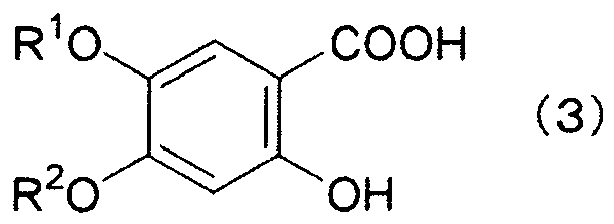
(wherein each of R1 and R2 represents a lower alkyl group), the method comprising causing a 3,4-dialkoxybenzoic acid represented by the following formula (1):
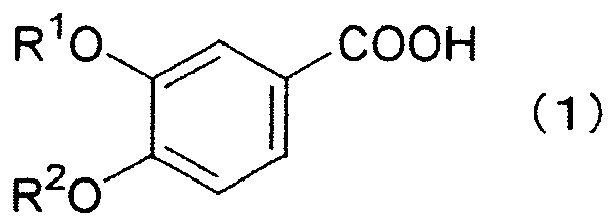
(wherein R1 and R2 have the same meanings as defined above) to react with bromine in concentrated hydrochloric acid; and hydrolyzing the resultant 2-bromo-4,5-dialkoxybenzoic acid represented by the following formula (2):
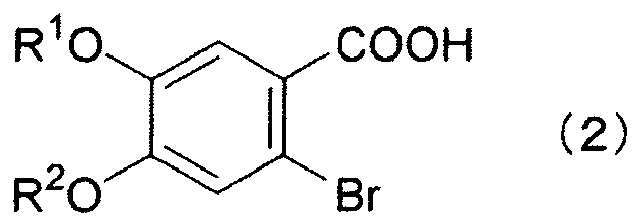
(wherein R1 and R2 have the same meanings as defined above) in the presence of a copper compound and an amine compound.
(wherein each of R1 and R2 represents a lower alkyl group), the method comprising causing a 3,4-dialkoxybenzoic acid represented by the following formula (1):
(wherein R1 and R2 have the same meanings as defined above) to react with bromine in concentrated hydrochloric acid; and hydrolyzing the resultant 2-bromo-4,5-dialkoxybenzoic acid represented by the following formula (2):
(wherein R1 and R2 have the same meanings as defined above) in the presence of a copper compound and an amine compound.
7. The production method according to claim 6, wherein the copper compound is selected
from among copper sulfate, cuprous chloride, cupric chloride, cuprous bromide, cupric
bromide, cuprous oxide, cupric oxide, copper acetate, and copper powder.
8. The production method according to claim 6 or 7,
wherein the amine compound is selected from among pyridine, dialkylamine, morpholine, piperidine, pyrrolidine, piperazine, and trialkylamine.
wherein the amine compound is selected from among pyridine, dialkylamine, morpholine, piperidine, pyrrolidine, piperazine, and trialkylamine.
9. The production method according to any one of claims 6 to 8, wherein the hydrolysis
reaction is carried out under alkaline conditions.
10. The production method according to any one of claims 6 to 9, wherein the concentrated
hydrochloric acid has a hydrogen chloride content of 30% or more.
11. The production method according to any one of claims 6 to 10, wherein bromine is employed
in an amount of 1.0 to 1.1 equivalents.
12. The production method according to any one of claims 6 to 11, wherein the 3,4-dialkoxybenzoic
acid is caused to react with bromine at 10 to 45°C.
13. The production method according to any one of claims 6 to 12, wherein, in formulas
(1), (2), and (3), both R1 and R2 are a methyl group.
REFERENCES CITED IN THE DESCRIPTION
This list of references cited by the applicant is for the reader's convenience only. It does not form part of the European patent document. Even though great care has been taken in compiling the references, errors or omissions cannot be excluded and the EPO disclaims all liability in this regard.
Patent documents cited in the description