|
(11) | EP 2 662 075 A1 |

| (12) | EUROPEAN PATENT APPLICATION |
|
|
|
|
|||||||||||||||||||||||
| (54) | Taste masking compositions of praziquantel |
| (57) The present invention relates to improvements in the oral formulations of the anthelmintic
praziquantel used for control and treatment of endoparasitic infestations in warm-blooded
animals in particular in companion animals such as cats, dogs and horses and methods
of producing the formulations. The composition of the invention comprises particles
of praziquantel with an integral coating of a lipid or a mixture of lipids which are
insoluble in water and which serve to mask to extremely bitter taste of praziquantel
upon oral administration but which disperse or dissolve on contact with gastrointestinal
tract and thus do not influence the bioavailability of the drug substance. The present
invention also provides compositions for oral administration of praziquantel in cats
and dogs which are substantially free of the bitter taste associated with praziquantel
and comprise a dispersion of the lipid-coated particles of praziquantel in suitable
vehicle. According to a yet further aspect, the invention provides a method of masking
the bitter taste of praziquantel which comprises coating praziquantel with a suitable
lipid or a mixture of lipids and incorporating the lipid-coated particles into oral
formulations, for example into tablets, oral pastes or gels. |
[0001] The present invention relates to improvements in the oral formulations of the anthelmintic praziquantel used for control and treatment of endoparasitic infestations in warm-blooded animal in particular in companion animals such as cats, dogs and horses and methods of producing the formulations.
[0002] The primary attributes of a successful pharmaceutical product for companion animals remain efficacy and safety of the active ingredient. However, the importance of palatability has significantly increased during the past several years because it markedly affects convenience and compliance.
[0003] It can be a rather challenging task for a pet owner to administer an oral product to cats or dogs as the animals mostly do not take their medicine willingly, especially if it is badly tasting or smelling. Their acute sense of smell will often warn them that their owner is approaching with an unpleasant drug product even when it is hidden in a treat or the food. Administering, bad-tasting medicines to a horse also offers several challenges. Horses are intelligent animals, and will learn after the first effort that the tube inserted in their mouth has an unpleasant flavour. Therefore, palatability is one of the main factors to be considered in development of oral formulations for companion animals.
[0004] Examples of such unpleasant medicines are anthelmintic veterinary formulations containing the active ingredient praziquantel (2-(cyclohexylcarboriyl)-1,2,3,6,7-11b-hexahydro-4H-pyrazino[2,1-a]isoquinoline-4-one). Praziquantel is a well known anthelmintic agent, widely used in both human and animal medicines. In animal health it is used against cestodes and trematodes, whereas in human pharmaceuticals praziquantel is the drug of choice for treatment of all forms of schistosomiasis.
[0005] Praziquantel has a very bitter taste and a bad smell, a consequence of which it is refused virtually by all cats and dogs offered the drug without some type of taste masking. The simplest way to try to overcome the bitter taste of praziquantel is to add a well-accepted flavour to the composition. However, the simple addition of a flavour may not be sufficient because this does not mask the taste of very bitter drugs and also does not cover odors. Cats are especially sensitive to bad taste and odor and are not tricked as easy as dogs by simply adding a flavour. Other methods to achieve taste masking may include coating, complexation or embedding in taste masking agents. The most often used and easiest technique to mask the bitter taste of human medicines is coating because it encloses the drug and therefore also masks the odor. However, the animals may crush the coating during chewing and as a result, perceive the bitter taste and refuse to swallow the drug product. A better result is achieved if microparticles of granules of the bitter drug are coated with different polymers or by complex formation with suitable carriers, such as cyclodextrins by co-precipitafion or by kneading.
[0006] Nearly all of these processes require solvents, i.e. water, organic solvents or mixtures. The use of organic solvents may lead to environmental problems, solvent residues and excessive cost of recovery. Furthermore, instability of the active ingredient in these solvents may occur, and aqueous solvents generally prolong the duration of processes.
[0007] Several thermal techniques such as melt granulation, hot-mett extrusion, hot-mett coating and spray congealing may also show promising results for taste masking of bitter drugs. These methods are based on the use of suitable hydrophobic carriers, mostly lypophilic waxes with a rather low melting temperature. Because of the hydrophobic nature of the lipid carriers, the release of drug substances is mostly delayed. This may affect the bioavailability of the drugs especially in case of those substances for which the dissolution is the absorption rate limiting factor. As regards the biopharmaceutics properties, praziquantel belongs into this class of drugs (Class II in the Biopharmaceutics Classification System).
[0008] Various methods of taste masking praziquantel have been described. US Patent No. 7,348,027 provides a method of possible taste masking by mixing praziquantel, Pyrantel embonate and febantel with artificial beef and yeast components and subjected to a first compression. The resulting rough tablet is then ground to increase the density of the material which is then subjected to a second compression to form a final, self-take tablet.
[0009] WO 2005/081612 describes a solid pharmaceutical composition for veterinary use, where such composition includes a compressed nucleus which contains the active ingredients of unpleasant taste, such as praziquantel and pharmaceutically accepted excipients, as well as a coat which includes flavourings and compression co-adjuvants. EP Patent No. 1,566,173 provides a method of taste masking praziquantel in which the anthelmintic agent is adsorbed to the inner surface of an excipient having a porous structure with particular surface area providing an efficient taste- and odour-masking effect as well as a sustained release profil. Using charcoal as excipient, a good taste masking and sustained release of praziquantel was achieved. GB Patent No. 2,403,407 discloses a method of taste masking where praziquantel and fenbendazole are wet granulated with a taste-masking polymer, sweetener and sweet excipients. The taste-masking polymer, sweetener and sweet excipients fill up the intergranular mass of the composition, thereby providing a sweeter taste to it.
[0010] EP Patent No. 1,362,583 relates to masking the taste of praziquantel and epsiprantel by microencopsulation comprising a dispersion of the active ingredients surrounded by an impermeable capsule wall.
[0011] WO 2007/073911 provides a method of taste masking powders that are to be inhaled or administered orally by coating the microparticles of the active substance, such as praziquantel with a wax dissolved in an organic solvent and then spray dried to obtain particles between 1 and 40 µm.
[0012] EP 2008/065335 is concerned with an anthelmintic paste, comprising praziquantel and a macrocyclic lactone as active ingredients. According to the invention taste masking of praziquantel is achieved by inclusion complexation with cyclodextrins. WO 2008-/148484 describes a method of taste masking praziquantel and some other pharmacologically active substances by melt extrusion with thermoformable materials including polymers, lipids, surfactants, macrogols, sugars, sugar alcohols and combination thereof. The extrudates of the invention have a strand diameter of 0.5 mm or less which is said to be suitable for concealing the taste of ingredients with an unpleasant taste.
[0013] EP Patent No. 1,675,474 relates to chewable veterinary compositions of parasiticidal agents including praziquantel by extrusion of the active ingredients with partially gelatinized starch and meat flavouring comprising a high fat content at temperatures not exceeding 40°C.
[0014] As can be seen from data above, the methods applied for taste masking of praziquantel until now include dry and wet granulation, adsorption to porous substances, polymer and wax coating using organic solvents, microencapsulation and extrusion.
[0015] We have now found that the extremely bitter taste of praziquantel may be masked by embedding the drug substance into a suitable lipid. The praziquantel particles of integral lipid coatings are substantially insoluble in water as a consequence of which do not release the bitter praziquantel in the wet environment of the mouth. Because of the hydrophobic nature of the lipids it was expected that the lipid coating of the particulate praziquantel will also delay the release of the active in the gastrointestinal tract as described e.g. by Jannin et al. (Jannin, V. et al: Influence of poloxamers on the dissolution performance and stability of controlled-release formulations containing Precirol ATO 5. International Journal of Pharmaceutics, 309, 6-15.). For veterinary products, mainly for cats and dogs, this is not reasonable as the gastrointestinal transit time is less in companion animals than in humans.
[0016] Therefore, it is suprising and was absolutely not predictable that the formulations according to the present invention containing the lipid-coated praziquantel could lead to the same level of bioavailability in terms of bioequivalence as the administration of similar formulations containing non-coated praziquantel. The formulated coated particles, while not releasing the bitter praziquantel in the wet environment of the mouth, break down upon contact with the gastrointestinal fluid, thus allowing rapid dispersion and dissolution in the gastrointestinal tract. Thus, the present invention provides highly palatable, easy to administer oral anthelmintic compositions that are at least as efficacious and safe as conventional oral praziquantel formulations.
[0017] Thus according to one aspect the present invention provides a composition comprising particles of praziquantel with an integral coating of a lipid or a mixture of lipids which are insoluble in water and which serve to mask to extremely bitter taste of praziquantel upon oral administration but which disperse or dissolve on contact with gastrointestinal tract and thus do not influence the bioavailability of the drug substance.
[0018] According to a further aspect, the present invention provides compositions for oral administration of praziquantel in cats and dogs which are substantially free of the bitter taste associated with praziquantel and comprise a dispersion of the lipid-coated particles of praziquantel in suitable vehicle. According to a yet further aspect, the invention provides a method of masking the bitter taste of praziquantel which comprises coating praziquantel with a suitable lipid or a mixture of lipids and incorporating the lipid-coated particles into oral formulations, for example into tablets, oral pastes or gels.
[0019] In order to effectively mask the bitter taste of praziquantel the mean diameter of the particles should be less than 100 µm.
[0020] The melting point of the lipid used should be sufficiently high to prevent melting of the coated particles in the mouth, thereby leading to release of the bitter tasting active substance, but not so high that praziquantel itself melts and/or becomes chemically degraded during the coating process. Thus the lipid or mixture of lipids for use in the present invention will have a melting point from 40°C to 80°C and preferable from 50°C to 70°C.
[0021] Suitable lipids for the coating of praziquantel particles include fatty acids or monohydric alcohols thereof, fixed oils, fats, waxes, sterols, phospholipids either singly or in mixture. The lipid may, for example, be a high molecular weight (C10-C30) straight chain saturated or unsaturated aliphatic acid, such as palmitic or stearic acid, glycerol mono-, di- or triesters of C10-C30 fatty acids, such as glycerol dibehenate, glycerol distearate, glycerol trilaurate, glycerol myristate, glycerol tripalmitate or glycerol tristearate and mixtures of glycerol mono-, di- or triesters such as, for example, glycerol palmitostearate. Mention may also made of waxes, especially those having 30 to 60 carbon atoms, such as cetyl palmitate. Mention may furthermore be made of partially hydrogenated vegetable or animal oils such as hardened palm oil or hardened edible tallow, and high molecular weight (C10-C30) straight chain aliphatic alcohols such as stearyl alcohol or cetyl alcohol. Particularly preferred examples are glycerol distearate and cetyl palmitate.
[0022] The lipid-coated particles according to the invention will contain 5 to 80%, preferably 10 to 50%, more preferably 20 to 40% praziquantel on a weight-to-weight (w/w) basis.
[0023] The lipid-coated particles of the invention will generally have a diameter of less than 500 µm, and preferably less than 300 µm. Coated particles with a diameter in the range of 1-300 µm, e.g. 40-200 µm are preferred. Control of the particle size is necessary to ensure that the subsequently formulated product does not induce a gritty feel in the mouth. Particles having a diameter of less than about 200 µm are preferred in this respect.
[0024] The lipid-coated particles of the invention may be prepared by atomising a dispersion of praziquantel in a molten lipid and cooling the particles hereby obtained and such a process constitutes a further feature of the invention. The dispersion may be prepared by adding particulate praziquantel to the molten lipid or mixture of lipids or
| Oral Paste | Amount (% w/w) |
| Lipid coated Praziquantel* | 4.0 |
| Moxidectin | 0.05 |
| Xanthan gum | 0.5 |
| Lactose | 26.7 |
| Saccharose | 33.4 |
| Wheat starch | 2.0 |
| Artificial honey | 2.0 |
| Methyl parahydroxybenzoate | 0.05 |
| Purified water | ad 100.0% |
| * According to Example 1 |
Example 5: In vivo bioavailability
[0025] The in vivo bioavailability of praziquantel used in the lipid-coated form according to Example 2 of the invention and administered as a tablet formulation according to Example 3 of the present invention was determined in comparison to a reference formulation containing the same amount of praziquantel (50 mg/tablet) but in non-coated form. Both formulations were administered at a dose of 5 mg praziquantel per kg of body weight in a cross-over design. Geometric means of the measured/calculated kinetic parameters were found as follows.
| Measured/calculated kinetic parameters of praziquantel | ||
| Test formulation of the invention | Reference formulation | |
| Cmax(ng/ml) | 308.3 | 325.6 |
| Tmax(h) | 1.9 | 1.8 |
| AUC (ng·h/ml) | 921.1 | 984.0 |
| Cmax = maximum plasma concentration; Tmax = time to reach the maximum concentration; AUC = area under the curve |
[0026] Based on the statistical evaluation of the relevant pharmacokinetic parameters the test formulation containing the lipid coated praziquantel was found to reliably fulfil the bioequivalence requirements.
Example 6: Palatability (acceptance) test
[0027] 129 male and female dogs of different breeds and age were tested. The testing person offered to each dog a single dose of the test formulation which was adapted to the body weight of the animal. In the case of tablet formulations of the present invention, in a first instance the tablet was offered by hand for 1 minute. If the dog does not take the formulation it was offered the dog in his empty bowl. The dog had again 1 minute to take the formulation. If not, it was placed into his/her mouth. If one of the three abovementioned offers leads to the dog willingly eaten the tablet, this is evaluated as acceptance of the tablet. If the dog spits it out it is reported as not accepted.
[0028] A similar test was carried out with the oral paste/gel formulations of the present invention on 34 cats. The tested formulations were filled in graduated oral syringes. Throughout the study conduct, 1 ml of all tested oral paste/gel formulations were offered to each cat. First, a small amount of paste was applied on the lips/nose of the animal and if the cat spontaneously licked and swallowed the paste the compete dose was administered by this way. When the paste was not spontaneously licked, the total dose was administered by interesting the syringe in the cat's mouth. The acceptability was assessed based on the cat's behaviour and scored as follows:
score 2 = swallowed all;
score 1 = swallowed part;
score 0 = entirely rejected/spat it all out.
| Tablet formulation | Flavour | Total acceptance by dogs (%) | ||
| Tablet containing lipid-coated Praziquantel, Febantel and Pyrantel embonate | Pig, liver powder, brewer's yeast | 91.6 | ||
| Tablet containing lipid-coated Praziquantel, Febantel and Pyrantel embonate | Artificial beef | 95.4 | ||
| Tablet containing lipid-coated Praziquantel, Febantel and Pyrantel embonate | Artificial liver flavour | 88.7 | ||
| Tablet containing lipid-coated Praziquantel, Febantel and Pyrantel embonate | Pig liver powder, brewer's yeast | 90.9 |
| Paste formulation | Flavour | Total acceptance by cats (%) | ||
| Score 2 | Score 1 | Score 0 | ||
| Paste containing lipid-coated Praziquantel and Moxidectin | Artificial beef | 61.8 | 29.4 | 8.8 |
| Paste containing lipid-coated Praziquantel and Moxidectin | Artificial honey | 58.8 | 32.4 | 8.8 |
| Paste containing lipid-coated Praziquantel and Pyrantel embonate | Artificial beef | 67.6 | 26.5 | 5.9 |
| Paste containing lipid-coated Praziquantel and Pyrantel embonate | Artificial honey | 64.7 | 26.5 | 8.8 |
1. A composition which is substantially free of the bitter taste associated with praziquantel
and comprises praziquantel in particulate form coated with a lipid or mixture of lipids
which are insoluble in water and which serve to mask the extremely bitter taste of
praziquantel upon oral administration but which disperse or dissolve on contact with
gastrointestinal fluid.
2. A composition according to Claim 1 wherein the lipid or lipid mixture comprises one
or more straight chain aliphatic carboxylic acids having from 10 to 30 carbon atoms.
3. A composition as Claimed in Claim 1 wherein the particles have diameters in the range
of 1 to 300 µm.
4. A composition according to Claim 1 wherein the praziquantel content of the coated
particles ranges from 5 to 80% w/w.
5. A composition as claimed in Claim 4 wherein the praziquantel content of the coated
particles is in the range from 20 to 40% w/w.
6. A process for the preparation of a composition according to Claim 1 which comprises
dispering particulate praziquantel in a molten lipid, atomising the dispersion and
then cooling and collecting the coated particles, thereby obtained.
7. A pharmaceutical composition for oral administration to warm-blooded animals in particular
to cats, dogs and horses, comprising
a) a veterinary effective amount of composition as claimed in Claim 1,
b) veterinary effective amounts of one or more antinematodal agents selected from benzimidazoles, tetrahydropyrimidines or macrocyclin lactones such as avermectins, milbemycins and derivatives thereof,
c) one or more physiologically acceptable excipients.
8. A pharmaceutical composition as claimed in Claim 6 in the form of tablets and oral
pastes or gels.
9. A pharmaceutical composition according to Claim 6 or Claim 7 containing praziquantel
in the range of 0.5 to 25% w/w, based on the entire formulation.
10. A pharmaceutical composition according to Claim 6, wherein the benzimidazole agent
is febantel or fenbendazole and the tetrahydropyrimidine compound is pyrantel embonate.
11. A pharmaceutical composition according to Claim 6, wherein the macrocyclic lactone
is of formula:
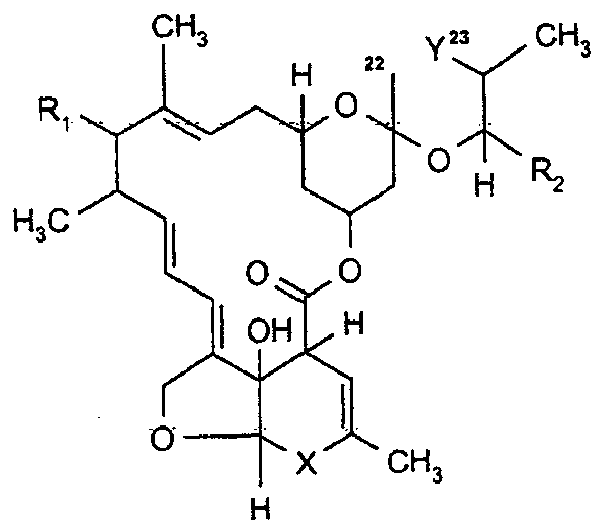
wherein X is -C(H)(OH)-; -C(O)-; or -C(=N-OH)-; Y is -C(H2)-; =C(H)-; -C(H)(OH)-; or - C(=N-OCH3)-; R-i is hydrogen or one of radicals
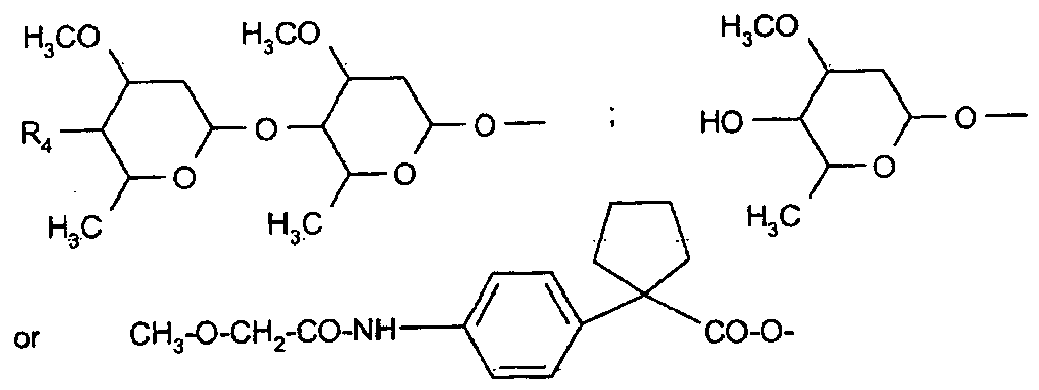
R4 is hydroxyl, -NH-CH3 or-NH-OCH3; and R2 is hydrogen, -CH3, -C2H5, -CH(CH3)2, - CH(CH3)-C2H5, -C(CH3)=CH-CH(CH3)2 or cyclohexyl; and if the bond between atoms 22 and 23 represents a double bond the carbon atom in 23-position is unsubstituted so that Y is =C(H)-, or if is the bond between atoms 22 and 23 is a single bond the carbon atom in 23-position is unsubstituted or substituted by hydroxy or by the group =N-0-CH3 so that Y is -C(H2)-; -C(H)(OH)-; or -C(=N-OCH3)-; in free form or in the form of a physiologically acceptable salt.
wherein X is -C(H)(OH)-; -C(O)-; or -C(=N-OH)-; Y is -C(H2)-; =C(H)-; -C(H)(OH)-; or - C(=N-OCH3)-; R-i is hydrogen or one of radicals
R4 is hydroxyl, -NH-CH3 or-NH-OCH3; and R2 is hydrogen, -CH3, -C2H5, -CH(CH3)2, - CH(CH3)-C2H5, -C(CH3)=CH-CH(CH3)2 or cyclohexyl; and if the bond between atoms 22 and 23 represents a double bond the carbon atom in 23-position is unsubstituted so that Y is =C(H)-, or if is the bond between atoms 22 and 23 is a single bond the carbon atom in 23-position is unsubstituted or substituted by hydroxy or by the group =N-0-CH3 so that Y is -C(H2)-; -C(H)(OH)-; or -C(=N-OCH3)-; in free form or in the form of a physiologically acceptable salt.
12. A pharmaceutical composition according to Claim 6 containing one or more antinematodal
agents in the range of 0.01 to 50% w/w, based on the entire formulation.
13. A pharmaceutical composition according to Claim 6 wherein the bioavailability of praziquantel
in terms of bioequivalence is the same as that of a similar composition containing
non-coated praziquantel.
REFERENCES CITED IN THE DESCRIPTION
This list of references cited by the applicant is for the reader's convenience only. It does not form part of the European patent document. Even though great care has been taken in compiling the references, errors or omissions cannot be excluded and the EPO disclaims all liability in this regard.
Patent documents cited in the description
- US7348027B [0008]
- WO2005081612A [0009]
- EP1566173A [0009]
- GB2403407A [0009]
- EP1362583A [0010]
- WO2007073911A [0011]
- EP2008065335A [0012]
- WO2008148484A [0012]
- EP1675474A [0013]
Non-patent literature cited in the description
- JANNIN, V. et al.Influence of poloxamers on the dissolution performance and stability of controlled-release formulations containing Precirol ATO 5International Journal of Pharmaceutics, vol. 309, 6-15 [0015]