| (19) |
 |
|
(11) |
EP 2 692 217 A1 |
| (12) |
EUROPEAN PATENT APPLICATION |
| (43) |
Date of publication: |
|
05.02.2014 Bulletin 2014/06 |
| (22) |
Date of filing: 29.07.2013 |
|
| (51) |
International Patent Classification (IPC):
|
|
| (84) |
Designated Contracting States: |
|
AL AT BE BG CH CY CZ DE DK EE ES FI FR GB GR HR HU IE IS IT LI LT LU LV MC MK MT NL
NO PL PT RO RS SE SI SK SM TR |
|
Designated Extension States: |
|
BA ME |
| (30) |
Priority: |
30.07.2012 PL 12123512
|
| (71) |
Applicant: Szramke, Kazimierz |
|
85-166 Bydgoszcz (PL) |
|
| (72) |
Inventor: |
|
- Szramke, Kazimierz
85-166 Bydgoszcz (PL)
|
| (74) |
Representative: Czub, Krzysztof |
|
Kancelaria Prawa Wilasnosci Przemyslowej i
Prawa Autoskiego Teresa Czub & Krzysztof
Czub Rzecznicy Patentowi Spólka Partnerska
PO Box 12
80-900 Gdansk 2
80-900 Gdansk 2 (PL) |
|
| |
|
| (54) |
A shovel for burying faeces, especially from animals (called a portable cat and dog
service) |
(57) The shovel for burying faeces, especially from animals is distinguished by the scoop
(3) with rounded cuts (4) on either side and by the handle (2) connected with the
scoop (3) by means of a bolt or press stud in a drilled hole (5) at the point of connection
between the scoop (3) with the handle (2) at one end and with the grip (1) at the
other.
|
|
[0001] The object of the invention is a shovel mainly used for the disposal of animal faeces
by burying them at the place at which the animal has defecated.
[0002] Many kinds of shovels are known, which differ between themselves in the manufacturing
technology, appearance of various elements, and with application. The shovel made
as per the invention has a scoop with cuts (dents, grooves) at the inner side, in
the central part of the scoop and at its lower end (towards the blade), so the shovel
may be inserted into the grass or gravel easily without the use of a big force. Owing
to that, the shovel may be used even by children under adult supervision. The handle
advantageously is connected with the scoop or with the grip by means of a hole, into
which a fixing element is inserted. We cut the turf (grass) or dig a small hole with
a shovel and place faeces in that hole (after the pet has defecated). Then we backfill
and compact the hole with the same shovel.
[0003] Animal faeces are a problem faced by almost every municipality, county or province.
Even though dog and cat owners are obliged to clean up faeces after their pets, those
owners do not do it at all or do it only to a very limited degree. Currently available
solutions aiming at the removal and disposal of animal faeces by means of bags, garbage
bins or hovers, do not solve the problem. Owing to faeces burying by means of a shovel
supplied in a handy and aesthetic bag, we leave the place clean and free from animal
faeces.
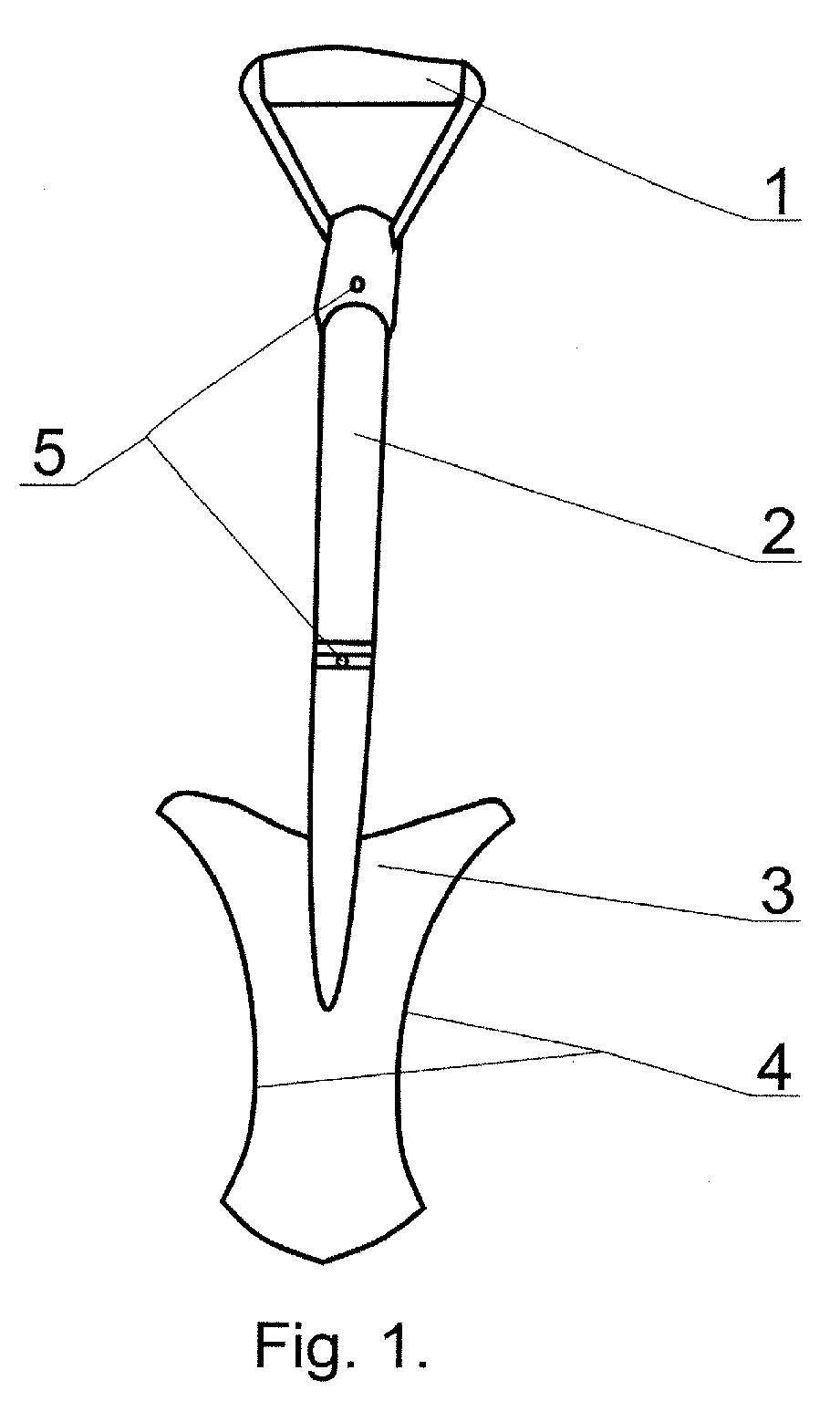
[0004] The invention in question was shown on the attached figures, where Fig. 1 shows the
shovel ready for use when seen from the front, and Fig. 2 presents the shovel seen
from the back.
[0005] The shovel consisting of three main parts: the grip (1), the handle (2) and the heart-shaped
scoop (3). The grip is made of wood or plastic (a cast). The handle is made of one
piece of wood with a round cross section and with ends fitting the scoop (3) and grip
(1). The handle (2) is connected with the scoop (3) and grip (1) by means of bolts
or press studs fitted in holes (5) for the structure to make a uniform whole. The
scoop (3) has rounded cuts (4) in its inner and lower parts, which permit easy driving
the shovel into the soil or gravel.
1. The shovel for burying faeces, especially from animals, has a scoop and handle connecting
the scoop with the grip, characterised in that the shovel is distinguished by the scoop (3) having rounded cuts (4) on either side.
2. The shovel, according to the claim 1, characterised in that the handle (2) is connected with the scoop (3) by means of a hole (5), into which
a fixing element is inserted.
3. The shovel, according to the claim 1 or 2, characterised in that the handle (2) is connected with the grip (1) by means of a hole (5), into which
a fixing element is inserted.