|
(11) | EP 2 754 981 A1 |

| (12) | EUROPEAN PATENT APPLICATION |
|
|
|
|
||||||||||||||||||||
| (54) | A method for controlling the defrost of an evaporator in a refrigeration appliance and refrigeration appliance using such method |
| (57) A method for controlling the defrost of an evaporator in a refrigeration appliance
provided with a temperature sensor used for detecting temperature inside a cell of
the appliance comprises measuring the evaporator temperature, applying an algorithm
which, on the basis of the temperature inside the cell and the temperature of the
evaporator, simulates the thermodynamic behavior of the cell, and detecting a change
in any of the parameters of the above algorithm which is indicative of a need to defrost. |
[0001] The present invention relates to a method for controlling defrost of an evaporator in a refrigeration appliance comprising a temperature sensor used for measuring the temperature inside a cell of the appliance.
[0002] A method of the above kind is disclosed by EP 1619456 where, starting from said measured temperature, a model is used in order to estimate the evaporator temperature. The evaporation temperature by itself doesn't provide a way to establish if a defrost is required.
[0003] EP1450230 discloses a method for controlling the temperature inside a cavity in which a computation is based on empirical values determined from the thermal behavior of the cavity. According to this method a first and a second temperature are detected, the second temperature being detected on or in the proximity of the evaporator. This method doesn't provide a way to establish if a defrost is required.
[0004] It is an object of the present invention to provide a method to evaluate in a reliable and accurate way the need to perform a defrost in a refrigerator appliance, estimating the amount of frost accumulated over the heat exchanger.
[0006] According to the invention, thermal heat exchange coefficients of a model can be related to the ice collected over the evaporators. In other words, in the following preferred model the parameters k1,k2,k3.are generally constant:
[0007] In the above model or algorithm TCavity is the temperature detected by the temperature sensor in the cell, while THeatExchan ger is the temperature detected on or in the proximity of the evaporator.
[0008] Another recursive algorithm is used to detect k1,k2,k3 as, for example, Least Square, Kalman, etc. We introduce k̂1(t),k̂2(t),k̂3(t) to identify the estimations of the k1,k2,k3. The estimations are time-dependent, updated each time new measured values TCavity , THeatExchan ger are available.
[0009] The general criteria are:
- The estimated parameters are constant if no ice formation occurs.
- The estimated parameters changes if the ice formation occurs.
[0011] While these parameters are constant over time, no defrost is required. If ice is present on the evaporator, then the heat exchange coefficient decreases: so time by time the frost collects over the evaporator, the estimated k̂1(t),k̂2(t),k̂3(t) values change (in particular, k̂2(t) decreases significantly). Once frost begins accumulating over the heat exchanger, its performance starts decreasing and the values of the three over mentioned parameters experience a significant change. Since frost formation cause the variation of the parameters, comparing their values to a pre-determined reference (i.e. their initial values after the previous defrost or at appliance start-up, when the heat exchanger is supposed to be completely ice-free) does provide the information of performance degradation.
[0012] Once the difference between the parameters and their reference value is higher than a threshold value, the request of a defrosting action is sent to the temperature control system.
[0013] Further advantages and features of the method according to the invention will become clear from the following detailed description, with reference to the attached drawing which shows schematically how the estimation algorithm is applied according to the present invention.
[0014] The first step of the method according to the invention is to build a thermo dynamical/electrical model of the system. Then the model equations are used and combined in order to obtain an equation with one or more unknown values, whereas the other terms are assumed to be known or already estimated. An estimation algorithm is then used to estimate the unknown values. Every kind of estimation algorithm can be used, depending upon robustness requirements, linearity, stationary behavior, computational power required and so on. The applicant has used in his tests an estimation algorithm based on Least Square, but any estimation algorithm is fine (e.g. Kalman algorithms)
[0015] The method according to the invention may be applied to any refrigerating appliances, irrespective of the type of cooling circuit which is dedicated to remove heat from the cavity (i.e.: vapor compressor circuit with any type of compressor, magnetic refrigerator, Stirling cycles, thermoelectric cooling devices, etc.). Only condition required is that at least two temperature probes shall be present, one located on (or close to) the evaporator and one located within the refrigerated compartment. If power measurements are available, as well as control request representing the amount of heat instantaneously removed from the refrigerated compartment (directly, as a cooling capacity request, or indirectly, as a speed request to the compressor), their measure can be added to the model, refining the estimation precision.
1. Method for controlling the defrost of an evaporator in a refrigeration appliance comprising
a temperature sensor used for detecting temperature inside a cell of the appliance,
characterized in that it comprises measuring the evaporator temperature, applying an algorithm which, on
the basis of the temperature inside the cell and the temperature of the evaporator,
simulates the thermodynamic behavior of the cell, and detecting a change in any of
the parameters of the above algorithm which is indicative of a need to defrost.
2. Method according to claim 1, wherein the algorithm is as follows:
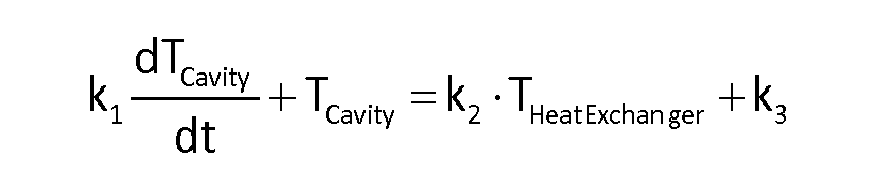
where TCavity is the temperature detected by the temperature sensor in the cell, THeatExchan ger is the temperature detected on or in the proximity of the evaporator and k1,k2,k3 are the parameters of the algorithm.
where TCavity is the temperature detected by the temperature sensor in the cell, THeatExchan ger is the temperature detected on or in the proximity of the evaporator and k1,k2,k3 are the parameters of the algorithm.
3. Method according to claim 1 or 2, wherein said parameters are estimated with any auxiliary
known estimation algorithms, preferably Least Square or Kalman filters algorithms.
4. Refrigeration appliance having at least a cell with an evaporator, a first temperature
sensor for detecting the temperature inside the cell , a second temperature sensor
for detecting the temperature of the evaporator, and a control circuit for driving
actuators of the refrigeration appliance, characterized in that the control circuit is adapted to evaluate the timing for defrosting the evaporator
on the basis of an algorithm which simulates the thermodynamic behavior of the cell,
any detected change in any of the parameters (k1,k2,k3) of the above algorithm being indicative of a need to defrost.
5. Refrigeration appliance according to claim 4, wherein the algorithm is as follows:

where TCavity is the temperature detected by the temperature sensor in the cell, THeatExchan ger is the temperature detected on or in the proximity of the evaporator and k1,k2,k3 are the parameters of the algorithm.
where TCavity is the temperature detected by the temperature sensor in the cell, THeatExchan ger is the temperature detected on or in the proximity of the evaporator and k1,k2,k3 are the parameters of the algorithm.
6. Refrigeration appliance according to claim 4 or 5, wherein said parameters are estimated
with any auxiliary estimation algorithms, preferably Least Square or Kalman filters
algorithm.
REFERENCES CITED IN THE DESCRIPTION
This list of references cited by the applicant is for the reader's convenience only. It does not form part of the European patent document. Even though great care has been taken in compiling the references, errors or omissions cannot be excluded and the EPO disclaims all liability in this regard.
Patent documents cited in the description