(57) Configuration: A knitted fabric having a plurality of triangular parts is designed
so that the knitted fabric is knittable on a flat knitting machine. An external shape
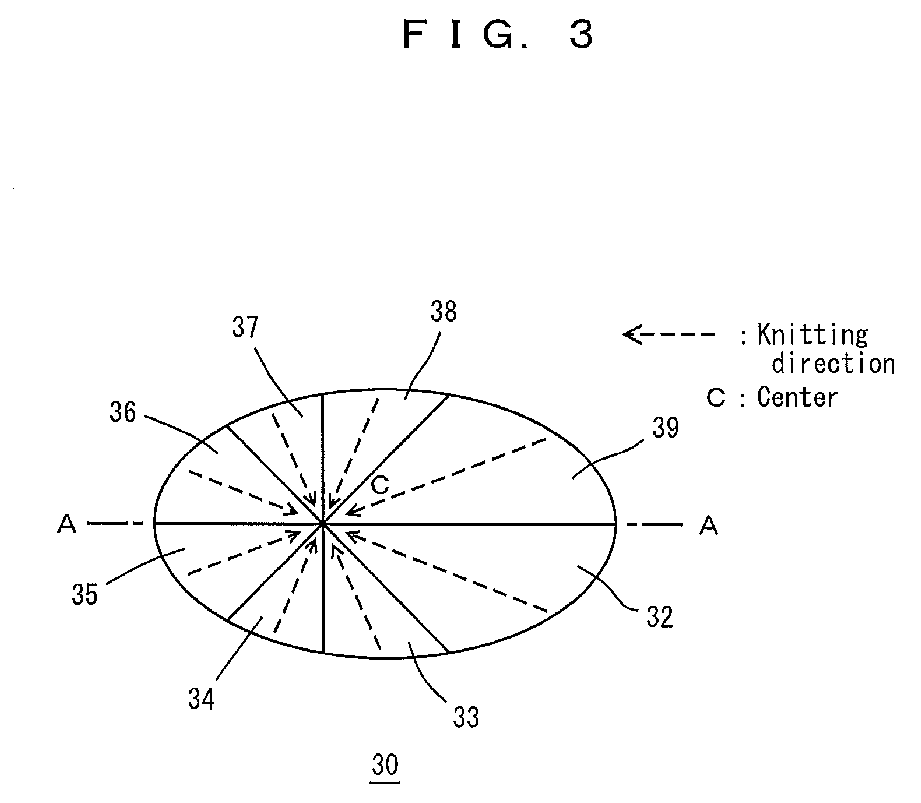
(30, 50) of a knitted fabric is input, the position of a center (C) at which apexes
of respective parts into which the knitted fabric is divided gather is input, and
the number of parts is determined. The knitted fabric is divided into a plurality
of parts, each part having the shape of a triangle, the center (C) being the apex
of the triangle, a peripheral edge of the knitted fabric being the base of the triangle,
and lines connecting both ends of the base to the center (C) being the two sides of
the triangle. Assuming that the peripheral edge of the knitted fabric is set in the
course direction of knitting, whether the number of stitches corresponding to the
length (d) of the base of each part can be decreased during knitting of the number
of rows corresponding to the height (h) of that part while satisfying a condition
of decrease is evaluated. If it is evaluated that the decrease is not possible, the
number of parts is increased, or the base of the part is shortened. Then, flechage
lines (60) are produced so as to be parallel to the course direction so that the difference
in the number of rows between the two sides of each part due to a difference between
lengths of the two sides is compensated for by flechage knitting that turns back in
that part, and decrease courses are produced so that the same number of stitches as
the number of stitches of the base are decreased.
Effects: A knitted fabric that is knittable can be substantially automatically designed
even in the cases of a knitted fabric having a complicated external shape and a knitted
fabric whose center (C) is shifted from the center of its external shape.
|
|
