|
(11) | EP 2 877 151 B1 |

| (12) | EUROPEAN PATENT SPECIFICATION |
|
|
| (54) |
HAIR COLORING PROCESS HAARFÄRBEVERFAHREN PROCÉDÉ DE COLORATION CAPILLAIRE |
|
|
|||||||||||||||||||||||||||
| Note: Within nine months from the publication of the mention of the grant of the European patent, any person may give notice to the European Patent Office of opposition to the European patent granted. Notice of opposition shall be filed in a written reasoned statement. It shall not be deemed to have been filed until the opposition fee has been paid. (Art. 99(1) European Patent Convention). |
[0001] Present invention relates to a hair coloring process which allows visualization of the color to be achieved prior to application of coloring composition onto hair using a sheet comprising two or more parts having each different natural hair color.
[0002] Hair coloring is used in a daily hair dressing practice for beautifying hair. Coloring hair with oxidative dyes involves partly or completely degradation of existing hair natural and/or artificial color with the aid of oxidizing agents especially hydrogen peroxide and simultaneously changing hair color with polymerization of the oxidative dye precursors and/or couplers. In such a process it is relatively easy to provide a view to the customer the final color with the use of standard streaks provided by almost all hair color provider.
[0003] On the other hand, when coloring with the aid of direct dyes and especially in the absence of any oxidizing agent, prediction of the final hair color is almost impossible since the existing hair color is not removed and/or degraded at all. The problem is especially aggravated when more than one ready to use composition must be mixed prior to application to reach the final color. In such a case, there may not be any standard colored streak provided by the supplier and therefore, color reviewing is impossible if the final intended color meets the expectations of the customers. This brings about problems because in the case of dissatisfaction, additionally chemically aggressive compositions have to be used to remove the added color and hair coloring must be carried out again. Therefore, a hair coloring service can easily end up time and cost intensive experience, on one hand, to hair dresser providing the service and, on the other hand, customer.
[0004] Therefore, there is a great need for a simple solution in a way of visualizing the resulting hair color prior to carrying out the real process.
[0005] The inventors of the present invention have surprisingly found out that a sheet comprising two or more parts colored with the color of various natural hair may easily be used to visualize the color finally be achieved on the head of customer by applying the coloring composition solely comprising hair direct dyes onto the said sheet. By doing so, hair dresser providing the coloring service and customer willing to change hair color can easily review approximately the final color to be achieved at the end of the service.
[0006] Therefore, the first object of the present invention is a hair coloring process with an aqueous composition comprising solely one or more direct dye(s) wherein prior to application onto hair it is first applied onto a sheet (1), which is made of cellulosic wood free paper weighing 140 g/m2, comprising two or more areas (2) having each different natural hair color to visualize the color of hair at the end of the coloring process and applied the said composition onto hair and after processing 1 to 45 min rinsed off from hair, hair is optionally shampooed and optionally dried.
[0007] In the preferred embodiment of the present invention, aqueous hair coloring composition used in the process of the invention is resulting from mixing two or more ready to use hair coloring compositions comprising solely one or more hair direct dyes.
[0008] The sheet (1) comprising two or more areas (2) having each different natural hair color comprises preferably 2 to 15 areas having each different natural hair color, more preferably 3 to 10, most preferably 4 to 8 and in particular 4 to 6 areas having each different hair color.
[0009] In a further preferred embodiment of the present invention the areas having different natural hair color are parallel to each other as on figure 1.
[0011] In a further preferred embodiment of the present invention is that the sheet is made of cellulosic wood free paper weighing 140 g/m2.
[0012] Further object of the present invention is the use of a sheet (1) made of cellulosic wood free paper weighing 140 g/m2 and comprising two or more areas (2) having each different natural hair color in a hair coloring process wherein hair coloring compositions comprising solely hair direct dyes.
[0013] In particular, further object of the present invention is the use of a sheet made of cellulosic wood free paper weighing 140 g/m2 and comprising two or more areas having each different natural hair color in a hair coloring process wherein hair coloring compositions comprising solely hair direct dyes for visualizing to be achieved hair color prior to actual hair coloring is carried out.
[0014] Hair coloring composition used in the process of the present invention has a pH in the range of 1 to 10, preferably 1.5 to 9.5, more preferably 2 to 9, most preferably 2.2 to 8.5. pH of the compositions are adjusted with the well known organic and/or inorganic acids and basis. Preferably, aqueous coloring composition comprises at least one carboxylic acid. Suitable ones are lactic acid, citric acid, malic acid, maleic acid. Most preferred is lactic acid.
[0015] Aqueous coloring compositions may be in any form known in the art. Preferred are solutions, gels, foams, thickened liquids and emulsions. Most preferred are gels and emulsions.
[0016] Accordingly, aqueous compositions in the form of gels comprise at least one gelling agent at a concentration in the range of 0.1 - 5 %, preferably 0.1 - 3% and most preferably 0.1 - 2% by weight calculated to the total composition. Suitable ones may be of the know polymers forming gel. Preferred are acrylates and derivatives, cellulose and its derivatives such as hydroxyalkyl celluloses, e.g. hydroxyethyl cellulose, hydroxypropyl cellulose, hydroxypropyl methyl cellulose, bio polymers such as bio-polyheterosaccharides such as xanthan gum, guar gum and the alkoxylation products thereof. The most preferred gelling agent is xanthan gum.
[0017] In case aqueous composition is an emulsion then it comprises at least one fatty alcohol and at least one emulsifying agent.
[0018] Aqueous colouring composition comprises at least one fatty alcohol or mixture of fatty alcohols having alkyl chain length of 14 to 22 C atoms which may be straight or branched, saturated or unsaturated. Examples to suitable fatty alcohols, without limiting, are myristyl alcohol, cetyl alcohol, stearyl alcohol, behenyl alcohol, oleyl alcohol and cetostearyl alcohol, octyldodecanol. The most preferred is cetostearyl alcohol well known with its trade name Lanette O or as Lanette N in mixture with sodium cetearyl sulfate from Cognis. Total fatty alcohol concentration is in the range of 1 to 20% by weight, calculated to total composition.
[0019] Aqueous coloring composition comprises emulsifying agents selected from anionic, non-ionic, amphoteric (or zwiterionic) and/or cationic surfactants. The most preferred are anionic, non-ionic and cationic surfactants.
[0020] The preferred non-ionic emulsifiers are ethoxylated fatty alcohols with an alkyl chain of 12 to 24 C atoms and with number of ethoxyl groups of 2 to 50, preferably 10 to 30. Examples are ceteth-20, seteareth-30, palmeth-20, steareth -20, beheneth-20 etc. These compounds are named according to the fatty alcohol they are originating and number of ethoxyl groups is given at the end. These compounds are well known emulsifiers and found in any cosmetic ingredient book.
[0021] Further suited nonionic surfactants are, especially in mixture with fatty alcohol ethoxylates, for example, long-chain fatty acid mono- and dialkanolamides, such as coco fatty acid mono- or diethanolamide and myristic fatty acid mono or diethanolamide, stearic acid mono or diethanolamide.
[0022] Further nonionic surfactants suited again especially in admixture with fatty alcohol ethoxylates mentioned above are alkyl polyglucosides of the general formula
R1-O-(R2O)n-Zx,
wherein R1 is an alkyl group with 8 to 18 carbon atoms, R2 is an ethylene or propylene group, Z is a saccharide group with 5 to 6 carbon atoms, n is a number from 0 to 10 and x is a number between 1 and 5.
[0023] Further additionally useful nonionic surfactants are, for example, the various sorbitan esters, such as polyethylene glycol sorbitan stearic acid ester, fatty acid polyglycol esters or poly-condensates of ethyleneoxide and propyleneoxide, as they are on the market, for example, under the trade name "PluronicsR", as well as fatty alcohol ethoxylates.
[0024] Anionic surfactants suitable are of the sulfate, sulfonate, carboxylate and alkyl phosphate types, for example, the known C10-C18-alkyl sulfates, and in particular the respective ether sulfates, for example, C12-C14-alkyl ether sulfate, lauryl ether sulfate, especially with 1 to 4 ethylene oxide groups in the molecule, monoglyceride (ether) sulfates, fatty acid amide sulfates obtained by ethoxylation and subsequent sulfatation of fatty acid alkanolamides, and the alkali salts thereof, as well as the salts of long-chain mono- and dialkyl phosphates.
[0025] Additional anionic surfactants useful within the scope of the invention are α-olefin sulfonates or the salts thereof, and in particular alkali salts of sulfosuccinic acid semiesters, for example, the disodium salt of monooctyl sulfosuccinate and alkali salts of long-chain monoalkyl ethoxysulfosuccinates.
[0026] Suitable surfactants of the carboxylate type are alkyl polyether carboxylic acids and the salts thereof of the formula
R3-(C2H4O)n-O-CH2COOX,
wherein R3 is a C8-C20-alkyl group, preferably a C12-C14-alkyl group, n is a number from 1 to 20, preferably 2 to 17, and X is H or preferably a cation of the group sodium, potassium, magnesium and ammonium, which can optionally be hydroxyalkyl-substituted, as well as alkyl amido polyether carboxylic acids of the general formula
wherein R3 and X have the above meanings, and n is in particular a number from 1 to 10, preferably 2.5 to 5.
[0027] Such products have been known for some time and are on the market, for example, under the trade name "AKYPO®" and "AKYPO-SOFT®".
[0028] Also useful are C8-C20-acyl isethionates, alone or in admixture with other anionic surfactants, as well as sulfofatty acids and the esters thereof.
[0029] Further suitable anionic surfactants are also C8-C22-acyl aminocarboxylic acids or the water-soluble salts thereof. Especially preferred is N-lauroyl glutamate, in particular as sodium salt, as well as, for example, N-lauroyl sarcosinate, N-C12-C18-acyl asparaginic acid, N-myristoyl sarcosinate, N-oleoyl sarcosinate, N-lauroyl methylalanine, N-lauroyl lysine and N-lauroyl aminopropyl glycine, preferably in form of the water-soluble alkali or ammonium, in particular the sodium salts thereof, preferably in admixture with the above-named anionic surfactants.
[0030] Suitable cationic surfactants are according to the formula,
where R4 is a saturated or unsaturated, branched or non-branched alkyl chain with 8-22 C atoms or
R8CONH(CH2)n
where R8 is saturated or unsaturated, branched or non-branched alkyl chain with 7-21 C atoms and n has typical value of 1 - 4 or
R9COO(CH2)n
where R9 is saturated or unsaturated, branched or non-branched alkyl chain with 7-21 C atoms and n has typical value of 1 - 4, and
R5, R6 and R7 are substituted or unsubstituted, straight or branched, saturated or unsaturated lower alkyl chain with 1 to 4 C atoms, and X is typically chloride, bromide, methosulfate.
[0031] Typical examples of those ingredients are cetyl trimethly ammonium chloride, stear trimonium chloride, stearamidopropyl trimonuim chloride, behentrimonium chloride, behenamidopropyl trimethylammonium chloride, stearoylethyltrimonium chloride.
[0032] As further surfactant component, the colouring compositions according to the invention can also contain amphoteric or zwitterionic surfactants. Useful as such are in particular the various known betaines such as alkyl betaines, fatty acid amidoalkyl betaines and sulfobetaines, for example, lauryl hydroxysulfobetaine; long-chain alkyl amino acids, such as cocoaminoacetate, cocoaminopropionate and sodium cocoamphopropionate and -acetate have also proven suitable.
[0033] Total surfactant concentration is in the range of 0.5 to 15%, preferably 1 to 10%, more preferably 1 to 7.5% by weight calculated to total composition.
[0034] Composition of the present invention may further comprise one or more direct dyes. Suitable ones are cationic, anionic and neutral nitro dyes and their mixtures.
[0035] Suitable non-limiting examples to cationic ones are Basic Blue 6, Basic Blue 7, Basic Blue 9, Basic Blue 26, Basic Blue 41, Basic Blue 99, Basic Brown 4, Basic Brown 16, Basic Brown 17, Natural Brown 7, Basic Green, Basic Orange 31, 1, Basic Red 2, Basic Red 12 Basic Red 22, Basic Red 76 Basic Red 51, Basic Violet 1, Basic Violet 2, Basic Violet 3, Basic Violet 10, Basic Violet 14, Basic Yellow 57 and Basic Yellow 87, and their mixtures.
[0036] Suitable non-limiting examples to anionic ones are Acid Black 1, Acid Blue 1, Acid Blue 3, Food Blue 5, Acid Blue 7, Acid Blue 9, Acid Blue 74, Acid Orange 3, Acid Orange 6, Acid Orange 7, Acid Orange 10, Acid Red 1, Acid Red 14, Acid Red 18, Acid Red 27, Acid Red 50, Acid Red 52, Acid Red 73, Acid Red 87, Acid Red 88, Acid Red 92, Acid Red 155, Acid Red 180, Acid Violet 9, Acid Violet 43, Acid Violet 49, Acid Yellow 1, Acid Yellow 23, Acid Yellow 3, Food Yellow No. 8, D&C Brown No. 1, D&C Green No. 5, D&C Green No. 8, D&C Orange No. 4, D&C Orange No. 10, D&C Orange No. 11, D&C Red No. 21, D&C Red No. 27, D&C Red No. 33, D&C Violet 2, D&C Yellow No. 7, D&C Yellow No. 8, D&C Yellow No. 10, FD&C Red 2, FD&C Red 40, FD&C Red No. 4, FD&C Yellow No. 6, FD&C Blue 1, Food Black 1, Food Black 2, Disperse Black 9 and Disperse Violet 1 and their alkali metal salts such as sodium, potassium. And their mixtures.
[0037] Suitable non-limiting examples to nitro dyes are HC Blue No.2, HC Blue No.4, HC Blue No.5, HC Blue No.6, HC Blue No.7, HC Blue No.8, HC Blue No.9, HC Blue No.10, HC Blue No.11, HC Blue No.12, HC Blue No.13, HC Brown No.1, HC Brown No.2, HC Green No.1, HC Orange No.1, HC Orange No.2, HC Orange No.3, HC Orange No.5, HC Red BN, HC Red No.1, HC Red No.3, HC Red No.7, HC Red No.8, HC Red No.9, HC Red No.10, HC Red No.11, HC Red No.13, HC Red No.54, HC Red No.14, HC Violet BS, HC Violet No.1, HC Violet No.2, HC Yellow No.2, HC Yellow No.4, HC Yellow No.5, HC Yellow No.6, HC Yellow No.7, HC Yellow No.8, HC Yellow No.9, HC Yellow No.10, HC Yellow No.11, HC Yellow No.12, HC Yellow No.13, HC Yellow No.14, HC Yellow No.15, 2- Amino-6-chloro-4-nitrophenol, picramic acid, 1,2-Diamino-4-nitrobenzol, 1,4-Diamino-2-nitrobenzol, 3-Nitro-4-aminophenol, 1-Hydroxy-2-amino-3-nitrobenzol and 2-hydroxyethylpicramic acid, and their mixtures.
[0038] Total concentration of one or more direct dyes is in the range of 0.001 to 15%, preferably 0.01 to 10%, more preferably 0.1 to 7.5% and most preferably 0.1 to 5% by weight calculated to total composition.
[0039] Aqueous coloring composition can comprise additionally fatty acids with 0 to 3 ethylenic bonds and with fatty acyl chain length of 12 to 22 C atom. Concentration of the fatty acids can be in the range of 0.1 to 10%, preferably 0.1 to 7.5% and most preferably 0.2 to 5% by weight calculated to the total composition. Non-limiting examples are myristic acid, palmitic acid, behenic acid, steraic acid, oleic acid, linoleic acid. The most preferred fatty acid is oleic acid.
[0040] Aqueous colouring composition can also contain cationic polymers as conditioning agents. Those are cationic cellulose type polymers know as Polymer JR type from Amerchol such as Polyquaternium 10 or cationic guar gum known with trade name Jaguar from Rhône-Poulenc and chemically for example Guar hydroxypropyl trimonium chloride. Furthermore, chitosan and chitin can also be included in the compositions as cationic natural polymers.
[0041] Furthermore, it has been found suitable those cationic polymers known with their CTFA category name Polyquaternium. Typical examples of those Polyquaternium 6, Polyquaternium 7, Polyquaternium 10, Polyquaternium 11, Polyquaternium 16, Polyquaternium 22 and Polyquaternium 28, Polyquaternium 30, Polyquaternium 37, Polyquaternium 36, Polyquaternium 46. Among those the most preferred one is the Polyquaternium 11 as well known with its trade name Gafquat from ISP and as Luviquat PQ from BASF.
[0042] Typical concentration range for any of the cationic conditioners mentioned above can be 0.01 - 5% by weight, preferably 0.03 - 2.5% by weight and more preferably 0.05 - 1.5% by weight.
[0043] Hair dyeing composition of the present invention preferably comprise an organopolysiloxane wherein at least one silicium atom is linked to an alkylene group having a hetero-atom, in particular a nitrogen atom, with a poly-(N-acyl alkyleneimine) units of the formula
wherein n is a number from 1 to 5 and R14 is hydrogen, a C1-C12-alkyl or cycloalkyl, aralkyl or aryl group.
[0044] Preferred organopolysiloxane polymers are those of the type disclosed in EP-A 640 643, in particular optionally quaternized aminoalkyl, in particular aminopropyl dimethyl polysiloxane/polyethyl oxazoline copolymers of the formula
wherein m and n each are numbers from 20 to 10,000, in particular 50 to 7,000, especially 100 to 5,000, x is a number between 1 and 5, preferably 3, and y is a number from 5 to 30, R15 is a C1-C12-alkyl or aryl group, in particular a methyl, ethyl or benzyl group, and Y- is an anion.
[0045] Especially suited are the organopolysiloxanes disclosed under the terms A-1, A-2 and A-3 on pages 12 to 13 of EP-A 640 643. The proportion of graft copolymers in the hair colouring compositions according to the invention ranges from 0.05 % to 5 %, preferably 0.1 % to 2.5 %, in particular 0.5 % to 1.5 % by weight, calculated to the total composition.
[0046] Aqueous coloring composition comprises preferably one or more organic solvents. Examples of such organic solvents are benzyloxy ethanol, benzyl alcohol, phenoxy ethanol, phenoxy isopropanol, methyl phenoxy ethanol, benzyl glycerol, N-benzyl formide, N-methyl pyrrolidone, N-ethyl pyrrolidone, cinnamyl alcohol, phenethyl alcohol, p-methyl benzyl alcohol, propylene carbonate, butyl cellosolve, methyl carbitol, ethyl carbitol, propyl carbitol, butyl carbitol, diethyleneglycol, diethyl ether and dipropyleneglycol diethyl ether. Typically the concentration of those solvents can be in the range from 0.5% to 40%, preferably 1 - 35%, more preferably 5 - 30%, by weight calculated to the total composition.
[0047] Optionally, aqueous colouring composition can comprise further hair conditioning agents such as silicone oils either volatile or non-volatile, natural and synthetic oils. Among silicone oils those can be added to the colouring composition include dimethicone, dimethiconol, polydimethylsiloxane, DC fluid ranges from Dow Corning, natural oils such as olive oil, almond oil, avocado oil, weizenkeim oil, ricinus oil and the synthetic oils, such as mineral oil, isopropyl myristate, palmitate, stearate and isostearate, oleyl oleate, isocetyl stearate, hexyl laurate, dibutyl adipate, dioctyl adipate, myristyl myristate and oleyl erucate.
[0048] Additional non-ionic conditioning agents may be polyols such as glycerin, glycol and derivatives, polyethyleneglycoles known with trade names Carbowax PEG from Union Carbide and Polyox WSR range from Amerchol, polyglycerin and polyethyleneglycol mono or di fatty acid esters.
[0049] Compositions may further comprise at least one ubiquinone of the formula
where n is a number between 1 and 10 at a concentration of 0.0001 to 1%, preferably from 0.0002 to 0.75%, more preferably from 0.0002 to 0.5% and most preferably from 0.0005 to 0.5% by weight, calculated to total composition.
[0050] The composition comprises ubiquinone which is preferably selected from the ones where n is a number between 6 and 10 and more preferably it is ubichinone 50 where n is 10, also known as Coenzyme Q10.
[0051] Composition can comprise at least one amino acid. At least one amino acid is comprised at a concentration of 0.01 to 10%, preferably 0.05 to 7.5% and more preferably 0.1 to 5% and most preferably 0.25 to 5% by weight calculated to total of each composition.
[0052] Aqueous coloring composition can comprise one or more amino acids. Suitable amino acids are glycin, histidine, citrullin, asparagine, alanin, valin, leucin, isoleucin, pyrolin, tryptophane, phenylalanine, methionine, serine, tyrosine, threonine and gluatamine. Preferably, the amino acid is selected from glycin, histidine, citrullin, asparagine, alanin, valin, leucin, isoleucin, pyrolin, serine, tyrosine, threonine and gluatamine. More preferably, at least one amino acid is selected from glycin, histidine, asparagine, alanin, valin, leucin, pyrolin, serine, tyrosine and gluatamine, and most preferably at least one amino acid is selected from glycin, asparagine, alanin, valin, leucin, and serine.
[0053] Aqueous colouring composition can comprise further ceramide type of compound at a concentration 0.01 to 3%, preferably 0.05 to 2.5% and more preferably 0.1 to 2% and most preferably 0.1 to 1.5% by weight calculated to total of each composition, with the general formula
where R10 and R11 are independent from each other alkyl- or alkenyl group with 10 to 22 carbon atoms, R12 is alkyl or hydroxyl alkyl with 1 to 4 carbon atoms group and n is a number between 1 to 6, preferably 2 or 3. Preferred compound according to the above chemical structure is cetyl-PG-hydroxyethylpalmitamide.
[0054] Further optional ingredient are sterols, especially the phytosterols as preferred hair restructuring agents, at a concentration 0.01 to 3%, preferably 0.05 to 2.5% and more preferably 0.1 to 2% and most preferably 0.1 to 1.5% by weight calculated to total of each composition. Especially preferred ones are of plant origin for example ergosterol, sitosterol, stigmasterol, fucosterol, brassicasterol, fungisterol, campesterol, zymosterol, ascosterol, cerevisterol, episterol, faecosterol, spinasterol. Among those phytosterols, the ones found in "Avocadin" which is the unsaponified fraction of the avocado oil is more preferred.
[0055] Aqueous coloring composition can comprise at least one diamine compound. Preferred diamide compounds are according to the general structure
wherein R20 is a linear or branched, saturated or unsaturated alkyl chain with 1 to 12 C atoms which may be substituted with hydroxy and/or alkoxy groups, preferably R20 is linear or branched, saturated or unsaturated alkyl chain with 1 to 12 C atoms which may be substituted by 1 to 3 substituents selected from a hydroxy group and C1 to C6 alkoxy group, more preferably R20 is a unsubstituted alkyl group with 1 to 12 C atoms, and alkyl group with 2 to 12 C atoms substituted by one or two hydroxyl groups, by one alkoxy group with 1 to 6 C atoms or by one hydroxyl and one alkoxy group with 2 to 6 C atoms, R21 is linear or branched alkyl chain with 1 to 5 C atoms, preferably linear or branched alkyl chain with 2 to 5 C atoms and more preferably an alkyl chain with 2 to 3 C atoms, and R22 linear or branched, saturated or unsaturated alkyl chain with 1 to 22 C atoms, preferably linear or branched, saturated or unsaturated alkyl chain with 11 to 22 C atoms.
[0057] Particularly preferred diamide compound is the compound F which is bis (methoxypropylamido) isodocosane and commercially available from Kao Corporation - Japan.
[0058] Concentration of diamide compound is in the range of 0.001 to 5%, preferably 0.002 to 3% more preferably 0.005 to 2% and most preferably 0.01 to 1% by weight calculated to total composition.
[0059] Aqueous coloring composition can comprise additionally substances customarily found in colouring compositions such as preservatives, fragrance, sequestering agents.
Example 1
[0061]
| Acid red 52 | 1 |
| Ethanol | 10 |
| Propylene carbonate | 20 |
| Dimethicone | 1 |
| Lactic acid | 4 |
| Xanthan gum | 1 |
| Fragrance | q.s |
| Water | to 100 |
[0062] Medium blond hair at a color level 6 of a consumer was colored with above composition. Prior to coloring hair consumer was shown the color to be achieved at the end of coloring and the expectation of the customer was met fully with a color direction red-blond.
Example 2
[0063] The coloring composition of Example 1 was mixed with the following composition at various ratios.
| Acid orange 7 | 0.3 |
| Acid violet 43 | 0.8 |
| Ethanol | 10 |
| Propylene carbonate | 20 |
| Dimethicone | 1 |
| Lactic acid | 4 |
| Xanthan gum | 1 |
| Fragrance | q.s |
| Water | to 100 |
Mixed coloring compositions
| A | B | C | D | E | |
| Example 1 | 10 | 25 | 50 | 35 | 75 |
| Example 2 | 90 | 75 | 50 | 65 | 25 |
[0064] The above compositions A, B, C and E were applied onto a sheet comprising 8 areas having each different natural hair color from level 3 (darkest) to 10 (lightest). The customer found the color to be achieved with the composition C too reddish and with the composition E too violet. On the basis of the finding, composition D was produced and shown on the sheet what the color approximately be at the end of the coloring process. The color direction was perfectly matched with the expectation of the customer and medium brown hair of the customer was colored to a red violet direction. It was noted that without the aid of the sheet, experimentation without actually coloring hair could not be performed and customer satisfaction could not be achieved.
1. Hair coloring process with an aqueous composition comprising one or more direct dye(s)
as the sole dyeing components wherein prior to application onto hair the said aqueous
composition is first applied onto a sheet (1), which is made of cellulosic wood free
paper weighing 140 g/m2, comprising two or more areas (2) having each different natural hair color to visualize
the color of hair at the end of the coloring process and applied the said composition
onto hair and after processing 1 to 45 min rinsed off from hair, hair is optionally
shampooed and optionally dried.
2. The process according to claim 1 characterized in that the aqueous coloring composition is resulting from mixing of two or more ready to
use hair coloring compositions comprising solely one or more hair direct dyes.
3. The process according to claims 1 and 2 characterized in that the sheet comprises 2 to 15 areas having each different natural hair color.
4. The process according to any of the preceding claims characterized in that the areas having each different natural hair color are parallel to each other.
5. The process according to any of the preceding claims characterized in that the aqueous coloring composition has a pH in the range of 1 to 10.
6. The process according to any of the preceding claims characterized in that the aqueous coloring composition has a pH in the range of 1.5 to 9.5.
7. The process according to any of the preceding claims characterized in that the aqueous coloring composition comprises at least one carboxylic acid, preferably
selected from citric, malic, lactic and maleic acids.
8. The process according to any of the preceding claims characterized in that the aqueous coloring composition is a gel and comprises at least one gelling agent,
preferably gelling agent is xanthan gum.
9. The process according to claims 1 to 7 characterized in that the aqueous coloring composition is an emulsion and comprises at least one fatty
alcohol and at least one emulsifying agent, preferably selected from anionic, non-ionic,
amphoteric (or zwiterionic) and/or cationic surfactants.
10. The process according to claim 9 characterized in that at least one nonoionic emulsifier is selected from ethoxylated fatty alcohols and
at least one cationic surfactant is selected from
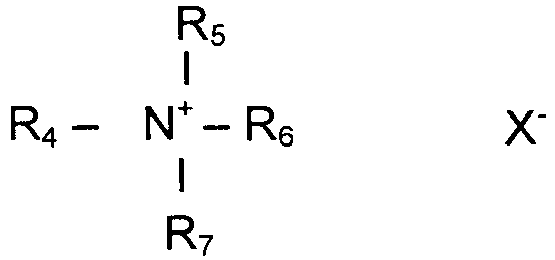
where R4 is a saturated or unsaturated, branched or non-branched alkyl chain with 8-22 C atoms or
R8CONH(CH2)n
where R8 is saturated or unsaturated, branched or non-branched alkyl chain with 7-21 C atoms and n has typical value of 1 - 4 or
R9COO(CH2)n
where R9 is saturated or unsaturated, branched or non-branched alkyl chain with 7-21 C atoms and n has typical value of 1 - 4, and
R5, R6 and R7 are substituted or unsubstituted, straight or branched, saturated or unsaturated lower alkyl chain with 1 to 4 C atoms, and X is typically chloride, bromide, methosulfate.
where R4 is a saturated or unsaturated, branched or non-branched alkyl chain with 8-22 C atoms or
R8CONH(CH2)n
where R8 is saturated or unsaturated, branched or non-branched alkyl chain with 7-21 C atoms and n has typical value of 1 - 4 or
R9COO(CH2)n
where R9 is saturated or unsaturated, branched or non-branched alkyl chain with 7-21 C atoms and n has typical value of 1 - 4, and
R5, R6 and R7 are substituted or unsubstituted, straight or branched, saturated or unsaturated lower alkyl chain with 1 to 4 C atoms, and X is typically chloride, bromide, methosulfate.
11. The process according to any of the preceding claims characterized in that one or more hair direct dye is selected from anionic, cationic and neutral nitro
dyes.
12. The process according to claim 11 characterized in that one or more direct dyes are selected from anionic dyes.
13. The process according to any of the preceding claims characterized in that aqueous coloring composition comprises ate least one organic solvent.
14. Use of a sheet made of cellulosic wood free paper weighing 140 g/m2 and comprising two or more areas, preferably 2 to 15 areas, having each different
natural hair color in a hair coloring process wherein hair coloring compositions comprising
solely hair direct dyes.
15. Use of a sheet made of cellulosic wood free paper weighing 140 g/m2 and comprising two or more areas, preferably 2 to 15 areas, having each different
natural hair color in a hair coloring process wherein hair coloring compositions comprising
solely hair direct dyes for visualizing to be achieved hair color prior to actual
hair coloring is carried out.
1. Haarfärbeverfahren mit einer wässrigen Zusammensetzung, welche einen oder mehrere
Direktfarbstoffe als die einzigen färbenden Komponenten aufweist, wobei vor dem Aufbringen
auf die Haare die wässrige Zusammensetzung zunächst auf ein Blatt (1) aufgebracht
wird, welches aus cellulosischem holzfreien Papier eines Gewichts von 140 g/m2 hergestellt ist, das zwei oder mehr Bereiche (2) mit jeweils unterschiedlicher natürlicher
Haarfarbe aufweist, um die Farbe der Haare am Ende des Färbeverfahrens zu visualisieren,
und die Zusammensetzung auf die Haare aufgebracht wird und nach einem Einwirken von
1 min bis 45 min aus den Haaren ausgespült wird, die Haare gegebenenfalls shampooniert
und gegebenenfalls getrocknet werden.
2. Verfahren nach Anspruch 1, dadurch gekennzeichnet, dass die wässrige Färbezusammensetzung aus einem Vermischen von zwei oder mehr gebrauchsfertigen
Haarfärbezusammensetzungen resultiert, welche lediglich einen oder mehrere Direktfarbstoffe
für Haare aufweisen.
3. Verfahren nach Anspruch 1 und 2, dadurch gekennzeichnet, dass das Blatt 2 bis 15 Bereiche mit jeweils unterschiedlicher natürlicher Haarfarbe aufweist.
4. Verfahren nach einem der vorhergehenden Ansprüche, dadurch gekennzeichnet, dass die Bereiche mit jeweils unterschiedlicher natürlicher Haarfarbe parallel zueinander
liegen.
5. Verfahren nach einem der vorhergehenden Ansprüche, dadurch gekennzeichnet, dass die wässrige Färbezusammensetzung einen pH-Wert im Bereich von 1 bis 10 aufweist.
6. Verfahren nach einem der vorhergehenden Ansprüche, dadurch gekennzeichnet, dass die wässrige Färbezusammensetzung einen pH-Wert im Bereich von 1,5 bis 9,5 aufweist.
7. Verfahren nach einem der vorhergehenden Ansprüche, dadurch gekennzeichnet, dass die wässrige Färbezusammensetzung mindestens eine Carbonsäure aufweist, vorzugsweise
ausgewählt aus Citronensäure, Äpfelsäure, Milchsäure und Maleinsäure.
8. Verfahren nach einem der vorhergehenden Ansprüche, dadurch gekennzeichnet, dass die wässrige Färbezusammensetzung ein Gel ist und mindestens ein Geliermittel aufweist,
wobei das Geliermittel vorzugsweise Xanthan ist.
9. Verfahren nach Anspruch 1 bis 7, dadurch gekennzeichnet, dass die wässrige Färbezusammensetzung eine Emulsion ist und mindestens einen Fettalkohol
und mindestens einen Emulgator aufweist, vorzugsweise ausgewählt aus anionischen,
nicht-ionischen, amphoteren (oder zwitterionischen) und/oder kationischen Tensiden.
10. Verfahren nach Anspruch 9, dadurch gekennzeichnet, dass mindestens ein nichtionischer Emulgator aus ethoxylierten Fettalkoholen ausgewählt
ist und mindestens ein kationisches Tensid ausgewählt ist aus
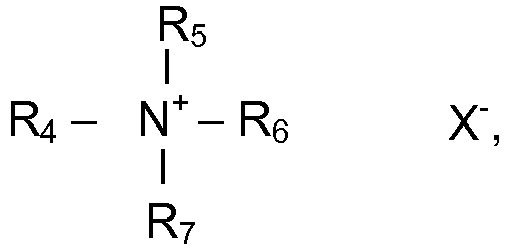
wobei R4 für eine gesättigte oder ungesättigte, verzweigte oder unverzweigte Alkylkette mit 8 bis 22 C-Atomen oder
R8CONH(CH2)n,
wobei R8 für eine gesättigte oder ungesättigte, verzweigte oder unverzweigte Alkylkette mit 7 bis 21 C-Atomen steht und n einen typischen Wert von 1 bis 4 aufweist, oder
R9COO(CH2)n
steht, wobei Rg für eine gesättigte oder ungesättigte, verzweigte oder unverzweigte Alkylkette mit 7 bis 21 C-Atomen steht und n einen typischen Wert von 1 bis 4 aufweist, und
R5, R6 und R7 für eine substituierte oder unsubstituierte, lineare oder verzweigte, gesättigte oder ungesättigte niedere Alkylkette mit 1 bis 4 C-Atomen stehen und X typischerweise für Chlorid, Bromid, Methosulfat steht.
wobei R4 für eine gesättigte oder ungesättigte, verzweigte oder unverzweigte Alkylkette mit 8 bis 22 C-Atomen oder
R8CONH(CH2)n,
wobei R8 für eine gesättigte oder ungesättigte, verzweigte oder unverzweigte Alkylkette mit 7 bis 21 C-Atomen steht und n einen typischen Wert von 1 bis 4 aufweist, oder
R9COO(CH2)n
steht, wobei Rg für eine gesättigte oder ungesättigte, verzweigte oder unverzweigte Alkylkette mit 7 bis 21 C-Atomen steht und n einen typischen Wert von 1 bis 4 aufweist, und
R5, R6 und R7 für eine substituierte oder unsubstituierte, lineare oder verzweigte, gesättigte oder ungesättigte niedere Alkylkette mit 1 bis 4 C-Atomen stehen und X typischerweise für Chlorid, Bromid, Methosulfat steht.
11. Verfahren nach einem der vorhergehenden Ansprüche, dadurch gekennzeichnet, dass ein oder mehrere Haardirektfarbstoffe aus anionischen, kationischen und neutralen
Nitrofarbstoffen ausgewählt sind.
12. Verfahren nach Anspruch 11, dadurch gekennzeichnet, dass ein oder mehrere Direktfarbstoffe aus anionischen Farbstoffen ausgewählt sind.
13. Verfahren nach einem der vorhergehenden Ansprüche, dadurch gekennzeichnet, dass die wässrige Färbezusammensetzung mindestens ein organisches Lösungsmittel aufweist.
14. Verwendung eines Blatts, das aus cellulosischem holzfreien Papier eines Gewichts von
140 g/m2 hergestellt ist, das zwei oder mehr Bereiche, vorzugsweise 2 bis 15 Bereiche, mit
jeweils unterschiedlicher natürlicher Haarfarbe aufweist, in einem Haarfärbeverfahren,
wobei die Haarfärbezusammensetzungen lediglich Haardirektfarbstoffe aufweisen.
15. Verwendung eines Blatts, das aus cellulosischem holzfreien Papier eines Gewichts von
140 g/m2 hergestellt ist, das zwei oder mehr Bereiche, vorzugsweise 2 bis 15 Bereiche, mit
jeweils unterschiedlicher natürlicher Haarfarbe aufweist, in einem Haarfärbeverfahren,
wobei die Haarfärbezusammensetzungen lediglich Haardirektfarbstoffe aufweisen, um
eine Visualisierung der Haarfarbe zu erreichen, bevor die tatsächliche Haarfärbung
durchgeführt wird.
1. Procédé de coloration des cheveux avec une composition aqueuse comprenant un ou plusieurs
colorant(s) direct(s) en tant que seuls composants de coloration, où avant l'application
sur les cheveux, ladite composition aqueuse est d'abord appliquée sur une feuille
(1), qui est faite en papier exempt de cellulose de bois pesant 140 g/m2, comprenant deux ou plusieurs zones (2) ayant chacune une couleur de cheveux naturelle
différente afin de visualiser la couleur des cheveux à la fin du procédé de coloration
et ladite composition est appliquée sur les cheveux et après un traitement de 1 à
45 minutes est enlevée des cheveux par rinçage, les cheveux sont éventuellement lavés
et éventuellement séchés.
2. Procédé selon la revendication 1, caractérisé en ce que la composition de coloration aqueuse est le résultat d'un mélange de deux ou de plusieurs
compositions de coloration des cheveux prêtes à l'emploi comprenant seulement un ou
plusieurs colorants directs des cheveux.
3. Procédé selon les revendications 1 et 2, caractérisé en ce que la feuille comprend de 2 à 15 zones ayant chacune une couleur de cheveux naturelle
différente.
4. Procédé selon l'une quelconque des revendications précédentes, caractérisé en ce que les zones ayant chacune une couleur de cheveux naturelle différente sont parallèles
les unes aux autres.
5. Procédé selon l'une quelconque des revendications précédentes, caractérisé en ce que la composition de coloration aqueuse a un pH dans la plage de 1 à 10.
6. Procédé selon l'une quelconque des revendications précédentes, caractérisé en ce que la composition de coloration aqueuse a un pH dans la plage de 1,5 à 9,5.
7. Procédé selon l'une quelconque des revendications précédentes, caractérisé en ce que la composition de coloration aqueuse comprend au moins un acide carboxylique, de
préférence choisi parmi les acides citrique, malique, lactique et maléique.
8. Procédé selon l'une quelconque des revendications précédentes, caractérisé en ce que la composition de coloration aqueuse est un gel et comprend au moins un agent gélifiant,
de préférence l'agent gélifiant est de la gomme xanthane.
9. Procédé selon les revendications 1 à 7, caractérisé en ce que la composition de coloration aqueuse est une émulsion et comprend au moins un alcool
gras et au moins un agent émulsifiant, de préférence choisi parmi les tensioactifs
anioniques, non ioniques, amphotères (ou zwitterioniques) et/ou cationiques.
10. Procédé selon la revendication 9, caractérisé en ce qu'au moins un émulsifiant non ionique est choisi parmi les alcools gras éthoxylés et
au moins un tensioactif cationique est choisi parmi
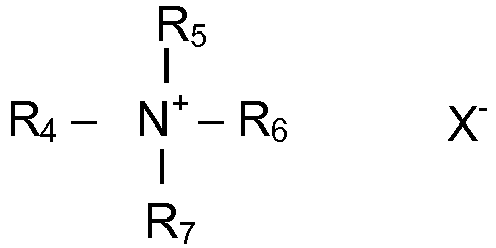
où R4 représente une chaîne alkyle saturée ou non saturée, ramifiée ou non ramifiée, avec de 8 à 22 atomes C, ou
R8CONH(CH2)n
où R8 représente une chaîne alkyle saturée ou non saturée, ramifiée ou non ramifiée, avec de 7 à 21 atomes C et n a une valeur typique entre 1 et 4, ou
R9COO(CH2)n
où R9 représente une chaîne alkyle saturée ou non saturée, ramifiée ou non ramifiée,
avec de 7 à 21 atomes C et n a une valeur typique entre 1 et 4, et
R5, R6 et R7 représentent une chaîne alkyle courte substituée ou non substituée, linéaire ou ramifiée, saturée ou non saturée, avec de 1 à 4 atomes C, et X représente de manière habituelle un chlorure, un bromure, un méthosulfate.
où R4 représente une chaîne alkyle saturée ou non saturée, ramifiée ou non ramifiée, avec de 8 à 22 atomes C, ou
R8CONH(CH2)n
où R8 représente une chaîne alkyle saturée ou non saturée, ramifiée ou non ramifiée, avec de 7 à 21 atomes C et n a une valeur typique entre 1 et 4, ou
R9COO(CH2)n
où R9 représente une chaîne alkyle saturée ou non saturée, ramifiée ou non ramifiée,
avec de 7 à 21 atomes C et n a une valeur typique entre 1 et 4, et
R5, R6 et R7 représentent une chaîne alkyle courte substituée ou non substituée, linéaire ou ramifiée, saturée ou non saturée, avec de 1 à 4 atomes C, et X représente de manière habituelle un chlorure, un bromure, un méthosulfate.
11. Procédé selon l'une quelconque des revendications précédentes, caractérisée en ce qu'un ou plusieurs colorants directs des cheveux sont choisis parmi les colorants nitrés
anioniques, cationiques et neutres.
12. Procédé selon la revendication 11, caractérisé en ce qu'un ou plusieurs colorants directs sont choisis parmi les colorants anioniques.
13. Procédé selon l'une quelconque des revendications précédentes, caractérisé en ce que la composition de coloration aqueuse comprend au moins un solvant organique.
14. Utilisation d'une feuille faite en papier exempt de cellulose de bois pesant 140g
/ m2 et comprenant deux ou plusieurs zones, de préférence de 2 à 15 zones, ayant chacune
une couleur de cheveux naturelle différente dans un procédé de coloration des cheveux,
dans lequel les compositions de coloration des cheveux comprennent uniquement des
colorants directs des cheveux.
15. Utilisation d'une feuille faite en papier exempt de cellulose de bois pesant 140g
/ m2 et comprenant deux ou plusieurs zones, de préférence de 2 à 15 zones, ayant chacune
une couleur de cheveux naturelle différente dans un procédé de coloration des cheveux,
où les compositions de coloration des cheveux comprennent seulement des colorants
directs des cheveux pour visualiser la couleur des cheveux à obtenir avant que la
coloration réelle des cheveux ne soit réalisée.
REFERENCES CITED IN THE DESCRIPTION
This list of references cited by the applicant is for the reader's convenience only. It does not form part of the European patent document. Even though great care has been taken in compiling the references, errors or omissions cannot be excluded and the EPO disclaims all liability in this regard.
Patent documents cited in the description