| (19) |
 |
|
(11) |
EP 2 891 426 A1 |
| (12) |
EUROPEAN PATENT APPLICATION |
|
published in accordance with Art. 153(4) EPC |
| (43) |
Date of publication: |
|
08.07.2015 Bulletin 2015/28 |
| (22) |
Date of filing: 02.10.2013 |
|
| (51) |
International Patent Classification (IPC):
|
| (86) |
International application number: |
|
PCT/RU2013/000865 |
| (87) |
International publication number: |
|
WO 2014/054979 (10.04.2014 Gazette 2014/15) |
|
| (84) |
Designated Contracting States: |
|
AL AT BE BG CH CY CZ DE DK EE ES FI FR GB GR HR HU IE IS IT LI LT LU LV MC MK MT NL
NO PL PT RO RS SE SI SK SM TR |
|
Designated Extension States: |
|
BA ME |
| (30) |
Priority: |
03.10.2012 RU 2012142105
|
| (71) |
Applicant: Moiseikin, Viktor Vladimirovich |
|
Yekaterinburg 620085 (RU) |
|
| (72) |
Inventor: |
|
- Moiseikin, Viktor Vladimirovich
Yekaterinburg 620085 (RU)
|
| (74) |
Representative: Flügel Preissner Kastel Schober |
|
Patentanwälte PartG mbB
Nymphenburger Strasse 20a
80335 München
80335 München (DE) |
|
| |
|
| (54) |
JEWELRY STONE SETTING |
(57) The invention is designed for use in the jewelry industry. A setting for stones of
any type of cut in jewelry manufacturing comprises a ring, having a form corresponding
to the lower part of the stone being set, connected to the base of the piece of jewelry
in two places, and one prong. The prong is connected to the base of the jewelry product
in one place at the top part and configured to enable fixation of the stone at a point
on the ring after positioning it on the top part. This ensures reliability and simplification
of stone fixation in the jewelry product and maximum concealment of the stone from
view.
|
|
[0001] The invention relates to the jewelry industry. The technical challenge, solved with
the help of the claimed invention, is the reliable and simple fixation of a stone
to the jewelry product, with a minimal degree of concealment of the stone from view.
[0002] A known prong setting for stones in jewelry products, where the stone is secured
using prongs (freestanding columns, which can be produced on the base of the product
and as a separate element of the jewelry product - holder). A disadvantage of this
type of setting is the concealment from view of the stone in more than two places
(the base and the locations covered by the prongs), connected using several prongs
instead of one.
[0003] The proposed technical solution, providing analogous reliability levels of stone
fixation in jewelry production, allows maximum exposure of the stone for viewing.
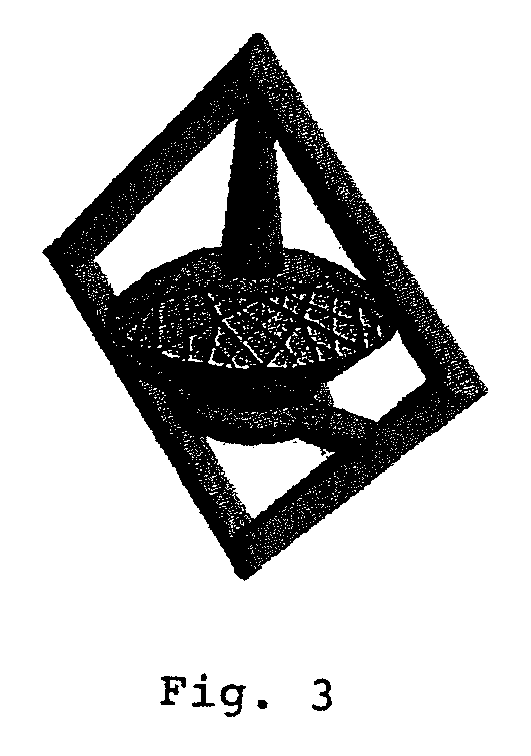
[0004] The setting consists of one ring (Fig. 1a), corresponding to the shape of the lower
part of the cut jewel, into which the stone is inserted, and prong (Fig. 1b), which
shifts and pin-point secures the stone from above (Fig. 1 - setting in open position;
Fig 2 - setting in closed position). The ring is connected from two sides to the base
of the piece of jewelry. Prong is connected to the base of the piece of jewelry at
one point at the top and, being shifted to the upper part of the jewel, provides stone
fixation. Fig. 3 shows a general view of the setting in closed position. Fig. 4 shows
the view of the setting in closed position from above. Fig. 5 shows the view of the
setting in closed position from the side. Fig. 6 shows the view of the setting in
closed position from the front.
[0005] The proposed technical solution is suitable for stones of any cut, as shown in Fig.
7.
1. A setting for stones of any cut in jewelry production, uniquely characterized by comprising a ring, having a form corresponding to a lower part of the stone being
set, connected to a base of a piece of jewelry in two places, and one prong, connected
to the base of the piece of jewelry in one place at a top part and configured to enable
fixation of the stone at a point on the ring after positioning it on the top part.