|
(11) | EP 2 968 320 B1 |

| (12) | EUROPEAN PATENT SPECIFICATION |
|
|
| (54) |
ORGANIC COMPOUNDS ORGANISCHE VERBINDUNGEN COMPOSÉS ORGANIQUES |
|
|
|||||||||||||||||||||||||||||||
| Note: Within nine months from the publication of the mention of the grant of the European patent, any person may give notice to the European Patent Office of opposition to the European patent granted. Notice of opposition shall be filed in a written reasoned statement. It shall not be deemed to have been filed until the opposition fee has been paid. (Art. 99(1) European Patent Convention). |
FIELD OF THE INVENTION
[0001] The invention relates to particular substituted heterocycle fused gamma-carbolines of Formula Q as defined in the claims, in free, pharmaceutically acceptable salt form, pharmaceutical compositions thereof, and methods of use in the treatment of diseases involving 5-HT2A receptor, serotonin transporter (SERT) and/or pathways involving dopamine D2 receptor signaling systems, e.g., diseases or disorders such as anxiety, psychosis, schizophrenia, sleep disorders, sexual disorders, migraine, conditions associated with cephalic pain, social phobias, gastrointestinal disorders such as dysfunction of the gastrointestinal tract motility and obesity; depression and mood disorders associated with psychosis or Parkinson's disease; psychosis such as schizophrenia associated with depression; bipolar disorder; and other psychiatric and neurological conditions, as well as to combinations with other agents.
BACKGROUND OF THE INVENTION
[0002] Certain substituted heterocycle fused gamma-carbolines have been reported to be agonists or antagonists of 5-HT2 receptors, particularly 5-HT2A and 5-HT2C receptors, in treating central nervous system disorders. These compounds have been disclosed in U.S. Pat. No. 6,548,493; 7,238,690; 6,552,017; 6,713,471; 7,183,282; U.S. RE39680, and U.S. RE39679, as novel compounds useful for the treatment of disorders associated with 5-HT2A receptor modulation such as obesity, anxiety, depression, psychosis, schizophrenia, sleep disorders, sexual disorders migraine, conditions associated with cephalic pain, social phobias, gastrointestinal disorders such as dysfunction of the gastrointestinal tract motility, and obesity. PCT/US08/03340 (WO 2008/112280) and U.S. Application Serial No. 10/786,935 (U.S. Pub. No. 2004/0209864) also disclose methods of making substituted heterocycle fused gamma-carbolines and uses of these gamma-carbolines as serotonin agonists and antagonists useful for the control and prevention of central nervous system disorders such as addictive behavior and sleep disorders. WO 2009/114181 also discloses of methods of preparing toluenesulfonic acid addition salt crystals of these substituted heterocycle fused gamma-carbolines.
[0003] In addition, WO/2009/145900 discloses use of particular substituted heterocycle fused gamma-carbolines for the treatment of a combination of psychosis and depressive disorders as well as sleep, depressive and/or mood disorders in patients with psychosis or Parkinson's disease. In addition to disorders associated with psychosis and/or depression, this patent application discloses and claims use of these compounds at a low dose to selectively antagonize 5-HT2A receptors without affecting or minimally affecting dopamine D2 receptors, thereby useful for the treatment of sleep disorders without the side effects of the dopamine D2 pathways or side effects of other pathways (e.g., GABAAreceptors) associated with convention sedative-hypnotic agents (e.g., benzodiazepines) including but not limited to the development of drug dependency, muscle hypotonia, weakness, headache, blurred vision, vertigo, nausea, vomiting, epigastric distress, diarrhea, joint pains, and chest pains.
[0004] While these substituted heterocycle fused gamma-carbolines and their uses have been reported, particularly for the treatment of diseases such as schizophrenia, patient compliance in adhering to the medication schedule is a common and critical problem in therapy. According to one study, non-compliance with antipsychotic medication is observed in around 50% of people with schizophrenia. Such non-compliance is linked to the increase in re-hospitalizations and generally poorer outcome in people with psychotic disorders. Therefore, there exists a need for drugs, particularly anti-psychotic drugs that can overcome the non-compliance and provide prodrugs which have a sustained or delayed release profile.
SUMMARY OF THE INVENTION
[0005] The present invention provides depot formulation of particular substituted heterocycle fused gamma-carbolines of Formula Q as defined in the claims that have altered pharmacokinetic profile, e.g., altered rate of absorption and distribution, and therefore may be useful for an improved formulation and/or for controlling the duration of the effect of the drug in the body (e.g., for sustained- or controlled release). the invention provides a pharmaceutical composition comprising a compound of the current invention as hereinbefore described, in admixture with a pharmaceutically acceptable diluent or carrier. Therefore, the invention provides the following: A Pharmaceutical Composition comprising the compound of Formula Q:
wherein X is -N(H)-, -N(CH3)- or -O-; and Y is -C(=O), -O- or -C(H)(OH), in free or pharmaceutically acceptable salt form, in admixture with a pharmaceutically acceptable diluent or carrier. The invention provides a pharmaceutical composition, e.g., for sustained or delayed release, e.g., depot, formulation, comprising (i) the compound of Formula Q as described above; and (ii) a polymeric matrix:
wherein X is -N(H)-, -N(CH3)- or -O-; and Y is -C(=O), -O- or -C(H)(OH), in free or pharmaceutically acceptable salt form.
[0006] In a further embodiment, the polymeric matrix comprises standard polymers used in depot formulations such as polymers selected from apolyester of a hydroxyfatty acid and derivatives thereof, or a polymer of an alkyl alpha-cyanoacrylate, a polyalkylene oxalate, a polyortho ester, a polycarbonate, a polyortho-carbonate, a polyamino acid, a hyaluronic acid ester, and mixtures thereof. In a further embodiment, the polymer is selected from a group consisting of polylactide, poly d,l-lactide, poly glycolide, PLGA 50:50, PLGA 85:15 and PLGA 90:10 polymer. In another embodiment, the polymer is selected from poly(glycolic acid), poly-D,L-lactic acid, poly-L-lactic acid, copolymers of the foregoing, poly(aliphatic carboxylic acids), copolyoxalates, polycaprolactone, polydioxonone, poly(ortho carbonates), poly(acetals), poly(lactic acid-caprolactone), polyorthoesters, poly(glycolic acid-caprolactone), polyanhydrides, and natural polymers including albumin, casein, and waxes, such as, glycerol mono- and distearate, and the like. In a preferred embodiment, the polymeric matrix comprises poly(d,l-lactide-co-glycolide). For example, the Pharmaceutical Composition of Formula Q wherein said compound is dissolved or dispersed in a polymeric matrix which comprises a poly(d,l-lactide-co-glycolide).
[0007] The pharmaceutical compositions are particularly useful for sustained or delayed release, wherein the compound is released upon degradation of the polymeric matrix and/or the prodrug. Therefore, these compositions may be formulated for controlled- and/or sustained-release of the active compounds as described above over a period of up to 180 days, e.g., from about 7 to about 14 to about 30 to about 180 days. For example, the polymeric matrix may degrade and release the compounds disclosed herein over a period of about 7, about 14, about 30, about 60 or about 90 days. In another example, the polymeric matrix may degrade and release the compounds disclosed herein over a period of about 120, or about 180 days. Therefore, in one embodiment, the Pharmaceutical Composition releases the compound over a period of up to 180 days, about 120 days, about 90 days, about 60 days, about 30 days, about 14 days or about 7 days.
[0008] In still another further embodiment, the Pharmaceutical Compositions of the Invention are formulated for administration by injection. In another embodiment, the Pharmaceutical Compositions of the Invention may be formulated for oral administration. The Compound of Formula Q may be included as a depot formulation, e.g., by dispersing, dissolving or encapsulating the compounds of the Invention in a polymeric matrix such that the compound is continually released as the polymer degrades over time. The release of the compounds of the Invention or the Compound of Formula Q from the polymeric matrix provides for the controlled- and/or delayed- and/or sustained-release of the compounds, e.g., from the pharmaceutical depot composition, into a subject, for example a warm-blooded animal such as man, to which the pharmaceutical depot is administered. Thus, the pharmaceutical depot delivers the active compounds described hereinbefore or the Compound of Formula Q to the subject at concentrations effective for treatment of the particular disease or medical condition over a sustained period of time, e.g., 7-180 days, preferably about 7 or about 14 or about 30, about 60 or about 90 days.
[0009] alpha-hydroxycarboxylic acid polymer (preferably lactic acid-glycolic acid polymer), its ester, poly-alpha-cyanoacrylic acid esters, etc. may be used, and lactic acid-glycolic acid copolymer (also referred to as poly(lactide-alpha-glycolide) or poly(lactic-co-glycolic acid), and hereinafter referred to as PLGA) are preferred. Thus, in one aspect the polymer useful for the polymeric matrix is PLGA. As used herein, the term PLGA includes polymers of lactic acid (also referred to as polylactide, poly(lactic acid), or PLA). Most preferably, the polymer is the biodegradable poly(d,l-lactide-co-glycolide) polymer.
[0010] In a preferred embodiment, the polymeric matrix of the invention is a biocompatible and biodegradable polymeric material. The term "biocompatible" is defined as a polymeric material that is not toxic, is not carcinogenic, and does not significantly induce inflammation in body tissues. The matrix material should be biodegradable wherein the polymeric material should degrade by bodily processes to products readily disposable by the body and should not accumulate in the body. The products of the biodegradation should also be biocompatible with the body in that the polymeric matrix is biocompatible with the body. The preferred polymer for use in the practice of this invention is dl(polylactide-co-glycolide). It is preferred that the molar ratio of lactide to glycolide in such a copolymer be in the range of from about 75:25 to 50:50.
[0011] Useful PLGA polymers may have a weight-average molecular weight of from about 5,000 to 500,000 daltons, preferably about 150,000 daltons. Dependent on the rate of degradation to be achieved, different molecular weight of polymers may be used. For a diffusional mechanism of drug release, the polymer should remain intact until all of the drug is released from the polymeric matrix and then degrade. The drug can also be released from the polymeric matrix as the polymeric excipient bioerodes.
[0012] The PLGA may be prepared by any conventional method, or may be commercially available. For example, PLGA can be produced by ring-opening polymerisation with a suitable catalyst from cyclic lactide, glycolide, etc. (see EP-0058481B2; Effects of polymerization variables on PLGA properties: molecular weight, composition and chain structure).
[0013] It is believed that PLGA is biodegradable by means of the degradation of the entire solid polymer composition, due to the break-down of hydrolysable and enzymatically cleavable ester linkages under biological conditions (for example in the presence of water and biological enzymes found in tissues of warm-blooded animals such as humans) to form lactic acid and glycolic acid. Both lactic acid and glycolic acid are water-soluble, non-toxic products of normal metabolism, which may further biodegrade to form carbon dioxide and water. In other words, PLGA is believed to degrade by means of hydrolysis of its ester groups in the presence of water, for example in the body of a warm-blooded animal such as man, to produce lactic acid and glycolic acid and create the acidic microclimate. Lactic and glycolic acid are by-products of various metabolic pathways in the body of a warm-blooded animal such as man under normal physiological conditions and therefore are well tolerated and produce minimal systemic toxicity.
[0014] In another embodiment, the polymeric matrix useful for the invention may comprise a star polymer wherein the structure of the polyester is star-shaped. These polyesters have a single polyol residue as a central moiety surrounded by acid residue chains. The polyol moiety may be, e. g., glucose or, e. g., mannitol. These esters are known and described in GB 2,145,422 and in U. S. Patent No. 5,538,739.
[0015] The star polymers may be prepared using polyhydroxy compounds, e. g., polyol, e. g., glucose or mannitol as the initiator. The polyol contains at least 3 hydroxy groups and has a molecular weight of up to about 20,000 Daltons, with at least 1, preferably at least 2, e. g. , as a mean 3 of the hydroxy groups of the polyol being in the form of ester groups, which contain polylactide or co-polylactide chains. The branched polyesters, e. g., poly (d, l-lactide-co-glycolide) have a central glucose moiety having rays of linear polylactide chains.
[0016] The depot composition of the invention as herein before described may comprise the polymer in the form of microparticles or nanoparticles, or in a liquid form, with the compounds of the Invention dispersed or encapsulated therein. "Microparticles" is meant solid particles that contain the compounds of the Invention either in solution or in solid form wherein such compound is dispersed or dissolved within the polymer that serves as the matrix of the particle. By an appropriate selection of polymeric materials, a microparticle formulation can be made in which the resulting microparticles exhibit both diffusional release and biodegradation release properties.
[0017] When the polymer is in the form of microparticles, the microparticles may be prepared using any appropriate method, such as by a solvent evaporation or solvent extraction method. For example, in the solvent evaporation method, the compounds of the Invention and the polymer may be dissolved in a volatile organic solvent (for example a ketone such as acetone, a halogenated hydrocarbon such as chloroform or methylene chloride, a halogenated aromatic hydrocarbon, a cyclic ether such as dioxane, an ester such as ethyl acetate, a nitrile such as acetonitrile, or an alcohol such as ethanol) and dispersed in an aqueous phase containing a suitable emulsion stabiliser (for example polyvinyl alcohol, PVA). The organic solvent is then evaporated to provide microparticles with the compounds of the Invention encapsulated therein. In the solvent extraction method, the compounds of the Invention and polymer may be dissolved in a polar solvent (such as acetonitrile, dichloromethane, methanol, ethyl acetate or methyl formate) and then dispersed in an aqueous phase (such as a water/PVA solution). An emulsion is produced to provide microparticles with the compounds of the Invention encapsulated therein. Spray drying is an alternative manufacturing technique for preparing the microparticles.
[0018] Another method for preparing the microparticles of the invention is also described in both U.S. Pat. No. 4,389,330 and U.S. Pat. No. 4,530,840.
[0019] The microparticle of the present invention can be prepared by any method capable of producing microparticles in a size range acceptable for use in an injectable composition. One preferred method of preparation is that described in U.S. Pat. No. 4,389,330. In this method the active agent is dissolved or dispersed in an appropriate solvent. To the agent-containing medium is added the polymeric matrix material in an amount relative to the active ingredient that provides a product having the desired loading of active agent. Optionally, all of the ingredients of the microparticle product can be blended in the solvent medium together.
[0020] Solvents for the compounds of the Invention or the compound of Formula Q and the polymeric matrix material that can be employed in the practice of the present invention include organic solvents, such as acetone; halogenated hydrocarbons, such as chloroform, methylene chloride, and the like; aromatic hydrocarbon compounds; halogenated aromatic hydrocarbon compounds; cyclic ethers; alcohols, such as, benzyl alcohol; ethyl acetate; and the like. In one embodiment, the solvent for use in the practice of the present invention may be a mixture of benzyl alcohol and ethyl acetate. Further information for the preparation of microparticles useful for the invention can be found in U.S. Patent Publication Number 2008/0069885, the contents of which are incorporated herein by reference in their entirety.
[0021] The amount of the compounds of the Invention or the compounds of Formula Q incorporated in the microparticles usually ranges from about 1 wt % to about 90 wt. %, preferably 30 to 50 wt. %, more preferably 35 to 40 wt. %. By weight % is meant parts of the compounds of the Invention per total weight of microparticle.
[0022] The pharmaceutical depot may comprise a pharmaceutically-acceptable diluent or carrier, such as a water miscible diluent or carrier.
[0023] A "therapeutically effective amount" is any amount of the compounds of the invention (for example as contained in the pharmaceutical depot) which, when administered to a subject suffering from a disease or disorder, is effective to cause a reduction, remission, or regression of the disease or disorder over the period of time as intended for the treatment.
[0024] Dosages employed in practicing the present invention will of course vary depending, e.g. on the particular disease or condition to be treated, the particular compound of the Invention used, the mode of administration, and the therapy desired. Unless otherwise indicated, an amount of the compound of the Invention for administration (whether administered as a free base or as a salt form) refers to or is based on the amount of the active drug compound in free base form or in pharmaceutically acceptable salt form (i.e., the calculation of the amount is based on the free base amount or pharmaceutically acceptable salt amount and in a non-prodrug form). Therefore, the dosage is based on the amount of the compound of Formula Q, wherein X is -N(CH3)- and Y is -C(=O), in free base form. In another embodiment, the dosage is based on the amount of the compound of Formula Q, wherein X is -N(CH3)- and Y is -C(=O), in pharmaceutically acceptable salt.
[0025] The compounds of the Invention may be administered by any satisfactory route, including orally, parenterally (intravenously, intramuscular or subcutaneous) or transdermally, but are preferably administered orally. In certain embodiment, the compounds of the Invention, e.g., in depot formulation, is preferably administered parenterally, e.g., by injection.
[0026] In general, satisfactory results for use of the compounds of the Invention or the compounds of Formula Q as hereinbefore described, e.g. for the treatment of a combination of diseases such as a combination of at least depression, psychosis, e.g., (1) psychosis, e.g., schizophrenia, in a patient suffering from depression; (2) depression in a patient suffering from psychosis, e.g., schizophrenia; (3) mood disorders associated with psychosis, e.g., schizophrenia, or Parkinson's disease; and (4) sleep disorders associated with psychosis, e.g., schizophrenia, or Parkinson's disease, as set forth above are indicated to be obtained on oral administration at dosages of the order from about 1 mg to 100 mg once daily, preferably 2.5mg-50mg, e.g., 2.5mg, 5mg, 10mg, 20mg, 30mg, 40mg or 50mg in free base or pharmaceutically acceptable, non-prodrug form, once daily, preferably via oral administration. Preferably, the daily dosage is 20mg-40mg in free base or pharmaceutically acceptable, non-prodrug form. For example, the method of treating schizophrenia or dementia comprises a daily dosage of 20-40mg in free base or pharmaceutically acceptable, non-prodrug form.
[0027] Satisfactory results for use of the compounds of the Invention or compounds or Formula Q as hereinbefore described, e.g. for the treatment of sleep disorder alone are indicated to be obtained on oral administration at dosages of the order from about 2.5mg-5mg, e.g., 2.5mg, 3mg, 4mg or 5mg, of a compound of the Invention, in free or pharmaceutically acceptable salt form, once daily, preferably via oral administration.
[0028] For treatment of the disorders disclosed herein wherein the depot composition is used to achieve longer duration of action, the dosages will be higher relative to the shorter action composition, e.g., higher than 1-100mg, e.g., 25mg, 50mg, 100mg, 500mg, 1,000mg, or greater than 1000mg in free base or pharmaceutically acceptable, non-prodrug form. For example, for the treatment of psychosis, schizophrenia or dementia (Methods I or III), the weekly biweekly and monthly dosages may be about 100mg-300mg (e.g., 140mg-160mg), about 250mg-600mg (e.g., 280-300mg) and about 500-1,240mg (e.g., 600mg-620mg) of the compound of the invention based on the free base or pharmaceutically acceptable salt and non-prodrug form. Duration of action of the compounds of the Invention may be controlled by manipulation of the polymer composition, i.e., the polymer:drug ratio and microparticle size. Wherein the composition of the invention is a depot composition, administration by injection is preferred.
[0029] The pharmaceutically acceptable salts of the compounds of the Invention can be synthesized from the parent compound which contains a basic or acidic moiety by conventional chemical methods. Generally, such salts can be prepared by reacting the free base forms of these compounds with a stoichiometric amount of the appropriate acid in water or in an organic solvent, or in a mixture of the two; generally, nonaqueous media like ether, ethyl acetate, ethanol, isopropanol, or acetonitrile are preferred. Further details for the preparation of these salts, e.g., toluenesulfonic salt in amorphous or crystal form, may be found in PCT/US08/03340 and/or U.S. Provisional Appl. No. 61/036,069.
[0030] Pharmaceutical compositions comprising compounds of the Invention may be prepared using conventional diluents or excipients (an example include, but is not limited to sesame oil) and techniques known in the galenic art. Thus oral dosage forms may include tablets, capsules, solutions, suspensions and the like.
1. A pharmaceutical composition comprising the compound of Formula Q:
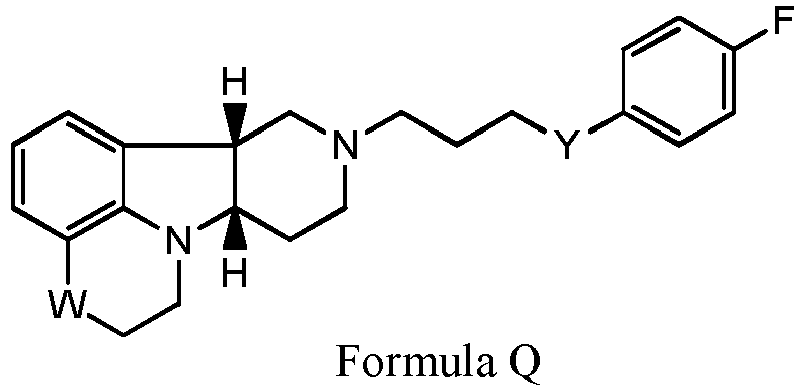
wherein W is -N(CH3)- ; and Y is -C(=O), in free or pharmaceutically acceptable salt form; and (ii) a polymeric matrix, wherein the polymeric matrix is a biodegradable poly(d,l-lactide-co-glycolide) microsphere.
wherein W is -N(CH3)- ; and Y is -C(=O), in free or pharmaceutically acceptable salt form; and (ii) a polymeric matrix, wherein the polymeric matrix is a biodegradable poly(d,l-lactide-co-glycolide) microsphere.
2. The pharmaceutical composition according to claim 1, wherein the compound of formula
Q is in free form.
3. The pharmaceutical composition according to claim 1, wherein the compound of Formula
Q is in toluenesulfonic acid addition salt form
4. The pharmaceutical composition according to any one of claims 1 to 3, in admixture
with a pharmaceutically acceptable diluent or carrier.
5. The pharmaceutical composition according to any one of claims 1-4, wherein said composition
releases of the active compound over a period of about 7 days, about 14 days, about
30 days, about 60 days or about 90 days.
6. A pharmaceutical composition according to any of claims 1-5 for use in the treatment
or prophylaxis of a central nervous system disorder.
7. The pharmaceutical composition for use according to claim 6, wherein said disorder
is selected from a group consisting of obesity, anxiety, depression, psychosis, schizophrenia,
sleep disorders, sexual disorders, migraine, conditions associated with cephalic pain,
social phobias, and gastrointestinal disorders such as dysfunction of the gastrointestinal
tract motility.
8. The pharmaceutical composition for use according to claim 6, wherein said disorder
is a disorder involving serotonine 5-HT2A, dopamine D2 and/or serotonin reuptake transporter (SERT) pathway.
9. The pharmaceutical composition for use according to claim 6, wherein said disorder
is a disorder selected from the following: (i) psychosis, e.g., schizophrenia, in
a patient suffering from depression; (2) depression in a patient suffering from psychosis,
e.g., schizophrenia; (3) mood disorders associated with psychosis, e.g., schizophrenia
or Parkinson's disease; and (4) sleep disorders associated with psychosis, e.g., schizophrenia
or Parkinson's disease.
10. The pharmaceutical composition for use according to claim 9, wherein the disorder
is psychosis.
11. The pharmaceutical composition for use according to claim 9, wherein the disorder
is schizophrenia.
12. The pharmaceutical composition for use according to claim 9, wherein the disorder
is depression.
13. The pharmaceutical composition for use according to claim 6 comprising administering
to a patient in need thereof an effective amount, optionally wherein said disorder
is selected from a group consisting of obesity, anxiety, depression (for example refractory
depression and MDD), psychosis, schizophrenia, sleep disorders (particularly sleep
disorders associated with schizophrenia and other psychiatric and neurological diseases),
sexual disorders, migraine, conditions associated with cephalic pain, social phobias,
agitation in dementia (e.g., agitation in Alzheimer's disease), agitation in autism
and related autistic disorders, and gastrointestinal disorders such as dysfunction
of the gastrointestinal tract motility.
1. Pharmazeutische Zusammensetzung, umfassend die Verbindung der Formel Q:
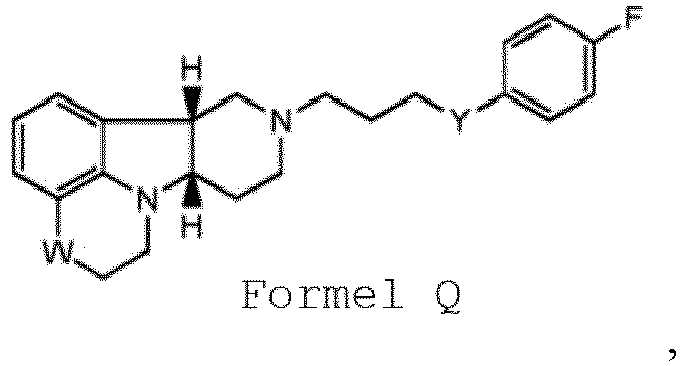
wobei W für -N(CH3)- steht; und Y für -C(=O) steht, in freier Form oder in Form eines pharmazeutisch unbedenklichen Salzes; und (ii) eine Polymermatrix, wobei es sich bei der Polymermatrix um eine biologisch abbaubare Poly(d,1-Lactid-co-Glycolid)-Mikrokugel handelt.
wobei W für -N(CH3)- steht; und Y für -C(=O) steht, in freier Form oder in Form eines pharmazeutisch unbedenklichen Salzes; und (ii) eine Polymermatrix, wobei es sich bei der Polymermatrix um eine biologisch abbaubare Poly(d,1-Lactid-co-Glycolid)-Mikrokugel handelt.
2. Pharmazeutische Zusammensetzung nach Anspruch 1, wobei die Verbindung der Formel Q
in freier Form vorliegt.
3. Pharmazeutische Zusammensetzung nach Anspruch 1, wobei die Verbindung der Formel Q
in Form eines Additionssalzes von Toluolsulfonsäure vorliegt.
4. Pharmazeutische Zusammensetzung nach einem der Ansprüche 1 bis 3, in Abmischung mit
einem pharmazeutisch unbedenklichen Streckmittel oder Träger.
5. Pharmazeutische Zusammensetzung nach einem der Ansprüche 1-4, wobei die Zusammensetzung
den Wirkstoff über einen Zeitraum von etwa 7 Tagen, etwa 14 Tagen, etwa 30 Tagen,
etwa 60 Tagen oder etwa 90 Tagen freisetzt.
6. Pharmazeutische Zusammensetzung nach einem der Ansprüche 1-5 zur Verwendung bei der
Behandlung oder Prophylaxe einer Störung des zentralen Nervensystems.
7. Pharmazeutische Zusammensetzung zur Verwendung nach Anspruch 6, wobei die Störung
aus der Gruppe bestehend aus Fettleibigkeit, Angstzuständen, Depression, Psychose,
Schizophrenie, Schlafstörungen, Sexualstörungen, Migräne, mit Kopf- bzw. Schädelschmerzen
assoziierten Leiden, sozialen Phobien und gastrointestinalen Störungen wie Fehlfunktion
der Motilität des Gastrointestinaltrakts.
8. Pharmazeutische Zusammensetzung zur Verwendung nach Anspruch 6, wobei es sich bei
der Störung um eine Störung handelt, an der Serotonin-5-HT2A, Dopamin-D2 und/oder der Serotoninwiederaufnahmetransporter(Serotonin Reuptake Transporter,
SERT)-Weg beteiligt sind.
9. Pharmazeutische Zusammensetzung zur Verwendung nach Anspruch 6, wobei es sich bei
der Störung um eine Störung handelt, die aus den Folgenden ausgewählt ist: (i) Psychose,
z. B. Schizophrenie bei einem Patienten, der an Depression leidet; (2) Depression
bei einem Patienten, der an einer Psychose leidet, z. B. Schizophrenie; (3) mit einer
Psychose assoziierten Stimmungsstörungen, z. B. Schizophrenie oder Parkinson-Krankheit;
und (4) mit einer Psychose assoziierten Schlafstörungen, z. B. Schizophrenie oder
Parkinson-Krankheit.
10. Pharmazeutische Zusammensetzung zur Verwendung nach Anspruch 9, wobei es sich bei
der Störung um eine Psychose handelt.
11. Pharmazeutische Zusammensetzung zur Verwendung nach Anspruch 9, wobei es sich bei
der Störung um Schizophrenie handelt.
12. Pharmazeutische Zusammensetzung zur Verwendung nach Anspruch 9, wobei es sich bei
der Störung um eine Depression handelt.
13. Pharmazeutische Zusammensetzung zur Verwendung nach Anspruch 6, umfassend
die Verabreichung einer wirksamen Menge an einen diese bedürftigen Patienten, wobei die Störung gegebenenfalls aus der Gruppe bestehend aus Fettleibigkeit, Angstzuständen, Depression (zum Beispiel therapieresistenter Depression und MDD), Psychose, Schizophrenie, Schlafstörungen (insbesondere mit Schizophrenie und anderen psychiatrischen und neurologischen Erkrankungen assoziierten Schlafstörungen), Sexualstörungen, Migräne, mit Kopf- bzw. Schädelschmerzen assoziierten Leiden, sozialen Phobien, Erregung bei Demenz (z. B. Erregung bei Alzheimer-Krankheit), Erregung bei Autismus und verwandten autistischen Störungen und gastrointestinalen Störungen wie Fehlfunktion der Motilität des Gastrointestinaltrakts ausgewählt ist.
die Verabreichung einer wirksamen Menge an einen diese bedürftigen Patienten, wobei die Störung gegebenenfalls aus der Gruppe bestehend aus Fettleibigkeit, Angstzuständen, Depression (zum Beispiel therapieresistenter Depression und MDD), Psychose, Schizophrenie, Schlafstörungen (insbesondere mit Schizophrenie und anderen psychiatrischen und neurologischen Erkrankungen assoziierten Schlafstörungen), Sexualstörungen, Migräne, mit Kopf- bzw. Schädelschmerzen assoziierten Leiden, sozialen Phobien, Erregung bei Demenz (z. B. Erregung bei Alzheimer-Krankheit), Erregung bei Autismus und verwandten autistischen Störungen und gastrointestinalen Störungen wie Fehlfunktion der Motilität des Gastrointestinaltrakts ausgewählt ist.
1. Composition pharmaceutique comprenant le composé de formule Q :
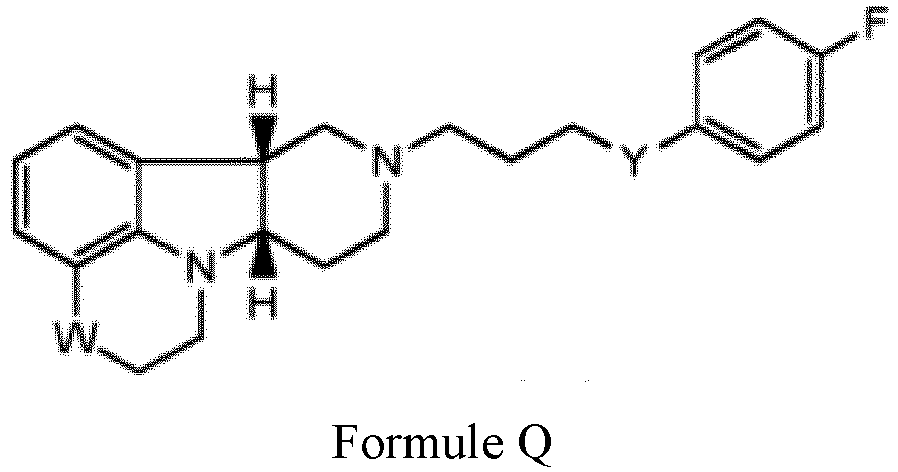
W étant -N(CH3)- ; et Y étant -C(=O), sous forme libre ou de sel pharmaceutiquement acceptable ; et (ii) une matrice polymère, la matrice polymère étant une poly(d,l-lactide-co-glycolide) microsphère biodégradable.
W étant -N(CH3)- ; et Y étant -C(=O), sous forme libre ou de sel pharmaceutiquement acceptable ; et (ii) une matrice polymère, la matrice polymère étant une poly(d,l-lactide-co-glycolide) microsphère biodégradable.
2. Composition pharmaceutique selon la revendication 1, le composé de formule Q étant
sous forme libre.
3. Composition pharmaceutique selon la revendication 1, le composé de formule Q étant
sous forme de sel d'addition d'acide toluène-sulfonique.
4. Composition pharmaceutique selon l'une quelconque des revendications 1 à 3, en mélange
avec un diluant ou support pharmaceutiquement acceptable.
5. Composition pharmaceutique selon l'une quelconque des revendications 1 à 4, ladite
composition libérant le composé actif sur une période d'environ 7 jours, d'environ
14 jours, d'environ 30 jours, d'environ 60 jours ou d'environ 90 jours.
6. Composition pharmaceutique selon l'une quelconque des revendications 1 à 5, destinée
à être utilisée dans le traitement ou la prophylaxie d'un trouble du système nerveux
central.
7. Composition pharmaceutique destinée à être utiliser selon la revendication 6, ledit
trouble étant choisi dans un groupe comprenant l'obésité, l'anxiété, la dépression,
la psychose, la schizophrénie, les troubles du sommeil, les troubles sexuels, la migraine,
les états associés à des douleurs céphaliques, des phobies sociales et des troubles
gastro-intestinaux tels qu'un dysfonctionnement de la motilité du tractus gastro-intestinal.
8. Composition pharmaceutique destinée à utiliser selon la revendication 6, ledit trouble
étant un trouble impliquant la voie de la sérotonine 5-HT2A, de la dopamine D2 et/ou du transporteur de recapture de la sérotonine (SERT).
9. Composition pharmaceutique destinée à être utilisée selon la revendication 6, ledit
trouble étant un trouble choisi parmi les suivants : (i) une psychose, par exemple,
la schizophrénie, chez un patient souffrant de dépression ; (2) la dépression chez
un patient souffrant de psychose, par exemple la schizophrénie ; (3) les troubles
de l'humeur associés à une psychose, par exemple la schizophrénie ou la maladie de
Parkinson ; et (4) les troubles du sommeil associés à une psychose, par exemple, la
schizophrénie ou la maladie de Parkinson.
10. Composition pharmaceutique destinée à être utilisée selon la revendication 9, le trouble
étant une psychose.
11. Composition pharmaceutique destinée à être utilisée selon la revendication 9, le trouble
étant la schizophrénie.
12. Composition pharmaceutique destinée à être utilisée selon la revendication 9, le trouble
étant la dépression.
13. Composition pharmaceutique destinée à être utilisée selon la revendication 6, comprenant
les étapes suivantes
administrer à un patient qui en a besoin une quantité efficace, éventuellement ledit trouble étant choisi dans un groupe comprenant l'obésité, l'anxiété, la dépression (par exemple la dépression réfractaire et le TDM), une psychose, la schizophrénie, les troubles du sommeil (en particulier les troubles du sommeil associés à la schizophrénie et à d'autres maladies psychiatriques et neurologiques), les troubles sexuels, la migraine, les états associés à des douleurs céphaliques, les phobies sociales, l'agitation dans le cas de démence (par exemple, l'agitation dans la maladie d'Alzheimer), l'agitation dans l'autisme et les troubles autistiques associés, et les troubles gastro-intestinaux tels que le dysfonctionnement de la motilité du tractus gastro-intestinal.
administrer à un patient qui en a besoin une quantité efficace, éventuellement ledit trouble étant choisi dans un groupe comprenant l'obésité, l'anxiété, la dépression (par exemple la dépression réfractaire et le TDM), une psychose, la schizophrénie, les troubles du sommeil (en particulier les troubles du sommeil associés à la schizophrénie et à d'autres maladies psychiatriques et neurologiques), les troubles sexuels, la migraine, les états associés à des douleurs céphaliques, les phobies sociales, l'agitation dans le cas de démence (par exemple, l'agitation dans la maladie d'Alzheimer), l'agitation dans l'autisme et les troubles autistiques associés, et les troubles gastro-intestinaux tels que le dysfonctionnement de la motilité du tractus gastro-intestinal.
REFERENCES CITED IN THE DESCRIPTION
This list of references cited by the applicant is for the reader's convenience only. It does not form part of the European patent document. Even though great care has been taken in compiling the references, errors or omissions cannot be excluded and the EPO disclaims all liability in this regard.
Patent documents cited in the description
- US6548493B [0002]
- US7238690B [0002]
- US6552017B [0002]
- US6713471B [0002]
- US7183282B [0002]
- USRE39680E [0002]
- USRE39679E [0002]
- US0803340W [0002] [0029]
- WO2008112280A [0002]
- US10786935B [0002]
- US20040209864A [0002]
- WO2009114181A [0002]
- WO2009145900A [0003]
- EP0058481B2 [0012]
- GB2145422A [0014]
- US5538739A [0014]
- US4389330A [0018] [0019]
- US4530840A [0018]
- US20080069885A [0020]
- US61036069 [0029]