|
(11) | EP 3 066 064 B1 |

| (12) | EUROPEAN PATENT SPECIFICATION |
|
|
| (54) |
CYCLOPROPANATION CYCLOPROPANIERUNG CYCLOPROPANATION |
|
|
|||||||||||||||||||||||||||||||
| Note: Within nine months from the publication of the mention of the grant of the European patent, any person may give notice to the European Patent Office of opposition to the European patent granted. Notice of opposition shall be filed in a written reasoned statement. It shall not be deemed to have been filed until the opposition fee has been paid. (Art. 99(1) European Patent Convention). |
[0001] The work leading to this invention has received funding from the European Union Seventh Framework Programme (FP7/2007-2013) under grant agreement No. PIEF-GA-2010-275400. and the Swiss National Science Foundation under grant 200020_137505.
[0003] Cyclopropanation, the conversion of a carbon-carbon double bond to a cyclopropane ring, is a chemical transformation used commonly in the synthesis of organic chemical compounds, in particular in the pharmaceutical, agrochemical, and flavors and fragrances industries. Cyclopropanation on a laboratory scale is commonly performed with the aid of diazo compounds, for example, diazomethane for methylenation reactions, and transition metal catalysts typically comprising copper or rhodium complexes. A wide variety of suitable catalysts is described in the review of Dzhemilev et al (Russian Chemical Bulletin, 1989, 38(8), 1707-1714).
[0004] On a larger, preparative scale relevant to production of commercially-significant quantities of cyclopropanated compounds, diazo compounds are avoided because of safety problems associated with their instability with respect to explosion, as well as the carcinogenicity of some of the best chemical precursors to diazo compounds.
[0005] One widely-exploited cyclopropanation reaction is the Simmons-Smith reaction (J.Am.Chem.Soc. 1958, 80, 5323, 1959, 81, 4256). This has the major advantage of being effective on a commercial scale, and it can deliver good-to-excellent yields. However, it produces more than stoichiometric amounts of zinc-containing waste, and furthermore typically requires diiodomethane, an expensive and potentially dangerous reagent.
[0006] One method seeking to overcome the deficiencies in the art is described in International Publication WO 02/04398, in which a diazoalkane is generated from an amine, and then this is reacted with an alkene-containing moiety, without isolating the diazoalkane.
[0007] It has now been found that it is possible to cyclopropanate carbon-carbon double bonds by a method that avoids the disadvantages of the prior art. There is therefore provided a method of preparing a cyclopropane ring-bearing compound of the formula I
in which R1 and R2 are independently selected from C1-C10 alkyl, optionally substituted, or R1 and R2, together with the bonds linking them to the cyclopropane ring, form a monocyclic or bicyclic ring system, which may comprise at least one hetero-atom, comprising the reaction of a compound of formula II
in which R1 and R2 have the significances hereinabove defined, with a compound of formula III
X-CH2-Y III
in which X is selected a nucleofuge selected from halides and pseudohalides and Y is an electrofuge selected from boranes and borates, in the presence of a metal catalyst complex selected from those that are useful for catalytic cyclopropanation and those useful for catalyzing Heck coupling.
[0008] It is particularly unexpected that a compound of the formula III can perform this function under these conditions.
[0009] The moieties R1 and R2 in Formulae I and II may be selected from
- (a) C1-C10 alkyl, optionally substituted;
- (b) R1 and R2, together with the bonds linking them to the cyclopropane ring, form a monocyclic or bicyclic ring system, which may comprise at least one hetero-atom.
[0011] Particular example of case (b) include styrene and (left to right below) norbornene and cis cyclooctene:
[0012] In the case of Formula III, the terms "nucleofuge" and "electrofuge" have their normal meanings, that is, respectively, a leaving group that retains the electron bonding pair from its previous bonding, and a leaving group that does not retain the bonding pair.
[0013] Typical examples of nucleofuge X include halogens and pseudohalogens (that is, compounds that are only partially halogen, or completely halogen-free). Examples of these include iodine and bromine. A particular example of a pseudohalogen includes acetate.
[0014] Typical examples of electrofuge Y include the trifluoroborate salts of alkali metals, such as sodium and potassium, and pinacol borane (4,4,5,5-tetramethyl-1,3,2-dioxaborolane).
[0015] The catalyst may be selected from any suitable catalyst known to be useful either for the cyclopropanation of olefins, or for use in the Heck reaction (see Zapf et al, Topics in Catalysis, 2002, 19, 101-109).
[0016] Particular examples are those complexes of metals of Group 10 (nickel, palladium, platinum) of the Periodic Table in the 0 or +2 oxidation state. A particular example is palladium.
[0017] A particular example of a catalyst is the Herrmann catalyst. This catalyst, trans-bis(acetato)bis[o-(di-o-tolylphosphino)benzyl]dipalladium(II), has the formula:
(see Angew. Chem. Int. Ed. Engl. 1995, 34, 1844-1848).
and is readily commercially available.
[0018] A wide variety of conditions and reactants are possible. Typical solvents are dimethylformamide (DMF) and dimethylacetamide (DMA), optionally with added water and/or methanol. Tetrahydrofuran has also been found to work in some cases. In some cases, added bases, such as carbonate or fluoride salts, can be useful. However, the skilled person can, by simple, non-inventive experimentation, easily provide a suitable method with suitable conditions and reactants in every case.
[0019] The process provides a relatively easy method of cyclopropanating olefinic bonds. It is especially effective in cyclopropanating in-ring olefinic bonds, and this permits the ready synthesis of a considerable number of interesting compounds that previously could only be made with difficulty. Such compounds are useful as intermediates in other chemical processes, or as final products, and they are useful in a wide variety of chemical fields, such as pharmaceuticals, dyestuffs, flavours and fragrances.
General procedure:
[0022] In the glove box, a 5 mL Young Schlenk (approximately 10 mL total volume) was equipped with a glass coated stir bar. In the glove box, base (1.5 equiv), methylenation reagent (1.5 equiv), olefin (1 equiv), and catalyst (5 mol%) were transferred to the vial. A degassed solvent mixture of a polar solvent (16 mL/mmol substrate) and a ROH solvent (2 mL/mmol substrate) were added and the Schlenk was closed. After transferring the Schlenk outside the glove box, the reaction mixture was heated to 90 °C in an oil bath and stirred for 16 h. Then the reaction mixture was rapidly cooled to 0 °C in an ice bath. Consecutively undecane (0.4 equiv) as internal standard, Et2O (45 mL/mmol substrate) and water (45 mL/mmol substrate) were then added. The phases were separated and the aqueous phase was extracted with Et2O (45 mL/mmol substrate). The combined organic phases were washed with brine (45 mL/mmol substrate), dried over MgSO4 and analyzed by GC-MS.
Procedure for standard reaction:
[0023] In the glove box, a 5 mL Young Schlenk (approximately 10 mL total volume) was equipped with a glass coated stir bar. In the glove box, K2CO3 (25.1 mg, 0.182 mmol), KBF3CH2I (43.1 mg, 0.174 mmol), norbornene (11.0 mg, 0.117 mmol), and Hermann PdII-catalyst (2.74 mg, 0.00292 mmol, dimer so 5.0 mol% PdII) were transferred to the vial. A degassed solvent mixture of DMF (2 mL) and H2O (0.25 mL) were added and the Schlenk was closed. After transferring the Schlenk outside the glove box, the reaction mixture was heated to 90 °C in an oil bath and stirred for 16 h. Then the reaction mixture was rapidly cooled to 0 °C in an ice bath. Consecutively undecane (10 µL, 7.4 mg, 0.047 mmol) as internal standard, Et2O (5 mL/mmol substrate) and water (5 mL/mmol substrate) were then added. The phases were separated and the aqueous phase was extracted with Et2O (5 mL/mmol substrate). The combined organic phases were washed with brine (5 mL), dried over MgSO4 and analyzed by GC-MS (method: 40 °C for 2 min, then from 40 °C to 300 °C in 17 min 20 sec [ramp: 15 °C/min]). The tricyclo[3.2.1.0-2,4]octane was obtained in 98% yield according to GC-MS (standardized).
tricyclo[3.2.1.02,4]octane (compared to authentic sample, identical fragmentation pattern [GC-MS])- retention time: 5.81 min, area: 20343140, correction factor: 1.304/1.00 tricyclo[3.2.1.0-2,4]octane/undecane;
undecane- retention time: 8.65 min, area: 15889470.
[0024] The results are set forth in the following tables. Table 1 shows the screening of catalysts using norborene as the test olefin, and Table 2 shows the optimization of solvent, additives, and the electrofuge/nucleofuge combinations. Table 3 shows results for olefins other than norbornene.
Table 1. Screening of catalysts for the methylenation of norbornene.a
|
|
| entry | catalyst | yield | remaining 1b |
| 1 | none | 0 % | 80 % |
| 2 | Pd0(PPh3)4 | 6 % | 71 % |
| 3c | Pd0(dba)2 + IPr | 2 % | 81 % |
| 4 | Pd0(IPr)2 | 37 % | 45 % |
| 5 | Pd0(P(tBu)3)2 | 85 % | 15 % |
| 6 | PdII-Herrmann | 98 % | 0 % |
| 7 | PdIIIPrCl2-dimer | 88 % | 4 % |
| a Conditions: scale 0.117 mmol 1, 0.06 M concentration of 1. b Standardized GC-yield and recovery of 1. c Pd0(dba)2 (5 mol%) and IPr ligand (6 mol%) were used. |
Table 2. Optimization of norbornene methylenation using the Herrmann (4) and Pd0(P(tBu)3)2 (5) catalysts.a
|
|
| # | cat | XCH2'B' | base | DMF/H2O | yieldb | rem. 1b |
| 1 | 4 | ICH2BF3K (2) | K2CO3 | 8/1 | 98 % | 0 % |
| 2 | 5 | ICH2BF3K (2) | K2CO3 | 8/1 | 85 % | 15 % |
| 3 | 4 | ICH2BF3K (2) | K2CO3 | DMF only | 25 % | 56 % |
| 4 | 5 | ICH2BF3K (2) | K2CO3 | DMF only | 47 % | 42 % |
| 5 | 4 | ICH2BF3K (2) | none | 8/1 | 24 % | 54 % |
| 6 | 5 | ICH2BF3K (2) | none | 8/1 | 35 % | 52 % |
| 7 | 4 | ICH2BF3K (2) | none | DMF only | 1 % | 73 % |
| 8 | 5 | ICH2BF3K (2) | none | DMF only | 87 % | 7 % |
| 9c | 4 | ICH2BF3K (2) | K2CO3 | 8/1 | 38 % | 37 % |
| 10c | 5 | ICH2BF3K (2) | K2CO3 | 8/1 | 66% | 17 % |
| 11 | 5 | BrCH2BF3K | none | DMF only | 7 % | 73 % |
| 12 | 5 | ICH2B(OR)2d | CsFe | DMF only | 70 % | 16 % |
| 13 | 5 | ICH2B(OR)2d | K2CO3 + CsFe | 8/1 | 92 % | 8 % |
| a Conditions: scale 0.117 mmol 1, 0.06 M concentration of 1. b Standardized GC-yield and recovery of 1. c Before addition of 1 and the catalyst the B-reagent 2 was preactivated at 90 °C for 30 min. d 2-(iodomethyl)-4,4,5,5-tetramethyl-1,3,2-dioxaborolane was used. e 3.0 equiv of CsF was used. |
Table 3. Methylenation of several electron-rich olefins using Herrmann catalyst 4.a
|
|
| # | substrate | cyclopropaneb | β-H elimination productb | remaining 7b |
| 1 |
|
|
|
58 % |
| 2 |
|
|
|
43 % |
| 3 |
|
|
|
39 % |
| a Conditions: scale 0.113-0.117 mmol, 0.06 M concentration of 7. b Standardized GC-yield and recovery of 7. c A mixture of several olefins was obtained. |
1. A method of preparing a cyclopropane ring-bearing compound of the formula I
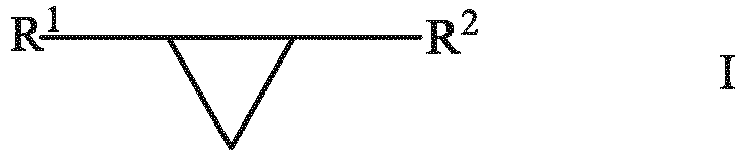
in which R1 and R2 are independently selected from C1-C10 alkyl, optionally substituted, or R1 and R2, together with the bonds linking them to the cyclopropane ring, form a monocyclic or bicyclic ring system, which may comprise at least one hetero-atom, comprising the reaction of a compound of formula II

in which R1 and R2 have the significances hereinabove defined, with a compound of formula III
X-CH2-Y III
in which X is selected a nucleofuge selected from halides and pseudohalides and Y is an electrofuge selected from boranes and borates, in the presence of a metal catalyst complex selected from those that a useful for catalytic cyclopropanation and those useful for catalyzing Heck coupling.
in which R1 and R2 are independently selected from C1-C10 alkyl, optionally substituted, or R1 and R2, together with the bonds linking them to the cyclopropane ring, form a monocyclic or bicyclic ring system, which may comprise at least one hetero-atom, comprising the reaction of a compound of formula II
in which R1 and R2 have the significances hereinabove defined, with a compound of formula III
X-CH2-Y III
in which X is selected a nucleofuge selected from halides and pseudohalides and Y is an electrofuge selected from boranes and borates, in the presence of a metal catalyst complex selected from those that a useful for catalytic cyclopropanation and those useful for catalyzing Heck coupling.
2. Method according to claim 1, in which the nucleofuge is selected fron halogens and
pseudohalogens.
3. Method according to claim 1, in which the electrofuge is selected from trifluoroborate
salts of alkali metals, and pinacol borane.
4. Method according to claim 1 in which the catalyst is a Herrmann catalyst.
1. Verfahren zur Herstellung einer Verbindung mit einem Cyclopropanring der Formel I
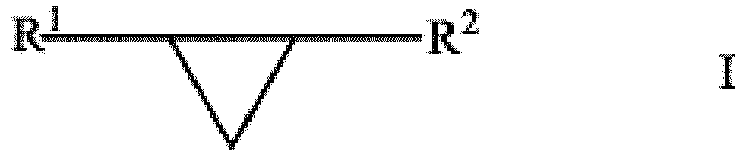
in der R1 und R2 unabhängig aus gegebenenfalls substituiertem C1-C10-Alkyl ausgewählt sind oder R1 und R2 zusammen mit den Bindungen, die sie mit dem Cyclopropanring verbinden, ein monocyclisches oder bicyclisches Ringsystem, das mindestens ein Heteroatom enthalten kann, bilden, umfassend die Umsetzung einer Verbindung der Formel II

in der R1 und R2 die oben definierten Bedeutungen haben, mit einer Verbindung der Formel III
X-CH2-Y III
in der X für ein Nukleofug, das aus Halogeniden und Pseudohalogeniden ausgewählt ist, steht und Y für ein Elektrofug, das aus Boranen und Boraten ausgewählt ist, steht, in Gegenwart eines Metallkatalysatorkomplexes, die aus denjenigen, die für die katalytische Cyclopropanierung geeignet sind, und denjenigen, die für die Katalyse der Heck-Kupplung geeignet sind, ausgewählt sind.
in der R1 und R2 unabhängig aus gegebenenfalls substituiertem C1-C10-Alkyl ausgewählt sind oder R1 und R2 zusammen mit den Bindungen, die sie mit dem Cyclopropanring verbinden, ein monocyclisches oder bicyclisches Ringsystem, das mindestens ein Heteroatom enthalten kann, bilden, umfassend die Umsetzung einer Verbindung der Formel II
in der R1 und R2 die oben definierten Bedeutungen haben, mit einer Verbindung der Formel III
X-CH2-Y III
in der X für ein Nukleofug, das aus Halogeniden und Pseudohalogeniden ausgewählt ist, steht und Y für ein Elektrofug, das aus Boranen und Boraten ausgewählt ist, steht, in Gegenwart eines Metallkatalysatorkomplexes, die aus denjenigen, die für die katalytische Cyclopropanierung geeignet sind, und denjenigen, die für die Katalyse der Heck-Kupplung geeignet sind, ausgewählt sind.
2. Verfahren nach Anspruch 1, bei dem das Nukleofug aus Halogenen und Pseudohalogenen
ausgewählt ist.
3. Verfahren nach Anspruch 1, bei dem das Elektrofug aus Trifluoroboratsalzen von Alkalimetallen
und Pinacolboran ausgewählt ist.
4. Verfahren nach Anspruch 1, bei dem es sich bei dem Katalysator um einen Herrmann-Katalysator
handelt.
1. Procédé de préparation d'un composé comportant un cycle cyclopropane de formule I
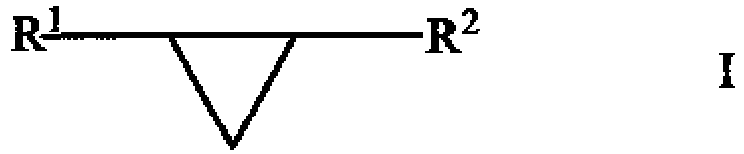
dans lequel R1 et R2 sont indépendamment choisis parmi alkyle en C1-C10, facultativement substitué, ou R1 et R2, conjointement avec les liaisons les reliant au cycle cyclopropane, forment un système cyclique monocyclique ou bicyclique, qui peut comprendre au moins un hétéroatome, comprenant la réaction d'un composé de formule II

dans lequel R1 et R2 ont les significations présentement définies ci-dessus, avec un composé de formule III
X-CH2-Y III
dans lequel X est choisi parmi un nucléofuge choisi parmi des halogénures et des pseudohalogénures et Y est un électrofuge choisi parmi des boranes et des borates, en présence d'un complexe de catalyseur métallique choisi parmi ceux qui sont utiles pour la cyclopropanation catalytique et ceux utiles pour catalyser un couplage de Heck.
dans lequel R1 et R2 sont indépendamment choisis parmi alkyle en C1-C10, facultativement substitué, ou R1 et R2, conjointement avec les liaisons les reliant au cycle cyclopropane, forment un système cyclique monocyclique ou bicyclique, qui peut comprendre au moins un hétéroatome, comprenant la réaction d'un composé de formule II
dans lequel R1 et R2 ont les significations présentement définies ci-dessus, avec un composé de formule III
X-CH2-Y III
dans lequel X est choisi parmi un nucléofuge choisi parmi des halogénures et des pseudohalogénures et Y est un électrofuge choisi parmi des boranes et des borates, en présence d'un complexe de catalyseur métallique choisi parmi ceux qui sont utiles pour la cyclopropanation catalytique et ceux utiles pour catalyser un couplage de Heck.
2. Procédé selon la revendication 1, dans lequel le nucléofuge est choisi parmi des halogènes
et des pseudohalogènes.
3. Procédé selon la revendication 1, dans lequel l'électrofuge est choisi parmi des sels
de trifluoroborate de métaux alcalins, et le pinacol-borane.
4. Procédé selon la revendication 1 dans lequel le catalyseur est un catalyseur de Herrmann.
REFERENCES CITED IN THE DESCRIPTION
This list of references cited by the applicant is for the reader's convenience only. It does not form part of the European patent document. Even though great care has been taken in compiling the references, errors or omissions cannot be excluded and the EPO disclaims all liability in this regard.
Patent documents cited in the description
Non-patent literature cited in the description
- DZHEMILEV et al.Russian Chemical Bulletin, 1989, vol. 38, 81707-1714 [0003]
- J.Am.Chem.Soc., 1958, vol. 80, 5323- [0005]
- J.AM.CHEM.SOC., 1959, vol. 81, 4256- [0005]
- ZAPF et al.Topics in Catalysis, 2002, vol. 19, 101-109 [0015]
- Angew. Chem. Int. Ed. Engl., 1995, vol. 34, 1844-1848 [0017]