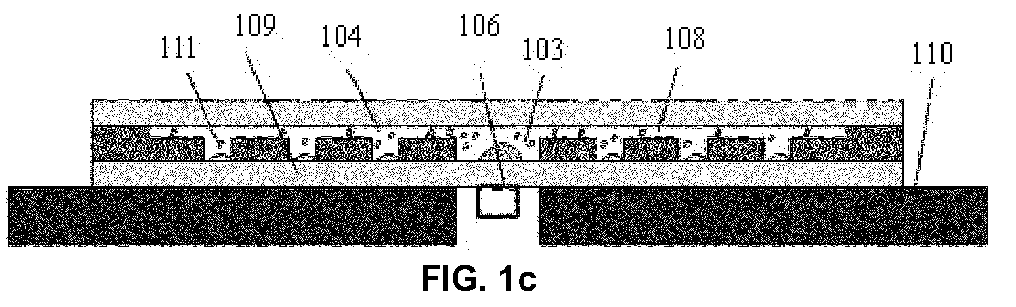
(57) A method for filling, on a wafer, chip-level atomic clock absorption bubbles with
a high-purity alkali metal. The method comprises: 1) forming a micro groove (102),
an absorption bubble cavity groove and an accommodation cavity groove in a silicon
wafer (101); 2) sealing an alkali metal compound (106) in an accommodation cavity
(103) in the center of the wafer, and forming a vacuum environment in the wafer comprising
a temporary flowing micro channel, an absorption bubble cavity and the alkali metal
accommodation cavity (103); 3) implementing decomposition of the alkali metal compound
to generate a rubidium or cesium metal in a needed amount, and vaporizing and volatilizing
the metal; 4) solidifying and coagulating the gaseous alkali metal in the absorption
bubble cavity (104); and 5) bending a glass sheet under the action of electrostatic
force, eliminating the precast temporary flowing micro channel (108), and simultaneously
sealing all absorption bubbles. By means of the method, the problems of high filling
difficulty, complex process and the like caused by extremely high probability of oxidization
of an alkali metal are solved, reaction impurities probably left in the absorption
bubbles are eliminated, and all the absorption bubbles on the alkali metal wafer are
filled at a time, and the method can be used for mass production of chip-level atomic
clock bubbles.
|
|
