|
(11) | EP 3 127 539 A1 |

| (12) | EUROPEAN PATENT APPLICATION |
|
|
|
|
||||||||||||||||||||||||
| (54) | USE OF 2-(5S-METHYL-2-OXO-4R-PHENYL-PYRROLIDIN-1-YL)-ACETAMIDE IN THE TREATMENT OF SEIZURES |
| (57) Use of 2-(5S-Methyl-2-oxo-4R-phenyl-pyrrolidin-1-yl)-acetamide or its pharmaceutically
acceptable salt in manufacture of a medicament for prophylaxis and treatment of seizure. |
Technical Field
[0001] The present invention relates to use of 2-(5S-Methyl-2-oxo-4R-phenyl-pyrrolidin-1-yl)-acetamide or its pharmaceutically acceptable salts in the treatment and prophylaxis of seizures.
Background Art
[0002] Epilepsies are chronic neurological disorders in which clusters of nerve cells, or neurons, in the brain sometimes signal abnormally and cause seizures. Epilepsy can be considered as a spectrum disorder because of its different causes, different seizure types, its ability to vary in severity and impact from person to person, and its range of co-existing conditions. About 2.3 million adults and more than 450,000 children and adolescents in the United States currently live with epilepsy. Each year, an estimated 150,000 people are diagnosed with epilepsy. Epilepsy affects both males and females of all races, ethnic backgrounds, and ages. In the United States alone, the annual costs associated with the epilepsies are estimated to be $15.5 billion in direct medical expenses and lost or reduced earnings and productivity (http://www.ninds.nih.gov/disorders/epilepsy/detail-epilepsy.htm#l 927231 09. Accessed 09.07.2015).
[0003] Despite the rapid expansion in the number and type of anticonvulsant drugs over the past two decades, the development of new anticonvulsants for refractory epilepsy is hampered by a lack of knowledge of physiological events that induce different seizure types. Furthermore, ∼20-30% of patients are reported to suffer from refractory epilepsy, despite trying several medications, and an estimated 0.7-1.1 million patients with epilepsy across the seven major pharmaceutical markets (US, France, Germany, Italy, Spain, UK and Japan) are currently inadequately treated (Charlotte Mackey (2010). The anticonvulsants market. Nat Rev Drug Discov 9:265-266.).
[0004] Process of synthesis of 4R,5S-enantiomer of 2-(5S-Methyl-2-oxo-4R-phenyl-pyrrolidin-1-yl)-acetamide and its nootropic and cognition function enhancing properties has been described in EP2496555 (B1) (GRINDEKS JSC; 28.08.2013).
Summary of invention
Technical Problem
[0005] Epilepsy as a medical problem has significant socio-economical impact and there is a demand for new medicine for treatment of epileptic seizures.
Solution to Problem
[0006] It was surprisingly discovered that the 2-(5S-Methyl-2-oxo-4R-phenyl-pyrrolidin-1-yl)-acetamide significantly reduces clonic and tonic seizures.
Description of embodiments
[0007] 2-(5S-Methyl-2-oxo-4R-phenyl-pyrrolidin-1-yl)-acetamide can be used in pharmaceutical preparations containing the compound, or a pharmaceutically acceptable salt thereof, in combination with a pharmaceutically acceptable carrier or diluents. Suitable pharmaceutically acceptable carriers include inert solid fillers or diluents and sterile aqueous or organic solutions. Thus, for oral administration the compounds can be combined with a suitable solid or liquid carrier or diluents to form capsules, tablets, powders, syrups, solutions, suspensions and the like. The pharmaceutical compositions may, if desired, contain additional components such as flavorants, sweeteners, excipients and the like. For parenteral administration the compounds can be combined with sterile aqueous or organic media to form injectable solutions or suspensions. The injectable solutions can then be administered intravenously, intraperitoneally, subcutaneously, or intramuscularly.
[0008] The composition of the present invention can be liquid preparation, preferably injection, vials or prefilled syringes, which can be prepared by conventional method. The injection, vials or prefilled syringes are prepared by lyophilizing 2-(5S-Methyl-2-oxo-4R-phenyl-pyrrolidin-1-yl)-acetamide or salt and then adding suitable excipients.
Example
Animals and treatment
[0009] Male ICR mice (Harlan Laboratories BV, Netherlands, ICR (CD-1)) weighing 23-25 g were housed under standard conditions (21-23 °C, 50% ± 10% relative humidity, 12 h light - dark cycle) with unlimited access to standard food (R70 diet, Lactamin AB, Sweden) and water. All experimental procedures were carried out in accordance with guidelines of the EU Directive 2010/63/EU and were approved by the Ethics Council of Animal Protection at the Veterinary and Food Service, Riga, Latvia.
Chemoconvulsant-induced seizures
[0010] To accurately detect even slight modulatory effects on convulsive tendencies, we employed the more sensitive intravenous (i.v.) administration route of pentylenetetrazol (PTZ) administration (Loscher W, Honack D, Fassbender CP, Nolting B (1991). The role of technical, biological and pharmacological factors in the laboratory evaluation of anticonvulsant drugs. III. Pentylenetetrazole seizure models. EpilepsyRes 8:171-189; Mandhane SN, Aavula K, Rajamannar T (2007). Timed pentylenetetrazol infusion test: a comparative analysis with s.c.PTZ and MES models of anticonvulsant screening in mice. Seizure 16:636-644) and used bicucculine (BIC) to inhibit the GABA pathway and to induce seizures (Meldrum BS (1975). Epilepsy and gamma-aminobutyric acid-mediated inhibition. Int Rev Neurobiol 17:1-36.). Chemoconvulsant-induced clonic and tonic seizures were initiated by inserting a 30-gauge needle into the tail vein of mice and infusing PTZ 1 % or BIC 0.01 % at a constant rate of 10 µl/ 1 s to restrained animals. Infusion was halted when forelimb clonus followed by tonic seizures of the full body were observed. Minimal doses of PTZ or BIC (mg/kg of mouse weight) necessary to induce clonic and tonic seizures were considered as an index of seizure threshold.
[0011] 2-(5S-Methyl-2-oxo-4R-phenyl-pyrrolidin-1-yl)-acetamide (E1R) was administered i.p. at doses of 10 and 50 mg/kg. The test session was started 60 min after the administration of E1 R or saline.
[0012] In the saline-treated mice, the doses of PTZ that induced clonic and tonic seizures in control mice were 24 ± 2 and 45 ± 3 mg/kg (Table 1) and doses of BIC were 0.38 ± 0.02 and 0.75 ± 0.09 mg/kg, respectively (Table 2). When E1 R was administered at a dose of 50 mg/kg, the clonic and tonic seizures -inducing doses of PTZ and BIC were significant increased (Table1;2). As also seen in Table 1, E1R at a dose of 10 mg/kg significantly reduced the induction of tonic seizures by PTZ.
Table 1.
| Thresholds for PTZ- induced clonic and tonic seizures. E1R administered i.p. at doses of 10 and 50 mg/kg 60 min before 1% PTZ injection | ||
| Dose of PTZ, mg/kg ± SEM | ||
| Clonic seizure | Tonic seizure | |
| Saline | 24 ± 1 | 45 ± 3 |
| E1 R 10 mg/kg | 27 ± 2 | 64 ± 6* |
| E1 R 50 mg/kg | 30 ± 1* | 80 ± 8* |
Table 2.
| Thresholds for BIC-induced clonic and tonic seizures. E1R administered i.p. at doses of 10 and 50 mg/kg 60 min before 0.01 % BIC injection. | ||
| Dose of BIC, mg/kg ± SEM | ||
| Clonic seizure | Tonic seizure | |
| Saline | 0,38 ± 0.02 | 0,75 ± 0.09 |
| E1 R 10 mg/kg | 0,42 ± 0.02 | 0,88 ± 0.08 |
| E1R 50 mg/kg | 0,48 ± 0.03 | 1,15 ± 0.09* |
1. 2-(5S-Methyl-2-oxo-4R-phenyl-pyrrolidin-1-yl)-acetamide (I) or a
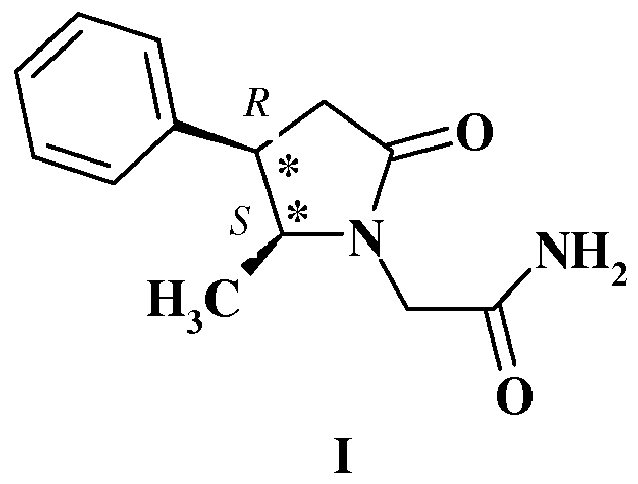
pharmaceutically acceptable salt thereof for use in the treatment of seizures.
pharmaceutically acceptable salt thereof for use in the treatment of seizures.
2. 2-(5S-Methyl-2-oxo-4R-phenyl-pyrrolidin-1-yl)-acetamide (I) or a pharmaceutically acceptable salt thereof
for use in the prophylaxis of seizures.
3. The use according to claim 1, wherein seizures are epileptic seizures.
4. The use according to claim 1, wherein seizures are tonic seizures.
5. The use according to claim 1, wherein seizures are clonic seizures.
REFERENCES CITED IN THE DESCRIPTION
This list of references cited by the applicant is for the reader's convenience only. It does not form part of the European patent document. Even though great care has been taken in compiling the references, errors or omissions cannot be excluded and the EPO disclaims all liability in this regard.
Patent documents cited in the description
Non-patent literature cited in the description
- CHARLOTTE MACKEYThe anticonvulsants marketNat Rev Drug Discov, 2010, vol. 9, 265-266 [0003]
- LOSCHER WHONACK DFASSBENDER CPNOLTING BThe role of technical, biological and pharmacological factors in the laboratory evaluation of anticonvulsant drugs. III. Pentylenetetrazole seizure modelsEpilepsyRes, 1991, vol. 8, 171-189 [0010]
- MANDHANE SNAAVULA KRAJAMANNAR TTimed pentylenetetrazol infusion test: a comparative analysis with s.c.PTZ and MES models of anticonvulsant screening in miceSeizure, 2007, vol. 16, 636-644 [0010]
- MELDRUM BSEpilepsy and gamma-aminobutyric acid-mediated inhibitionInt Rev Neurobiol, 1975, vol. 17, 1-36 [0010]