|
(11) | EP 3 189 837 A1 |

| (12) | EUROPEAN PATENT APPLICATION |
| published in accordance with Art. 153(4) EPC |
|
|
|
|
||||||||||||||||||||
| (54) | USE OF FLAVONOID COMPOUND IN PREPARATION OF COMPOSITION FOR HEALING WOUND |
| (57) Disclosed is a use of a flavonoid compound in the preparation of a composition for
healing a wound, wherein the compound is preferably nonglycosylated flavone. Specifically,
the present invention can be used for treating skin symptoms of a trauma, a burn,
a scald and a chronic wound, and can be particularly used for healing a wound of a
diabetes patient. |
FIELD OF THE INVENTION
[0001] The present invention discloses a new use of a compound in the preparation of a wound healing composition. Particularly, the present invention involves a new use of a flavonoid compound in the preparation of a wound healing composition.
BACKGROUND OF THE INVENTION
[0002] Flavonoids are refer generally to a series of compounds having two benzene rings containing phenolic hydroxyl groups, mutually connected with the central three-carbon atoms, having the structure shown as the general formula:
[0003] They are generally found in fruits, vegetables, tea, grape wine, seeds, or plant roots etc. Although they are not belonged as vitamins, they are demonstrated to have anti-oxidation functions and anti-inflammatory reaction effects, and also confirmed to have the effects of resisting or relieving the formation of tumors, relieving pain and relieving cardiovascular diseases or malaemia.
[0004] Flavonoids include flavones and flavonols. Flavones also include glycosylated flavones and non-glycosylated flavones.
[0005] U.S. Patent No. 7,471,973 B2 issued on October 29, 2002 disclose that flavonoids can be used in cosmetics but does not mention other effects. In addition, U.S. Patent No. 6,451,837B1 issued on September 17, 2002 discloses the neuroprotective effects of flavonoids.
SUMMARY OF THE INVENTION
[0006] The purpose of the present invention is to provide a new use of flavonoids in the preparation of a wound healing composition.
[0007] In one aspect, the present invention provides a new use of a compound in the manufacture of a wound healing composition, wherein the compound is a compound with the structure as shown in the general formula I or an isomer thereof:
wherein A is a hydrogen atom, R or -OH;
n1 and n2 are the same or different, being an integer of 0 to 4, wherein the sum of n1 and n2 is at most equal to 4;
n3 and n4 are the same or different, being an integer of 0 to 5, wherein the sum of n3 and n4 is at most equal to 5;
wherein R, R1, R2, R3 or R4 is defined as a hydrogen atom, an alkyl group with 1 to 30 carbon atoms, an acyl group having an alkyl group with 1 to 30 carbon atoms, or a hydrocarbon chain containing 1 to 30 carbon atoms; or a pharmaceutically acceptable ester or salt thereof.
[0008] According to the present invention, the wound healing composition is used for treating wound healing, which is used for treating wound healing for skin symptoms of trauma, bums and scalds and chronic wounds, and particularly relates to healing of wounds of diabetic patients.
[0009] According to one example of the present invention, the compound is a flavone, particularly a non-glycosylated flavone.
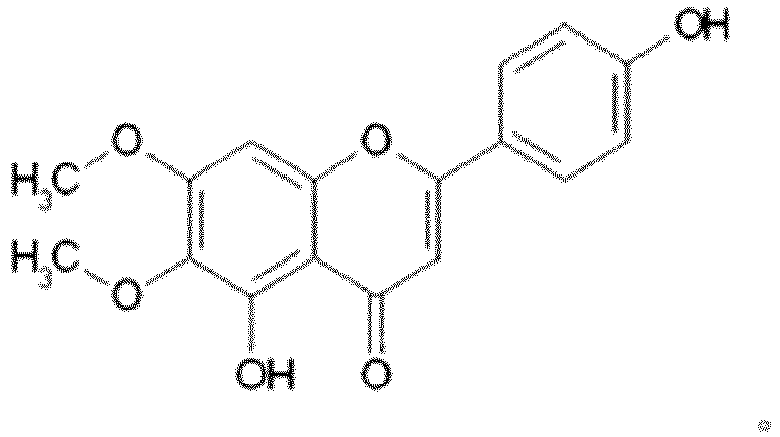
[0010] According to the preferred embodiment of the present invention, the non-glycosylated flavone compound is cirsimaritin, and has the following structure:
[0011] Those and other aspects of the present invention may be further clarified by the following descriptions and drawings of preferred embodiments. Although there may be changes or modifications therein, they would not betray the spirit and scope of the novel ideas disclosed in the present invention.
DETAILED DESCRIPTION OF THE INVENTION
[0012] Unless defined otherwise, all technical and scientific terms used herein have the same meanings as commonly understood by one of skill in the art to which this invention belongs.
[0013] Unless clearly specified herein, meanings of the articles "a," "an," and "said" all include the plural form of "more than one." Therefore, for example, when the term "a component" is used, it includes multiple said components and equivalents known to those of common knowledge in said field.
[0014] The present invention provides a new use of a compound in the manufacture of a wound healing composition, wherein the compound is a compound with the structure as shown in the general formula I or an isomer thereof:
wherein A is a hydrogen atom, R or -OH;
n1 and n2 are the same or different, being an integer of 0 to 4, wherein the sum of n1 and n2 is at most equal to 4;
n3 and n4 are the same or different, being an integer of 0 to 5, wherein the sum of n3 and n4 is at most equal to 5;
wherein R, R1, R2, R3 or R4 is defined as a hydrogen atom, an alkyl group with 1 to 30 carbon atoms, an acyl group having an alkyl group with 1 to 30 carbon atoms, or a hydrocarbon chain containing 1 to 30 carbon atoms; or a pharmaceutically acceptable ester or salt thereof.
[0015] According to the present invention, the compound is a flavone, particularly a non-glycosylated flavone. The non-glycosylated flavone is cirsimaritin, and has the following structure:
[0016] According to the invention, the present invention comprises a pharmaceutically acceptable carrier.
[0017] According to the invention, the composition comprises an appropriate excipient and is prepared as an external medicament form, a cosmetic form or pharmaceutical material form.
[0018] According to the invention, the composition further comprises a therapeutic agent, for example, other anti-inflammatory agents, antibacterial agents or other therapeutic agents.
[0019] As used herein, the term "skin symptoms" includes wounds or sores, including skin injuries such as incised injuries, lacerated injuries, stabbing injuries, wear injuries, etc. in skin. According to the present invention, the compounds show the effects in healing wounds for skin symptoms of trauma, bums and scalds and chronic wounds, which are particularly effective in treating wounds of diabetic patients, such as chronic wounds of diabetic patients.
[0020] As used herein, the term "treatment" includes the meaning of "treating" or "promoting" which means improving symptoms.
[0022] As used herein, the term "pharmaceutically acceptable carrier" refers to a diluent, excipient or the like as used in a commonly used technique for the preparation of a pharmaceutical composition. According to the present invention, a medicament form, a cosmetic form, or a pharmaceutical material form can be made. According to the present invention, a form for local application can be made for example, in the form of a spray. Spray forms include a spray agent and a liquid agent; or in a semi-solid form or a solid form, preferably a solid form with dynamic viscosity greater than that of water. Appropriate formulations include, but are not limited to, suspension, emulsion, cream, ointment, liniment, etc. Preferably, it is in the form of an ointment. The pharmaceutical composition of the present invention, no matter what form it is, can further include emollient, fragrances or pigments to improve their acceptability for various uses.
[0023] As used herein, the term "therapeutically effective amount" refers to a dosage that can effectively treat injuries for treatment of symptoms. The appropriate dosage can be used based on the needs of patients or wounds and according to technologies and clinical knowledge commonly used in pharmaceutics, and adjusted according to the manners and treatment conditions of the application, including age, body weight, symptoms, treatment effects, application modes and treatment time.
[0024] The present invention is explained in the above description of the invention and the following examples, which are not intended for limiting the scope of the present invention.
Example 1: Establishment of Animal Testing Mode
[0025] After rats' body weight reach 300 g, the induction of hyperglycemia was carried out with streptozotocin (STZ) (65 mg / kg, ip administration). Choosing animals with successfully induced hyperglycemia (300 mg/DL), the hyperglycemic animals were subjected to diabetic wound healing tests two months after the onset of hyperglycemic symptoms. Hyperglycemic animals with a body weight less than 300 g were excluded, and random grouping was performed. Animals were anesthetized with pentobarbital and then their backs were shaved and disinfected. Three pieces of animal skin (full thickness) were harvested from the back of the animals at points 4, 6 and 8 cm from the midpoint of the two scapula with an 1- cm-diameter drilling round knife.
[0026] Wounds of each animal were applied with testing agents. New skins were harvested for examination after the end of experiment.
[0027] Analyzing the areas of the three wounds on the back of each rat by image pro with the area on day zero as the original wound area. The original wound area is subtracted by the wound area at each time point and then divided by the original wound area to serve as the percentage of wound healing. The average value of the three percentages of wound healing of each rat is considered as the respective would healing extent of each rat. The number of rats was 6 for each group of each test. Data is expressed as mean ± SEM. P value is calculated for the test results by t-test against control group, where P<0.05 indicates significant differences, denoted *.
[0028] A 0.5% cirsimaritin composition was prepared in an ointment form, and was applied to the rats as treated above. The results are as follows. The comparison between the percentages of wound healing at 9, 11, 13, and 15 days after administration, and the untreated control group is shown below. There were significant differences for each group. The wound half-closure time (CT50 value) was further calculated and also shows significant differences.
| Days after administration (%) | 9 | 11 | 13 | 15 | CT50 |
| Control group | 20.4 ± 4.1 | 35.0 ± 2.8 | 56.1 ± 2.8 | 67.7 ±3.1 | 13.3 ± 0.4 |
| cirsimaritin (0.5%) | 37.2 ± 3.9* | 51.5 ± 3.1* | 70.6 ±3.5* | 83.3 ± 3.2* | 10.7 ± 0.4* |
| %: percentage of wound healing CT50: wound half-closure time *: p<0.05 Number of animals: n=6 |
1. Use of a compound in the manufacture of a composition for wound healing, wherein the
compound is a compound with the structure as shown in the general formula I or an
isomer thereof:

wherein A is a hydrogen atom, R or -OH;
n1 and n2 are the same or different, being an integer of 0 to 4, wherein the sum of n1 and n2 is at most equal to 4;
n3 and n4 are the same or different, being an integer of 0 to 5, wherein the sum of n3 and n4 is at most equal to 5;
wherein R, R1, R2, R3 or R4 is defined as a hydrogen atom, an alkyl group with 1 to 30 carbon atoms, an acyl group having an alkyl group with 1 to 30 carbon atoms, or a hydrocarbon chain containing 1 to 30 carbon atoms; or a pharmaceutically acceptable ester or salt thereof
wherein A is a hydrogen atom, R or -OH;
n1 and n2 are the same or different, being an integer of 0 to 4, wherein the sum of n1 and n2 is at most equal to 4;
n3 and n4 are the same or different, being an integer of 0 to 5, wherein the sum of n3 and n4 is at most equal to 5;
wherein R, R1, R2, R3 or R4 is defined as a hydrogen atom, an alkyl group with 1 to 30 carbon atoms, an acyl group having an alkyl group with 1 to 30 carbon atoms, or a hydrocarbon chain containing 1 to 30 carbon atoms; or a pharmaceutically acceptable ester or salt thereof
2. The use of claim 1, wherein the wound healing is healing of wounds for skin symptoms
of trauma, bums and scalds and chronic wounds.
3. The use of claim 1, wherein the wound healing is healing of wounds of diabetic patients.
4. The use of claim 1, wherein the wound healing is healing of chronic wounds of diabetic
patients.
5. The use of any one of claims 1-4, wherein the compound is a flavone.
6. The use of claim 5, wherein the compound is a non-glycosylated flavone.
7. The use of claim 6, wherein the compound is cirsimaritin and has the following structure:
8. The use of claim 1, wherein the composition includes an appropriate excipient and
is prepared as an external medicament form, a cosmetic form, or a pharmaceutical material
form.
9. The use of claim 5, wherein the composition includes an appropriate excipient and
prepared as an external medicament form, a cosmetic form, or a pharmaceutical material
form.
10. The use of claim 7, wherein the composition includes an appropriate excipient and
prepared as an external medicament form, a cosmetic form, or a pharmaceutical material
form.
REFERENCES CITED IN THE DESCRIPTION
This list of references cited by the applicant is for the reader's convenience only. It does not form part of the European patent document. Even though great care has been taken in compiling the references, errors or omissions cannot be excluded and the EPO disclaims all liability in this regard.
Patent documents cited in the description