|
(11) | EP 3 189 842 A1 |

| (12) | EUROPEAN PATENT APPLICATION |
| published in accordance with Art. 153(4) EPC |
|
|
|
|
|||||||||||||||||||||||||||
| (54) | COMPOSITION FOR PREVENTING HAIR LOSS OR PROMOTING HAIR GROWTH, CONTAINING OLEANOLIC ACID DERIVATIVE AND PHARMACEUTICALLY ACCEPTABLE SALT THEREOF |
| (57) The present invention provides a composition for preventing hair loss or promoting
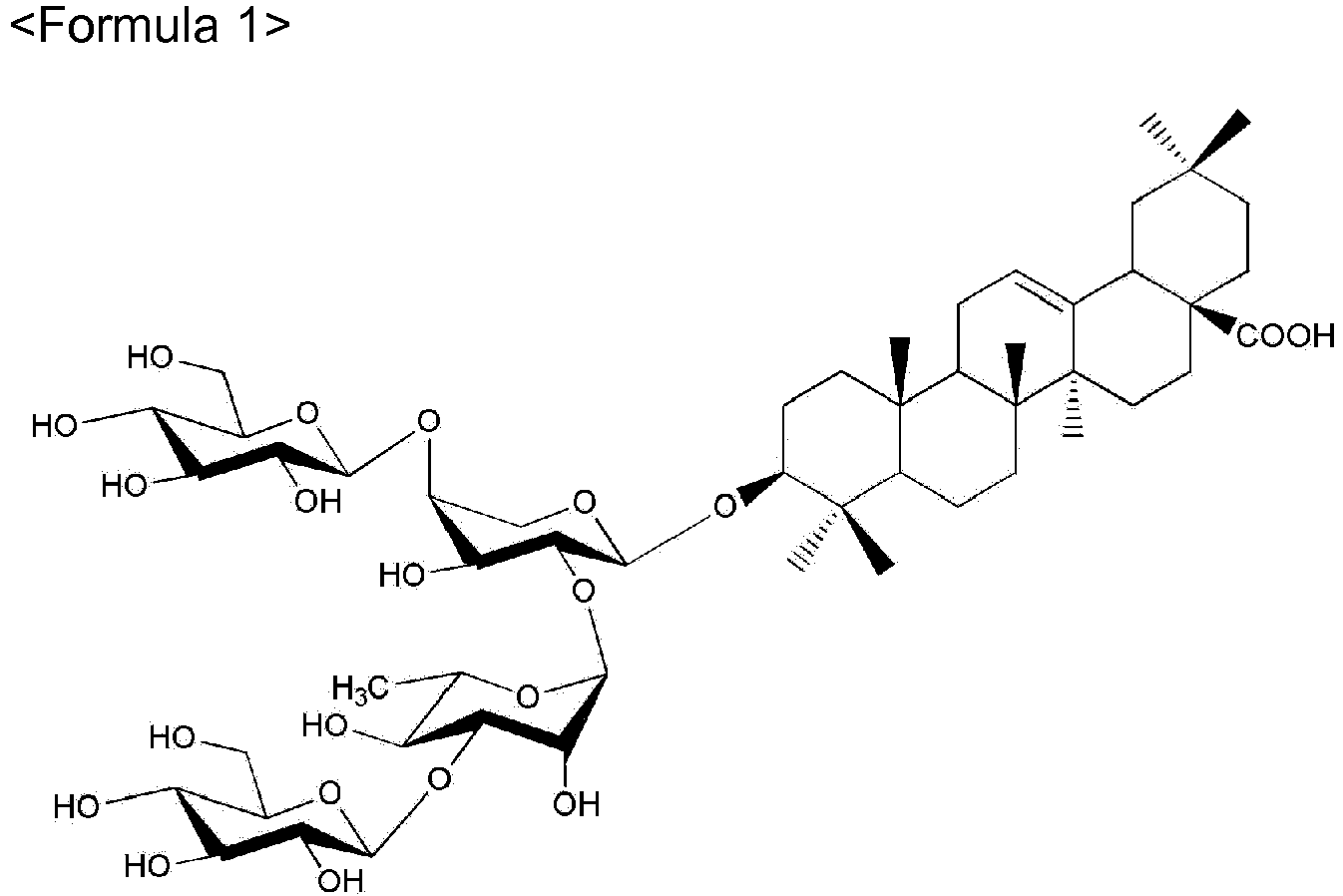
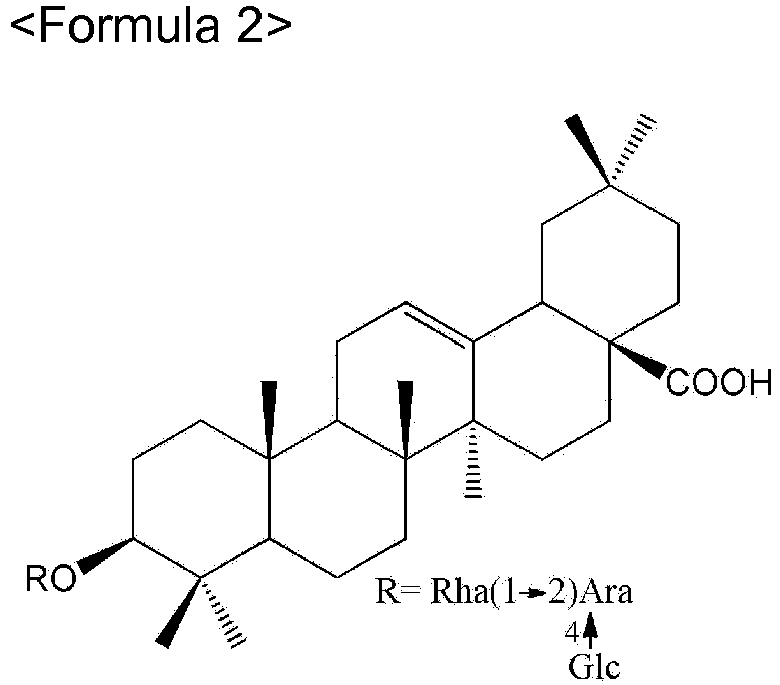
hair growth, comprising an oleanolic acid derivative or a pharmaceutically acceptable
salt thereof as an active ingredient. |
TECHNICAL FIELD
[0001] The present invention relates to a composition for preventing hair loss or promoting hair growth, comprising an oleanolic acid derivative or a pharmaceutically acceptable salt thereof as an active ingredient.
BACKGROUND ART
[0002] Corticotropin releasing hormone (CRH) is one of the major components of the hypothalamic-pituitary-adrenal axis (HPA axis) and is activated by mental stress. CRH, a peptide consisting of 41 amino acids, is a major contributor of the HPA axis. In response to stress, CRH plays an important role in the hormone and neurotransmitter cascade in vertebrates.
[0003] Serious psycho-emotional stress affects hair growth significantly and causes the development of alopecia areata. It has been reported that CRH inhibits hair shaft elongation and promotes apoptosis of hair matrix keratinocytes in an ex vivo culture of human hair follicles (Ito N, et al., Human hair follicles display a functional equivalent of the hypothalamic-pituitary-adrenal(HPA) axis and synthesize cortisol, FASE8 J. 19 (2005) 1332-4). In addition, it has been reported that CRH receptor antagonists induce hair growth in CRH-overexpressing hairless mice (Lixin Wang, et al., CRH receptor antagonist astressin-B reverses and prevents alopecia in CRH over-expressing mice, Plos One. 6(2011) e16377-e16385). It has been also reported that cultured human hair follicles respond to CRH stimulation and exhibit the HPA axis, including regulatory feedback systems (Natsuho Ito, et al., Human hair follicles display a functional equivalent of the hypothalamic-pituitary-adrenal (HPA) axis and synthesize cortisol, Faseb J. 19(2005)1332-4).
[0004] Accordingly, CRH plays an important role in human hair growth, and especially it is expected that a substance capable of regulating expressions of the cytokines regulated by CRH can be used as a material for preventing hair loss or promoting hair growth.
DISCLOSURE
Technical Problem
[0005] The present inventors have evaluated the effect of CRH on human hair dermal papilla cells which play an important role in hair formation. The present inventors have found that CRH inhibits expressions of the hair growth-related cytokines, namely KGF, TGFβ-2, Wnt5a and Nexin and promotes the transition from anagen phase to catagen phase in the hair cycle in the follicular culture system. In order to identify a substance capable of blocking the action of CRH, including CRH receptor antagonists, the present inventors isolated various compounds from various herbal products and their extracts which have been proven to have safety; and performed extensive screenings for finding out the materials showing antagonistic effects on the CRH receptor. As the results thereof, it has been found that a certain oleanolic acid derivative remarkably inhibits the transition of the hairs in the anagen phase to the hairs in the catagen phase by CRH.
[0006] Therefore, it is an object of the present invention to provide a composition for preventing hair loss or promoting hair growth, comprising the oleanolic acid derivative or its salt as an active ingredient
Technical Solution
[0007] In accordance with an aspect of the present invention, there is provided a composition for preventing hair loss or promoting hair growth, comprising a compound of Formula 1 or 2 or a pharmaceutically acceptable salt thereof as an active ingredient.
[0008] In the composition of the present invention, the hair loss may be a stress-induced hair loss.
ADVANTAGEOUS EFFECTS
[0009] It has been found by the present invention that a certain oleanolic acid derivative having the chemical structure of Formula 1 or 2 remarkably inhibits the anagen-catagen transition of hair, which is originated from antagonistic action on the receptor of the stress hormone CRH. Accordingly, the compound of Formula 1 or 2 or a pharmaceutically acceptable salt thereof can be usefully used in a composition for preventing hair loss (particularly for preventing stress-induced hair loss) or promoting hair growth.
BEST MODE
[0010] The present invention provides a composition for preventing hair loss or promoting hair growth, comprising a compound of Formula 1 or 2 or a pharmaceutically acceptable salt thereof as an active ingredient.
[0011] The compound of Formula 1 is a known material and its chemical name is 3-O-β-D-glucopyranosyl (1→3)-α-L-rhamnopyranosyl (1→2) [β-D-glucopyranosyl (1→4)]-α-L-arabinopyranosyl oleanolic acid. The CAS number thereof is 106577-41-7. The compound of Formula 2 is also a known material and its chemical name is oleanolic acid-3-O-α-L-rhamnopyranosyl-(1→2)-[β-D-glucopyranosyl-(1→4)]-α-L-arabinopyranosi de. The CAS number thereof is 106577-39-3. The compound of Formula 2 is also referred to as 'Raddeanoside R13' or 'Hederacolchiside A1'. The compounds of Formulas 1 and 2 can be obtained according to the methods known in the arts, for example, Wei Li et al, Oleanane-type triterpenoid saponins from the roots of Pulsatilla koreana and their apoptosis-inducing effects on HL-60 human promyelocytic leukemia cells, Arch. Pharm. Res. (2013) 36, pp768-774, and the like. The salt of the compound of Formula 1 or 2 includes a pharmaceutically acceptable conventional salt, e.g., an alkali metal salt such as sodium salt, an alkaline earth metal salt such as calcium salt, and the like, but is not limited thereto.
[0012] The composition of the present invention can be usefully applied to prevent hair loss. The hair loss includes alopecia such as alopecia areata and diffuse alopecia, according to the hair loss forms, and alopecia such as stress-induced hair loss and female hair loss, according to the hair loss causes. The composition of the present invention can be applied preferably to a stress-induced hair loss among the hair losses originated from various causes.
[0013] The composition of the present invention may be formulated in the form of a pharmaceutical composition and/or a cosmetic composition. For example, the composition of the present invention may be in the form of a pharmaceutical composition for preventing hair loss or promoting hair growth, comprising the compound of Formula 1 or 2 or a pharmaceutically acceptable salt thereof as an active ingredient. In addition, the composition of the present invention may be in the form of a cosmetic composition for preventing hair loss or promoting hair growth, comprising the compound of Formula 1 or 2 or a pharmaceutically acceptable salt thereof.
[0014] The pharmaceutical composition may include a pharmaceutically acceptable carrier and may be formulated into a parenteral formulation such as a solution, a suspension, an emulsion, a lotion, an ointment or a lyophilized formulation according to conventional methods. Preferably, the pharmaceutical composition may be formulated into a transdermal dosage form such as a solution for external use, an emulsion, and an ointment. The pharmaceutically acceptable carrier includes an aqueous diluent or solvent such as phosphate buffered saline, purified water, sterilized water, etc., and a non-aqueous diluent or solvent such as propylene glycol, polyethylene glycol, olive oil, etc. And also, if necessary, the pharmaceutically acceptable carrier may include wetting agents, flavoring agents, preservatives, and the like. The dose of the compound of Formula 1 or 2 or a pharmaceutically acceptable salt thereof in the pharmaceutical composition varies depending on condition and body weight of a patient, severity of the disease, dosage form, administration route and time, and can be appropriately selected by a skilled person in the art. For example, the compound of Formula 1 or 2 or a pharmaceutically acceptable salt thereof may be administered at a dose of 0.01 to 1000 mg/kg per day, preferably 0.1 to 100 mg/kg per day. The administration may be carried out once or several times a day.
[0015] The composition of the present invention may be in the form of a cosmetic composition comprising the compound of Formula 1 or 2 or a pharmaceutically acceptable salt thereof as an active ingredient. The cosmetic composition of the present invention may be prepared in various forms according to conventional methods thereof, using the compound of Formula 1 or 2 or a pharmaceutically acceptable salt thereof. For example, the cosmetic composition of the present invention may be prepared in forms of a cosmetic product, a shampoo, a hair lotion, a hair cream, a hair gel, a scalp essence, a tonic, etc. containing the compound of Formula 1 or 2 or a pharmaceutically acceptable salt thereof, which may be diluted with a cleansing water, an astringent solution, or a moisture solution, for the use thereof. And also, the cosmetic composition may include conventional excipients, such as a stabilizer, a solubilizing agent, vitamin, a pigment, a flavoring agent, which are conventionally used in the field of cosmetic composition. In the cosmetic composition of the present invention, the compound of Formula 1 or 2 or a pharmaceutically acceptable salt thereof may be present in an amount enough to provide the effects for preventing hair loss or promoting hair growth, for example in an amount ranging from 0.001 to 50 wt%, preferably about 1 to 20 wt%, based on the total weight of the composition.
[0016] The present invention will be described in further detail with reference to the following examples. These examples are for illustrative purposes only and are not intended to limit the scope of the present invention.
Example: Evaluation of the effects of the compounds of Formulas 1 and 2 on anagen-catagen transition in a human hair follicle culture test
[0017] Normal human scalp tissues (Bundang Cha Hospital) were washed with 70% ethanol for 2 minutes, with phosphate buffered saline (PBS) for 2 minutes, with 5X Anti-anti (Gibco) for 2 minutes, and then with PBS for 2 minutes, to remove any contamination. The hair follicles in the anagen phase were selected and then cultured in William's medium (containing insulin, hydrocortisone, HEPES, Anti-anti) (hereinafter referred to as "the medium", unless otherwise described) for one day. The hair follicles maintaining the anagen phase were used in the experiment.
[0018] The hair follicles in the anagen phase were selected and then one hair follicle per well of a 24-well cell culture plate was cultured along with the medium. 20 Hair follicles were used per group. The test was performed with three groups, i.e., a control group, a positive control group, and test groups. The hair follicles of the control group were cultured in the medium for 3 days and 6 days. The hair follicles of the positive control group were cultured in the medium containing CRH (10-6M) for 3 days and 6 days. The hair follicles of each test group were respectively pretreated for 2 hours with the medium containing the compound of Formula 1 or 2 in the concentration of 0.5 uM. CRH (10-6 M) was added to the medium of each test group, which was then for 3 days and 6 days. After culturing each group for 3 days and 6 days, the numbers of anagen hairs and catagen hairs in each group were observed through a stereoscopic microscope. The results thereof are shown in Table 1 below.
<Table 1 >
[0019] Inhibitory effects of the compound of Formulas 1 and 2 against anagen-catagen transition
| Control group | Positive control group (CRH) | Test group | ||
| Compound of Formula 1 | Compound of Formula 2 | |||
| 3 days | 15% | 60 % | 25 % | 10% |
| 6 days | 60 % | 95 % | 35 % | 10% |
[0020] As can be seen from the results in Table 1, in the control group, 15% and 60% of the hairs were converted from the anagen phase to the catagen phase after culturing for 3 days and 6 days, respectively. In the positive control group, 60% and 95% of the hairs were converted to the catagen phase after culturing for 3 days and 6 days, respectively, because of the CRH effects. In the test group treated with the compound of Formula 1, only 25% and 35% of the hairs were converted to the catagen phase after culturing for 3 days and 6 days, respectively. In the test group treated with the compound of Formula 2, only 10% and 10% of the hairs were converted to the catagen phase after culturing for 3 days and 6 days, respectively. From the above results, it can be seen that CRH promotes the transition of the hair in the anagen phase to the hair in the catagen phase, and the compounds of Formulas 1 and 2 effectively block the effect of CRH, thereby maintaining the hairs in the anagen phase well.
1. A composition for preventing hair loss or promoting hair growth, comprising a compound
of Formula 1 or 2 or a pharmaceutically acceptable salt thereof as an active ingredient.
2. The composition according to claim 1, wherein the hair loss is a stress-induced hair
loss.
REFERENCES CITED IN THE DESCRIPTION
This list of references cited by the applicant is for the reader's convenience only. It does not form part of the European patent document. Even though great care has been taken in compiling the references, errors or omissions cannot be excluded and the EPO disclaims all liability in this regard.
Non-patent literature cited in the description
- ITO N et al.Human hair follicles display a functional equivalent of the hypothalamic-pituitary-adrenal(HPA) axis and synthesize cortisolFASE8 J., 2005, vol. 19, 1332-4 [0003]
- LIXIN WANG et al.CRH receptor antagonist astressin-B reverses and prevents alopecia in CRH over-expressing micePlos One, vol. 6, 2011e16377-e16385 [0003]
- NATSUHO ITO et al.Human hair follicles display a functional equivalent of the hypothalamic-pituitary-adrenal (HPA) axis and synthesize cortisolFaseb J., 2005, vol. 19, 1332-4 [0003]
- WEI LI et al.Oleanane-type triterpenoid saponins from the roots of Pulsatilla koreana and their apoptosis-inducing effects on HL-60 human promyelocytic leukemia cellsArch. Pharm. Res., 2013, vol. 36, 768-774 [0011]