|
(11) | EP 3 204 453 B1 |

| (12) | EUROPEAN PATENT SPECIFICATION |
|
|
| (54) |
LOW MOLECULAR WEIGHT GRAFT POLYMER FOR SCALE INHIBITOR NIEDERMOLEKULARES PFROPFPOLYMER ALS KESSELSTEINHEMMER POLYMÈRE GREFFÉ DE BAS POIDS MOLÉCULAIRE POUR INHIBITEUR DE TARTRE |
|
|
|||||||||||||||||||||||||||||||
| Note: Within nine months from the publication of the mention of the grant of the European patent, any person may give notice to the European Patent Office of opposition to the European patent granted. Notice of opposition shall be filed in a written reasoned statement. It shall not be deemed to have been filed until the opposition fee has been paid. (Art. 99(1) European Patent Convention). |
BACKGROUND
1. FIELD OF THE INVENTION
[0001] The present invention relates generally to a composition comprising a graft polymer. More particularly, the present invention relates to a composition comprising a low molecular weight graft polymer. The graft polymer is a graft terpolymer. Additionally, the present invention relates to a scale inhibitor composition comprising the low molecular weight graft polymer. Furthermore, the present invention relates to a process for preventing the deposition of scale from water or aqueous solution and a method for scale inhibition treatment of an oil or gas production well by using the low molecular weight graft polymer. The scale inhibitor is low corrosive for application in the oilfield.
2. BACKGROUND OF THE INVENTION
[0002] In most aqueous systems used in industry, such as in cooling towers, in boilers and in formation fluids and production fluids for oil and gas extraction, the formation and deposition of scales cause severe problems for these systems. The scales commonly encountered include calcium carbonate, calcium sulfate, barium sulfate, magnesium carbonate, magnesium hydroxide, strontium carbonate and strontium sulfate. The scales formed and deposited can lead to the plug of the pipes and bores, the sticking of valves and the damage or hindrance of equipment, particularly those with moving parts. Thus, the aqueous systems used in industry are generally treated with one or more scale inhibitors to minimize and/or prevent scale deposition in the systems.
[0003] Current methods for inhibiting formation of inorganic deposits of scale employ compounds containing phosphorus, usually polymers of the carboxylic acid, sulfonic acid, or phosphonic type.
[0004] Treatment levels up to a few hundred parts per million (ppm) of scale inhibitors are usually effective. The scale-inhibiting polymer is typically added to the fluid to be treated or may be applied to oil bearing formations by means of "squeeze treatment". Squeeze treatment involves pumping a scale inhibitor into an oil production well so that the inhibitor enters the formation rock and is retained there. When the well is put back into production, the produced fluids are treated by the scale inhibitor which leaches out of the formation rock. Thus the scale inhibitor is released into a fluid. The scale inhibitor may be applied in an aqueous or non-aqueous medium. The objective is to prevent or control the scale formation in systems wherein the fluid is used.
[0005] Capillary injection is another method for delivering scale inhibiting materials. In capillary injection, a relatively concentrated form of the scale inhibitor composition is continuously pumped into the well during production.
BRIEF DESCRIPTION OF THE FIGURES
[0006] FIG. 1 shows the comparative dynamic scale loop (DSL) test results of Bellasol S28 with the samples of Examples 1 and 2.
DETAILED DESCRIPTION OF THE INVENTIVE CONCEPT(S)
[0007] Before explaining at least one embodiment of the present invention in detail, it is to be understood that the present invention is not limited in its application to the details of construction and the arrangement of the components or steps or methodologies set forth in the following description or illustrated in the drawings. The present invention is capable of other embodiments or of being practiced or carried out in various ways. Also, it is to be understood that the phraseology and terminology employed herein is for the purpose of description and should not be regarded as limiting.
[0008] Unless otherwise defined herein, technical terms used in connection with the present invention shall have the meanings that are commonly understood by those of ordinary skill in the art. Further, unless otherwise required by context, singular terms shall include pluralities and plural terms shall include the singular.
[0009] All patents, published patent applications, and non-patent publications mentioned in the specification are indicative of the level of skill of those skilled in the art to which the present invention pertains.
[0010] All of the articles and/or methods disclosed herein can be made and executed without undue experimentation in light of the present disclosure. While the articles and methods of the present invention have been described in terms of preferred embodiments, it will be apparent to those of ordinary skill in the art that variations may be applied to the articles and/or methods and in the steps or in the sequence of steps of the method described herein without departing from the scope of the present invention as defined by the claims..
[0011] As utilized in accordance with the present disclosure, the following terms, unless otherwise indicated, shall be understood to have the following meanings.
[0012] The use of the word "a" or "an" when used in conjunction with the term "comprising" may mean "one," but it is also consistent with the meaning of "one or more," "at least one," and "one or more than one." The use of the term "or" is used to mean "and/or" unless explicitly indicated to refer to alternatives only if the alternatives are mutually exclusive, although the disclosure supports a definition that refers to only alternatives and "and/or." Throughout this application, the term "about" is used to indicate that a value includes the inherent variation of error for the quantifying device, the method being employed to determine the value, or the variation that exists among the study subjects. For example, but not by way of limitation, when the term "about" is utilized, the designated value may vary by plus or minus twelve percent, or eleven percent, or ten percent, or nine percent, or eight percent, or seven percent, or six percent, or five percent, or four percent, or three percent, or two percent, or one percent. The use of the term "at least one" will be understood to include one as well as any quantity more than one, including but not limited to, 1, 2, 3, 4, 5, 10, 15, 20, 30, 40, 50, 100, etc. The term "at least one" may extend up to 100 or 1000 or more depending on the term to which it is attached. In addition, the quantities of 100/1000 are not to be considered limiting as lower or higher limits may also produce satisfactory results. In addition, the use of the term "at least one of X, Y, and Z" will be understood to include X alone, Y alone, and Z alone, as well as any combination of X, Y, and Z. The use of ordinal number terminology (i.e., "first", "second", "third", "fourth", etc.) is solely for the purpose of differentiating between two or more items and, unless explicitly stated otherwise, is not meant to imply any sequence or order or importance to one item over another or any order of addition.
[0013] As used herein, the words "comprising" (and any form of comprising, such as "comprise" and "comprises"), "having" (and any form of having, such as "have" and "has"), "including" (and any form of including, such as "includes" and "include") or "containing" (and any form of containing, such as "contains" and "contain") are inclusive or open-ended and do not exclude additional, unrecited elements or method steps. The term "or combinations thereof' as used herein refers to all permutations and combinations of the listed items preceding the term. For example, "A, B, C, or combinations thereof' is intended to include at least one of: A, B, C, AB, AC, BC, or ABC and, if order is important in a particular context, also BA, CA, CB, CBA, BCA, ACB, BAC, or CAB. Continuing with this example, expressly included are combinations that contain repeats of one or more item or term, such as BB, AAA, AAB, BBC, AAABCCCC, CBBAAA, CABABB, and so forth. The skilled artisan will understand that typically there is no limit on the number of items or terms in any combination, unless otherwise apparent from the context.
[0014] As used herein any reference to "one embodiment" or "an embodiment" means that a particular element, feature, structure, or characteristic described in connection with the embodiment is included in at least one embodiment. The appearance of the phrase "in one embodiment" in various places in the specification are not necessarily all referring to the same embodiment.
[0015] The present invention encompasses a low molecular weight graft polymer. The graft polymer is a graft terpolymer.
[0016] The present invention relates to a low molecular weight graft terpolymer produced by polymerizing a mono-ethylenically unsaturated carboxylic acid and two different mono-ethylenically unsaturated monomers to form a terpolymer and grafting a morpholine compound to the terpolymer. The two mono-ethylenically unsaturated monomers are different from the mono-ethylenically unsaturated carboxylic acid for making the terpolymer.
[0017] The mono-ethylenically unsaturated carboxylic acids can have from about 3 to about 8 carbon atoms. Examples can include, but are not limited to, acrylic acid, methacrylic acid, dimethacrylic acid, ethacrylic acid, maleic acid, citraconic acid, methylenemalonic acid, allylacetic acid, vinylacetic acid, crotonic acid, fumaric acid, mesaconic acid, itaconic acid, and combinations thereof. The mono-ethylenically unsaturated carboxylic acids can be used in the polymerization as free acids, as anhydrides and in partially or completely neutralized forms.
[0018] The mono-ethylenically unsaturated monomers can be represented by the following general formula (I):
R1R2C = CR3R4 Formula (I)
where R1-R4 are independently hydrogen, C1-C20 alkyl, C1-C20 cycloalkyl, C6-C24 aryl, halogen, cyano, C1-C20 alkylacid, C1-C20 cycloalkylacid, C1-C20 alkylester, C1-C20 cycloalkylester, C1-C20 alkylamide, C1-C20 cycloalkylamide, C6-C24 acrylacid, C6-C24 acrylester, or C6-C24 acrylamide.
[0019] The mono-ethylenically unsaturated monomers can be selected from the group consisting of acrylic acid, methacrylic acid, crotonic acid, itaconic acid, aconitic acid, alkyl acrylic or methacrylic ester, acrylonitrile, acrylamide, vinyl acetate, styrene, α-methylstyrene, methyl vinyl ketone, acrolein, ethylene, propylene, and combinations thereof.
[0020] In one non-limiting embodiment, the monomers for the low molecular weight graft terpolymer can be maleic acid or anhydride, vinyl acetate and alkyl acrylic or methacrylic ester monomers.
[0021] The alkyl acrylic or methacrylic ester can be an alkyl acrylate or alkyl methacrylate. The esters which are operative in the present invention are alkyl esters of acrylic and methacrylic acids in which the alkyl groups contain from about 1-8 carbon atoms including methyl, ethyl, propyl, butyl, isobutyl, 2-ethyl hexyl, and octyl groups. Suitable alkyl acrylate monomers can include, but are not limited to, methyl acrylate, ethyl acrylate, propyl acrylate, butyl acrylate, isopropyl acrylate and tert-butyl acrylate.
[0022] Suitable morpholine compounds can be presented by Formula (II):
where R is H, C1-C20 aliphatic being liner or branched, or aromatic; and R1-R4 are independently H, C1-C20 aliphatic being linear or branched, aromatic, or (CH2)nX, where n = 0-20 and X is OH, COOH, SH, NH, Cl, F, Br, or I.
[0023] In one non-limiting embodiment, the morpholine compounds of Formula (II) can include, but are not limited to, morpholine, methylmorpholine, ethylmorpholine, propylmorpholine, butylmorpholine, pentylmorpholine, hexylmorpholine, heptylmorpholine, octylmorpholine, nonylmorpholine, decylmorpholine, undecylmorpholine, dodecylmorpholine, morpholinecarboxylic acid, hydroxymethylmorpholine, chloroethylmorpholine, aminomethylmorpholine, aminopropylmorpholine, 3-chloro-2-morpholin-4-phenylamine, 4-chloro-5-(4-morpholinyl)-1,2-benzendiamine, 3-chloro-4-(4-morpholinyl)aniline.
[0024] Other suitable morpholine compounds can be represent by Formula (III)
where R is H, C1-C20 aliphatic being linear or branched, or aromatic; R1-R4 are H; and X is OH, NH2, COOH, Cl, Br, I, or SH.
[0025] In one non-limiting embodiment, the morpholines of Formula (III) can include, but are not limited to, alpha-2,6-trimethyl-4-morpholineethanol, 4-(2-hydroxypropyl)morpholine, 4-(2-aminoethyl)morpholine, 4-(2-aminopropyl)morpholine, 4-(2-hydroxyethyl)morpholine, 4-(2-chloroethyl)morpholine, 4-)2-carboxyethyl)morpholine, alpha-phenyl-4-morpholineethanol, aminomorpholine, morpholin-4-yl-acetic acid, 4-(2-chloroethyl)morpholine, 2-morpholin-4-ylethanethiol, and 4-(2-hydroxyethyl)morpholine.
[0026] The morpholine compound can be polymerizable morpholine derivatives (incorporated onto the polymer backbone). Examples can include, but are not limited to, 4-acryloylmorpholine, 4-(2-ehtyl-1-butenyl)morpholine and N-allyl-N'-(4-morpholinylmethyl)urea. Other morpholine compounds can include 4-(N-(5-chloro-2-methylphenyl)carbamoyl)morpholine, ethyl 4-morpholinylacetate, 4-allyl-2-[(2,6-dimethyl-4-morpholinyl)methyl]-6-methoxyphenol, (Z)-chloro(4-morpholinyl)methylidenephosphoramidic dichloride, 4-)N-(4-chloro-2-methylphenyl)-2,6-dimehtylmorpholine, N-(imino-(2-methyl-3-phenyl-morpholin-4-yl)-methyl)guandine, 4-(2-chloro-6-ditrophneyl)morpholine, N-(2-(4-chloro-phneyl)-1-(morpholine-4-carbonyl)-vinyl)-4-nitro-bezamide, 3-chloro-4-morpholinobenzoic acid, 2-[2E)-2-(3-chloro-4-nitrobenzylidene)hydrazino]-N-[2-(4-morpholinylcarbonyl)phenyl]-2-oxoacetamide, 2-[2E)-2-(5-chloro-2-nitrobenzylidene)hydrazino]-N-[2-(4-morpholinylcarbonyl)phenyl]-2-oxoacetamide, 2-[2E)-2-(5-chloro-2-hydroxybenzylidene)hydrazino]-N-[2-(4-morpholinylcarbonyl)phenyl]-2-oxoacetamide, 2-(2-(3-CL-benzylidene)hydrazine)-N-(2-(4-morpholinylcarbonyl)PH)-2-oxoacetamide, N-(2-(4-morpholinyl)ethyl)-2-phneyl-4-quinolineamine, 2-((@E)-2-{2-[3-bromobenzyl)oxy]benzylidene}hydrazine)-N-[2-(4-morpholinylcarbonyl)phenyl]-2-oxoacetamide, 6-cholo-4-(4-morpholinyl)-2-phneylquinoline, 4-(4-morpholinyl)benzaldehyde-3,4,5-tetrahydro-2H-azepin-7-ylhydrazom, and 1-chloro-2,4-dimopholino-5-nitrobenzene.
[0027] In one non-limiting embodiment, a graft terpolymer of the present invention can be produced by polymerizing a mixture of vinyl acetate, maleic anhydride and an alkyl acrylate in the presence of a free radical producing catalyst (also called initiator) and a solvent to form a terpolymer. The formed terpolymer is then grafted by adding morphine to form the graft terpolymer. The graft terpolymer is then hydrolyzed to form a final product. The whole process is shown below.
[0028] The polymerization reaction can be conducted at 60 °C or above. The upper limit of the reaction temperature will depend on the type of initiators and chain transfer agents. In addition, it will depend on the controllability of the reaction rate and on the reflux temperature of the solvent or mixture thereof provided that the employed solvent or mixture thereof boils at a temperature higher than 60 °C. In one non-limiting embodiment, the reaction temperature can be varied in a range of about 65 °C to about 155 °C. In another non-limiting embodiment, the reaction temperature can be varied in a range of about 70 °C to about 150 °C. In yet another non-limiting embodiment, the reaction temperature can be varied in a range of about 90 °C to about 150 °C. In yet another non-limiting embodiment, the reaction temperature can be varied in a range of about 120 °C to about 150 °C.
[0029] The reaction time can be varied according to the particular starting materials used. The usual course of the polymerization can be followed by observing the precipitation of the polymer as fine particulate granules. The polymerization is substantially complete when precipitation ceases. The polymerization time can be varied in a range of about 1 to about 10 hours. In one non-limiting embodiment, the polymerization time can be varied in a range of about 3 to about 5 hours. The formed terpolymer is then cooled down to about 90 to 100 °C. A morpholine compound is added at this temperature for about 1 to about 2 hours. The terpolymer grafted with morpholine is then hydrolyzed using water, dilute acid or alkali.
[0030] The terpolymer grafted with morpholine can have a molecular weight between 500 Daltons and 200,000 Daltons. A more suitable graft terpolymer polymerized from maleic anhydride, alkyl acrylate and vinyl acetate can have a molecular weight between 500 Daltons and 5,000 Daltons.
[0031] The graft terpolymer can be prepared by polymerizing the unsaturated carboxylic acid monomer in an amount of at least 30% by weight of the graft terpolymer, the vinyl acetate monomer in an amount of 1% to 60% by weight of the graft terpolymer, and the alkyl acrylate monomer in an amount of 1% to 60% by weight of the graft terpolymer to form a terpolymer; and grafting the morphine compound in an amount of 0.5% and 10% by weight of the graft terpolymer onto the terpolymer.
[0032] In one non-limiting embodiment, the graft terpolymer can be prepared by polymerizing the unsaturated carboxylic anhydride monomer in an amount of at least 40% by weight of the graft terpolymer, the vinyl acetate monomer in an amount of 1% to 50% by weight of the graft terpolymer, and the alkyl acrylate monomer in an amount of 1% to 50% by weight of the graft terpolymer to form a terpolymer; and grafting the morphine compound in an amount of 1% and 5% by weight of the graft terpolymer onto the terpolymer.
[0033] The alkyl acrylate and/or vinyl acetate monomers may be hydrolyzed in the concentrate or in the use composition. For example, the alkyl acrylate and/or vinyl acetate segments can be hydrolyzed to carboxylic acids at a high pH. The alkyl acrylate and/or vinyl acetate segments may be partially or completely hydrolyzed in the concentrate and/or use solution. In one example, the terpolymer may be produced by at least one hydrolyzed vinyl acetate or alkyl acrylate monomer. Additionally, as used herein, reference to maleic acid monomers can include monomers of maleic acid, malice anhydride, and salts thereof.
[0034] The free radical producing catalysts used in the present invention can be peroxy type catalysts including organic and inorganic peroxides and hydroperoxides, esters of peracids such as peracetic acid and perbenzoic acid, etc. Other free radical producing catalysts such as azonitriles, other organic azo compounds, tetra-alkyl diamino diphenyl methanes, etc., can also be used. For many purposes it is desirable to use two or more catalysts. In one non-limiting embodiment, the catalyst can be di-tert-butyl peroxide (DTBP). The total amount of catalyst may vary between about 0.1 and about 0.5 parts per 100 parts of the total monomer.
[0035] Generally, the morpholine compound used for grating the terpolymer can be varied in a range of 0.1 to 30 % by weight of the total weight of the terpolymer. In one non-limiting embodiment, the morpholine compound can be varied in a range of about 1 to 25 by weight. In another non-limiting embodiment, the morpholine compound can be varied in a range of about 2 to 20 % by weight. In yet another non-limiting embodiment, the morpholine compound can be varied in a range of 5 to 10 % by weight.
[0036] The solvent can be an aromatic hydrocarbon such as benzene, toluene, xylene, and mixtures thereof. The solvent can also be a mixture of a cycloaliphatic hydrocarbon such as cyclohexane and an ester of an aliphatic acid such as ethyl acetate. In one non-limiting embodiment, the solvent is xylene. In another non-limiting embodiment, the solvent is a 50:50 (weight ratio) mixture of cyclohexane and ethyl acetate.
[0037] Additionally, the present invention relates to a scale inhibitor composition comprising the low molecular weight graft polymer. Furthermore, the present invention relates to a process for preventing the deposition of scale from water or aqueous solution and a method for scale inhibition treatment of an oil or gas production well by using the low molecular weight graft polymer. The graft polymers can be the graft terpolymers as described previously. The scale inhibitor is low corrosive for application in the oilfield.
[0038] An effective amount of the scale inhibitor composition against scale formation may vary based on various factors including, but are not limited to, the particular system to be treated, the scale inhibiting moieties, the area subjected to scale deposition, water quantity, pH, temperature, or concentration of the scale forming species. In one non-limiting embodiment, an effective amount of the scale inhibitor composition may be less than 50 ppm. In another non-limiting embodiment, the effective amount may be varied from about 5 ppm to about 25 ppm. In yet another embodiment, the effective amount may be varied from about 7 ppm to about 15 ppm.
[0039] The aqueous low molecular weight graft polymer solution prepared can directly be used as a scale inhibitor composition without further treatment. The scale inhibitor composition may be added to the oilfield fluids such as produced water or injection water during secondary recovery processor periodically, continually or continuously. Furthermore, the scale inhibitor composition may be added by squeeze applying to the subterranean formations. Additionally, the scale inhibitor composition may be applied by other techniques commonly used offshore including, but not limited to, gas-lift injection, downhole annulus injection, encapsulation or soluble matrix techniques, sub-sea wellhead injection, or secondary topside treatment.
[0040] In one non-limiting embodiment, a method for scale inhibition treatment of oil or gas production well comprises adding the low molecular weight graft polymer solution to the oilfield fluids subjected to scale formation; measuring an amount of the scale inhibitor composition in the oilfield fluids; and further adding the scale inhibitor composition to the oilfield fluids when the measured amount of the scale inhibitor composition is approaching a minimum inhibition concentration of the scale inhibitor composition.
[0041] The minimum inhibitor concentration of the scale inhibitor composition can be measured using any known technique. For example, as shown in the Examples described herein, the minimum inhibitor concentration of the sale inhibitor composition may be measured using a dynamic scale loop (DSL) test. At the field site, the operators may quickly determine an amount of the scale inhibitor composition in the tested fluids. By comparing the detected amount of the scale inhibitor composition in the tested fluids with the minimum inhibitor concentration of the scale inhibitor composition, the operators may readily decide when it is most suitable to apply additional scale inhibitor composition, and at which rate and amount the additional scale inhibitor composition should be added into the fluids.
[0042] In another non-limiting embodiment, a method for scale inhibition treatment of oil or gas production well includes squeeze applying the scale inhibitor composition comprising the low molecular weight graft polymer solution to the subterranean formations. In the squeeze treatment application, the scale inhibitor composition may be used in conjunction with spearhead chemicals, surfactants and/or emulsifiers. These chemicals may be applied prior to the squeeze treatment of the scale inhibitor composition to aid adsorption onto the rock and to minimize emulsification problems.
[0043] In a normal "squeeze" treatment, it may be difficult to control the concentration of the scale inhibitor composition returning in produced brines. The scale inhibitor composition may be produced quickly initially, with its concentrations tailing off with time to ineffective amounts. Spearhead chemicals, surfactants and/or emulsifiers, or pH adjustment can used to control or delay the return time of the scale inhibitor (i.e., increase squeeze lifetime).
[0044] In addition to oilfield applications, the scale inhibitor composition may be used as a scale inhibitor in any industrial water system where scale inhibition is needed. Examples of such industrial water systems may include, but are not limited to, cooling tower water systems; boiler water systems; hot water heaters; heat exchangers; mineral process waters; paper mill water systems; black liquor evaporators in the pulp industry; desalination systems; cleaning system; pipelines; gas scrubber systems; continuous casting processes in the metallurgical industry; air conditioning and refrigeration systems; industrial and petroleum process water; water reclamation and purification systems; membrane filtration water systems; food processing streams; and waste treatment systems.
[0045] The scale inhibitor composition of the present invention may be used in combination with other water treatment agents, if other agents are compatible with the scale inhibitor composition and do not cause precipitations of the scale inhibitor composition. Non-limiting examples of other water treatment agents may include, but are not limited to, viscosification agents; surfactants such as anionic surfactants, non-ionic surfactants and cationic surfactants; sequestrates; chelating agents; corrosion inhibitors; hydrate inhibitors; anti-agglomeration agents; asphaltene inhibitors wax inhibitors; biocides; bleaches; demulsifiers; foam controlling agents; oxygen scavengers; sulfide scavengers; pH controlling and/or buffering agents; chromium salts; zinc salts; dispersants; coagulants; or combinations thereof.
[0046] The following examples illustrate the present invention, parts and percentages being by weight, unless otherwise indicated. Each example is provided by way of explanation of the present invention, not limitation of the present invention. In fact, it will be apparent to those skilled in the art that various modifications and variations can be made in the present invention without departing from the scope of the invention. For instance, features illustrated or described as part of one embodiment, can be used on another embodiment to yield a still further embodiment. Thus, it is intended that the present invention covers such modifications and variations as come within the scope of the appended claims and their equivalents.
EXAMPLES
Pitting Index
[0047] The pitting index is an assessment measurement to determine how severe a substrate is damaged by pitting corrosion. It is determined by observing and measuring the size of pitting corrosion area on carbon steel coupon. In the present invention, the pitting index was determined according to Table 1.
TABLE 1
| Description for Pitting Index | Pitting Index |
| None | 0 |
| A couple of monitor corrosion (<5) on the coupon edge | 1 |
| A couple of monitor corrosion (>5) on the coupon edge | 2 |
| Small pin point pits on the coupon surface <25mil | 3 |
| Small pin point pits on the coupon surface >25mil | 4 |
| Pits on the coupon surface were 16 to 31 mil diameter and 8 to 16 mils depth. Total = 10 or less | 5 |
| Pits on the coupon surface were 16 to 31 mil diameter and 8 to 16 mils depth. Total = 11-25 pits. | 6 |
| Pits on the coupon surface were 16 to 31 mil diameter and 8 to 16 mils depth. Total > 25 pits. | 7 |
| Large pits on the coupon surface with 63-126 mils diameter, more than 31 mils depth | 8 |
| more severe pitting than pitting index above | 9 |
Dynamic Testing of Scale Inhibitor Efficiency
[0048] The scale depositions under dynamic conditions were measured using PMAC DSL-250 system (available from Process Measurement and Control Systems, PMAC Systems). The system comprised a constant flow unit and a microbore test coil. The flow was provided by two High Pressure Liquid Chromatography (HPLC) pumps. The differential pressure across the microbore test coil due to the scale buildup in the coil was measured with time. The change of pressure with time (called the pressure curve) is indicative of the scale deposition rate within the coil, which can be used to measure the effectiveness of any scale inhibitors or cleaning agents that are injected into the flow unit.
Testing Solution Preparation
1. Cationic Brine Solution
[0049]
Cationic Brine Composition
| Type of Ion | Quantity, mg/l |
| Chloride | 23500 |
| Barium | 130 |
| Calcium | 1400 |
| Strontium | 225 |
| Magnesium | 275 |
| Sodium | 115000 |
| Potassium | 250 |
[0050] Into a suitable container weighed out of reagent grades of NaCl (32.55 g), CaCl.2H2O (10.271 g), MgCl2.6H2O (4.600 g), KCl (0.953 g), SrCl2.6H2O (1.369 g) and BaCl2.2H2O (0.462 g). The reagents were transferred into a liter glass beaker containing 600 ml of deionized water and a clear solution was formed. The solution was then poured into a liter graduated flask to make a liter solution.
2. Anionic Brine Solution
[0051]
Anionic Brine Composition
| Type of Ion | Quantity, mg/l |
| Chloride | 23500 |
| Sulfate | 800 |
| Bicarbonate | 800 |
[0052] Into a suitable container weighed out of reagent grades of NaCl (32.55 g), NaSO4 (2.366 g) and NaHCO3 (2.203 g). The reagents were transferred into a liter glass beaker containing 600 ml of deionized water and formed a clear solution. The solution was then poured into a liter graduated flask to make a liter solution.
3. Acetate Buffer
[0053] Into a suitable container weighed out of reagent grades of NaOAc (135 g) and 100% acetic acid (40 ml). The reagents were transferred into a liter glass beaker containing 600 ml of deionized water and formed a clear solution. The solution was then poured into a liter graduated flask to make a liter solution.
Polymer Preparation
Example 1
[0054] To a 1-L reactor, equipped with a heating apparatus, a temperature controller, a mixing stirrer, a water condenser and N2 inlet/outlet, was charged with 140 g maleic anhydride and 140 g commercial xylene. The temperature was set to 150°C while degassing for 30 min. Once maleic anhydride was melted, nitrogen was removed to the headspace to form a N2 blanket. The mixing stirrer was turned on at 150 rpm. A monomer mixture was prepared by mixing 30 g ethyl acrylate, 30 g vinyl acetate, 7.5 g di-tert-butylperoxide and 30 g commercial xylene. The monomer mixture was then fed into the reactor over 120 min once the internal reactor temperature reached to 120 °C. Once the feed was finished, all the material in the reactor was held under reflux at 140 °C for another 3.5 hours. Then, the temperature was cooled down to 90-100 °C and 30 g morpholine was added into the reactor over 60 min. Additional 1 hour was held after addition. 330 g deionized water was added into the reactor and the reaction was kept for another 1.5 hrs. Xylene was distilled off and about 40% solids of the aqueous polymer solution was obtained.
Example 2
[0055] The aqueous polymer solution containing about 40% solids was prepared by the same method described in Example 1 except that 20 g morpholine was added into the reactor over 60 min.
Example 3 (not in accordance with the invention)
[0056] To a 1-L reactor, equipped with a heating apparatus, a temperature controller, a mixing stirrer, a water condenser and N2 inlet/outlet, was charged 200 g maleic anhydride and 140 g commercial xylene. The temperature was set to 150 °C while degassing for 30 min. Once maleic anhydride was melted, nitrogen was removed to the headspace to form a N2 blanket. The mixing stirrer was turned on at 150 rpm to form a first mixture. A second mixture containing 10 g ditert-butyl peroxide and 30 g commercial xylene was prepared. The second mixture was then fed into the reactor over 120 min once the internal reactor temperature was reached to 120 °C to mix with the first mixture. Once the feed was finished, 2 g ditert-butyl peroxide was added into the reactor and additional 3.5 hours were held under reflux at 140 °C. Then, the temperature was cooled down to 90-100 °C and 30 g morpholine was added into the reactor over 60 min. Additional 1 hour was held after addition. 400 g deionzed water was added into the reactor and the reaction was kept for another 1.0 to 1.5 hrs. Xylene was distilled off and about 30-45% solids of the aqueous polymer solution was obtained.
Example 4 (not in accordance with the invention)
[0057] To a 1-L reactor, equipped with a heating apparatus, a temperature controller, mixing stirrer, a water condenser and N2 inlet/outlet, is charged 75 g acrylic acid, 25 g 2-acrylamido-2-methylpropane sulfonic acid (AMPS), 10 g sodium hypophosphite and 500 g DI water. The temperature is set to 70 °C while degassing for 30 min. Once AMPS is dissolved, nitrogen is removed to the headspace to form a N2 blanket. The mixing stirrer is turned on at 150 rpm. 10 g sodium persulfate is dissolved in 100 g DI water to form a solution. The solution is then fed into the reactor over 60 min to form a mixture. Once the feed is finished, additional 3.5 hours are held at 70 °C. Then, the temperature is cooled down to room temperature. The pH value of the mixture is adjusted to about 4-6 by adding 50% of NaOH solution. 15.5 g 1-ethyl-3-(3-dimethylaminopropyl)carbodiimide is added into the reactor. 8.7 g morpholine is added into the reactor over about 60 minutes. After the addition, the mixture is kept for another hour.
Polymer Application
Example 5
[0058] 90 ml deoxygenized seawater solution was mixed with 10 ml of the aqueous polymer solution prepared from Example 1 and placed in a Duran bottle. A carbon steel coupon which was pre-washed with acetone and ethanol and pre-weighted was put into the bottle and sealed. The bottle was then placed in an oven at 90 °C for 24 hours. After 24 hours, the coupon was rinsed in fresh water and brushed clean, followed with acetone and methanol rinse and dried in an oven. The weight loss of the carbon steel coupon was measured and the pitting was inspected at 20x and 40x magnification. The pitting index was determined according to Table 1 and the results are shown in Table 2.
TABLE 2
| Scale Inhibitor | Test Temperature | Corrosion Rate | Pitting Index | pH Value |
| Bellasol S28* | 90 °C | 6-12 mm/y | 4-7 | < 2 |
| Example 1 | 90 °C | 7.9 mm/y | 2 | 2.17 |
| * Commercially available from BWA Water Additives, Tucker, GA, USA |
Example 6 -Scale Inhibitor Efficiency
[0059] The scale inhibitor efficiency was measured on a PMAC's Dynamic Scale Loop, which was the industry standard technique available from PMAC Products, UK. The testing solution was prepared based on the procedure described previously and contained cationic Na+, K+, Ca2+, Mg2+, Sr2+, and Ba2+, and anionic Cl-, SO42- and HCO3-. The aqueous solutions from Examples 1 and 2 as well as commercial scale inhibitor Bellasol S28 were tested in the testing solution. The results are shown in Figure 1. The polymer of the present invention show higher inhibition efficiencies to CaSO4 and BaSO4 scale compared to the commercial one.
1. A composition comprising a graft terpolymer produced by polymerizing a mono-ethylenically
unsaturated carboxylic acid monomer or mono-ethylenically unsaturated carboxylic anhydride
monomer, vinyl acetate monomer and an alkyl acrylate monomer to form a terpolymer
and grafting a morpholine compound onto the terpolymer.
2. The composition of claim 1, wherein the alkyl acrylate monomer is selected from the
group consisting of methyl acrylate, ethyl acrylate, propyl acrylate, isopropyl acrylate,
tert-butyl acrylate, hexyl acrylate, isooctyl acrylate, and combinations thereof
3. The composition of claim 1, wherein the mono-ethylenically unsaturated carboxylic
acid monomer is selected from the group consisting of acrylic acid, methacrylic acid,
itaconic acid, maleic acid, crotonic acid, acrylamido-2-methylpropane sulfonic acid,
and combinations thereof
4. The composition of claim 1, wherein the mono-ethylenically unsaturated carboxylic
anhydride monomer is selected from the group consisting of acrylic anhydride, methacrylic
anhydride, itaconic anhydride, maleic anhydride, crotonic anhydride, and combinations
thereof
5. The composition of any one of claims 1 to 4, wherein the morpholine compound is represented
by Formula (I)
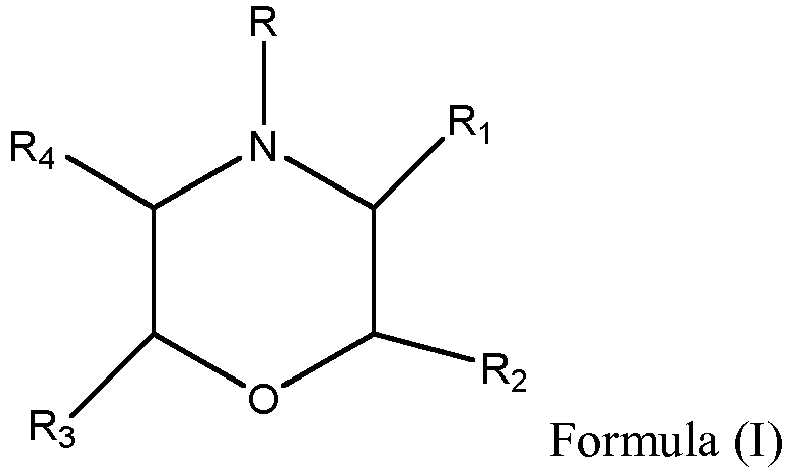
wherein R is H, C1-C20 aliphatic being linear or branched, or aromatic; and R1-R4 are independently H, aliphatic being linear or branched, aromatic, or (CH2)nX, wherein n = 0-20, and X is OH, COOH, SH, NH2, Cl, F, Br, or I.
wherein R is H, C1-C20 aliphatic being linear or branched, or aromatic; and R1-R4 are independently H, aliphatic being linear or branched, aromatic, or (CH2)nX, wherein n = 0-20, and X is OH, COOH, SH, NH2, Cl, F, Br, or I.
6. The composition of claim 5, wherein the morpholine compound is selected from the group
consisting of morpholine, methylmorpholine, ethylmorpholine, propylmorpholine, butylmorpholine,
pentylmorpholine, hexylmorpholine, heptylmorpholine, octylmorpholine, nonylmorpholine,
decylmorpholine, undecylmorpholine, dodecylmorpholine, morpholinecarboxylic acid,
hydroxymethylmorpholine, chloroethylmorpholine, aminomethylmorpholine, aminopropylmorpholine,
3-chloro-2-morpholin-4-phenylamine, 4-chloro-5-(4-morpholinyl)-1,2-benzendiamine,
3-chloro-4-(4-morpholinyl)aniline, and combinations thereof
7. The composition of any one of claims 1 to 4, wherein the morpholine compound is represented
by Formula (II)
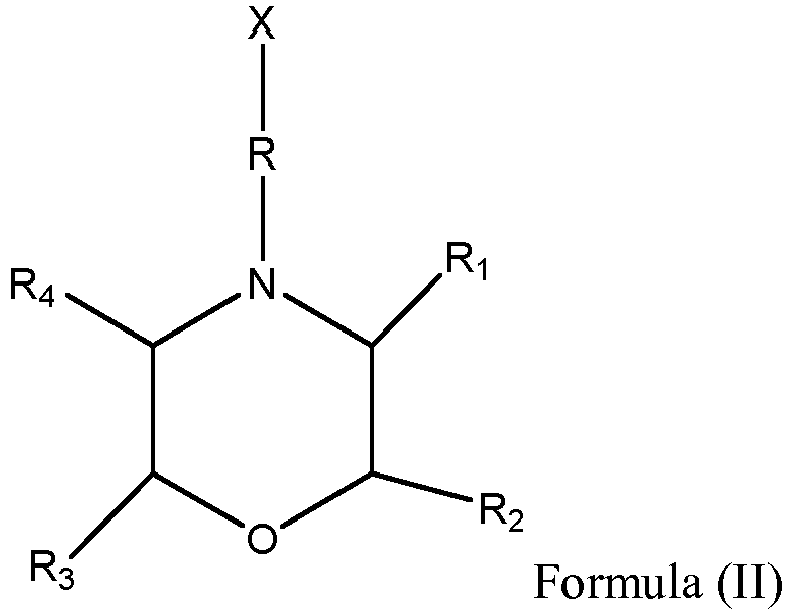
wherein R is H, C1-C20 aliphatic being linear or branched, or aromatic; R1-R4 are H; and X is OH, NH2, COOH Cl, Br, I or SH.
wherein R is H, C1-C20 aliphatic being linear or branched, or aromatic; R1-R4 are H; and X is OH, NH2, COOH Cl, Br, I or SH.
8. The composition of claim 7, wherein the morpholine is selected from the group consisting
of alpha-2,6-trimethyl-4-morpholineethanol, 4-(2-hydroxypropyl)morpholine, 4-(2-aminoethyl)morpholine,
4-(2-aminopropyl)morpholine, 4-(2-hydroxyethyl)morpholine, 4-(2-chloroethyl)morpholine,
4-)2-carboxyethyl)morpholine, alpha-phenyl-4-morpholineethanol, and combinations thereof.
9. The composition of claim 1, wherein the graft terpolymer has a molecular weight of
500 to 20,000 Daltons.
10. The composition of claim 1, wherein the graft terpolymer is produced by polymerizing
the unsaturated carboxylic acid monomer in an amount of at least 30% by weight of
the graft terpolymer, the vinyl acetate monomer in an amount of 1% to 60% by weight
of the graft terpolymer, and the alkyl acrylate monomer in an amount of 1% to 60%
by weight of the graft terpolymer to form a terpolymer; and grafting the morphine
compound in an amount of 0.5% to 10% by weight of the graft terpolymer onto the terpolymer;
in particular wherein the graft terpolymer is produced by polymerizing the unsaturated
carboxylic anhydride monomer in an amount of at least 40% by weight of the graft terpolymer,
the vinyl acetate monomer in an amount of 1% to 50% by weight of the graft terpolymer,
and the alkyl acrylate monomer in an amount of 1% to 50% by weight of the graft terpolymer
to form a terpolymer; and grafting the morphine compound in an amount of 1% to 5%
by weight of the graft terpolymer onto the terpolymer.
11. The composition of claim 1, wherein the vinyl acetate monomer comprises at least one
hydrolyzed vinyl acetate; or the alkyl acrylate monomer comprises at least one hydrolyzed
alkyl acrylate.
12. A scale inhibitor composition comprising the composition of claim 1 and optionally
a compound selected from the group consisting of sodium ally methyl sulfonate, sodium
allyl sulfonate, vinyl sulfonate, and combinations thereof.
13. A process for preventing the deposition of scale from water or aqueous solution, comprising
adding to the water or the aqueous solution 0.1 to 100 parts per million by weight
of the scale inhibitor composition of claim 12, wherein the graft terpolymer is optionally
hydrolyzed with water.
14. A method for scale inhibition treatment of an oil or gas production well, in particular
at a temperature ranged from 38 to 260 °C (100 to 500°F) and/or at a pressure ranged
from 690 kPa to 6900 kPa (100 psi to 1000 psi), comprising injecting the scale inhibitor
composition of claim 12 into the oil or gas production well.
15. The method of claim 14, wherein the injection of the scale inhibitor composition into
the oil or gas production well occurs during a squeeze application or topside application.
1. Zusammensetzung, die ein Pfropfterpolymer umfasst, welches hergestellt ist, indem
ein mono-ethylenisch ungesättigtes Carbonsäuremonomer oder mono-ethylenisch ungesättigtes
Carbonsäureanhydridmonomer, ein Vinylacetatmonomer und ein Alkylacrylatmonomer so
polymerisiert werden, dass ein Terpolymer gebildet wird, und eine Morpholinverbindung
auf das Terpolmyer gepfropft wird.
2. Zusammensetzung nach Anspruch 1, wobei das Alkylacrylatmonomer ausgewählt ist aus
der Gruppe bestehend aus Methylacrylat, Ethylacrylat, Propylacrylat, Isopropylacrylat,
tert-Butylacrylat, Hexylacrylat, Isooctylacrylat und Kombinationen davon.
3. Zusammensetzung nach Anspruch 1, wobei das mono-ethylenisch ungesättigte Carbonsäuremonomer
ausgewählt ist aus der Gruppe bestehend aus Acrylsäure, Methacrylsäure, Itaconsäure,
Maleinsäure, Crotonsäure, Acrylamido-2-methylpropansulfonsäure und Kombinationen davon.
4. Zusammensetzung nach Anspruch 1, wobei das mono-ethylenisch ungesättigte Carbonsäureanhydridmonomer
ausgewählt ist aus der Gruppe bestehend aus Acrylsäureanhydrid, Methacrylsäureanhydrid,
Itaconsäureanhydrid, Maleinsäureanhydrid, Crotonsäureanhydrid und Kombinationen davon.
5. Zusammensatzung nach mindestens einem der Ansprüche 1 bis 4, wobei die Morpholinverbindung
durch die folgende Formel (I) dargestellt ist
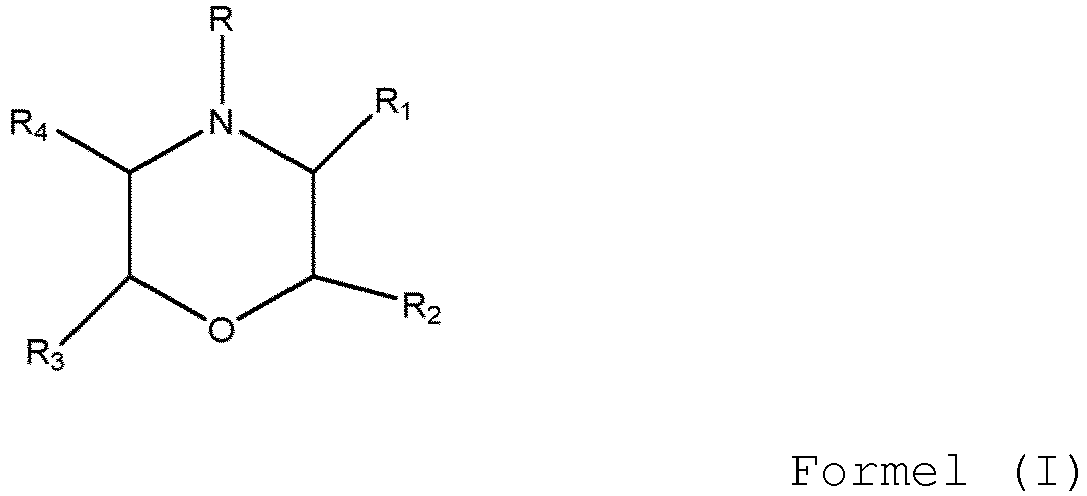
worin R H, C1-C20 linear oder verzweigt aliphatisch, oder aromatisch ist; und R1-R4 unabhängig H, linear oder verzweigt aliphatisch, aromatisch, oder (CH2)nX sind, worin n = 0-20, und X OH, COOH, SH, NH2, Cl, F, Br oder I ist.
worin R H, C1-C20 linear oder verzweigt aliphatisch, oder aromatisch ist; und R1-R4 unabhängig H, linear oder verzweigt aliphatisch, aromatisch, oder (CH2)nX sind, worin n = 0-20, und X OH, COOH, SH, NH2, Cl, F, Br oder I ist.
6. Zusammensetzung nach Anspruch 5, wobei die Morpholinverbindung ausgewählt ist aus
der Gruppe bestehend aus Morpholin, Methylmorpholin, Ethylmorpholin, Propylmorpholin,
Butylmorpholin, Pentylmorpholin, Hexylmorpholin, Heptylmorpholin, Octylmorpholin,
Nonylmorpholin, Decylmorpholin, Undecylmorpholin, Dodecylmorpholin, Morpholincarbonsäure,
Hydroxymethylmorpholin, Chlorethylmorpholin, Aminomethylmorpholin, Aminopropylmorpholin,
3-Chlor-2-morpholin-4-phenylamin, 4-Chlor-5-(4-morpholinyl)-1,2-benzyldiamin, 3-Chlor-4-(4-morpholinyl)anilin
und Kombinationen davon.
7. Zusammensatzung nach mindestens einem der Ansprüche 1 bis 4, wobei die Morpholinverbindung
durch die folgende Formel (II) dargestellt ist
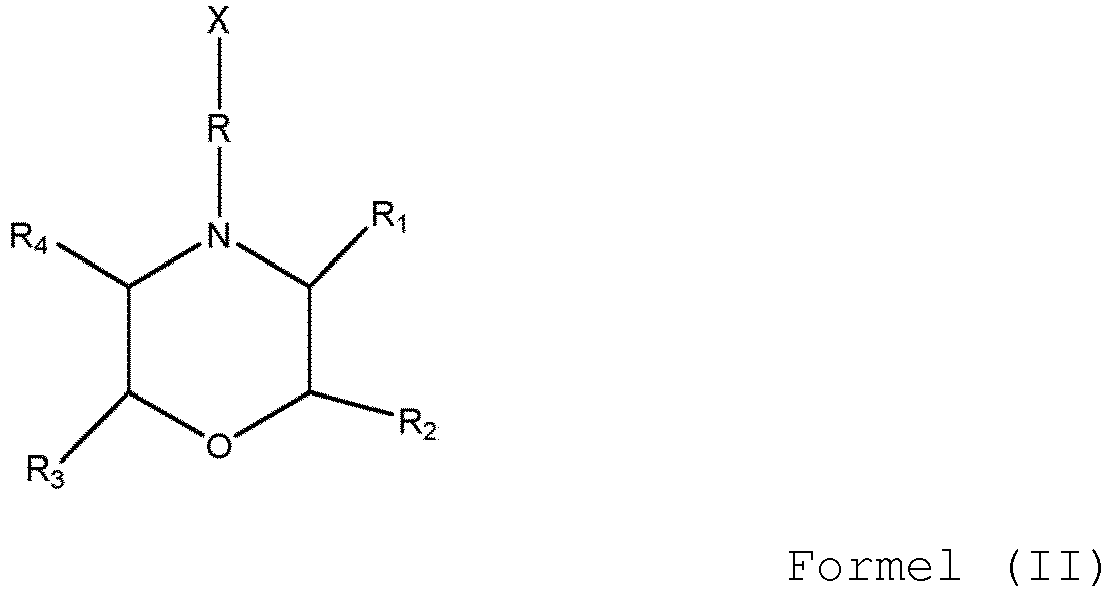
worin R H, C1-C20 linear oder verzweigt aliphatisch, oder aromatisch ist; R1-R4 H sind; und X OH, NH2, COOH, Cl, Br, I oder SH ist.
worin R H, C1-C20 linear oder verzweigt aliphatisch, oder aromatisch ist; R1-R4 H sind; und X OH, NH2, COOH, Cl, Br, I oder SH ist.
8. Zusammensetzung nach Anspruch 7, wobei das Morpholin ausgewählt ist aus der Gruppe
bestehend aus alpha-2,6-Trimethyl-4-morpholinethanol, 4-(2-Hydroxypropyl)morpholin,
4-(2-Aminoethyl)morpholin, 4-(2-Aminopropyl)morpholin, 4-(2-Hydroxyethyl)morpholin,
4-(2-Chlorethyl)morpholin, 4-(2-Carboxyethyl)morpholin, alpha-Phenyl-4-morpholinethanol
und Kombinationen davon.
9. Zusammensetzung nach Anspruch 1, wobei das Pfropfterpolymer ein Molekulargewicht von
500 bis 20.000 Dalton aufweist.
10. Zusammensetzung nach Anspruch 1, wobei das Pfropfterpolymer hergestellt ist, indem
das ungesättigte Carbonsäuremonomer in einer Menge von mindestens 30 Gewichts-% des
Pfropfterpolymers, das Vinylacetatmonomer in einer Menge von 1 bis 60 Gewichts-% des
Pfropfterpolymers und das Alkylacrylatmonomer in einer Menge von 1 bis 60 Gewichts-%
des Pfropfterpolymers so polymerisiert werden, dass ein Terpolymer gebildet wird;
und die Morpholinverbindung in einer Menge von 0,5 bis 10 Gewichts-% des Pfropfterpolymers
auf das Terpolymer gepfropft wird; insbesondere wobei das Pfropfterpolymer hergestellt
ist, indem das ungesättigte Carbonsäureanhydridmonomer in einer Menge von mindestens
40 Gewichts-% des Pfropfterpolymers, das Vinylacetatmonomer in einer Menge von 1 bis
50 Gewichts-% des Pfropfterpolymers und das Alkylacrylatmonomer in einer Menge von
1 bis 50 Gewichts-% des Pfropfterpolymers so polymerisiert werden, dass ein Terpolymer
gebildet wird; und die Morpholinverbindung in einer Menge von 1 bis 5 Gewichts-% des
Pfropfterpolymers auf das Terpolymer gepfropft wird.
11. Zusammensetzung nach Anspruch 1, wobei das Vinylacetatmonomer mindestens ein hydrolysiertes
Vinylacetat umfasst; oder das Alkylacrylatmonomer mindestens ein hydrolysiertes Alkylacrylat
umfasst.
12. Kesselsteinhemmer-Zusammensetzung, die die Zusammensetzung nach Anspruch 1 und optional
eine Verbindung, ausgewählt aus der Gruppe bestehend aus Natriumallylmethylsulfonat,
Natriumallylsulfonat, Vinylsulfonat und Kombinationen davon, umfasst.
13. Verfahren zum Verhindern der Ablagerung von Kesselstein aus Wasser oder wässriger
Lösung, das folgendes umfasst: zu dem Wasser oder der wässrigen Lösung werden 0,1
bis 100 Gewichts-ppm der Kesselsteinhemmer-Zusammensetzung nach Anspruch 12 hinzugefügt,
wobei das Pfropfterpolymer optional mit Wasser hydrolysiert ist.
14. Verfahren zur Kesselsteininhibierungsbehandlung einer Öl- oder Gasherstellungsbohrung,
insbesondere bei einer Temperatur im Bereich von 38 bis 260 °C (100 bis 500 °F) und/oder
einem Druck im Bereich von 690 kPa bis 6900 kPa (100 psi bis 1000 psi), das folgendes
umfasst: die Kesselsteinhemmer-Zusammensetzung nach Anspruch 12 wird in die Öl- oder
Gasherstellungsbohrung injiziert.
15. Verfahren nach Anspruch 14, wobei das Injizieren der Kesselsteinhemmer-Zusammensetzung
in die Öl- oder Gasherstellungsbohrung während einer Quetschanwendung (squeeze application)
oder einer Oberseitenanwendung (topside application) erfolgt.
1. Composition comprenant un terpolymère greffé produit en polymérisant un monomère d'acide
carboxylique mono-éthyléniquement insaturé ou un monomère d'anhydride carboxylique
mono-éthyléniquement insaturé, un monomère d'acétate de vinyle et un monomère d'acrylate
d'alkyle pour former un terpolymère et en greffant un composé de morpholine sur le
terpolymère.
2. Composition selon la revendication 1, dans laquelle le monomère d'acrylate d'alkyle
est sélectionné à partir du groupe constitué par l'acrylate de méthyle, l'acrylate
d'éthyle, l'acrylate de propyle, l'acrylate d'isopropyle, l'acrylate de tert-butyle,
l'acrylate d'hexyle, l'acrylate d'isooctyle, et des combinaisons de ceux-ci.
3. Composition selon la revendication 1, dans laquelle le monomère d'acide carboxylique
mono-éthyléniquement insaturé est sélectionné à partir du groupe constitué par l'acide
acrylique, l'acide méthacrylique, l'acide itaconique, l'acide maléique, l'acide crotonique,
l'acide acrylamido-2-méthylpropane sulfonique, et des combinaisons de ceux-ci.
4. Composition selon la revendication 1, dans laquelle le monomère d'anhydride carboxylique
mono-éthyléniquement insaturé est sélectionné à partir du groupe constitué par l'anhydride
acrylique, l'anhydride méthacrylique, l'anhydride itaconique, l'anhydride maléique,
l'anhydride crotonique, et des combinaisons de ceux-ci.
5. Composition selon l'une quelconque des revendications 1 à 4, dans laquelle le composé
de morpholine est représenté par la Formule (I)
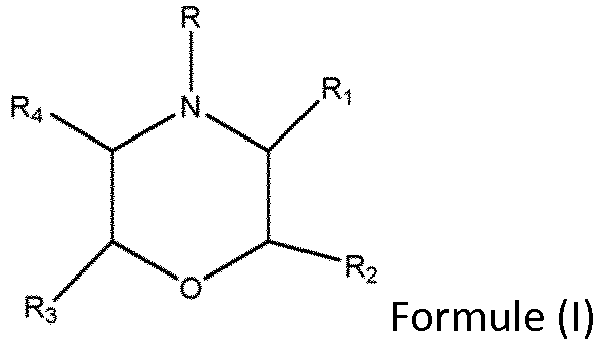
dans laquelle R est H, un composé aliphatique en C1-C20 linéaire ou ramifié, ou un composé aromatique ; et R1-R4 sont indépendamment H, un composé aliphatique linéaire ou ramifié, un composé aromatique, ou (CH2)nX, dans laquelle n = 0 à 20, et X est OH, COOH, SH, NH2, Cl, F, Br, ou I.
dans laquelle R est H, un composé aliphatique en C1-C20 linéaire ou ramifié, ou un composé aromatique ; et R1-R4 sont indépendamment H, un composé aliphatique linéaire ou ramifié, un composé aromatique, ou (CH2)nX, dans laquelle n = 0 à 20, et X est OH, COOH, SH, NH2, Cl, F, Br, ou I.
6. Composition selon la revendication 5, dans laquelle le composé de morpholine est sélectionné
à partir du groupe constitué par la morpholine, la méthylmorpholine, l'éthylmorpholine,
la propylmorpholine, la butylmorpholine, la pentylmorpholine, l'hexylmorpholine, l'heptylmorpholine,
l'octylmorpholine, la nonylmorpholine, la décylmorpholine, l'undécylmorpholine, la
dodécylmorpholine, l'acide morpholinecarboxylique, l'hydroxyméthylmorpholine, la chloréthylmorpholine,
l'aminométhylmorpholine, l'aminopropylmorpholine, la 3-chloro-2-morpholin-4-phénylamine,
la 4-chloro-5-(4-morpholinyl)-1,2-benzènediamine, la 3-chloro-4-(4-morpholinyl)aniline,
et des combinaisons de ceux-ci.
7. Composition selon l'une quelconque des revendications 1 à 4, dans laquelle le composé
de morpholine est représenté par la Formule (II)
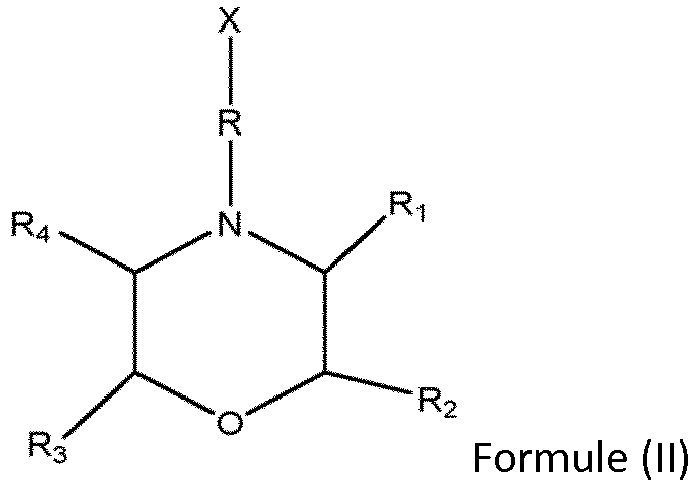
dans laquelle R est H, un composé aliphatique en C1-C20 linéaire ou ramifié, ou un composé aromatique ; R1-R4 sont H ; et X est OH, NH2, COOH Cl, Br, I ou SH.
dans laquelle R est H, un composé aliphatique en C1-C20 linéaire ou ramifié, ou un composé aromatique ; R1-R4 sont H ; et X est OH, NH2, COOH Cl, Br, I ou SH.
8. Composition selon la revendication 7, dans laquelle la morpholine est sélectionnée
à partir du groupe constitué par l'alpha-2,6-triméthyl-4-morpholineéthanol, la 4-(2-hydroxypropyl)morpholine,
la 4-(2-aminoéthyl)morpholine, la 4-(2-aminopropyl)morpholine, la 4-(2-hydroxyéthyl)morpholine,
la 4-(2-chloréthyl)morpholine, la 4-(2-carboxyéthyl)morpholine, l'alpha-phényl-4-morpholineéthanol,
et des combinaisons de ceux-ci.
9. Composition selon la revendication 1, dans laquelle le terpolymère greffé a un poids
moléculaire de 500 à 20 000 Daltons.
10. Composition selon la revendication 1, dans laquelle le terpolymère greffé est produit
en polymérisant le monomère d'acide carboxylique insaturé dans une quantité d'au moins
30 % en poids du terpolymère greffé, le monomère d'acétate de vinyle dans une quantité
de 1 % à 60 % en poids du terpolymère greffé, et le monomère d'acrylate d'alkyle dans
une quantité de 1 % à 60 % en poids du terpolymère greffé pour former un terpolymère
; et en greffant le composé de morphine dans une quantité de 0,5 % à 10 % en poids
du terpolymère greffé sur le terpolymère ; en particulier dans laquelle le terpolymère
greffé est produit en polymérisant le monomère d'anhydride carboxylique insaturé dans
une quantité d'au moins 40 % en poids du terpolymère greffé, le monomère d'acétate
de vinyle dans une quantité de 1 % à 50 % en poids du terpolymère greffé, et le monomère
d'acrylate d'alkyle dans une quantité de 1 % à 50 % en poids du terpolymère greffé
pour former un terpolymère ; et en greffant le composé de morphine dans une quantité
de 1 % à 5 % en poids du terpolymère greffé sur le terpolymère.
11. Composition selon la revendication 1, dans laquelle le monomère d'acétate de vinyle
comprend au moins un acétate de vinyle hydrolysé ; ou le monomère d'acrylate d'alkyle
comprend au moins un acrylate d'alkyle hydrolysé.
12. Composition d'agent antitartre comprenant la composition selon la revendication 1
et facultativement un composé sélectionné à partir du groupe constitué par l'allylméthylsulfonate
de sodium, l'allylsulfonate de sodium, le vinylsulfonate, et des combinaisons de ceux-ci.
13. Procédé de prévention du dépôt de tartre à partir d'eau ou d'une solution aqueuse,
comprenant l'addition à l'eau ou à la solution aqueuse de 0,1 à 100 parties par million
en poids de la composition d'agent antitartre selon la revendication 12, dans lequel
le terpolymère greffé est facultativement hydrolysé avec de l'eau.
14. Procédé de traitement antitartre d'un puits de production de pétrole ou de gaz, en
particulier à une température allant de 38 à 260 °C (100 à 500 °F) et/ou à une pression
allant de 690 kPa à 6900 kPa (100 psi à 1000 psi), comprenant l'injection de la composition
d'agent antitartre selon la revendication 12 dans le puits de production de pétrole
ou de gaz.
15. Procédé selon la revendication 14, dans lequel l'injection de la composition d'agent
antitartre dans le puits de production de pétrole ou de gaz survient pendant une application
d'esquiche ou une application en surface.